November 7, 1837 Abolitionist, clergyman and editor Elijah P. Lovejoy, 34, was murdered by a pro-slavery mob in Alton, Illinois, as he defended his newly delivered printing press.
Elijah P. Lovejoy
He had lost two other presses to mob attacks, but refused to surrender this one, which had been contributed by the Ohio Anti-Slavery Society. For this he was shot five times in the fatal attack. Lovejoy had moved 20 miles to Alton from St. Louis where, after denouncing the lynching and burning of a black man, a mob tore down his office. Warehouse with Lovejoy’s press set ablaze by mob; “We must stand by the Constitution and laws, or all is gone.” Elijah Lovejoy, The Observer Read more
November 7, 1862 1700 members of the Dakota Sioux, mostly women, children and the eldersly, were force-marched 150 miles (240 km) to a concentration camp at Fort Snelling in Minnesota. The four-mile-long (6.5 km) procession was subject to physical abuse by white residents of towns along the way. Governor Alexander Ramsey had committed himself to ridding the state of all the Dakota, raising the bounty on an Indian scalp to $200. One of the prisoners at Fort Snelling Simultaneously, 300 Dakota men were tried summarily (as many as 40 cases in a single day) and marched to another camp in Mankato. They had surrendered to the U.S. Army at the end of the Dakota War, expecting to treated as prisoners of war. Little War on the Prairie (This American Life) More on this forced march
November 7, 1916 Jeannette Rankin, a Republican from Missoula, Montana, became the first woman elected to the U.S. Congress. American women in 19 states had no voting rights whatsoever until passage of the 19th amendment four years later. Female Montanans had full voting rights even before statehood (in 1889). Readmore
November 7, 1919 Hundreds, presumed to be members of the Union of Russian Workers, were arrested in New York and other cities across the country on the second anniversary of the Russian Revolution. President Woodrow Wilson’s attorney general, A. Mitchell Palmer, and Intelligence Division chief, John Edgar Hoover, used the Sedition and Espionage Acts to thwart what they saw as a Communist plot to overthrow the government. This was but one many assaults on radicals in what was known as the Palmer Raids. Thousands were arrested and thousands deported. It had been a year of significant labor unrest including steel, coal, and Boston police strikes, and a Seattle general strike. There was high unemployment in the wake of the demobilization after World War I. Around May Day there had been dozens of mail bombs, most of them intercepted, and a suicide bomber died outside Palmer’s Washington residence. The Palmer Raids The first mass arrest of immigrant workers Attorney General Mitchell’s view
November 7, 1973 New Jersey became the first state to allow girls to play Little League Baseball.
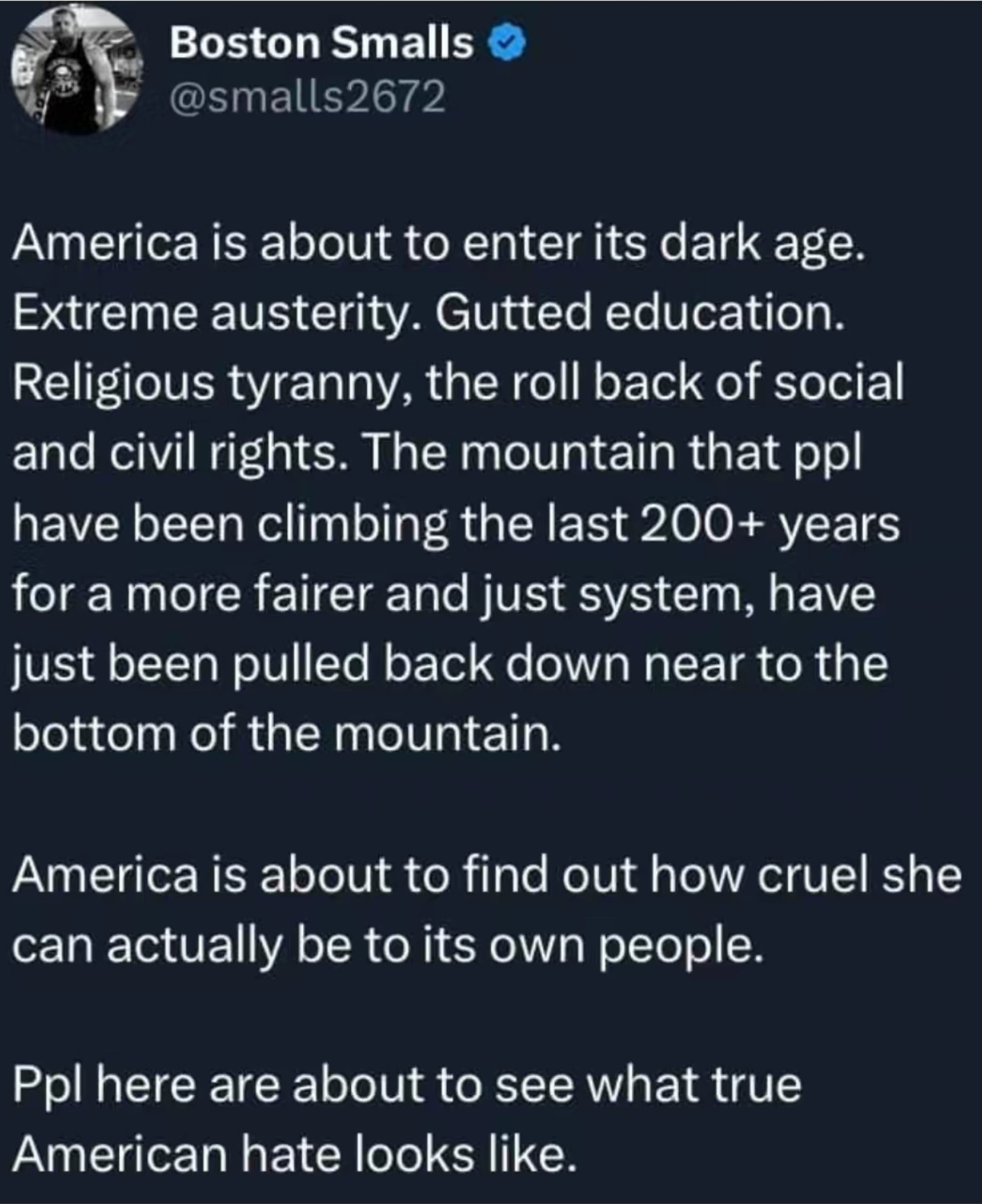
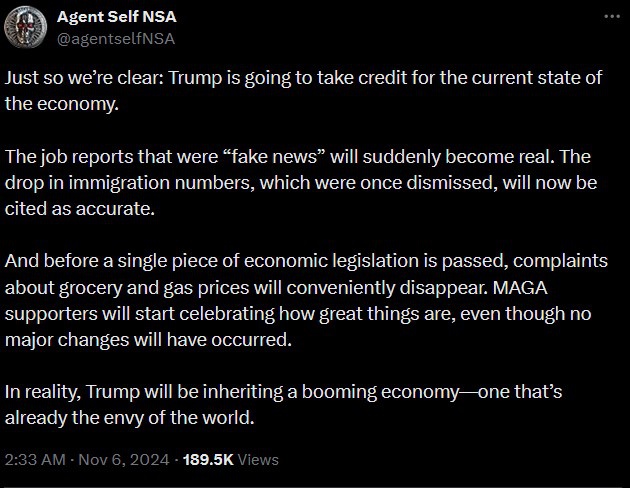
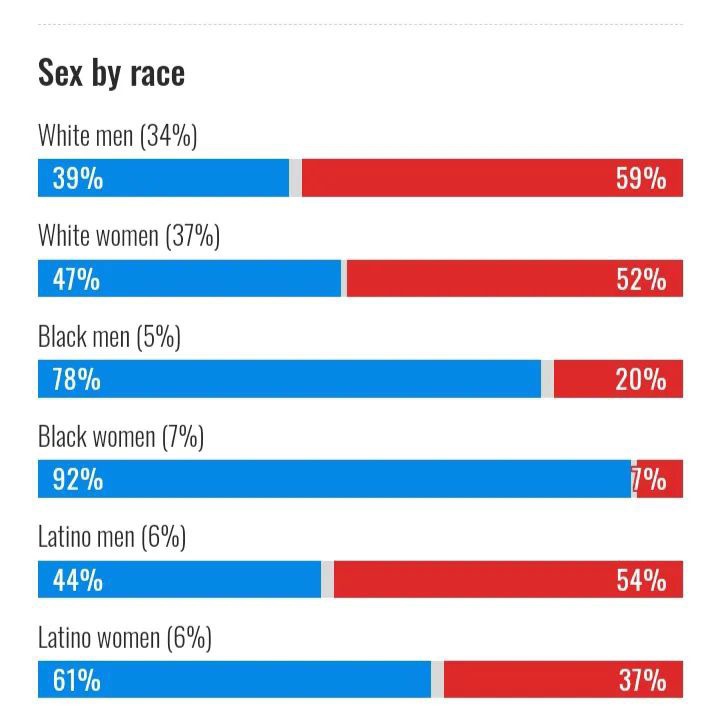
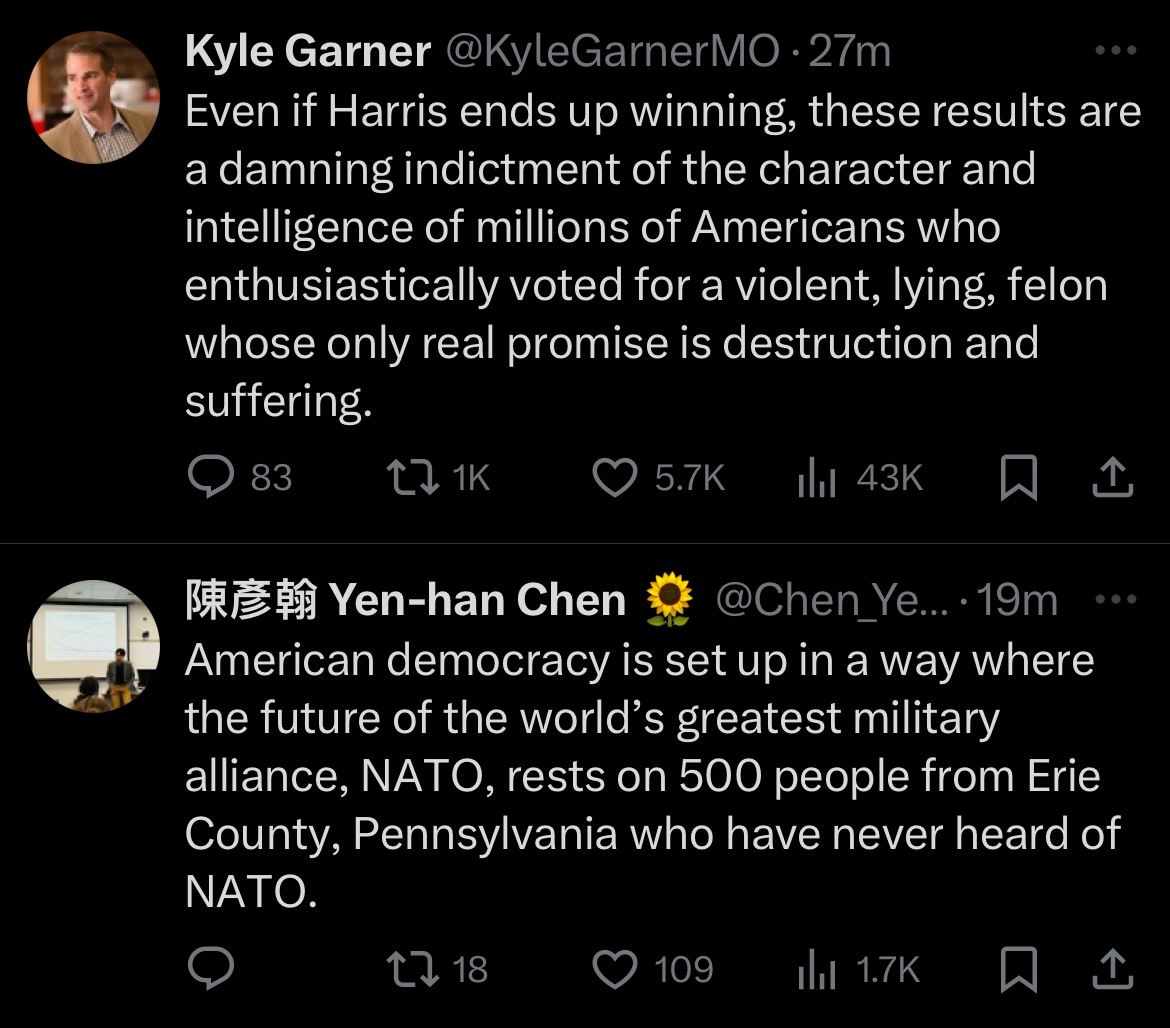
As I said yesterday, today is the day we start to figure out how to fight back against what is coming. From what I read yesterday a lot of men still won’t vote for a woman, especially Latino heritage men. Plus people said things cost less under tRump in 2019 and felt he could bring prices down to those levels. But that is stupid, he won’t and can’t because to him and the wealthy profit is king. But what could happen is that their incomes will be cut, their safety nets will be cut. One guy was heard saying tRump had the economy and immigration and Harris only had women’s rights and Democracy. Think on it, hating others was more important than others rights and Democracy. But we will learn more. Arab voters who claim they warned Harris she needed to change on Gaza will notice that already Israel has increased its take over of Gaza, saying that Palestinians will NOT be allowed to return to the north and all that are still there will be killed. Knowing that tRump will back him. So they sure made a difference didn’t they. Hugs.
Vice President Kamala Harris led President-elect Donald Trump 86% to 12% among lesbian, gay, bisexual and transgender voters, according to the NBC News Exit Poll Desk.
By Patrick J. Egan, NBC News Exit Poll Desk
Former President Donald Trump defeated Vice President Kamala Harris to become the next U.S. president, NBC News projected, but he didn’t do so with the help of lesbian, gay, bisexual and transgender voters.
LGBT voters shifted even more solidly into the Democratic camp this year, according to the NBC News Exit Poll. Harris led President-elect Trump 86% to 12% among LGBT voters, the poll found. That’s a 15-point change from 2020, when Trump won 27% of the LGBT vote against Biden.
Harris’ performance among LGBT voters was stronger than that of any Democratic candidate in the last five presidential elections.
Although Republican vice presidential candidate Sen. JD Vance predicted that he and Trump would win the “normal gay guy vote,” the GOP presidential ticket captured fewer than 1 in 5 LGBT male voters, though that figure could also include bisexual and transgender men. Trump’s support among LGBT female voters was even more tepid, at 8%. White LGBT people went solidly for Harris over Trump by 82% to 16%, though Harris’ margin was even bigger among LGBT voters of color at 91% to 5%.
Most LGBT voters said they’d be either “excited” (39%) or “optimistic” (43%) if Harris were elected president. By contrast, 62% of LGBT respondents said they’d be “scared” if Trump won.
According to the exit poll, 8% of American voters identified as LGBT in 2024. That’s the highest share on record. The percentage of the electorate identifying as LGBT has doubled since Barack Obama was elected president in 2008, when it was 4%.
As in previous elections, LGBT voters stood out as one of the most left-leaning voter blocs in the electorate. Among LGBT voters, Democrats vastly outnumber Republicans, 56% to 5%, and liberals surpass conservatives, 61% to 5%. LGBT voters are staunchly pro-choice: 59% say abortion should be legal in all cases, a much higher level of support for abortion rights than among non-LGBTs, at 31%.
“As an American, I’m out of fucks to give for my fellow Americans. It’s been almost 10 years to see who he really is, and 3/4 of us either LIKE that or are too ignorant to care.
Don’t come crying when your loved one gets beaten by a police officer and they face no charges.
Don’t come crying when a friend/family member gets raped and the baby can’t be aborted, nor if they suffer a miscarriage from a pregnancy and bleed out because they can’t get medical help.
Don’t come crying when the Supreme Court is packed with 2 more far right corrupt justices and more lifelong rights start to vanish.
Don’t come crying when Ukraine aid stops and, if the rest of the world doesn’t pick up the slack, Russia takes even more land and continues killing more people.
Don’t come crying as the deficit explodes from corruption and the economy crashes as Trump lines his own pockets.
Don’t come crying when our education system bottoms out because Elon guts the government so that, combined with project 2025 ending all abortion care, poor people are forced to raise lots of stupid babies to run his factories.
Don’t come crying when worker protections are cut and overtime pay is all but eliminated.
Don’t. Complain. To. Me. I’ll ask who you voted for and then laugh in your fucking face. ‘But. But. I didn’t think. . . ‘
‘Of course you didn’t fucking think. You voted for him. Well, we tried to tell you. We tried to reason with you. We tried to compromise, but no. You just had to take your stand on whatever single fucking issue.’”
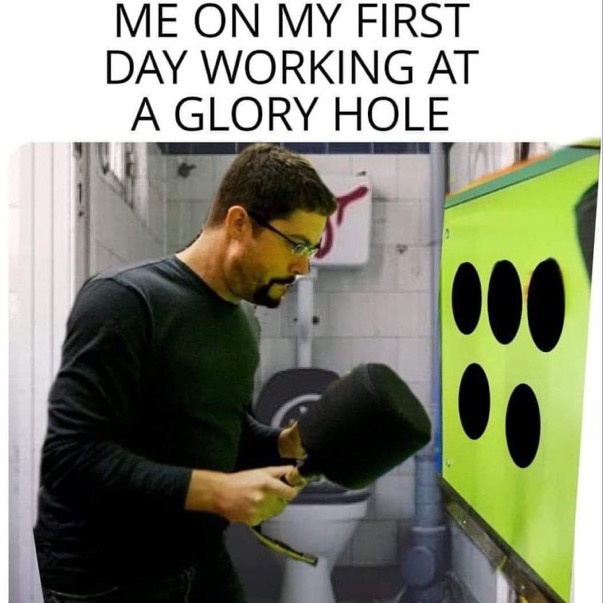
It was still something shoved up your ass while strangers watched.
GOP candidate for NC schools chief has spread conspiracy theories, ‘groomer’ rhetoric – Michele Morrow has a track record of falsehoods – for example, saying Islam is a cult and that the plus in LGTBTQ+ stands for pedophilia. via NPR https://t.co/nItjI0LE6r
While much of the contiguous United States is talking about Puerto Rico after comedian Tony Hinchcliffe referred to the archipelago as a “floating pile of garbage” at Donald Trump’s campaign rally at Madison Square Garden on October 27, the people of Puerto Rico have another election on their minds: a historic gubernatorial race. For the first time in history, a pro-independence candidate could win the election for the head of the government in the U.S. territory.
Since the mid-20th century, Puerto Rico has been governed by the pro-statehood New Progressive Party (PNP) or the pro-commonwealth Popular Democratic Party (PPD). While third-party candidates have run, none has been able to garner enough votes to threaten Puerto Rico’s two-party system. But this election season, Puerto Rico’s Pro-Independence Party and its new Citizen’s Victory Movement — an anti-colonial party founded in 2019 — have come together under a coalition called La Alianza de País, or Alianza, and its nominee — Juan Dalmau — has gained enough support in the polls to potentially defeat the two traditional parties.
At the time of writing, Jenniffer González, the candidate from the incumbent pro-statehood party, is leading Dalmau by just about 2 to 8 percentage points, according to NBC News. However, political scientists on the archipelago believe it’s a lead that Dalmau could eclipse on Election Day, especially if young voters make it out to the polls and if older, religious Puerto Ricans cast their ballot for the emerging Christian party Project Dignity’s nominee Javier Jiménez. But Pro-Trump comedian Hinchcliffe delivered Dalmau another advantage: Some long-term PNP voters riled by the disparaging “joke” could reconsider their support as González, Puerto Rico’s current resident commissioner, is a Republican and staunch Trump ally.
PHOTO: COURTESY OF JUAN DALMAU.
For decades, the United States, which invaded and colonized Puerto Rico in 1898, has used fear as a tool to thwart pro-independence movements on the archipelago. While masterminding the lie that Puerto Rico could not exist without its colonial relationship with the U.S., the government on the archipelago, then led undemocratically by non-Puerto Rican U.S.-appointed governors, used violence to ensure it doesn’t.
During a peaceful civilian march organized by Puerto Rico’s Nationalist Party to commemorate the abolition of slavery on the archipelago on March 21, 1937, police opened fire, killing 17 civilians. When the party’s leader, Pedro Albizu Campos was arrested on October 30, 1950 after pro-independence revolts in Jayuya, Utuado, and the governor’s mansion in Old San Juan, he alleged that the state subjected him to human radiation experiments that could have later contributed to his death. In 1948, the legislature passed the Gag Law, which made it illegal to own or display a Puerto Rican flag, sing or write a patriotic song or literature, or convene in favor of Puerto Rican independence. The law wasn’t repealed until 1957.
In more recent years, both the PNP and the PPD have sustained this fear by spreading misinformation about pro-independence parties. During the ongoing gubernatorial race, for instance, González has used political ads to liken Dalmau’s social democracy platform to communism, a popular strategy used by Republicans in the contiguous United States to manipulate the traumas of people who fled authoritarian communist or socialist governments, including those in Puerto Rico’s neighboring Cuba.
“
“Puerto Ricans have found that betting on themselves, their community, their land, and their autonomy could be a more fruitful path forward.”
RAQUEL REICHARD
”
But Puerto Ricans are increasingly reconsidering the story the ruling governments on the archipelago and in the U.S. have been telling them. Amid recent back-to-back financial, natural, and political disasters, many have come to the conclusion that their colonial relationship is actually holding them back from prospering in their own homeland. From its 2015 financial crisis, which led the U.S. Congress to create the undemocratic fiscal control board that cut budgets and caused job losses, and the 2017 hurricanes, which revealed devastating state corruption, to the ousting of then-Governor Ricardo Rosselló, which helped many islanders recognize and utilize their own power, many Puerto Ricans have found that betting on themselves, their community, their land, and their autonomy could be a more fruitful path forward.
This growing sentiment was on display on November 3 during Alianza’s Festival of Hope at Lot 4 near the Pedro Rosselló Convention Center in Santurce, where more than 50,000 people holding Puerto Rican flags and green and white Patria Nueva flags gathered to support Dalmau and the Alianza movement. Among them were party leaders like Dalmau, Ana Irma Rivera Lassen (running for resident commissioner), Manuel Natal Albelo (running for mayor of San Juan); U.S. Congresswoman Nydia M. Velázquez (D-New York); and popular music artists like Rauw Alejandro, Residente, iLe, and Bad Bunny, who closed out the event announcing his official endorsement of Dalmau.
“I dream of a prosperous and dignified Puerto Rico like the one we deserve. That my people have the quality of life we deserve, a better quality of life. I dream of a Puerto Rico where the education of our boys and girls is a priority and not a dirty system of corruption. I dream of a Puerto Rico where young people do not have to leave to fulfill their duties. I dream of a functional and accessible health system for the love of God. I dream of a road where I don’t have a tire blow out every time I go outside. I dream of something as basic as not having the power go out every day in my country,” Bad Bunny said in a 20-minute long speech. “I dream of a people who are awake and who recognize the strength we have, that here the people rule, that here you, we, the people rule and not the political parties.”
“
“I dream of a people who are awake and who recognize the strength we have, that here the people rule, that here you, we, the people rule and not the political parties.”
BAD BUNNY
”
While it was the first time the artist, who went on to perform his song “Una Velita,” publicly endorsed Dalmau, this election year he has been vocal about local politics. In June, the rapper, born Benito Antonio Martínez Ocasio, announced a buy-one-get-one-free concert ticket deal for his Most Wanted Tour stops in Puerto Rico to locals who showed their voter registration card. The initiative aimed to improve voter turnout. For decades, the archipelago had impressively high voter turnouts of 73% to 89%, but starting in 2016, it dropped to 55% as Puerto Ricans grew increasingly apathetic about the traditional parties. Additionally, in September, Bad Bunny purchased billboards across San Juan that criticized the pro-statehood party and has consistently used his social media accounts to spread educational information about Dalmau and his anti-corruption platform.
At a time when Trump’s camp refers to Puerto Rico as a “pile of garbage” — essentially calling the archipelago’s people who make up the land trash, repeating language that has been used by the U.S. colonial state to dehumanize Puerto Ricans for more than 100 years — Puerto Ricans are eager to support a government that could, if even symbolically, actually challenge that colonial power.
Ahead of Puerto Rico’s November 5 gubernatorial election, we spoke with islanders about the historic support for a pro-independence candidate and what an Alianza governorship could symbolize and accomplish.
Mayra Díaz-Torres
Why do you think there is so much support for Juan Dalmau?
For me it’s important to talk about the context. After Hurricane Maria, Puerto Rico has experienced great sorrows. Puerto Rico has experienced natural and political onslaughts. Not long after the storm, we dealt with the blows from then-Governor Ricky Rosselló, and the entire PNP, which represents a corrupt class — that withheld first-aid goods even though there were people dying. I think that from all of this heartbreak and all of this rage that we experienced from Maria and the aftermath of that hurricane, that corruption we endured from the PNP and the PPD, too — the failures of this two-party system has elevated us. I’m hopeful that it has brought us as a people to rage and to turn our hurt into solutions. And I believe that’s the result of this revelation, one that Indigenous and Afro-descendants have always talked about, that we have been domesticated, and that there is no greater form of domestication than colonialism. Puerto Rico has been a colony of the U.S. for more than 100 years.
Most recently, look at the Trump rally, where the comedian [Hinchcliffe], who by the way is a pendejo, and others have tried to tell us that the way they speak about us and treat us are all jokes and that we have to lighten up, to have a better sense of humor. But that’s not true. That’s the systemic racism and colonialism we’ve experienced for many years. And I feel like this anger and pain — especially in the last five years from the colonial, racist, and anti-democratic Financial Oversight and Management Board (La Junta) — is pushing us to restore our dignity, humanity, and utilize our power.
What would a pro-independence governorship symbolize for Puerto Rico?
For me, the idea that a pro-independence candidate could win the governorship in Puerto Rico is historic. As a colony, we have a lot of trauma and a lot of fears that the United States have told us and that the criollo class here has repeated to us: the lie that we aren’t anything without the United States. This language is abusive. This is what a man who abuses and violates a woman tells her: “You can’t exist without me.” This is the language that an abusive father tells his children: “You are no one.” Thinking about this cycle of violence we have experienced under colonialism for hundreds of years, seeing us in this moment brings me enthusiasm. I’m trying to be cautious, but I am enthusiastic. Yes, there are things we need to look at and preoccupy ourselves with, but I think this election is historic for us as a country.
“
“This colonial fallacy that we are nothing without the United States doesn’t work on us anymore. It’s a mantra that has kept us subjugated.”
MAYRA DÍAZ-TORRES
”
Of course, though, when the leading parties see that the people they want to oppress are finding their dignity and realizing this treatment is criminal, the ammo, the response to that, is to create fear. And I think the traditional parties are inciting fear around independence because historically in Puerto Rico conversations around independence have been criminalized. They don’t want us to know or accept Puerto Rico’s history struggling for independence. We have rebelled, many times, in many decades, and under many contexts. There has been state prosecution against pro-independence movement leaders in an effort to thwart the revolution and criminalize even the idea of independence, from Pedro Albizu Campos to the Ponce massacre. Historically, we’ve seen this ideology be treated as criminal, something to not be taken seriously, and now we’ve seen the traditional parties taking advantage of that narrative to stir fear in this moment. But fear doesn’t work on us anymore. This colonial fallacy that we are nothing without the United States doesn’t work on us anymore. It’s a mantra that has kept us subjugated.
What would you say to someone fearful of pro-independence leadership in Puerto Rico?
Liberation is coming. It’s unavoidable. Because no nation can be subjugated forever under imperialism. People are leaving Puerto Rico, not because we want to but to seek opportunities, because these opportunities are not available to us here due to the policies of the PNP and the PPD. The aftermath of Maria taught us so much. We know that despite more than 100 years of colonialism, we have so much love for our country, our culture, and our people. I think that if you consider that love we have for ourselves and for our land, a land they’re trying to displace us from, I think we are moving. I think this is a critical moment. There’s going to be fear and hardships, but we haven’t succeeded under this colonial regime. Yes, we have cultural prominence globally; we are talented. But we are not happy. We are struggling. This isn’t just about status; it’s also about great corruption from the traditional parties. Liberation is destined. Every nation deserves and needs freedom to prosper.
Ale Figueroa
Why do you think there is so much support for Juan Dalmau?
We are at a turning point. I work as a digital strategist to transform the narrative for societal change, and this has been a long time coming. It may seem like it’s coming out of the blue, but it’s something that has been simmering since about the 2008 election, when the plan was set into motion to make Puerto Rico be in the service of millionaires, billionaires, and Wall Street, at the expense of locals.
A group of people, an entire society, have been promised things that just never arrived. Growing up, we were told, “you take these steps, and it’ll lead to success.” But millennials are the first generation in Puerto Rico to really encounter dystopia and lies. We never saw prosperity. We never saw this future that they boasted about and benefited from in the past. It’s taken a toll on our ability to even be part of our own community and participate in our own country. The impacts of colonialism means that everyday people will have to say goodbye to their homes, communities, and families, just so they can find a means to survive. We are a generation that is split, that is fragmented, and is dispersed throughout the world. It is not untrue that there are more Puerto Ricans living outside of Puerto Rico than on the islands, and that is a testament to the sacrifices that people have had to make while still being deeply connected to their culture and communities.
What would a pro-independence governorship symbolize for Puerto Rico?
It symbolizes a change. I think if we are honest we know that nothing can change overnight, even if we have a pro-independence governor in power. That decision is ultimately not up to the people of Puerto Rico because of our colonial situation with the United States. Ultimately, who decides whether or not Puerto Rico becomes independent or a state of the U.S. union is the United States Congress.
“
“If what we create and bring to the world is this rich in these conditions, I can’t begin to imagine how incredibly beautiful and magical it is for ourselves and the rest of our global community for us to thrive, and for people like us across the world to thrive. “
ALE FIGUEROA
”
But I think it means something a lot more meaningful, something that will take generations to build upon, but it is the promise of something new. It’s the promise of being able to — and for the first time in our history — finally have a say and decide what we want. It is an opportunity for Puerto Ricans to know and understand that our future is in our hands and that we have complete authority and autonomy for ourselves without intervention. And we deserve a future where our people and communities can thrive. If what we create and bring to the world is this rich in these conditions, I can’t begin to imagine how incredibly beautiful and magical it is for ourselves and the rest of our global community for us to thrive, and for people like us across the world to thrive.
What would you say to someone fearful of pro-independence leadership in Puerto Rico?
I would ask them if they think it’s worth it to continue going through what we’re going through to the point of normalizing, to the point of expecting future generations to not believe that they deserve better. I’d ask them to take a chance on themselves and their futures, not because this would be independence for Puerto Rico but because it would mean independence for us to finally have a seat at the table, to be represented, and make the decisions we want to make when the time comes, while still keeping our mouths fed, our bodies clothed, our families sheltered, and our culture and our people thriving.
Aliana Margarita Bigio-Alcoba
Why do you think there is so much support for Juan Dalmau?
The Patria Nueva project as well as the Alianza de País continue to gain momentum because people see in Juan Dalmau and the rest of the candidates a hopeful, inclusive vision for Puerto Rico. This campaign is driven by a clear path toward a Puerto Rico for all — not just for tax dodgers and gentrifiers.
Unlike others, Dalmau has shown his dedication by engaging directly with communities through forums and town halls, positioning himself as the people’s candidate and the best choice for Puerto Rico’s future.
What would a pro-independence governorship symbolize for Puerto Rico?
I was born and raised in a household that supported statehood for Puerto Rico, and I saw what assimilation did to my parents. They shared stories of not being allowed to have a Puerto Rican flag in their rooms, cars, or school notebooks. Showing love for your country was frowned upon, labeled as “terrorist” or “communist.” These are the effects of colonialism; it’s not just political — it’s personal.
“
“Many former statehood supporters now support Dalmau because his campaign with La Alianza de País proposes an Asamblea Constituyente, one that would include everyone, offering Puerto Rico a respectful, dignified, and binding decolonization process.”
ALIANA MARGARITA BIGIO-ALCOBA
”
Now, at 26, watching my loved ones support Dalmau and the possibility of an Alianza de País victory brings immense joy and a show of radical hope.
What would you say to someone fearful of pro-independence leadership in Puerto Rico?
I’d encourage people to review our history, to resist the collective amnesia the powerful try to impose on us.
The status of Puerto Rico won’t be resolved through non-binding plebiscites with Congress. Many former statehood supporters now support Dalmau because his campaign with La Alianza de País proposes an Asamblea Constituyente, one that would include everyone, offering Puerto Rico a respectful, dignified, and binding decolonization process.
November 5, 1872 Susan B. Anthony and a few other women in Rochester, New York, voted in the presidential election, all of them for the first time. Susan B. Anthony She wrote later that day to her fellow suffragist Elizabeth Cady Stanton, “If only now—all the women would work to this end of enforcing the existing constitution—supremacy of national law over state law—what strides we might make . . . .” Anthony’s vote went to U. S. Grant and other Republicans, based on that party’s promise to consider the legitimacy of women’s suffrage. Elizabeth Cady Stanton Read Susan B. Anthony’s speech On Women’s Right to Vote
November 5, 1949 The Peace Pledge Union in Great Britain set up the Non-Violence Commission to study nonviolent resistance and how the ideas of Gandhi could be used to reach the Union’s goals of getting U.S. troops out of Britain and to end production of nuclear weapons there.
November 5, 1969 Bobby Seale Bobby Seale, a founder of the Black Panther Party, was sentenced to four years in prison on sixteen counts of contempt of court during the federal Chicago Eight trial in Chicago; he was charged for his insistent claims to the right to choose his own lawyer, or to represent himself. After the Chicago Eight verdict, the contempt charges were withdrawn.
November 5, 1982 36 were arrested in a demonstration at Honeywell, Minnesota’s largest defense contractor. The “Honeywell Project,” a local campaign against the arms maker, dogged the company for over three decades, at times with success. It continues today, targeting Alliant Technologies, the arms-making branch of Honeywell that was spun off in the 1990s. Protests at Alliant continue today. Alliant is the manufacturer for the Pentagon of artillery shells made with depleted uranium (DU or U-238, a by-product of uranium enrichment) which have been used extensively in Iraq and Kosovo. The Defense Department denies any health effects from use of DU (though army manuals warn soldiers of its toxicity), and contests accusations of DU’s role in Gulf War Syndrome. More about the Honeywell project from War Resisters’ international
November 5, 1987 Govan Mbeki, an early leader of the African National Congress, was released from South Africa’s Robben Island prison after serving twenty-four years (for treason). He served his sentence alongside Nelson Mandela, Walter Sisulu and many others who fought apartheid. Govan Mbeki His son, Thabo Mbeki, was elected in 1998 (and force to resign in 2008) to succeed Mandela, who was the first president elected following a new constitution which granted the right to vote to the entire non-white population, comprising 85% of the country’s population. Read more about Govan Mbeki
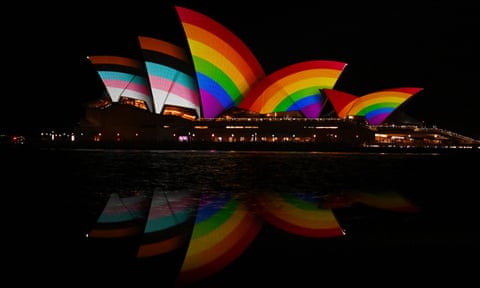
The NSW equality bill brings the state into line with others. Photograph: Dean Lewins/AAP
Rights and protections for LGBTQ+ people in New South Wales have been strengthened with the passing of a bill in the state parliament late on Thursday, after the legislation was watered down to gain Labor support.
The equality bill will give transgender people the ability to have their sex changed on their birth certificates without undergoing invasive surgery, bringing the state in line with others, and non-binary will become a gender option for birth certificates.
There were cheers in the chamber when the bill passed about 8.40pm. The independent MP Alex Greenwich, who introduced the package a year ago, embraced the leader of the government in the upper house, Penny Sharpe after the vote that succeeded without the opposition’s support.
Greenwich said the changes would “improve LGBTIQA+ dignity, safety and equality” and thanked Sharpe for her work getting the legislation through the upper house.
“We’ve got more work to do and we start that work now with new confidence from these significant wins for our community,” he said on Thursday night.
After months of stagnation, Greenwich convinced the premier, Chris Minns, to support the bill by making a number of major concessions, including dropping changes to the anti-discrimination act.
While advocates welcomed the remaining elements of the bill, many also raised concerns that protections for LGBTQ+ teachers and students at private schools had been dumped.
The Equality Australia chief executive, Anna Brown, thanked community members who shared their stories and all those who campaigned to garner support for the changes.
“These new laws will have no impact on the lives of most people in our state, but for a small number of people it will make their lives immeasurably better,” she said after the bill passed.
“It’s a journey that continues as we turn our attention to the state’s anti-discrimination laws and our ongoing efforts to protect vulnerable teachers and students in religious and private schools across the state.”
Greenwich had hoped the Coalition would allow MPs a conscience vote on the bill but earlier in the week the opposition leader, Mark Speakman, confirmed his party would stand against the reforms.
Despite that, the Liberal MP for the North Shore, Felicity Wilson, crossed the floor.
“Just because your party doesn’t have a conscience vote doesn’t mean you don’t have a conscience,” she told ABC Radio Sydney earlier in the week.
Greenwich said on Wednesday that the Coalition was moving further to the right and “using my community as a political football, as a political punching bag”.
“I am concerned that we are seeing a rightwing trend developing within the Coalition,” he said. “No other leader has denied their members a conscience vote on LBGT issues.”
The opposition attorney general, Alister Henskens, held a news conference with religious figures and community members opposed to the reforms earlier in the week.
Among the concerns he raised was about the “impact upon the privacy of women’s spaces”.
“It’s moving too far and it’s moving too quickly,” he said.
But the attorney general, Michael Daley, said the opposition was misrepresenting the package.
The bill also repealed offences for living off the earnings of a sex worker and made threatening to “out” a person’s LGBTIQA+ status an offence.

 Elijah P. Lovejoy
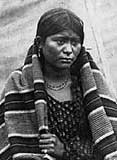 One of the prisoners at Fort Snelling













 Susan B. Anthony
 Elizabeth Cady Stanton
 Bobby Seale
 Protests at Alliant continue today.
 Govan Mbeki
 Scottie's Playtime