October 15, 1965 In demonstrations organized by the student-run National Coordinating Committee to End the War in Vietnam, the first public burning of a draft card in the United States took place. David Miller burning his draft card, 1965. These demonstrations drew 100,000 people in 40 cities across the country. In New York City, David Miller, a young Catholic pacifist, became the first U.S. war protester to burn his draft card, doing so in direct violation of a recently passed federal law forbidding such acts. Agents from the Federal Bureau of Investigation later arrested him; he was tried, found guilty, and sentenced to two years’ imprisonment. Memoirs of a Draft-Card Burner
October 15, 1966 Huey Newton and Bobby Seale formed the Black Panther Party for Self-Defense in Oakland, California. Its revolutionary agenda, and the fact that its members, all U.S. citizens, were armed, prompted FBI chief J. Edgar Hoover to refer to it as as “the greatest threat to the internal security of the United States.” First 6 members – Top Left to Right: Elbert “Big Man” Howard; Huey P. Newton, Sherman Forte, Chairman, Bobby Seale. Read the Panthers’ Ten Point Platform and Program: Bobby Seale(L) and Huey Newton(R) Black Panther Party Legacy and Alumni Black Panther Party pin
October 15, 1966 The “Endangered Species Preservation Act” became law. It allowed the U.S. Fish and Wildlife Service to identify plant and animal varieties threatened with extinction, and to acquire land to preserve their habitats. How the law has evolved
October 15, 1969 22 million took part in the National Moratorium, a protest against the continuing war in Vietnam. This was an effort by David Hawk and Sam Brown, two anti-war activists, to forge a broad-based movement against the war.The organization initially focused its effort on 300 college campuses, but the idea soon grew and spread beyond colleges and universities. Hawk and Brown were assisted by the New Mobilization Committee to End the War in Vietnam, which was instrumental in organizing the nationally coordinated demonstrations. One of the largest of the many events involved 100,000 people converging on Boston Common, but activities nationwide also included smaller rallies, marches, and prayer vigils. The demonstrations involved a broad spectrum of the population, including many who had never before raised their voices against the war. This was considered unprecedented: Walter Cronkite (then CBS news anchor) called it “historic in its scope. Never before had so many demonstrated their hope for peace.” Later, a declassified Kissinger (then Nixon’s National Security Advisor) file revealed that these protests discouraged a plan by Nixon to use nuclear weapons in Vietnam. Read more Reissued: The original Vietnam Moratoium Peace Dove button
The American Federation of Labor (AFL) voted to boycott all German-made products as a protest against Nazi antagonism to organized labor within Germany.
(It can’t hurt to put bits like this out into the universe. Somebody’s working on this, and more people ought to. So a nice little discussion of what’s working is appropriate. -A)
October 11, 2024 ARC Laureate Fellows
This Cosmos series on Australian Research Council Laureate Fellows 2024 reflects excellence from world class researchers in Australia.
Chris Gibson is a Senior Professor in the School of Geography and Sustainable Communities at the University of Wollongong. For his ARC Fellowship, he is investigating how decarbonisation impacts Australian regions.
Professor Chris Gibson: finding a truce in the climate wars.
Decarbonisation and energy transition are at the sharp edge of a hot political battle. There is a lot of dispute over new technologies like offshore wind, and exactly what mix of energy we need. It’s like a second iteration of the climate wars. But after a decade of stalled policy on climate, we have to embrace the decarbonised future, whether we like it or not. It’s an issue that needs to transcend the political divide.
But we’re faced with a dilemma: we need urgent change, but urgent change rarely occurs, if ever, in a way that is fair. The burdens and benefits of change are not distributed equally across society. And the quicker the change, the more risks there are. Regions can be all too easily left behind.
Geographers think about how substantial change, like this energy transition, affects communities. We think of ourselves as an integrative discipline. We bring together expertise from across environmental science, economics, social geography, legal geography, and from experts who are good on governing transitions. By stitching together insights from all directions, we try to see the bigger picture.
My ARC project is aiming to put together a systematic understanding of what’s happening in decarbonisation, both from the top down, with a nationwide view, and from the ground up, about how people in different regions are responding to change.
We’re putting together a team to look at how decarbonisation hits the ground in different regions, and how it affects different workers, different industries, what kinds of opportunities come out of that, what kinds of changes are needed, how communities and households are responding to the decarbonisation challenge, and how a First Nations’ perspective can lead the way.
Community responses have to be taken seriously. It’s too easy and too convenient to cast aside sceptics as “nimbies” (Not In My Backyard) or selfish or ignorant. If you take the time to hear the diversity of opinions that come from communities, you’ll often find that people are worried about real issues, with valid concerns. Local communities are very knowledgeable about their patch, and have a capacity to understand what kinds of changes are needed. If we can forge a more inclusive process that brings regional perspectives, skills and experience to the forefront, we reduce the risk that regions are left behind. And governments might actually see regional communities as an opportunity rather than a hindrance to change.
A good example is here in the Illawarra, (Coastal New South Wales) where offshore wind has been very controversial in the last year. One of the lessons to be had is to not underestimate the community’s ability to understand what an energy transition means, and not to underestimate the degree of attachment people have to their local places.
The community here is highly knowledgeable about energy. The Illawarra has a workforce with a long history in heavy industry – the number of electricians per capita in the Illawarra must be as high as anywhere in Australia. And people have opinions – it’s not a passive region that knows nothing about the change that’s coming. The task is not purely to convince local people that this is a good thing, but to have a mature conversation with them about the pros and cons.
Who benefits in the energy transition?
There are all kinds of philosophical questions about who benefits, how those benefits are shared, what it means to turn our oceans into a space for energy generation. Some members of the community are asking for a proper conversation, because they don’t feel like they’ve been part of the story so far.
People react unpredictably to change that they see is imposed upon them. Let’s say it’s closing down a coal-fired power station in the Hunter Valley in New South Wales, or proposing a green hydrogen hub in South Australia – people don’t necessarily assess these as singular proposals that exist outside of everything else in their region or in their lives. People make sense of change in relation to their place, their community, their household, their family.
My work is about putting those people and their households first, and looking at it from their point of view. How does structural change look when we take into account the pressures of cost of living, on housing, on employment? People are grappling with these issues in their everyday lives.
There’s also a real risk in introducing changes that are presented to communities as if they have arrived from elsewhere, as a fait accompli. The direction of the flow of ideas and proposals, how they hit the ground, are a very important part of the process. If a proposal seems to arrive in their backyard from the top down – from a government or a corporation provider – you can get a community offside from the outset.
My work is about setting up different kinds of approaches that recognise that these communities have their own capacities and their own perspectives to offer. What we hope to do in the five years of the ARC Laureate program is develop an evidence base so that we can craft better models of how to manage this change. We’re looking at some of the implementations that have already occurred, tracing where those decarbonisation initiatives are hitting the ground, and looking at different kinds of community reactions – what sorts of processes work better than others in terms of building that relationship with community, as well as what happens when things end up in a more antagonistic situation.
Geography is the study of the relationship between humans and our environment. It has always occupied a slightly slippery position in universities and in public life, because we’re both a science and a social science, because we do this work of integrating perspectives from different areas of knowledge. In fact, we call ourselves all sorts of different things: we’re also environmental managers and coastal managers, policy officers and sustainability experts. It’s a discipline that connects, that fills the gaps. We often find solutions to problems by putting knowledge together from those different perspectives. It’s making these connections that can make a big difference.
October 12, 1492 Natives of islands off the Atlantic shore of North America came upon Italian explorer Christopher Columbus, who was searching for a water route to India for Spanish Queen Isabella.
October 12, 1945 Pfc. Desmond Doss became the first conscientious objector ever to be awarded the Congressional Medal of Honor. Doss, a Seventh Day Adventist, enlisted in 1942 but refused to carry a rifle or train on Saturdays. On the island of Okinawa, under heavy Japanese fire, he saved the lives of 75 sick and wounded soldiers by lowering them, one by one, down a 400-foot cliff. The guest house at Walter Reed Army Medical Center is Doss Memorial Hall in his honor. Read more (includes movie trailer)
October 12, 1958 A Reform Jewish Temple in Atlanta (the city’s oldest) was firebombed with fifty sticks of dynamite in retaliation for Jewish support of local black civil rights activists. The Temple’s Rabbi, Jacob Rothschild, was outspoken in his support of civil rights and integration, and was a friend of Reverend Martin Luther King, Jr. before he became well known nationally. From Georgia PBS
October 12, 1967 British zoologist Desmond Morris stunned the world with his book, “The Naked Ape,” a frank study of human behavior from a zoologist’s perspective. Morris had earlier studied the artistic abilities of apes and was appointed Curator of Mammals at the London Zoo. Read more
October 12, 1967 “A Call to Resist Illegitimate Authority” appeared in The Nation and the New York Review of Books. 20,000 signed it, including academics, clergymen, writers. It urged “that every free man has a legal right and a moral duty to exert every effort to end this war [Vietnam], to avoid collusion with it, and to encourage others to do the same.” This document became the main basis for the federal government’s criminal prosecution (for encouraging draft evasion) of five of the signers: Dr. Benjamin Spock, Marcus Raskin, Mitchell Goodman, Michael Ferber, and the Reverend William Sloane Coffin. Read the Call
October 12, 1970 Lt. William Calley was court-martialled for the massacre of 102 civilians in the Vietnamese village of My Lai; far more actually died during the incident. The full sad story
Lt. Calley
October 12, 1977 “Regents of the University of California v. Bakke” was argued in front of the U.S. Supreme Court. The question: Did the University of California violate the Fourteenth Amendment’s equal protection clause, and the Civil Rights Act of 1964, by practicing an affirmative action policy that resulted in the repeated rejection of Bakke’s application for admission to its medical school? Read more
Monday marked the one year anniversary of the October 7th massacre in Israel, and at sundown Friday, the Jewish day of atonement—Yom Kippur—begins. It’s the holiest day of the Hebrew calendar, saddled with even more gravity given the past year of intra and inter-community turmoil. It’s meant to be observed with deep self-reflection.
Rabbi Jason Rubenstein, Executive Director of Harvard University’s Hillel (an international Jewish student organization) endeavored to do just that with a searching letter posted to his chapter’s website Thursday evening. The nearly 2,600 word missive was published in response to a fairly confusing fracas on campus earlier this week. The details are important, so I’ll break it down for you:
On Monday, October 7, 2024, a student affiliated with JStreet U, the university arm of the liberal pro-Israel Jewish nonprofit JStreet, allegedly used the printing resources of the campus Hillel to produce copies of posters without permission. The student was later identified in a self-published statement as Meredith W. B. Zielonka.
The printable posters were produced by Halachic Left, a grassroots Jewish organization. They featured a variety of images depicting death and suffering in Gaza over the past year juxtaposed with Hebrew and English translations of the “Al Chet,” a list and confession of sins recited throughout Yom Kippur services.
These posters were hung outside the campus Hillel center and discovered by staffers early Tuesday morning. The staffers then called the Cambridge Police Department because, according to a statement, “the flyers contained graphic content they felt was meant to be intimidating.”
The Crimson, Harvard’s student newspaper, reported Tuesday that Harvard Hillel “temporarily suspended” JStreet U because of their actions, though it remains unclear from what they were suspended and what authority Hillel has over JStreet U.
I reached out to JStreet’s national organization Wednesday, who informed me the following day that they no longer have an official chapter at Harvard and that a student—now identified as Zielonka—who had been affiliated with them in the past was the one who printed the posters. They said she “engaged in activity that was in violation of both Hillel’s affiliate agreement and J Street U’s own standards for our campus chapters.” I asked JStreet for specifics as to how Zielonka violated their standards, but they declined to comment further.
JStreet also shared with me a letter their president and directors sent to Rabbi Rubenstein profusely apologizing for Zielonka’s actions. “We are committed to developing genuine J Street U leadership on campus that represents our values and mission, specifically providing a safe space for students to hold nuanced views without compromising their pro-Israel values,” they wrote.
Thursday evening Rubenstein published his letter in response to the situation. He likened the posters to antisemitic propaganda—both historic and recent—that depicts Jews as dangerous vermin who should be met with violence. In his view, the posters “stigmatize” a type of Jew (IDF soldiers enacting violence in Gaza) and even if they’re not necessarily an attack, create “the potential to engender conflict between different elements of our community”. He wrote: “The saturation of public spaces, and the minds of an increasing number of Americans, with images of Jews as heinous, is real, and dangerous, and requires – just like testing and masking during COVID – that we curtail some public freedoms to protect one another.”
Shortly after, Zielonka published a statement. She wrote that she put up the posters to “protest Israel’s conduct in Gaza and underscore my genuine moral and religious concerns for Palestinian lives,” and added, “While I stand by my beliefs, I regret the misunderstandings that overshadowed our message.”
Zileonka explained: “I received permission to spend funds to print the posters as a Hillel affiliated group, but I should have preemptively shown Hillel the content given their rules precluding the use of their funds for controversial matters. Out of respect for Hillel and their mission, I have already donated the $41 back to the organization.”
Another poster from Halachic Left
I’d like to share some additional language from Rubenstein’s letter so that my criticism makes sense. He writes that the poster images from Gaza, “depict, in ways that are painful to confront, effects of the IDF’s campaign against Hamas there on Palestinian civilians. It is vital that we, as Jews, not evade the effects of the Jewish state’s army’s actions on others.”
The framing in that first sentence feels especially important. It’s a reminder that from a Zionist perspective, Israel’s government and army have killed tens of thousands of people in Gaza for a reason: to eradicate Hamas. The Palestinian civilians are simply bystanders caught up in war, and while their pain should cause us pain, it doesn’t mean that all Jews should have to repent for it.
I as much as anyone have consistently made it clear that the conflation of Zionism with Judaism is dangerous and harmful. The trouble is, however, that from the perspective of the world, the atrocities being committed against Palestinians are being done in our name–therefore, we’ve become part of the story, whether we agree with the premise or not. And so from my perspective, the posters are not trying to say that every Jew should atone this Yom Kippur for the sins of the IDF, but that we should atone for what is seen as violence carried out to protect our religion. After all, “not in our name” is a phrase that has been used by Jews long before, but especially since, October 7, 2023.
But what’s perhaps even more troubling on a micro level is the involvement of law enforcement and the idea that certain freedoms be curtailed in the name of safety.
“Jewish institutions have a tremendous amount of power, and it hurts my heart that they so often use it to gate-keep and exclude rather than enfranchise,” Rabbi and author Danya Ruttenberg, who publishes the newsletter Life is a Sacred Text, told me. “That Harvard Hillel decided to engage law enforcement on a matter of…postering (never mind that they were posters with…our sacred liturgy? Inviting us to collective moral reflection?) speaks to just how profoundly some corners of our institutional life have lost the thread here.”
A Jewish Harvard student I spoke with Friday morning, whose name I’m not sharing to protect their privacy, pointed out that the situation could have turned out even worse had the JStreet U-affiliated student been a person of color. They felt that involving the cops rapidly escalated the situation, when it could have easily been an opportunity for community building handled privately between groups.
And, as Ruttenberg pointed out, there was no actual crime was committed.
The impact of Hillel’s rush to suspend and punish JStreet U, another Jewish student organization—never mind the fact that they didn’t have an active chapter on campus or that Hillel doesn’t have any apparent authority over other student organizations—goes beyond this one incident. The student told me how they feel this represents something larger about how Hillel views left of center Israel activism, and that even the actions of an organization as close to the center as JStreet is unacceptable.
Harvard has been no stranger to controversy (legitimate and manufactured) since last October, which is why this seemingly niche story captured my interest. While one elite university campus is not representative of the country or world at large, much like Judaism and Zionism, the school’s experience and reality have been conflated. And so even a relatively small event looms large.
“How ready are our institutions to criminalize young people who simply seek to engage about horrific moral questions with the community, and with those in power?” Ruttenberg wondered. “This was a moment for communal conversation, for drawing in and speaking to. Is this who we want to be?”
If you’re observing Yom Kippur, I hope that however you choose to observe is meaningful to you. I will be attending a Yizkor service tomorrow organized by Rabbis for Ceasefire. And, in keeping with Jewish tradition, I want to apologize to anyone I may have hurt by my words or actions this past year. I hope you can accept my sincere forgiveness.
(Note from Ali: Jess wrote the anti-misogyny rant I was thinking of.)
“Do the best you can until you know better. Then when you know better, do better.”
~Maya Angelou
I go solo camping often. I head up to the North Shore in Minnesota or down to Northwest Arkansas and hang out a few days by myself or with my daughter. My husband is a big ole, corn-fed country boy who will not sleep on the ground, so we leave him at home.
I love to sleep outside, but the very thing I hate about camping is sleeping outside — exposed. As a woman, this is something I think about a lot. When I wake up for some unknown reason and wonder if I heard something in my sleep. Or, I wake up to actually hearing something or someone. I get scared. I get nervous. I wonder why in the hell I do the things I do and take the chances I take.
And then I go back to sleep and wake up on Lake Superior or Devil’s Den and hike to waterfalls and forget it all until it is time to go back to sleep outside. Love and hate.
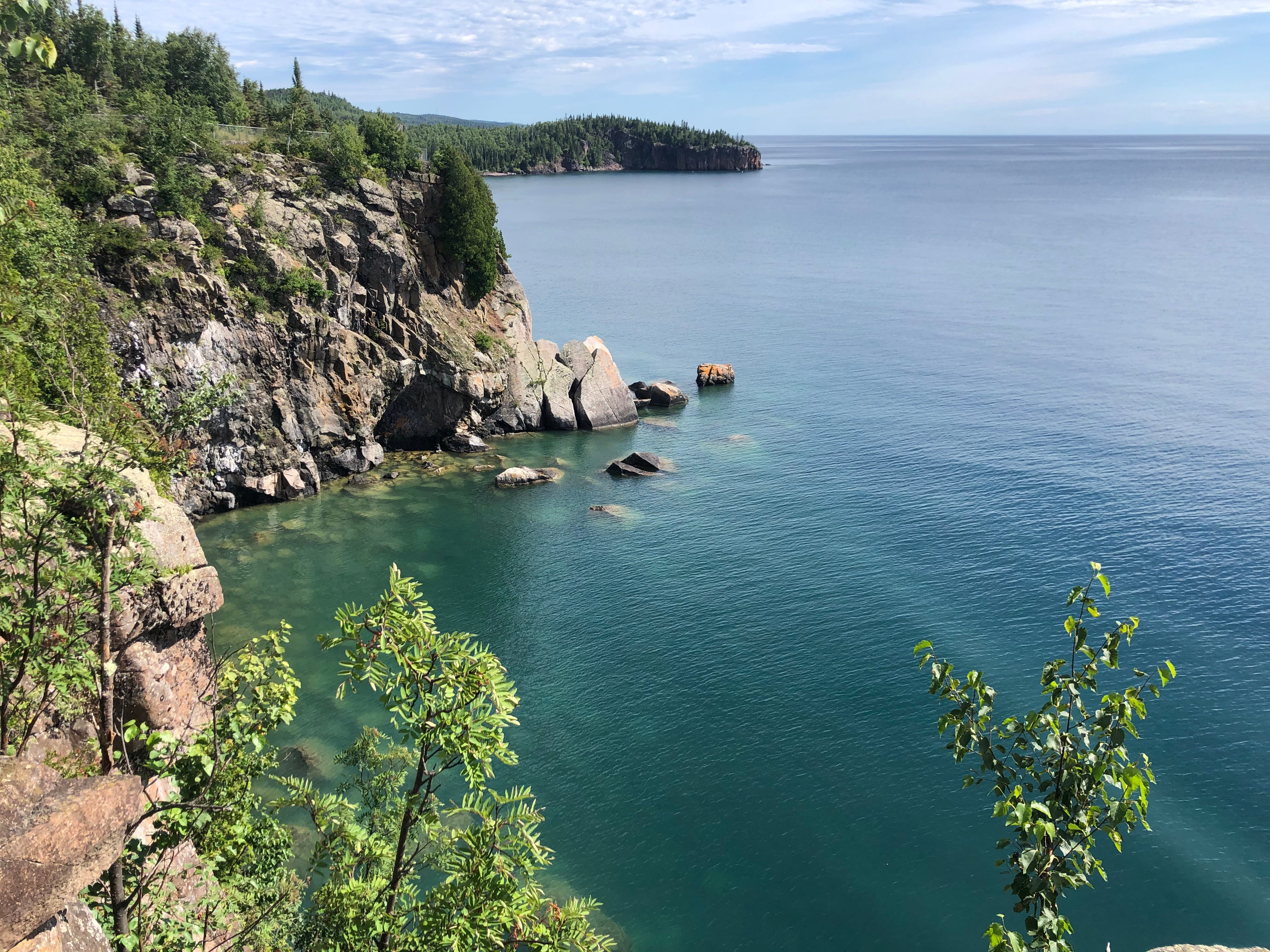
Lake Superior, Split Rock Lighthouse State Park.
I once asked my husband if he’s ever afraid when he is alone. He laughed out loud.
“Of what? Why would I be scared?”
I tend to be an overthinker, but I can’t tell you how many times I have wondered about his statement of fact. He is not scared. Of men or animals or most of the danger I intuitively see around me. He has nothing to be scared of — he is physically imposing and there is not one law on the books that will harm him.
He has never worried about walking at dark. Or encountering someone on a trail. Or sleeping outside. Or most of the things that take up a lot of my mental space.
He has lived his life completely unencumbered by his environment, even as a resident of a red state. A homegrown Missouri man.
Sure, the Missouri GOP trifecta, a supermajority, has defunded the schools and let our roads crumble and closed hospitals and generally made a nuisance of themselves, but that is exactly what they were to him. An inconvenience. Annoying. Turds in the punchbowl, but nothing to get too riled up about.
He was just living his life.
He didn’t see it. Not because he is not empathetic. Not even because he doesn’t pay attention to politics. It’s because he has lived his life with a privilege he didn’t know existed until I pointed it out. Because, until he saw the world through his daughters’ eyes, through my eyes, these things just never occurred to him. He didn’t deny privilege, he just didn’t see it. He isn’t uncaring or a dolt — he just had absolutely no experience being marginalized. I had to tell him.
Once he saw it, though, he couldn’t look away. He was disgusted. He understood.
This is where I should mention something that I have spoken of in front of safe men. When I tell them that I have been sexually assaulted as well as almost every woman I know, they are astounded. When I tell them of sexual harassment, they are amazed. And then, one day it clicked for me. These are good and safe men and the predators know it. They don’t hurt women while they are around. They don’t talk about it or joke about it, because these men wouldn’t put up with it. The good guys have often really not been a witness to the behavior we have endured because they are just that…good guys.
I am not making excuses for the menfolk.
The men in my life will attest to the fact that I constantly push them to see what we see. I am hard on them. I ask that they look beyond themselves and be an ally to others. To be a witness and bear witness.
We don’t need protectors, but we do need witnesses.
As a woman, as a mom of girls and granddaughters, I have no degree of safety in Missouri and I know all of my girls fall into the same category. They are not safe from sexual assault or rape. They are not safe after a sexual assault or rape. They will likely be dismissed, or worse, blamed. They would be forced to bear the child of their rapist. They would likely be forced to co-parent with their rapist.
Missouri has a total abortion ban with no exemptions for rape or incest. Not that it would matter…I am sure there is some process to that exemption as well and I really hate the notion that a woman or girl can’t have bodily autonomy unless she has first been violated.
Writing that sentence made me sick at my stomach.
Missouri women have been denied care because of the abortion ban. A Kansas OBGYN, Dr. Ahmed, shared a story last week about her Missouri patient who suffered a miscarriage:
“She came in for a follow-up still bleeding,” said Dr. Ahmed. “Turns out there was some tissue that was still there. Retained tissue in that setting can become infected, can cause a lot of bleeding, so I discussed with her the options.”
The patient decided on medication and Dr. Ahmed says she prescribed it. But the following morning, she received a fax from Walgreens on Stateline after prescribing Misoprostol or Cytotec for the miscarriage stating, “Under Missouri law medication abortion is now illegal. Please advise patient to fill across Kansas border”.
Missouri has also had a 25% decrease in OBGYN residency applicants willing to come to our state because of the ban. That decreases care for all women, not just pregnant women.
We aren’t safe in Missouri.
The good news is that Missourians will get to vote on Amendment 3 in a few weeks. This amendment will restore abortion rights in Missouri. We will be the first state to overturn a complete ban.
The bad news is that our bodily autonomy is even put to a vote. That geography dictates our rights. That random folks will get to decide if we are first or second-class citizens. That we have been treated as less than. That our rights have been up for debate.
This is red state shit. We are used to it. It is constant and it is something we live in fear of every day. It is the thing I point to when I am speaking to the men around me. I never let them daydream their way back into complacence. I don’t let them fade into the peace of not knowing…of not being engaged. I don’t let them forget the fear of the women around them. I keep them awake.
Woke. (Emphasis mine- Ali)
I don’t want to be scared of living in Missouri anymore. I don’t want anyone to be scared in their home state. This is why we have to speak on it. Say it.
The reality is that we cannot gain our rights back without involving men. I have such good men in my life. Would they have voted yes on Amendment 3 without me telling them? I’d say yes. Would they be as rabid in telling other men around them to vote yes if I had not worked on them for so long? Maybe not.
It’s not that we are dealing with self-centered jerks. It’s that they didn’t know what they didn’t know.
More than half a million people flooded Washington, D.C., demanding civil rights for gay and lesbian Americans, now celebrated each year as National Coming Out Day. Many of the marchers objected to the government’s response to the AIDS crisis, as well as the Supreme Court’s 1986 decision to uphold sodomy laws in Bowers v. Hardwick. The AIDS quilt, first displayed in 1987 in Washington, DC The NAMES Project AIDS Memorial Quilt was first displayed there, bringing national attention to the impact of AIDS on gay communities, a tapestry of nearly two thousand fabric panels each a tribute to the life of one who had been lost in the pandemic.
“We need cis allies to speak up for us. Vote to remove the bigots from positions of power. The biggest thing you can possibly do right now is to vote. Vote for Democrats. Because, no, they aren’t perfect, and no one is. But they are a darn sight better than the alternative.”
The UK’s last coal-fired power plant, Ratcliffe-on-Soar in Nottinghamshire, will close this month, ending a 142-year era of burning coal to generate electricity.
The UK’s coal-power phaseout is internationally significant.
It is the first major economy – and first G7 member – to achieve this milestone. It also opened the world’s first coal-fired power station in 1882, on London’s Holborn Viaduct.
From 1882 until Ratcliffe’s closure, the UK’s coal plants will have burned through 4.6bn tonnes of coal and emitted 10.4bn tonnes of carbon dioxide (CO2) – more than most countries have ever produced from all sources, Carbon Brief analysis shows.
The UK’s coal-power phaseout will help push overall coal demand to levels not seen since the 1600s.
The phaseout was built on four key elements.
First, the availability of alternative electricity sources, sufficient to meet and exceed rising demand.
Second, bringing the construction of new coal capacity to an end.
Third, pricing externalities, such as air pollution and carbon dioxide (CO2), thus tipping the economic scales in favour of alternatives.
Fourth, the government setting a clear phaseout timeline a decade in advance, giving the power sector time to react and plan ahead.
The UK’s experience, set out and explored in depth in this article, demonstrates that rapid coal phaseouts are possible – and could be replicated internationally.
As the UK aims to fully decarbonise its power sector by 2030, it has the challenge – and opportunity – of trying to build another case study for successful climate action.




 Scottie's Playtime