Snippets of each. Simply click on the “Read on Substack” links to finish each bit. History is important, and ought to be known. Again, be warned about some language within.
Queer History 104: Martha May Eliot & Ethel Collins Dunham by Wendy🏳️⚧️🏳️🌈🌈
Two brilliant women who revolutionized medicine while sharing one bed and one beautiful life Read on Substack
Let me tell you about a love story so powerful it saved millions of children’s lives. Martha May Eliot and Ethel Collins Dunham weren’t just pioneering scientists in a time when women were told to shut up and make babies—they were soulmates who supported each other through nearly six decades of groundbreaking work, homophobia, and institutional sexism. Their love letters tell a story of passion so deep it changed the fucking course of medical history.
When I think about these two women finding each other in the early 1900s—holding hands under tables at medical conferences, stealing kisses between hospital rounds, and building a home together despite the judgment of their peers—I’m not just impressed. I’m goddamn moved to tears. This is the kind of queer history that reminds us we’ve always been here, always been brilliant, always been changing the world even when the world tried to erase us. (snip-MORE)
Queer History 106: Reed Erickson by Wendy🏳️⚧️🏳️🌈🌈
The Trans Guy Millionaire with a Pet Leopard Who Bankrolled a Revolution: How one man’s wealth, vision, and complicated legacy shaped transgender rights in America Read on Substack
Holy shit, you need to hear about Reed Erickson—a transgender millionaire who casually took his pet leopard on private planes while funding the movements that would eventually give trans people like himself basic human rights. This isn’t some fictional character from a Ryan Murphy series; this was a real fucking person who lived hard, loved harder, and threw his considerable fortune behind a revolution most people weren’t ready for.
Reed’s story hits me in the gut because it’s so goddamn messy and human. He wasn’t a sanitized LGBTQ+ icon with a perfect narrative arc. He was brilliant, visionary, and deeply flawed—a three-time divorcee who became a drug fugitive while still managing to fundamentally reshape how America understood gender. His life reads like a fever dream, but his impact on transgender rights was dead serious. (snip-MORE)
Queer History 107: The Daughters of Bilitis by Wendy🏳️⚧️🏳️🌈🌈
From secret social club to revolutionary force – the women who changed queer history forever Read on Substack
In a world where being yourself could get you arrested, institutionalized, or worse, eight women decided to host a goddamn picnic. That picnic club – the Daughters of Bilitis (DOB) – became the first recognized lesbian civil rights organization in the United States and sparked a revolution that would change queer history forever. This isn’t just another boring historical footnote; it’s the story of women who risked everything to carve out space for themselves when no one else would.
Let’s be real – what started as a way for “Sapphics to dance and talk together” (the most lesbian thing I’ve ever heard) evolved into the first nationally published lesbian magazine in America and eventually led to the first gay wedding in California. These women weren’t just creating community; they were planting the seeds of a movement while the rest of society was trying to pretend they didn’t exist. (snip-MORE)
May 11, 1973 Charges against former Pentagon analyst Daniel Ellsberg (including conspiracy, espionage and larceny) for his role in the release of The Pentagon Papers (a comprehensive classified study of the origins and conduct of the Vietnam War) were dismissed. Judge William M. Byrne cited government misconduct, including attempts to bribe him with an appointment as FBI Director, and previously undisclosed wiretaps of Ellsberg. His compatriot, Tony Russo, a former RAND Corporation analyst, was also released. Secrets: A Memoir of Vietnam and the Pentagon Papers a book review Daniel Ellsberg’s website
May 11, 1975 80,000 turned out in New York City’s Central Park to celebrate the end of the Vietnam War.
I apologize for the lateness of today’s blog, but I had three deadlines today. I’ll explain further in a future blog.
We have the first American pope, and to add to that, he’s from Chicago. How cool is that? I think Chicago all by itself spites Trump, but a pope who’s criticized the administration for its policies on immigration is a nice plus. Also, Pope Leo XIV is against the death penalty, racism (Trump is a racist), and understands that Climate Change is a real thing and not a “hoax” created by China.
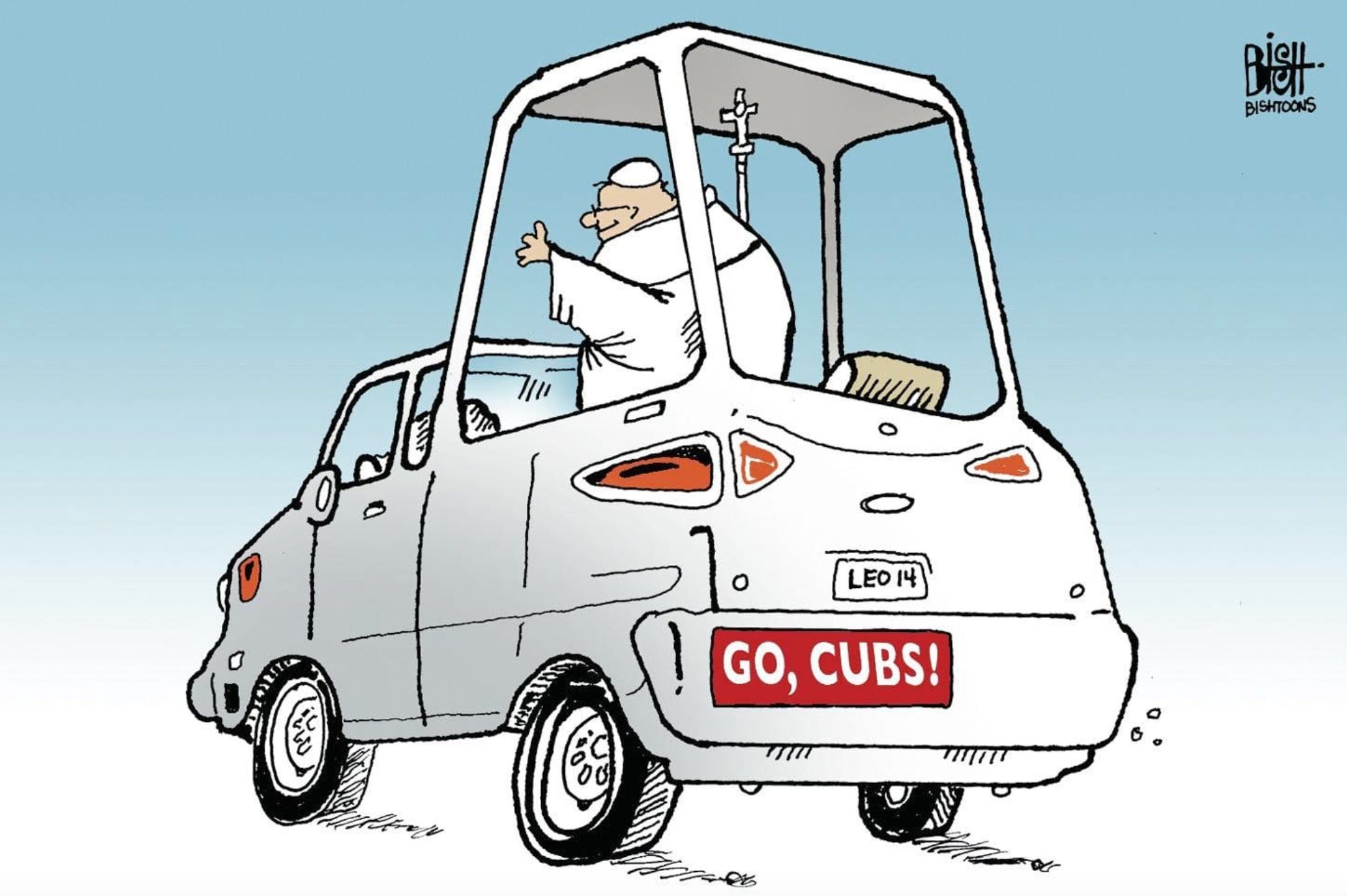
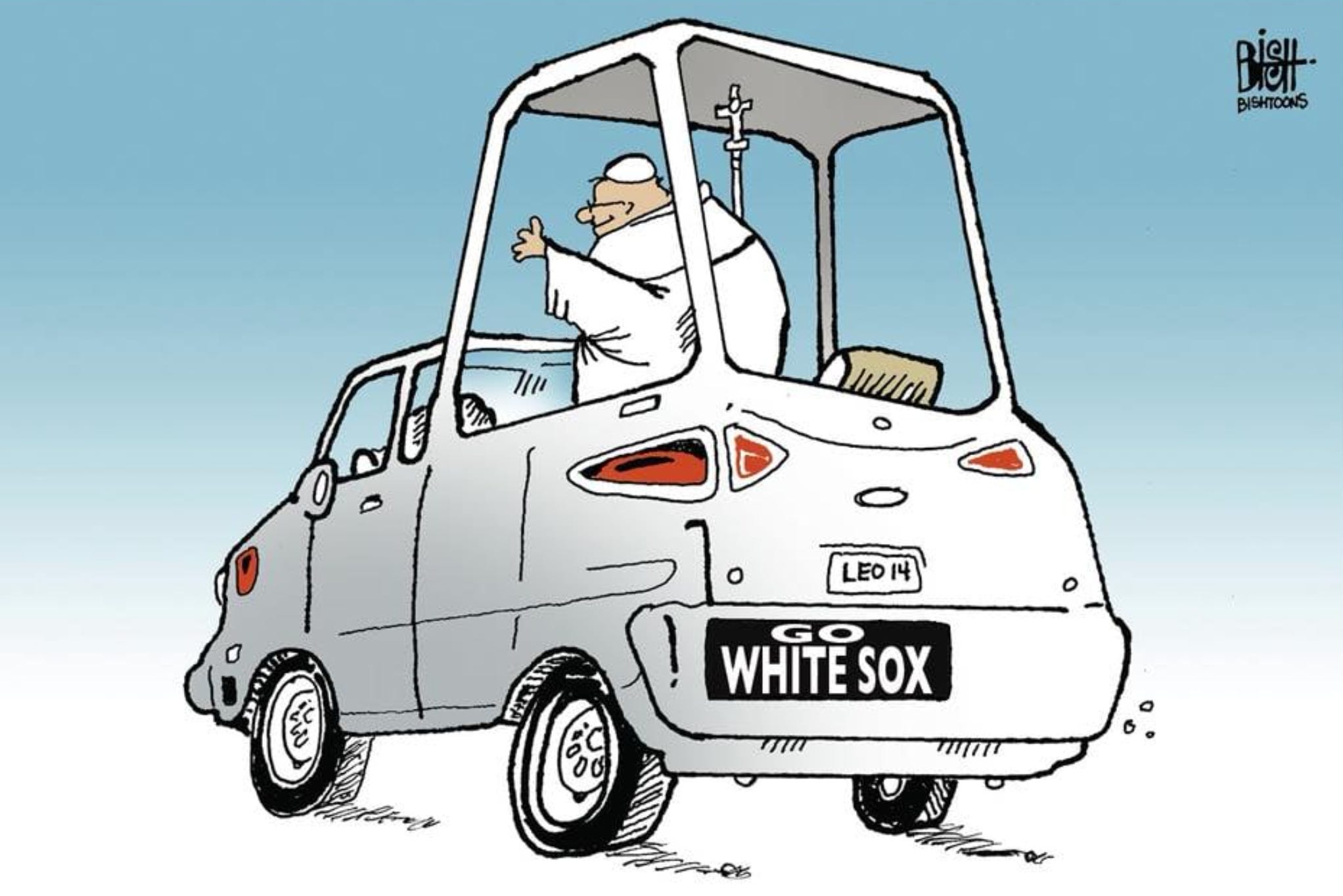
One of the first things I was curious about with our Chicago pope was if he is a Cubs fan. The Chicago Cubs posted on their famous marquee above Addison Street at Wrigley Field that Pope Leo is a Cubs fan. They got it wrong. So did some cartoonists.
Henry Payne is already an idiot. That’s not new news. Randy Bish rushed to judgment.
But it didn’t matter to him because he just made a simple swap when he found out he was wrong.
Sorry, Randy, but this is generic cartooning. Plus, nobody should listen to you about Chicago. You’re from Pittsburgh.
What else is from Pittsburgh is this shit.
What is it? It’s ketchup. There’s nothing special about this ketchup. It’s just regular shitty Heinz ketchup, but the company was trying to trick Chicagoans to fuck up their hot dogs with it. It didn’t work, and Eater.com let them know it.
I’m sure the Pope would agree that it’s sacrilege to put ketchup on a hot dog, but since he’s the Pope, he would probably forgive you, but I won’t. How dare you put ketchup on a hot dog? What are you? Five?
I used to have a theory that people who love ketchup had mothers who couldn’t cook. I developed this theory because my ex-wife LOVED ketchup, and her mother could not cook. I hope she doesn’t read this because she’s very nice and my son’s grandmother. My father-in-law, may he rest in peace, made the best fried pork chops I’ve ever had.
I think there are only four acceptable reasons for using ketchup, and they are, for crinkle-cut fries, very bad fries, meatloaf, and if you’re five. I kid, I kid. I know some of you love your ketchup, and none of us is perfect. For example, Donald Trump LOVES ketchup. Let that sink in.
What I learned about Chicago pizza is that most Chicagoans eat more tavern-style than deep dish. Chicagoans like deep dish, but it’s more for special occasions and when they have visitors. Deep dish is more for tourists. I don’t really get deep dish, and I don’t even think it should be considered a pizza.
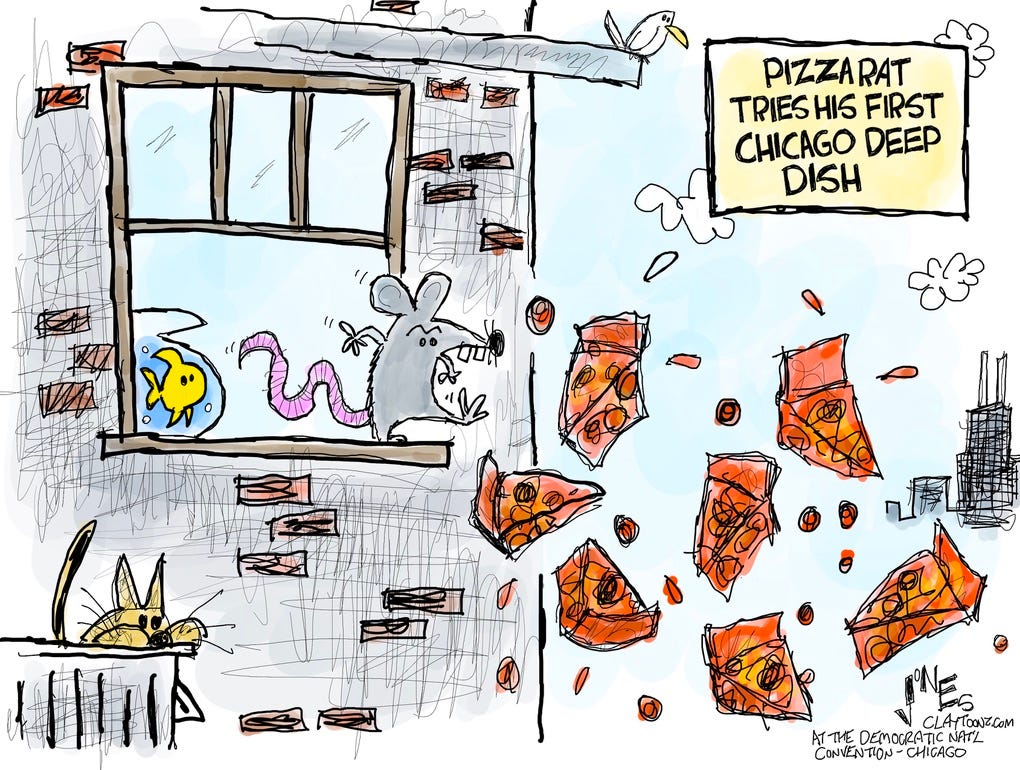
Do you remember Pizza Rat’s first trip to Chicago last year? He tried the deep dish.
Not a fan.
Today’s cartoon put me in the mood for tavern-style tonight, and Pizza Hut has it as a special. When I picked it up, the manager apologized because they had accidentally cut it into triangles instead of squares. A lot of Chicagoans would not stand for that, but I’m tolerant. I thought of Pope Leo, and I forgave them…this time.
Shout-out and dedication: I dedicate this cartoon to Greg Zaborniak, who introduced me to Old Style beer and tavern-style Chicago pizza last year during the Democratic convention. Thank you again, Greg.
Creative note: I didn’t know what I was going to draw today, and I also had a deadline for the Advance. And then, one of my clients contacted me wanting a cartoon on a local issue, and they wanted it today. So, I was facing three deadlines with zero ideas. But they came to me, one by one, and I knocked ‘em all down.
I deserved that pizza.
There’s a version of this cartoon without Pizza Rat. I didn’t include him because not everyone who will see this cartoon will be a regular reader of mine, and they might think the rat is an aspersion on Catholicism. So I sent it to my clients without Peezy. But then, a reader changed my mind because he thought it was a bigger sin to include a pizza without Pizza Rat. I figured I was going to hear more howls about missing Peezy than I’d hear from angry Catholics. The version at GoComics may not feature Peezy because sometimes a new file won’t override the existing file. I did resend the Peezy version to my clients, but they’ll use the one they want, and maybe not even care.
As the House Ways and Means Committee prepares to mark up a major tax bill, it is important to step back and consider which priorities it will reflect — whether it will prioritize tax policies that help families meet basic needs, require corporations and the wealthy to pay a fairer share of tax, and strengthen the nation’s fiscal outlook to allow us to meet existing commitments and make high-value investments.
Numerous independent analyses have shown that the 2017 tax law, which the bill is expected to extend, was skewed to the rich, drove up deficits and debt, and failed to deliver on its economic promises.[1] It also has proved unpopular with the public.[2] The 2025 bill should be held to a much higher standard than the 2017 bill, given its poor record of achievement, the higher risks the country now faces due to higher levels of debt, and the more uncertain economic outlook.
President Trump’s extreme and chaotic tariff policies pose a major threat of recession and are already raising consumer prices.[3] The President’s attacks on the rule of law, scientific and medical research, top universities and law firms, and the functioning of the federal government — including its ability to collect revenue and deliver core services — pose large additional economic risks, over both the short and long term.
Any forthcoming Ways and Means bill should respond to the current economic moment and the growing risks that families face: rising costs, increasing risks of job loss, and high uncertainty about their future financial stability. The bill also must be examined in connection with the other central pieces of the Republican economic agenda: massive cuts in health coverage, food assistance, and other forms of help for families and communities to partially offset the cost of the bill’s tax cuts.[4]
The answers to the following ten questions will illuminate what House Republicans prioritized as they put together their signature tax bill.
Prioritizing Tax Policies That Help Families Meet Basic Needs
1. Do House Republicans block the President’s reckless global tariffs to protect their constituents and stop a potential recession?
The tariffs’ impact on consumers and the economy is already impossible to ignore. Importantly, the Ways and Means Committee has jurisdiction not only over tax policy but also over Congress’ constitutional trade policy authority.[5] Thus, the committee can and should respond to the President’s destructive tariff policy.
Unless they are stopped, tax increases due to the tariffs are likely to more than erase any forthcoming tax cuts for households in all income groups except the top 10 percent, whose incomes are above $317,000. (See Figure 1.) Moreover, while the 2017 tax cuts won’t expire until the end of this year, households and businesses are already feeling the impact of the tariffs on prices, supply chains, and business viability.[6]
Figure 1
Soon after President Trump imposed the highest tariffs since the Smoot-Hawley tariffs of the 1930s on more than 100 countries, a number of states and businesses filed lawsuits challenging his legal authority.[7] Yet House Republicans, despite their constitutional responsibility over tariff policy and the obvious risks the tariffs pose to their constituents, have failed to act. Meanwhile, the tariffs and the frequent shifts in the Administration’s tariff policies are paralyzing businesses, raising costs on consumers, and sharply increasing the risk of recession, which could lead to a rise in unemployment and the number of people who need help to afford the basics, just as those supports are slated for cuts.
A major question for the committee markup is whether House Republicans will, in parallel with the tax bill, assert their constitutional trade policy authority to stop these destructive policies and protect the country from a potential self-inflicted recession.
Furthermore, as Figure 1 shows, these historic tariffs represent major tax increases on households with low or moderate incomes.[8] Given that extending the 2017 tax law would give the biggest benefits to high-income households, it will be important to see if Republicans modify the upcoming bill to reflect the current economic situation, including through measures discussed below.
2. Do House Republicans extend enhanced premium tax credits for marketplace health coverage to protect millions of people, including many small business owners, from sharp premium increases?
While the Ways and Means bill is expected to extend many other expiring tax provisions, it may not extend the premium tax credit enhancements, which are critical to making health coverage in the Affordable Care Act (ACA) marketplace more affordable.
Failing to extend them would drive up health care premiums by an average of 79 percent for over 20 million people, including 3 million small business owners.[9] (Figure 2 shows the average premium increases nationally for a family of four at different income levels; in some states the increases would be far higher.)[10] Roughly 4 million people would then be expected to lose their health insurance as its cost rose to unaffordable levels.[11] As a result, they would be more likely to forgo necessary care or to incur medical debt.
Figure 2
3. Do House Republicans expand the Child Tax Credit for children in working families who get less than the full credit, whom 169 House Republicans voted to help last year?
Under the Child Tax Credit now in place, 17 million children receive less than the full credit, or none at all, because their families’ earnings are too low; the large majority of these children live in families with earnings.[12] Last year, Ways and Means Chair Jason Smith negotiated and championed legislation to expand the credit for the vast majority of these children. The bill, which passed the House, would have corrected many (but not all) key flaws in the credit’s design.[13]
First, the bill would have improved how the credit phases in with earnings. As it stands now, higher-income families get a $2,000 credit for each child, but because of the way the phase-in works for low-income families, many families with two or three children receive roughly the same total credit as a family with one child at the same earnings level. Not allowing lower-income families to claim the credit on a per-child basis harms the roughly three-quarters of children in lower-income families who live in a family with more than one child.
Second, the bill would have treated families with low or moderate incomes the same as higher-income families when it comes to the maximum credit they can receive. Currently, these families are restricted to a smaller maximum credit. The lower maximum credit for families who don’t owe income taxes means that when they are able to increase their earnings, they often receive no additional Child Tax Credit, as they remain stuck at the lower maximum credit. This is seemingly at odds with Republicans’ rhetorical focus on increasing returns to work.
If Republicans simply increase the $2,000 maximum credit, or index it for inflation, not one of the 17 million children or their families would benefit from the change. The children who wouldn’t benefit include an estimated 650,000 children in veterans’ families, as well as millions of children whose parents work important jobs for low pay, such as truck drivers, cooks and waiters, nursing assistants, home health aides, construction workers, cashiers, and others. These children should be the top priority, not the lowest.
Some prior Republican proposals to expand the Child Tax Credit would offset the cost by cutting the Earned Income Tax Credit (EITC) for families with children and eliminating the head-of-household filing status for single parents.[14] In effect, this would increase income support for single parents with one hand while taking away part or all of that added support with the other. The Ways and Means bill should boost the incomes of single parents, an economically precarious group — not take away support.
4. Do House Republicans prevent low-paid working adults not raising children in their homes from being taxed into poverty?
More than 6 million working adults aged 19 and older who aren’t raising children at home will be taxed into, or deeper into, poverty by federal income and payroll taxes in 2026 if House Republicans do not improve the very limited EITC for this group.[15]
Republicans should increase the paltry size of their EITC, expand the income range for people to qualify, and expand the age range (currently 25-64) to include anyone aged 19 or older. This would help young adults entering the workforce, who currently do not qualify for any EITC, and adults aged 65 and over, many of whom continue to work but aren’t eligible for any EITC. And it would provide a larger credit for currently eligible adults aged 25 to 64.
These changes would also be consistent with the President’s attention during the campaign to the economic circumstances of young men, especially those who don’t go to college.
5. Do House Republicans protect energy tax credits that help families lower their utility bills and create economic opportunities for struggling communities?
Tax credits for investments in clean, affordable energy have spurred tremendous growth in the solar, wind, and geothermal energy industries, and they are bringing new economic opportunities to areas of the country facing underinvestment and hardship, including many rural areas.[16] But House Republicans are reportedly considering large cuts to energy tax credits, which risks upending this progress.[17]
Repealing these credits would result in higher utility bills for households and businesses (increases of 7 percent and 10 percent, respectively)[18] at a time when consumers already face higher costs from the President’s tariffs. Repeal could also add up to $49 billion in annual health care costs and lost productivity.[19]
Requiring Corporations and Wealthy Households to Pay a Fairer Share of Tax
6. Do House Republicans end costly tax cuts targeted to high-income households?
Extending the expiring individual income and estate tax provisions of the 2017 law would benefit households with considerable wealth and high incomes far more than households with low or moderate incomes. Roughly half the cost of extending the expiring tax cuts would flow to households with incomes in the top 5 percent (those with incomes over around $320,000).[20]
This tilt to the top reflects several costly provisions that primarily benefit the most well-off:
Lower top rate. The 2017 law cut the top individual income tax rate, which now applies to taxable incomes over roughly $730,000 for married couples, from 39.6 percent to 37 percent. Some House Republicans have reportedly considered including a higher top rate in their bill — such as 40 percent for people with taxable incomes over $1 million — but President Trump and House Speaker Mike Johnson have both rejected the idea.[21]Allowing the top rate to revert to 39.6 percent while extending all of the 2017 law’s other expiring provisions would still give households in the top 1 percent a $40,000 average annual tax cut, according to the Tax Policy Center.[22] That’s because most high-income households receive large tax cuts from the law’s other provisions, like the pass-through deduction (see below), and also benefit from the law’s rate cuts that apply to the lower tax brackets. Still, even this modest change would be a welcome departure from the failed “trickle-down” approach to tax policy.
Pass-through deduction. The 2017 law adopted a special 20 percent deduction for certain income that owners of pass-through businesses (partnerships, S corporations, and sole proprietorships) report on their individual tax returns. Over half of the benefits go to 200,000 business owners with incomes over $1 million, who now face a lower top rate (29.6 percent) than their employees (37 percent).[23] Research finds the deduction had no trickle-down benefits for workers’ wages or business investment.[24]At a minimum, Republicans can follow through on their rhetorical support for small business owners by letting the deduction expire for millionaires, which would reduce the deduction’s cost by over $350 billion from 2025-2034, and instead extending enhanced premium tax credits that help 3 million business owners (see above) for a somewhat lower cost.[25]
Tax break for large estates. The 2017 law doubled the estate tax exemption to $22 million per couple and indexed it for inflation going forward; today a couple can pass on an estate worth up to $28 million tax free. Extending this generous exemption amounts to a $5.7 million tax cut for the wealthiest 1 in 1,000 estates, whose value consists largely of unrealized capital gains income that has never been taxed.House Republicans may double down on this costly estate tax break, with some even calling for permanently repealing the estate tax altogether.[26] Providing tax breaks to multi-million-dollar estates would be especially egregious given that Republicans also appear poised to steeply cut vital health care and food assistance, while the President’s sweeping tariffs will cost families with low or moderate incomes hundreds if not thousands of dollars a year and drive up the likelihood of a recession.
7. Do House Republicans revisit the 2017 law’s permanent and steep cut in the corporate tax rate?
The centerpiece of the 2017 law was a deep, permanent cut in the corporate tax rate — from 35 percent to 21 percent — that cost $1.3 trillion from 2018-2027 and is tilted even more heavily toward wealthy people than the expiring individual tax cuts.[27] (See Figure 3.) Rigorous research shows that the corporate rate cut did not produce the promised economic benefits: a study by economists from the Joint Committee on Taxation and the Federal Reserve Board found that workers in the bottom 90th percentile of their firm’s income scale saw no change in earnings from the rate cut.[28]
Rather than revisit this costly, skewed rate cut, which was even deeper than corporate lobbyists had expected to achieve in the 2017 law,[29] House Republicans are likely to go in the opposite direction: reverse scheduled business tax increases that Congress added to the 2017 law to partially offset the cost of the corporate rate cut. Reversing these increases without a corresponding increase in the corporate rate would amount to hundreds of billions in additional tax cuts for corporations.[30]
figure 3
8. Do House Republicans reject additional unwise tax cuts?
The House-passed budget resolution calls for $4.5 trillion of tax cuts over fiscal years 2025-2034, which leaves room for $1.2 trillion in additional tax cuts on top of extending the 2017 individual and estate tax cuts. In addition to the likely business tax cuts discussed above, House Republicans may include some costly new tax cuts that disproportionately benefit high-income households.
Notably, Republicans appear poised to weaken the2017 law’s $10,000 cap on deductions for state and local taxes (SALT). The SALT cap has received outsized public attention, potentially creating the mistaken impression that the affected filers fared relatively poorly under the 2017 law. Even with the SALT cap, the 2017 law delivered the biggest average tax cut, measured as a share of pre-tax income, to households with incomes in the 95-99th percentiles, a group making roughly between $400,000 and $1 million.
These households would also be the biggest winners from most proposals to expand the SALT cap. For example, increasing the cap to $25,000 for married couples would mean an additional $5,550 to high-income couples, or 12 times as much as households with incomes in the bottom 60 percent would receive from extending the entire 2017 law.
The Ways and Means bill also will likely include other tax cuts President Trump proposed during the campaign, such as exempting Social Security income and tips from income taxes. But these policies would do little for households with low incomes and would add significantly to the cost.
For example, repealing the taxation of Social Security benefits would weaken the financing of Social Security and Medicare and make the Social Security system less progressive.[31] About half of Social Security beneficiaries already pay no tax on their benefits, primarily because their incomes fall below the specified thresholds. Similar proposals, like retaining the tax on benefits but fully offsetting it with an equal income tax credit, would still dig a large and growing hole in the federal budget (costing well over $1 trillion over ten years) without benefiting low-income seniors.[32]
The President’s proposal to eliminate taxes on tips would help only a small minority of low-paid workers and barely add to the tax cuts going to families with low and moderate incomes.[33] It also could open up significant tax gaming opportunities as people with high incomes seek to reclassify their income as tips to avoid tax.
Strengthening the Fiscal Outlook to Meet Existing Commitments and Make High-Value Investments
9. Do House Republicans offset the cost of their tax cuts with sound revenue proposals?
Despite rising needs due to the aging of the baby boom generation and underinvestment in public services and the economy, policymakers have enacted tax cuts in the past two decades that have eroded the revenue base.[34] This has undermined investments and driven up deficits and debt, increasing future risks to the economy.
Instead of raising revenues, many congressional Republicans have used the increase in debt to push for deep cuts in Medicaid and SNAP even as they seek to extend costly tax cuts and add a trillion dollars or more in new cuts on top.
Republicans could cut the cost of extending the 2017 law by more than half, from $4.2 trillion to $1.8 trillion over 2026-2035, by reversing the tax cuts for anyone with income above $400,000.[35] Moreover, sound tax policies are readily available for Republicans to pay for the tax cuts they want to extend.[36]
10. Do House Republicans avoid gimmicks and timing shifts that prior tax bills (such as the 2017 law) have used to hide their true cost?
The 2017 law relied on budget tricks such as making many tax cuts temporary or having tax increases phase in later to make its tax cuts appear less costly, which allowed Republican lawmakers to squeeze in a larger corporate rate cut. They may do so again this year, despite authorizing an even more costly bill than the original 2017 law.
For example, House Republicans are reportedly considering limiting any new tax cuts — that is, those other than extensions of the 2017 law, such as eliminating tax on tips — to just four years.[37] This would lower the bill’s official cost relative to permanent new tax cuts but would mask the true cost of those provisions, because lawmakers could be expected to push for their extension later, likely without offsetting the cost. An even more egregious gimmick would be for House Republicans to copy Senate Republicans in adopting a “current policy” baseline, where the expiring tax cuts are simply assumed to continue after 2025 and thus that they would have zero cost.[38]
[5] The House Ways and Means Committee has jurisdiction over “Revenue measures generally,” including tariffs. See Clause 1(t)(3) of House Rule X. Other committees, including the House Foreign Affairs Committee, have jurisdiction over export controls.
[35] Treasury, “The Cost and Distribution of Extending Expiring Provisions.” Treasury’s analysis reflects the Biden Administration’s pledge not to raise taxes for people making up to $400,000 a year. Its estimates of reversing the tax cuts for people with incomes above $400,000 include certain tax changes that would modestly increase tax rates for households in the top 1 percent (those with incomes over $743,247) relative to allowing all the tax cuts to fully expire. For example, the 2017 tax law’s revenue-raising provisions are assumed to be extended for all income levels rather than being allowed to expire.
May 9, 1967 In April, World Heavyweight Boxing Champion Muhammad Ali had refused induction into the U.S. Army based on his religious convictions.He claimed, “I ain’t got no quarrel with those Vietcong.” On this day, following his indictment by 24 hours, he was stripped of his title and his license to fight by the World Boxing Association. In June, a court found him guilty of draft evasion, fined him $10,000, and sentenced him to five years in prison. He remained free, pending numerous appeals, but was still barred from fighting for three years. Muhammad Ali refuses Army induction Remembering Muhammad Ali’s act of defiance
May 9, 1969 The New York Times revealed the United States had been secretly bombing Cambodia—officially a noncombatant, neutral country—during the Vietnam War.
May 9, 1970 Five days after the Kent State killings [see May 4, 1970], 100,000 marched in Washington, D.C. against the Vietnam War. On the same day, about 600 Canadian protesters defaced the Peace Arch at the U.S.-Canadian border in Blaine, Washington.
May 9, 1979 At least 18 demonstrators were killed and many wounded after police opened fire on anti-government protesters outside the Metropolitan Cathedral in San Salvador, the capital of El Salvador. CBS reporter: “The police continued to fire as bodies piled up on the cathedral steps” More (including graphic video) on the cathedral bloodbath
May 9, 1996 In San Salvador six soldiers were arrested in the slaying of Catholic church workers from the U.S.
Dueling Substacks about the new Pope, one from Charlotte Clymer, one from The Alt Media (language alert); both inoffensively readable by those who frequent here. Well, the language thing maybe. Snippets, not full pieces.
An American for Pope and a Great Choice by Charlotte Clymer
Chicago native Robert Francis Prevost has just been elected the 267th Bishop of Rome, the head of the Catholic Church, taking the name Leo XIV.
He was only made a cardinal in 2023 and was serving as Prefect of the Dicastery for Bishops, or overseeing the selection of new bishops. Prior to that was a long pastoral career in Peru. He speaks English, Spanish, Italian, French, and Portuguese, and can read Latin and German.
Goodness gracious, y’all, I could not have been more wrong in my prediction for the new pope. I never thought the cardinal electors would select an American. To say I’m stunned would be an understatement.
However, for the record, I did humor his chances in my prediction:
For example, there’s a (very unlikely) scenario in which someone like Cardinal Robert Prevost is elected: a compromise candidate who’s broadly considered safe and palatable between both ends of the ideological spectrum. But there are other cardinals that fit this and Prevost could be in 20+ years.
Okay, so, here are my initial thoughts:
This is a great choice, and I’m quite happy.
Folks need to understand that any choice for the new pope was going to be nominally anti-LGBTQ in a number of ways. What’s important is compassion and openness toward LGBTQ folks, and I’m optimistic that Pope Leo XIV will continue that direction pursued by Pope Francis. (snip-MORE)
We might have that second question wrong. But thanks to twitter, we know the answer to the first one. And while we doubt the new pope really hates Vance, it’s nice to know he at least disagrees with the ass-kissing couch-fuck.
Before he became Pope Leo XIV on Thursday, Robert Prevost was on twitter. And it was there that he wrote “JD Vance is wrong,” posting a story that was a rebuke of Vance’s hateful beliefs. It was on twitter that he suggested he wants to battle climate change and believes that Black lives matter and subtweeted about Trump laughing at Kilmar Garcia. Thanks to twitter, we know the new pope is nothing like the new president. https://embed.bsky.app/embed/did:plc:5xeqzwhqcwnczcb62wv3da7o/app.bsky.feed.post/3loohb33sps2i?id=5706215191635626
The new pope is an American. And there’s nothing more American than thinking JD Vance is a douchebag. (snip-MORE, and you can see the bluesky bit on the page)
SALT LAKE CITY (AP) — The Democratic controlled cities of Salt Lake City and Boise adopted new city flags this week showing support for LGBTQ+ people in defiance of their states’ Republican-controlled Legislatures, which have banned traditional rainbow pride flags at schools and government buildings.
The newly adopted city flags are displayed at the Salt Lake City and County building showing support for LGBTQ+ in defiance of their state’s Republican controlled Legislature, Wednesday, May 7, 2025, in Salt Lake City. (AP Photo/Melissa Majchrzak)
Utah’s capital of Salt Lake City created new flag designs while Boise, the capital of Idaho, made the traditional pride flag one of its official city flags. The move in Utah came hours before a ban on unsanctioned flag displays took effect Wednesday.
The cities’ mayors spoke Tuesday morning to discuss their individual plans and offer each other support, said Andrew Wittenberg, a spokesperson for Salt Lake City Mayor Erin Mendenhall’s office.
Salt Lake City Mayor Erin Mendenhall smiles as she attends the IOC session in Paris, July 24, 2024. (AP Photo/David Goldman, File)Mayor Lauren McLean listens during a news conference at the Linen Building in Boise, Idaho, June 26, 2024. (AP Photo/Kyle Green, File)
May 8, 1882 The American Peace Society was established when the peace societies of Maine, New Hampshire, Massachusetts, New York, and Pennsylvania merged to become a national organization. Currently based in Boston, the merged organization was a result of the leadership of William Ladd, an advocate of a “Congress and High Court of Nations” for solving international disputes. William Ladd, one of the founders of the American Peace Society American Peace Society
May 8, 1933 Mohandas Gandhi began a 21-day fast to support political rights for the Dalit (or untouchables) whom he called Harijans, the children of God. He had been jailed by the British to interfere with his movement to end colonial control of India. He was released the day after he began his personal purification because the colonial authorities were afraid he might die in prison. Gandhi And His Fasts
May 8, 1962 An estimated 9,000,000 people in Belgium participated in a ten-minute work stoppage to protest nuclear weapons.
May 8, 1971 Nguyen Thi Co immolated herself in protest of the Vietnam War, as did Thich Nu Tinh Nhuan later that month.
May 8, 1984 Presbyterian minister Reverend Benjamin Weir was kidnapped in Beirut, Lebanon, while out walking with his wife, Carol. Members of Islamic Jihad (later known as Hezbollah), a terrorist group in Lebanon, held Weir for sixteen months—twelve of them in solitary confinement—along with six other Americans who were released later, including journalist Terry Anderson. Before the kidnapping, Weir had spent nearly three decades in Lebanon as a Christian missionary and teacher at the Near East School of Theology. In his various positions in the Presbyterian church since his release, Weir was a voice for reconciliation and tolerance. Reverend Benjamin Weir












 Scottie's Playtime