
Tag: Inclusion
A Redux Post For PRIDE
Somebody Did It-No One Has To Walk Alone ! 🏳🌈
An Archive of Queer Catholic Histories Didn’t Exist. So I Made One
By Emma Cieslik
When I was coming out of the closet, I was looking for someone—anyone—to share about their experience of coming out as a queer woman raised Catholic.
Any stories I found about reconciling queerness and Catholicism came from the perspective of gay white men. I could not find any accounts of Catholic women, nor could I find stories about deconstructing purity culture as a queer Catholic. But I knew—or rather, had faith—that I couldn’t be alone. So in 2021, I reached out to Bernie Schlager, executive director of the Center for LGBTQ & Gender Studies in Religion at the Pacific School of Religion, and asked if there were any archives, projects, or books that shared my own experience.
Schlager confirmed my suspicions: No such archives existed. But he invited me to begin the work of making an archive. I jumped at the suggestion. After all, I felt a need to find and hear other people’s stories, and I also had the skill set to conduct these interviews, having worked on oral history projects in the past. Maybe it was my calling to create an archive of queer and trans people grappling with their identity and how it related to Catholicism.
In 2022, I founded the Queer and Catholic Oral History Project. The purpose of this project is to record stories of queer and trans people who have some connection to Catholicism—whether they were born into it, converted to it, left it, or returned to it. So far, I’ve recorded over 100 interviews with LGBTQ+ clergy and laypeople who are proud to let the Catholic Church know that they exist, even if the church continues to bar them from being full members of the faith.
And as I’ve discovered, I am not alone in searching for queer Catholic stories as a way to find and affirm my place within this tradition.
As Justin Telthorst, a gay Catholic man who runs the LGBTQ+ Catholic ministry Empty Chairs, shared with me after his interview, many people reached out to him seeking stories of LGBTQ+ Catholics, but he didn’t know where to direct them until he learned about my project.
They’re not alone. Philip Calabro, a gender-fluid Catholic drag queen and employee of PFLAG, an LGBTQ+ advocacy organization, explained his own search for representation in his interview: “One thing I find myself doing pretty consistently is looking for other queer Catholics who are existing as queer Catholics because I want to know how they do it,” Calabro said. “Because I know it is possible. I can feel it.”
Like me, Calabro had faith that we were not the only ones navigating these identities. And what I will say after working on this project for five years is that learning how other people hold these two identities together only strengthens my belief in the importance of recording our histories and the transformative power of an all-inclusive gospel.
Often, anti-LGBTQ+ Christians claim that queer and trans people did not exist before the 20th century, or that modern LGBTQ+ inclusion or theology is shallow because it is rooted in cultural trends rather than the deep wells of the Christian tradition. But it’s less a matter of us not existing, or of there being no evidence that we have always been part of religious communities, than of certain terms only coming into use as society’s understanding of gender and sexuality expanded.
Sister Eva Lynn Goode, a nonbinary and Catholic Sister of Perpetual Indulgence, shared the following with me in their interview: “I come from a long line of queer people in church history, and I am blessed to continue that tradition.” They are not wrong. As I dig into contemporary queer Catholic histories, I’ve learned that there are many saints throughout church history whom people today consider queer and trans. These saints are recognized by the institutional church, but their queerness is not. Although they would not have known or claimed these terms, modern queer historians identify these saints as queer and trans ancestors who lit the way for LGBTQ+ people living today.
Perhaps the best example is queer Catholic author, teacher, and medievalist A.W. Strouse, who believes that their queerness cannot be separated from their spirituality. In fact, as they shared in their interview, being queer is a spiritual vocation.
“I don’t really see them as being distinct,” Strouse explained. “I think that being queer just saturates everything, and being a believer also saturates everything. And I know many people would find this sacrilegious, but I think that being gay for me is a spiritual vocation. I think that it’s my mission to love other queer people. And I mean, talk about loving your neighbor. If there’s anyone more destitute and in need, it is other queer people.”
LGBTQ+ Catholic lay minister and lawyer Yunuen Trujillo agreed that her visibility is an urgent testament to and a call to return to the gospel teachings of love and inclusion in her interview. “I think God made me an LGBTQ person for a reason, and I think that reason was to call the church back to its roots and to be able to show the church that we’re not supposed to be a church of power and dominance and exclusion, but we’re supposed to be a church of love and care,” she explained. “I think they fit perfectly, even though the church might not agree.”
For some people, their faith is only deepened by their identities. As they came to understand themselves more fully, they grew spiritually. In finding queer and trans spiritual ancestries, they realize and affirm the divinity and dignity in themselves—and connect more deeply with Catholicism.
In her interview, Madeline Marlett, a trans Catholic woman and board member of the LGBTQ+ Catholic organization DignityUSA, explained that she returned to the faith after stepping away from the church for a period of time. “It wasn’t until part of the way through transitioning that I felt like I wanted to reconnect with my faith,” she explained, “so that kind of brought me back into Catholic spaces, helped me find dignity.”
It’s one of the reasons many queer and trans Catholics I speak to are often very literate in church dogma and the catechism. After fighting against bigoted members of the church to live how they want and love whomever they want, they have a fuller understanding of gospel teachings and Catholic theologies of the body.
For transmasculine Catholic artist Elliott Barnhill, who creates icons of queer saints online, learning about the fields of queer theology and queer biblical studies was critical. “It’s really important for me in my coming out experience, my own acceptance of Catholicness in myself,” he said in his interview. “I have a very strong interest in the way that this fits together, that queer lives and deaths can be found in Catholic history and the way that echoes back to the present day. I believe that this history is a form of good news, and is a form of Gospel.”
It’s important to note that not all of the people I interviewed are still Catholic or align themselves with the Roman Catholic Church. The project is a testament to the diverse experiences of many queer and trans people raised in Catholic homes, communities, and cultures.
Documenting our queer religious histories and educating the Catholic church about its queer members is, on the one hand, a way to resist the homophobia in our tradition and, on the other hand, a way to honor the LGBTQ+ ancestors and contemporaries who have and are charting pathways forward inside and outside of the church. Their testimony brings attention to the harm that the church has caused, but it also brings attention to the fact that there are people committed to the church even if it rarely loves them back. For those who choose to stay, they live the gospel truth just by showing up as themselves.
Ultimately, my hope is that the Queer and Catholic Oral History Project will offer future queer Catholics what I didn’t have when I was coming out: an archive of stories to remind queer Catholics that we can change things and that we have always and will always exist.
From Barry:
I would only add that POTUS’s claims are an attack on pregnant people, too. Pregnancy is a complicated and physically painful condition to undergo, and that’s prior to labor which is different (and shorter, even when long.) Barry’s points about continuing to misrepresent and marginalize autistic people are well made and well taken. Pregnancy, as well, should not be misrepresented as something other than a serious medical condition.
I Used To Save Tips All Year So I Could Buy A Victoria’s Secret Bathing Suit-This Is Cool!
History-Making Alex Consani Gives BTS Tea of Latest Victoria’s Secret Shoot (Tucking Panties and All)
The brand also confirmed that Consani, a Victoria’s Secret Angel, will appear in this year’s fashion show.

Alex Consani confirmed that a tucking panty can be an Angel’s best friend.
The superstar model, who became the first trans woman to win Model of the Year in 2024, shared some behind-the-scenes footage from a recently released campaign with lingerie brand Victoria’s Secret on her Instagram on Tuesday. Alongside usual brand accoutrement, including the iconic angel wings, was another important accessory: a tucking panty.
“Cant stop smiling! So happy to have the opportunity to shoot with the baddest group of girls and the best team there is!” Consani wrote. “I’m so so so grateful!”
The carousel of images and selfies in the mirror featured Consani’s outfit for the day, group shots with her winged campaign colleagues, shots of her in the glam chair and raw footage from the shoot. The shoot celebrated “the first six angels hitting the Victoria’s Secret Fashion Show 2025 runway,” according to the brand’s Instagram.
One shot featured the aforementioned Tuck Kit, a product of Unclockable, a trans-led brand that was founded “to meet the unique needs of trans and queer people,” per its website. The description of the product Consani showed says that it allows the wearer to don their “favorite feminine styles without a gaff and with no bulge,” and “zero panty lines.”
In 2024, Consani became the first trans model, alongside Valentina Sampaio, to walk a Victoria’s Secret runway show. Their casting came six years after Ed Razek, the brand’s former chief marketing officer, made regrettable comments to Vogue about casting “transsexuals” in their fashion shows. ‘
“Shouldn’t you have transsexuals in the show? No. No, I don’t think we should,” he said. “Well, why not? Because the show is a fantasy. It’s a 42-minute entertainment special.” Days after the interview, a statement released by the brand attributed to Razek backtracked to say that the brand “would cast” a trans model for the show, and that it has considered trans models at castings, though one had never been hired. “It was never about gender,” he added.
In 2019, Valentina Sampaio became the first out trans model to work with Victoria’s Secret as part of a shoot with the brand’s VS Pink label. Days later, Razek retired from the company. Emira D’Spain, Edun Sodipo, Honey Dijon and Ceval Omar, all trans women, have since worked with the brand. Consani’s BTS shot is a reminder of her own declaration about the fashion industry that “the future is dolls,” as she stated in a June interview with Them.
“Seeing more of us, not just white versions of our community, not just thin versions of our community, not just able-bodied versions of our community, but all of the facets of being trans,” she said. “I think that’s so fashionable: the expression that comes from having an identity, especially now, that’s so unappreciated and unsupported.”
A Bit Of A Sojo Article I Read Earlier
of interest here. OpinionPoliticsDemocracy, Voting, and Governance
The Church Can Offer Trans Refuge From Bad Theology and Bad Legislation
By Oisín Rowe
Snippet:
In the book The Great Open Dance: A Progressive Christian Theology, theologian Jon Paul Sydnor argues that even the apostle Paul calls for an allegorical reading of Genesis by citing his letter to the church in Galatia. In Galatians 4:21-31, Paul explains the significance of Sarah and Hagar. In verse 24, he tells his audience, “These things are being taken figuratively: the women represent two covenants.” If Paul didn’t read Genesis literally, then I think that permits Christians to interpret Genesis from a more open perspective when it comes to gender and sexuality.
I hold out hope that the Bible can be interpreted in such a way as to make room for me and other trans people. I grasp on to the idea that there is a Christianity out there that is safe and committed to fighting anti-trans legislation. Perhaps to my own harm, I even sometimes find myself hoping that fundamentalists and the Far Right can be persuaded. Persuaded to care, persuaded to see the shared humanity between themselves and transgender people, persuaded by their own good book to protect my community and change their ways. Though I know this is unlikely, I continue to cling to hope. As I am literally fed and cared for by a Christian community, I gain a better understanding of what faith looks like. Today, I am choosing to have faith in my identity as something beautiful and chosen, and good.
In Transgender, Intersex, and Biblical Interpretation, theologians Terese J. Hornsby and Deryn Guest write, “The trans body is not a minority exception to a two-gendered system; it is not an anomaly or a body that exists in the margins. The reality is that there are no margins.” This limitlessness, this abundance, is not only good theology, it is safety, it is belonging.

Unity
Off Topic, A Piece from Nancy Beiman
She was there, too. by Nancy Beiman
NPR interviewed me in 2014. Read on Substack
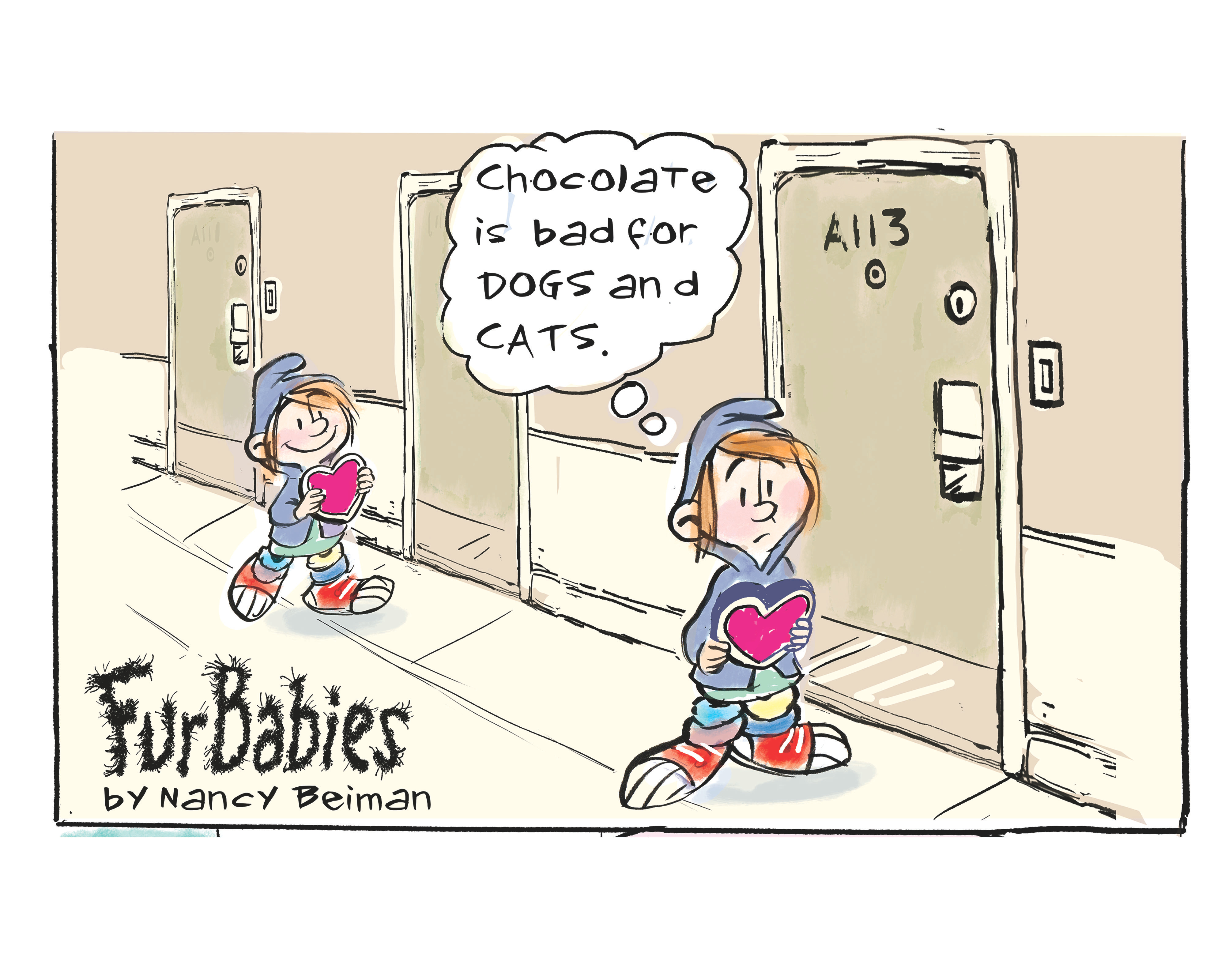
The number A113 appears in [yesterday]’s FurBabies strip. It’s the number of our classroom at Cal Arts. Click on the link to see the entire comic.
https://www.gocomics.com/furbabies/2025/02/16
NPR interviewed me for an hour in 2014 after a Vanity Fair article appeared about the program. Here it is.
Leslie Margolin, the other girl in the first class, was not interviewed. A group photo was taken of other graduates for Vanity Fair. I am not in it. Tim Burton was Photoshopped in, but no one would do that for me even though I offered to go to New York for the photo shoot.
The so called Cal Arts Mafia only worked for the male students.
Thanks for reading FurBabies (formerly Animation Anarchy)! Subscribe for free to receive new posts and support my work.
A Brain Cleanser from Lit Hub
Snippets from my this week’s newsletter, with links.
| Edgar Allan Poe’s “The Raven” is published in The Evening Mirror. |
| In January 1845, the greatest goth in literary history published what would swiftly become his most famous poem: “The Raven.” Poe first sold the poem (for $9, the equivalent of about $375 today) to the American Review, where it would appear—under the pen name “Quarles”—in the February 1845 issue. It was published concurrently in the January 29 edition of The Evening Mirror, prefaced by a note from editor Nathaniel Parker Willis, who called it “the most effective single example of ‘fugitive poetry’ ever published in this country, and unsurpassed in English poetry for subtle conception, masterly ingenuity of versification, and consistent sustaining of imaginative lift and ‘pokerishness.’” Well, sure. “The Raven,” if for some reason you don’t know it, is a narrative poem about a young scholar who, sitting alone on a bleak December night, mourning his lost love Lenore, is visited by a raven, who torments him by speaking, over and over again, a single word. Poe later wrote that he knew he wanted this word—“nevermore”—to be repeated throughout the poem, but finding the idea of a person uttering it too implausible, he struck upon “the idea of a non-reasoning creature capable of speech; and, very naturally, a parrot, in the first instance, suggested itself, but was superseded forthwith by a Raven, as equally capable of speech, and infinitely more in keeping with the intended tone.” Well, it worked pretty well, you might say. The poem, writes Poe biographer Arthur Hobson Quinn, “made an impression probably not surpassed by that of any single piece of American poetry. It was widely copied, parodied, and one humorist even took over a page of the Mirror to suggest five alternatives as to the relation of Lenore to the poet.” One-hundred-eighty years later, it may be still unsurpassed, though contenders abound. Either way, as you have probably noticed, the parodies and tributes have never stopped. We shall be quoting it forevermore. |
MORE WHERE THAT CAME FROM
In Search of the Rarest Book in American Literature: Edgar Allan Poe’s Tamerlane

A Brief and Incomplete Survey of Edgar Allan Poes in Pop Culture
The Greatest Goths in Literary History

| YEP, STILL SLAPS Once upon a midnight dreary, while I pondered, weak and weary, Over many a quaint and curious volume of forgotten lore— While I nodded, nearly napping, suddenly there came a tapping, As of some one gently rapping, rapping at my chamber door. “’Tis some visitor,” I muttered, “tapping at my chamber door— Only this and nothing more.” –EDGAR ALLAN POE, “THE RAVEN” |
| In other (old)news this week Benjamin Franklin writes a letter to his daughter, pooh-poohing the bald eagle as the symbol of America, and instead championing the great and noble turkey (January 26, 1784) • John Millington Synge’s play The Playboy of the Western World premieres at The Abbey Theatre in Dublin and causes a riot (January 26, 1907) • The first part of Henry James’s novella The Turn of the Screw is published in Collier’s Weekly magazine (January 27, 1898) • Franz Kafka begins work on his novel The Castle at the mountain resort of Spindermühle (January 27, 1922) • Jane Austen’s Pride and Prejudice is published anonymously in London (January 28, 1813) • Thomas Jefferson sells his library to the government after the Library of Congress burns down (January 30, 1815) • Anton Chekhov’s The Three Sisters premieres at the Moscow Art Theater (January 31, 1901) • The first edition of the Oxford English Dictionary is published (February 1, 1884) • Great American Iconoclast Ken Kesey’s One Flew Over the Cuckoo’s Nest is published (February 1, 1962) • David Foster Wallace’s eerily prescient Infinite Jest is published (February 1, 1996). (snip-More) |
I hope you enjoyed it! These newsletters are free, and are great for brain/heart health breaks.
Useful Info for We Who Care
DEI in the Age of Trump: A Roadmap on How to Build More Just Communities in the Next Four Years
PUBLISHED 1/18/2025 by Nilanjana Dasgupta
With Trump’s second presidential administration looming before us, Americans who care deeply about equality and social justice are asking ourselves: What now? How do we move forward in this dramatically changed political and legislative climate? What actions will have a fighting chance of getting traction? What is the most effective sphere of influence for individuals?
A high priority of Trump’s agenda for his second presidential term is to eliminate diversity equity and inclusion (DEI) programs in federal agencies and to also take away federal funding from agencies, contractors and organizations that have DEI programs. This, together with the repeal of affirmative action in college admissions by the U.S Supreme Court, makes many initiatives related to diversity and civil rights a target for the second Trump administration.
The truth is some diversity, equity and inclusion programs, like training, haven’t worked. Research shows that while DEI trainings increase attendees’ awareness and knowledge about bias, there’s little evidence of changes in attendees’ behavior, nor increased diversity in the types of people hired, promoted, retained or more inclusive climate in the organizations where such training is implemented. Sometimes DEI training backfires, creating resentment and resistance when people feel coerced.


In my new book, Change the Wallpaper: Transforming Cultural Patterns to Build More Just Communities, I explain why.
DEI training tries to change individuals’ beliefs, hoping it will change their future behavior. But individuals’ beliefs often don’t shift behavior because human behavior is buffeted by multiple situational forces. These include the social roles individuals occupy and their accompanying behavioral etiquette, what others around them are saying or doing, and norms and rules that constrain their actions, all of which guide people’s behavior no matter what their personal beliefs.
Another situational force is the physical design of places where people live and work, which influences whether casual interactions with others of diverse backgrounds are easy or not. Such interactions, when pleasant and repeated, morph into familiarity and friendliness that are an essential building block for trust.
Like wallpaper, these situational forces are in the background, barely noticed. Yet they subtly nudge people’s thoughts and actions in small ways, accumulating over time in one of two directions. They either pull us apart based on initial differences, increasing unfamiliarity, mistrust and polarization, or they push us together, increasing familiarity, trust and inclusion.
We need to notice the wallpaper that silently pulls and pushes our own behavior. To do that, we must step out of our bubble and mix with people different from ourselves.
Even if individuals’ behavior were to be changed by DEI training, they would be quickly overwhelmed by the wallpaper when they returned to their workplace, stepped into their old roles, surrounded by unchanged norms, rules and colleagues, and in buildings with limited physical arrangements for cross-group mixing and relationship building.
Here is an alternative roadmap to social justice backed by scientific research simplified in the form of five steps.
First, we need to notice the wallpaper that silently pulls and pushes our own behavior. To do that, we must step out of our bubble and mix with people different from ourselves. Have real conversations, be curious and learn about the material conditions of others’ lives that may not be visible from the outside. Repeated interactions start a virtuous cycle of growing familiarity, understanding, trust, cross-group relationships and a sense of belonging in a shared community. These interactions reveal stories about people’s material conditions, highlighting inequality or vulnerability in a personal way, and grow solidarity and momentum for change.
Know that inequalities often hide in the “3 Rs” where we live and work: rules, resources and recognition. Do the rules in the place where you live or organization where you work exclude some people’s voices from decision-making, especially people with less power? Are there transparent and reasonable processes to change these rules? Are resources distributed to individuals based on need, merit, effort, seniority, or a combination? Are the criteria and processes for resource distribution open and transparent? Are people recognized for their contribution fairly?
If you see inequalities in the 3 Rs where you live or work, don’t be silent. Talk to others, see what they think, and explore ways to act collectively for change.
Second, actions make more of a difference if they attempt to change the material conditions of people’s lives—access to high quality education, healthcare, housing and employment—than if they are mostly symbolic—mission statements, lawn signs or imagery of diverse people on websites and marketing materials.
Third, acting collectively with other people will get more traction rather than acting alone because individuals quickly get swept away by situational forces. In acting together, the goal is not to limit ourselves to gather with people who are all the same. Rather, when we are not afraid to mix with people different from ourselves, we are able to discover and develop new allies across the spectrum instead of being caught in old identity traps that haven’t served us well.
Because the wallpaper is old and sticky, collective action is needed over and over again in different ways. It’s not one and done. That’s the fourth step.
Finally, actions get more traction if they are local. That’s the Goldilocks space. That’s our call for action in the next four years and the hope for change.
==============================================================
Ms. Classroom wants to hear from educators and students being impacted by legislation attacking public education, higher education, gender, race and sexuality studies, activism and social justice in education, and diversity, equity and inclusion programs for our series, ‘Banned! Voices from the Classroom.’ Submit pitches and/or op-eds and reflections (between 500-800 words) to Ms. contributing editor Aviva Dove-Viebahn at adove-viebahn@msmagazine.com. Posts will be accepted on a rolling basis.

