In The Republican War On Libraries

This came in email a few days ago. The email has a few stories in it that are pertinent to our interests. This was going to be a snippet post of those, but as I read this, I realized everyone needs to read it all, because there’s not much opinionating in it, but/and the actual information does not stop.


The Institute for Museum and Library Services Was Just Gutted

Kelly Jensen Mar 31, 2025

Today, members of the Department of Government Efficiency (DOGE) gutted the Institute for Museum and Library Services (IMLS). As of this afternoon, all staff members have been placed on administrative leave. They received a letter from the Director of Human Resources that the leave would be paid for 90 days and that no one will be allowed on IMLS property during that time.
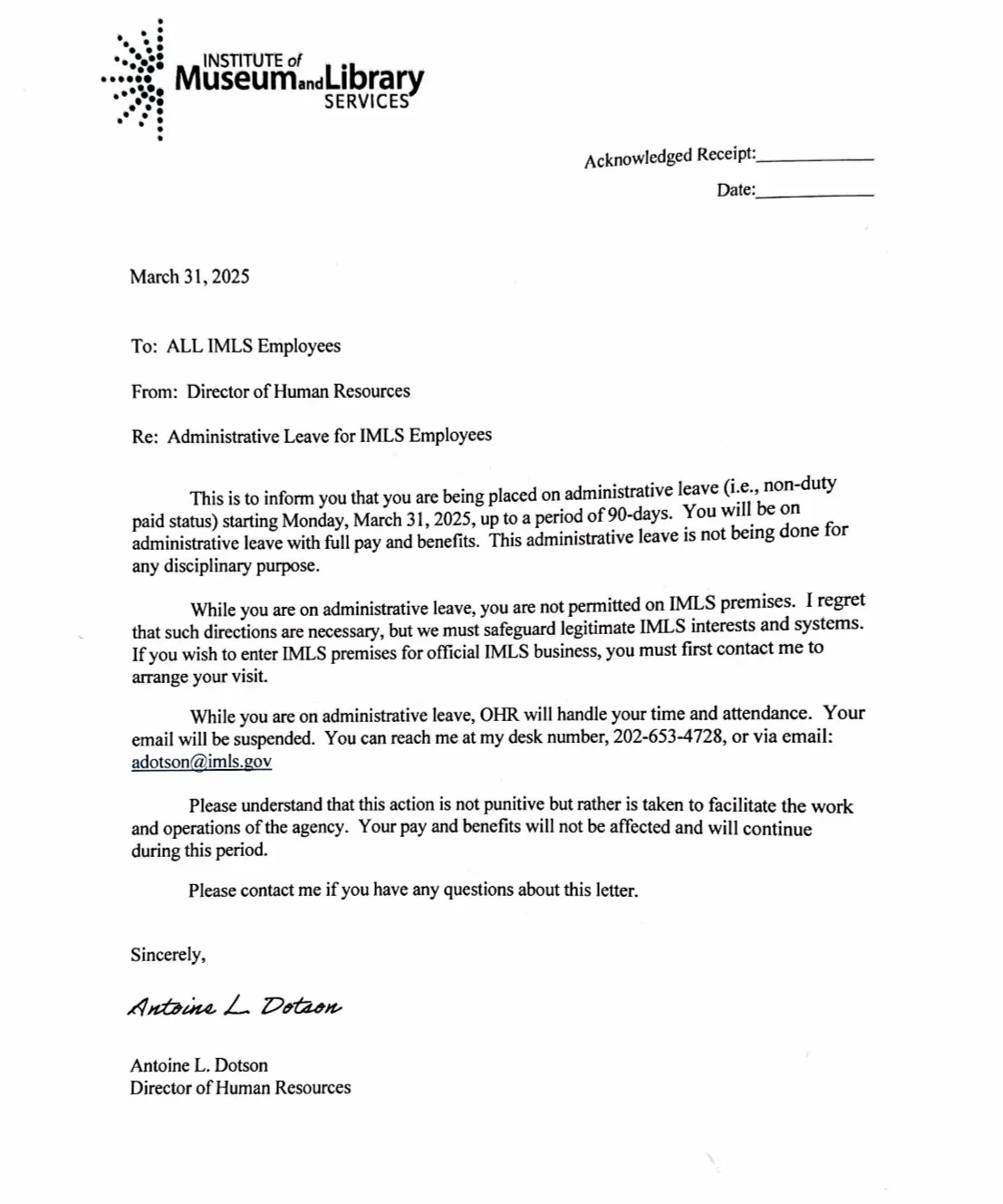
Image of the letter all IMLS staff received about administrative leave.

The union representing IMLS staff, AFGE Local 3403, indicated that the decision to fire staff came after a short meeting between DOGE and IMLS leadership. Everyone working at IMLS was required to return government property before exiting the workplace.

Email addresses for all IMLS staff were being disabled today. Those with questions or concerns over IMLS funding will no longer be able to reach the individual or individuals with whom they’d been working.
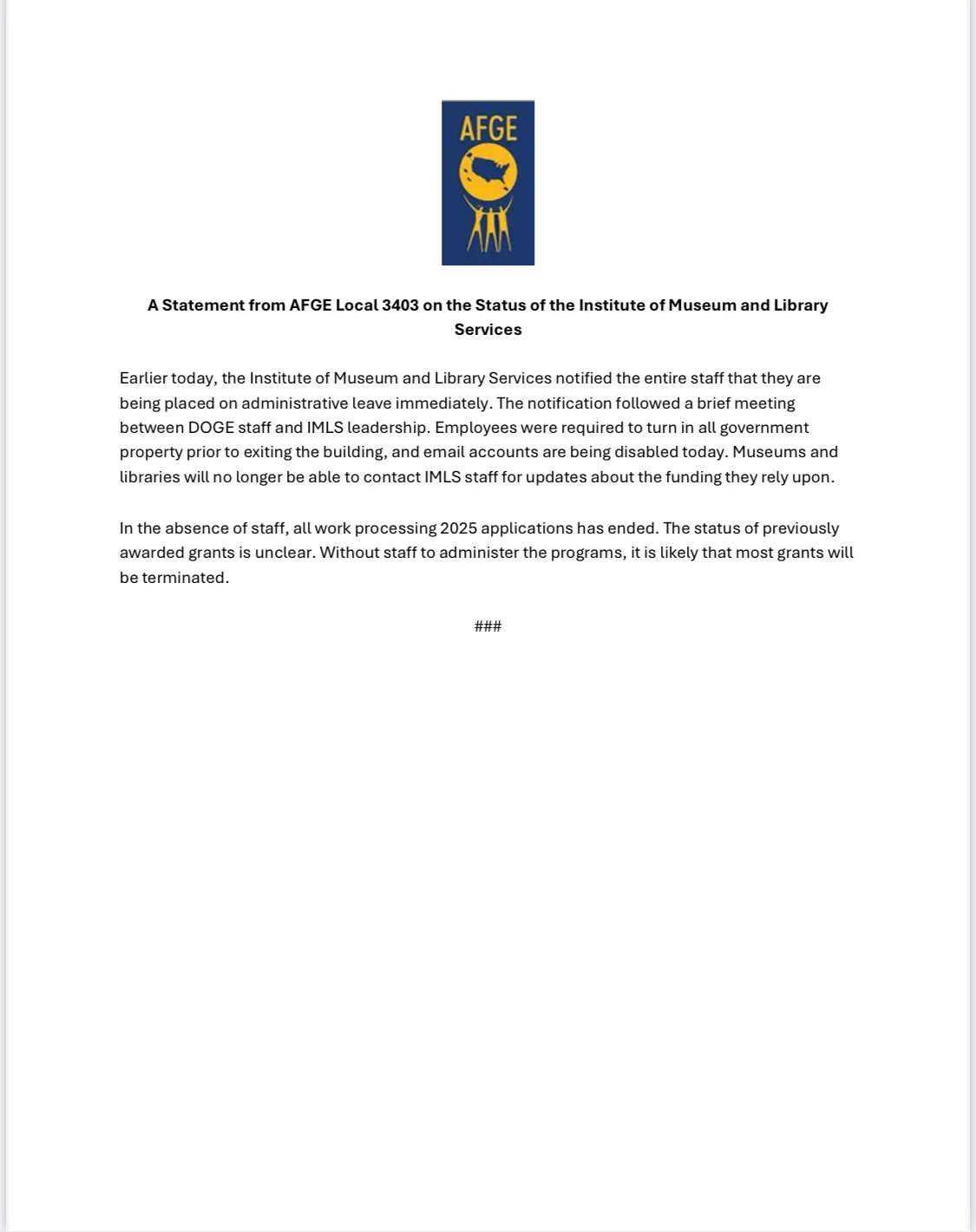
Letter from AFGE Local 3403 stating that IMLS staff were no longer in the building and their emails were being shut down.

Further, all processing work on 2025 funding applications is over and there is no information about the status of awards that have already been granted for the year. The union believes most grants will simply be terminated.

IMLS makes up .0046% of the federal budget.

Two weeks ago, President Trump issued an Executive Order targeting funds allocated to libraries and museums nationwide. The Institute of Museum and Library Services (IMLS) is a federal agency that distributes fund approved by Congress to state libraries, as well as library, museum, and archival grant programs. IMLS is the only federal agency that provides funds to libraries. The Executive Order states that the functions of the IMLS have to be reduced to “statutory functions” and that in places that are not statutory, expenses must be cut as much as possible.

One week later, the Department of Government Efficiency (DOGE) entered the IMLS offices. Many at IMLS were prepared to see their jobs disappear, but that didn’t quite happen. Instead, DOGE installed a new Acting Director of the agency, Deputy Secretary of Labor Keith E. Sonderling.

It wasn’t just a new Acting Director, though. The IMLS took on a new direction thanks to the Executive Order and DOGE. It would now operate “in lockstep with this Administration to enhance efficiency and foster innovation. We will revitalize IMLS and restore focus on patriotism, ensuring we preserve our country’s core values, promote American exceptionalism and cultivate love of country in future generations.”

The new goal of the administration with the IMLS is for it to function as a propaganda machine. This wouldn’t be the first nor the last federal cultural institution to see its mission shift from serving the needs and interests of all of America. On March 28, the administration would issue another Executive Order, this time demanding that the Smithsonian, the National Museum of African American History and Culture, and other federal museums stop the “revisionist movement” through displays and installations that showcase American history and culture as “racist, sexist, oppressive, or otherwise irredeemably flawed.”

Such institutions are now to engage in “igniting the imagination of young minds, honoring the richness of American history and innovation, and instilling pride in the hearts of all Americans.” The Executive Order specifically notes that the Independence National History Park see time and energy poured into these pro-patriotic efforts in order to be prepared for the 250th American anniversary events in 2026.

The defunding and gutting of the IMLS did not happen without strong support shown for public library and museum resources across the country, both on the ground and in congress.

On March 24, the board of the Institution of Museum and Library Services drafted a letter that went to Sonderling as their new Acting Director. The letter outlines the essential functions of the agency, making it clear that any cuts to the IMLS would have a direct and long-lasting impact on public museums and libraries nationwide. It emphasized that an Executive Order alone is not enough to change the functions or services provided by the IMLS.

From the letter:

All such statutory obligations may not be discontinued or delayed under an Executive Order or other executive action. Sections 9133 and 9176 of the Act affirm IMLS’s duty to obligate and disburse funds to grantees, subject only to the availability of appropriations, not to executive discretion. Any failure to fulfill these legal obligations or to reduce staffing or program operations below the minimum required to meet statutory mandates would place the agency in noncompliance with Congressional intent.

Several members of Congress also pushed back against the Executive Order. On March 26, a bipartisan coalition consisting of Senators Jack Reed, Kirsten Gillibrand, Susan Collins, and Lisa Murkowski sent a letter to Sonderling as well. The letter again defines the role of the IMLS and its obligation when it comes to funding institutions across the US.

From their letter:

Libraries and museums play a vital role in our communities. Libraries offer access for all to essential information and engagement on a wide range of topics, including skills and career training, broadband, and computing services. IMLS grants enable libraries to develop services in every community throughout the nation, including people of diverse geographic, cultural, and socioeconomic backgrounds, individuals with disabilities, residents of rural and urban areas, Native Americans, military families, veterans, and caregivers. Museums serve not only as centers for education but also as drivers of local economic development. The IMLS Office of Museum Services is the largest dedicated source of investment in our nation’s museums, which typically support more than 700,000 jobs and contribute $50 billion annually to the U.S. economy. IMLS funding plays a significant role in this economic impact by helping museums reach more visitors and spur community development.

While that letter circulated, another was passed around the House of Representatives. Led by Representatives Dina Titus (NV-01) and Suzanne Bonamici (OR-01), the letter was shared among House members. It urged them to sign on in asking for the administration to reconsider its Executive Order related to IMLS funding and structure.

Public libraries and public library associations nationwide have spoken loudly about how potential cuts to IMLS could impact state and local level services. Among the services that could most quickly and directly impact library users would be the end of digital resource availability through apps like Libby.

It is worth noting that despite some viral claims made online in the wake over fears of IMLS funding cuts, OverDrive’s Libby app and other similar digital resource programs are not funded by IMLS directly. They are, however, sometimes made available in individual states via funding received via IMLS. This is a crucial distinction. Libby and other eresources are not creations of libraries themselves by third-party systems that license access to materials. Libraries pay for that access.

Ebook and digital audiobook services are not funded by IMLS money in every state, and because of how many different types of ebook and digital audiobooks are available–indicative of how many different audiences and needs are being met–essential services without the Libby name recognition are being overlooked. In states where such services are made available through IMLS money, many times the apps and resources are not explicitly named by state funding, making it difficult to determine where such impact would be felt immediately. For example, Indiana libraries use IMLS funding for the Indiana Digital Library, which among its many databases and services provides access to Libby.

Find below a roundup of state library associations, local-level libraries, social media library workers/advocates, and/or local/regional news sources who have identified where and how IMLS cuts would directly impact their state libraries. This isn’t a comprehensive list, but you’ll see within the states here, many rely on IMLS funds to help acquire, fund, and maintain essential digital resources:

The future of IMLS remains uncertain, and with ongoing efforts to rewrite the truth of America via Executive Orders and whitewashing cultural institutions funded and respected by American taxpayers, it’s essential to continue speaking up on behalf of your local library, as well as one of your local library’s most crucial federal agencies.

Those which stand to be most devastated by potential cuts are rural and small libraries, who are also most impacted by the administration’s dismantling of the Department of Education and the United States Postal Service.

Whether or not Trump and his DOGE team have the legal authority to shut down the IMLS completely remains to be seen. Eliminating all staff and pausing all funding certainly defies the administration’s own order that only activities outside of “statutory requirements” be touched. Expect a lawsuit to be filed in the courts, much as we’ve seen with the other slash-and-burn efforts taken by an executive branch overstepping its constitutional authority.

Peace & Justice History for 4/18

April 18, 1912
Members of the United Mine Workers of America on Paint Creek in Kanawha County, West Virginia, demanded wages equal to those of other area mines. The operators rejected the wage increase and miners walked off the job. Miners along nearby Cabin Creek, having previously lost their union, joined the Paint Creek strikers and demanded:
• the right to organize
• recognition of their constitutional rights to free speech and assembly
• an end to blacklisting union organizers
• alternatives to company stores
• an end to the practice of using mine guards
• prohibition of cribbing
• installation of scales at all mines for accurately weighing coal
• unions be allowed to hire their own checkweighmen to make sure the companies’ checkweighmen were not cheating the miners.When the strike began, operators brought in mine guards from the Baldwin-Felts Detective Agency to evict miners and their families from company houses. The evicted miners set up tent colonies and lived in other makeshift housing. The mine guards’ primary responsibility was to break the strike by making the lives of the miners as uncomfortable as possible.


Striking miners and their families being evicted from company houses.
Deep background on the W. Virginia coal business and the strike 
April 18, 1941

Reverend Adam Clayton Powell, Jr.
Bus companies in New York City agreed to hire 200 black drivers and mechanics after a four-week boycott by riders led by Reverend Adam Clayton Powell, Jr. of Harlem’s Abysinnian Baptist Church, the largest Protestant congregation in the U.S. Powell ran and won a City Council seat later that year and became a member of Congress four years later.
A Bus Boycott Before Its Time 
April 18, 1955

Sukarno hosts Bandung conference
A conference bringing together government representatives from 29 Asian and African countries began in Bandung, Indonesia. The intention was to promote economic and cultural cooperation, and to oppose Western colonialism, then still prevalent on both continents. At the same time, many countries were worried about communism and the power of the Soviet Union.
The principal actors were Sukarno of Indonesia, one of the countries that organized the meeting; Jawahrlal Nehru, prime minister of recently independent India; Kwame Nkrumah, prime minister of the Gold Coast (now Ghana); Gamal Abdel Nasser, president of Egypt; Chou En Lai, premier of China; and Ho Chi Minh, prime minister of Vietnam.

Chou En-Lai and Jawaharlal Nehru at the Bandung Conference
Many concepts of international cooperation and mutual interest were discussed at the week-long conference, including Pan-Islam, Pan-Arabism, Pan-Asianism, and Pan-Africanism. The meeting was a precursor to what became known as the Non-Aligned Movement (aligned neither with Washington nor Moscow).
Bandung Conference background info 
April 18, 1958
The first march against nuclear arms in West Germany took place.
April 18, 1960

Tens of thousands of people marked the end of the Aldermaston “ban the bomb” march at a rally with at least 60,000 gathering in Trafalgar Square, the largest demonstration London had seen to date.
Read more 
April 18, 1989
Thousands of Chinese students from several universities took to the streets to protest government policies and issue a call for greater democracy in the communist People’s Republic of China (PRC). Mourning over the death of Hu Yaobang began on the 15th in Tiananmen Square. As Secretary General of the Chinese Communist Party, he had called for rapid reform in the PRC, but had been pushed out of office over the Democracy Wall protests. Students in the Square demanded response from government officials, and began a sit-in and other activities that persisted for weeks.
Timeline of the Beijing democracy protests 

https://www.peacebuttons.info/E-News/peacehistoryapril.htm#april18

A Timely Resource from Janet

Peace & Justice History for 4/17

April 17, 1959
22 were arrested in New York City for refusing to take shelter during a civil defense drill.
April 17, 1960
Inspired by the Greensboro sit-in of four black college students at an all-white lunch counter, nearly 150 black students from nine states formed the Student Nonviolent Coordinating Committee (SNCC). Meeting in Raleigh, North Carolina, with Ella Baker, James Lawson and Martin Luther King, Jr., the founders set SNCC’s initial goals as overturning segregation in the South.

They also considered it important to give young blacks a stronger voice in the civil rights movement, as many had participated in sit-ins that had proliferated to dozens of cities over the previous three months.
At the Raleigh conference Guy Carawan sang a new version of “We Shall Overcome,” an adaptation of an old labor song. This song would become the national anthem of the civil rights movement.

People joined hands and gently swayed in time singing “black and white together,” repeating over and over, “Deep in my heart, I do believe, we shall overcome some day.
History of SNCC  (It’s a Stanford.edu page, which “cannot be reached.” Take from that what you will. I’ve decided to note these things when they happen.)
What SNCC did to make change happen (This page is good.)
April 17, 1961

Cuban leader Fidel Castro during the Bay of Pigs invasion.
An army of 1500 anti-Castro Cuban exiles, mercenaries equipped and trained at a secret Guatemala base by the CIA, landed at Bahia de Cochinos (Bay of Pigs) in an attempt to “liberate” Cuba from Communist rule. Within three days, the invasion proved disastrous with nearly 1200 members of Brigade 2506 (who had been trained in the U.S.) taken prisoner. 
Known as Operation Zapata, it was conceived by Vice President Nixon, planned and approved by the Eisenhower administration, and executed shortly after President John Kennedy’s inauguration.

President Kennedy receives the Brigade 2506 flag in Miami in 1962 and declares: “I promise to return this flag in a free Havana.”

Soviet General Secretary Nikita Kruschev sent a telegram to President Kennedy:
“Mr. President, I send you this message in an hour of alarm, fraught with danger for the peace of the whole world. Armed aggression has begun against Cuba. It is a secret to no one that the armed bands invading this country were trained, equipped and armed in the United States of America. The planes which are bombing Cuban cities belong to the United States of America, the bombs they are dropping are being supplied by the American Government . . . .”
What actually happened 
April 17, 1965

The first national demonstration against the Vietnam War took place in the nation’s capital. Students for a Democratic Society (SDS), the organizers, had expected about 2000 marchers; the actual count was 15,000–25,000. This was the largest anti-war protest ever to have been held in Washington, D.C. up to that time. The number of marchers approximately equaled the number of U.S. soldiers in Vietnam. Several hundred students in the protest broke away from the main march and conducted a brief sit-in at the U.S. Capitol’s door.
An exam prepared by SDS about the Vietnam War (answers available) 
April 17, 1965

Gay rights advocate Jack Nichols
The first demonstration promoting equal treatment of homosexuals, Jack Nichols, Barbara Gittings and others picketed in front of the White House.
There were no media present..

Read more
April 17, 1986
Reverend Jesse Jackson, future congresswoman Maxine Waters and others co-founded the Rainbow Coalition, initially intended as a progressive public-policy think tank within the Democratic Party.

Representative Maxine Waters, Harry Belafonte, John Sweeney, President of the AFL-CIO, Reverend Jesse Jackson, and Willie Nelson August 6, 2005-Atlanta, Georgia.
Brief history of Rainbow Push Coalition
April 17, 1992
On Good Friday morning, about 50 people accompanied Fr. Carl Kabat and Carol Carson to Missile Silo Site N5 at Whiteman Air Force Base in Missouri, the same silo that Carl and other members of the Silo Pruning Hooks (see below) disarmed in 1984. They cut through a fence and, once inside, Carol used a sledgehammer on the concrete lid of the silo while Carl performed a rite of exorcism.
Eventually, the police arrived and arrested Carl and Carol. They were jailed and held until their court appearance. At that time, they made a preliminary agreement with federal prosecutors wherein they would plead “no contest” to trespass in exchange for the property destruction charge being dropped; they were sentenced to six and three months, respectively, in a halfway house.


Carl Kabat
A History of Direct Disarmament Actions 
About the Silo Pruning Hooks action 

https://www.peacebuttons.info/E-News/peacehistoryapril.htm#april17

Interesting That It’s Tech Magazines That Are Covering News We Can Use

Trump Admin Has a New Target: People Who Aggressively Believe in Nothing

The fight against extremism marches on.

By Lucas Ropek Published April 16, 2025 

Over the past decade, there’s been a lot of talk about “ideological extremism” on both the left and right, and the government has often claimed that warped political beliefs are encouraging Americans to commit violent acts. However, under the new Trump administration, the government now seems prepared to go after people who don’t believe in anything at all.

Independent journalist Ken Klippenstein writes that the government has a new target in its war on extremism: nihilists—more specifically, Nihilist Violent Extremists, or NVEs. The government has reportedly come up with this designation as a kind of catchall for the culprits behind various violent incidents, and the term has shown up in several recent court cases.

Who is a true NVE? That’s a good question, and the answer is: anybody. Klippenstein aptly notes that the term has a conveniently loose definition that could be applied to all sorts of different groups that the government considers undesirable. He writes that the NVE term…

…has the beauty of being elastic enough to apply to individuals and groups who are the focus of the administration’s war on all kinds of Americans. Nihilism also avoids all of the rusty and problematic words of the past: subversive, dissident, insurrectionist, revolutionary, or even “anti-government” (the Biden term).

Klippenstein writes that the term was recently used in the legal proceedings of Nikita Casap, a teen from Wisconsin who was arrested in February and charged with murdering his parents. Law enforcement claims Casap also planned to assassinate President Trump to spur a civil war in the U.S. But there are plenty of people who have been accused of committing violent crimes for vaguely anarchistic reasons, be it people like Luigi Mangione, or the gaggle of people of who have recently been arrested for vandalizing and firebombing Teslas, or the Zizians.

The road to this new low in law enforcement terminology has been long. While “ideological extremism” has always existed in the U.S., it became a political (and, eventually, policy) issue in the modern era during the Clinton years, when incidents like Ruby Ridge and the Oklahoma City bombing brought fears of the rightwing militia movement into the mainstream. During the Bush years, 9/11 spurred a war on Islamist extremism—both in the U.S. and all over the world. Then, during the Biden years, the specter of January 6th encouraged the government to declare a war on “domestic terrorism.”

In short, the government has always found reasons to justify its federal police powers, though few of them have ever been as sloppily constructed as the current government’s newest fearmongering buzzword. (snip)

Peace & Justice History for 4/16

April, 16, 1971
The Internal Revenue Service (IRS) estimated over 2,000 people openly refused to pay part or all of their income tax.
“If a thousand [people] were not to pay their tax bills this year, that would not be a violent and bloody measure, as it would be to pay them and enable the state to commit violence and shed innocent blood.”
Henry David Thoreau on the Mexican War


National War Tax Resistance Coordinating Committee 
April 16, 2000
Between 10,000 and 20,000 activists blockaded meetings of the
World Bank and International Monetary Fund in Washington, D.C. Sitting down at intersections and locking arms to form human chains, the protesters were opposed to Bank and IMF policies that increased third-world indebtedness and did little to directly benefit the poor in those countries.
“The World Bank is subjugating our economic and social independence,” Vineeta Gupta, a doctor from the Punjab in India, said in a letter he delivered to World Bank President James Wolfensohn at his home. “It is time that we shut the bank down, and this boycott is a great start.”

https://www.peacebuttons.info/E-News/peacehistoryapril.htm#april16

Jackie Robinson, and More, in Peace & Justice History for 4/15

April 15, 1947
Jackie Roosevelt Robinson became the first African American to play in a major league baseball game in the 20th century. His stepping onto Ebbets Field in a Brooklyn Dodgers uniform broke the “color line,” the segregation of professional teams.
The International League in 1887 began a wave of League-wide black exclusion, and it had been complete since 1899, when Bill Galloway became the last African-American player in white organized ball (Woodstock, Ontario).
Though hitless in three at-bats, Robinson started at first base, and the Dodgers beat the Boston Braves that day, 5-3.


“Jackie, we’ve got no army. There’s virtually nobody on our side. No owners, no umpires, very few newspapermen. And I’m afraid that many fans will be hostile. We’ll be in a tough position. We can win only if we can convince the world that I’m doing this because you’re a great ballplayer, a fine gentleman.”

“There was never a man in the game who could put mind and muscle together quicker and with better judgment than (Jackie) Robinson.”
-Branch Rickey
Jackie Robinson and his work on civil rights from the National Archives
(with teaching activities and worksheets)
(I was concerned this wouldn’t be there, but then recalled they said they put him back. It’s there. -A)
April 15, 1967

King and Dr. Benjamin Spock lead an anti-war march to the United Nations, 15 April 1967
Amidst growing opposition to the war in Vietnam, large-scale anti-war protests were held in New York, San Francisco and other cities. In New York, the protest began in Central Park, where over 150 draft cards were burned, and concluded at the United Nations with speeches by Rev. Martin Luther King, Jr. and others.
King’s opposition to the war, excerpts of his speeches and reaction throughout the country 

https://www.peacebuttons.info/E-News/peacehistoryapril.htm#april15

From Stonewall to now: LGBTQ+ elders on navigating fear in dark times

(I saved this to post, then it got buried in email, but it came up again today. -A)

Mar 17, 2025 Orion Rummler

This story was originally reported by Orion Rummler of The 19th. Meet Orion and read more of his reporting on gender, politics and policy.

Karla Jay remembers joining the second night of street protests during the 1969 Stonewall uprising in New York City. For her, and for so many other LGBTQ+ people, something had shifted: People were angry. They didn’t want things to go back to normal — because normal meant police raids. Normal meant living underground. It meant hiding who they were at their jobs and from their families. They wanted a radical change.  

Radical change meant organizing. Jay joined a meeting with the Gay Liberation Front, which would become the incubator for the modern LGBTQ+ political movement and proliferate in chapters across the country. At those meetings, she remembers discussing what freedom could look like. Holding hands with a lover while walking down the street, without fear of getting beaten up, one person said. Another said they’d like to get married. At the time, those dreams seemed impossible. 

Jay, now 78, is worried that history will repeat itself. She’s worried that LGBTQ+ people will be put in the dark again by the draconian policies of a second Trump administration. 

“Are things worse than they were before Stonewall? Not yet,” she said. “It’s certainly possible that people will have to go back to underground lives, that trans people will have to flee to Canada, but it’s not worse yet.” 

The 19th spoke with severalLGBTQ+ elders, including Jay, about what survival looks like under a hostile political regime and what advice they would give to young LGBTQ+ people right now. 

Many states protect LGBTQ+ people through nondiscrimination laws that ensure fair access to housing, public accommodations and employment. Supreme Court precedent does the same through Bostock v. Clayton County. Other states have passed shield laws to protect access to gender-affirming care for trans people.But to Jay, a cisgender lesbian, it all still feels precarious. The Trump administration is trying to make it harder for transgender Americans to live openly and safely, and lawmakers in more than a handful of states want to undermine marriage equality. 

“We have forgotten that the laws are written to protect property and not to protect people. They’re written to protect White men and their property, and historically, women and children were their property,” she said. “To expect justice from people who write laws to protect themselves has been a fundamental error of the lesbian, gay, bisexual, trans community.” 

To fight back, LGBTQ+ Americans need to organize, Jay said. That starts with thinking locally — supporting local artists, independent stores and small presses, as well as LGBTQ+ organizations taking demonstrable political action and protecting queer culture. 

“See what you can do without going crazy. If you can focus on one thing and you can spend one hour a week, or you can spend one day a week, that’s much better than being depressed and doing nothing,” she said. “Because the person you’re going to help is yourself. This is the time for all of us to step up.” 

Renee Imperato (far right) poses with other demonstrators during a protest outside the Stonewall Inn.
Renee Imperato (far right) poses with other demonstrators during a protest outside the Stonewall Inn, after the word transgender was erased from the National Park Service’s webpage, in New York, on February 14, 2025. (Courtesy of Renee Imperato)

Renata Ramos feels obligated to share her experiences with young people.As a 63-year-old trans Latina,she wants young people to know that so many of their elders have already been through hard times — which means that they can make it, too, including during this moment. 

“I’m not scared in the least. Because we have fought so many battles — the elders. We have fought so many battles, with medicine, with HIV, with marching on Washington, with watching our friends die,” she said. “It’s been one war after another in our community that we have always won. We have always been resilient. We have always stood strong. We have always fought for our truth, and we’re still here. They haven’t been able to erase us.” 

As Ramos watches the Trump administration use the power of the federal government to target transgender Americans and erase LGBTQ+ history, she’s not afraid for herself. She’s afraid for young LGBTQ+ people, especially young trans people who now find themselves at the center of a growing political and cultural war. If someone transitioned six months ago, she said, they now have a target on their back — and little to no experience with what that feels like. 

“They don’t know what it is like to be a soldier going into war, as far as social issues. So I fear for them,” she said. “Who wouldn’t be scared?” 

Criss Christoff Smith has seen firsthand what that fear can look like. On January 28, at 3 a.m., he received a phone call from an LGBTQ+ person who was considering taking their own life. This was a stranger —someone who admired from afar Smith’s advocacy as a Black trans man and Jamaican immigrant. This was someone who had been considering a gender transition for years, Smith said, who was now feeling broken. He spoke with them for two hours. 

“It’s been quite dark,” Smith said. The onslaught of policies targeting marginalized people and the turbocharged news cycle are working to keep Black and trans people in a constant state of fear and uncertainty, he said.  

“I tell everyone in my community, you have to stop responding to those alerts and just try to go inward,” he said. “Find a space of peace and spirituality.”

To Smith, who is 64, looking inward can mean reflecting on what’s still here. Although the Trump administration is going to make daily life harder for LGBTQ+ people, he said, laws can’t be undone with the stroke of a pen on an executive order. LGBTQ+ Americans need to find whatever source of strength and peace they can find right now — and try to remove themselves from the daily fray as much as possible — while still finding ways to take action.  

“This is the time when we really have to find community, where we really have to hone in on our spiritual feelings and try to talk to someone. Don’t keep it to yourself,” he said. Joining protests or lobbying days at state capitols are great ways to find community in-person, Smith said — to be around like-minded people and to not feel so alone. 

“That’s the best space to be in, not home alone and in your feelings and in your mind, because we can get lost there thinking negatively. So we have to stay positive and stay with like-minded people, and have those people constantly around you to reassure you and just hold you tight in that space,” he said. 

Protests against the administration’s hostile LGBTQ+ policies have been ongoing — including outside the Stonewall National Monument. In at least one way, history is already repeating itself. 

The National Park Service deleted all references to transgender and queer people from its web page honoring the 1969 Stonewall uprising — the most well-known moment from LGBTQ+ history in the country — leaving references to only lesbian, gay and bisexual people.  Hundreds gathered in New York City to protest. Among them was Renee Imperato, a 76-year-old trans woman and New York native. 

“Protests like this are our survival,” she told The 19th over email. “The rhetoric of this administration is driving a violent onslaught against our community. The Stonewall Rebellion is not over. We are at war, and we are still fighting back. What other choice do we have?”

Jay, herself an old hand at joining protests and demonstrations, said that she’s been afraid before every one of them. She’s lost sleep the night before and feared for her safety — but she did it anyway. 

“I’m afraid I’ll be beaten. I’m afraid I’ll be arrested. But if you don’t do something even though you’re afraid, they win,” she said.

Today 4 13 2025

Earth News

Would Some Climate Nice Time Recharge Your Batteries? Here You Go! by Rebecca Schoenkopf

40 percent of the world’s electricity now comes from clean power. That’s big! Read on Substack

Photo of three floors of a midsized apartment building. Each floor's corner apartment has a large balcony with plants, very cozy looking. The balcony in the center has solar panels discreetly mounted on it, behind the mesh of its railing.
See that slightly darker middle balcony? Those are solar panels. Way to go, Germany! Video screenshot, EuroNews on YouTube.

With all the terribleness going on, we need to make those in power know that their attempts to bring fascism to America will not stand, man. But we also need to remind ourselves that a better country is worth fighting for, and that despite all the free range evil in our politics, humans really can do some amazing things, too. And so, let’s do another Climate Nice Time, not because we’re whistling past the graveyard and refusing to acknowledge the abyss, but because staring into that sucker all the time is exhausting.

Clean Energy Doing 40 Percent Of World’s Electricity, And Keeps Growing

The rapid growth of renewable energy in the last couple decades, especially the proliferation of solar, which has become almost ridiculously inexpensive, means that in 2024, a bit more than 40 percent of the world’s electricity came from carbon-free sources. That’s according to the latest annual review of world electricity by the clean-energy thinktank Ember, which looked at electricity use and generation data in 215 countries, not one of which is an island populated only penguins.

While solar has been the fastest-growing source of clean energy for 20 years running, all solar (both grid-scale power plants and rooftop home installations) still provides only seven percent of world electricity, with wind accounting for another eight percent. Thing is, those percentages keep growing, while the two top sources of carbon-free electricity, hydroelectric (14 percent) and nuclear (nine percent) have remained fairly static. Other renewable sources like geothermal, biomass, and tidal energy account for another three percent; the growth of enhanced geothermal in the next decade is almost certain to take it out of the “other” category as surely as the Professor and Mary Ann broke out of “And the rest” in the second season of “Gilligan’s Island.”

The Ember study notes that total solar generation has doubled in the last three years, and about half of that new solar has come online in China, which is beating the pants off the rest of the world in deploying clean energy.

Ember had previously predicted that the world’s emissions from electricity would peak in 2023 and begin declining after that, but a series of deadly heatwaves around the world that year boosted air conditioning use and therefore electricity demand past the growth of clean energy, also increasing fossil fuel generation by about 1.4 percent. Hello again, first chapter of The Ministry for the Future. Even if we don’t see a similar outbreak of heatwaves, increasing demand from data centers and for charging EVs means it remains critical to install as much new renewable energy as possible to keep up. Happily, the rest of the world doesn’t have That Man running it. [Guardian Ember]

Germany: Balcony Solar Panels Help Renters Go Greener

Here’s just one of the energy success stories that contributed to the growth in clean energy: Germany has in the last few years seen a small revolution in solar panels that can be mounted right on apartment balconies. Unlike rooftop systems that are meant for homeowners, balcony solar is meant to be easily installed by renters, and the basic equipment can be bought online or even in supermarkets. Hell yeah, energy solutions for renters!

They start at around 500 Euros (around $570) for a simple system. In Germany, that socialist hellhole, government incentives also help with the purchase price. The systems include a “microinverter” that converts the panels’ DC output to AC home current, and plugs right into the wall. Regulations limit balcony systems’ output to 800 watts, because grid strain problems could result from lots of folks plugging more powerful systems into apartment walls. Still, it’s enough to

power a small fridge or charge a laptop, [and] the cumulative effect is nudging the country toward its clean energy goals while giving apartment dwellers, who make up more than half of the population, an easy way to save money and address the climate crisis.

Then there’s the sense of shared community involvement in doing one’s part: Neighbors see those panels and want to know more, and as renter Matthias Weyland said of his balcony solar setup,

“I love the feeling of charging the bike when the sun is shining, or having the washing machine run when the sun is shining, and to know that it comes directly from the sun. […] It’s a small step you can take as a tenant.”

Neato! I’m always excited to hear about options for renters to become part of the energy transition, and when you elect me, I’ll make damn sure the next climate bill includes subsidies for ebikes, balcony solar, and incentives for EV charging for apartments and condos too! [Grist]

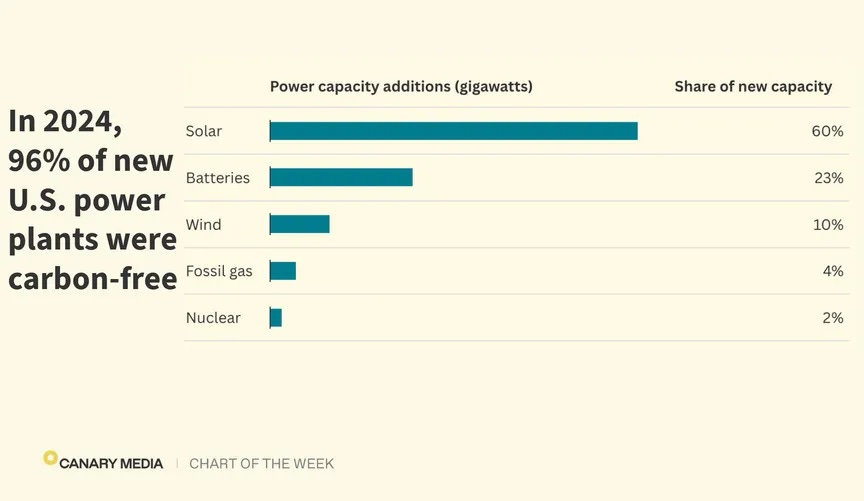
USA: Still Too Much Fossil Overall, But 96 Percent Of New Power Last Year Was Carbon-Free!

Thanks in part to the incentives in Joe Biden’s climate law, but also because solar is so friggin’ cheap, a whopping 96 percent of new energy capacity in 2024 was carbon-free. Here, have a nice chart from Canary Media:

Bar chart showing the share of new electricity plants in 2024, by type. Solar: 60%; Batteries:  23%; Wind: 10%; Fossil gas: 4%; Nuclear: 2%
Chart by Canary Media, based on an analysis by Cleanview of data from the US Energy Information Administration

Solar installations dominated power plant additions — 34 gigawatts of utility-scale solar were constructed across the U.S., a 74 percent jump from 2023’s record-high year. Texas and California drove most of this surge.

Grid batteries were the next-biggest new source of power capacity — and saw the fastest growth. The U.S. built 13 GW of energy storage last year, almost double 2023’s record-shattering 6.6 GW. Texas and California led the way here as well.

The amount of new wind resources coming online dropped for the fourth straight year, however. The pandemic’s supply chain disruptions, followed by high inflation and the Fed’s high interest rates meant to combat inflation, really did a number on wind, far more than on solar and storage. Wind has also been hit hard by the slow process of connecting new generation capacity to the grid, a huge problem for all new energy. Donald Trump’s bizarre hatred of wind is likely to seriously slow wind growth in the US in the next few years, as will astroturfed rightwing opposition in red states. Stupid, stupid Right creatures!

We still need to do a good deep dive on just how idiotic Trump’s “energy emergency” declaration is, since it leaves out renewables, the least expensive and fastest-growing energy sector, for the sake of trying to boost fossil fuels — even as his idiotic tariffs will play hell with fossil fuel prices, too! But today is climate nice time, so that deep dive remains on our to-do list.

Hey, speaking of nice, here’s another fun fact, also from Canary Media and Ember: March was pretty sunny and windy in the USA, and that meant that for the first time ever, America’s energy grid had more clean energy on it than electricity generated by fossil fuels. A decade ago, the US electric grid relied on fossil fuels for two-thirds of its power, and a good chunk of that (34 percent) was still coal, the most carbon-intensive source, and one that’s far more expensive than renewables. It’s down to just 15 percent of the energy mix today, and fuck you, Donald Trump, we ain’t going back. (Fuck Trump is always in the “nice” category). [Canary Media Canary Media again]

Climate Nicetime McNuggets!

Just a few random nice climate moments, Tabs-style:

Two years ago, Helsinki, Finland, decided to ditch coal power, which at the time made up 64 percent of the city’s electric power. The effort to reach the decision took a decade, but once made, it’s gone into effect quickly. Thanks to being ideally situated for wind power (resulting in absurdly low electric rates that approached zero Euros per kilowatt hour) and having a huge distributed heating system that warms homes and businesses with hot water pipes, Helsinki has largely shut down the coal plants that it used to run on. [Fast Company (paywalled); archive link]

For Earth Day (April 26) this month, 54 streets in New York City will be closed to cars so people can stroll and bike and generally see what living without cars could look like. It’s a one-day cleaner, quieter, Euro-style socialist hellhole celebration that the city has been doing since 2016! [Time Out New York]

Thanks to aggressive socialist hellhole government regulations and oppression, plastic pollution along Australia’s coastlines has dropped nearly 40 percent since 2013, and the sea turtles and people walking and doing recreation On the Beach are pretty damn glad to see it. The number of surveyed sites that had no plastic debris at all increased by an impressive 16 percent in the same period. [The Independent]

Lego this week opened a $1 billion factory in Vietnam that will by 2026 be making the popular building bricks using entirely clean energy, primarily solar panels and battery storage. The playsets produced there will be almost entirely for the booming Asian market, although Crom only knows how stupid US tariffs on Vietnam and the rest of the world may affect that rollout. Possibly some! And yes, Lego bricks are made with oil-based plastic; the company is spending big on researching more sustainable materials, but so far with only mixed success. [AP]

Go have you a great weekend, keep your activist batteries charged, and remember that the bastards only win if we let them! (snip)