March 17, 1966 Cesar Chavez and the National Farm Workers Association left Delano for Sacramento, the capital of California, a 340-mile march which would take three weeks. They were calling public attention to the plight of farm workers and for their struggle for the right to organize a union.
March 17, 1968 In London’s Trafalgar Square, at the largest anti-Vietnam War protest in Britain to date, 25,000 people marched. They were demonstrating against American action in Vietnam and British support for the United States policy. Some then attempted to storm the U.S. Embassy, resulting in 200 arrests and fifty taken to hospital, nearly half police officers.
March 17, 1978 The oil supertanker Amoco Cadiz ran aground and, in the worst oil spill ever, lost its entire cargo of 1,619,048 barrels (223,000 tons).A slick 18 miles wide and 80 miles long polluted approximately 200 miles of France’s Brittany coastline. The Amoco Cadiz disaster was the first marine environmental catastrophe to be covered by the world’s media in real time. one of the victims Read more
March 17, 2003 President George W. Bush warned U.N. weapons inspectors to leave the Iraq within 48 hours. They were in country searching for weapons of mass destruction (WMD), conducting 900 inspections at 500 locations in four months.Bush had given Saddam Hussein the same amount of time to step down from power or suffer the consequences of the planned invasion. Hans Blix, the chief weapons inspector, and Mohamed El Baradei, head of the International Atomic Energy Agency, and the inspectors had found no WMDs, or any evidence of a renewed Iraqi nuclear weapons program. Despite increasing cooperation from Iraqi authorities relenting to international pressure, the inspectors were unable to complete their work due to the American threat of war. U.N. weapons inspectors in Iraq before they were forced to leave by President George W. Bush Hans Blix’s report to the UN Security Council just ten days earlier
“I stopped breathing and my heart skipped. My pants were down around my ankles, and no one else was within earshot.”
By Rey Katz Mar 11, 2025, 08:25 AM EDT Updated Mar 11, 2025
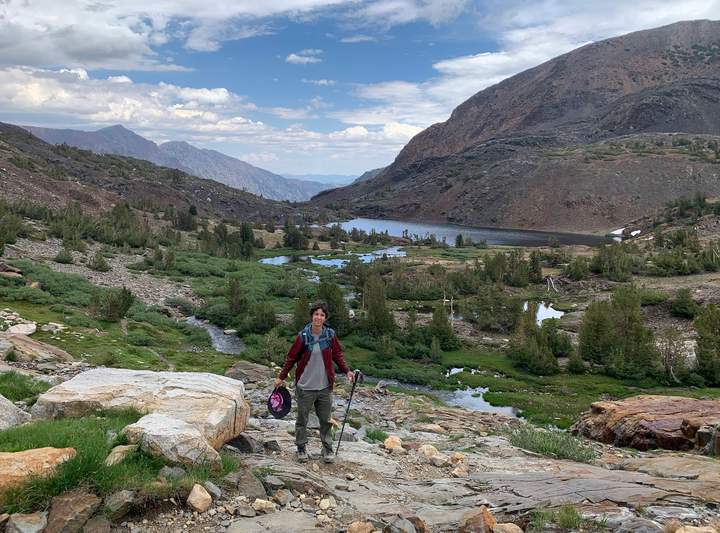
The author hiking just outside Yosemite National Park in July 2024, after cutting their hair short, holding their pink hat.
“Hello? Are you a male or female in there?” a rumbling voice called into the women’s restroom. A man’s boots stepped across the threshold, clunking on the tile floor, as I sat alone in the stall closest to the door.
I stopped breathing and my heart skipped. My pants were down around my ankles, and no one else was within earshot.
My hands went to where my freshly shorn curls used to be — fingers twining into my 2 remaining inches of hair — and I wondered if I had made a mistake. I had been using women’s restrooms my entire life, from when I had long braided pigtails and my mom taught me to lay down two layers of toilet paper on the seat, to my road trip around California as a white, skinny, short, nonbinary person in my early 30s.
***
My partner and I were on an adventure. We had sublet our apartment and were camping in a van for the summer. We slept every night on a memory foam mattress in the van and cooked most of our meals outdoors on a propane stove. Immersed in nature, at a distance from society and community, I could recognize my true self more clearly, and I took the opportunity to explore a more masculine appearance.
I don’t have much experience with people thinking I might be a man. Growing up, people always assumed I was a girl. I still can’t cut my hair without shame, hearing women’s voices in my head: “Oh, but your hair is so lovely, you should keep it long.” It’s as if I hurt my community every time I do it.
Despite the shame, I had cut my hair earlier that week, camped alongside a beautiful, remote river. I trimmed a couple of inches off to give myself the 2-inch-long “men’s” cut I usually give my partner. He is supportive of whatever hair length I want for myself. I squinted into a little travel mirror and lopped off chunks, feeling bits of hair drift down my bare shoulders. Finished with the trim, I dove into the brown river water and scrubbed my scalp with my fingers. I floated in the sun, naked and unjudged by the birds watching me from the trees.
I didn’t feel judged for my haircut until we traveled back into town. While I was washing my face at the sink in a restroom, someone peeked in and then left. I put my glasses back on and walked out. A woman with long hair was standing outside, uncertain, wearing a long skirt. As she turned to face me, I said hello.
“Is this the women’s room?” she asked.
“Yes,” I answered curtly, forced a smile, and walked away quickly, past the word “Women” in 6-inch green painted letters on the wooden wall of the building.
I guess I had been gendered as too-butch-to-be-in-the-women’s-room. Affirming? Slightly. But it was a preview to an unsolvable problem. If I’m not supposed to be in the women’s room, but I also can’t use the men’s, how can I use the bathroom?
***
My partner and I found a lovely city park with a picnic area and gazebo to eat breakfast in after camping on National Forest land nearby. After a mug of coffee, I visited the public restroom. I didn’t expect a stranger to yell at me through the flimsy stall door.
“Hello? Are you a male or female?”
I was the only person using the restroom — the kids who had been in there a minute ago had left. I felt this man’s eyes on my sneakers and blue hiking pants under the stall. I was scared this harassment could escalate if I didn’t say something to diffuse the situation. I gulped and called back, “Hello?”
“Oh, you’re a female. My bad.” He sounded reassured by my quavering voice. I heard his footsteps leaving the room. My heart raced as I fumbled with toilet paper, fingers shaking. I felt nauseated.
My voice had immediately identified me as the “female” I didn’t feel myself to be — and all it took was two syllables. But my “female” voice had also saved me from further harassment. Would that man have dragged me out of the stall if I sounded “like a man” or remained quiet? Would he have looked under the stall? Would he have tried to check what was between my legs while my pants were down? Did he have any idea how much of a violation these real and imagined threats were to me?
And why was a man even in the women’s room, questioning me? Did a kid’s mother report me to her husband for looking too much like a man in the women’s room? Perhaps they were alarmed that I, with my short hair, had been in the restroom with their young kids. I felt physically ill at the troubling thought that someone would assume I would do anything harmful to children. I hadn’t said anything, made eye contact with anyone or done anything other than sit quietly in the stall in the room that matches my assigned sex at birth.
I felt bad for looking masculine to make myself more comfortable, because I didn’t want to make anyone else uncomfortable. Some part of me longed to return to my habit of looking more like a woman, but I also felt sick from not feeling right in my body.
The author sitting beside a mountain stream in August 2024, wearing the same hat, jacket, pants and shoes they had on during the bathroom incident earlier that day.
I can empathize with these strangers viewing me and my body as a threat because I have also viewed my body as a threat. I have been unhappy with the shape of my body, my appearance in the mirror and the tone of my voice. And to have that thrown back in my face in such a vulnerable moment — pants down, defenseless, forced by my body’s very personal needs to be in this gendered room — hit close to home.
It did not occur to me to call the police, because the last thing I needed was to wait around for law enforcement to judge my qualifications to use a bathroom and give a police report about someone I hadn’t actually seen. Instead, I texted a friend — a woman with short hair — to tell her my story of being harassed in the bathroom and share how uncomfortable that made me. She responded that women have screamed after seeing her in the restroom, and she’d had security called on her. My experience seemed mild by comparison. I appreciated her perspective.
For the next several days, I felt intensely conflicted and full of gender dysphoria. I was tense and nervous using public restrooms. I wore my pink hat, forced a big smile and strode in confidently, femininely, trying to look like the kind of woman no one would object to. But I’m not a woman. I came out as a transmasculine, nonbinary person in my late 20s — a person who feels more like a boy than a girl on the inside. A person whose anxiety and depression eased once I no longer had to hide who I am.
I have to choose between a women’s or men’s restroom in most public spaces, as unisex bathrooms are uncommon. Laws restricting bathroom access, which are becoming more prevalent in the United States, attempt to define sex based on whether an individual can produce eggs or sperm. In practice, people look at your body shape, clothes and hair and make an assumption about which restroom you should use. Most people assume I would use the women’s room, so that’s what I continue to use. Trans women often have harder choices. Anyone who pushes back on my use of the women’s room suspects that I am a trans woman. They correctly identify me as trans, but in the incorrect direction.
Trans women are the target of these “bathroom bills” and may encounter harassment and violence in either restroom. Being legally required to use the “wrong” restroom can out people as trans, which can be dangerous for them.
Trans women may need to go more frequently on average. One of the most common testosterone blockers, spironolactone, is a diuretic which means you need to pee often while taking it. The constant stress of navigating public spaces as a trans person with a filling bladder is incredibly — literally — painful.
At the park the day of the bathroom incident in August 2024, the author was wearing a hat, glasses and a fleece jacket.
***
A couple of weeks later, my partner and I returned to the same city park. After relaxing at the picnic tables, I walked over to the bathroom. A new porcelain toilet sat whimsically outside the building, prepped for installation. Uh oh, I thought, rounding the corner to see a plumber with a pickup truck. A “closed for cleaning” sign was braced across the door of the women’s restroom.
The plumber, burly, with a beard, glanced at me and asked, “You need to use the restroom?” gesturing to the men’s door. I nodded, but looked back to peer past the closed sign into the women’s room.
“Oh, you want to use that one?” he asked, squinting at me. It was a cold morning. I was bundled up in a knit cap and two layered jackets. Looking at me, the plumber honestly seemed to think I was heading for the men’s. I shrugged and took what I hoped was a few casual steps toward the men’s room.
“Use the toilet in the last stall,” he prompted me. Perhaps the other plumbing hadn’t been hooked up yet.
“All right, thanks,” I said, pitching my voice down, trying to sound like I’d meant to go in the men’s room all along.
I used the toilet in the empty men’s room to pee, washed my hands, walked out, nodded to the plumber and walked off. I felt rattled but also surprisingly comfortable. Someone had told me that I could use that bathroom, that stall, and I felt validated in doing the right thing. It was the opposite of being questioned for being in the women’s room. I hadn’t made anyone else uncomfortable by existing. Was that a success? Is not making anyone uncomfortable except myself a healthy baseline?
***
Although that experience felt validating, using the “wrong” bathroom can have very real consequences. In California, I didn’t face legal consequences for using a men’s bathroom. If I had instead been in Florida and refused to leave the men’s bathroom if asked, I could have been charged with criminal trespass, likely a first-degree misdemeanor, which carries a prison term of up to one year or a $1,000 fine.
Proponents of “bathroom bills” claim they protect children from predators, but assaulting children in restrooms (or anywhere else) is already illegal. A bathroom law doesn’t physically prevent male abusers already willing to break the law from stepping into women’s spaces. However, these laws can prevent trans women from comfortably and legally using any public bathroom, including restrooms in their workplace.
U.S. Rep. Nancy Mace introduced the Protecting Women’s Private Spaces Act in November 2024. If enacted, this law would prohibit transgender individuals from using restrooms that align with their gender identity on federal property, specifically targeting U.S. Rep. Sarah McBride, the first openly transgender member of Congress, who would no longer be allowed to use the women’s bathroom at her workplace in the Capitol.
The author relaxing in a camp chair behind the van, with short hair and wearing masculine clothes, in September 2024.
I am lucky I don’t work in a place where I can’t use the bathroom, but navigating my gender identity is still a constant struggle — not solely with myself, but with everyone I interact with. I have to justify my gender expression to strangers and negotiate with them, whether or not our interactions are negative or positive. So why do I subject myself to this frustration? Because it would hurt more to hide myself every moment of every day.
Finding more authentic ways to express myself feels like a weight that I wasn’t aware of has been lifted off my chest, and suddenly, I can breathe deeply, newly grounded in the reality of my body. Swimming in the river after I cut my hair, I felt distantly afraid but excited about what was to come. I felt grateful I took this step toward my true self.
Rey Katz is a nonbinary writer, MIT alum, small-business owner, and black belt in Kokikai Aikido. They are working on a memoir about coming of age as a nonbinary martial artist. Check out their relatable true stories at Amplify Respect and small biz services at reykatz.com.
March 15, 1869 The first proposed amendment to the constitution guaranteeing women’s suffrage was introduced in the U.S. Congress.
March 15, 1942 Over 1300 Norwegian teachers were arrested by the German Nazi-installed government run by Vidkun Quisling after 12,000 of 14,000 nationwide had refused to join the new teachers’ association and resisted nazification of the curriculum. Half were held in a concentration camp outside the capital of Oslo. The rest were shipped to the Arctic for forced labor alongside Russian prisoners of war. The loss of the arrested teachers forced a school shutdown for several weeks. Each day the imprisoned teachers were marched to their job of unloading supply ships, citizens stood respectfully by as they passed. When the teachers returned home later in the year, they were treated as heroes. Hitler and Quisling Following Germany’s defeat, Quisling was tried for treason, convicted and sentenced to death. Quisling is now considered a synonym for traitor. Vidkun Quisling – ‘The Hitler of Norway’
March 15, 1963 Students from South Carolina State and Claflin College organized to integrate the lunch counter at Kresge 5&10 in Orangeburg, South Carolina. Though their efforts were disciplined and peaceful, 400 were attacked by police then herded behind fences in the largest mass arrest of the civil rights movement. More than a 1000 students marched peacefully to integrate lunch counters in Orangeburg, South Carolina. Convicted of “Breach of the Peace,” the U.S. Supreme Court later overturned those convictions because those arrested were petitioning for redress of grievances within the protection of the 1st Amendment. More on the Orangeburg action
March 15, 1965 Less than a week after the Bloody Sunday police attacks on peaceful marchers at the Edmund Pettus Bridge in Selma, Alabama, President Lyndon Johnson addressed the American people before a televised Joint Session of Congress. He said, “There is no issue of States rights or national rights. There is only the struggle for human rights . . . We have already waited a hundred years and more, and the time for waiting is gone . . . .” Watch video or read the text of his speech
March 15, 1993 The United Nations Commission on the Truth for El Salvador concluded that most of the murder and human rights abuses during its civil war had been committed by the U.S.-backed Salvadoran government through its various military, security and allied paramilitary organizations. Truth Commission: El Salvador, U.S. Institute of Peace
By Edward-Isaac Dovere, CNN 4 minute read Published 8:09 PM EDT, Wed March 12, 2025
Tim Walz is headed back out on the road – this time, for a tour of House districts represented by Republicans who have stopped holding in-person town halls amid the raucous receptions some of their colleagues have gotten across the country.
The Minnesota governor and 2024 vice presidential candidate will start on Friday in Iowa, in the district represented by Rep. Zach Nunn, then head across the border to Nebraska, for the district represented by Rep. Don Bacon – both of whom won tight races for re-election last year. Walz’s team is already planning stops in Wisconsin, Minnesota and Ohio for the coming weeks, with more stops expected to be added.
Given his national profile after his time on the Democratic ticket last year, Walz said he felt obligated to step up.
“There was just a primal scream of folks recognizing what’s going on with the Trump administration, their authoritarian tendencies, and what they viewed was a lack of a proper response from their representatives,” he told CNN on Wednesday. “It was about these Republican representatives recognizing this stuff’s really unpopular, so they’re going to quit the town halls. These folks need to be heard. They need to be heard, and to be candid with you, Democratic leadership needs to hear them.”
Walz’s plans started with a post last week on X, responding to House Republican leaders who advised their colleagues to stop holding town halls. Republicans have accused those town halls of being packed with paid activists – though those making such accusations haven’t provided any evidence or explanations of why Democratic members’ town halls have also been packed.
Walz said he’d been overwhelmed by the response to that tweet, and his staff has been sifting through what an aide told CNN was hundreds of invitations from local party leaders and candidates asking him to come. He said he found that response reassuring after he and Kamala Harris lost to Donald Trump and JD Vance.
“I always feared that they would become apathetic after this last election and just check out, but they are not doing that,” Walz said.
Other than independent Vermont Sen. Bernie Sanders, who has taken two swings of his own through the Midwest in the past month, no major Democratic leaders have been stepping forward with similar kinds of public events. Walz chalked that up in part to his party “trying to find our feet,” but the situation clearly frustrates him.
“I’m going to tell them that it doesn’t have to be this way,” he said, referencing the Trump administration’s moves to dismantle the Department of Education as a prime example. “I’m going to say ways that they can mobilize to fight back, ways that I think are the most effective ways. And I fully expect them to tell me ways that they’re looking for.”
As the Tea Party rose through a different set of town hall protests in the 2010 election cycle, Walz was a congressman in a tight district running for a third term. He won, but that experience was a rough one, he said, and he warned Republicans now to ignore what’s happening at their own peril.
“I’m a catalyst to provide them a megaphone to lift up their voice. And I think that’s what people are looking for,” he said. “I understand now my responsibility. I have a little more of a national voice, so I should bring it to them, and I’m going to basically be handing the megaphone to them.”
But he said when Democrats are “just being a foil to Trump, we are not crossing into that space we need to, to have them believe us, to know what we stand for.”
After going deliberately quiet in the months after the campaign – following a largely low-profile role as running mate that sources say was designed by the Harris campaign leadership – Walz has been stepping out more in recent weeks.
Many expect Walz to run for a third term as governor next year, and he downplayed the suggestion that this effort was laying the groundwork for a future national run.
“I will do anything possible to make sure that we win in ‘28. I do not need to be on that ticket,” he told CNN. “That’s not my pursuit here. My pursuit is that I am still in a position where I have a platform and I have some power to make a difference, and if 20 people show up that’s good by me because those 20 people are making a difference. This isn’t about drawing a crowd. I’ll go to states where it wouldn’t matter, but it matters to those people. And that’s what I’m going to do.”
March 13, 1830 The term “rat,” referring to a worker who betrays the interests of fellow workers, first appeared in print. The New York Daily Sentinel reported on replacement workers who had agreed to work for two-thirds of the going rate. “ . . . [many printers are out of work, others are being paid about 2/3 the regular pay; they should join in cooperative associations, ‘as we have done’] “ [While] the master printers [fill] their offices with boys and two-thirds men, alias ‘rats,’ it will be difficult to find a remedy.”
March 13, 1864 The first contingent of 14,030 Navajo reached Fort Sumner, New Mexico. Men, women and children had been forced to march almost 400 miles from northeastern Arizona and northwestern New Mexico to Bosque Redondo, a desolate tract on the Pecos River in eastern New Mexico. Traveling in harsh winter conditions for almost two months, about 200 Navajo died of cold and starvation along the way. More died after they arrived at the barren reservation. The forced march, led by Kit Carson, an Indian agent and military leader in both the Mexican and Civil Wars, became known by the Navajos as the “Long Walk.” A grueling 400-mile march to imprisonment in a sterile land. More on The Long Walk
March 13, 1945 Pax Christi, an international Catholic peace organization, was founded in France. From their website: “Pax Christi is a ground up organization – it began with a few committed people who spoke out, prayed and worked for reconciliation at the end of the second world war, and is now active in more than 60 countries and five continents, with more than 60,000 members worldwide.” Pax Christi history
March 13, 1968 Clouds of nerve gas drifted outside the Army’s Dugway Proving Grounds in Utah, poisoning 6,400 sheep in nearby Skull Valley. Sign near Dugway: Warning Hazardous Area: This area may contain Chemical, Biological and Radiological contaminated material and explosives . . . Read more about Dugway – the home of Amerian WMD
The very first execution of a Conscientious Objector, and more in today’s items.
March 12, 295 Maximilian of Thebeste (near Carthage in North Africa) was beheaded by Romans after refusing military service because he said his Christian beliefs did not permit him to become a soldier.
March 12, 1912 Workers led by the Industrial Workers of the World (IWW) won the Lawrence, Massachusetts, “Bread & Roses” textile strike after 32,000 workers (mostly young female immigrants who spoke 25 different languages, half between the ages of 14 and 18) stayed out for nine weeks. They were striking for a wage increase, double time for overtime and safer working conditions: the equipment was dangerous and the air quality caused lung disease in about one-third of the workers before the age of twenty-five. IWW organizer Elizabeth Gurley Flynn addresses a strike rally Background “Bread and Roses” became the strikers slogan and inspired a poem by by the same name. Bread & Roses victory parade
March 12, 1930 Gandhi’s Salt March began from Ahmadabad, India, with 76 followers to protest the salt tax. Great Britain’s Salt Acts prohibited Indians from collecting or selling salt, a staple of the Indian diet. Gandhi leading the Salt March Citizens were forced to buy it from the British, who, in addition to exercising a monopoly over the manufacture and sale of salt, also exerted a heavy salt tax. Defying the Salt Acts, Gandhi reasoned, would be a simple way for many Indians to break an unjust law nonviolently (civil disobedience), increasing the pressure for independence from the British Empire. By the time Gandhi had covered the 241 miles to the coastal city of Dandi on the Arabian Sea, the number of marchers had grown into the thousands. More on the Salt March
March 12, 1978 150,000 demonstrated against construction of a nuclear power plant in Lemoniz, Spain, part of the Basque region. No fewer than a dozen plants were planned in a relatively small, densely populated area, Lemoniz being only 12 km (5 miles) from Bilbao, a city of a million. The opposition was concerned about the possibility of accidents. Lemoniz protest
March 12, 1990 Sixteen disability-rights activists from ADAPT (American Disabled for Accessible Public Transit)were arrested at the U.S. Capitol demanding passage of what would become the Americans With Disabilities Act. The Capitol Crawl
Simply very bad news. Precisely what Project 2025/Agenda 47/Republican National Platform said they want to do. I’m sorry; I don’t like to bring bad news. But people need to prepare. This is written in editorial/opinion style, but facts are within and there are citations. For people like us who need time to prepare for austerity, it’s news we ought to read.
Also, there are Senator names included for who we should write to regarding this bill. That’s our last chance. Shutdown is on Republicans, not Democrats, no matter how they try to deflect. We need to tell the Dem senators to speak what’s in this bill, every chance they get, and to refuse to vote in favor, pointing at Republicans the entire time.
There are parts in the article complaining about Democrats and their choices, etc., et. m. Read it if you want (you’ll have to click through for it,) but it won’t help anyone to read more complaining about Democrats. We the people need to energize Dem. Senators to speak out, and to vote no. Especially the speak out portion; Sen. Mark Kelly does that especially well, and is among those the author of this piece feels is wavering. I intend to start first thing in the morning, and I hope all of us will devote some time to this. It’s vital.
Without the luxury of Republicans falling apart, Democrats in the Senate need to decide whether to prevent a dangerous and harmful budget that shrinks the power of Congress in the government. Since operating on principle goes against their “adults in the room” mindset, they are wavering on what to do. But it should be an open-and-shut case.
A normal continuing resolution funds the government at the same level as the previous budget. This bill does not. It cuts non-defense discretionary spending by $13 billion below last year’s level, while increasing military spending by $6 billion. It zeroes out funding for programs that fund homeless shelters and prevent child abuse. It cuts health care funding for clinics and hospitals, emergency preparedness for communities, clean water projects and tribal assistance. Meanwhile, it adds money for mass deportations, just as Immigrations and Customs Enforcement has illegally detained a green card holder for his political beliefs.
Most of the budget cuts are achieved by removing earmarks, which members of Congress put in to direct projects. But usually when earmarks are removed, the money goes back to the agency to decide how to distribute it. This maneuver cuts the earmarks and the money.
The House Republican bill also fails to fix a carryover of a $20 billion rescission to IRS money from the Inflation Reduction Act, effectively doubling that cut. This was kind of pre-ordained when Democrats punted on this in a prior continuing resolution last December, but it still means that practically all of the IRA’s funding for greater enforcement of tax collection is now gone.
The bill not only adds $6 billion to the Department of Defense’s enormous budget, but adds $8 billion in “transfer authority” that allows the agency to shift spending where they deem important, a flexibility no other agency gets.
While Republicans tout a $6 billion increase in veterans health care in the bill, they neglect to mention the removal of a $23 billion appropriation to the Toxic Exposure Fund to implement the PACT Act, which cares for veterans exposed to burn pits and other cancer-causing chemicals. While there’s an extra $2.2 billion for the Federal Emergency Management Agency’s disaster relief fund, there’s no additional money to support the rebuilding in southern California after the January wildfires.
But most important, the bill grants an open invitation to Trump and Elon Musk to continue to ignore Congress and toss out disfavored spending. Vice President JD Vance, while selling the deal to House Republicans, stated outright that “Trump would continue cutting federal funding with his Department of Government Efficiency initiative and pursue impoundment — that is, holding back money appropriated by Congress.” This has been reiterated by others in the Trump administration.
In fact, the House Republican bill gives the president more leeway to move money around. It appropriates money for things that Musk has eliminated, meaning that money can operate as a floating slush fund for Trump’s priorities, as long as the courts don’t roll back the illegal impoundments.
… The Trump administration is saying that they will sign a bill appropriating specific funding, and then go about cutting funding anyway. If you’re a member of Congress, you’re being told that your work product doesn’t matter, that the constitutional power of the purse doesn’t matter, and that there’s no guarantee that anything you pass will actually reach the people you serve.
I can see why Republicans would take this deal: they want budget cuts but know they don’t have the votes for them, so they’re plenty happy to outsource that to the president, even if it turns Congress into a separate and unequal branch of government. But why would Democrats willingly submit to a fake budget on paper that can be so easily circumvented? As Rep. Greg Casar (D-TX), chair of the Congressional Progressive Caucus, said on X, “The Republican spending plan will supercharge Musk’s theft from working people to pay for billionaire tax cuts. Senate Democrats must stop it.”
…
So far, only Sen. John Fetterman (D-PA) has committed to voting yes. But as Josh Marshall has documented at Talking Points Memo, a number of Senate Democrats have stated no position on the bill, leaving their options open. In general, senators have been hedging their bets until forced to make a decision. That time has come.
Credible sources indicate that the most likely Democrats to offer up the remaining seven votes to avoid a shutdown are Mark Kelly (D-AZ), Ruben Gallego (D-AZ), Michael Bennet (D-CO), John Hickenlooper (D-CO), Jon Ossoff (D-GA), Gary Peters (D-MI), Elissa Slotkin (D-MI), Maggie Hassan (D-NH), and Mark Warner (D-VA).
March 11, 1988 Ten days of protest and direct action ensued demanding an end to nuclear testing at the Nevada Test Site. The site, larger than the state of Rhode Island, is an outdoor laboratory and national experimental center for testing nuclear weapons. The actions resulted in over 2,200 arrests, the largest number of arrests in U.S. history for a political protest outside Washington, D.C.
March 11, 2011 More than 85,000 Wisconsin citizens rallied outside the Capitol in Madison to welcome the return to the state of fourteen Democratic state senators. Known as the Wisconsin 14, they had left the state to deny the senate a quorum, thus delaying passage of legislation which took away public employees right to collectively bargain and restricting other rights of union members. State Senate Minority Leader Mark Miller remarked about the gathering, “This is what democracy looks like!” The Wisconsin 14
Hope you’re enjoying your weekend. To give you a bit more enjoyment, here’s all the good news I could find from the week that just ended. I’m certain there was more, but the below is a good sampling. As awful as things are right now—and they are awful—there’s much good happening as well.
Enjoy this list, read it a few times, and share it with friends. It is not by staring relentlessly at what’s wrong that we will prevail, but in lifting up what’s working and celebrating it. Really!
Let’s do that. Then tomorrow we’ll get back to work making new victories.
The Trump administration has rescinded its decision to cut off legal aid for unaccompanied immigrant children. You sent letters about that! Bravo!
After a public outcry, the Alabama Department of Economic and Community Affairs has resumed the Low-Income Home Energy Assistance Program, lowering energy bills for thousands of Alabamans.
The Supreme Court lifted its hold on a lower court order compelling the Trump administration to resume nearly $2 billion in foreign aid funding from USAID. HUGE!
Over the weekend after Trump and Vance’s meeting with Zelensky in the Oval Office supporters like you donated $2,597,908 to UNITED24, the Ukrainian government’s official fundraising website. Wonderful!
In Minnesota, House Republicans brought House File 12 to the Floor, legislation that would prohibit trans and non-gender conforming youth from participating in girls’ sports in Minnesota schools and subject all women and girls to inappropriate scrutiny about their bodies. Democrats defeated it!
Rep. Al Green, was ushered out of Trump’s address to Congress by security guards after raising his voice about Medicaid. THAT is resistance!
Campaign Legal Centerfiled a new lawsuit challenging the creation of the Department of Government Efficiency (DOGE). They claimed Elon Musk’s and DOGE’s actions are unconstitutional.
The African Development Foundation is putting up a fight and denying DOGE and Pete Marocco — the State Dept official dismantling USAID — access to their building.
More than 34,000 Vermonters attended Rep Rebecca Balint’s town hall the night of the SOTU —she was joined by Sen Bernie Sanders and Peter Welch. Wow! (You can view a recording on Facebook.)
A federal judge extended a nationwide preliminary injunction on Trump’s executive order to end federal funding for gender-affirming healthcare for trans youth.
The White House pulled the expected signing of the executive order to dismantle the Department of Education
A federal judge ruled that the head of the Office of the Special Counsel, who is responsible for protecting whistleblowers, must be able to continue in his role through the duration of his term.
Alabama’s parole rate more than doubled in 2024. The board released 20 percent of prisoners last year compared to just eight percent in 2023. One lawmaker credited the boost to increased scrutiny from journalists.
A crowd hundreds strong gathered near the National Oceanic and Atmospheric Association campus in Boulder on Monday to protest cuts made to the agency last week as part of the Trump administration’s effort to downsize the federal government.
The U.S. Merit Systems Protection Board (MSPB) reinstated about 5,600 probationary USDA employees that had been terminated by the Trump administration.
“Hamilton” is canceling plans to perform next year at the Kennedy Center, citing President Trump’s moves to impose his values on the venue. “We’re not going to be a part of it while it is the Trump Kennedy Center,” said its creator, Lin-Manuel Miranda. Couldn’t love him more.
Virginia lawmakers unanimously passed a bill to educate the public about common menstrual disorders like endometriosis and PCOS.
Educators in New York City are embracing rather than restricting discussions of race in schools. Leaders have said they’ll do so whether the Trump administration approves or not.
Black churches across the country were awarded more than $8 million in grants by The National Trust for Historic Preservation, part of an effort to preserve buildings that played significant roles in Black history.
Stanford University chemists have developed a practical, low-cost way to permanently remove atmospheric carbon dioxide, the main driver of global warming and climate change, using rocks.
A federal judge ordered the reinstatement of Democratic NLRB member Gwynne Wilcox, whom Trump fired to eliminate the board’s quorum.
CBS has filed a motion to dismiss Trump’s $20 billion lawsuit over former Vice President Kamala Harris’ 60 Minutes interview last year, calling the suit an “affront to the First Amendment without basis in law or fact.”
Ontario will charge 25% more for electricity shipped to 1.5 million Americans starting Monday in response to Trump’s tariffs, Premier Doug Ford said Thursday.
A Federal judge in Rhode Island entered a preliminary injunction that indefinitely blocks Trump’s freeze on federal grants and loans, saying the Trump Administration “put itself above Congress.” This lawsuit was brought by Democratic state Attorneys General, led by New York AG Letitia James.
Watch This! 👀
Warning, this is slightly risque. But if you saw the weird AI-generated video about “Trump Gaza” that Trump reposted last week, you have to see this. (Full disclosure; I have not watched it. No time for videos today unless it’s one of you people here. Also, the scene shown has ruined my lunch. -A)







 Pax Christi, an international Catholic peace organization, was founded in France. From their website: “Pax Christi is a ground up organization – it began with a few committed people who spoke out, prayed and worked for reconciliation at the end of the second world war, and is now active in more than 60 countries and five continents, with more than 60,000 members worldwide.”



 Scottie's Playtime
