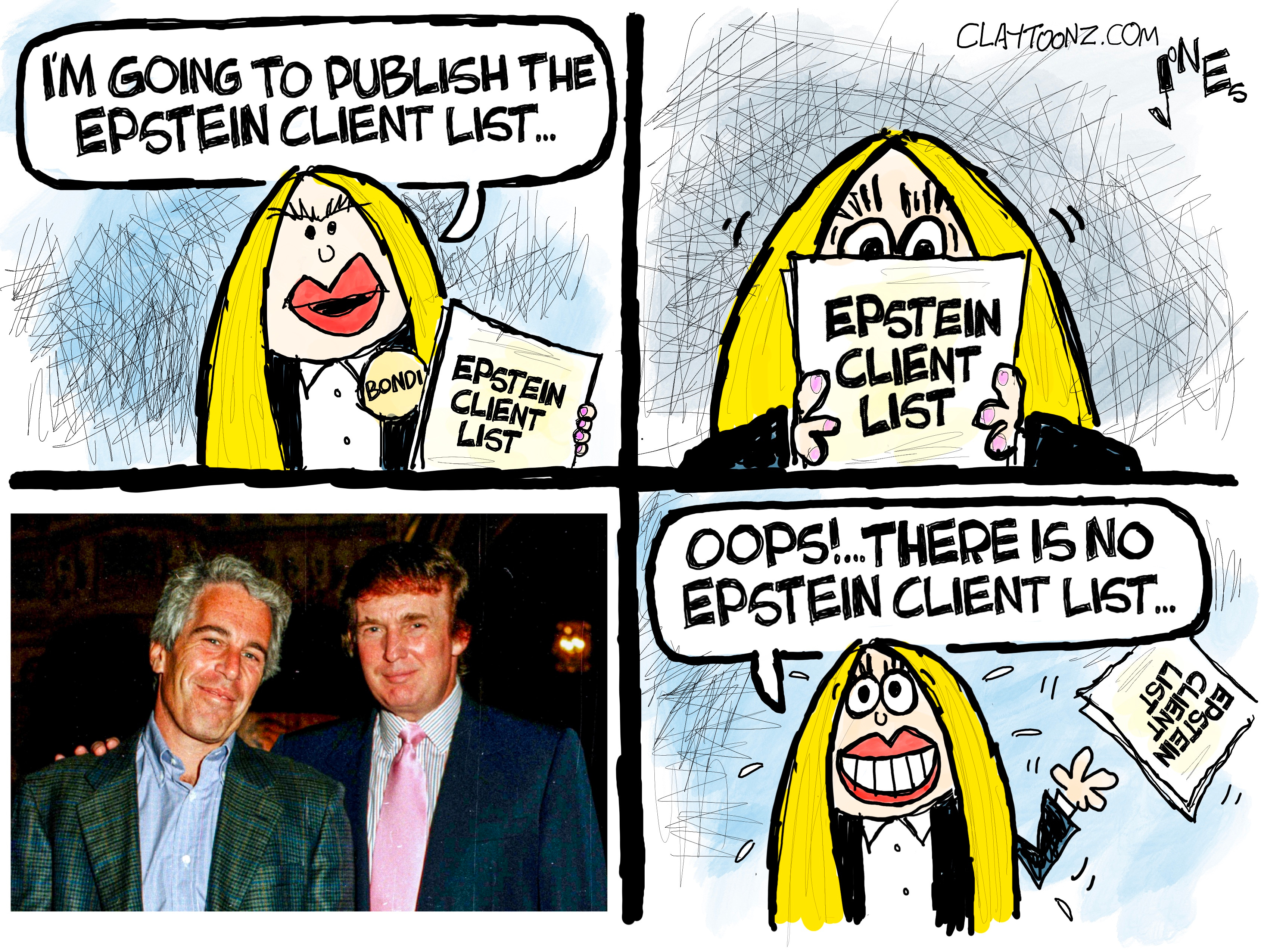
Today, the Justice Department posted a memo saying there is no evidence that the late pedophile and Trump party buddy Jeffrey Epstein was murdered or that he kept anything amounting to a much-anticipated “client list.” A DOJ spokesgoon told CNN that the department does not plan to release any new documents on the matter.
If you’re not surprised that there’s not a list of Epstein’s clients, that’s probably because you know New York City’s medical examiner had ruled Epstein’s death (hanging himself in jail) a suicide. The attorney general in Trump’s first term, Bill Barr, said the same thing, despite his suspicions of something more sinister. A Justice Department Inspector General report also pushed back on the idea that the death was anything but a suicide, while criticizing staff failures for allowing it to happen.
The Miami Herald’s Julie K. Brown, one of the best-sourced reporters on the Epstein case, reported earlier this year, “Those who have worked with the FBI on the case for decades say there is no evidence Epstein kept a ledger or a list of clients who were involved with his sex trafficking operation.”
But the problem for Trump 2.0 is that the regime promised to expose everything upon taking power, even promising to produce Epstein’s “client list.” Even an insider in Trump’s DOJ said there was a “client list.” Now, who in the Justice Department would jump the gun so badly when there’s not a client list? Who, who I ask? Who? Who? Who? Oh, it was the Attorney General, Pam Barbie Bondi. That’s who.
Remember, Bondi was Florida’s Attorney General who was going to investigate Trump University’s fraud in that state, but pulled the investigation after being paid off by Trump, who funneled it through his fake charity, the Trump Foundation. Later, she defended Trump in his impeachment trials, and was his second choice to be his AG after Matt Gaetz.
Imagine being the second choice after Matt Gaetz. If I were the second choice to Matt Giggity Gaetz, I’d probably hang myself. (snip-MORE, and it’s really good)
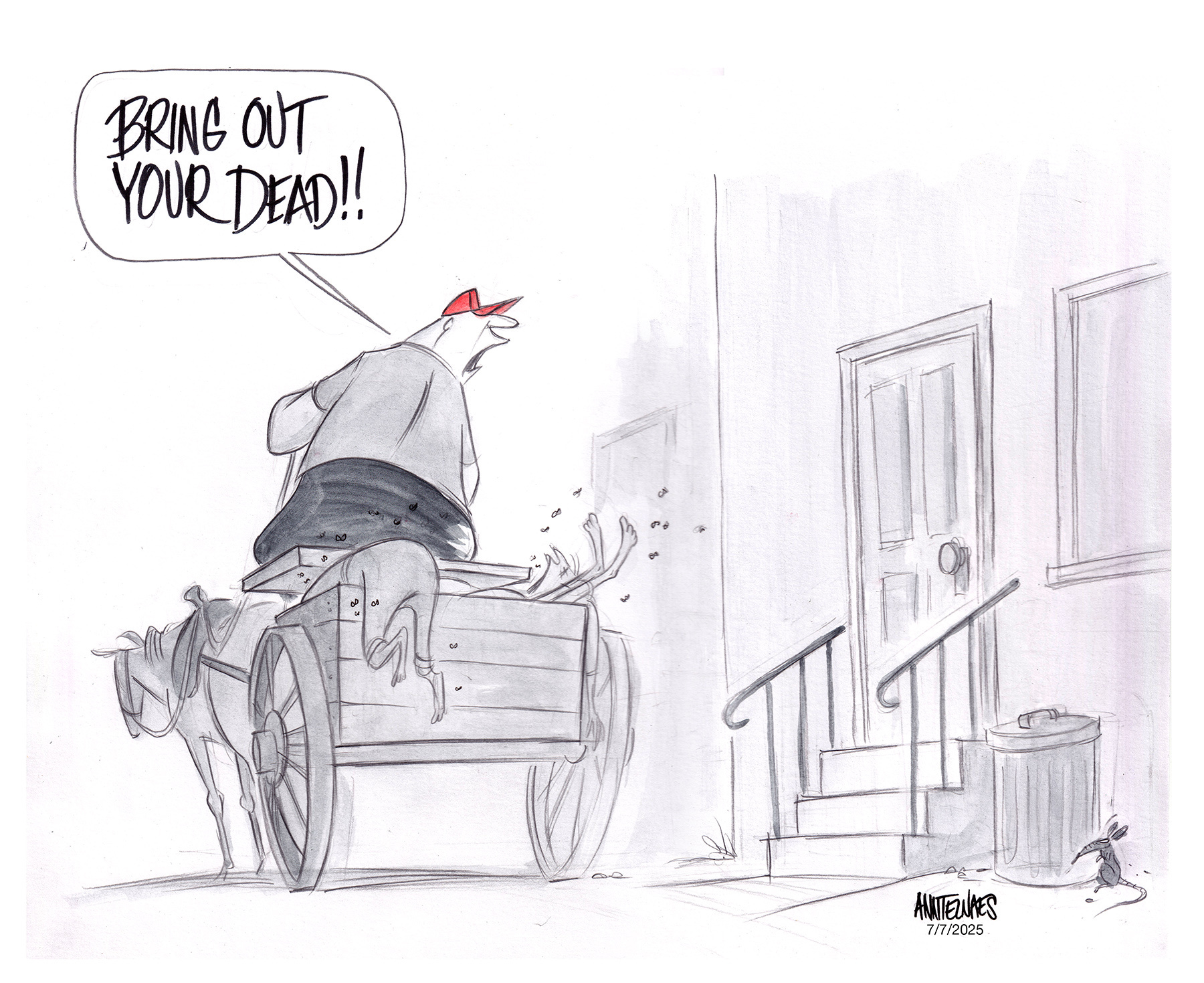
The Republican idea of a healthcare system by Ann Telnaes
Between their medicaid cuts and an anti-vaccine HHS secretary, this is the Republicans’ idea of a healthcare system. And as I’ve said before, Americans don’t have a healthcare system, they have a healthcare insurance system. Contrary to what politicians say, it is not the best in the world- far from it. There are many, many other countries which provide superior preventive care to all (which is the foundation of a healthy society).
FEMA Fiend by Clay Jones
Trump is once again doing something he accused Biden of Read on Substack
I told you that you were getting two blogs today. This is the second.
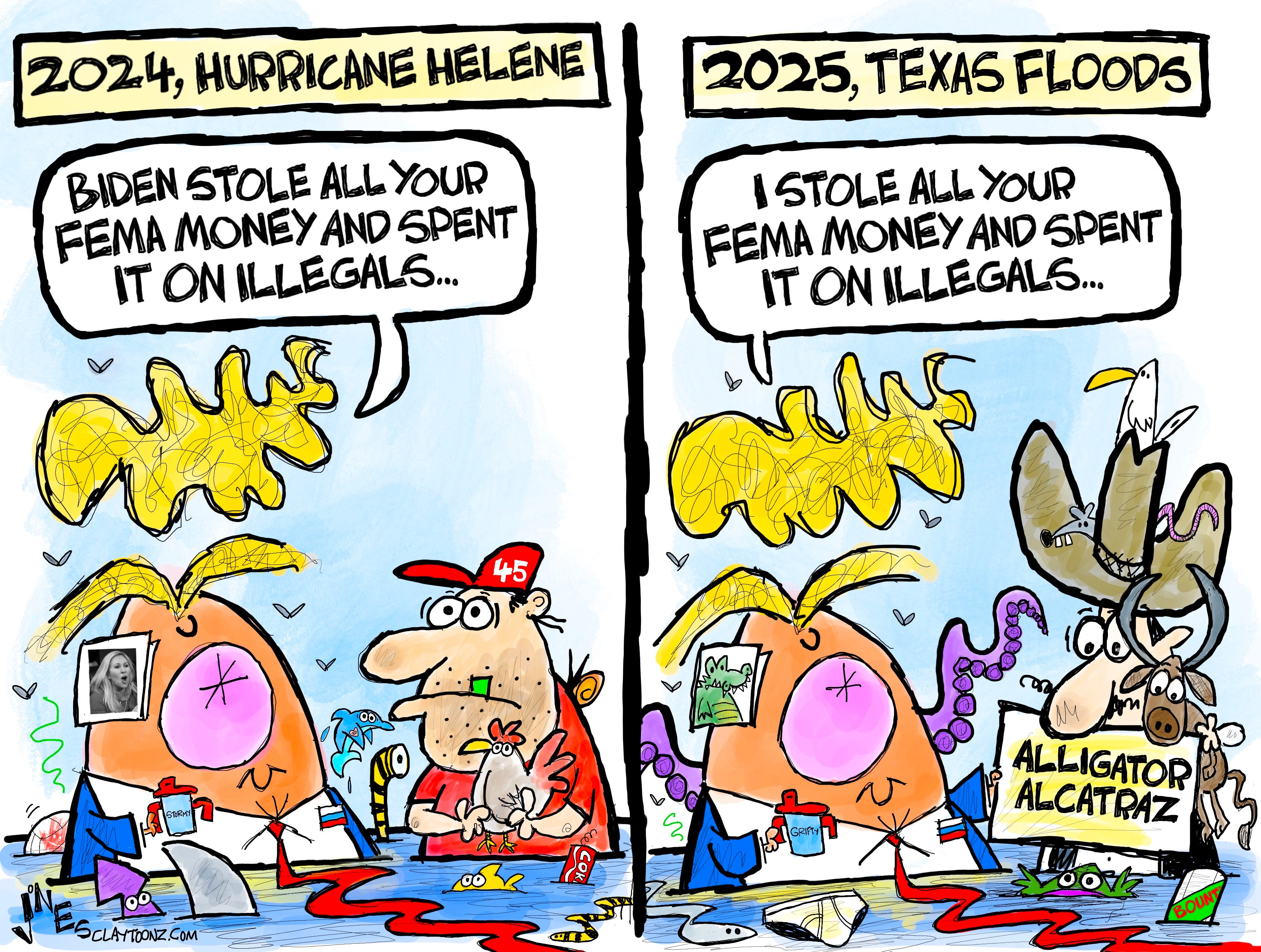
I’ve heard more than one liberal say that because they support Trump and other horrible Republicans, Texas parents deserve to have their children die in these floods. Folks, no. Hell no. Cut that crap out. Let the GOP and MAGAts be the heartless ones. Do NOT emulate them. We must always be better than them. It’s not hard.
Last September, Hurricane Helene hit the southeast Atlantic coast, being one of the strongest storms on record. It brought devastation to Florida, Georgia, the Carolinas, and even landlocked Tennessee. Naturally, Republicans politicized it.
First, they claimed the Biden administration wasn’t providing any recovery aid to areas that voted Republican. Of course, this was a lie.
Marjorie Taylor Greene showed a map of Republican congressional districts hit by the hurricane, and claimed Democrats manipulated the weather and sent the hurricane to those districts. These idiots don’t believe in science but believe a hurricane can be shot at a target.
Then, Donald Trump, who was running for president, claimed that Joe Biden spent all the FEMA funds on “illegal immigrants. He said the Biden administration “stole the FEMA money just like they stole it from a bank.” If anyone knows anything about stealing from a bank, or taxpayers, grifting his own supporters, or being a felon, it’s Donald Trump.
Of course, what Trump said was a lie…at least about Biden, because there has been a president (sic) stealing from FEMA.
As we’ve all come to learn, unless you’re a MAGAt living in denial, any accusation Trump makes is projection. (snip-MORE, and it’s sizzling hot!)
July 7, 1863 The first military draft was instituted in the U.S. to provide troops for the Union army in the American Civil War. Once called, a draftee had the opportunity to either pay a commutation fee of $300 to be exempt from a particular battle, or to hire a replacement that would exempt him from the entire war.
July 7, 1903 The March of the Mill Children watch a video – highly recommended Labor organizer Mary Harris “Mother” Jones led the “March of the Mill Children” over 100 miles from Philadelphia to President Theodore Roosevelt’s Long Island summer home in Oyster Bay, New York, to publicize the harsh conditions of child labor and to demand a 55-hour work week. It is during this march, on about the 24th, she delivered her famed “The Wail of the Children” speech. Roosevelt refused to see them. “Fifty years ago there was a cry against slavery and men gave up their lives to stop the selling of black children on the block. Today the white child is sold for two dollars a week to the manufacturers.” –from Mother Jones’s autobiography Read more about Mother Jones
July 7, 1957 Convened at the onset of the Cold War, a group of scientists held their first peace conference in the village of Pugwash, Nova Scotia, Canada. The mission of the Pugwash Conference was to “. . . bring scientific insight and reason to bear on threats to human security arising from science and technology in general, and above all from the catastrophic threat posed to humanity by nuclear and other weapons of mass destruction . . . .” Bertrand Russell Wealthy industrialist and Pugwash son Cyrus Eaton had invited the world’s greatest minds to his family home in Nova Scotia and address the emerging threat of nuclear war. The Conference became the basis for an ongoing organization that deals with issues of weapons of mass destruction. The 1995 Nobel Peace Prize was awarded to Joseph Rotblat (one of the original signatories of the Pugwash Manifesto) and to the Pugwash Conferences on Science and World Affairs. Albert Einstein Pugwash home
Fifty years later . . . 25 scientists, diplomats and former military officers from 15 countries gathered for a “Revitalizing Nuclear Disarmament” strategy workshop. The meeting was held near the Thinkers’ Lodge, the site of the first meeting in 1957. “Fifty years ago from Pugwash, Nova Scotia, nuclear scientists helped alert the world to the dangers of nuclear weapons, and especially the newly developed hydrogen bomb,” said Paolo Cotta-Ramusino, Secretary General, Pugwash Conferences on Science and World Affairs. “Today, we are working with experts from around the world for global action to revitalize nuclear disarmament and the final elimination of nuclear weapons.” Senator Roméo Dallaire, Honorary Patron of the Pugwash Peace Exchange, said “It is appalling to observe the increasing potential for many regional nuclear arms races, shameless plans to modernize nuclear arsenals and bald-faced threats of pre-emptive nuclear use,” said Senator Dallaire. “Only by revitalizing discussion and implementation of disarmament leading to abolition can we ensure that these genocidal devices will never again be used.”
July 7, 1977 The United States conducted its first test of the neutron bomb. The neutron bomb was a tactical thermonuclear weapon designed to cause very little physical damage through limited blast and heat but was designed to kill troops through localized but intense levels of lethal radiation. A neutron bomb explosion at a test site
July 7, 1979 2,000 American Indian activists and anti-nuclear demonstrators marched through the Black Hills of western South Dakota to protest the development of uranium mines on sacred native lands.
News outlets are supposed to expose corruption, not engage in it Read on Substack
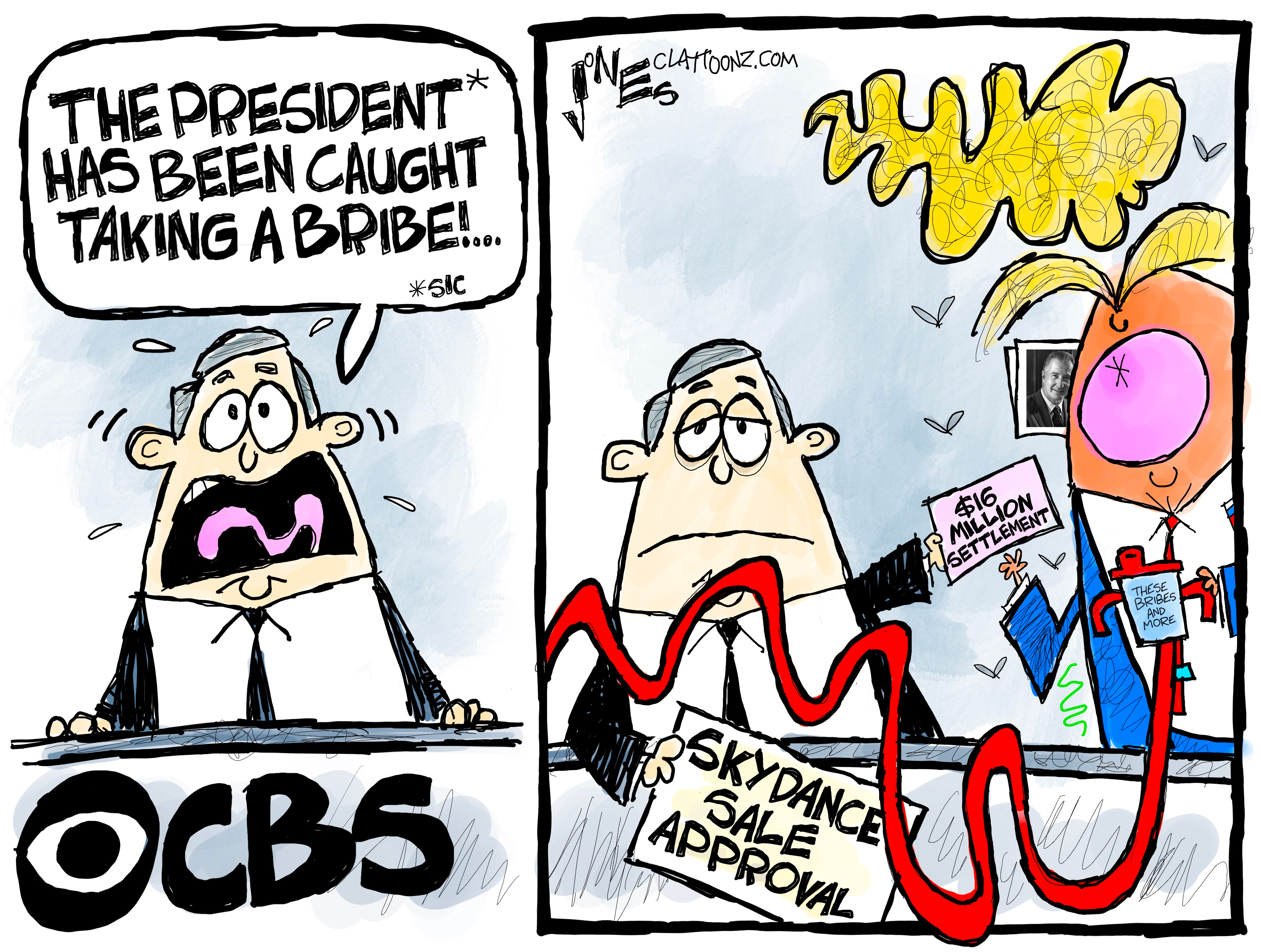
The headline at Fox News blasted, “Paramount, CBS forced to pay eight figures, change editorial policy in settlement with President Trump.” Forced? Would Fox News use the word “forced” when they settled a lawsuit with Dominion for over $787 million? You may feel forced, but a settlement is a choice. It’s a choice not to go any further into a trial and shut that shit down, for whatever reasons. And yes, CBS has changed its editorial policy, which is that anytime Trump comes for a bribe, you pay it.
Usually, when someone settles a lawsuit, they’re trying to get off cheaper as they fear the result of the trial will cost them more. In Fox News’ case with Dominion, they were afraid the verdict in a trial would bankrupt them. They were guilty of spreading misinformation that they knew were lies. It’s why Tucker’s no longer on their payroll.
When CNN and the Washington Post settled with teenage Trumper Nicholas Sandmann, one of those smirky, obnoxious, entitled white privileged Catholic Covington kids who was in the center of a viral video controversy with an elderly Native American, they didn’t settle because they were guilty. They settled for what legal experts estimate to be a small portion of the $275 million they were sued for, in order to save on lawyer fees. They weren’t afraid of losing the trial because it had already been dismissed once, but felt they’d pay more to their lawyers than to the little asshole whose feelings got hurt. I hope the ugly little entitled priviliged fuck isn’t feeling too litigious today.
When Disney settled a lawsuit with Trump earlier last December, who sued because ABC news anchor George Stephanopoulos said Trump was “liable for rape,” it wasn’t because they were guilty of anything other than hurting TACO’s feelings because Stephanopoulos was technically correct. Disney, ABC’s parent company, settled because the judge was scary and said in her denial to dismiss that “a reasonable jury could interpret Stephanopoulos’s statements as defamatory,” despite the fact that Donald Trump is a rapist who also liked to pal around with rapists while also endorsing pedophiles for the United States Senate. Also, Trump put Alexander Acosta in his first cabinet. He was the prosecutor who saved Epstein from a criminal trial.
When Meta settled a lawsuit with Trump in January, it was to bribe Trump. Trump sued Meta for banning him from its platforms, Facebook and Instagram, in 2020 after his election denial and white nationalist terrorist insurrection attempt. Trump told Mark Zuckerberg that he would have to settle the lawsuit before he could be “brought into the tent.” I don’t think he’s talking the kind of tent migrants will be forced to sleep in at Alligator Alcatraz, but the MAGA tent. The settlement was for $25 million, and it was a bribe.
Even Elon settled a lawsuit with Trump, and was also to bribe Trump. As if the $275 million Elon paid to elect him wasn’t enough. Like with Meta, Trump sued Twitter for banning him, citing that his First Amendment rights were violated. A federal court in California tossed the case, saying only the government can deny First Amendment rights, not corporations. But Trump’s team took it to an appeals court, which was skeptical. Elon settled with Trump for $10 million. Why would you settle when you already won? Because it’s a bribe.
Also, do you like the irony of Trump claiming his First Amendment rights were violated, and now he’s trying to deport people for protesting? (snip-MORE)
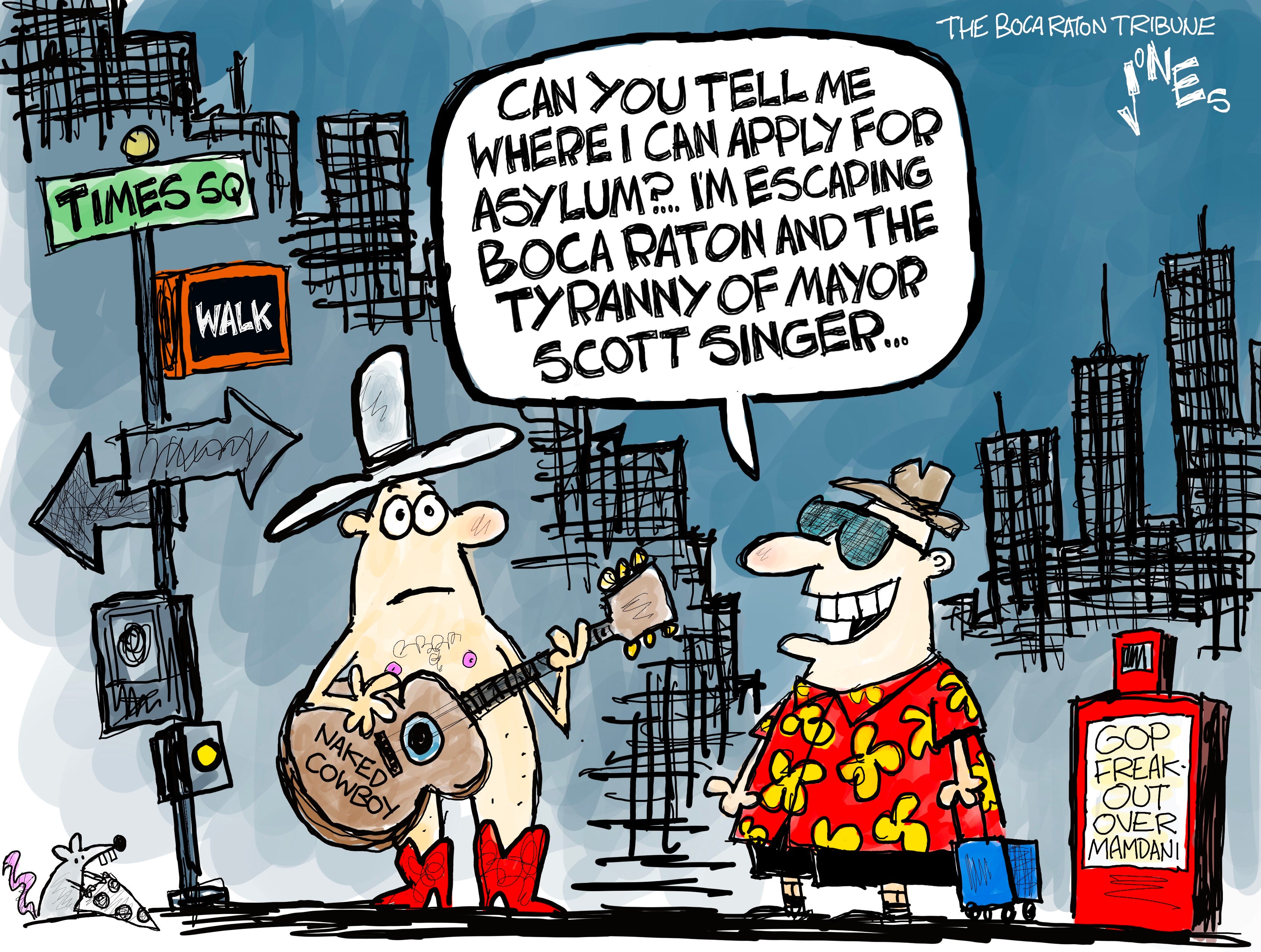
This cartoon was drawn for The Boca Raton Tribune, whose mayor went on Fox News and offered New Yorkers an escape from “socialist” New York City if Zohran Mamdani wins the mayoral race in November.
The mayor, Scott Singer, has aspirations for higher office, and to do that as a Republican, you have to be a vile piece of shit. This is the kind of stuff MAGAts find amusing, like throwing migrants to alligators.
Being the mayor of a city in Florida, Singer should focus on being the mayor of his city in Florida. That’s the job he was elected to do, and not worry about who’s the mayor of New York City. Right now, Republicans are using Mamdani as red meat for their base, without even understanding what they’re talking about.
Sometimes, I think I should move to Florida just for the issues, and syndicate cartoons about them to Florida newspapers. But then, I’d be living in Florida. (snip-MORE)
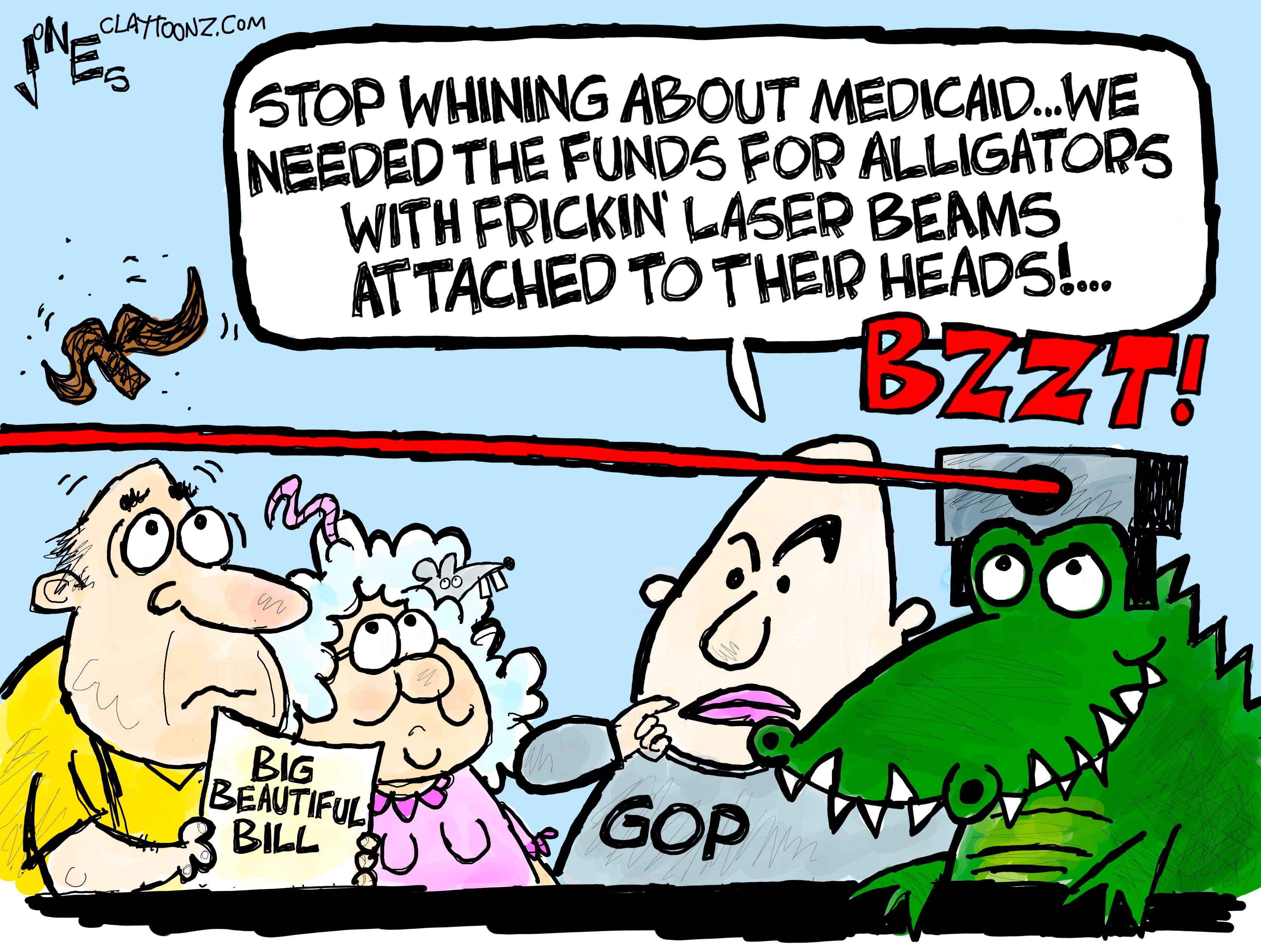
Trump’s $4 trillion (at least) “big beautiful bill” is giving seniors a tax credit of $6,000, which is great because they’re gonna need it.
The bill makes deep cuts to Medicaid, the government health insurer for the poor, which covers more than 60 percent of the nation’s nursing home residents.
The nonpartisan Congressional Budget Office (CBO) estimated that the BBB will cut federal spending on Medicaid and Children’s Health Insurance Program (CHIP) benefits by $1.02 trillion, due in part to eliminating at least 10.5 million people from the programs by 2034.
This will lead to benefit losses, increased paperwork requirements, and rural hospital closures that will hurt Americans, especially those with disabilities. It will also make nursing homes scramble to find resources for services they’re currently providing, or simply eliminate services.
Republicans like to say, or lie, that people who receive Medicaid aren’t going to notice any changes. But you can’t find one of the shitweasels who can explain how you don’t lose any services after cutting out over a trillion dollars. Find me one Republican, just one, who can explain that shit.
This will hit rural communities harder. Do you know which party rural communities mostly vote for? The one that just cut their Medicaid. Republican voters are stupid. Red states need the most federal support. Red states need the most welfare, which they also cut. (snip-MORE)
July 6, 1892 In one of the worst cases of violent union-busting, a fierce battle broke out between the striking employees (members of the Amalgamated Association of Iron and Steel Workers) of Andrew Carnegie’s Homestead Steel Company and a Pinkerton Detective Agency private army brought on barges down the Monongahela River in the dead of night. Twelve were killed. Henry C. Frick, general manager of the plant in Homestead, near Pittsburgh, Pennsylvania, had been given free rein by Carnegie to quash the strike. At Frick’s request, Pennsylvania Governor Robert E. Pattison then sent 8,500 troops to intervene on behalf of the company. Read more (2 links)
July 6, 1942 In Nazi-occupied Holland, thirteen-year-old Jewish diarist Anne Frank and her family were forced to take refuge in a secret sealed-off area of an Amsterdam warehouse under threat of arrest and deportation to a concentration camp by the Einsatzgruppen (Task Force), a part of the German Gestapo. The Anne Frank Center for Mutual Respect
July 6, 1944 Irene Morgan, a 28-year-old black woman, was arrested for refusing to move to the back of the bus eleven years before Rosa Parks did so. Her legal appeal, after her conviction for breaking a Virginia law (known as a Jim Crow law) forbidding integrated seating, resulted in a 7-1 Supreme Court decision barring segregation in interstate commerce. Irene Morgan More about Irene Morgan June 3, 1946: Morgan v. Commonwealth of Virginia Zinn Ed Project
July 6, 1965 As many as 500 students in Berkeley, California, attempted to block trains carrying troops destined for Vietnam along the Santa Fe Railroad tracks; there were no casualties. Organized by the Vietnam Day Committee, this was the first civil disobedience at UC-Berkeley against the Vietnam War.
I have long liked this young YouTuber. I started following him when he was more into debunking stuff while also producing atheist content. I felt he understood what a lot of people were going through in that he was trying hard to hide being an atheist from his parents and family which gave him an idea what many in the LGBTQ+ community were going through with their families. He himself noted that similarity. One of the things I like about him is his calm quiet fact filled delivery. If others have not noticed I don’t like aggressive angry yelling videos, they are too close to what I grew up with and suffered in my childhood. Drew is not a fervent anti-Christian like so many atheists are. Instead he simply is against the bad stuff some people do in the name of religion / Christianity. I like that. At the end of this video he again says if you are getting something good from your faith, don’t leave it, just change it to make it better. I agree. He explains how Christianity was abused by corporations and wealthy people to get people to do things against their own interest they otherwise wouldn’t do. In the name of god work more at a lower cost to make money for your employer type stuff. Hugs
July 5, 1827 The newly freed African-American population of New York, led by men on horseback, marched in an Emancipation Day Parade from the Battery at the foot of Manhattan to City Hall. Follow the route of the parade
July 5, 1894 Buildings erected for the 1892 Columbian Exposition in Chicago’s Jackson Park were set ablaze, seven reduced to ashes. The fire was part of the chaos in reaction to President Grover Cleveland’s calling out federal troops to end the Pullman Strike. The Pullman Palace Car Company produced the sleeping cars used by most of the railroads. The contingent of federal, state and local forces equalled the number of striking workers.The Pullman employees, who lived in company-owned housing in Pullman, Illinois, had suffered massive layoffs and pay cuts averaging 25%. The company refused to cut the rent on the housing its employees were required to occupy, nor would it bargain with workers’ representatives. Federal troops guarding the Arcade Building in Pullman, Illinois. The Pullman workers’ cause had been taken up by Eugene V. Debs, the leader of the American Railway Union, who helped organize a nationwide boycott of any train that included a Pullman car. The Pullman Strikers’ Statement More on the Great Pullman Strike
July 5, 1934 Bloody Thursday, July 5, 1934, near Rincon Hill. On “Bloody Thursday,” police armed with machine guns opened fire against striking longshoremen and their supporters, killing two, wounding 32 more by gunfire, and injuring 75 others at Rincon Hill in San Francisco.
July 5, 1935 The National Labor Relations or Wagner Act (named for New York’s Senator Robert Wagner) became law, recognizing workers’ rights to organize and bargain collectively. It was signed into law by President Franklin D. Roosevelt. Read more about the act
July 5, 1989 Former National Security Council aide Oliver North received a $150,000 fine and a suspended prison term for his part in the Iran-Contra scandal. The scandal was a secret arrangement directed from the Reagan White House that provided funds to the Nicaraguan Contra rebels (despite specific congressional prohibition) from profits gained by selling arms to Iran (at war with Iraq at the time) in hopes of their releasing hostages, despite President Reagan’s claim that he would never negotiate with hostage-takers. North’s conviction was later overturned because evidence revealed in the congressional Iran-Contra hearings had compromised his right to a fair trial. The real details on Ollie North’s activities (It’s still up! -A.)
There are videos at the link below. I don’t know where we are a species right now. It seems more and more people are willing to give in to the lowest of our natures while mocking those who try to live up to the best we could be. The Christians trying to keep books that have LGBTQ+ characters out of schools can’t be bothered by the shooting of starving people including kids trying desperately to get something to eat. They are not doing anything to help, just everything they can to lash out bashing a minority group just for existing using their god to do it. Yet did not their god say to feed the hungry? To help the immigrants among you? They are so desperate to control others sexuality but they don’t care about those acting cruelty to the ones most needing help. Hypocrites, which side of god do they get to sit on? Hugs
American contractors guarding aid distribution sites in Gaza are using live ammunition and stun grenades as hungry Palestinians scramble for food, according to accounts and videos obtained by The Associated Press.
Two U.S. contractors, speaking to the AP on condition of anonymity because they were revealing their employers’ internal operations, said they were coming forward because they were disturbed by what they considered dangerous and irresponsible practices. They said the security staff hired were often unqualified, unvetted, heavily armed and seemed to have an open license to do whatever they wished.
They said their colleagues regularly lobbed stun grenades and pepper spray in the direction of the Palestinians. One contractor said bullets were fired in all directions — in the air, into the ground and at times toward the Palestinians, recalling at least one instance where he thought someone had been hit.
“There are innocent people being hurt. Badly. Needlessly,” the contractor said.
He said American staff on the sites monitor those coming to seek food and document anyone considered “suspicious.” He said they share such information with the Israeli military.
Videos provided by one of the contractors and taken at the sites show hundreds of Palestinians crowded between metal gates, jostling for aid amid the sound of bullets, stun grenades and the sting of pepper spray. Other videos include conversation between English-speaking men discussing how to disperse crowds and encouraging each other after bursts of gunfire.
The testimonies from the contractors — combined with the videos, internal reports and text messages obtained by the AP — offer a rare glimpse inside the Gaza Humanitarian Foundation, the newly created, secretive American organization backed by Israel to feed the Gaza Strip’s population. Last month, the U.S. government pledged $30 million for the group to continue operations — the first known U.S. donation to the group, whose other funding sources remain opaque.
A spokesperson for Safe Reach Solutions, the logistics company subcontracted by GHF, told the AP that there have been no serious injuries at any of their sites to date. In scattered incidents, security professionals fired live rounds into the ground and away from civilians to get their attention. That happened in the early days at the “the height of desperation where crowd control measures were necessary for the safety and security of civilians,” the spokesperson said.
Aid operation is controversial
Gaza’s more than 2 million Palestinians are living through a catastrophic humanitarian crisis. Since Hamas attacked Israel on Oct. 7, 2023, setting off the 21-month war, Israel has bombarded and laid siege to the strip, leaving many teetering on the edge of famine, according to food security experts.
For 2 1/2 months before GHF’s opening in May, Israel blocked all food, water and medicine from entering Gaza, claiming Hamas was stealing the aid being transported under a preexisting system coordinated by the United Nations. It now wants GHF to replace that U.N. system. The U.N. says its Gaza aid operations do not involve armed guards.
Over 57,000 Palestinians in Gaza have been killed since the war erupted, according to the territory’s Health Ministry, which does not distinguish between civilians and militants.
GHF is an American organization, registered in Delaware and established in February to distribute humanitarian aid during the ongoing Gaza humanitarian crisis. Since the GHF sites began operating more than a month ago, Palestinians say Israeli troops open fire almost every day toward crowds on roads heading to the distribution points, through Israeli military zones. Several hundred people have been killed and hundreds more wounded, according to Gaza’s Health Ministry and witnesses.
In response, Israel’s military says it fires only warning shots and is investigating reports of civilian harm. It denies deliberately shooting at any innocent civilians and says it’s examining how to reduce “friction with the population” in the areas surrounding the distribution centers.
AP’s reporting for this article focuses on what is happening at the sites themselves. Palestinians arriving at the sites say they are caught between Israeli and American fire, said the contractor who shared videos with the AP.
“We have come here to get food for our families. We have nothing,” he recounted Palestinians telling him. “Why does the (Israeli) army shoot at us? Why do you shoot at us?”
A spokesperson for the GHF said there are people with a “vested interest” in seeing it fail and are willing to do or say almost anything to make that happen. The spokesperson said the team is composed of seasoned humanitarian, logistics and security professionals with deep experience on the ground. The group says it has distributed the equivalent of more than 50 million meals in Gaza in its food boxes of staples.
GHF says that it has consistently shown compassionate engagement with the people of Gaza.
Throughout the war, aid distribution has been marred by chaos. Gangs have looted trucks of aid traveling to distribution centers and mobs of desperate people have also offloaded trucks before they’ve reached their destination. Earlier this month, at least 51 Palestinians were killed and more than 200 wounded while waiting for the U.N. and commercial trucks to enter the territory, according to Gaza’s Health Ministry and a local hospital. Israel’s military acknowledged several casualties as soldiers opened fire on the approaching crowd and said authorities would investigate.
Videos, texts, internal reports document havoc at food sites
AP spoke to the two contractors for UG Solutions, an American outfit subcontracted to hire security personnel for the distribution sites. They said bullets, stun grenades and pepper spray were used at nearly every distribution, even if there was no threat.
Videos of aid being dispensed at the sites seen by the AP appear to back up the frenetic scenes the contractors described. The footage was taken within the first two weeks of its distributions — about halfway into the operations.
In one video, what appear to be heavily armed American security contractors at one of the sites in Gaza discuss how to disperse Palestinians nearby. One is heard saying he has arranged for a “show of force” by Israeli tanks.
“I don’t want this to be too aggressive,” he adds, “because this is calming down.”
At that moment, bursts of gunfire erupt close by, at least 15 shots. “Whoo! Whoo!” one contractor yelps.
“I think you hit one,” one says.
Then comes a shout: “Hell, yeah, boy!”
The camera’s view is obscured by a large dirt mound.
The contractor who took the video told AP that he saw other contractors shooting in the direction of Palestinians who had just collected their food and were departing. The men shot both from a tower above the site and from atop the mound, he said. The shooting began because contractors wanted to disperse the crowd, he said, but it was unclear why they continued shooting as people were walking away.
The camera does not show who was shooting or what was being shot at. But the contractor who filmed it said he watched another contractor fire at the Palestinians and then saw a man about 60 yards (meters) away — in the same direction where the bullets were fired — drop to the ground.
This happened at the same time the men were heard talking — effectively egging each other on, he said.
In other videos furnished by the contractor, men in grey uniforms — colleagues, he said — can be seen trying to clear Palestinians who are squeezed into a narrow, fenced-in passage leading to one of the centers. The men fire pepper spray and throw stun grenades that detonate amid the crowd. The sound of gunfire can be heard. The contractor who took the video said the security personnel usually fire at the ground near the crowds or from nearby towers over their heads.
During a single distribution in June, contractors used 37 stun grenades, 27 rubber-and-smoke “scat shell” projectiles and 60 cans of pepper spray, according to internal text communications shared with the AP.
That count does not include live ammunition, the contractor who provided the videos said.
One photo shared by that contractor shows a woman lying in a donkey cart after he said she was hit in the head with part of a stun grenade.
This photo, provided by an American contractor on condition of anonymity because they were revealing their employers’ internal operations, shows a woman slumped over in a donkey cart after the contractor said she was hit in the head with part of a stun grenade at a food distribution site in Gaza run by the Gaza Humanitarian Foundation in June 2025. (AP Photo)
An internal report by Safe Reach Solutions, the logistics company subcontracted by GHF to run the sites, found that aid seekers were injured during 31% of the distributions that took place in a two-week period in June. The report did not specify the number of injuries or the cause. SRS told the AP the report refers to non-serious injuries.
More videos show frenzied scenes of Palestinians running to collect leftover food boxes at one site. Hundreds of young men crowd near low metal barriers, transferring food from boxes to bags while contractors on the other side of the barriers tell them to stay back.
Some Palestinians wince and cough from pepper spray. “You tasting that pepper spray? Yuck,” one man close to the camera can be heard saying in English.
SRS acknowledged that it’s dealing with large, hungry populations, but said the environment is secure, controlled, and ensures people can get the aid they need safely.
Verifying the videos with audio analysis
To confirm the footage is from the sites, AP geolocated the videos using aerial imagery. The AP also had the videos analyzed by two audio forensic experts who said they could identify live ammunition — including machine-gun fire — coming from the sites, in most cases within 50 to 60 meters of the camera’s microphone.
In the video where the men are heard egging each other on, the echo and acoustics of the shots indicate they’re fired from a position close to the microphone, said Rob Maher, a professor of electrical and computer engineering at Montana State University and an author and research expert in audio forensic analysis. Maher and the other analyst, Steven Beck, owner of Beck Audio Forensics, said there was no indication that the videos’ audio had been tampered with.
The analysts said that the bursts of gunfire and the pop sequences in some of the videos indicated that guns were panning in different directions and were not repeatedly aimed at a single target. They could not pinpoint exactly where the shots were coming from nor who was shooting.
GHF says the Israeli military is not deployed at the aid distribution sites. Lt. Col. Nadav Shoshani, an army spokesman, said the army is not stationed at the sites or within their immediate proximity, especially during operating hours. He said they’re run by an American company and have their own security.
One of the contractors who had been on the sites said he’d never felt a real or perceived threat by Hamas there.
SRS says that Hamas has openly threatened its aid workers and civilians receiving aid. It did not specify where people were threatened.
Palestinians carry boxes containing food and humanitarian aid packages delivered by the Gaza Humanitarian Foundation, a U.S.-backed organization approved by Israel, in Rafah, southern Gaza Strip, Tuesday, May 27, 2025. (AP Photo/Abdel Kareem Hana,File)
American analysts and Israeli soldiers work side by side, contractors say
According to the contractor who took the videos, the Israeli army is leveraging the distribution system to access information.
Both contractors said that cameras monitor distributions at each site and that American analysts and Israeli soldiers sit in a control room where the footage is screened in real time. The control room, they said, is housed in a shipping container on the Israeli side of the Kerem Shalom crossing into Gaza.
The contractor who took the videos said some cameras are equipped with facial recognition software. In live shots of the sites seen by the AP, some videos streams are labeled “analytics” — those were the ones that had the facial recognition software, said the contractor.
If a person of interest is seen on camera — and their information is already in the system — their name and age pops up on the computer screen, said the contractor. Israeli soldiers watching the screens take notes and cross-check the analysts’ information with their own drone footage from the sites, he said.
The contractor said he did not know the source of the data in the facial recognition system. The AP could not independently verify his information.
An internal SRS report from June seen by the AP said that its intel team would circulate to staff a “POI Mugs Card,” that showed photos of Palestinians taken at the sites who were deemed persons of interest.
The contractor said he and other staff were told by SRS to photograph anyone who looked “out of place.” But the criteria were not specified, he said. The contractor said the photos were also added to the facial recognition database. He did not know what was done with the information.
SRS said accusations that it gathers intelligence are false and that it has never used biometrics. It said it coordinates movements with Israeli authorities, a requirement for any aid group in Gaza.
An Israeli security official who was not named in line with the army’s protocol, said there are no security screening systems developed or operated by the army within the aid sites.
I just ran across this in my SBTB email. It belongs here. Doesn’t look like it embedded (it didn’t on SBTB, either,) so click through on “View this post…” and make sure the sound is on. A very worthy click.