
The items don’t have to do with each other; they interested me or looked like something I ought to know about, so I read them and thought someone else might like to read one or another or maybe all of them.
=======================
=============
Snippet:
The 1947 partition of the South Asian subcontinent into India and Pakistan led to the world’s largest mass migration. Populations from both sides of newly formed demarcations suffered in heinous riots. Women in particular were subjected to extreme violence. Yet, the severity of gendered crime during Partition wasn’t caused by an arbitrary upsurge of madness. Systemic patriarchy in South Asia had long reduced women to male-owned property. They were objectified to such an extent that a woman’s sexual “purity” became a metonym of her husband’s and kinsmen’s honor (izzat). In other words, male respectability was gauged by how successfully women’s bodies were regulated. With Partition, this dynamic became a forum for contesting powers and prestige at the communal and national levels.
To assert manhood and symbolize triumphal power over the enemy, rivaling sides opted for sexually charged violence, grotesquely marking, mutilating, and branding the bodies of women. According to historian
“[T]housands of women on both sides of the newly formed borders,” writes historian Urvashi Butalia,
were abducted, raped, forced to convert, forced into marriage, forced back into what the two states defined as “their proper homes,” torn apart from their families once during Partition by those who abducted them, and again, after Partition, by the state which tried to “recover” and “rehabilitate” them.
In the guise of celebrating independence from British rule, official narratives of nationalism largely omitted female experiences of such violence during the divisive convulsions of 1947. Among the earliest Partition texts that documented gory details which would have otherwise slithered into oblivion is Pinjar (which can translate to both “Skeleton” and “Cage”), a novella by Amrita Pritam that captures the cataclysmic years of Partition via a series of abductions.
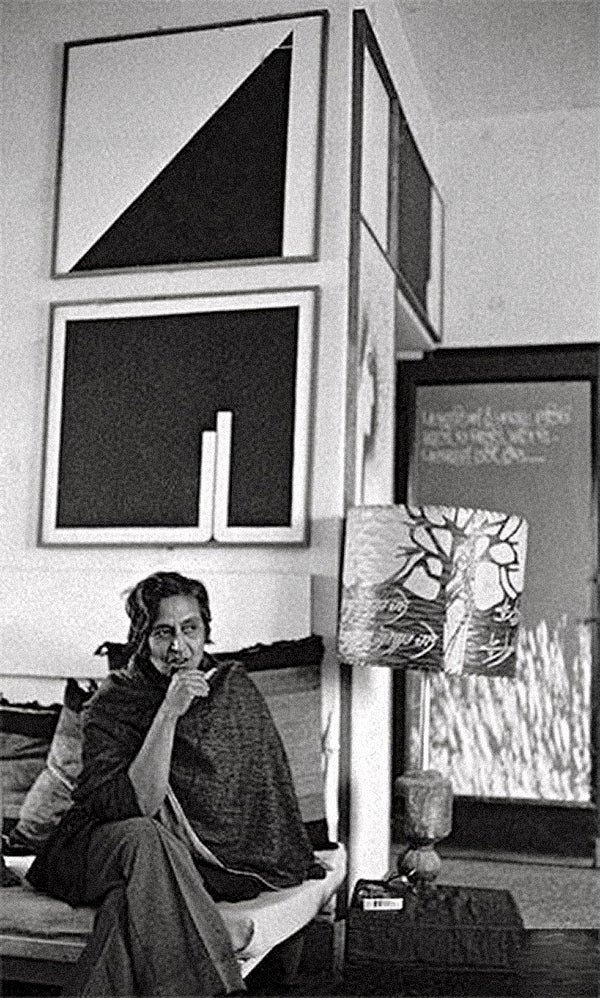
A writer celebrated for both powerful poetry and prose, Amrita Pritam (1919–2005) is a well-known figure in South Asian literature. Inspired by real life, much of her work serves as testimony. Pritam witnessed firsthand the horrors of Partition—communal riots forced her to migrate to India from Pakistan in 1947 with nothing but her two small children and a red shawl. She never returned home. (snip-MORE on their page linked above)
==========================
Designing Intersex History: Behind the Intersex Flag with Morgan Carpenter
The Intersex Human Rights Fund (IHRF) at the Astraea Lesbian Foundation for Justice is celebrating its 10th year of funding intersex liberation efforts across the globe. Join us in reflecting on the IHRF’s many accomplishments, intersex movement successes, and our vision for the future of intersex organizing.
Created in 2013 by Morgan Carpenter, an intersex man based in Australia, the intersex flag was intentionally designed to stand out, communicate values important to intersex communities, and be used widely and freely. The intersex flag has a simple design: a bold purple circle on a bright yellow background. The circle represents many things, including wholeness and bodily autonomy, while the colors yellow and purple both represent the strength and diversity of intersex communities while avoiding all references to gender.
(Snip-a bit MORE)
====================
Vacuuming, laundry, and doing the dishes: My life as a ‘trad son’
Plenty of us are living back at home, adopting ‘traditional’ duties in exchange for free accommodation – Charlie Aslet
When I read the term “trad sons” on my phone, I spat the hot cocoa my mother had prepared for me out onto the screen. “What fresh torture will the live-at-home generation be subjected to next?” I cried. It only got worse when I scrolled to see that mothers were calling their stay-at-home sons “hubsons”, a play on the word husbands. “Has the whole world gone Oedipal?” I exclaimed in horror.
Following on from the trend of the “tradwife”, the internet has coined the term trad sons for children who stay at home with their parents and adopt “traditional” sonly duties in exchange for free accommodation. (Snip-MORE, it’s not long)
 Scottie's Playtime
