






Well, Here’s An Idea For Eco-Health:

Hair salons in Europe are dumping their clippings into forests and it’s miraculous

Deers don’t like it but trees absolutely love it.

By Heather Wake

Every day, hair salons sweep countless hair clippings off their floors and toss them into the trash without much thought. But in parts of France, Belgium, and Luxembourg, those discarded strands are finding an entirely different purpose: helping forests grow.

French recycling company Capillum has developed a surprisingly effective way to reuse human hair by turning it into biodegradable mulch that protects young trees from hungry deer. The company collects hair from participating salons and transforms it into flattened fiber sheets that can be wrapped around vulnerable saplings.

What sounds unusual at first actually solves several environmental problems at once.

A second life for salon clippings

Hair salons generate an enormous amount of waste each year. Most clippings are simply thrown away, even though human hair is remarkably durable because it is made largely from keratin, a fibrous protein that breaks down slowly over time.

Capillum saw potential in a material most people never think twice about. The company accepts hair regardless of texture, length, color, or whether it has been dyed. Once gathered, the hair is fed into a machine that minces everything together into dense fiber sheets that can be laid around the base of trees. The process transforms something typically viewed as garbage into a practical tool for conservation efforts.

Why young trees need protection

Many forests depend on saplings surviving long enough to mature and replenish the ecosystem. However, young trees often struggle in areas with large deer populations. Deer are known to chew on bark, especially during seasons when food is scarce. Because saplings have thin bark and delicate trunks, even small amounts of damage can stunt their growth or kill them entirely.

Foresters have historically relied on plastic fencing and tree guards to keep deer away. While those barriers can work well, they also create waste and require maintenance over time.

Capillum’s recycled hair mats offer another approach. The scent of human hair naturally discourages deer from getting too close to the trees, steering them toward other vegetation instead. The method protects saplings without harming wildlife.

A biodegradable alternative to plastic

Unlike plastic guards, the hair fibers gradually decompose and return nutrients to the soil. As the keratin breaks down, it releases nitrogen and amino acids that can support plant growth. That nutrient-rich quality is one reason some gardeners have long experimented with placing hair into compost piles or using it directly in garden beds. Knowing this, Capillum sells its eco-friendly hair mulch to home gardeners interested in more sustainable growing methods. 

Human hair is more useful than most people realize (snip-MORE)

Political cartoons / memes / and news I wish I want to share. 5-21-2026

One of my objectives with my new children’s book “My Dad Thinks I’m a Boy?!” is to show kids how being authentic isn’t unreasonable, unlike many parents’ expectations. Who is stubborn between the child expressing themselves and the adult unwilling to...


Image from What Are You Really Afraid Of?


Image from What Are You Really Afraid Of?


Image from What Are You Really Afraid Of?


#corruption from Oh Canada !


Gary Varvel for 5/17/2026
Gary Varvel for 5/7/2026


‘Under babied’ is a dystopian term. It removes men from responsibility and commitment. It sounds very sterile and detached. Dr. Oz sounds loveless.

Republican men see women as white baby-making machines. They want mothers to be on the verge of destitution. They envision desperate mothers as more controllable. These misogynist men are given way too much influence in conservative politics.


Political/Editorial Cartoon by David Horsey on Ultimatum Fails


Gary Varvel for 5/18/2026

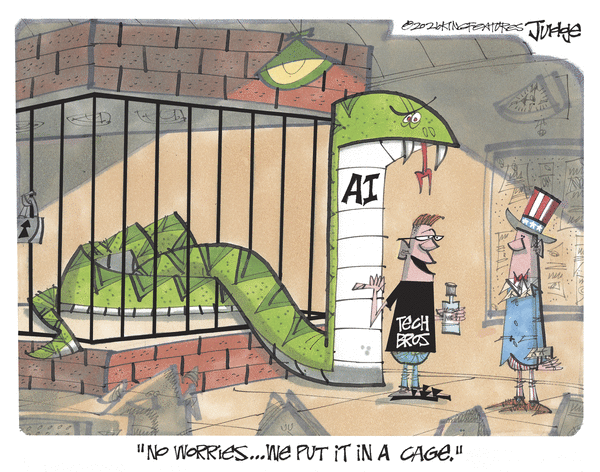
AI data centers are the surveillance state trojan horse


Two people wearing sunglasses walk in bright sunshine.

“It’s so nice when the temperatures get up to where the President wishes his approval rating was.”

Political cartoons / memes / and news I want to share. 5-20-2026


Tumblr: Image


Tumblr: Image


#memory from What Are You Really Afraid Of?


political cartoon


image


#politics from Cartoon Politics


#politics from Cartoon Politics


#white people twitter from White People Twitter


#politics from Cartoon Politics


#politics from Cartoon Politics


It’s well known he abuses illicit “uppers” and “downers” so maybe he was hopped up on the latter.


#politics from Cartoon Politics


#politics from Cartoon Politics


#wall from What Are You Really Afraid Of?


image

#politics from Cartoon Politics


#ManChildTrump from What Are You Really Afraid Of?


#politics from Cartoon Politics

#politics from Cartoon Politics


#politics from Cartoon Politics


political cartoon


#politics from Cartoon Politics


#white people twitter from White People Twitter


#politics from Cartoon Politics


#politics from Cartoon Politics


#politics from Cartoon Politics


political cartoon


#politics from Cartoon Politics


political cartoon


Let’s talk about Trump and children and seniors not getting food….

‘Leave or we’ll kill you’: Settler’s warn Palestinians in Jerusalem’s Old City

It’s horrifying that these Jewish settlers who want to eradicate entirely the Muslim population.  One woman described Islam as a cancer and wants the Islamists killed or reeducated.  Muslims who own businesses can’t even open their shops.  But there is a small minority trying to protect the arabs.  Hugs

Lots Happening This Week; Joyce Vance Previews And Comments:

The Week Ahead

May 17, 2026

Joyce Vance

Coming this week:

Looks like the law firms win

Last week I flagged that oral argument was set in the D.C. Circuit for this past Thursday in the combined challenges filed by four law firms against Trump’s executive orders seeking to keep them from conducting much of their business. All four firms won in the lower courts. Based on the panel’s reception, they seem on track to do it again.

These cases are highly significant because they go to the heart of a major abuse of executive power: Trump’s insistence that he has the ability to put entities that oppose him out of business. Former Solicitor General for George W. Bush, Paul Clement, representing the firms, argued that Trump’s executive orders “run afoul of the better part of the Bill of Rights.” Not just one or two provisions, mind you, but “the better part.” He argued that they threaten the right to counsel, the separation of powers, and the rule of law.

Clement explained, “The executive orders here strike at the heart of the First Amendment and the ability of lawyers to zealously represent their clients. Lawyers cannot zealously represent their clients while walking on eggshells for fear of reprisals; thus, the executive orders strike at the heart of the rule of law and the zealous representation on which the judiciary and the adversary process depend.” That seems entirely clear. It could even be possible that firms might avoid representing certain clients—one of Trump’s early attacks was on Covington and Burling, a D.C. firm that gave advice to Jack Smith, the special counsel during the Biden administration who oversaw the two prosecutions of Donald Trump.

Clement also explained the headlock Trump had put firms in: “I either keep my security clearance, or I can sue the Trump administration, not both.” For many defense firms, the ability to obtain a security clearance is essential to doing certain types of work. Trump’s orders purported to remove those clearances for lawyers at firms that ran afoul of him. He also tried to suspend active government contracts and prevent attorneys who worked at the interdicted firms from entering government buildings, including federal courthouses. As we discussed here, it was always going to be a nonstarter because the orders, if permitted to go into effect, would allow a president to pick and choose which attorneys could continue to make a living and put ones he didn’t like out of business.

During argument, the panel seemed unpersuaded that the executive orders were discretionary national security decisions made by a president that aren’t subject to review by the courts. If the case makes its way to the Supreme Court, Trump will undoubtedly argue that the district judges who first considered the case were biased. Assuming Trump loses at the Court of Appeals, the Supreme Court could take the case on appeal, but is not obligated to. For instance, Judge Richard Leon, one of first district judges to consider a law firm executive order case, is also the judge who issued a preliminary injunction halting construction of Trump’s ballroom, finding that the president is the “steward” of the White House and not the “owner,” and that Trump had no statutory authority to proceed, absent authorization from Congress. So prepare yourself for meritless arguments about judicial bias if Trump suffers a loss here. There is no way of predicting how long it will take the court to rule, and the administration is enjoined from putting the orders into effect while the cases are being litigated.

Closing the loop on mifepristone

With only two justices, predictably, Thomas and Alito, writing in dissent, the Supreme Court has prevented Louisiana’s law, which would make mifepristone unavailable via telehealth, from going into effect while the litigation moves forward.

It’s not skeptical to question whether this happened because the Court is well aware of the risk of agitating voters in advance of the midterm elections.

Trump is hyperfocused on trying to salvage the November election despite his sinking performance in the polls.

We always knew that, backed into a corner, Trump would become ever more willing to damage democracy to save himself. It’s on.

NOTUS is reporting that meetings are being held, out of the public eye, between the White House, DOJ, DHS, and the Postal Service to try and interfere with the election. The goal seems to be building a national voter database that can then be used to determine who can and can’t vote—which is up to the individual states—and implement Trump’s order that the Post Office should interfere with mailing ballots.

The report in NOTUS included comments from an unidentified White House staffer speaking on background, who declined to acknowledge that the conversations were taking place, but did say that “it is standard process for administration officials to coordinate on implementing President Trump’s executive orders. We do not comment on private meetings that may or may not have happened.” That’s as good as a yes.

Trump’s executive order directing USPS to interfere in state-run elections is under challenge in court. At a hearing last week, DOJ argued that the court can’t act because the issue being raised is an “abstract legal question unless and until the Postal Service actually issues a rule that injures the plaintiffs and it does so only because it was directed to by the president — rather than, for example, as an exercise of the agency’s own independent judgment.” Judge Carl Nichols seemed inclined to buy that argument at one point in the hearing, asking how there could be irreparable injury, which he must find before he can enjoin the executive order, when no action has been taken as of yet. But at other points in the hearing, he pushed the government on the constitutionality of the president’s executive order.

We’ll watch carefully for a forthcoming ruling in this case, which will tell us a lot about whether the courts will entertain presidential interference in each state’s administration of its own election. But the White House is making its position clear.

Stephen Miller, who it’s always worth noting is not a lawyer and doesn’t seem to appreciate what the Constitution says, seems to be continuing to look for a new way to militarize the country for reasons that don’t hold water in advance of the election. We’ll take up the issue of the illegality of sending federal troops or federal agents to the polls first breather we get.

Also …

On Wednesday, the state of Tennessee has a court date to defend itself against the NAACP’s allegations that it cannot, without violating state law, redraw its voting maps this late in the decade.

On Thursday, SCOTUS will be issuing more opinions.

By Friday, the Government has to produce discovery to the defendants in the Minnesota church protest case against Don Lemon and individual protestors who were indicted for violating the FACE Act. A judge ruled that heavily redacted discovery that prevents the defendants from identifying witnesses, including members of law enforcement, so they can prepare their cases violates the law. He has given the government until Friday to rectify its errors and “produce discovery consistent with its Rule 16(a) obligations, unredacted as to all victim and witness names, addresses, and telephone numbers; as well as fully unredacted as to law enforcement PII [personally identifiable information]” to every defendant who has agreed to abide by a protective order preventing its public dissemination. The government’s case has been widely viewed as likely violating the First Amendment from the outset.

Next up on the list of bad cabinet secretaries

Agriculture Secretary Brooke Rollins is being sued for violating employees’ right to be free from establishment of religion by the government. She’s been proselytizing in emails to the captive audience that is her workforce.

I recall once handling a case where a public employee was being subject to far less overt religious commentary, and the government agency immediately conceded error and fired the offender. This case is even more clear. Government employees are not disciples of Christ.

But don’t hold your breath for the president to fire her. This was a weekend characterized by a full-scale display of support for Christianity being promoted by the White House. The administration held a “Rededicate 250,” which many observers, both approvingly and disapprovingly, referred to as a Christian religious service featuring high-ranking government officials on the National Mall.

Rededicate 250 was “a White House-backed prayer festival dedicated to America’s Christian roots.” Trump gave a video speech. Speaker Mike Johnson, Secretary of Defense Pete Hegseth, and Secretary of State Marco Rubio were present, standing with evangelical leaders on the stage. Johnson told the crowd, “Our founders boldly proclaim that our rights do not derive from the government. They come from you, our Creator and Heavenly Father.”

Podcaster Brian Allen posted this snippet from MAGA radio host Eric Metaxas’ speech at the federally funded prayer event on the National Mall today: “It’s hard to believe that it would take two centuries for the Lord to raise up a great man to bring that ballroom finally to stand where it needs to stand. It’s extraordinary. We only had to wait two hundred years.”

As Allen put it, Metazas “told a crowd of thousands of Christians that God spent two centuries waiting to raise up Donald Trump — to build a ballroom.” The crowd responded by cheering.

The only way to overcome this sort of thing, a clear violation of the Constitution, is with a relentless commitment to telling the truth and sharing it widely. We know from Trump’s poll numbers that some of it is breaking through. The utter lunacy of the Christian God wanting a ballroom is something to ask people to stop, and instead of just following like sheep, spend a moment thinking about.

More Kleptocracy

Bloomberg is reporting that Trump’s disclosure forms for the first quarter of 2026 show that he made 3,600 Stock trades, and that they are worth as much as $750 Million (the reporting is done in bands, so it’s impossible to determine the exact amount from the forms). Former Undersecretary of State Rick Stengel pointed out that Bush and Clinton kept their assets in a blind trust and neither Obama nor Biden traded stocks or bonds while in office.

“3,700 trades,” Stengel tweeted, “is probably more than all the trades of all the presidents until now. And he is trading stocks that are affected by his decisions. A walking conflict of interest, at the least, and perhaps insider trading. Just as members of Congress should not be able to trade stocks, so too the president.” Stock trades aren’t official acts; they’re clearly personal ones. Stengel has certainly identified reasons that merit a closer look at these trades.

So, lots happening this week. We’ll be here through everything as we head into the Memorial Day weekend, trying to make it make sense. I’m grateful to all of you who spend part of your week here with me, thinking carefully about the law, democracy, and where we go from here. Thank you for being a part of Civil Discourse.

We’re in this together,

Joyce

Political cartoons / memes / and news I want to share. 5-18-2026


Dave Granlund PoliticalCartoons.com

Harley Schwadron CagleCartoons.com


image


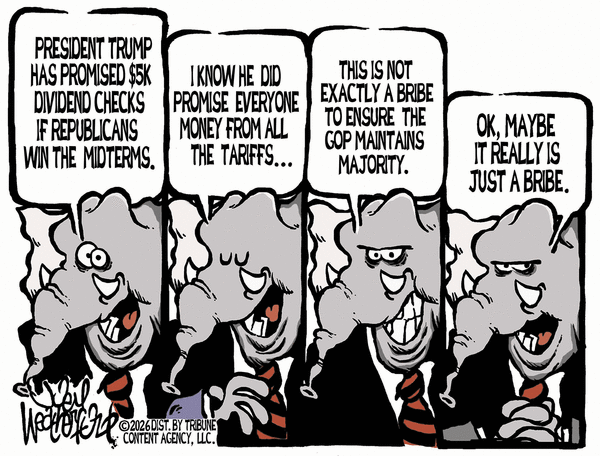
Monte Wolverton Battle Ground, WA


Dave Granlund PoliticalCartoons.com


John Cole Tennessee | Lookout


Gary McCoy Shiloh, IL


Gary McCoy Shiloh, IL


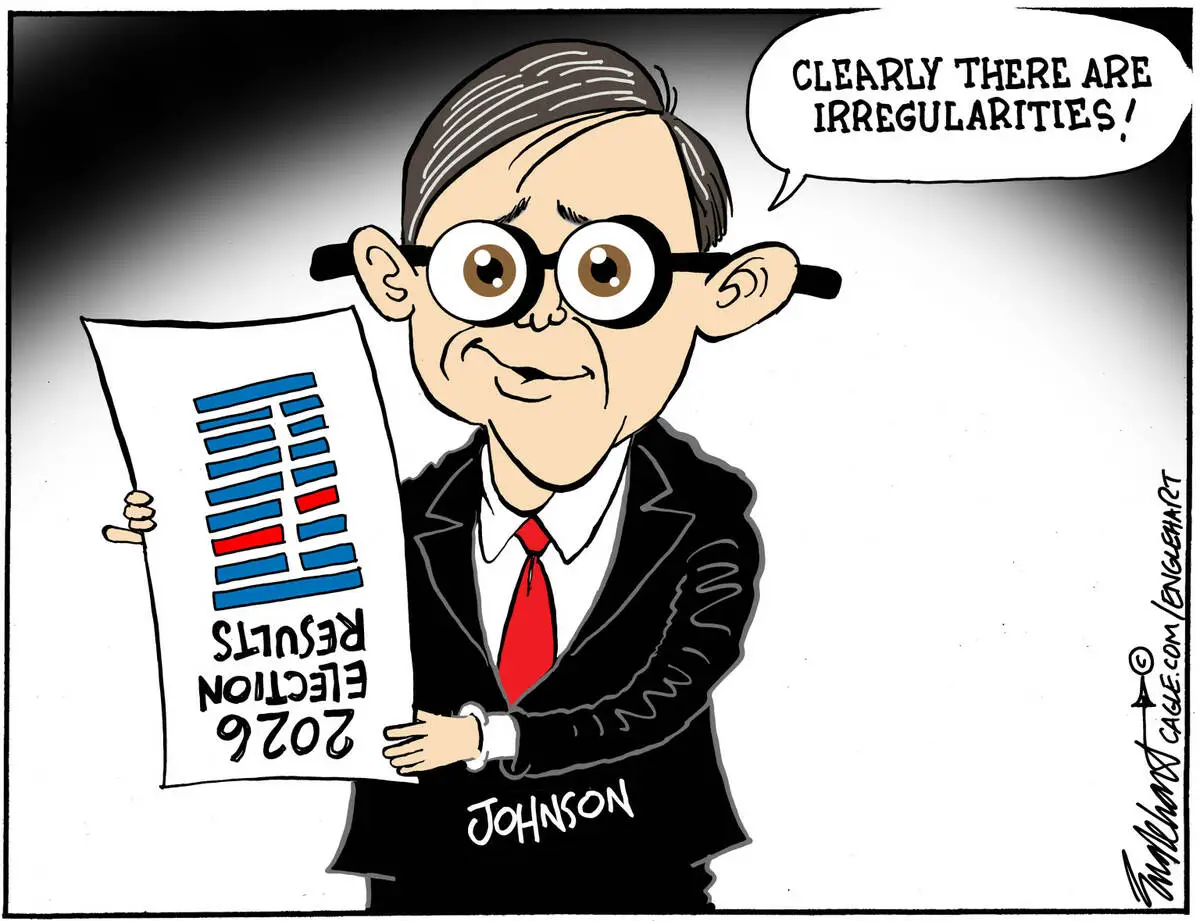
Bob Englehart PoliticalCartoons.com


Harley Schwadron CagleCartoons.com

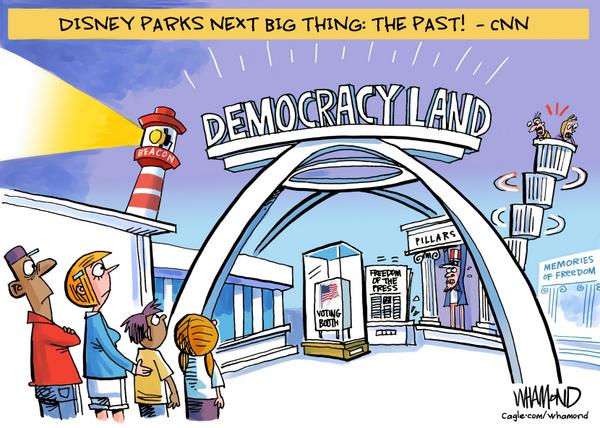
Dave Whamond PoliticalCartoons.com


Bill Day FloridaPolitics.com


Harley Schwadron CagleCartoons.com


Christopher Weyant The Boston Globe


John Darkow Columbia Missourian

Dave Whamond PoliticalCartoons.com


Someone Is Helping Control Data Center Development

‘Nobody’s negotiating for the people here’: comedian Charlie Berens takes on AI datacenters

Daniel A Medina

Sun 17 May 2026 07.00 EDT

Last summer, journalist turned comedian Charlie Berens started getting social media messages from concerned Wisconsin residents about plans for a massive datacenter campus in their state.

The developer, Vantage Data Centers, claimed the $8 bn project would largely run on zero-emission energy resources like solar, wind and battery storage. The company said the campus would bring thousands of temporary construction jobs and potentially more than 1,000 permanent jobs to Port Washington, a city of 13,000 people about a half-hour north of Milwaukee. Residents opposed the project for what they said was lack of transparency and criticized the lucrative tax incentives offered to Vantage. They worried about the strain on local water and energy sources from an enormous 1.3-gigawatt project that could ultimately span 1,900 acres.

Berens, who shot to internet fame with his “Manitowoc Minute” videos that play on midwestern quirks and stereotypes, had his own reservations about the artificial intelligence datacenter boom. A Milwaukee-area native who still lives in the city, he’d heard about the potential environmental hazards, the steep rise in energy costs for neighbors and noise pollution, among other risks.

When he Googled, he found that lawmakers in his state had paved the way to make the Port Washington project a reality. The deal between Port Washington and Vantage gave an estimated $458m in tax breaks to the developer over 20 years to fund infrastructure for the project, with the city not seeing any of that tax revenue during that period.

“It was shocking,” Berens said.

That’s when he decided to do something he had rarely done before: discuss politics in his videos. He used his platform to address one of the more polarizing issues in contemporary life: what AI portends for Americans.

In August 2025, Berens published his first “Manitowoc Minute” video on AI datacenters. The two-minute skit matched the typical style of Berens’s videos, where he intersperses facts with humor in the style of a TV news report. But he was remarkably direct in his critique of big tech. Sporting a Green Bay Packers tie, he lambasted Silicon Valley CEOs, accusing them of using Wisconsin as a “dumping ground” for datacenters at the expense of the state’s cherished natural resources while evading any type of public scrutiny.

“It is our civic duty to make sure the billionaires become trillionaires,” said Berens in a satiric bit.

He channelled his outrage at lawmakers in Port Washington, a historic city on the banks of Lake Michigan and once home to thriving fishing and shipping industries. In a contentious vote last August, officials there approved the initial $8bn datacenter campus despite strong resistance from residents. (The project later expanded to a $15bn joint venture with OpenAI and Oracle, one of the Trump administration’s showcase “Stargate” megaprojects.)

“I was shocked at how many people I saw speak against this [at public meetings he watched online] and then to see a unanimous vote for it,” Berens said. “It just felt like an imbalance of democracy.”

The video went viral, garnering more than 2.5m views on YouTube alone. Berens’s inbox was soon flooded with messages of support from Wisconsinites of all political stripes – self-declared Maga supporters, avowed socialists and everyone in between – sounding the alarm on datacenters.

“It was 99% positive comments, which doesn’t happen on anything these days,” said Berens. “From that point, I decided that I should do more because nobody’s negotiating for the people here.”

Berens has since thrown himself into the cause, routinely publishing videos and headlining well-attended events with field experts and anti-datacenter activists. He has quickly become the most famous face of a burgeoning movement in Wisconsin, where resistance to these projects – Port Washington is just one of seven hyperscale datacenter projects across the state – has risen dramatically in the last year. A March survey from Marquette University Law School found that nearly 70% of registered voters in Wisconsin say the costs of large datacenters outweigh the benefits they provide, a remarkable shift from last October when that figure stood at 55%.

The attention has placed the comedian in the crosshairs of most of the state’s labor unions, pro-business groups and much of its political establishment, who argue the badger state cannot afford to be left behind in the AI arms race.

In a series of interviews, Berens laid out why he decided to jump head-first into the movement; his case for how big tech destroyed public trust through hard-armed, often secretive tactics to push forward datacenters; and what he has learned as he has crisscrossed the state and toured the country.

“Every step of the way, the more people look, they’re seeing that this is not really a fair fight here,” said Berens.

‘Protecting the people

On a late winter evening in March, hundreds of people packed a community center in Juneau, a tiny rural town about 45 miles north-east of the state capital, Madison.

The crowd had assembled for a “people’s town hall” to address a $1bn Meta datacenter that has pitted residents of nearby Beaver Dam against their elected officials. The featured speakers ranged from community activists to a former Meta employee. The main act was Berens, who squeezed in the appearance between stops in Iowa and Vermont on his standup comedy tour.

“This is the most bipartisan issue since beer,” he said in opening remarks.

view of a construction site for an AI datacenter
Construction is ongoing at the Beaver Dam Commerce Park where a new Meta datacenter is being built on 2 February 2026 in Beaver Dam, Wisconsin. Photograph: Wisconsin Watch/Getty Images

In his roughly 15-minute speech, he called for more regulation of AI, pointing out that a beloved Wisconsin staple, bratwurst, was more heavily regulated than the trillion-dollar industry. Berens warned the audience of the risks of AI technology, running through a slideshow of news headlines that highlighted the potential, and very real, harm to children. He also addressed his critics.

“I will stick to comedy when our politicians stick to policy and stop protecting big tech and start protecting the people that put them into office,” said Berens, to applause.

As he turned his attention to the project in Beaver Dam, he attacked Meta’s use of a shell company and nondisclosure disagreements (NDAs) that required secrecy from some public officials in the process of getting to an approval. In April 2025, a report found Meta was the mystery tech company behind Degas LLC, the listed corporation on the development. By November, the company acknowledged they were behind the project.

Meta’s practices in Beaver Dam are part of a larger pattern across the state, where datacenter projects have often been developed in secrecy despite their huge price tags and massive footprint on communities. A recent investigation from Wisconsin Watch, a non-profit news site, found that NDAs have been signed in at least five cities in Wisconsin where AI datacenters are proposed or under construction.

Another panel speaker that night was Maily Kocinski, a lifelong Beaver Dam resident whose farm lies less than 2 miles from the 700,000 sq ft datacenter campus construction site. Last June, she posted a TikTok video after a creek that runs on her property had gone dry one morning. The water came back, but occasionally appeared milky white and gave off a toxic smell. Kocinski said she contacted the state’s department of natural resources on several occasions and was told the agency collected water samples but were not always able to reach her property in time before the water cleared up again.

She personally commissioned a water analysis in February from a lab at the University of Wisconsin-Stevens Point, which found metal levels in her well water above what was considered safe to drink, per recommendations from the Wisconsin department of health services. She questions whether the daily controlled blasts on the construction site led to disruptions in her water supply. Meta commissioned its own study in response, denying any link.

A spokesperson for the Wisconsin department of natural resources confirmed that the department collected a water sample at Kocinski’s creek last November. The results, shared with the Guardian, show elevated metal levels but the department did not speculate as to the potential cause.

“Without a site specific review, the DNR cannot speculate on the role of the blasting on the aquifer and Ms. Kocinski’s private water supply,” the spokesperson said in a statement.

a group of people protesting against datacenters in front of a capitol building
Protesters gather for a statewide datacenter day of action at the Wisconsin state capitol on 12 February 2026 in Madison, Wisconsin. Photograph: Wisconsin Watch/Getty Images

Kocinski, an elementary school teacher, said since last fall, she has spent up to 15 hours a week researching the large-scale construction of datacenters and the potential environmental harms they can wreak in a community. In March, she testified in the Wisconsin senate in favor of a datacenter oversight bill that ultimately failed to reach a vote.

She said she had never met Berens before the event in Juneau but the two had been in regular contact for months after she cold-emailed him her story.

“Charlie has really put in the work to understand this issue,” said Kocinski. “Most people came to Juneau probably because he was there, but they stayed and maybe learned a bit about these things [datacenters] … That kind of education leads to action.”

The risks of speaking out

As Berens’s critiques of datacenter projects in Wisconsin have gained traction with the public, he has faced pushback from the state’s trade unions, who welcome the thousands of temporary construction jobs that typically come with a project.

A major Wisconsin labor leader called out Berens in a December op-ed in the Milwaukee Journal Sentinel. “For us in the building trades, data centers aren’t some big, scary mystery,” wrote Emily Pritzkow, head of the Wisconsin Building Trades Council that represents nearly 50,000 workers in the state. “They’re high-skill, long-term work. The kind of work that feeds families, pays mortgages, and sends kids to college.”

Local governments have weighed in too. In Port Washington, city officials posted a “fact sheet” online to “clarify some lingering misconceptions” after Berens posted a second video urging residents to question officials about the datacenter project at an October council meeting.

Ted Neitzke, Port Washington’s mayor, expressed frustration with the attention that Berens’s videos had brought his city. He noted that more than 100 people began showing up at council meetings after the comedian published his first video last August, forcing the city to move them to a hotel conference center with an added police presence.

“After Charlie Berens’s video, things escalated very rapidly, very contentiously, and our city was besieged with people from outside of our town,” said Neitzke. “Charlie Berens created chaos for us.”

Neitzke also challenged some claims Berens has made in his videos, including those about the amount of jobs the project would create, its environmental impact and whether residents’ power bills would increase.

“I don’t know where the line gets drawn between factual and embellishment for him,” said Neitzke. “There’s a very gray area between the entertainment and the facts.”

Berens defended his videos and the people who showed up to council meetings in response, noting that a hyperscale datacenter affects not just one city but the surrounding communities and “they deserve a say too”. He maintained that his videos were well-researched and cited news articles to back up his claims.

“I informed people about a massive AI datacenter going up by adding some punchlines,” said Berens. “If the truth brings chaos, that seems like something the mayor would want to take accountability for.”

Neitzke met with Berens last fall in an attempt to find common ground. The mayor described the two-hour meeting as cordial but both left in disagreement. He has been the project’s greatest champion, referring to it as a “transformative” development for the Rust Belt city, one that has the potential to once again make Port Washington a hub in the midwest.

That stance has drawn some fierce public opposition, even leading to an attempted recall effort over the $458m tax incremental finance, or TIF, district with Vantage. Under the deal, Vantage will pay upfront costs for the development and the city will reimburse the company with new property tax revenues over a period up to 20 years. Neitzke said he was no fan of TIFs but called them a “necessary evil” in negotiations to win the contract over other cities chasing major developments to boost revenue.

“This is a save our city strategy,” said Neitzke. “[Berens is] doing what he does, and we’re going to do what we’re doing.”

Berens has also faced criticism online from those who say the comedian has built his career on tech platforms, while looking to close the door to their projects in Wisconsin. He said he “understands the irony” but wants to use his sizable platform to educate his audience on these types of developments that could remake their communities.

a man on stage interacts with an audience member by fist bumping them
Berens engaging with his audience on stage. Photograph: Todd Rosenberg

Advertisers, too, have noticed his shift to politics. Berens acknowledged that he lost a major brand deal with a company that did not want to appear alongside his anti-datacenter content, though he declined to name the business.

“I’m asking for transparency. I’m asking for honesty. I’m asking for people to get informed,” said Berens. “I’m trying to facilitate that and if that at the end of the day means I lose everything, then so be it.”

A personal evolution on AI

Berens was not always an AI pessimist.

A few years ago, he believed the utopian vision laid out by AI luminaries like OpenAI’s Sam Altman, who spoke of how the technology could be used to cure social ills, even to treat intractable diseases. Berens thought maybe it could also help Wisconsin deal with its Pfas contamination issue. “My interest in AI started with a lot of hope and optimism actually,” he said.

That sentiment eventually turned to cynicism as, he claims, the industry’s billionaire CEOs dispelled any virtuous use of the technology for the social good in favor of enriching themselves and their investors. He cited Altman’s recent efforts to create an Erotica feature in OpenAI’s ChatGPT chatbot, despite concerns even from the company’s advisers that such a tool could create a “sexy suicide coach”, according to a Wall Street Journal report.

“I thought this thing was supposed to cure cancer,” Berens said, referencing Altman’s past statements. “Is this what we’re giving our land for? Is that what we’re giving our water for? Is this what you’re asking to change our communities for?”

For him, the “tip of the iceberg” was the gold rush to build hyperscale datacenters in his state through secretive tactics and potentially exploitative agreements in post-industrial cities longing for an economic revival.

“Wisconsin created an environment that would please the billionaire tech companies,” said Berens of the tax incentives. “Billionaire tech companies took full advantage of that.”

Prescott Balch knows a bit about those types of corporate tactics. A former technology executive at US Bank turned anti-datacenter activist in retirement, Balch was on the frontlines of the successful effort to stop a major Microsoft AI datacenter project last fall in the picturesque eastern Wisconsin village of Caledonia, where he lives. In April, he won a seat on the town’s village board, beating an incumbent who supported the datacenter. He views the AI datacenter boom as akin to the dot-com bubble crash of the early 2000s, another chapter in the boom-and-bust cycles of the volatile tech industry.

“We got irrationally exuberant and built too much stuff,” Balch said of the dot-com period. “Maybe the company running your datacenter will go bankrupt. This big dollar amount that you’re chasing comes with significant risk.”

Balch’s insider expertise in the wonky world of municipal subsidies has been fundamental for Berens. Balch factchecked many of Berens’ videos on the issue, even appearing in one where he methodically crunched the numbers on these developments, referring to the Port Washington project as “up and down a horrible deal”.

The 62-year-old is, in many ways, the polar opposite of Berens. He is professorial in demeanor and careful to point out that he is not an AI alarmist. Where the two agree is a belief that there’s been an information vacuum around these projects, leaving the public largely uninformed about their size and scope. That’s part of the message they have taken on the road, appearing together at events in Wisconsin and Illinois. Berens’s celebrity has been the draw for people to turn out.

“[He] gets people interested in the topic and warms them up,” Balch said. “And I get to do the dry delivery of the financial perspective.”

Port Washington vote

On 7 April, Port Washington residents passed the nation’s first anti-datacenter referendum. By a roughly 2-1 margin, voters approved a measure that would require city officials to get approval from voters before approving tax incremental districts of more than $10m.

an aerial view of Port Washington showing trees and houses
An aerial view of Port Washington, Wisconsin. Photograph: Lena Platonova/Shutterstock

The effort came together after a group of residents called Great Lakes Neighbors United gathered more than 1,000 signatures in less than two weeks to get it on the ballot. The referendum does not stop the $15bn datacenter campus under construction, but would apply to all future projects above that $10m threshold. Industry advocates have warned the vote could set a dangerous precedent for municipalities across the country, potentially paralyzing AI datacenter developments.

Mayor Neitzke said the referendum makes the city less competitive and puts it at a disadvantage to vie for future projects. For Berens, the vote reflected the energy he has seen on the ground in Port Washington and in every corner of the state.

“The people who are the heartbeat of this movement are like people in Great Lakes Neighbors United,” said Berens. “These are people from all different walks and all different political stripes, but they all care about the same thing: [that] their community should have a voice.”

© 2026 Guardian News & Media Limited or its affiliated companies. All rights reserved. (dcr)

Political cartoons / memes / and news I want to share. 5-17-2026


Dave Whamond PoliticalCartoons.com


Political/Editorial Cartoon by Bob Englehart, Hartford Courant on MAGA Weakens Slightly


A man is holding a baseball and talking to a child holding a bat.

“Keep your eye on the ball—not on the mess the grownups have made of things.”

A rooster and a hen watch TV in a living room.

“When are we gonna get to the other side?”

A woman and a girl stand in a kitchen.

“The grownup version of ‘mewing’ is called ‘gritting your teeth.’ ”


A man and a woman watch TV in the living room.

“Sometimes I wonder if we’ll ever know the truth about anything.”


Bill Bramhall for 5/16/2026


John Deering for 5/16/2026


Bill Bramhall for 5/12/2026

Jeff Danziger for 5/13/2026


Mike Luckovich for 5/14/2026


Steve Breen for 5/12/2026


Chris Britt for 5/14/2026


Joel Pett for 5/14/2026


Dave Granlund PoliticalCartoons.com


Manny Francisco Manila, The Philippines

A woman standing next to her car reads a sign with gas prices “REGULAR 6.50 PLUS 6.70 PREMIUM 6.90 BUNDLED W HULU 16.90.”


Bill Bramhall for 5/17/2026


Drew Sheneman for 5/13/2026


Steve Breen for 5/16/2026


Drew Sheneman for 5/15/2026


Joel Pett for 5/15/2026


Political/editorial cartoon


Political/editorial cartoon


Political/Editorial Cartoon by Milt Priggee, www.miltpriggee.com on SCOTUS Lynches Voting Rights

Political/Editorial Cartoon by Dave Granlund on SCOTUS Lynches Voting Rights


Clay Bennett for 5/15/2026

John Deering for 5/13/2026

Chris Britt for 5/12/2026


Harley Schwadron CagleCartoons.com

Harley Schwadron CagleCartoons.com

Lisa Benson 5/15/2026


Dick Wright PoliticalCartoons.com


Clay Bennett for 5/13/2026


Mike Luckovich for 5/15/2026


Margolis & Cox PoliticalCartoons.com


Monte Wolverton Battle Ground, WA

Tom Stiglich for 5/12/2026


Michael Ramirez for 5/15/2026

Drew Sheneman for 5/12/2026


Chris Britt for 5/15/2026


Political/editorial cartoon


Mike Luckovich for 5/17/2026

Jon Russo for 5/15/2026


Mike Luckovich for 5/13/2026


Clay Bennett for 5/16/2026


Michael Ramirez for 5/17/2026

Bill Bramhall for 5/14/2026

Jeff Danziger for 5/15/2026


Bill Bramhall for 5/13/2026


Drew Sheneman for 5/14/2026


John Deering for 5/14/2026

Jon Russo for 5/14/2026

Joel Pett for 5/12/2026


Jon Russo for 5/13/2026


Political cartoon of the day


Gary McCoy Shiloh, IL


A short video about how tired I have been and Ron’s car crash.

Best wishes for all and hugs for those that want them.