
A fine tribute by Charlotte Clymer.
If You Don’t Understand Jason Collins
Allow me to explain.
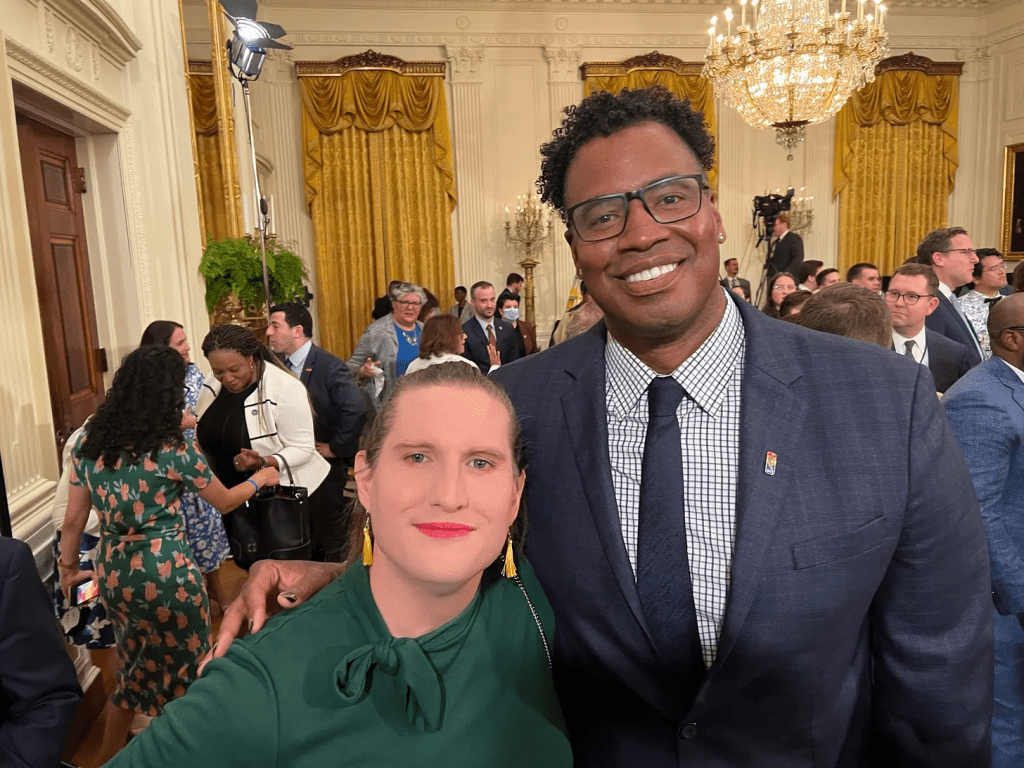
(Mr. Collins and me at the White House in 2022.)
We were eight, nine, ten-years-old, and we called it “Smear the Queer.”
The game went like this: there were a group of kids—nearly always all boys—and a football. The pigskin got tossed up, a boy would grab it, the rest of us would chase and tackle him, and either he would surrender the ball or one of us would take it, and the chasing and tackling would start all over again.
That was the whole game. It was basically freeform rugby with no points, but this was Central Texas in the mid-90s and none of us were aware of rugby, so we thought of it as reverse tag with violence.
We called it “Smear the Queer” because that’s what the older boys called it. They called it that because the boys older than them called it that. Or that’s what their older brothers called it. Or that’s what their fathers and uncles called it.
At that age, I don’t think there was any discussion on the etymology of the word “queer” or why the ball carrier was called “the queer.” That was just the name of the game, and if you had a group of young boys and a football and enough interest, a kid might say “Smear the Queer?” and the game would start.
We were conditioned to think of being gay as a bad thing before we knew what it meant to be gay. By the time we got to middle school, it was made crystal clear to us that there were two things it was absolutely wrong for a boy to be: either gay or a girl.
If another boy called you gay or a girl, it was either because they were being “friendly” (or what passed for “friendly” among boys then) and playfully teasing you with the easiest insult — or they really didn’t like you and were going for the jugular with the worst insult. The intent was based on context, but at the end of the day, being gay or being a girl were not good things.
By that age, homophobic and sexist language had seeped into casual conversations among most of our peers. “That’s gay” was the most common way of saying a situation sucked.
“Wanna come over and play video games after school?”
“Can’t. Got detention.”
“That’s gay.”
“Yeah.”
At the close of the ‘90s, the words “faggot” and “pussy” were at the center of teenage boy lexicon. And a lot of the teenage girls used them, too. These terms flew freely in the hallways of middle school and sometimes in the classroom. Some teachers and parents might put a stop to it, and some teachers and parents willfully ignored it.
I got called “faggot” so many times in those years that I was pretty much resigned to it long before high school.
I was called a faggot for being in choir. I was called a faggot for getting good grades. I was called a faggot for reading. I was called a faggot for listening to Mariah Carey. I was called a faggot for my girlish laugh. I was called a faggot for my mannerisms. I was called a faggot if I did something nice. I was called a faggot for being smaller than the other boys. I was called a faggot for not wearing the right clothing. I was called a faggot for the way I walked. I was called a faggot for the way I talked. I was called a faggot if I followed the rules. I was called a faggot because a boy just didn’t like me. I was called a faggot because a boy in my grade might just feel like saying “faggot” and I was conveniently there.
I never said “faggot” or “that’s gay” myself because it felt wrong. I had a gay uncle. He had a boyfriend. They would come over and hang out and drink and smoke with my mother and stepfather. They were always welcome. The four of them would have a grand ole time.
This did not stop my mother and stepfather from asking my uncle and his boyfriend to sit me down when I was nine or so and make it clear that I needed to act like a boy and never act like a girl because everyone could see the writing on the wall and they wanted to prevent me from getting my ass kicked by other boys.
I didn’t understand their intent at the time. I felt very confused. I thought I had been acting like a boy. Apparently not enough. I needed to try harder. I had no idea what “try harder” meant.
What I remember most is my uncle’s boyfriend giving me a serious look and saying the following: “Don’t be a faggot, kid.”
The world that was supposedly the opposite of “being gay” was professional sports. Football, basketball, baseball. Emmitt Smith, Troy Aikman, Michael Jordan, Kobe Bryant, Allen Iverson, Barry Bonds, Mark McGwire, etc.
These men were considered the opposite of gay. They were big and strong and famous and talented and handsome and all the girls loved them and all the boys wanted to be them.
At least where I grew up, the thought of gay men in professional sports was so far removed from rationality that it never came up in conversation. Male celebrities in music, film, and television? All fair game for speculation. But not sports. There was no way a man could be gay if he were a pro athlete. Impossible.
When Jason Collins came out 13 years ago this spring, you could have knocked me over with a feather. My peers and I had grown up, and the world had rapidly changed in such a short time. And yet, it was still a jarring, welcome surprise.
By then, homophobic language was largely frowned upon, even by many conservatives who opposed LGBTQ rights. It felt like everyone personally knew someone in their lives who were openly gay. And the vast majority of folks, regardless of politics, were then enjoying entertainment made by openly-gay celebs.
“Don’t Ask, Don’t Tell” had recently been repealed, which meant gay, lesbian, and bisexual folks could serve openly in the military. Tammy Baldwin had recently become the first openly-LGBTQ person elected to the U.S. Senate in Wisconsin, and she had seven openly-LGBTQ colleagues in the House, not including Barney Frank, who had retired from Congress on the same day she was sworn-in.
It felt at the time like same-sex marriage could possibly be legalized nationwide within the decade but maybe not. It wasn’t anywhere near certain. Possible, yes, but no guarantee. Yet, just that it was possible felt incredible.
But male sports? Many years away, it was assumed. Americans could accept gay and bisexual male soldiers dying on their behalf but openly-gay men in the NFL, NBA, MLB, and NHL? Not for a long time to come.
It wasn’t that most of us thought there weren’t closeted gay men in the leagues. We assumed there were. Statistically, how could there not be closeted gay men playing pro sports?
But they weren’t going to come out while still playing. Nope, not for a long time. Pro sports were (and remain) the last cultural bastion of American masculinity, the sole extracurricular distraction of tens of millions of American men who don’t want anything uncomfortable messing up their entertainment.
Make music. Make movies. Serve in the military. Run for office. Get married. Go be gay and live your life. Just stay away from male sports.
It mattered little to them that Sue Wicks and Sheryl Swoopes and other women had come out in the WNBA by then. It mattered little to them that lesbian and bisexual women were, by 2013, out in every major pro women’s sports league. All were courageous, all were leaders, all faced discrimination, and yet, a strange misogyny permitted Americans—particularly men—to have an uneasy, conditional acceptance of openly-gay women in major pro sports but not openly-gay men.
This was the environment in which Jason Collins came out. Everything about it astonished me. The cover of Sports Illustrated? Doing so while a free agent after the season had ended and making a huge gamble on his career? Doing so as a Black man in a country with a long history of diminishing and dehumanizing Black masculinity?
I was in awe of him. I remain in awe of him.
No teams signed him in the offseason. Maybe it was his production on the court. Maybe there were no teams who thought he’d be a good fit for their needs. Maybe—just maybe—even with the general support he received, it was because he was now an openly-gay man and no teams wanted that controversy.
Even with NBA superstars like LeBron James, Kobe Bryant, Dwayne Wade, Steve Nash, and many others praising his courage and saying all that mattered was the game itself and meeting the standard of excellence, he still got passed over.
It was ten months later when, finally, the Brooklyn Nets signed Mr. Collins to a ten-day contract. February 23rd, 2014. Jason Kidd—the coach of the Nets and a former teammate and good friend of Mr. Collins—pushed for the contract. He played that night for 11 minutes against the Lakers. The first openly-gay man to compete in any of the four major male pro sports leagues in North America.
He would eventually be signed for the remainder of the season with the Nets and retired from pro basketball that November.
But here’s what really gets me about Jason Collins: he never rested on his laurels, nor did he decide coming out while an active gay male pro athlete was enough, even though, I would argue, he’d have been well within his right to do so.
Jason Collins had that quality inherent in all great leaders: a heart for service. He always thought about others. He always wanted to lift up others.
It was only revealed after he came out that he had worn No. 98 on his jersey while with the Celtics and Wizards—when he was still closeted—in honor of Matthew Shepard, the 21-year-old, openly-gay man who was beaten, tortured, and murdered in Laramie, Wyoming in 1998.
He returned to No. 98 after coming out and signing with the Nets. It became the highest-selling jersey in the NBA for a time. He had that level of impact with his courage.
He consistently supported others in the broader LGBTQ community, even when he had no personal connection to us.
Several times over the years, Jason Collins—the retired NBA pro—reached out to me—a little-known trans woman political writer— over social media just to offer words of encouragement and make sure I felt supported and loved — because he saw the vile hatred trans folks were experiencing.
He would tell me he was proud of me. He would remind me that I should keep my chin up and be proud of myself. I remember one random occasion in 2020, as tired and stressed as I was during the presidential campaign, when I opened a DM from Jason that simply read: “Sending you a big hug today.”
Jason Collins went out of his way to be a big brother to queer folks he didn’t know just because he wanted to ensure we didn’t feel alone in tough moments. He felt protective of us because he knew, more than just about anyone, that sharp pang of loneliness in the public arena.
Many of us received an email this past Monday evening from Jason’s husband, Brunson Green, informing us that Jason was headed to hospice care and requesting we record a video offering words of love and what he means to us.
I cried after the reading the email and got to writing. It didn’t feel like enough. How do I tell this man how much he’s meant to me, meant to all of us? I decided to rewrite it (yet again) and film it and send it by the following evening. I wanted to do it right. He deserved at least that. He deserved way more than what I could offer.
Jason passed the next day before I could send it. I will forever regret not telling him all this, even though he likely wouldn’t have seen it in the mountain of videos his family received from countless people who loved and admired him.
What gives me comfort is knowing he was surrounded by those who loved him most, supported by millions who have thought about him this week, said a prayer for him, acknowledged his greatness and his humanity, given thanks for his selflessness and public service.
The world lost a great man on Tuesday.

