
Black Skimmer
Rynchops niger
Wayaya (Wayampi)
Also Known As
- Tayataya (Carib)
- Pa’â guasu (Guaraní)
- Iwenti (Palikúr)
- Corta-Mar (Portuguese)
- Rayador (Spanish)
About
A group of Black Skimmers in flight resembles an aerial ballet, circling, banking, and gracefully alighting as one. Although taxonomists place this unique, long-winged waterbird in a separate genus, it’s closely related to gulls and terns.
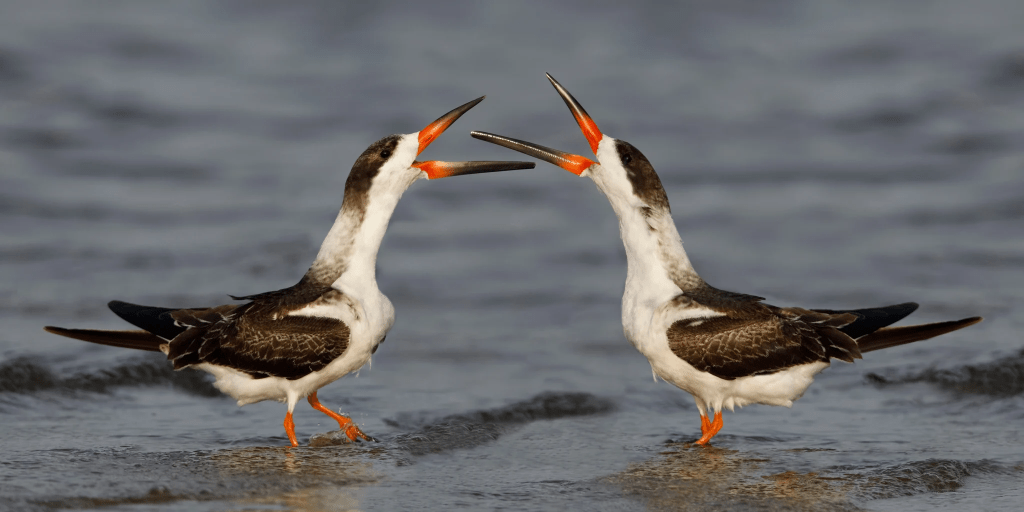
The Black Skimmer’s most striking feature is its gaudy red-and-black bill: Both jaws are long and narrow like a knife blade, with the lower jutting out well beyond the upper. Its unique appearance lends the Black Skimmer a number of evocative folk names, including Scissor-bill, Cutwater (Cortagua or Corta-agua in South America), and Seadog (after its calls, often compared to dog barks).
This odd bill is what affords these birds their distinctive foraging style, and the name “skimmer.” A feeding skimmer flies low over the water with its beak open and lower mandible partially submerged. Where a broader bill would send a continuous spray of seawater straight down the throat of another species, the uniquely narrow mandible of the skimmer cuts through the water like a fin. When the extended lower mandible touches prey, such as a small fish, the bill’s upper mandible snaps down, securing the bird’s meal.
Another remarkable feature of the Black Skimmer is its eyes, which have large pupils that can narrow to vertical slits, like a cat’s pupils. This adaptation compensates for glare off the water’s surface and may enhance the bird’s vision as it hunts in dim light or at night.
Threats
According to the North American Breeding Bird Survey, Black Skimmers have declined in the United States by almost 90 percent since 1966. This is largely due to habitat loss and human disturbance at nesting colonies. These birds are also affected by oil spills and chemical pollution in coastal waters, and may face additional threats during the breeding season with climate change as sea levels continue to rise. (snip-MORE)


One thought on “Your Saturday Bird Post:”