Justice Jackson In Court, re The 14th Amendment

Black America Rallies Behind Justice Kentanji Jackson as She Shreds Trump’s Birthright Challenge

Ketanji Brown Jackson stood out from several justices appearing to be skeptical of the president’s argument against the Citizenship Clause in the 14th Amendment.

By Phenix S Halley

As the Supreme Court continues to debate President Donald Trump’s case to end birthright citizenship, Justice Ketanji Brown Jackson is going viral after clips of her questioning Trump’s interpretation of the 14th Amendment began circling the internet.

(embedded social media post-see it on the page)

As we previously told you, the high court heard arguments on Wednesday (April 1) for the landmark case. Jackson stood out from several justices, appearing to be skeptical of the president’s argument against the Citizenship Clause in the 14th Amendment. Specifically, the first Black woman Supreme Court Justice grilled Solicitor General D. John Sauer about how enforcing Trump’s January 2025 executive order would actually work.

“How does this work? Are you suggesting when a baby is born people have to present documents,” Jackson asked. “Is this happening in the delivery room? How are we determining when or whether a newborn child is a citizen of the US under your rule?” 

The Root reported that the president attempted to axe birthright citizenship on his first day back in the White House and was met with serious backlash from folks who saw the order as an attack against immigrants and an attack on the U.S. Constitution.

Online, folks praised Jackson for getting straight to business. “Had his a** sounding like he just smoked a whole carton of Newport box short cigarettes,” @PatrickJnmarie said.

(embedded post, visible on the story page)

Pew Research estimated that 320,000 infants were born on American soil to immigrant parents without authorization in 2023. Under Trump’s order, babies of millions of migrants who enter the country– legally or not– wouldn’t automatically be eligible for citizenship. This is a complete turnaround from the way the U.S. has viewed birthright citizenship since 1868.

“This isn’t just a misstep it’s a fundamental misunderstanding of the Fourteenth Amendment to the United States Constitution,” @Popular_EY said.

Other folks online gave President Joe Biden credit for choosing Jackson for her position on the court. “Shoutout to President Joe Biden. You did good, kid,” @CarolDright said. “God love ya.” @WmAG_V agreed, writing, “Joseph Robinette Biden Jr did his MF job when he got Justice KBJ on the bench!”

Jackson became the first Black woman to serve as Supreme Court justice back in 2022. Since then, she’s positioned herself as a liberal leader unafraid to go against her fellow justices on the bench. “Justice Ketanji is head and shoulders above trumps DEI pics on the Supreme Court,” @ClaudetteGGibs1 tweeted.

(embedded tweet or whatever they are on X, on the story page)

But while many Black folks rallied behind Jackson’s Wednesday remarks, she was also met with conservative and MAGA supporters like Fla. Gov. Ron Desantis, who called her bluff.

Still, it seems Jackson is supported by plenty of Black Americans rooting for her. “Ketanji Brown Jackson has more real, hands-on experience in the justice system than any current Supreme Court Justice—including the Chief,” @lab_ftwtx pointed out. “She’s been a public defender, a trial judge, and an appellate judge. She’s actually worked at every level, not just one side of it. Facts.”

Internet Shutdowns Should Be Discussed

When repression meets resistance: internet shutdowns in 2025

PUBLISHED: 31 March 2026 LAST UPDATED: 31 March 2026

Everyone is on high alert, constantly watching the sky with fright and exhaustion […] We also keep our eyes on our mobile phone connections — the moment the signal drops, we immediately take cover in underground shelters. We’ve come to understand that a loss of communication signals an impending airstrike. Humanitarian aid worker on the internet shutdown that took place in Myanmar during air strikes near Tamu township in the Sagaing region.


The 2025 data and analysis confirm a horrific reality: internet shutdowns are increasing, not decreasing — and their impact on people’s lives is devastating. Shutdowns reached a new record high in the past year, continuing the steady increase since 2020. Our new report, Rising repression meets global resistance: Internet shutdowns in 2025, documents how democratic and autocratic governments alike deploy them to silence, collectively punish, and terrorize populations, as well as to hide human rights violations and killings. At the same time, we highlight how resistance is growing and people’s power is rising, and offer recommendations for stakeholders to push back. From Myanmar to Iran, Tanzania to Nepal, communities are challenging repression, demanding accountability, and devising new ways to reconnect during blackouts.

read the report

In 2025, Access Now and the #KeepItOn coalition documented 313 shutdowns in 52 countries, surpassing the appalling records from 2024 (304) and 2023 (289). Seven new countries joined the offender list in 2025, meaning that people in 100 countries have now experienced a shutdown since we started tracking in 2016. As 2026 began, there were 75 shutdowns in 33 countries that persisted from 2025, a significant increase from the 54 shutdowns in 26 countries that were ongoing from 2024 into 2025. This shows that perpetrators are increasingly attempting to permanently block communications platforms or even keep entire populations cut off from the internet indefinitely.

If you can’t see the highlights below, please check your privacy-enhancing browser extensions. Open in desktop view for the best experience.

https://www.accessnow.org/internet-shutdowns-2025/

About Conversion Therapy

A Christian ‘Conversion Therapy Dropout’ on the Supreme Court’s Decision

By Tyler Huckabee

On March 31, the Supreme Court sided with a Christian therapist in Colorado and tossed out the state’s ban on conversion therapy for minors. The therapist, Kaley Chiles, challenged the state’s ban on the grounds that it violated her First Amendment rights. The Court agreed with Chiles by an 8-to-1 vote.

Conversion therapy is a practice that generally involves treatment intended to “cure” same-sex attraction or gender dysphoria. Every major medical study has determined that conversion therapy does not work and often leads to serious mental health problems for patients who are subjected to it. Timothy Schraeder Rodriguez knows that from personal experience.

Rodriguez is the author of Conversion Therapy Dropout: A Queer Story of Faith and Belonging, which will be released on May 5. The memoir unpacks the eight years Rodriguez spent in conversion therapy, struggling to reconcile the tension between the version of Christianity he had been taught growing up and his sexual identity. For Rodriguez, the path to healing began when he accepted that there was no tension.

Rodriguez told Sojourners the Supreme Court’s decision is deeply personal and painful, and he hopes that his story will both help LGBTQ+ Christians feel a little less alone and help convince non-affirming Christians to rethink their convictions.

This conversation has been edited for length and clarity.

Tyler Huckabee, Sojourners: When critics talk about the harm that conversion therapy can cause, particularly for minors, what sort of harm are we talking about?

Timothy Schraeder Rodriguez: Where to begin? There’s documented research to show that anyone who experiences conversion therapy, especially as a minor, is subject to higher rates of depression and anxiety. The suicidal ideation rate nearly doubles for LGBTQ+ youth who have experienced conversion therapy, and then the long-term effect of it tends to show up in the inability to create lasting relationships, substance abuse, all those kinds of things. It’s a very devastating practice in the sense that it attacks body, mind, and spirit. When all three of those parts of yourself have been attacked, disengaging from the harm that that causes takes a lot of time and a lot of real therapy. But a lot of folks who have experienced conversion practices are untrusting of therapeutic spaces.

What arguments did conversion therapy advocates use that convinced the Supreme Court to side with them?

They were able to successfully reduce the idea of what the role of a therapist in a therapeutic setting is: that it’s just a space for conversation, that this is a free speech zone, that this is a space where we should all be allowed to say what we believe. Really, it shifted the definition of what happens in therapists’ office from approved therapeutic practices, to saying, “Well, actually, if a therapist has a different viewpoint, they should be allowed, with their First Amendment right and religious freedom, to be able to interject their own thoughts and go against what has been the conventional therapeutic practices.”

Tell me about your experience with this practice. You call yourself a conversion therapy dropout.

Yeah, I grew up in an evangelical Christian home in Illinois and was insulated in the evangelical Christian culture of the late 1990s and 2000s. Not much was said about homosexuality, but everything around me led me to believe that to be anything but straight was a problem.

So, when I was 19-years-old, I finally admitted for the first time that I was “struggling with same sex attraction,” as I called it back then. I was working at a church in Washington state and was dismissed on the spot for even admitting that it was a struggle that I had. I was told that I was broken and that there was no place for people like me in churches.

I was 19. 

No one forced me in [to conversion therapy]. I opted myself in because I thought that was the only option someone like me had to maintain my relationship with God, my family, my community, the church.

I first was involved with the organization under the umbrella of Exodus International. It was an online forum that existed for folks who didn’t have access to a local ministry in their area. I was a part of that for about a year. I did talk therapy with a therapist for eight years, and then when I moved to Chicago and had access to in-person ministries, I started going to in-person support groups. And then all throughout that, I also attended an annual conference put on by Exodus that was their flagship event. It took a lot of different forms over eight years. It was a wild journey.

When somebody like me hears about conversion therapy, we assume a lot of Jigsaw-type Saw torture traps with gay people being violently forced to recant their sexuality. But in reading your book, you describe it as a process that can be deceptively gentle and cloaked in the language of love and acceptance. You even found some community there.

The experiences that people see portrayed in movies or documentaries—just the lore of conversion therapy—those do exist. But when I encountered conversion therapy, it was much more insidious. I was in talk therapy. I thought I was talking to someone who was trying to help me process my past, but all the information that I gave my therapist was weaponized against me and used as proof as to why I was struggling with what I was struggling with.

And so, from that side, you know, I was trained to moderate myself, to police my mannerisms, to change my behaviors, to change my interests, to try to be more like a man, all those kinds of things. And then there was a spiritual component to it: Pray, seek God, do what all good Christians are supposed to do.

And there was a community component to it. I think it was probably the thing that I’m most grateful for that I got out of it, but also the most dangerous. Most of us were on our own little islands and had no one around us who knew what we were going through. And when we’d go to these groups or go to these events, we’d be around hundreds or thousands of people who were facing the same struggle. There was a camaraderie in the community that formed. Most of us didn’t realize it then, but that was the first time we were ever really, truly experiencing queer community and what it was like to be around others who are like us. Even though we were trying to do all we could to not be ourselves, there was still that underlying connection that bonded us all together. As harmful as all of it was, some of the closest friends that I have in my life today are people that I met in conversion therapy. We were in the trenches together.

But there was an underlying sense throughout all of it that I didn’t measure up, that something was wrong with me because I wasn’t experiencing the change that other people experienced. They were really good in those settings at bringing people out to share their testimonies: “Hey, I went from darkness to light, and here’s my wife and kids! God really can work miracles!” There was this whole system of shame, self-hatred, and self-doubt. But on the surface, it was hard to see that at first.

What was your breaking point with this process?

After eight years, I had done everything. I followed the rule book, and I was also working in evangelical Christian megachurches. I was becoming a rising star in that space for helping churches understand digital marketing and communication. The whole time, I never questioned the program. I was always taught to question myself. If there was something that I wasn’t experiencing, it wasn’t because the program was wrong; it was that there was something in me that wasn’t adding up.

So that was just this constant state of depression and anxiety and fear and all those things raging. I started drinking a lot. I was just a shell of a person. I threw myself into my work, and thought maybe if I just work hard enough, God will finally do the work that I wanted God to do in me.

I was at a big Christian conference—Catalyst—and there was a pastor speaking there, talking about how we needed to fight against gay marriage, that we needed real men, no more sissies, that we needed to fight the gay agenda. And I watched this whole stadium of people erupt and stand on their feet and cheer, knowing that they were talking about me. That led me to have a nervous breakdown.

It just came to a point where I thought I would rather end my life than keep going. But thankfully, I chose to end the way I had been living my life and decided to figure out how I could integrate my faith and sexuality, quit conversion therapy, and figure out what it could look like to become a gay Christian.

There were—especially during the late 2010s—not a lot of openly gay Christian blueprints to follow. Today, many parts of the church obviously remain very hostile to the LGBTQ+ community, and that feeling is often understandably reciprocated. What’s it like having a foot in both worlds?

It’s the weird experience that we carry. I understand why queer people leave the church when they come out, because they’ve been told their whole lives by this particular religious community that they’re broken, that God doesn’t love them, that there’s not a place for them. Why would you want to stay there?

Thankfully, right after I dropped out of conversion therapy, I was connected with Q Christian Fellowship—it was called the Gay Christian Network back then—but it’s one of the leading organizations that’s working with queer Christians to help them reconcile their faith and sexuality.

I went to one of those conferences in 2010, and it was such a weird experience, because it felt just like Exodus or any of the other conferences I had gone to, except it was OK for me to have a crush on other attendees and admit it [laughs]. 

It just exposed me to a whole new way of reading the Bible, understanding what scripture says, and just seeing other folks who were still engaged with their faith. It gave me the hope and courage that I could find affirming spaces where I could be loved and accepted just as I was as a gay man.

So, given all of that, tell me about how it feels to see this ruling come from the Supreme Court, largely on the pretext of religious freedom. I imagine this feels like the war that you experienced within yourself for so long made manifest in the legal system.

It’s disheartening, but it’s not surprising. As long as the church continues to other people and to draw lines around who is accepted, this will, sadly, be a fight we’ll have. I am grateful, though, for the churches that have made room at the table for queer people and that have courageously gone against the conventional wisdom.

But the Christian nationalism that we’re experiencing today is emboldening people to do a lot of horrible things in God’s name. I think people like me are very frustrating to them, because it would be a lot easier for their narrative if I were a person who had been in the church and left it because now I’m gay and hate the church.

But there’s a growing number of us where that’s not the case. We still love God. My relationship with God is stronger today than it ever was when I was in conversion therapy. I’m being fully honest with who I am and who God created me to be.

I hate that my story and my book are very relevant right now, but I’m grateful too. I didn’t have those mentors or those people or that guidebook to follow when I was on this journey early on. I can hopefully help others like myself—that younger version of myself—to know that you know who they are, loved just as they are.

For any queer people reading this—maybe they’re out, maybe they’re not—who are scared or alone, what would your message be?

Take care of yourselves, keep your chosen family close. There are affirming church communities out there. Church Clarity is a great resource that can help you connect with those if you feel like you need that kind of support.

But church can be complicated. Tony Campolo said at that Q Christian conference I went to that the church may be a whore, but she’s your mother. And so remember that what the church did to you is not how God feels about you, and it’s not the truth. Remember that God is love, and God loves you just as you are.

And for folks who have experienced conversion therapy, this is a time for all of us to be emboldened to share our stories. Our lived experience is the thing that can counter all the narratives that are out there now. We can bring a human face and voice to what this decision means, and hopefully, our experience can help the next generation.

I get the sense that there are a lot of Christians who, inside, wish they could be affirming, but don’t feel like they can, maybe because of their jobs, or their community, or just because they feel that the Bible doesn’t allow them to be. That’s a place I know that you yourself were in for quite a while as well. What would you say to them?

Listen to our stories. Talk to queer Christians who have walked this path. Matthew Vines’ book God and the Gay Christian is an excellent starting point just to understand how you can start to look at scripture in a different way and examine all the things that were shoved down all our throats about how we were taught to believe.

Also, look at churches that are affirming and learn from them. See what they’re doing and how they’ve chosen to read scripture and care for and love people.

I didn’t know that affirming denominations existed. I mean, I knew that they did in the ether, but it was a foreign world to me. And I think one of the challenges, particularly for those churches now, is to really become bold in their stance and in how they are speaking about these issues. It is a life-or-death issue, and I think many mainline denominations that have historically been affirming can tend to rest on their laurels. You just start thinking: “Hey, we’ve got this. We’re good. Everyone’s welcome.” But someone like me, who’d never set foot in a church like that, doesn’t even know how to even begin to navigate that space. We see your rainbow flags. We see the “All Are Welcome” signs. But I think that we need some love and coaxing in, just because it feels like we’re crossing an enemy line going into those churches. It felt that way for me at first.

https://sojo.net/sojoshare/MTUyNXwyMzgzOTl8MTc3NTI0MzM0M3w5

2 Items Regarding Book Bans, & Time Travel For World Improvement

What to Know About the National Book Ban Bill

House Resolution 7661 is a potentially significant piece of book ban legislation. Here’s what you need to know about it.

On March 17, the U.S. House Committee on Education and the Workforce advanced H.R. 7661. There is no word regarding when the bill will be voted on, but the vote is expected to occur sometime in the coming weeks. While that bill number may not sound familiar, there’s a good chance you have recently heard it referred to as the National Book Ban Bill.

Though that title is not formally associated with the proposed resolution, it does speak to the concerns many have regarding the bill’s language, intentions, and potential long-term impact. While it can understandably feel overwhelming to keep up with every potentially impactful piece of legislation in the modern United States government, the details of H. R. 7661 (including those not printed, which only exist between the lines) make it worth knowing about for anyone who opposes the growing trend of book bans and public education funding.

What is H. R. 7661, or the Stop the Sexualization of Children Act?

Formally, what is sometimes referred to as the National Book Ban Bill is being presented as H.R. 7661 or the “Stop the Sexualization of Children Act.” You can read that act here. It has also been referred to as the “National Don’t Say Gay bill,” a reference to a 2022 statute that triggered significant school policy changes, including legislation that restricted public schools from introducing material in kindergarten through 3rd-grade classrooms that was deemed to be related to matters of sexual orientation and gender identity. The law also included requirements specific to students in higher grades and age ranges.

A sweeping initiative, the Don’t Say Gay bill (formally referred to as the “Parental Rights in Education” bill) established several education restrictions regarding both curricula and school policies that could be enforced via various means (including potential legal action). It required schools to inform parents if their children received any mental health services at school, it allowed parents to have greater access to formerly private documents related to their kids, and it enacted a series of moderation policies that effectively enabled legislators to have greater control over what is (and isn’t) taught to students in those age ranges via funding decisions and similar policies. Said policies included book bans, which are also at the heart of H.R. 7661’s many potential effects.

The Main Provisions of H. R. 7661

The primary purpose of H. R. 7661 is to enable the U.S. government to deny federal funding to schools that use those funds for programs and materials the bill deems to be inappropriate.

The bill is effectively an amendment to the Elementary and Secondary Education Act of 1965. The act was designed to provide expanded federal funding to public schools to ensure that their students (more specifically, public school students in lower-income areas) didn’t continue to fall far behind students at schools with access to more resources. It was a milestone piece of legislation that remains one of the cornerstones for federal public school funding in the United States to this day.

While H. R. 7661 would not eliminate that act, it would, in the bill’s own language, “prohibit the use of funds provided under such Act to develop, implement, facilitate, host, or promote any program or activity for, or to provide or promote literature or other materials to, children under the age of 18 that includes sexually oriented material, and for other purposes.”

The broad nature of that language is one of the more controversial aspects of the bill. For instance, it would deny schools the ability to use federal funding for programs, literature, and related texts that include “sexually oriented material” and “material that exposes such children to nude adults, individuals who are stripping, or lewd or lascivious dancing.” H. R. 7661 also includes exemptions for scientific texts, works related to major religions, as well as “classic works of literature” and “classic works of art” (more on those in a bit) that may naturally include references to the content it intends to restrict. Furthermore, the authors of the bill note that “sexually oriented material” includes “any depiction, description, or simulation of sexually explicit conduct (as defined in subparagraphs (A) and (B) of section 2256(2) of title 18, United States Code).” You can read those United States Code subparagraphs here. They largely reference material such as “bestiality” and “sadistic or masochistic abuse” but also include the far more general idea of “sexual intercourse… whether between persons of the same or opposite sex” as sexually explicit content. It is a rather large collection of topics which could potentially fall under that umbrella definition.

However, H. R. 7661 would expand the definition of “sexually oriented material” to include material that “involves gender dysphoria or transgenderism.” Along with suggesting that matters of identity should be considered a sexually obscene topic, the inclusion of that language has significant legal implications. That choice of wording makes it clear that this bill will most directly and immediately affect transgender students, transgender-related materials, and it could be argued, gender non-conformity topics in general, which may include discussions of specifically prohibited subjects in affected schools. 

What’s important to remember is that the bill specifies works that will be excluded, but it is more vague regarding what, exactly, could be impacted. It could, for instance, be determined that a variety of LGBTQIA+ books that make passing reference (or even perceived passing references) to such materials could also be effectively banned from federally funded schools. The policies for such determinations and review procedures are not set. It should also be noted that the use of “sexually oriented material” and similar pieces of broad language have often been contested as the basis for similar pieces of legislation (more on those below). 

There are undoubtedly concerns regarding the direct targeting of students and materials that would be most obviously impacted by the “gender dysphoria or transgenderism” language. The reason that this is being referred to as a “National Book Ban Bill,” though, is due to both the bill’s relationship with current federal funding policies (and thus its potential reach) and the ways that its language could be used to legally justify a variety of bans or create a precedent for similarly sweeping bills. 

What Would Happen If H. R. 7661 Passes?

(snip-More, at link right up there. Go read it, so you know what we each need to know-)


Five Time Travel Stories About Taking Out Hitler

Exploring very different takes on a familiar thought experiment.

By Lorna Wallace

It’s a familiar question in time travel narratives: If you could go back in time and kill Adolf Hitler, would you? Sometimes, of course, there are time travel rules in place that prevent such interference; for instance, in About Time (2013) time travelers can only go back to moments in their own pasts. But there are plenty of other stories where the opportunity does present itself (although not everyone is able to follow through with it, including antihero Deadpool).

While the basic premise—removing Hitler from existence in some way (often as a baby, or before he can be born)—is sometimes only briefly touched on in time travel narratives, there are a number of stories that explore the problems and ramifications of such an action in a bit more depth. Here are five short stories (well, four stories and one comic, which is arguably a short story with art) that do just that.

I Killed Hitler” by Ralph Milne Farley (1941)

Just a few years into World War II—before America had even joined the fight—Ralph Milne Farley wrote the earliest known story about using time travel to kill Hitler. The unnamed main character is one of the Nazi leader’s distant cousins but he lives half a world away in Massachusetts. He’s deeply unhappy about Hitler’s warmongering—partly because the genocidal leader’s actions are unequivocally wrong, but also partly (and honestly… largely) because being drafted into the war is going to interfere with our narrator’s painting career.

After complaining to a friend about all the Allies who haven’t taken the chance to assassinate Hitler during their face-to-face meetings, our protagonist gets the chance to go back in time and murder the Führer while he’s still a young boy. Although the outcome is now a fairly basic rendition of the theme, this story remains notable for being the first take on the idea.

I Killed Adolf Hitler” by Jason (2006)

Set in a world where being a killer-for-hire is a legitimate profession, this comic book sees our protagonist, an anthropomorphic dog who is once again unnamed, take on an unusual job: killing Hitler. The time machine that sends him back only has enough energy for one round trip every 50 years, so it’s crucial that he doesn’t mess it up—which, of course, he does. Not only does he fail to kill Hitler, but the Führer uses the time machine’s one ride back to the present and then promptly blends in with modern society.

Our hitman still needs to finish the job, though, and now he’s tasked with tracking down the Nazi leader, in spite of the fact that he’s much older once he’s caught up to his target (because, after being stranded in the past, he had to live through the years to get back to the present). He decides to enlist the help of his (now much younger) ex-girlfriend and the journey they go on together is filled with both dry humor and unexpectedly tender moments. Sure, their goal might be murder, but there’s still room for touching character growth along the way…

Missives from Possible Futures #1: Alternate History Search Results” by John Scalzi (2007)

Written in the second person, this short story sees you sampling a technology called Multiversity™, which is essentially Google Search for the multiverse. You enter “THE DEATH OF ADOLF HITLER”—one of the most popular searches—and are shown eight sample realities based on the various ways that Hitler has died in alternate histories. This story is short and sweet, with only a few sentences outlining each scenario (although you’re informed that you can get a more detailed breakdown for the low, low price of $59.95!).

The hilarious scenarios become increasingly unhinged (and one does explicitly feature time travel!), but because there are only eight I don’t want to spoil any of them by going into too much detail, here. What I will say is that I would absolutely pay to find out more about the squids in Scenario #8…

This short story served as the basis for the “Alternate Histories” episode in the first season of Love, Death & Robots—so if this concept seems familiar to you, that might be why.

Wikihistory” by Desmond Warzel (2011)

“Wikihistory” is written entirely as a series of online forum posts from members of the International Association of Time Travelers. The first post in the story comes from FreedomFighter69, a new member of the IATT who is celebrating their first excursion: going to the opening of the 1936 Olympic Games to kill Hitler. SilverFox316 is none too impressed with this move and a few minutes later posts to say that they’ve successfully gone back and stopped FreedomFighter69. Much to the frustration of SilverFox316, new members continue making this same mistake (which could be avoided if they’d simply read Bulletin 1147 as they’ve been repeatedly asked to do!).

The forum format is inventive, the time travel plot is chaotically fun, and the bickering dynamic between the posters feels hilariously true to life.

It’s OK to Say if You Went Back in Time and Killed Baby Hitler” by Jo Lindsay Walton (2018)

This is another short story written in the second person; this time you’re a member of a small group of anti-fascists intent on using a time travel rig to kill baby Hitler. Umeko volunteers for the gruesome mission and when she returns, she’s confident that she got the job done. But then she learns that history hasn’t changed, which makes no sense because she’s certain that she beheaded baby Hitler.

While the group squabble over this unexpected result, you as the protagonist take the opportunity to slip into the rig and go back to 1890 to figure out what went wrong with the original mission. You get your answer, but unfortunately both time travel and group projects are a very messy business, so combining the two isn’t exactly a recipe for success.


Although using time travel to put an end to Hitler and his rise to power is a fairly well-trodden trope at this point, hopefully this list has proven that there are still plenty of creative ways to tell this kind of story. I’d love to hear if you have any particularly intriguing, thoughtful, and/or original stories that riff on this theme, regardless of format!

(no snip; they’re all here.)

World Autism Day/Month

Important Words From Rev. William Barber

Rev. William Barber: Why the Midterm Election is So Important

Rev. Barber: We have to start teaching people that when we talk about politics, there is not an aspect of your life—from your birth to your death—that is not impacted.

By Rev. William Barber II

Published March 30, 2026

When we look at the midterm elections, we have to start with the basics. We are electing every member of the United States House of Representatives and one-third of the United States Senate. In most places, we are electing their entire state general assemblies, and many are electing governors, attorney generals, and so forth. We are electing the very people who impact every aspect of our lives. These elections determine whether we will have people in office who want to ensure everyone has health care or who want to take health care away; whether we want people in office who will vote to make sure everyone is paid a living wage versus just giving more money to corporations; whether they will care about poor and low-wage voters and the resources for people to afford a basic life, or whether all they will care about is giving more wealth to the already wealthy. That is what’s on the line.

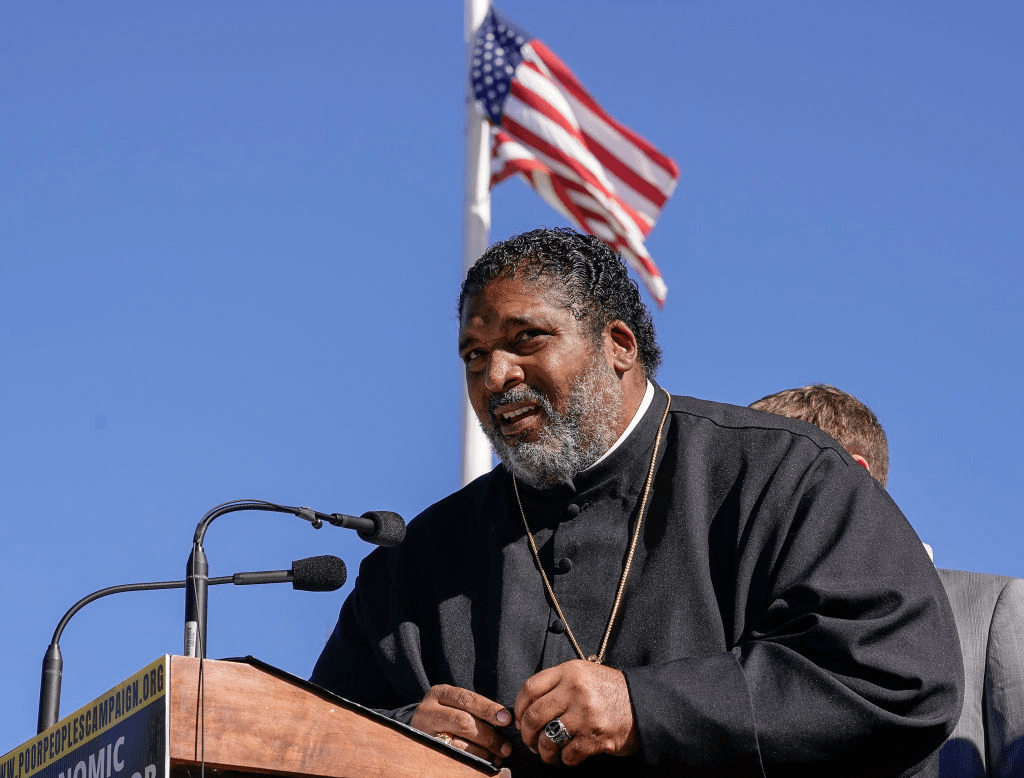
Rev. Dr. William Barber, co-chair of the Poor People’s Campaign speaks at the Poor People’s Campaign: A National Call For Moral Revival Rally at the US Supreme Court on October 27, 2021 in Washington, DC. (Photo by Jemal Countess/Getty Images for Repairers Of The Breach)

What is at stake is whether or not you have a Congress that will demand that the President, whoever that President is, cannot just act unilaterally, but must get congressional approval for war; whether or not we have a budget; whether or not TSA agents are paid; whether or not government employees are paid; whether or not we have a Congress that will stand up and not just be a rubber stamp to what an authoritarian President wants to do or will just “go along to get along.”

We have to start teaching people that when we talk about politics, there is not an aspect of your life—from your birth to your death—that is not impacted. You’re not officially recognized without a birth certificate, which is the result of a political decision. You can’t guarantee your Medicaid, Medicare, or Social Security without political decisions. Even as you die, people must understand that politics is not just about personality; it’s about people being put in place and the kinds of policies and vision they will enact.

Rev. Dr. William J. Barber II, is a Professor in the Practice of Public Theology and Public Policy and Founding Director of the Center for Public Theology and Public Policy at Yale Divinity School. He serves as President and Senior Lecturer of Repairers of the Breach, Co-Chair of the Poor People’s Campaign

Yeah, Another One Of Those Posts

Under New Olympic Sex Testing Policy, A Cis Woman Who Gives Birth Could Be Considered Male

History is set to repeat itself after the IOC announced a trans ban and mass sex testing for the 2028 Olympics.

Erin Reed

On Thursday, the International Olympic Committee announced that it would ban transgender women and many cisgender women athletes from competing in women’s events and institute mandatory genetic screening of all female athletes. The decision is significant—the Olympics has allowed transgender women to compete since 2004, yet none has ever won a medal, and only a single transgender woman has ever competed: weightlifter Laurel Hubbard of New Zealand, who failed to place at the 2021 Tokyo Games. The ban applies to all sports, including those where no male performance advantage exists, and will require every woman to undergo a genetic test to participate. It will also exclude many cisgender women who produce elevated testosterone due to genetic or medical conditions, such as two-time Olympic champion Caster Semenya. And it is not the first time the Olympics has subjected women to mass sex testing—the last time it did, from 1992 to 1999, the results were disastrous, with cisgender women discovering they had intersex conditions they never knew about, leading to public humiliation, career destruction, and at least one suicide before such testing was abolished.

Under the new policy, every woman seeking to compete in a female event at the Olympics or any IOC competition must undergo a one-time SRY gene screening—a cheek swab or blood test that detects the presence of a gene on the Y chromosome associated with male sex development. The test is similar to the one the IOC abolished 27 years ago after it produced disastrous human consequences. Because the screening identifies the presence of XY genetics, it will target not only transgender women but also intersex people—including cisgender women who carry a genetic condition that some argue makes them “male” despite having been born with a vagina and uterus, raised as girls, and having lived their entire lives as women. In at least 15 documented cases, women with 46,XY karyotypes—the same genetics this test screens for—have successfully carried pregnancies to term and given birth, including women with XY karyotypes that naturally produce testosterone. Under the IOC’s new framework, a woman who has been pregnant and delivered a child could be classified as male and barred from competition for failing this test.

Genetic sex testing was introduced at the Olympics in 1992, but it existed for only a short time. In the two Summer Games it covered—Barcelona in 1992 and Atlanta in 1996—over 20 female athletes who were assigned female at birth, had lived their entire lives as women, and had female anatomy were told they were genetically “male” due to conditions they had never known about. The consequences were disastrous. Dr. Myron Genel, a Yale physician who was a prominent critic of the program, reported that the testing was “highly discriminatory” and caused “emotional trauma and social stigmatization” for women with intersex conditions who had been screened out of competition. For athletes from countries where being labeled male could carry severe social or physical consequences, the disclosure was not merely humiliating—it was dangerous. Indian swimmer Pratima Gaonkar died by suicide after her failed sex verification test became public and she was subjected to blackmail attempts; Indian runner Santhi Soundarajan attempted suicide after being stripped of her Asian Games silver medal. The testing was abolished in 1999.

The ban also applies to sports where a male genetic advantage is dubious or nonexistent. In rifle shooting, ESPN reported that women are “as good as, if not fractionally better than, men” in 10m air rifle, and yet these athletes will still have to prove their femininity with a genetic test. In sailing, the competition was mixed for nearly a century at the Olympics, from 1900 to 1988. In archery, men and women shoot the same 70-meter Olympic distance and the world records are extremely close. In December 2025, women’s Olympic champion An San exactly matched the men’s indoor qualification round record of 599 in Taipei. And outside the Olympics, transgender bans have spread even further—to darts, pool, disc golf, competitive dancing, and even chess.

The scientific evidence, meanwhile, does not support the blanket ban the IOC has imposed. A 2026 meta-analysis published in the British Journal of Sports Medicine—the most comprehensive to date, drawing on 52 studies and nearly 6,500 participants—found that while transgender women on hormone therapy for one to three years retained higher absolute lean body mass than cisgender women, there were no statistically significant differences in upper-body strength, lower-body strength, or aerobic capacity. The researchers concluded that “the convergence of transgender women’s functional performance with cisgender women, particularly in strength and aerobic capacity, challenges assumptions about inherent athletic advantages” and that the current evidence “does not justify blanket bans.” A separate review in the Journal of Clinical Endocrinology and Metabolism found that after two years of hormone therapy, no advantage was observed for physical performance measured by running time, and that muscle strength corrected for lean mass, hemoglobin, and cardiovascular capacity were no different from cisgender women. No study has demonstrated that transgender women on hormone therapy for more than two years retain a measurable performance advantage in any specific sport.

Some intersex athletes who would be impacted by the decision are already speaking out. Caster Semenya, a two-time Olympic gold medalist, was assigned female at birth in South Africa and has naturally elevated testosterone levels due to a difference in sex development. On Sunday, she expressed her disappointment with IOC President Kirsty Coventry, a fellow African woman and former Olympic swimmer. “Personally, for her as a leader, she’s an African, I’m sure she understands how, you know, we as Africans, we are coming from, as a global South, you know, you cannot control genetics,” Semenya said at a press conference in Cape Town. “For me personally, for her being a woman coming from Africa, knowing how, you know, African women or women in the global South are affected by that, of course it causes harm.”

“Reintroducing sex testing brings the IOC back to policy that it had discontinued exactly thirty years ago. Back then, they rightfully concluded that sex testing was scientifically inconclusive and caused considerable harm to athletes. Then, in 2021, they approved a Framework on Fairness, Inclusion and Non-Discrimination to best support trans athletes and athletes with sex variations. Now, they are retreating from their own decisions and ignoring the recommendations of various UN bodies, the World Medical Association, and athletes worldwide. But the evidence is clear: sex testing exposes women and girls to privacy violations, public humiliation, and abuse. And it is profoundly discriminatory, too. No one is asking men and boys to undergo these tests. Women and girls shouldn’t either,” said Gurchaten Sandhu, ILGA World Director of Programmes.

The policy takes effect at the 2028 Los Angeles Summer Games and is not retroactive. Affected athletes are expected to bring challenges before the Court of Arbitration for Sport in Lausanne, as Caster Semenya has done with previous eligibility rules. Over 100 civil society organizations, including the Sport & Rights Alliance, ILGA World, and Humans of Sport, have called on the IOC to reverse the decision.

IF Helping Try to Avert An Execution Might Be A Thing You’d Do Today,

James Duckett. A snippet from the petition page:


James Duckett is scheduled for execution in Florida on March 31, 2026 for his alleged 1987 murder of Teresa McAbee.

NOTE: As of 6pm ET on March 27, 2027, a *temporary* stay remains in place as the State seeks to reverse the stay rather than follow the advice of its own expert, who suggests that further DNA evaluation is warranted. Read the press release from FADP here. This stay may be revoked at any time. Please act as if the March 31 execution date will proceed.

Mr. Duckett has maintained his innocence since the day he was arrested. His attorneys argue that the case against him, built entirely on circumstantial evidence, has been undermined by recanted testimony, discredited forensic science, and the possibility of DNA testing that was never presented to the jury who sentenced him to death.

Duckett’s attorneys argue that modern forensic technology — capable of producing answers that were unattainable in the 1980s — now exists, yet the state is pressing forward with an irreversible punishment while key evidence remains inconclusively tested and thus, unresolved. (snip; more on the page, which is the petition page.)

A #No Kings Report

No Kings 3, fuck yeah

massive protests coast to coast — and country to country

Jeff Tiedrich

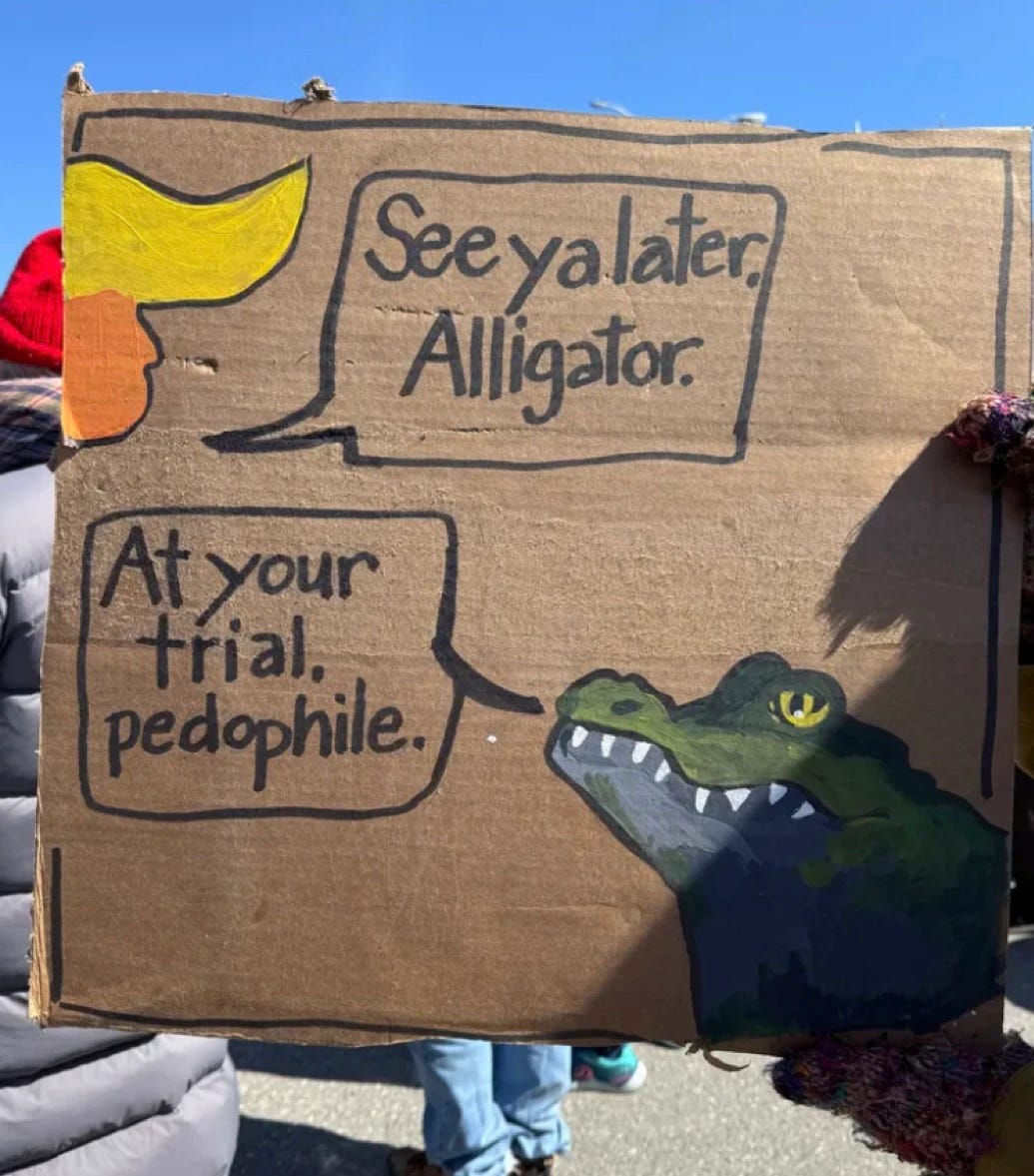
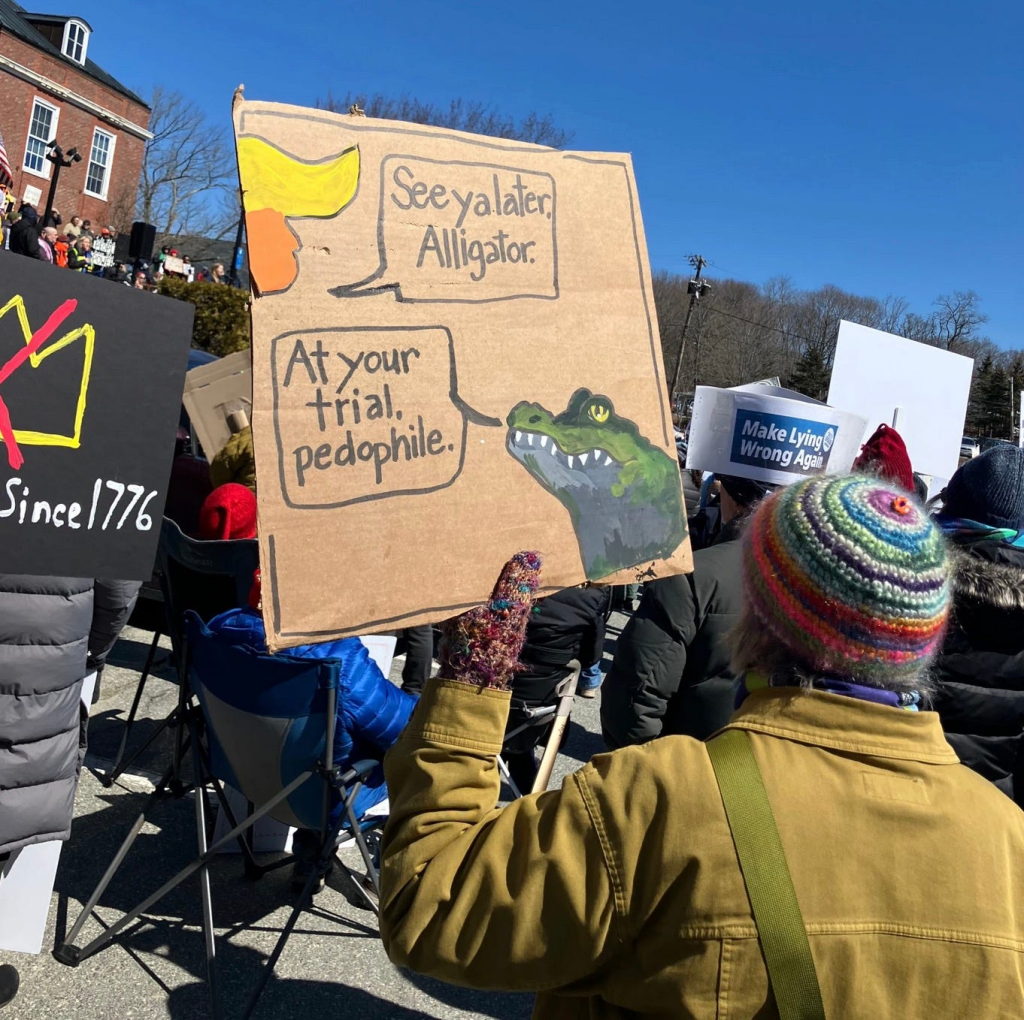
let’s start off with a bang, and put the hero of the day right up top. ladies and gents, I give you the Poet Laureate of No Kings Day.

‘see you later, alligator. at your trial, pedophile’ — now that’s a message we can all get behind.

we did it again, folks. in fact, We the People outdid ourselves. yesterday’s No Kings 3 was the largest single-day protest in U.S. history.

over eight million of us gathered peacefully coast to coast, to rise up as one and convey a singular message: fuck you, you fucking fuck — you’re not our king.

wait, did I say coast to coast? no, it was the entire world telling Donny Convict to fuck straight off.

HAPPENING NOW: A HUGE crowd has gathered in London, England for a protest against the far right in coordination with the No Kings day protests in the US

[image or embed]— alexjungle.bsky.social (@alexjungle.bsky.social) March 28, 2026 at 10:07 AM

and at the Bastille in Paris.

In 1789, furious protesters stormed the Bastille in Paris. This marks the start of the French Revolution that put an end to the highly corrupt, rotten regime of aristocrats and the ultra rich. Yesterday, thousands joined a #NoKings protest at the Bastille.

[image or embed]— Hendrik Klaassens #FBPE #FBR #BanX (@aurorablogspot.bsky.social) March 29, 2026 at 4:39 AM

Scotland fucking loathes Donny.

Solidarity from #Scotland. 🏴󠁧󠁢󠁳󠁣󠁴󠁿🇺🇸 #NoKings

[image or embed]— Dial M for Madeye 🏴󠁧󠁢󠁳󠁣󠁴󠁿 🇮🇪 🏴󠁧󠁢󠁷󠁬󠁳󠁿 (@carnaptiousmadeye.bsky.social) March 29, 2026 at 1:32 AM

so does Portugal.

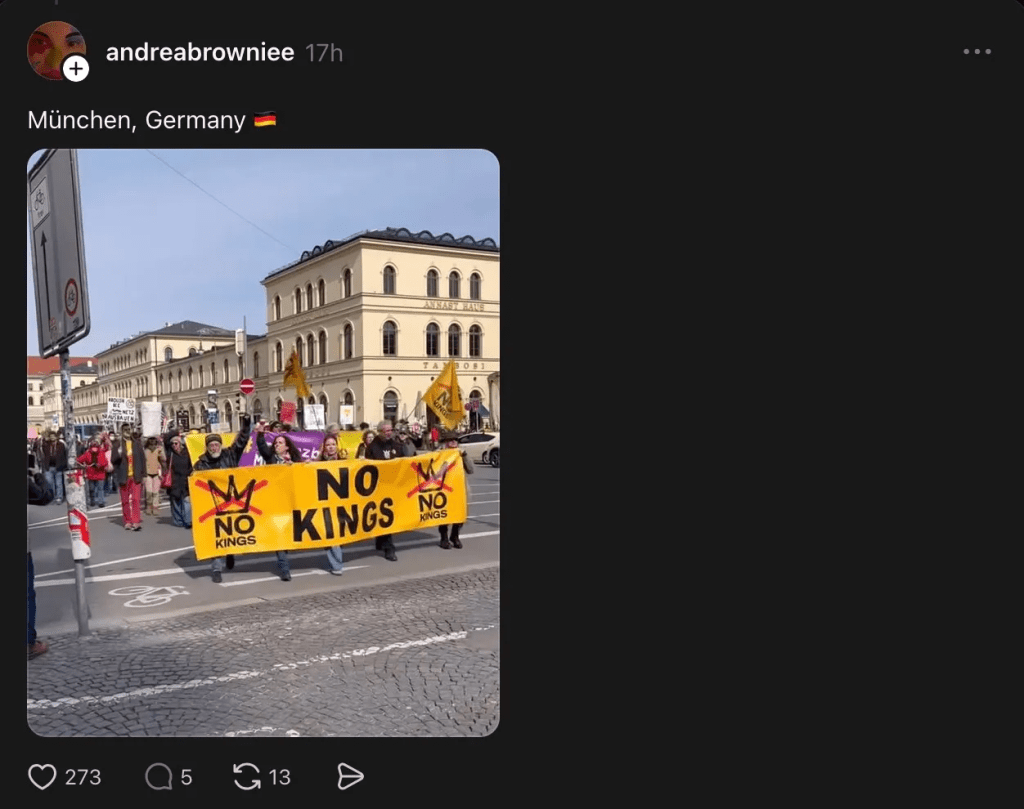
Germany’s seen this movie before, and they want no part of its sequel.

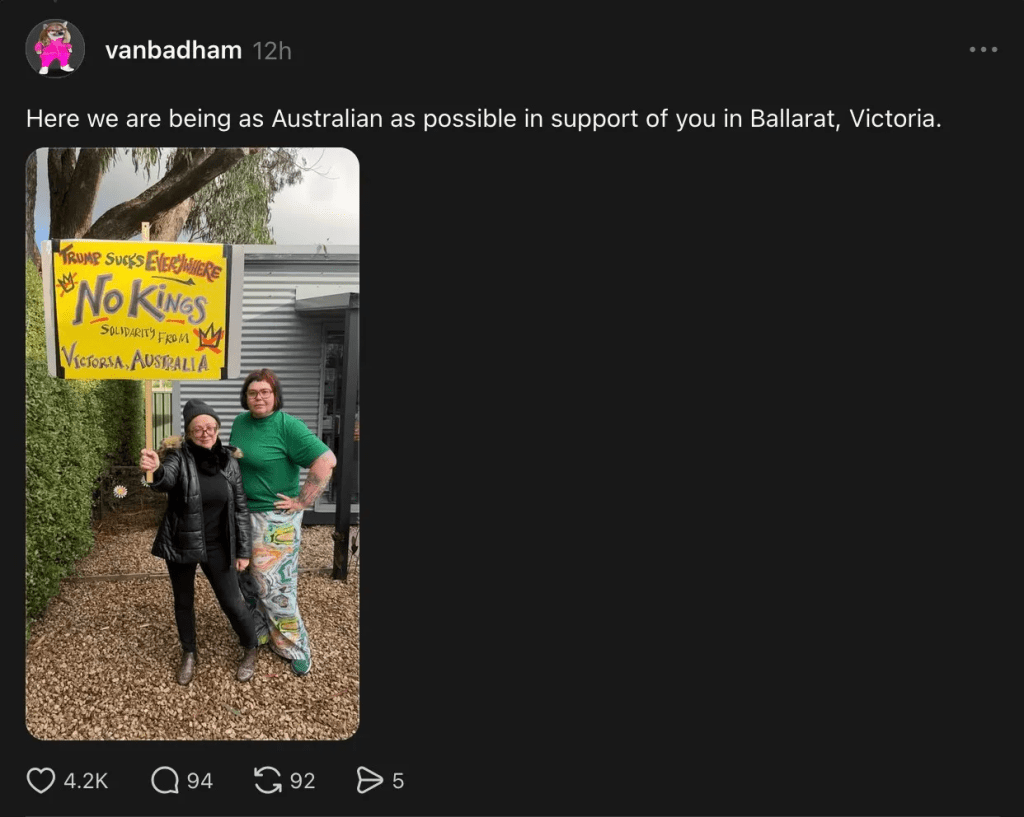
two stalwarts showed up in the town of Ballarat, Victoria, Australia.

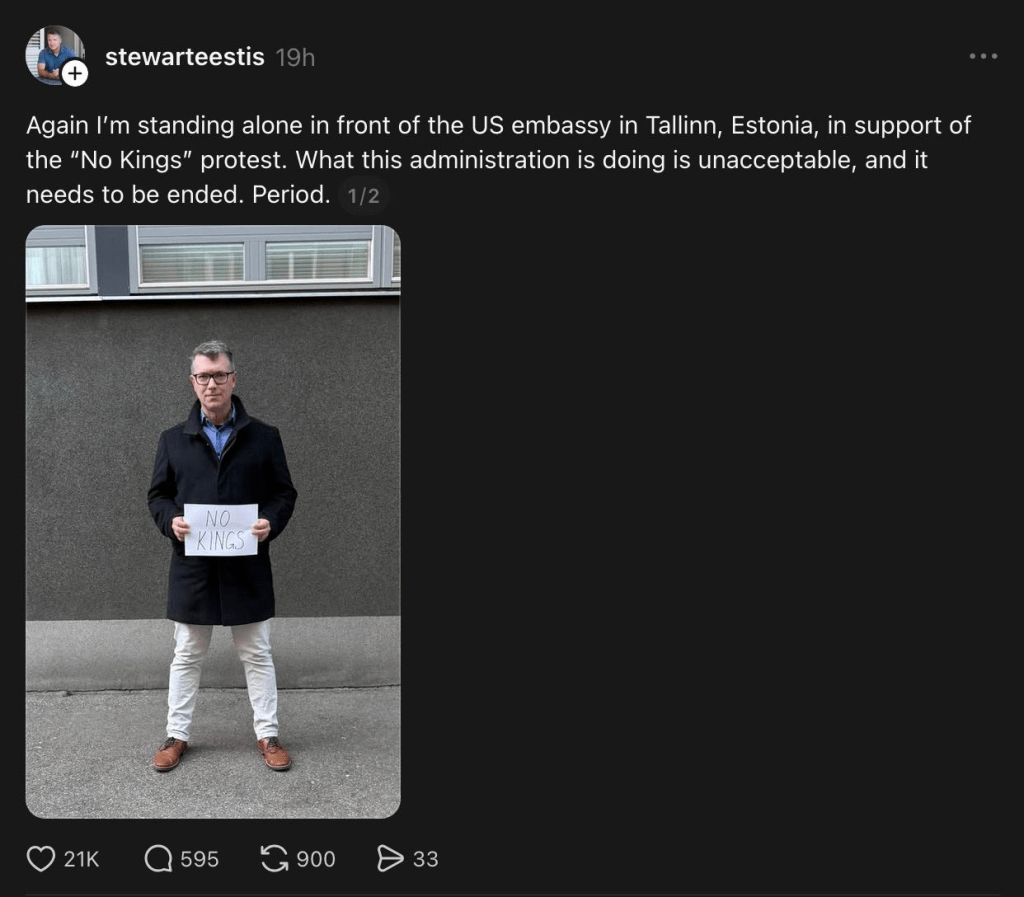
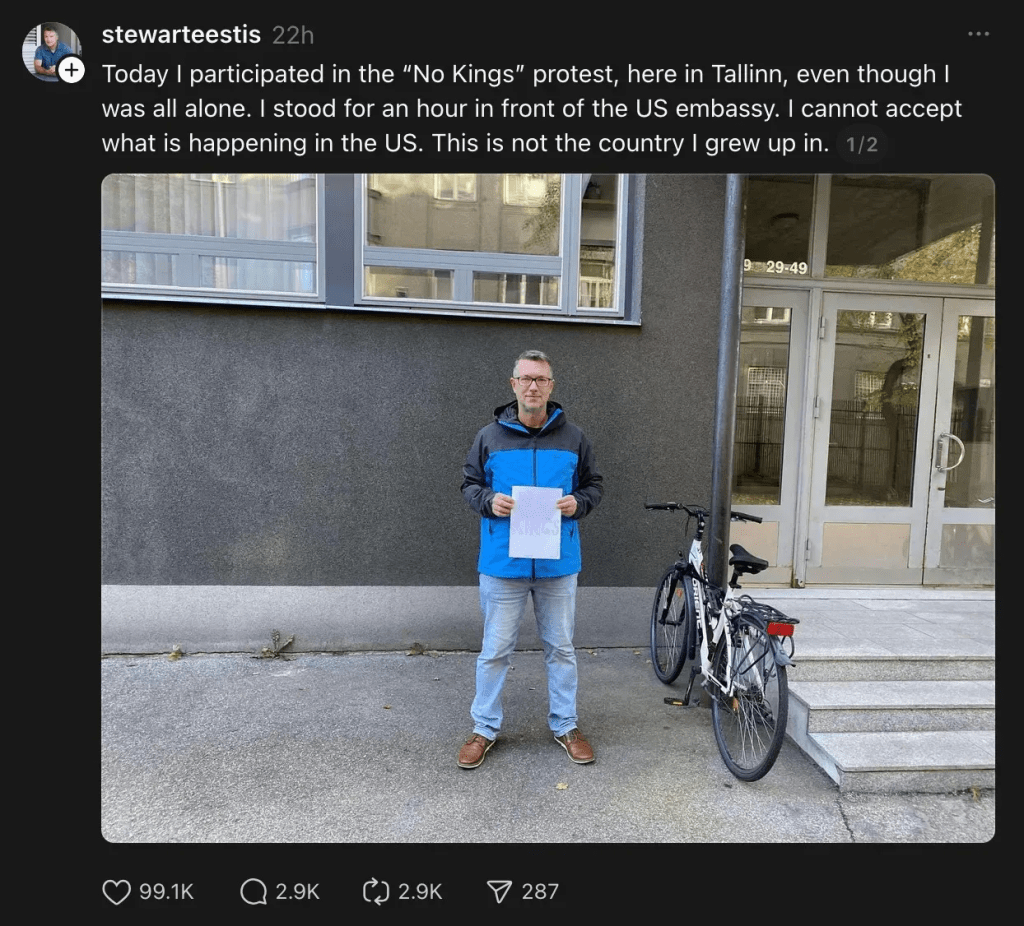
holy shit, there was even one homey who parked himself in front of the US embassy in Tallinn, the capital of Estonia.

this dude fucking rules. he held the exact same one-person protest during the previous No Kings Day last October.

meanwhile, back here in the US of A, the crowds were gi-fucking-normous.

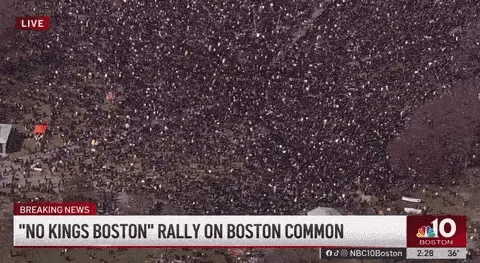
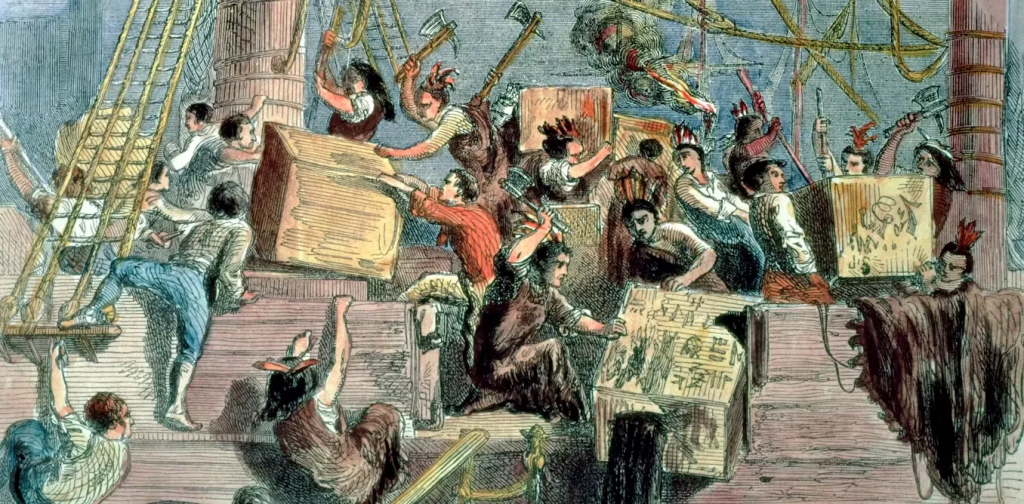
of course, Boston is in the major leagues when it comes to protesting. they’ve been perfecting this shit since 1773.

another two hundred thousand showed up at the rally in the Twin Cities.

We are estimating more than 200,000 people at the flagship No Kings rally in the Twin Cities. #NoKings

[image or embed]— Indivisible ❌👑 (@indivisible.org) March 28, 2026 at 2:37 PM

while we’re in the Twin Cities, you need to hear this chunk from comedian Lizz Winstead’s great speech.

“I’m so proud of you. you chased out of this state pure evil. you chased them out. you chased out the fun-size fascist Greg Bovino. you chased out that evil Kristi Noem. Kristi Noem is so evil, I’m starting to think that that dog took his own life. just couldn’t take it. ‘is this my future? I need to get out. I’m taking the goat with me.’”

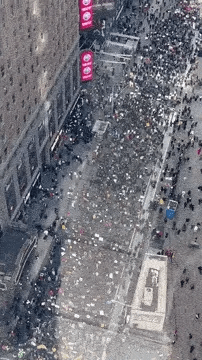
Times Square in New York City was packed to the gills.

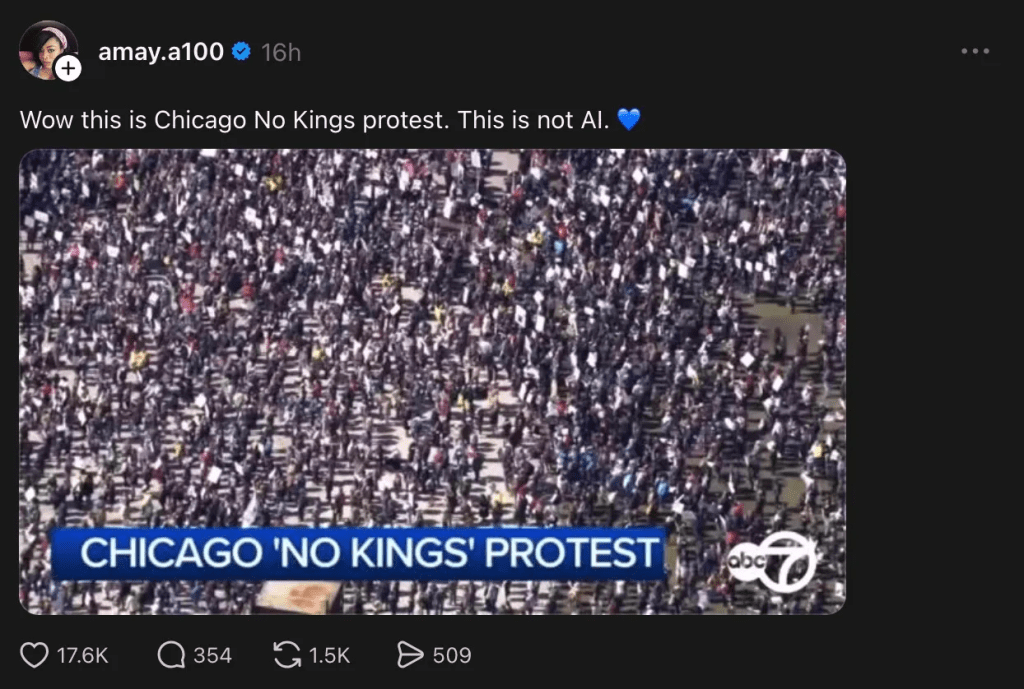
so was Chicago.

San Francisco does not screw around. at Ocean Beach, protesters formed a human banner telling Donny to get the fuck out.

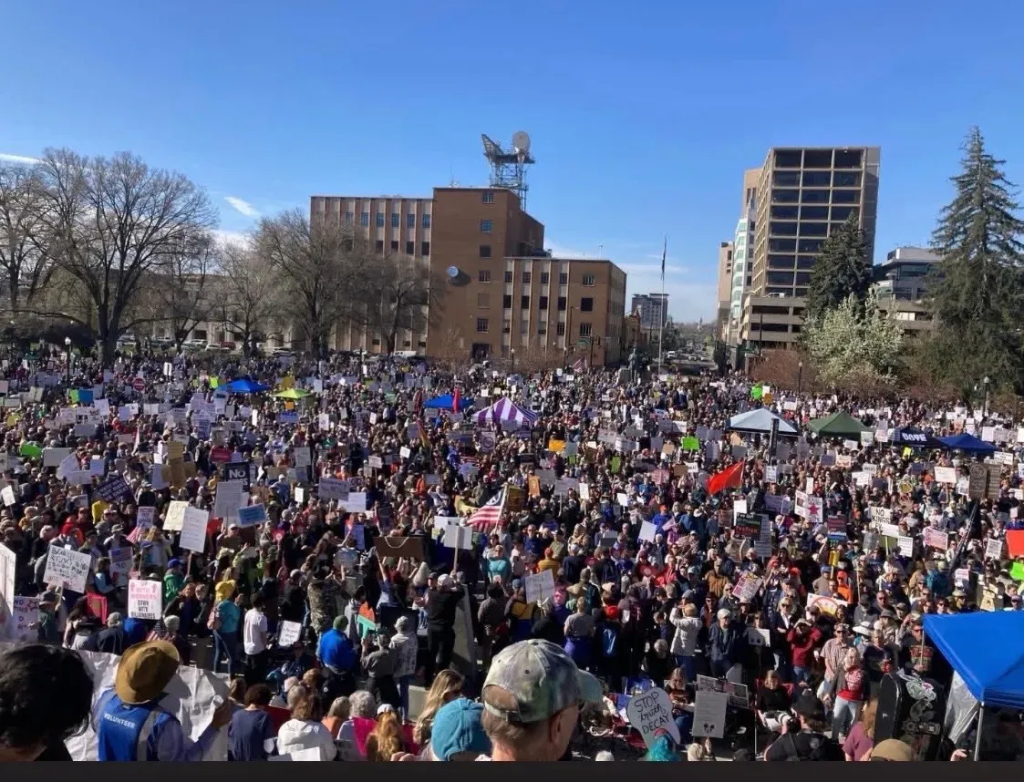
check out deeply-red Boise, Idaho, folks. even Republicans are fed up with this shit.

Bill Kristol, who used to be the biggest neocon in the world and is now an actual goddamned social progressive, was in Waltham, MA.

huge crowds were everywhere — except for one place: the CPAC conference in Texas.

while millions of people were protesting the fucked-up reign of Mad King Donny, CPAC couldn’t even fill one small room. look at this clownfuckingly pathetic display.

it’s as if Sad Trombone became a real political party.

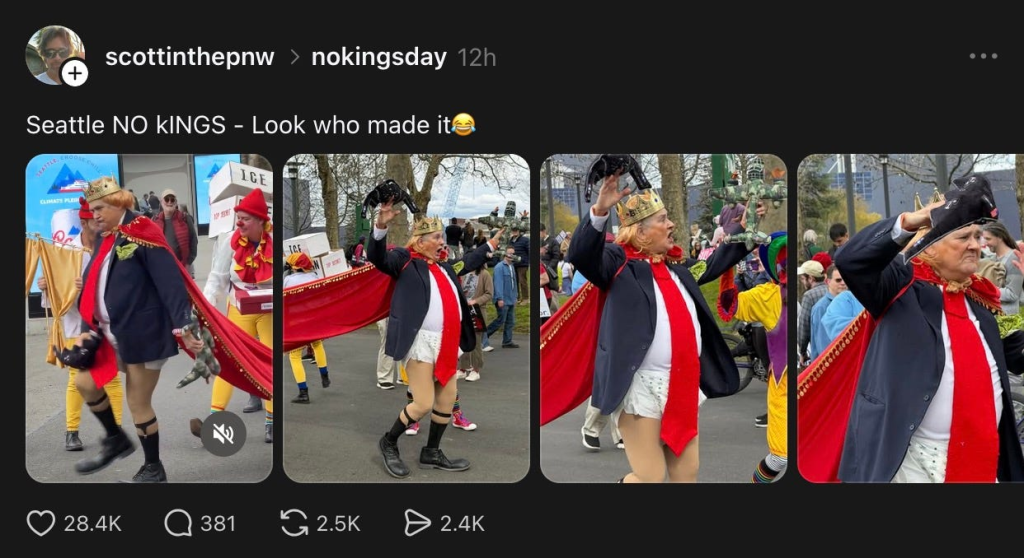
now let’s check out some heroes — like this dude in Seattle.

we definitely need to gif this hilarious shit for posterity’s sake.

it was raining frogs in the District of Columbia.

we’re going to need to gif that shit, too.

handmaidens bearing the names of Jeffrey Epstein’s degenerate BFFs showed up in Nashville.

there’s no way we’re not giffing that shit.

hey, do you know who can go fuck themselves all the way to Mars? the Los Angeles Police Department, that’s who. these goons couldn’t make it through the day without arresting a protester who was dressed up as the Statue of Liberty.

A remarkable photo from #NoKings in DTLA from Connor Sheets of @latimes.com http://www.latimes.com/california/l…

[image or embed]— sam³⁰⁰⁰ (@samgavin.com) March 28, 2026 at 9:09 PM

great optics, you guys. bravo. ten out of ten — no notes.


fuck those fucking fucks. let’s go out with a bang. here are some of the best protest signs from around the country.

and finally, once again, our unknown poet laureate from Ellsworth, Maine.


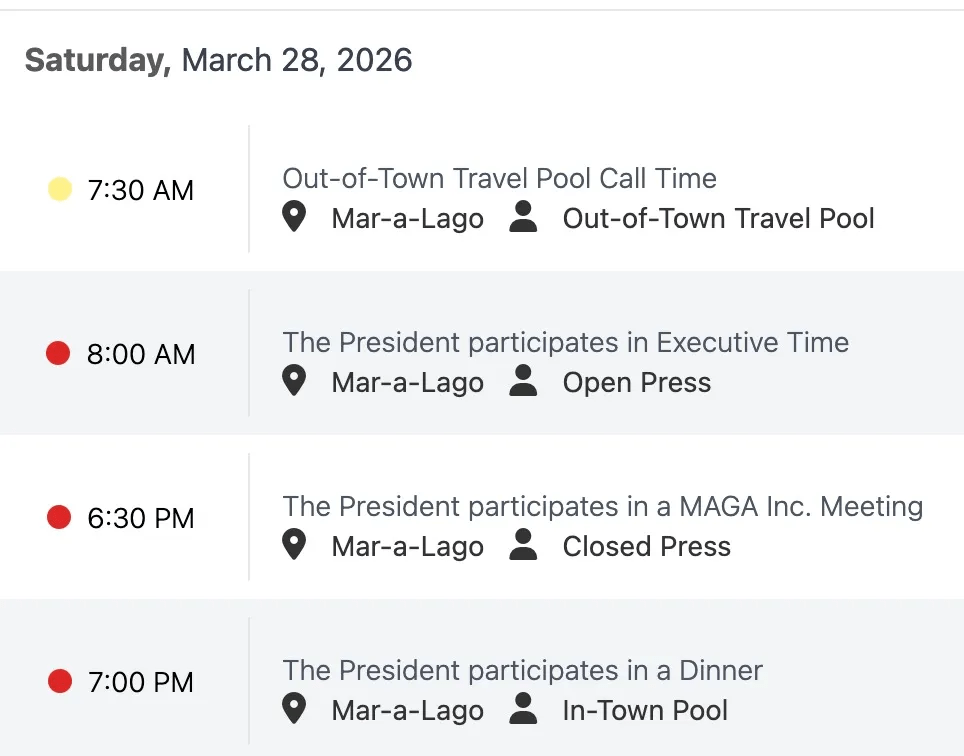
as for Sundowning Grandpa Bugfuck, he was unusually silent — and nowhere to be seen. there were none of his usual protest-day batshit meltdowns on the feed of his crappy app. he couldn’t even be bothered to post AI slop of himself shitting on protesters, as he did last October.

he just spent the day holed up in Motel-a-Lago. according to his official schedule, the lazy fuck didn’t even bother to cheat at golf.

I’ve got a news flash for you, Donny: America is sick of you. aside from your brain-dead cultists who are too fucking stupid to understand what’s going on, nobody voted for this shit.

nobody voted for the historic and stately East Wing to be demolished so that you can replace it with some vulgar Epstein Dance Hall™ — and speaking of your dead pedo bestie, nobody voted for the continuing cover-up of a massive pedophile ring.

nobody voted for off-the-charts corruption and greed.

nobody voted for masked ICE thugs teargassing children, and murdering anyone who looks at them funny. nobody voted for innocent immigrants to be disappeared off the streets and shipped off to far-away slave-labor gulags.

nobody voted for the price of everything continuing to skyrocket — especially when you promised bring all that shit down on Day One.

nobody voted for our allies to be insulted and ignored, or for Ukraine to be thrown to the wolves, or for Greenland to be perpetually harassed, or for Venezuela to become a vassal state.

and nobody voted for an unwinnable clusterfuck of a don’t-you-dare-call-it-a-war in Iran — certainly not one that shut down the Strait of Hormuz, destabilized the entire Middle East, and sent the price crude through the roof.

guess what, Donny: you’re such a loathsome piece of shit that over eight million people took to the streets yesterday to deliver this singular message: fuck you, you fucking fuck — you’re not our king, and you never will be.

boo fucking hoo, bro. sucks to be you.


have a great Sunday, everyone. you earned it.

Enjoy Some Clay Jones This Morning!

Mr. Johnson No Johnson

Gonads are gone-gone

Clay Jones


Grifting With The Aliens

Those aliens are going to starve

Clay Jones