March 9, 1839 The U.S. Supreme Court, with only one dissent, freed the slaves who had seized the Spanish slave ship Amistad, ruling that they had been illegally forced into slavery, and thus were free under American law. Slave ship They had mutinied and taken control of the ship off the shore of Cuba (then a colony of Spain) and demanded to be taken back to Africa but wound up in U.S. waters off the coast of Long Island, New York. More on the Amistad mutiny
March 9, 1945 Phyllis Daley became the first African-American commissioned nurse in the U.S. Navy. Though more than 500 black nurses served in the Army during World War II, the Navy had only dropped its color ban a few weeks before.
March 9, 1964 Five Sioux Indians, led by Richard McKenzie, claimed the island of Alcatraz in San Francisco Bay as Indian land. The island had recently been abandoned, and the action was based on an 1868 treaty which entitled Indians to take possession of surplus federal land. The native Americans advocated turning it into a cultural center and Indian university, but their occupation lasted only four hours.
March 9, 1965 Two days after Bloody Sunday [see March 7, 1965] Reverend Martin Luther King, Jr. led 1500 outraged people gathered from around the country back to the Edmund Pettus Bridge on the outskirts of Selma, Alabama. They were attempting for a second time to march to the state capital of Montgomery in support of voting rights for black Americans. Confronted once again by state troopers blocking passage to the bridge, King knelt in prayer, then led his followers back, avoiding further violence. Later that evening three white ministers were attacked by local whites as they left a soul food restaurant in Selma. Reverend James Reeb was struck on the head with a club and died two days later.
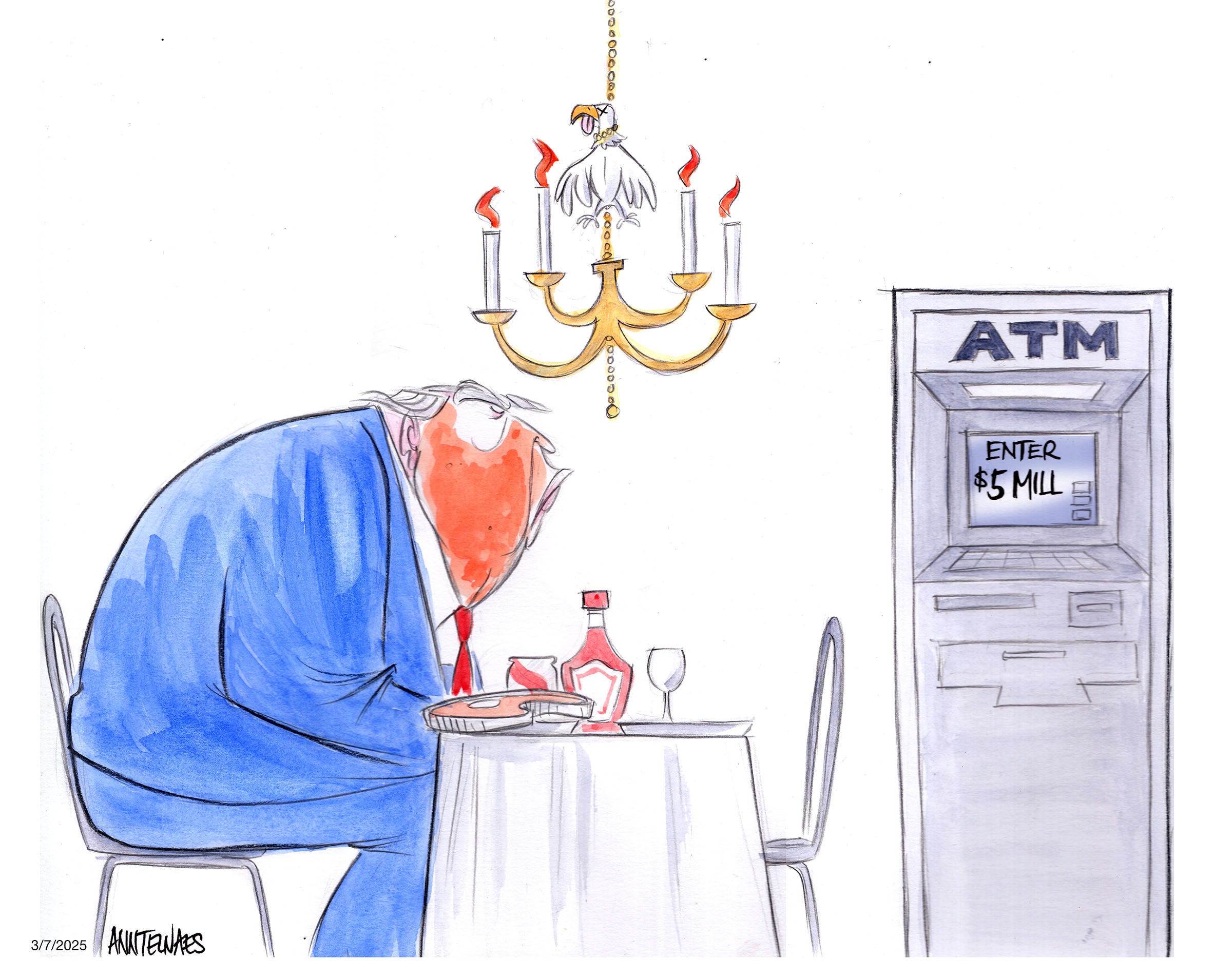
It is still funny, though chillingly so. If you click through to watch on YouTube, you’ll see much honesty in the comments, from the rest of the world. Not rude, just honest.
Please enjoy International Women’s Day, and give respect and your compliments to all the women with whom you interact (I know that you do!) A history bit for the day is below. -A
March 8, 1965 About 3,500 U. S. Marines became the first American combat troops in Vietnam, landing near the coastal city of Da Nang. The ships USS Henrico, Union, and Vancouver, carrying the 9th Marine Expeditionary Brigade under Brigadier General Frederick J. Karch, took up stations 4,000 yards off Red Beach Two, north of Da Nang.
March 8, 1983 40,000 in Tel Aviv, Israel, organized by Peace Now, rallied against the war in Lebanon.
March 8, 1995 Women in Black demonstrated in the center of Belgrade, Serbia, on International Women’s Day, expressing solidarity with Kosovar women: “The Albanian women from Kosovo are our sisters.”The women were both spit at and kicked, but didn’t give up, and stood there to the end of the usual hour. Though Kosovo is overwhelmingly (90%) ethnically Albanian, it is considered the national and religious birthplace of Serbians. Both Kosovo and Serbia had been part of the former Yugoslavia, which had granted partial autonomy to Kosovo in 1974. Serbian President Slobodan Milosevic (later tried for war crimes) in 1989 withdrew that autonomy and revoked the official status of the Albanian language in Kosovo.
I wish I could still say it’s amazing that these bills even come up, while now instead, it’s amazing that they’re not brought into law. But here we are. Decent news from Montana!
Powerful Speeches From Trans Dems Flip 29 Republicans, Anti-Trans Bills Die In Montana by Erin Reed
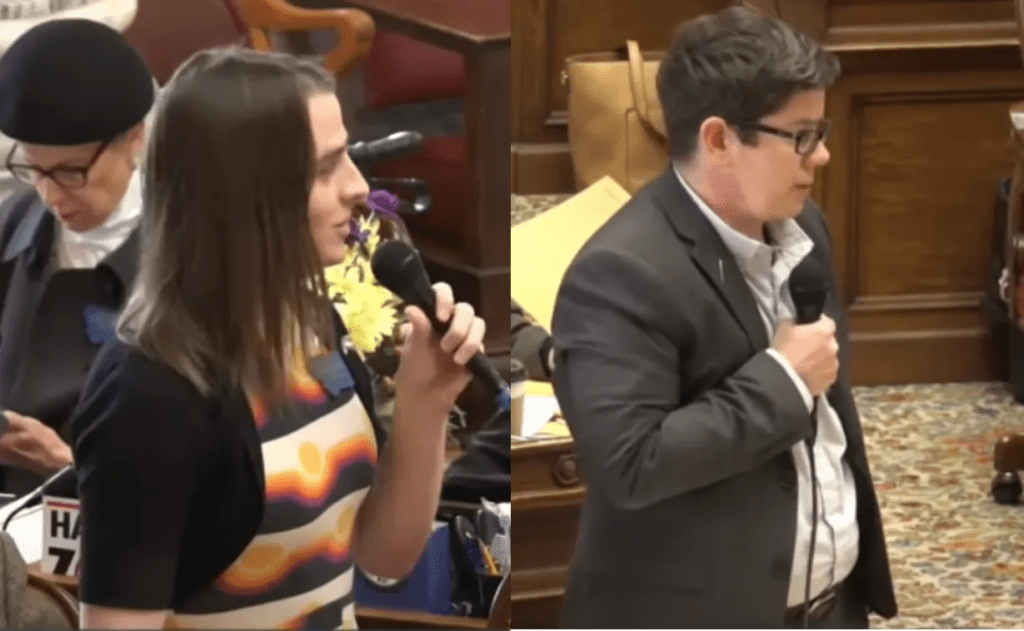
Transgender Reps Zooey Zephyr and SJ Howell delivered powerful speeches on the Montana House floor on Thursday. Republicans defected en masse to join them in voting against anti-trans bills. Read on Substack
Something remarkable happened in Montana today. As has become routine, anti-trans bills were up for debate—the state has spent more than half of its legislative days this session pushing such bills through committees and the House floor, with Republicans largely voting in lockstep. But something changed.
A week ago, transgender Representative Zooey Zephyr delivered a powerful speech against a bill that would create a separate indecent exposure law for transgender people. Since then, momentum on the House floor slowed. Today, two of the most extreme bills targeting the transgender community came up for a vote. Transgender Representatives Zooey Zephyr and SJ Howell gave impassioned speeches—this time, they broke through. In a stunning turn, 29 Republicans defected, killing both bills. One Republican even took the floor to deliver a scathing rebuke of the bill’s sponsor.
The first bill to reach the House floor was HB 675, a measure that would ban drag performances and Pride parades in Montana. A previous drag ban had already been struck down by the courts after it was enforced against a transgender woman—who was not a drag artist—to prevent her from speaking about public history at a library. In response, the bill’s sponsor, Rep. Caleb Hinkle, introduced HB 675 to circumvent that ruling.
Rather than relying on state enforcement, this bill would grant individuals the private right to sue if a public drag performance took place, making it more difficult to challenge in court. During committee hearings, Hinkle went even further, calling being transgender “a fetish” and arguing that the law was necessary to prevent trans people from dancing in public.
And that’s when transgender Representative Zooey Zephyr took to the floor.
“Here I am again to rise on another bill targeting the LGBTQ+ community,” she said, exasperated. “At its very core, drag is art. It is very beautiful art. It has a deep history in this country, and it is important to my community. You know, if you are a woman in this body wearing a suit today, you are in some way challenging gender norms that existed long ago… There were three-article-of-clothing laws 50 years ago that said if you wore three articles of clothing that were indicative of the opposite gender, they could stop you, arrest you… it was those laws that led to the police raiding an LGBTQ+ bar that led to the Stonewall riots, one of the most important civil rights moments in my community’s history,” she began.
“When the sponsor closed on this bill, he said, this bill is needed… and I quote his words… ‘because transgenderism is a fetish based on crossdressing.’ And I am here to stand before the body and say that my life is not a fetish. My existence is not a fetish. I was proud within a month ago to have my son up in the gallery here. Many of you on the other side met him. When I go to walk him to school, that’s not a lascivious display. That is not a fetish. That is my family. This is what these bills are trying to come after… not obscene shows in front of children, we have the Miller test for that, we have laws for that. This is a way to target the trans community, and that is in my opinion, and in the speaker’s own words.”
Then something even more remarkable happened: A Republican, Representative Sherry Essman, rose to defend Rep. Zephyr and chastised the bill’s sponsor. “I’m speaking as a parent and a grandmother. And I’m very emotional because I know the representative in seat 20 is also a parent. No matter what you think of that, she is doing her best to raise a child. I did my best to raise my children as I saw fit, and I’m taking it for granted that my children are going to raise my grandchildren as they see fit,” she began.
“Everybody in here talks about how important parental rights are. I want to tell you, in addition to parental rights, parental responsibility is also important. And if you can’t trust a decent parent to decide where and when their kids should see what, then we have a bigger problem,” she turned to parental rights and spoke about how people who claim those rights should vote against the bill.
And then, she closed by chastising the bill’s sponsor for bringing the bill, “Trust the parents to do what’s right, and stop these crazy bills that are a waste of time. They’re a waste of energy. We should be working on property tax relief and not doing this sort of business on the floor of this house and having to even talk about this.”
Following the speeches, 13 Republicans, the most of any anti-trans bill this cycle, flipped and voted against the bill. See it as it happened here:
Were this all that happened, it would have been remarkable enough—such aisle-crossing has become rare in modern politics, and on transgender issues, it is almost unheard of. But Representative Zephyr is not the only transgender lawmaker in Montana. Representative SJ Howell, a powerhouse in their own right, took the floor when an even more extreme bill followed immediately afterwards—HB754, a measure that would remove transgender children from their parents. They had a powerful speech to deliver as well.
Representative Howell opened, “I stand to oppose this bill… When a state intervenes to remove a child from their family, that is one of the most serious and weighty responsibilities that the state has. That is not something to be taken lightly. Every time a child is removed from their family, it’s a tragedy. Sometimes a necessary tragedy, but a tragedy nonetheless. This bill does not come close to the seriousness with which those decisions should be contemplated.”
They pointed directly to the bill’s language: “On page 1, line 19, any child protective service specialist, peace officer, or county attorney who has reason to believe any child is in immediate danger or harm may immediately remove the child. What we are adding… a child transitioning gender with the support of a parent or guardian is considered in immediate or apparent danger or harm.”
Howell then turned to the bill’s vagueness and the dangers it posed to transgender children as well as any child who defies gender norms. “Transitioning gender is not defined in this bill… so what does that mean? Maybe it means, as the sponsor said, surgery or medical treatment. Maybe it means therapy, mental healthcare. Maybe it means a kid who gets a haircut and a new set of clothes. Maybe a name change… a legal name change, or someone who wants to try out a different name… a strict reading of this bill could include all of that.”
They urged lawmakers to consider the real consequences. “Put yourself in the shoes of a CPS worker who is confronted with a young person, 15 years old maybe, who is happy… healthy… living in a stable home with loving parents, who is supported and has their needs met? And they are supposed to remove that child from their home and put them in the care of the state? We should absolutely not be doing that.”
Then, the bill went to a vote. This time, the Montana Republican Party fully fractured—29 Republicans crossed the aisle to defeat it.
Watch it as it happened here:
Following the vote, Representative Zephyr took to social media to discuss the implications. “These kind of votes are born out of transgender representation in government,” she posted on her bluesky account. “Howell & I have built solid relationships with Republicans and those relationships change hearts, minds, and (eventually) votes. It is painful, grueling work. But it makes a difference.”
At a time when anti-trans bills are sailing through red-state legislatures, many are left wondering how they can be stopped. Some Democrats, like Gavin Newsom, have chosen appeasement—standing alongside anti-trans hate leaders like Charlie Kirk instead of standing up for transgender people. But Representatives Zooey Zephyr and SJ Howell offer a different path. As transgender lawmakers in a Republican-dominated government, they have shown that representation, relationships, and the power of speaking truth in hostile spaces can move hearts and minds. Their success is a reminder that even in the most challenging environments, refusing to back down can make a difference.
Editor’s Note: The writer of this article is happily married to Representative Zooey Zephyr. While I am mindful of disclosing personal relationships in my reporting as a transgender journalist, I also recognize the importance of covering major moments like today’s events in Montana, and so I chose to report on this story with this disclosure. My goal remains delivering critical LGBTQ+ news to my readers with the integrity and urgency it deserves.
March 7, 1932 The Ford Hunger March began on Detroit’s east side and proceeded 10 miles seeking relief during the Great Depression. Facing hunger and evictions, workers had formed neighborhood Unemployed Councils. Along the route, the marchers were given good wishes from Detroit Mayor Frank Murphy as well as two motorcycle escorts, and thousands joined the marchers along the route. At the Detroit city limit, the marchers were met by Dearborn police and doused by fire hoses. Despite the cold weather, they continued to the Employment Office of the Ford River Rouge plant, from which there had been massive layoffs. Five workers were killed and nineteen wounded by police and company “security” armed with pistols, rifles and a machine gun. Dave Moore According to Dave Moore, one of the marchers, “That blood was black blood and white blood. One of the photos that was published in the Detroit Times, but never seen since, shows a black woman, Mattie Woodson, wiping the blood off the head of Joe DiBlasio, a white man who lay there dying . . .
It’s been 75 years, but when you drive down Miller Road today, your car tires will be moistened with the blood that those five shed.” Grave markers with the words “His Life for the Union” pay tribute to the fallen hunger marchers in Woodmere Cemetery on Detroit’s west side.
March 7, 1965 525 civil rights advocates began a 54-mile march on a Sunday morning from Selma, Alabama, to the capital of Montgomery, to promote voting rights for blacks. Just after crossing the Edmund Pettus Bridge on the outskirts of Selma, the marchers were attacked in what became known as Bloody Sunday. Enforcing an order by Governor George Wallace, the group was broken up by state troopers and volunteer officers of the Dallas County sheriff who used tear gas, nightsticks, bullwhips and rubber tubing wrapped in barbed wire. John Lewis, then head of the Student Nonviolent Coordinating Committee and a leader of the march, suffered a fractured skull.John Lewis was elected a member of Congress from Georgia in 1986 and served till his death in 2020.ABC television interrupted a Nazi war crimes documentary, “Judgment at Nuremberg,” to show footage of the violence in Selma, confusing some viewers about who was beating whom. Injured in Selma Selma 1965 – Edmund Pettus Bridge, video excerpt from a PBS documentary with Rep. John Lewis and others who were there Read more
March 7, 1988 A Federal Court ruled in Atlanta, Georgia, that a peace group must have the same access to students at high school career days as military recruiters. the anti-recruitment movement today: LEAVE MY CHILD ALONE!
March 6, 1857 The U.S. Supreme Court handed down the Dred Scott decision (Dred Scott v. Sandford) which declared that an escaped slave, Scott, could not sue for his freedom in federal court because he was not a citizen. Those of African descent could never be considered citizens but “as a subordinate and inferior class of beings,” according to the Court. Dred Scott Dred Scott’s fight for freedom (2 links) Chief Justice Roger Taney stated in his opinion that the “unhappy Black Race. . . had no rights which the white man was bound to respect; and that the negro might justly and lawfully be reduced to slavery for his benefit. He was bought and sold and treated as an ordinary article of merchandise and traffic, whenever profit could be made by it.” Chief Justice Roger Taney Read the decision
March 6, 1884 Susan B. Anthony Susan B. Anthony and more than 100 delegates from the National Woman Suffrage Association met with President Chester Alan Arthur concerning women’s right to vote. Anthony asked him, “Ought not women have full equality and political rights?” He responded, “We should probably differ on the details of that question.” President Chester Alan Arthur
March 6, 1957 Ghana became the first black African country to become independent from colonial rule. Dr. Kwame Nkrumah became independent Ghana’s first leader. Ghana’s flag Read more
March 6, 1967 Muhammad Ali was ordered by the Selective Service to be inducted into military service. He refused, citing his religious beliefs that precluded him from killing others. “I ain’t got no quarrel with those Vietcong.” Top Black athletes gather to hear Muhammad Ali (formerly Cassius Clay) give his reasons for rejecting the draft, United States, June 4, 1967.
March 6, 1982 The University for Peace near San Jose, Costa Rica, was founded. UPeace, the U.N.-mandated graduate school of peace and conflict studies had been chartered by the General Assembly for research and the dissemination of knowledge specifically aimed at training and education for peace. Visit the University for Peace
The monument on campus sculpted by Cuban artist Thelvia Marín in 1987, is the world’s largest peace monument.






 Dave Moore


 Scottie's Playtime