Updating German pastor Martin Niemöller’s 1946 poem for 2025 Read on Substack
My Fellow Democracy Defenders,
Martin Niemöller was a prominent Lutheran pastor in Germany. After Hitler seized power in 1933, the pastor became an outspoken critic. For defying a dictator, he spent the last eight years of Nazi rule (1937 to 1945) in prisons and concentration camps. Pastor Niemöller is best remembered for his 1946 poem, which I have updated for our current situation below.
First they came for the refugees, and I did not speak out—because I was not a refugee.
Then they came for the trans children, and I did not speak out—because I was not a trans child.
Then they came for the people of color, and I did not speak out—because I was not a person of color.
Then they came for the abortionists, and I did not speak out—because I was not an abortionist.
Then they came for the socialists, and I did not speak out—because I was not a socialist.
Then they came for the journalists, and I did not speak out—because I was not a journalist.
Then they came for the trade unionists, and I did not speak out—because I was not a trade unionist.
Then they came for the Jews, and I did not speak out—because I was not a Jew.
Then they came for the civil servants, and I am speaking out—my partner has lost her job, and I am fighting for mine.
Then they came for me—and there was no one left to speak for me.
Will you speak up for all those who are oppressed by fascists? (snip)
And no, she didn’t “earn her money in the divorce”; she built Amazon into what it is/was. She earned her money by working. It’s important to note because of opposition comments about her.
MacKenzie Scott Nice Time Update! by Rebecca Schoenkopf
Turns out that the way she gives money is a really good way.Read on Substack
And now let us check in with breath-of-fresh-air MacKenzie Scott, the heart-of-gold billionaire who spun her share of her divorce from Jeff Bezos after he cheated on her into philanthropy and Yield Giving, a foundation that has so far given out almost $20 billion in unrestricted gifts for social justice, human services (like abortions and health care), education, LGBTQ+ services, playgrounds, historically Black colleges and universities, a total of 2,450 excellent causes that happen to be the ones that piss off Elon Musk and other right-wing chuds the very most!
Turns out, according to a three-year-analysis by the Center for Effective Philanthropy of 800 of the donations her foundation has made, the no-strings-attached way she gives out money is quite effective!
When Scott started handing out unrestricted gifts in 2019, the world of philanthropy got shook. The usual way to go about doling out large sums of cash with a foundation is to give restricted gifts, like for eradicating the rockin’ pneumonia, but not the boogie-woogie flu, or a scholarship fund for sensitive boys with at least a 3.0 who play the flute, or constructing the Phineas Q. Oilman Center for Fracking Studies.
Donors like to direct exactly where their money goes. And they like to have their names on stuff, like etched on a plaque, or a “thank you” in the opera program. Also naming rights are a way to encourage ongoing involvement. Don’t you think dear departed Grandpa Oilman would have wanted his heirs to make sure that his building has plenty of money in trust to keep the center’s roof repaired?
And foundations usually give out grants in response to proposals. This usually starts with announcing the grant: The Betsy VonThundersnatch Foundation For The Arts intends to award $5 million to bring drag brunches to underserved populations. Then nonprofits that work in that area respond with a proposal that assesses the need, lays out project with objectives, includes a step-by-step timetable, detailed budget estimate for renting a van, buying wigs and champagne etc., a pitch of why their organization is the most capable one to meet the need, what the benchmarks for measuring success will be, and so on.
Then after a grantee gets the money, they’re usually required to regularly report back the details of their benchmark-hitting to a board. What some might call micromanaging and others might call responsible stewardship helps foundations and charities solicit gifts, because donors want to know exactly where their money is going and be reassured that it’s not going to get blown fast. Which makes sense! But all of that takes time, and wig money. It can be many months and sometimes even years between when a grant is announced and an awardee can cash a check, and charities have to pay overhead for people to look for grants to apply to, and write the proposals.
But MacKenzie Scott’s Yield Foundation does the opposite of this! They skip the solicitation-and-proposal part entirely, quietly and secretly researching organizations’ track records. And then the foundation cuts a surprise check, with no spending-timetable or strings attached, and lets the nonprofit roll with it. It is bold! It is brave! It is trusting!
And here’s the Center for Effective Philanthropy’s report on how it’s going: The grantees are actually not blowing all of the money. Most are using it to shore up longer-term stability and plan to spend it within two to five years. Some have been able to pay debt, and have reserves and health insurance for their employees for the first time, and they are able to provide more services and expand their missions.
Like the South Texas Food Bank. They were able to give their employees free health care, and also nearly doubled the amount of food they distributed to eight counties and one tribal nation in south Texas with the $9 million Scott’s foundation gave them. Also Kaboom! They build playgrounds, and with Scott’s $14 million they have quadrupled the size of their playgrounds, and have gotten into advocacy too, pushing for elimination of the use of toxic chemicals on playground surfaces.
Eighty-five percent of nonprofit recipients said that Scott’s gifts have helped them improve or expand their programming, and 52 percent reported a greater capacity to respond to the needs of the communities they serve. The organizations that received awards from Scott had double the amount of cash reserves as comparable nonprofits, which is vital for the long-term stability of any organization that depends on the kindness of strangers in a volatile economy.
Ninety-three percent reported that Scott’s grant moderately or significantly strengthened their ability to carry out their mission, and 90 percent said the gift bolstered their financial positions. More than 60 percent said they used the grant to establish credibility with other funders, though 53 percent were concerned that other funders might withdraw their support, believing that recipients didn’t need additional funding. But the other side to that is Scott’s foundation has already done the research, so her endorsement could also encourage more donations. How that will pan out in the end for charities remains to be seen.
And, though the grants don’t require them to, 70 percent of the recipients are tracking the impact of the money, some say even better than they actually were before, because now they have better capacity to do that. Said one, “This grant has allowed us to focus more deliberatively on our metrics and impact to better equip us to answer this question/tell our story/show our impact.”
And what an impact! Samples from the survey: 33,521 loans for a total of $1.26 billion to low-income households to buy homes, start or capitalize businesses, and address their financial needs. Health care for 100,000 new patients. Legal orientation for more than 12,000 refugees, and 200 unaccompanied immigrant minors re-unified with their families, and millions of meals served in the US and other countries.
And her freewheeling gifts are having an impact on other foundations also. More than half of foundation leaders surveyed said that they now thought that their foundations should consider giving out large, multiyear, unrestricted support, too. Which is not simple, because foundations are staffed, structured and budgeted to do things the way they’ve always done them, and it’s hard to get boards to agree on lunch, much less to a complete overhaul on how they do everything, and possibly to re-write of all of their bylaws. But now they have a fine example to follow, and success to point to.
That MacKenzie! She is so humble, it is hard to find pictures of her anywhere, unless they’re from her as Bezos’ plus-one in the old days. And while her ex is out here kissing Trump’s behind, whoring out the newspaper he bought and swanning around Aspen with his affair partner, she is making a difference in a good way. And still the 5th-richest woman in the world.
It’s all lovelier than a drag brunch in June.
OPEN THREAD. (We’ll have something up later too, you know what time.)
I wonder how Ukraine feels about today’s anniversary. sigh
March 5, 1970 The Nuclear Non-Proliferation Treaty went into effect after ratification by 43 nations. The agreement sought to prevent the spread of nuclear weapons and weapons technology, to promote cooperation in the peaceful uses of nuclear energy, and to further the goal of achieving nuclear disarmament, as well as general and complete disarmament. It has since been joined by 189 countries, and is enforced through the International Atomic Energy Agency (IAEA). Part of the United Nations, IAEA is the principal intergovernmental organization working on safe, secure and peaceful nuclear technology. It has been involved in the repercussions of the Fukushima earthquake/tsunami disaster as well as the proliferation issues regarding Iran and North Korea. More on the Non-Proliferation Treaty
March 5, 1994 Schoolchildren preparing to turn the keys to destroy the last missile silo in the Ukraine. October 30, 2001 Ukraine, having voluntarily agreed to give up its nuclear weapons following the collapse of the Soviet Union, began their transfer to Russia. Ukraine, which had the world’s third largest weapons stockpile, 130 SS-19 missiles, 46 SS-24 missiles and dozens of strategic bombers, rid itself of all 1300 warheads within about two years. Read more
This writer, Crip Dyke, feels about Dems the way many here do; that they’re worthless doing anything except being polite. But when Dems do what they should, this writer publishes it so that people know. It’s what we should all do until someone with money forms a new party if that’s what people really want. (To me, it’d be easier to jump in and participate in the Dem party, and fix it from within. With numbers, it’d be easy and relatively quick to make the desired improvements. Anyway, here is good news about an issue on which we’ve all been writing and calling.)
Democrats Strike At Heart Of GOP Darkness, Kill Anti-Trans Sports Bill by Rebecca Schoenkopf
In the moment Death stepped on the Senate floor to claim S9, Tuberville reportedly whispered, ‘The horror. The horror.’Read on Substack
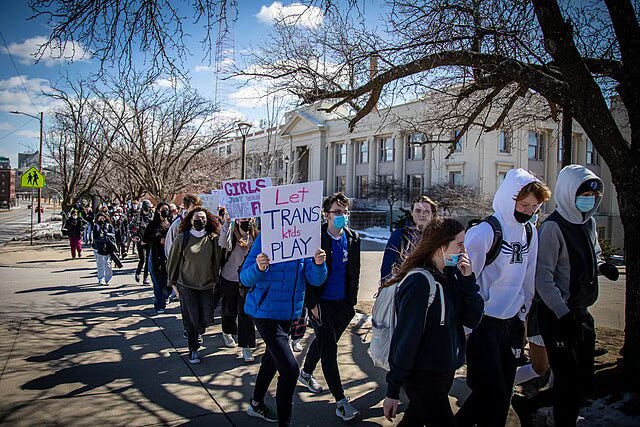
Let trans kids play. Image by Phil Roeder. Used under CCA 2.0.
In the 19 long, bitter decades since Trump issued Executive Order 14201, “Keeping Men Out Of Women’s Sports,” generations have been born, come of age, and died buried away from the sun, divided by uncrossable rivers. Few could conceive of the darkness of the soul in those times who have not lived them.
And so our forgotten years of hope reflecting off the waters of that most colonial of rivers, the Potomac, produced the most unexpected flicker yesterday: a filibuster victory in the Senate, blocking the codification of 14201 into law and ban trans participation in girls’ and women’s school sports. To quote Erin Reed:
Republicans called it the “Protection of Women and Girls in Sports Act.” Democrats dubbed it “The GOP Child Predator Empowerment Act”. The Senate clerk said it didn’t have the votes.
To misquote Joseph Conrad, the Democratic Party is a droll thing, a mysterious arrangement of spineless yes-men for a futile purpose. The most you can hope from it is some acknowledgement of yourself that comes too late, leaving a crop of inextinguishable regrets. But not March 3, 2025!
And not today, Satan!
The vote was not quite so positive as The Hill would have you believe: They reported that “all Democrats voted against” the bill, recorded as S. 9. While zero Democrats voted for it, two Dems known to waffle in the face of anti-trans attacks did abstain. The Senate’s two independents (both of whom caucus with Democrats), Angus King of Maine and Bernie Sanders of Vermont, both voted against. The final margin of 51-45 included two abstentions from Republicans as well, Shelley Capito (R-WV) and Cynthia Lummis (R-WY). Though Trump hasn’t ruled on the prior state of these Senators as blastocysts, both do appear to be women, curiously enough.
The defeat of S9 marks a rare moment in the 119th Congress in which Democrats hung together. On other votes including prominent Senate confirmations and measures in both the Senate and the House, there have been significant defections. HR 28, the House version of this bill, snagged two Democratic votes (both Texas centrists and both men). In a time when Democratic voters and other lefties have been crying out for principled obstructionism to be waged against Trump and the MAGA agenda, blocking S9 was a largely unexpected win. Calling out trans participation in girls’ and women’s sports has been a particularly effective form of attack by the GOP, even when lying their asses off, as Tommy Tuberville did on FOX:
“We’re getting to a point now where women and girls’ sports and getting ready to be extinct. Because already in states across this country, we have high school teams that are made up of totally boys participating against girls. […And wank, wank, wank.]”
Of course no one other than GOP primary voters have taken Tuberville seriously since his Auburn Tigers lost to 14 transsexual squirrels in Commodore drag. But if you need to hear it from someone who knows better than yr Wonkette, Kate Starbird, former NCAA basketball standout, former professional baller in the ABL and WNBA, and current University of Washington professor, had this to say about Tuberville’s demented lie:
“As a former athlete & current researcher of online rumors & disinfo, today’s atrocious example of the ‘right wing bullshit machine’ in action — anchored on a truly idiotic claim from a football coach turned GOP senator about trans girls making girls sports ‘extinct’ — enrages along both dimensions.”
(Wonkette was so impressed with this quote we are currently reviewing her inventory of dick jokes in preparation for the possible extension of an offer of employment.)
To be clear, under the filibuster rules, which could change if the GOP thinks abandoning this Senate tradition is important enough, the bill needed 60 votes to clear a procedural step — cloture — that would then allow an up-or-down vote on enactment. That final vote would have needed only the barest majority, and a tie can be split by the Vice President. But Republicans are not currently talking about eliminating cloture votes, and as long as the filibuster survives, the Protection of Women & Girls in Sports Act is dead.
Despite this victory depending on the GOP maintaining the filibuster and the fact that Republicans are constantly launching other attacks on immigrants, people of color, teachers, and many others, there’s good reason to celebrate the Dems acting like they know how to win. And many people are celebrating, including another former professional athlete and generally decent person, Chris Kluwe:
“I support and am happy the party came together to stop this.”
Of course the party pooper had to add:
“However, this is what they should be doing on EVERYTHING. I’ve said it before and I’ll keep saying it – we are in an existential crisis as a country. We’re either going to emerge as Americans, or as something else.”
And that is, indeed, where we are. Like a flash of lightning in the clouds, we are glimpsing an ephemeral brightening of hope. We live in the flicker, may it last as long as the old earth keeps rolling! But darkness was here yesterday. The GOP has lost only the first of the ebb.
March 4, 1917 Montana elected Republican Jeannette Rankin as the first woman to sit in the U.S. House of Representatives three years before American women nationwide could legally vote. Rep. Jeannette Rankin with her colleagues in the 61st Congress. A persistent advocate for women’s rights, particularly suffrage, Rankin voted in Congress against American entry into both world wars, and late in life led marches against the Vietnam war. More about Jeanette Rankin Visit the Jeanette Rankin Peace Center
March 4, 1933 Franklin Delano Roosevelt was sworn in as president in the midst of the Great Depression. From his inaugural address: “This is preeminently the time to speak the truth, the whole truth, frankly and boldly. Nor need we shrink from honestly facing conditions in our country today. This great Nation will endure, as it has endured, will revive and will prosper. So, first of all, let me assert my firm belief that the only thing we have to fear is fear itself — nameless, unreasoning, unjustified terror which paralyzes needed efforts to convert retreat into advance. In every dark hour of our national life, a leadership of frankness and of vigor has met with that understanding and support of the people themselves which is essential to victory.” President Franklin Delano Roosevelt delivering his first inaugural address Audio and video of the speech
March 4, 1965 Moved to action by President Lyndon Johnson’s sustained bombing of North Vietnam beginning two months before, Vietnam Day was declared by the Universities Committee, led by Wayne State University Professor Otto Feinstein. At about 100 college campuses nationwide, faculty, students and others gathered for lectures and meetings about the war. This occurred just three weeks before the first “teach-in” at the University of Michigan.
March 4, 1969
The Union of Concerned Scientists (UCS) was founded. From its founding document: “Misuse of scientific and technical knowledge presents a major threat to the existence of mankind. Through its actions in Vietnam our government has shaken our confidence in its ability to make wise and humane decisions. There is also disquieting evidence of an intention to enlarge further our immense destructive capability…”. . . continued here
March 4, 1978 40,000 demonstrated against the enlargement of the uranium enrichment plants in Almelo, Holland. Enrichment is the processing of uranium with gas cetrifuges to the level required for use as fuel in nuclear reactors.
March 4, 2011 A new Egyptian prime minister called on thousands of cheering protesters in Cairo’s Tahrir Square to rebuild their country. Essam Sharaf, appointed by the military, told the crowd: Egypt’s new prime minister, Essam Sharaf, is greeted by supporters at Tahrir Square in Cairo. Photo: Amr Nabil/AP “I salute the martyrs. Glory and respect to the families of the victims and a special salute to everyone who took part and gave for this white revolution. I am here to draw my legitimacy from you. You are the ones to whom legitimacy belongs.”
He ws appointed to replace deposed President Hosni Mubarak who had forced out of office by the widespread unrest that had spread from Tunisia, Egypt’s neighbor to the west. Sharaf was cheered and carried to and from the podium on the shoulders of protesters, escorted by military police.
March 4, 2011 In cities across Iraq demonstrators gathered for the second consecutive Friday to demand jobs, effective government services and an end to corruption. Inspired by movements elsewhere in the Arab world, 500 convereged in Liberation Square in the capital Baghdad, 1000 in Basra. Those in Baghdad were surrounded by at least as many security forces and overcame official resistance to the gathering including a citywide ban on vehicles. One protester had walked from Sadr City and had to pass through eight checkpoints.
Snippet (We can read or watch, on the page linked above.):
Chair Walberg, Ranking Member Scott, and members of the committee, thank you for the opportunity to testify today.
My name is Heidi Shierholz, and I am an economist and the president of the Economic Policy Institute (EPI) in Washington, D.C. EPI is a nonprofit, nonpartisan think tank created in 1986 to include the needs of low- and middle-wage workers in economic policy discussions. EPI conducts research and analysis on the economic status of working America, proposes public policies that protect and improve the economic conditions of low- and middle-wage workers, and assesses policies with respect to how well they further those goals. I previously served as Chief Economist at the U.S. Department of Labor.
In considering the topic of “unleashing” America’s workforce and strengthening the economy, I make three main points in this testimony: (1) the Trump-Vance administration has inherited unquestionably the strongest economy for an incoming administration in a quarter-century;1 (2) that strength was driven in large part by economic policy choices by the prior administration and Congress; and (3) the Trump-Vance administration agenda will be profoundly destructive to the incomes and economic security for both the most vulnerable families and the broad middle class. The administration is aiming to gut key income support and safety net programs that provide direct support to tens of millions of working families, and the chaos and uncertainty they are intentionally sowing with reckless power grabs over key economic institutions will likely cause an economic crisis unless it is stopped.
The basic facts about the economy that the Trump-Vance administration inherited
The availability of jobs and the growth in real wages (i.e., growth in the purchasing power of wages after accounting for inflation) are where the rubber meets the road as far as “the economy” goes for working people. On both of these fronts, the economy that the Trump-Vance administration inherited is extremely strong.
In January 2025, when the Trump-Vance administration took office, the unemployment rate was 4.0%, and had been at or below 4.2% since November 2021. The last time the United States saw unemployment that low, for that long, was more than a half century ago. Further, the share of prime-age adults (25–54 years old) with a job was higher during January 2025 than at any time during the business cycle from 2007 to 2019, and near its highest rate in a quarter-century. The labor force participation rate of prime-age adults was also higher than at any time during the business cycle from 2007–2019, and the labor force participation of prime-age women was near its all-time high. Finally, job growth averaged 168,000 per month over the 12 months ending January 2025—a very healthy pace of growth, particularly considering how close the economy is to full employment (when job growth would be expected to slow since there is no longer a large employment gap to be filled).
The purchasing power of workers’ wages, after taking inflation into account, was higher in 2024 than it was at the most recent business cycle peak in 2019 or any point before that. (In other words, real wages were higher in 2024 than they were in 2019 or any point before that.) Further, this was true all across the wage distribution—for low-wage workers, middle-wage workers, and high-wage workers. In fact, bucking the trend of the business cycles of the prior 40 years, wage growth since 2019 has been stronger among low-wage workers than at any other point in the wage distribution. Real wage growth for workers at the 10th percentile, for example, rose by 3.4% annually between 2019 and 2024, for a total increase of 18.2%—the fastest five-year stretch of real wage growth for this group since data started being collected in the 1970s. (snip-MORE)
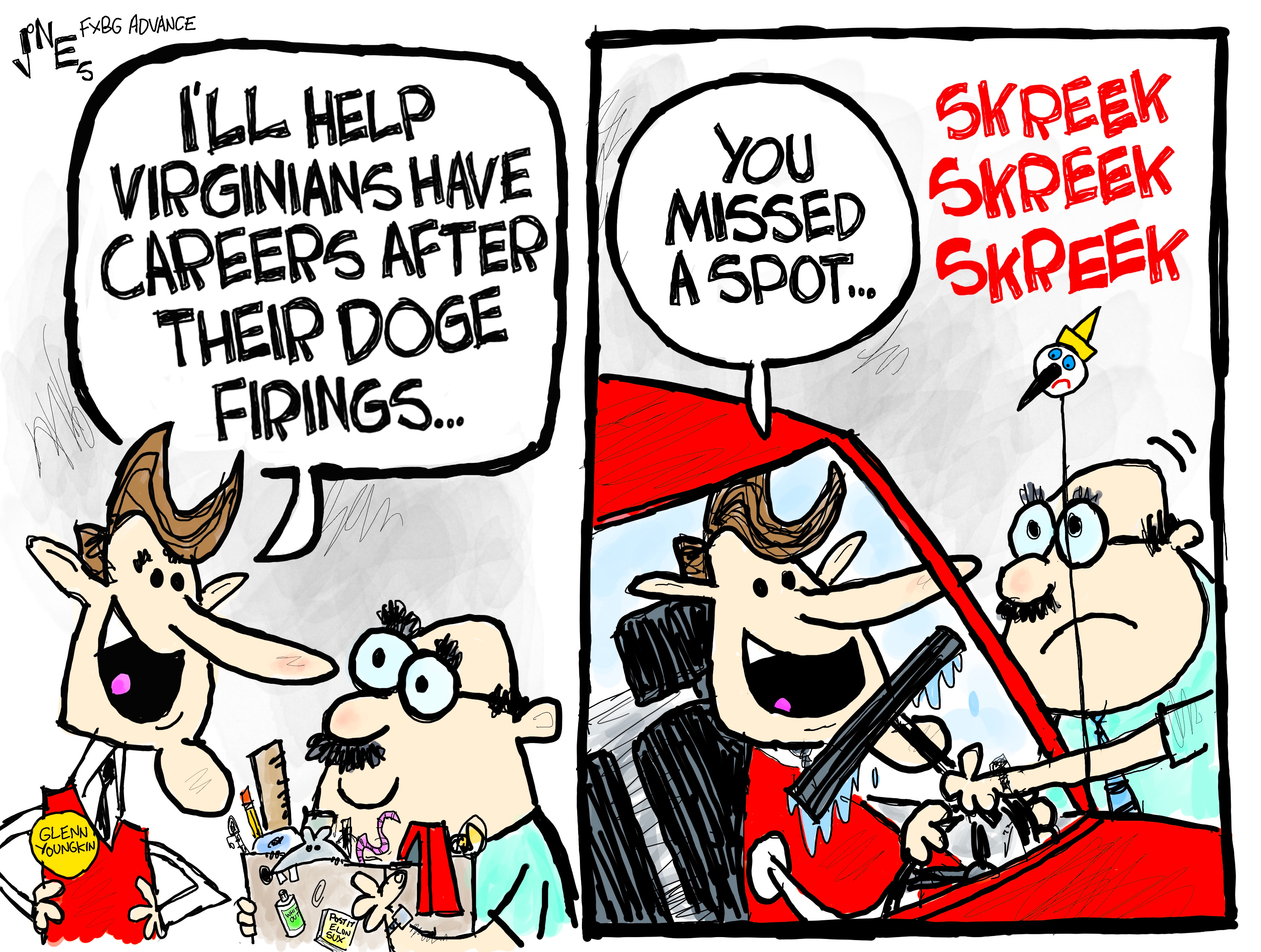
Virginia is one the states being hit the hardest by the DOGE cuts, you know…Elon’s Department of Government Efficiency, which isn’t an official department.
Virginia has more federal employees than any other state except California, which has maybe around 2,000 more. In case you suck at geography, Virginia borders Washington, DC. Virginia, along with Maryland, donated land to form DC…and then took it back many years later. But a lot of federal workers live in NoVA (Northern Virginia) because as expensive as it is there, it’s even more expensive in DC.
It’s cheaper to live in Fairfax, Arlington, Falls Church, Manassas, and even Fredericksburg for federal workers. People in Fredericksburg don’t like to admit they’re a part of Northern Virginia, and there are arguments for and against, but we’re definitely a commuter town. We have a commuter train that runs several times a day.
Do you remember a few weeks ago when I did a cartoon about housing and commuting in the Burg? The issue in the cartoon was about the housing problem in the area, and the only way to afford the newly-built homes was to work in NoVa or DC. Now, a lot of people won’t be able to do that, thanks to Elon Musk.
Right about now is when you need your governor to swoop in and fight for you. Since our governor is a Republican and has always supported Trump, he may have some sway in easing or even ending the layoffs of Virginians. Oh, boy….here comes our governor, red-vest-wearing Glenn Youngkin. Where are the horns announcing our champion’s arrival? Here, I’ll do a. mouth trumpet for it. DOO-DA-Doo!
What’s your message, Gov? Let’s hear it! Here it is! Youngkin said, “Listen. We have a federal government that is inefficient, and we have an administration that is taking on that challenge of rooting out waste, fraud, and abuse and driving efficiency in our federal government. It needed to happen.”
Uhhhh….what?
Our “champion” just said that many Virginians are wasteful, fraudulent, abusive, and inefficient. Youngkin is taking the side of DOGE over Virginias, but he doesn’t care. Most of those federal workers live in NoVA, and NoVA didn’t vote for Youngkin. But, he’s still gonna help us out.
Youngkin said, “We have a lot of federal workers in the Commonwealth, and I want to make sure that they know we care about them and we value them and we want them to find that next chapter.”
Dawwww, thank you, Mr. Red Vest. We’re so happy you care. Now, lay it on us.
Youngkin announced a new “resource package” at an event hosted by Capital One and introduced a new government website, VirginiaHasJobs.com, for fired federal employees. The site has information for recently fired federal workers that includes information on “virtual job fairs,” advice on how to apply for unemployment, and helpful tips on updating their resumes.
The next time your car doesn’t start, maybe Mr. Red Vest will come along and helpfully say, “Try kicking the tires.”
You would think Youngkin would have more sympathy since he was once a commuter when he was co-CEO of the Carlyle Group, an investment firm that helped make Youngkin a multimillionaire with a net worth of around $440 million. No wonder he doesn’t give a shit about you.
And I wouldn’t care about you either if I was a Republican worth $440 million. I’d be in an ivory tower penthouse somewhere, smoking huge cigars while laughing evilly, Bwa-ha-ha-ha-cough-cough-cough-hack-hack-hack-gag-gag-gag. I just remembered that I don’t like cigars.
Anyway, the new website includes an incomplete list (is Enron still around?) of some of the state’s largest employers (a Youngkin staffer did some googling), including Capital One (the Capitol One Cafes are nice. Maybe you can get a job there if you can’t land a position in offering predatory loans). Basically, the governor is telling you to search LinkedIn and Indeed and make sure you smile during your job interviews. Thanks, Governor.
Thank God there’s a one-term limit on governors in Virginia.
Hey, speaking of that. The governor is about to be unemployed himself. Since I have as much empathy for him as he has for his constituents, I’ll give him some job-hunting advice.
Governor, update your resume and make sure to include you’re an orange Kool-Aid-swilling MAGAt, and maybe you can get a job in the Trump administration (sic). After all, you have chosen Trump and Elon Musk over your constituents.
Make sure you include that you like Nazis in your resume because that can get you in good with Elon Musk, who is a Nazi. Don’t get your hopes up too much because word is, Elon favors young boys for those positions. I’m not insinuating anything nasty here, but it’s true. Elon favors young, inexperienced men still in the Clearasil demographic for jobs in DOGE.
During your campaign for governor, you spread lies about the FBI tracking and intimidating parents of students in public schools. Mention that, too. Say something hateful about Biden. They love that shit.
Since you don’t have any accomplishments from your time as governor, you might have to start as an intern. Just crawl up Trump’s ass and wait for your call. What? You’ve already done that? Good job thinking ahead.
Also, tell them you really really really really really wanted to ban abortion in the state, but those commie socialist woke Democrats in the General Assembly wouldn’t let you.
Just hang in there because there will be an opening in the Trump cabinet soon. Which cabinet? Who knows, but this is Trump. He’ll fire someone soon, or perhaps one of them will discover he or she has a couple of ounces of dignity left and will quit after the next international shameful embarrassment. No, it won’t be Rubio.
Also, if you do get inside the Oval Office, be cautious about sitting on any couches. JD’s been in there.
You could also apply for a job at Fox News. Perhaps you can get Pete Hegseth’s former seat on the couch (I’m not sure if JD’s been on that one). What? You don’t have any journalism experience? HAHAHAHA. You’re funny, Gov. This is Fox News, not an actual news outlet.
Ya know, Gov…I think you’re going to be fine (you can probably scrape by with your $440 million), at least for the first three years after you leave office, but it could be close to four years if you leave now.
Nudge, nudge. Hint, hint.
Lieutenant Gov. Winsome Sears made a direct-to-camera video acknowledging “concern about the federal government workforce transition” and shared five links to “additional resources to assist.” All five links led to “404 Page Not Found” website errors. Sears is going to have a lot of fun running to replace Youngkin in this year’s gubernatorial election. Winsome, make sure to constantly mention these firings “needed to happen.” It’ll be a real winner of a message in NoVA, Richmond, Norfolk, etc, ect.
March 3, 1863 In the midst of the Civil War, President Abraham Lincoln signed a conscription act that created the first draft lottery of American citizens. The act called for registration of all males between the ages of 20 and 35, and unmarried men up to 45, including aliens with the intention of becoming citizens, by April 1. Exemptions from the draft could be bought for $300 or by finding a substitute draftee. Many objected to this provision describing the war as a “rich man’s war, but poor man’s fight.” Black Americans were also not eligible for the draft because they weren’t considered citizens. Bounties for New York military “volunteers” during the Civil War
March 3, 1913 The day before Woodrow Wilson’s inauguration as president, 8000 from the National American Woman Suffrage Association (NAWSA), representing every state, marched in Washington, D.C. to call for a constitutional amendment granting women the right to vote. Organized by Alice Paul and Lucy Burns, who had been inspired by the parades, pickets and speeches of the British suffragists, the march drew hundreds of thousands of spectators. Though some of the marchers were attacked by onlookers, the march focused attention on the suffrage issue. [see March 4, 1917 ] More about Alice Paul
March 3, 1961 The village council in the Inupiat Eskimo town of Point Hope, Alaska, formally protested, in a letter to President Kennedy, the proposed chain explosion of three atomic bombs in the nearby above-ground “Project Chariot” tests. The project entailed using atomic explosions to create a harbor near Point Hope, above the Arctic Circle in northwest Alaska. The excavation never happened due to public opposition and inspired native peoples in Alaska to assert their rights and legitimate land claims. Edward Teller “Father of the hydrogen bomb” arrives to promote plans for Project Chariot. Read more about Project Chariot
March 3, 2003 In the first-ever worldwide theatrical act of dissent, there were at least 1029 stagings of Lysistrata, the 2400-year-old anti-war comedy by Greek playwright Aristophanes. Conceived and organized in just two months by Kathryn Blume and Sharron Bower, the performances all occurred on the same day to express opposition to the U.S. invasion of Iraq. Staged in 59 countries (including Iraq), the bawdy play tells of Athenian and Spartan women who unite to deny their lovers sex in order to stop the 22-year-long Peloponnesian War between the two city-states. Desperate for intimacy, the men finally agree to lay down their swords and see their way to achieving peace through diplomacy. More about how it happened
I have strong feelings about women’s restrooms, too, as we all know; so many thoughts about so many women’s bathroom issues. I’m in agreement with this essay. Stick with it, you’ll see. You might want a tissue.
A Trans Girl Approached Me in the Ladies’ Bathroom and It Bothered Me. Here’s Why. by Natalie S. Ohio
Why the girls’ bathroom is a sacred space for women and how we must seek to keep it that way.Read on Substack
Ugh, no hand soap. Again.
If there’s one thing living in Spain will teach you, it’s that hand washing isn’t priority número uno in public spaces.
Luckily, as someone who grew up here, this is no surprise to me. As Gang Starr once said, “I’m not new to this, I’m true to this.”
In other words, I carry soap sheets wherever I go.
As I was washing my hands in the shopping mall bathroom last week, the door cracked open and a head peeked around.
Big brown eyes appeared from under a blunt-cut fringe. A smattering of adolescent acne decorated soft, rounded cheeks and a set of metallic braces twinkled between glossy pink lips.
Either retro makeup is back in style or rubbing my hands together had sent me ricocheting back to the mid-80s…
We regarded each other for a moment.
“¿Puedo pasar?” May I come in?
Her delicate, childlike voice softly penetrated the silence of the empty bathroom.
“Sí, claro.” Of course.
I smiled and gestured to the vacant stalls and the rows of mirrored sinks behind me.
I wondered if she mistakenly believed from the outside that this was a single-person bathroom. Or maybe she thought I was a cleaner. It wouldn’t be the first time a Spaniard had seen my complexion and automatically assumed I was the help.
I was otherwise a little perplexed as to why she would ask.
She hesitated slightly as she stepped around the door.
“Bueno, es que… soy trans.”
Well, it’s just that… I’m trans.
What I’m about to say may sound strange to some, but here goes:
The ladies’ bathroom plays a surprisingly significant role in girlhood.
I’m not talking about the one at Grandma’s house with its peach-coloured wall tiles, nor the ones in fancy restaurants where you go to check your appearance on a date.
I’m talking about the public toilets that double as makeshift community hubs for women — grubby little social sinkholes you find in nightclubs, bars, and airports that offer a brief moment of tranquillity as the commotion fades behind the closing door.
Restrooms with precarious toilet seats, broken flushes, and “love urself babe ur perfect” scribbled in eyeliner on the inside of the stall.
I’m willing to bet that anybody who has used a public ladies’ room has had at least one memorably positive encounter with someone they’ve met inside.
What’s so special about it? I hear you cry. Men have bathrooms too and nobody bats an eyelid. If anything, the less said about those, the better.
On a functional level, nothing at all.
In fact, the ladies’ very often sucks in comparison to the men’s. A victim of long queues, scarce toilet paper, and the most unflattering lighting known to man.
However, we’re not talking about serviceability. If we were, we wouldn’t have a leg to stand on.
What I’m referencing is much deeper than that. Much more visceral.
I once undid a drunken stranger’s bodysuit in a nightclub bathroom so she could relieve herself before going back out to tear up the dancefloor. If you’ve any idea what a bodysuit is and where its fastening is located, you’ll understand why that’s a tall order.
I’ve witnessed countless girls take their drinks inside and leave them unattended by the sink without any concerns over getting roofied.
There’s nearly always someone giving an empowering pep talk to a broken-hearted friend who needs a boost of confidence.
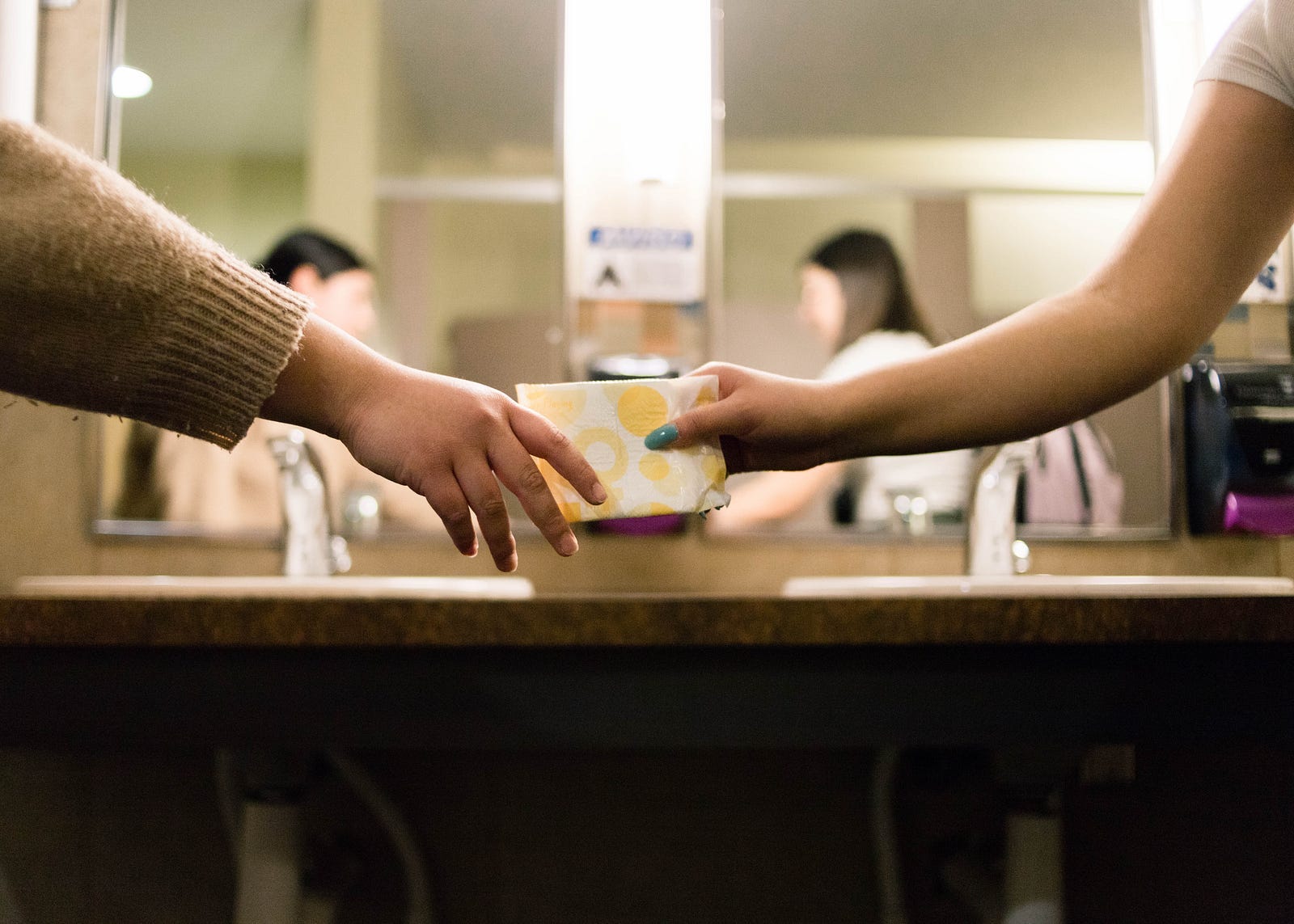
Blister plasters, boob tape, and tampons are handed out like Werther’s Originals at a Women’s Institute meeting. Pleasant conversation dapples the air. Strangers become new best friends.
Outfits are readjusted, hair is coiffed, perfume is shared, and doors with faulty locks are guarded to prevent accidental walk-ins. Those who are desperate are permitted to jump the line.
It’s where the power of sorority is comfortably displayed.
The girls’ bathroom is one of the few places where female vulnerability isn’t preyed upon.
Conversely, it’s often bolstered and allowed to exist without any need for justification.
Sure, it’s where you go when nature calls. But it also acts as a cocoon-like environment — somewhere you can retreat to when you want to feel… safe.
Nat, why are you waxing lyrical about the loo?
Well, because this recent encounter brought about a bracing realisation for me — a conventional woman with an uncomplicated identity who fits comfortably within the margins of the archetype.
I realised that the person peeking her head around the door wasn’t merely asking for permission to enter the room.
She was asking for permission to belong.
She was giving me the power to accept or reject her appeal to exist freely in a space that—for people like me—is a place of comfort, and for people like her, is commonly associated with hostility and consternation.
The alignment of my biological sex and gender identity affords me the confidence to take up space in social settings where others, with less streamlined identities, may feel reluctant.
Of course, uncertainty is a perfectly natural phenomenon in adolescence — kids are constantly trying to make sense of themselves and explore how and where they best fit in a world governed by grown-ups. And this kid, who looked to be some 14 or 15 years old, is no different.
However, this situation was unique because it didn’t focus on the implicit social hierarchy that comes with a significant age gap.
Instead, our respective positions on the spectrum of womanhood forced us to weigh up the other’s existence.
It was as though she believed that within a shared space her identity would encroach on mine; so announcing that she was trans and verbally acknowledging our differences would help me to legitimise her humanity some.
She asked me if she could come in because there may have been a chance that I wouldn’t have wanted her to.
And that is devastating to me.
“Bueno, hija, ¿qué más da? Pasa, pasa.” So what, kiddo? Come on in.
I headed over to the hand dryer.
“Ay, muchas gracias!”
She smiled sweetly and walked past me in her fishnet tights and patent Dr. Martens.
Transphobia is not an alien concept in countries that operate under organised religion or have a traditional set of social values, such as Spain.
Vox—a prominent far-right political party—has been consistently vocal about its disdain towards transgender people and its desire to prevent their access to base-level human rights. Transgender people are persecuted by conservative political parties and their followers all across the nation.
Adults berating other adults is one thing, but what happens when this toxic, nefarious behaviour falls upon the shoulders of children?
Children are sacred
“Los niños son sagrados” (children are sacred) is a phrase you see and hear typically in response to the mistreatment of children in any form.
Children are revered in Hispanic culture, so why was this particular child so acutely aware of the controversy surrounding her identity? Shouldn’t the innocence we try so hard to preserve in children include transgender children too?
Shouldn’t she be able to exist as comfortably as her peers do?
Had I voiced an issue with her coming into the bathroom, there is no doubt in my mind that she would’ve turned away and left. And that’s what bothered the hell out of me. It upset me that she felt the need to even mention it.
Because who am I? I’m not important. I have no authority over public spaces or gender identity whatsoever.
I don’t care what people do in the privacy of a bathroom stall. I don’t stop to intimidate them or pass judgement.
I’m just a stranger washing her hands at the sink. But luckily for this girl, I’m a kind stranger. Someone whose cup of compassion and understanding runneth over.
The fact that she felt the need to ask stirred up feelings of pity and rage in equal measure.
It disgusts me that this harmless individual possibly has and probably will suffer at the hands of narrow-minded losers who mind other people’s business more than their own.
As if growing up isn’t already fraught with insecurity and a heightened awareness of your differences from others. Being a teenager in today’s world is like wandering into the seventh circle of hell with gasoline shorts on.
Sure, the world is a big, scary place. But the girls’ bathroom is something else entirely, and it should stay that way.
I felt a wave of protectiveness wash over me as I thought about how she must feel on a regular basis. Physically, she was long-limbed and lofty, yet she seemed so small and defenceless.
A kid.
Just figuring herself out, one day at a time.
When she came into the sink area, she told me she liked my outfit — I told her that I have my own clothing line and was wearing one of my newest designs. I offered her a soap sheet and asked her about her makeup — her parents had bought her an eyeshadow palette for her birthday recently. I’ve never been any good with eyeshadow. She doesn’t go a day without it.
So there we were.
Just two gals chopping it up in the girls’ bathroom, enjoying pleasant conversation with someone we’ll probably recall warmly once or twice before returning to the monotony of our everyday affairs.
I suppose that these are the situations we need more of. Just witnessing humans being humans and doing human things.
So often bigots behave as though those they’re prejudiced towards are a subhuman entity that needs to be exterminated to restore a sense of harmony and order to the world.
In reality, we’re all just people. Trying to get by and get on with things before we shuffle off this mortal coil once our number is up.
Coexisting peacefully really isn’t as complicated as it’s made out to be. Being kind to others is far from difficult.
We’re all different, and that’s fine — it doesn’t need to be fire and brimstone and bloodbaths and battalions.
So when you meet someone different from you, just share the soap.














 Scottie's Playtime