I enjoy this man’s commentary. He’s always seemed to know whereof he speaks. Every weekend I intend to post this newsletter, and every weekend gets by me without me getting it done. This is a copy-paste of my newsletter; I receive it in email from “The Nation” magazine. All links within are live.
A retirement for the ages Illinois Senator Dick Durbin, who has been in Congress or the Senate for nearly my entire life, has announced that he will not seek reelection in 2026. The 80-year-old’s retirement will touch off a firestorm of a Democratic primary in Illinois, and I’m already dreading the prospect of a heap of progressives jumping into the race, cannibalizing each other, and clearing the path for the wealthiest available moderate white man to buy the nomination. If progressives could just coalesce around one candidate and stick together, they’d win this thing. Then again, if I had wheels, I’d be a wagon. In any event, Durbin’s long overdue retirement is more important to what I cover than the primary, because Durbin is the ranking member of the Senate Judiciary Committee, which controls the judicial nomination process. He was the head of the committee during Joe Biden’s presidency—a job he got by literally pulling rank over the guy who was best suited for the post (according to me), Senator Sheldon Whitehouse. The last four Democratic leaders on Judiciary have been, pretty much, a disaster. Durbin was preceded by Diane Feinstein, who was preceded by Patrick Leahy, who was preceded by Joe Biden. All four of these people were establishment moderates who were more concerned with formalities and courtesies than fighting for control of the courts. It was during their watch that the Federalist Society was able to overrun the judiciary with Republican judges who have literally taken away constitutional rights and redefined the law as a tool of the Republican political agenda. The Judiciary Committee desperately needs new, energetic leadership, to say nothing of a fighting spirit. I can only hope that Durbin’s retirement marks the end of the era of Democrats’ getting punked on judicial nominations.
The Bad and The Ugly SCOTUSblog, a popular website that reports on the Supreme Court, has been acquired by the right-wing media outlet The Dispatch. The acquisition likely marks the end of one of the few nonpartisan sources of information about the Supreme Court and plunges yet another independent outlet into the dark morass of the white-wing media ecosystem. I have a ton of respect for the website’s senior editor, Amy Howe, and I know she will fight like hell to retain the site’s nonpartisan independence. But this ain’t no fairy tale. When you lie down with dogs, you wake up with fleas.The number of young people who are incarcerated is going down, but the racial disparities among the children we put behind bars are “the highest in decades.” Black and Native American children are getting the worst of it, according to NPR. Pope Francis died. Francis was from Argentina. He was the first pope from Latin America, the first pope from the Southern Hemisphere, the first Jesuit pope, and the first pope born and raised outside of Europe since the 8th century. He was also one of the most progressive popes in the history of that office, though admittedly that’s a bit like saying he was the least fungal fungus. For my lapsed-Catholic part, I liked him. I hope the next pope is the second pope who can claim to be most of these things. Secretary of Defense Pete Hegseth has been caught up in yet more Signal-inspired controversy. I know I’m supposed to care, but I don’t. They put a Fox News host in charge of the American military; what the hell did people think was going to happen? Decency? Competence? A group of bigoted parents went before the Supreme Court this week and asked the justices to allow them to object to books in school that mention gay people. The Republican justices on the court fell all over themselves to agree with the parents. I am once again asking bigoted religious wing nuts to homeschool their children and leave the rest of us who want to live in a society alone.
Inspired Takes In The Nation, my colleague Joan Walsh took on the Trump administration’s ridiculous and sexist obsession with white birth rates. For my part, I am willing to help the administration accomplish its goals: If it really wants white birth rates to go up, all it has to do is make most white people poor again. The lesson from literally all today’s high-income societies is that birth rates go down as economic prosperity goes up, so the solution is actually pretty simple. Maybe that’s the real reason behind Trump’s tariffs? Contraband Camp has put out a “Trump Administration Discrimination Database.” So now, whenever your MAGA uncle says, “Point to one thing Trump has done that is racist,” you have a reference source. I used to feed my dog a “raw food” diet. It made sense to me, in an unthinking way (dog = wolf = murderous carnivore = “Aww… who’s the good girl who wants to feast on the raw viscera of your slain enemies?”). The fru-fru suburban veterinarian I go to didn’t immediately tell me it was a bad idea. But then, I happened to run into my old, hardscrabble city veterinarian and she basically said, “What the fuck? Don’t do that. I thought you were a smart person?” She then gave me some research. Now, we’re back to kibble. For people who don’t have the benefit of knowing a frank-talking vet, Emmet Frazier explains in The Nation why your fully domesticated dog doesn’t need to be eating rabbit liver.
Worst Argument of the Week This isn’t really an argument, but I read a story in Gothamist that almost made me cry. The Trump administration has largely cut off funding for legal aid programs that would provide lawyers to immigrant children sent here without their parents or legal guardians. That has forced thousands of children in New York City to go through the court process—which can lead to their deportation (among other things)—with no legal representation. We’re talking about children as young as 4 being hauled into a courtroom without a lawyer. I do not know what kind of sick fucks think this is OK. I cannot fathom the base, racist, cruelty and inhumanity you have to be comfortable with to think that Trump is right to cut this funding. I cannot conceive of the argument one might make to support this. All I know is that whatever argument one has for making this OK is wrong.
What I Wrote I was not prepared to engage with a Supreme Court decision at 1 o’clock on Saturday morning, but I’m very glad the court was still working. It issued a ruling that prevented Trump from deporting another group of immigrants, and in so doing, probably saved some of their lives. The Harvard lawsuit against the Trump administration over his illegal and unconstitutional freeze of the university’s research funding is very strong. Harvard should win, if winning in court still matters.
In News Unrelated to the Ongoing Chaos You should watch Andor. The first episode of its second season just came out and, trust me, you should just watch it. Forget that it’s part of the Star Wars franchise. Forget that it’s another Disney-owned media property looking to milk that franchise for all its worth. This show is about fighting fascism. It is the most relevant piece of dramatic fiction of this era.
April 27, 1936 The UAW (United Automobile, Aerospace, and Agricultural Implement Workers of America), gained autonomy from the AFL (American Federation of Labor), becoming the first democratic, independent labor union concerned with the rights of unskilled and semi-skilled laborers.
April 27, 1937 The Social Security Administration began operation by making its first payment to an American protected under the law, principally the elderly, and children who’ve lost their parents.
April 27, 1942 Sixteen pacifists, including Evan Thomas and A.J. Muste, refused to register for the World War II draft. Muste was a Quaker activist, founder of the Fellowship of Reconciliation, and author of two pamphlets that same year, War is the Enemy and Wage Peace Now. A.J. Muste still working for peace 25 years later with Dorothy Day, leader of the Catholic Worker movement. Read about War is the Enemy
April 27, 1974 Ten thousand marched in Washington, D.C., calling for impeachment of President Richard M. Nixon.
April 27, 1987 Central Intelligence Agency headquarters in Langley, Virginia, was blockaded by people protesting U.S. policies in Central America and Southern Africa. 700 were arrested.
April 27, 1989 Thousands of Chinese students took to the streets in Beijing to protest government policies and issued a call for greater democracy in the communist People’s Republic of China. The protests grew until the Chinese government ruthlessly suppressed them in June during what came to be known as the Tiananmen Square Massacre. Ignoring government warnings of violent suppression of any mass demonstration, students from more than 40 universities began a march to Tiananmen this day. The students were joined by workers, intellectuals, and civil servants and, by mid-May, more than a million people filled the square.
April 27, 1994 Nelson Mandela casting his first vote South Africa held its first multiracial elections and chose anti-apartheid leader Nelson Mandela (with more than 62% of the vote) to head a new coalition government that included his African National Congress Party. More on that historic election
Milwaukee County Circuit Judge Hannah Dugan was arrested by the FBI and charged with obstructing an immigration arrest operation. This is a further step away from democracy and toward fascism.
FBI Director (sic) bug-eyed hatchet man KashPatel announced the arrest on TwitterX, accusing her of “intentionally misdirecting” federal agents as they sought to detain an immigrant who was set to appear for an unrelated proceeding last week. Announcing this on social media makes it clear that this is political and is meant to set an example for other judges.
The regime has been publicly attacking judges who are delaying or halting Trump’s fascist moves, like deporting legal residents and canceling student visas. One GOP representative has even filed legislation to impeach judges who go against Trump. Kash Patel, another Trump appointee not qualified for his position, was more than happy to send thugs to arrest a judge.
This is another court fight that Trump should lose, and even be thrown out.
Attorney General (sic) and MAGA hack Pam Bondi said, “These judges think they’re above the law. They are not. We will come after you and prosecute you. We will find you.” She also called judges “deranged.”
Stephen “Baby Goebbels” Miller, the White House deputy chief of staff, said on social media, “No. One. Is. Above. The. Law,” which is ironic coming from a guy who works for a felon.
While these fascist idiots are tweeting and yammering about arresting a judge, the judge can’t comment about it at all because the judicial code of conduct restricts judges from commenting on pending or impending matters in any court.
I expect that the regime will cut out the bullshit reasons and excuses and soon start arresting judges on the charges of “obstructing Trump.”
Creative note: I drew this cartoon, then drew a local cartoon for the Advance. It’s not 6:40 p.m. and I haven’t eaten yet. That means this is all the blog you’re getting today. Clay tired. I’m off the clock until tomorrow, so if you email me anything today, I’m not replying until Sunday.
Music note: I’m still feeling Chicago, so I listened to the Blues Brothers.
April 26, 1954 The Geneva Conference began for the purpose of bringing to an end the conflicts in Korea and Indochina. This followed the defeat of the French in Vietnam at Dien Bien Phu. France had been trying to reassert colonial control over Indochina following World War II. The conferees included Cambodia, France, Laos, the People’s Republic of China, the Democratic Republic of Vietnam, the Soviet Union, Vietnam, the U.S. and the United Kingdom. As a result, Vietnam was temporarily partitioned pending elections on reunification to be held in 1956; those elections were never held.
April 26, 1966 Rodolfo “Corky” Gonzales Rodolfo “Corky” Gonzales founded the Crusade for Justice, a Chicano activist group, in Denver, Colorado, and marked his departure from the Democratic Party. It was the beginning of a nationalist strategy for the attainment of Chicano civil rights. Read more video Democracy Now
April 26, 1968 A national student strike against the Vietnam war enlisted as many as one million high school and college students across the U.S.
April 26, 1986 A major accident occurred at the Chernobyl nuclear power plant in the Ukraine near the border with Belarus, both then part of the Soviet Union (Union of Soviet Socialist Republics). An explosion and fire in the No. 4 reactor sent radioactivity into the atmosphere. Only after Swedish authorities reported the fallout over their country 1385 km away (860 miles), did Soviet authorities reluctantly admit that an accident had occurred. During a fire that burned for 10 days, 190 tons of toxic materials were expelled into the atmosphere (3% of the reactor core). Winds blew 70% of the radioactive material into neighboring Belarus. The explosion at Chernobyl was the world’s largest-scale nuclear accident. Approximately 134 power-station workers were exposed to extremely high doses of radiation directly after the accident. About 31 of these people died within 3 months. Another 25,000 “liquidators”—Soviet soldiers and firefighters who were involved in clean-up operations — have died since the incident of diseases such as lung cancer, leukemia, and cardiovascular disease. 400,000 were evacuated and over 2,000 towns and villages were bulldozed to the ground in areas considered permanently contaminated. Deaths and illnesses directly attributable to radiation exposure continue. “Chernobyl is a global environment event of a new kind. It is characterized by the presence of thousands of environmental refugees, long-term contamination of land, water and air, and possibly irreparable damage to ecosystems.” – Christine K. Durbak, Chairwoman of the World Information Transfer, New York Chernobyl for Kids
April 26, 1998 Bishop Juan Gerardi Conedera Bishop Juan Gerardi Conedera, a leading human rights activist in Guatemala, was bludgeoned to death two days after a report he had compiled was made public. The report blamed the U.S.-backed Guatemalan military government and its agencies for atrocities committed during Guatemala’s 36-year civil war. About Bishop Gerardi’s murder (Democracy Now)
April 25, 1945 Delegates from some 50 countries met in San Francisco for the United Nations Conference on International Organization. Over the next two months they would negotiate the principles and structure of the United Nations. Pres. Franklin D. Roosevelt had just died and had been working on his speech to the conference: “The work, my friends, is peace; more than an end of this war—an end to the beginning of all wars . . . As we go forward toward the greatest contribution that any generation of human beings can make in this world—the contribution of lasting peace—I ask you to keep up your faith . . . .”
April 25, 1969 The Reverend Ralph David Abernathy, head of the Southern Christian Leadership Conference, and 100 others were arrested while picketing a Charleston, South Carolina, hospital to support unionization by its workers. Read more about Reverend Ralph David Abernathy
April 25, 1974 A peaceful uprising by both the army and civilians, known as the Carnation Revolution (Revolução dos Cravos), ended 48 years of fascism in Portugal. People holding red carnations urged soldiers not to resist the overthrow and many placed the flowers in the muzzles of their rifles. The regime killed four before giving in to the popular resistance. Lisbon demonstration ’74 Read more about the Carnation Revolution
April 25, 1983 Women in Canberra, Australia, laid a wreath to remember women of all countries raped during wartime.
April 25, 1987 Tens of thousands marched on Washington, D.C. to demand an end to U.S.-sponsored and -supported wars in Central America.
April 25, 1993 Nearly one million marched for homosexual rights and liberation in Washington, D.C. Health Care Rally at April 25, 1993 The AIDS quilt on display as part of the event.
April 25, 2004 The March for Women’s Lives drew a record 1.15 million people to Washington, D.C. The marchers wanted to protect legal and safe access to reproductive services including abortion, birth control and emergency contraception. Organized by a coalition that included the National Organization for Women (NOW), Black Women’s Health Imperative, Feminist Majority, National Abortion Rights Action League (NARAL), the National Latina Institute for Reproductive Health, and Planned Parenthood, along with the American Civil Liberties Union (ACLU). The March for Women’s Lives was the largest protest in U.S. history. Read more
This blogger visits us here; I’ve seen likes on our posts. I checked out the blog and subscribed. I admit, I read with the Translate turned on, so I’ve copy-pasted a snippet here, in English. It’s not too long to read, so please do! It’s motivating.
The government’s instructions on the “sobriety” to be maintained in the celebrations of April 25 have led to the cancellation of celebrations and concerts, even in municipalities administered by left-wing councils. An indication is not a ban, but many mayors have preferred to avoid being accused of having violated the sobriety required during the five days of national mourning proclaimed for the death of the Pope. As in the case of Foligno, they even cancelled the performance of the philharmonic that was supposed to play the national anthem.
In Lastra a Signa, on the outskirts of Florence, the municipal council has decided to cancel the concert of Quarto Podere , a historic Tuscan band that has always combined commitment, tradition and irony in its long artistic career. In response to this absurd decision, the members of the group wrote a letter in which they expressed deep dismay and asked for a reconsideration. Here is a significant passage:
“ April 25, Liberation Day from Nazi-fascism, is a cornerstone of our Republic. We therefore consider it unacceptable that a left-wing government, in a secular State (as established by Article 1 of the Constitution), chooses to deny the possibility of adequately commemorating such a significant day, outraging the memory of those who sacrificed their lives for our freedom. This choice appears even more serious at a time in history when our dignity, workers’ rights and the founding values of the Republic are under attack by a far-right government, clearly of neo-fascist origin; a government that, since it has been in office, has undertaken a systematic demolition of political rights, limiting the possibility of dissent and resistance, as demonstrated by the latest Security Decree. The proclamation of five days of national mourning represents yet another opportunity to exploit a contingent event and silence any form of dissent. We are convinced that Pope Francis – a figure we deeply respect – would have been opposed to a cancellation that betrays the inclusive and profound spirit of a celebration that, for our country, is sacred .”
Music, singing, artistic expression have always been perceived as dangerous by totalitarian regimes. (snip-MORE)
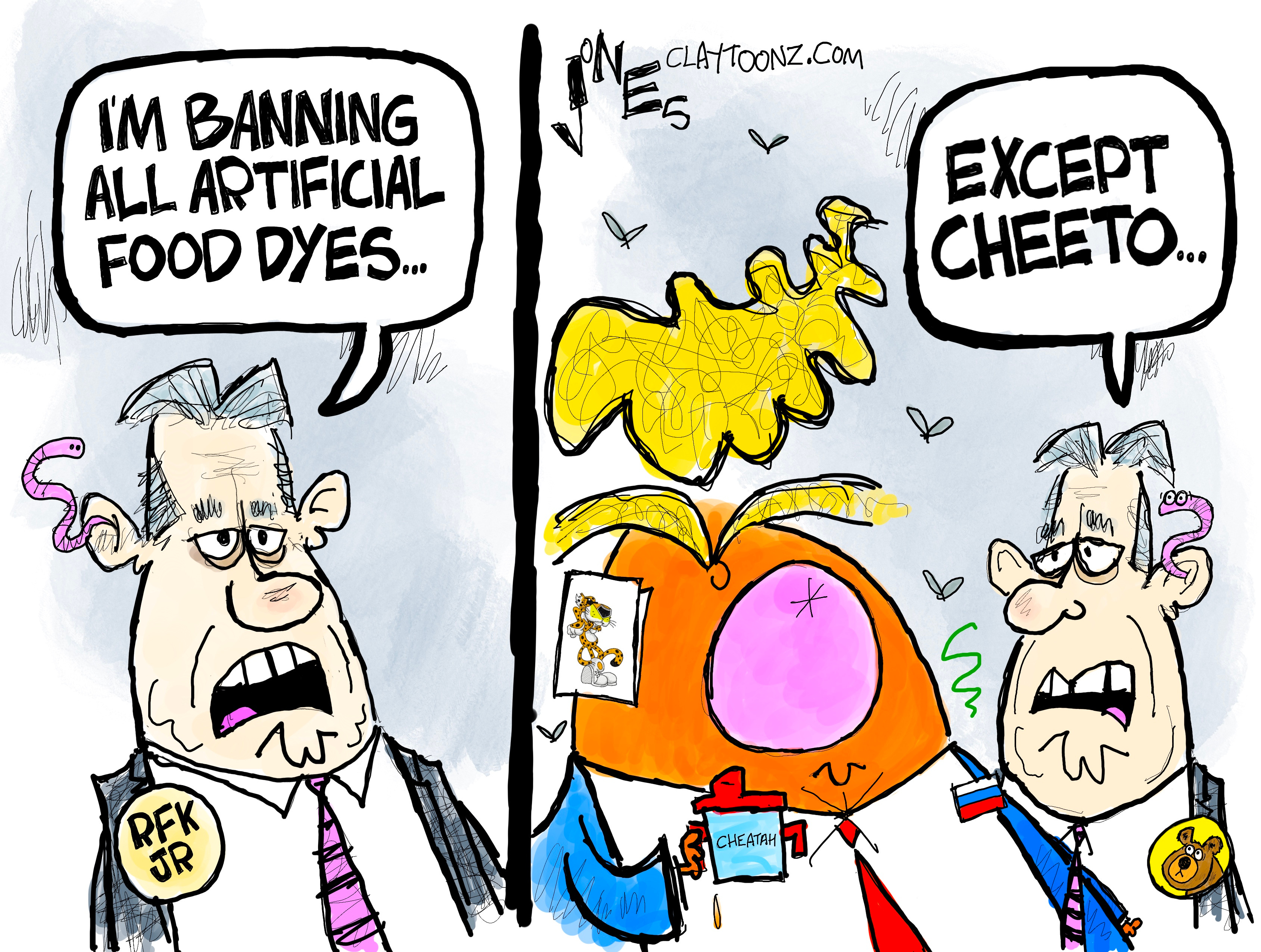
On Tuesday, the Department of Health and Human Services and the Food and Drug Administration announced a series of measures to phase out eight artificial food dyes and colorings from America’s food supply by the end of next year. Get ready for boring Cheetos.
RFK Jr, the nation’s laughingstock of a Health Secretary, said, to a crowd of “Make America Health Again” supporters (that’s a thing?), “I just want to urge all of you, it’s not the time to stop; it’s the time to redouble your efforts, because we have them on the run now, and we are going to win this battle.” Who do we have on the run? Food colorers? The Easter Bunny? He also said, “And four years from now, we’re going to have most of these products off the market, or you will know about them when you go to the grocery store.”
Are they sure that brain worm is dead?
FDA Commissioner Dr. Marty Makary said the agencies are looking to revoke authorization for two synthetic food colorings and to work with the food industry to eliminate six remaining synthetic dyes used in cereal, ice cream, snacks, yogurts, and more. They’re going to fuck up ice cream.
He said, “Today, the FDA is taking action to remove petroleum-based food dyes from the U.S. food supply and medications. For the last 50 years, American children have increasingly been living in a toxic soup of synthetic chemicals.”
Now get this. These bans will be voluntary with the food companies. RFK Jr. said, “We don’t have an agreement; we have an understanding.” Good luck with that, Mr. Wormy Bear Killer.
The food companies would like an agreement, and that is for there to be one federal regulation on food dyes, and regulations from every state. Remember state rights? That will be the case for abortions but not for the color in Cheetos. (Snip-MORE + Chicago trip stuff)
======================
The three branches of government, 2025 by Ann Telnaes
This year presents an opportunity to enact tax policy changes that would ease the strain on household budgets that people in low-paid jobs and their families face and allow them to invest in their future, while ensuring that the nation’s wealthiest pay more of their fair share in taxes. Expiration is approaching for a number of provisions in the 2017 tax law[1] — which showered expensive tax cuts on the wealthy and failed to deliver on promised benefits for economic growth and workers’ earnings — so the time is ripe for a new direction.
But the economic agenda the Trump Administration and congressional Republicans are pursuing would double down on the 2017 law’s flaws by extending its skewed taxed cuts, which would further balloon deficits and deliver another trickle-down failure. And to help pay for those tax cuts, House and Senate Republicans are planning massive cuts that would take health care and food assistance away from, and make college less affordable for, millions of people with low and middle incomes.[2]
Republicans should instead pursue one of the paths they campaigned on, as articulated by Senator Josh Hawley in January: “for every Republican who has hailed the new working-class coalition that President Trump has assembled, this is the time to deliver.”[3]
A better tax bill would:
Not take health care and food assistance away from millions of people or make it harder to afford college or pay energy bills.
Prioritize tax credits that help people make ends meet as they face rising costs for groceries, clothes and other retail goods, health care, and other items:
expand the Child Tax Credit in a way that prioritizes the 17 million children in families who get less than the full credit because their families’ incomes are too low;
permanently extend the larger premium tax credits that are helping people afford health coverage;
and expand the Earned Income Tax Credit (EITC) for adults in low-paid jobs not raising children at home, including young adults just starting out who may be struggling.
Require corporations and the wealthy to pay a fairer share of tax, which will also help offset any of these tax cuts. This includes ending tax cuts for high-income people on schedule, raising taxes on very wealthy people and corporations that receive enormous breaks under the current tax code, and building an IRS capable of collecting more of the taxes that are already legally owed.
And whether as part of the tax bill or separately, Republicans in the majority should also assert Congress’ constitutional power and responsibility over trade policy and turn off the destructive tariffs the Trump Administration has imposed and threatened. Separate bills introduced by Republican and Democratic Senators and Democratic House members are a step in the right direction.[4] The Administration’s tariffs will hit low- and middle-income families particularly hard at grocery and retail stores while risking a global recession, with all the human suffering that entails.
Don’t Take Away Health Care, Food Assistance, and College Support
One easy course correction toward crafting a better tax bill would be for Republicans to simply not harm the low- and middle-income people they campaigned on helping. But the Republican budget resolution includes instructions to House committees to make $1.4 trillion in cuts to programs in their jurisdiction that could potentially harm low- and middle-income people.[5] These include instructions to the committee with jurisdiction over Medicaid to cut at least $880 billion over ten years, the committee with jurisdiction over food assistance through SNAP to cut $230 billion, and the committee with jurisdiction over student loans to cut $330 billion. These programs serve tens of millions of people: Medicaid provides health coverage that 72 million people count on; SNAP helps over 40 million people put food on the table each month; and student loans make higher education more affordable for millions of people.[6] The Republican budget resolution may also assume cuts to energy tax credits and other climate investments, which would increase utility bills, imperil energy reliability, and threaten jobs and investment nationwide.[7]
Even cuts that are a fraction of the size of the potential $880 billion cut to Medicaid and $230 billion cut to SNAP in the House instructions would cause serious harm. They would still increase costs for strapped families and leave more people uninsured and unable to afford food. And it is possible the cuts will be deeper or cover more areas, as some House and Senate members press for far larger cuts.
These cuts are all designed to help offset the cost for wasteful, $1.8 trillion tax cuts for people in the top 5 percent of incomes. (See Figure 1.)
Figure 1
At the same time the Republican agenda would raise costs for families and leave more people uninsured, the Trump Administration’s tariffs threaten volatility and price increases — and a significantly increased risk of recession and higher unemployment — that will land hardest on people who can least afford it.
Expand the Child Tax Credit and EITC, Extend Enhanced Premium Tax Credit
The 2017 tax law included some structural improvements: it doubled the standard deduction and the maximum Child Tax Credit amount while eliminating the personal exemption. These changes cut taxes for most people with low and moderate incomes, though only modestly, while simplifying the tax returns of millions of taxpayers as they reduced the number of those who need to itemize their deductions. But these changes provide only modest help to many low- and moderate-income families and more is needed in a tax bill to help families afford the basics, including the cost of health care.
Child Tax Credit
The Child Tax Credit is key in helping millions of families afford the essentials, and lifted 3.6 million people, including 2.0 million children, above the poverty line in 2023.[8] But one of its greatest design flaws is that under the 2017 tax law, it leaves 17 million children, or roughly 1 in 4 children, out of receiving the full credit because their parents’ incomes are too low. While most of the children left out of the full credit receive a partial credit, children in families without income in a given year, for reasons including job loss, health, and caregiving responsibilities, don’t receive any credit at all.
While the 2017 tax law doubled the maximum Child Tax Credit amount from $1,000 to $2,000, millions of children in families with low and moderate incomes — those who would most benefit from an increase — didn’t receive that full increase the way that children in families with higher incomes did. In fact, millions received a Child Tax Credit increase of just $75 or less from the 2017 tax law, far below the $1,000-per-child increase that higher income families received.[9]
A better tax bill would fix these flaws. The best and simplest way to do that is to provide the full Child Tax Credit amount to all children in families with low and moderate incomes. This is often called making the credit “fully refundable,” because families whose credit exceeds their income tax liability receive the full credit as a refund. As one example, the American Family Act, recently reintroduced in the House by Rep. Rosa DeLauro and others and in the Senate by Sen. Michael Bennet and others, would do just that, while also increasing the maximum credit, paying it on a monthly basis, and providing a larger amount during the first year of a child’s life, among other changes.[10]
Making the credit fully refundable would have important benefits for children in families with lower incomes. When this feature and other key expansions, including a larger maximum credit and advance monthly payments, were in effect for the credit in 2021, low-income families used the money to pay for necessities like food and housing, as well as expanding educational opportunities for their children, like through tuition and after-school programs.[11]
And the 2021 expansion, together with other pandemic relief, helped drive down the number of children experiencing poverty to a historic low in 2021. Black, Latino, and American Indian and Alaska Native children, whose families face structural racism in the nation’s economic, housing, and educational systems that depresses their earnings, experienced particularly large decreases in child poverty. But when the credit’s temporary expansions and other pandemic-era assistance expired, child poverty rates rose back up. (See Figure 2.)
Figure 2
If Republicans fail to make the full credit available to the 17 million children in families whose earnings would otherwise be too low to qualify for it, they should, at minimum, expand the credit for the millions of children who receive some but not all of the credit, similar to the approach taken by the bipartisan bill from January 2024. Fully 169 House Republicans voted for that legislation, which was negotiated and championed by House Ways and Means Chair Jason Smith. In its first year, the bill would have expanded the Child Tax Credit for more than 80 percent of the children left out of the full credit, boosting the credit for children in working families. When fully in effect, it would have reduced the number of children experiencing poverty by 500,000.[12] The expansion would have helped parents across the country who work in important occupations for low pay. (See Table 1.)
One critical reform in that legislation — which should be a top priority in the upcoming tax bill — would have allowed families with low and moderate incomes to receive the same-sized credit for each of their children. As it stands, higher-income families get the same credit amount per child; lower-income families do not. The bill would have changed this by providing the credit on a per-child basis for families with low and moderate incomes just as it is presently provided per child for higher-income families, providing substantial help to the three-quarters of children left out of the full credit who live in a family with more than one child.[13] The bill also would have increased and eventually eliminated the lower maximum credit amount that applies to families with lower incomes, often called the “refundability cap.” This improvement would allow eligible parents to receive an increase in their credit for any increase in their work earnings, which is inexplicably denied in current law.[14] Policymakers could improve on these bill changes by also phasing in the credit from the first dollar of a family’s earnings, as many Republicans have proposed in the past.[15]
TABLE 1
Bipartisan Child Tax Credit Expansion Would Have Benefited Millions of Workers and Their Families Selected occupations of parents or other caregivers who would have benefited from the expansion in the first year
Occupation
Parents or caregivers in occupation who would have benefited
Cashiers
411,000
Maids and housekeeping cleaners
343,000
Cooks
340,000
Personal care and home health aides
339,000
Janitors and building cleaners
282,000
Construction laborers
267,000
Nursing assistants
252,000
Waiters and waitresses
239,000
Truck and delivery drivers
233,000
Laborers and hand freight, stock, and material movers
215,000
Customer service representatives
212,000
Landscaping and groundskeeping workers
199,000
Retail salespeople
194,000
First-line supervisors of retail sales workers
172,000
Other agricultural workers
165,000
Carpenters
146,000
Stockers and order fillers
141,000
Childcare workers
140,000
Teaching assistants
126,000
Food preparation workers
118,000
Miscellaneous production workers, including equipment operators and tenders
116,000
Secretaries and administrative assistants, except legal, medical, and executive
101,000
Receptionists and information clerks
100,000
Notes: Parents or caregivers who would have benefited are tax filers and/or their spouses who are at least age 18, worked at least one week in the year, and reported an occupation. “Personal care and home health aides” combines nearly 238,000 personal care aides (such as escorts for the elderly or those with disabilities) with nearly 102,000 home health aides (such as in-home hospice attendants). Table shows all occupations with at least 100,000 workers estimated to benefit from the expansion. Estimates reflect a pre-pandemic economy and tax year 2023 tax rules.
Source: CBPP analysis of 2015 IRS Statistics of Income Public Use File, allocated by occupation based on CBPP analysis of the American Community Survey (ACS) for 2017-2019
Enhanced Premium Tax Credits
Another tax policy key to working families that is missing from Republicans’ current agenda is extending the enhanced premium tax credits (PTCs). The enhanced credits are critical to making health coverage in the Affordable Care Act (ACA) marketplace more affordable to millions of people — and small business owners — across the country. The enhanced PTCs spurred record enrollment in ACA marketplace insurance and contributed to record low uninsured rates. (See Figure 3.) If Congress fails to extend them, health care premiums are going to surge by an average of 79 percent for over 20 million people.[16]
Figure 3
For example:
A single individual making $32,000 (212 percent of the poverty level) would see their monthly marketplace premium more than double, from $66 to $163 — an annual increase of $1,162.[17]
A family of four making $65,000 (208 percent of the poverty level) would see their monthly marketplace premium increase from $126 to $324 — an annual increase of about $2,400. (See Figure 4 for the premium increases that a family of four would experience at different income levels.)
Figure 4
Facing dramatic spikes in their premiums, families would be forced to make hard decisions about their health coverage. Roughly 4 million people would become uninsured.[18] As a result, they would be more likely to forgo necessary care or to incur medical debt.[19]
When it comes to small businesses, the contrast between readily available policy options is stark. On the one hand is House Republicans’ focus on extending the 20 percent pass-through deduction and the estate tax exemption at its current very high level; both are billed as helping small businesses but in reality overwhelmingly benefit the wealthy.[20] Extending the enhanced PTCs, meanwhile, would prevent 2.7 million small business owners who get coverage through the ACA marketplaces from facing a steep hike in health coverage costs.[21] A better tax bill would match the rhetoric to the reality and extend the enhanced PTCs.
Earned Income Tax Credit
Then-candidate Trump’s campaign focused attention on the economic circumstances of young men, especially those who don’t go to college. But neither President Trump nor Republican members of Congress have advanced policies to date that would meaningfully help them. If Republicans truly want to help young adults, there is an easy opportunity for them to seize. Young adults in lower paying jobs who aren’t raising children at home are one of the groups largely left out of the policy success of the Earned Income Tax Credit (EITC), a policy that has intellectual origins with conservative economist Milton Friedman. These young adults do not qualify for any EITC until they turn 25, which means they miss out on critical support as they are trying to get a toe-hold in the labor market, often in low-paying, entry-level jobs. This also disproportionately harms Black and Indigenous young people, who are more likely to work in low-paying jobs due to past and present hiring discrimination, inequities in educational and housing opportunities, and other sources of inequality.[22]
But just making these young adults eligible for the EITC isn’t enough, because the maximum credit amount for adults without children at home who are currently eligible is very small, and the income range for people to qualify is too limited. Under the current EITC, more than 6 million working adults age 19 and older who aren’t raising children at home will be taxed into, or deeper into, poverty by federal income and payroll taxes in 2026 if these changes aren’t made.[23] Republicans should change the qualifying age range to include young people as well as adults aged 65 and older, increase the current paltry maximum credit amount for these adults not raising children, and expand the income range for people to qualify. These changes were made temporarily in 2021, and if they had been continued in 2026, they would increase the credit for an estimated 14.5 million adults working in various occupations for low pay, including an estimated 529,000 cooks, 358,000 truck and delivery drivers, and 269,000 construction workers. (See Table 2.)
TABLE 2
Reinstating 2021 EITC Expansion for Workers Without Children Would Benefit More Than 14 Million Workers Selected occupations of workers who would benefit in 2026
Occupation
Workers who would benefit
Cashiers
772,000
Retail salespeople
584,000
Cooks
529,000
Janitors and building cleaners
498,000
Laborers and freight, stock, and material movers, by hand
470,000
Waiters and waitresses
446,000
Customer service representatives
373,000
Stockers and order fillers
359,000
Truck and delivery drivers
358,000
Personal care aides
326,000
Maids and housekeeping cleaners
314,000
Construction laborers
269,000
Food preparation workers
250,000
Landscaping and groundskeeping workers
245,000
Childcare workers
241,000
First-line supervisors of retail sales workers
203,000
Nursing assistants
182,000
Teaching assistants
166,000
Receptionists and information clerks
164,000
Secretaries and administrative assistants, except legal, medical, and executive
161,000
Security guards and gambling surveillance officers
155,000
Elementary and middle school teachers
143,000
Miscellaneous production workers, including equipment operators and tenders
142,000
Note: Those counted as benefiting are those aged 19 and older (excluding dependents and ineligible students under age 24) who would receive a larger credit if the 2021 expansion to the EITC resumed in 2026, assuming the parameters were indexed for inflation from 2021, compared to current law. Figures are rounded to the nearest 1,000 and may not sum to totals due to rounding. See end note 23 for details on how we project 2026 tax parameters and adjust incomes to 2026 levels.
Source: CBPP analysis of March 2024 Current Population Survey (for national total) allocated by occupation based on CBPP analysis of American Community Survey (ACS) for 2017-2019, and CBO inflation projections from “Tax Parameters and Effective Marginal Tax Rates” and “Economic Projections” data files in the Budget and Economic Outlook: 2025 to 2035, January 17, 2025, https://www.cbo.gov/publication/60870.
Pay for the Tax Cuts by Requiring the Wealthy and Corporations to Pay a Fairer Share
The 2017 tax law was skewed in favor of wealthy people, failed to deliver on its economic promises, and was extremely costly. Combined with other failed trickle-down tax cuts that preceded it, first enacted under President George W. Bush, the erosion in revenue has been severe. Revenue as a share of GDP fell from about 19.5 percent in the years immediately preceding the Bush tax cuts to just 16.3 percent in the years following the Trump tax cuts, though the Congressional Budget Office (CBO) expects revenue to rise modestly to 17.1 percent of GDP in 2025.[24] In dollar terms, the difference is stark: revenues would be roughly $700 billion higher in 2025 if they were still at 19.5 percent of GDP, as in the years before the Bush tax cuts. Policymakers who support lowering deficits should seek to raise revenues as part of a sound approach to address them.
Instead of addressing this revenue erosion, the Republican budget resolution puts the upcoming tax bill on a track to compound these fiscal policy mistakes. Two steps they are taking stand out in their fiscal irresponsibility. First, the Senate would adopt, for the first time ever, a “current policy” baseline which would pretend $3.8 trillion of tax cuts do not exist. Budget law generally requires that the cost of bills that change tax and entitlement laws be evaluated by comparing revenues and costs under the legislation to their costs under the law if the legislation were not enacted. Under current law these trillions of dollars in tax cuts will expire, so extending them will cost that amount. But congressional Republicans are assuming these tax cuts will be continued and that therefore they cost nothing, fooling nobody.
Second, the Senate reconciliation instructions allow the Finance Committee to write a tax bill that adds $1.5 trillion to the underlying $3.8 trillion cost. In other words, the instructions effectively add $5.3 trillion to deficits over the nine-year period 2026-2034 (the 2017 tax cuts do not expire until the end of 2025). This would be even more fiscally irresponsible than the original 2017 tax law. (The House bill allows the Ways and Means Committee to write a bill that adds $4.5 trillion to deficits, assuming a current law baseline.)
A better tax bill would instead be fiscally responsible. It would measure the true costs of the bill using the always-used-before current-law baseline and it would be fully paid for. This should be accomplished in two steps. First, tax cuts for high-income people, who did not need them in 2017 and don’t need them now, would expire on schedule. Second, the costs of expansions in tax credits for people with low and middle incomes, and any extensions of the 2017 tax cuts for people who aren’t wealthy, would be paid for by having wealthy people and corporations pay a fairer share of tax, including taxes that are legally owed yet go uncollected.
By taking these two steps, a better tax bill would result in much lower budget deficits than the upcoming reconciliation bill prescribed under the Republican budget resolution. Achieving more fiscal responsibility in this way is also far preferable to taking away people’s health care and food assistance, increasing the cost of college, and imposing substantial tariffs (effectively tax increases), which are all changes that would fall most heavily on low- and middle-income families.
Let the Tax Cuts for Wealthy People Expire
Our country has large budget deficits and glaring unmet needs, and has experienced decades of lopsided economic growth.[25] People with incomes in the top 10 percent now account for about half of overall consumption, and wealth is highly concentrated at the very top.[26] Wealthy people do not need more large tax cuts.
Instead Republicans should reverse the tax cuts for wealthy people and allow the individual and estate tax cuts to expire as scheduled.[27] If the tax cuts were reversed for anyone with income above $400,000, for example, it would more than halve their cost, dropping it from $4.2 trillion to $1.8 trillion over ten years (2026-2035), according to estimates from the Treasury Department.[28] (See Figure 5.)
Figure 5
This is a far better approach for reducing the cost of a tax bill than the main offsets the Trump Administration and congressional Republicans are planning to rely on for their wasteful, regressive tax cuts: large cuts to programs that help people afford food and medical care, as well as enormous, sweeping tariffs on imported goods. The tariffs Trump announced through April 15 would offset a roughly similar percentage of the cost of extending the tax cuts (65 percent) as reversing the tax cuts for households making over $400,000 (57 percent), but would leave most families worse off, while preserving large tax cuts for the wealthy.[29] (See Figure 6.)
Figure 6
Provisions to Raise Revenue and Promote Fairness
Moreover, sound tax policies are readily available for Republicans to pay for tax cuts. That is true even when including the $1.8 trillion ten-year cost of extending the tax cuts for people making under $400,000,[30] and the roughly $600 billion ten-year cost for the following: changing key features of the House-passed expansion of the Child Tax Credit,[31] extending the enhanced PTCs, and expanding the EITC for working adults not raising children.[32]
Revenue should come from three main sources:
Scaling back the 2017 law’s corporate tax cuts and strengthening the international tax regime. The centerpiece of the 2017 tax law was a deep, permanent cut in the corporate tax rate from 35 percent to 21 percent[33] — a deeper cut than what the corporate community had even lobbied for.[34] The promised economic benefits of that rate cut failed to materialize and the revenue raisers were flawed; policymakers should revisit both in a better tax bill. Raising the corporate rate to 28 percent — halfway between the current rate and the pre-2017 rate — as the Biden Administration proposed would make the tax code more progressive while raising around $1 trillion over ten years (2025-2034).[35]Relatedly, Republicans reportedly want to reverse certain corporate provisions[36] in the 2017 law that were specifically designed to raise revenue to offset some of the cost of that law’s deep corporate rate cut. The provisions are often mischaracterized as “extenders.” Any effort to reverse these corporate tax increases is another reason to simultaneously reverse the corporate tax rate cut they were designed to offset.The 2017 law’s international tax rules also require reforms to better deter costly profit shifting and to better align with the global minimum tax agreement that the United States and more than 130 other nations signed in 2021.[37] The 2017 law exempted certain foreign income of U.S. multinationals from U.S. tax and added a minimum tax on certain foreign profits to try to limit incentives for foreign profit shifting. The 2017 law’s international provisions have serious design flaws, however, and leave significant room for multinationals to avoid taxes by shifting their profits to low-tax countries.[38] The Biden Administration proposed reforms to international tax rules that would address these flaws and would raise around $600 billion over ten years (2025-2034) from large multinational corporations, according to the Treasury Department.[39]
Requiring the wealthiest people to pay some annual income tax and reducing some of the special tax breaks they enjoy. To a great degree, the federal income tax is essentially voluntary for the nation’s richest people. Much of their income comes in the form of gains in the value of their stocks and other assets, and they can avoid taxes on those gains simply by holding onto their assets rather than selling them. In addition to watching their untaxed incomes grow, they can use this income to finance their lifestyles by borrowing large sums against their unrealized capital gains, without generating taxable income. And under a tax code provision known as “stepped-up basis,” when they die any income tax owed on asset gains is erased, and their heirs inherit them tax free — and indeed may never pay tax on them if they keep the cycle going. This dynamic exacerbates income and wealth inequality across generations. It also widens racial income and wealth inequalities given that the wealthiest 10 percent of white households own more than 60 percent of the country’s wealth.[40]A better tax bill would ensure that wealthy people pay some tax on the income they earn. This should be accomplished by imposing an annual minimum tax on all of their income, including unrealized capital gains. At a minimum, the tax code should not simply “erase” the tax liability of wealthy people when they die. Stepped-up basis should be eliminated.In addition to making sure that wealthy people pay some tax on all their income, a better tax bill would reduce some of the special tax breaks they get when they do pay taxes. For example, realized capital gains and dividends, which disproportionately flow to wealthy people, are generally taxed at a rate of 20 percent,[41] far below the 37 percent top rate in place in 2025 (scheduled to rise to 39.6 percent in 2026) on wages and salaries. Capital gains and dividends should be taxed at the same rate as wages and salaries.Taxing capital gains and dividends at ordinary rates for households with more than $1 million in income, combined with ending the stepped-up basis loophole, would raise about $300 billion from 2025-2034, the Treasury Department estimates.[42]Other important reforms to reduce the special tax breaks wealthy people enjoy include closing a loophole that allows certain pass-through business owners to avoid a 3.8 percent Medicare tax that others pay; ending the “carried interest” loophole, which lets private equity executives treat their compensation as capital gains in order to benefit from lower rates; and repealing the “like-kind” exchange tax break, which lets real estate developers avoid capital gains tax even when they sell buildings and receive profits. Combined, these proposals would raise another $400 billion over ten years (2025-2034), according to Treasury.[43]Policymakers could also increase the 1 percent excise tax on stock buybacks, enacted in the 2022 Inflation Reduction Act (IRA), to 4 percent, as the Biden Administration proposed. This would have the effect of treating stock buybacks more like dividends, which are the other basic way corporations distribute profits to shareholders. Increasing the rate to 4 percent would raise $165 billion over ten years (2025-2034), according to Treasury.[44]
Protecting the IRS from debilitating cuts, and replenishing and extending mandatory IRS funding to reduce the tax gap. After a decade of budget cuts severely undermined the IRS’s ability to enforce the nation’s tax laws and serve taxpayers,[45] the IRA created an $80 billion, ten-year stream of mandatory funding — that is, funding provided directly in authorizing law rather than through the annual appropriations process — to provide stable funding that the IRS could count on over a longer period. This funding has increased tax collections primarily from high-income households, while also improving customer service for all tax filers.[46] For example, the IRS recovered $1.3 billion from high-income, high-wealth individuals through efforts targeting wealthy non-filers and millionaires with delinquent tax debt.[47] But all of this rebuilding is now at grave risk. Through rescissions in the Fiscal Responsibility Act, and the appropriations bills for fiscal years 2024 and 2025, congressional Republicans eliminated virtually all the enforcement money that was part of the $80 billion in mandatory funding (of the initial $45.6 billion, $1.6 billion was obligated, $2.2 billion is still available, and the remainder was rescinded.)[48]The “Department of Government Efficiency” (DOGE) and the second Trump Administration have led a myriad of attacks on the IRS, targeting staff, enforcement funding, customer service for filers, and data privacy.[49] The Administration reportedly has an end goal of cutting the agency workforce by up to 40 percent.[50] It has made significant progress toward that aim, having fired over 7,000 IRS employees,[51] and a stunning 25 percent of IRS civil servants have reportedly taken the option to retire, provided as part of DOGE’s cutback efforts.[52]Because every dollar spent on IRS enforcement raises multiple dollars in revenue from increased tax collections, these cuts to IRS funding and staff increase deficits. Recent research found that every $1 the IRS spends auditing a very high-income taxpayer yields over $6 in revenue from audit collections, and yields $12 when revenue from increased voluntary compliance is taken into account.[53] Staff cuts on the scale the Administration is considering could severely undermine voluntary tax compliance, and revenue losses could be measured in hundreds of billions or trillions of dollars over time, if not reversed.[54] These attacks on the IRS are the exact opposite of DOGE’s claimed goals;[55] they will lose substantial revenue and encourage more tax fraud. This is unfair to honest taxpayers.Instead of decimating the IRS, policymakers should be rebuilding it so that it can perform its basic function of government, including by fully restoring the cut IRS funding first enacted in the IRA and making the mandatory funding stream permanent. The Treasury Department estimated that restoring and extending the mandatory funding would raise a net $236.7 billion over ten years by ensuring that high-income and high-wealth households pay more of the tax they already owe under current law but are failing to pay.[56]
Free IRS Tax Filing Program Should Be Built On — Not Eliminated
A better tax bill would also build on IRS efforts to make it easier for people with simple tax circumstances to file their taxes, by funding the successful new Direct File program and ensuring its permanency. Now available in 25 states, Direct File is the first electronic tax filing tool designed completely by the IRS that provides taxpayers with a no-cost option to file their taxes directly through the agency, instead of using outside tax preparation software or paying a private tax preparer.
Users report high satisfaction, increased trust in the IRS, and in many cases filing times of less than one hour.a The Treasury Department estimates that Direct File is saving users millions in filing costs.b
Yet the “Department of Government Efficiency” (DOGE) reportedly cut Direct File staff at the IRS by 30 percent, and there have been reports that the Trump Administration plans to eliminate it entirely.c Building on, rather than cutting, Direct File would be a meaningful way to reduce filing costs and improve people’s experience filing taxes.
[6] Centers for Medicare & Medicaid Services November 2024 Medicaid enrollment data, U.S. Department of Agriculture FY2024 SNAP caseload data, and U.S. Department of Education Federal Student Loan Portfolio.
[8] CBPP analysis of the March 2024 Current Population Survey, using the Supplemental Poverty Measure and counting both the refundable and non-refundable portions of the Child Tax Credit.
[12] Kris Cox et al., “About 16 Million Children in Low-Income Families Would Gain in First Year of Bipartisan Child Tax Credit Expansion,” CBPP, updated January 22, 2024, https://www.cbpp.org/research/federal-tax/about-16-million-children-in-low-income-families-would-gain-in-first-year-of. The bipartisan legislation proposed staggered improvements over three years: 2023, 2024, and 2025. We estimated that more than 80 percent of children left out of the full credit would have seen their credit rise in the first year of the expansion, and that 500,000 children would have seen their families’ incomes rise above the poverty line when the proposal was fully in effect in 2025.
[21] Treasury Department, “U.S. Department of the Treasury Releases New Data Showing 3.3 Million Small Business Owners and Self-Employed Workers Covered by Affordable Care Act Marketplaces in 2022,” September 25, 2024, https://home.treasury.gov/news/press-releases/jy2608.
[23] CBPP analysis of March 2024 Current Population Survey, using 2026 tax parameters and incomes adjusted to 2026 levels. Estimate excludes dependents. We project 2026 tax parameters using Bureau of Labor Statistics (BLS) data on the consumer price index (CPI-U) and chained consumer price index (C-CPI-U), and Congressional Budget Office (CBO) projections of the C-CPI-U. We adjust incomes to 2026 levels in several ways: we assume earnings grow at the rate of wages and salaries plus proprietors’ income per employed person aged 16 and over in Bureau of Economic Analysis (BEA) income data through 2024, BLS employment data through 2024, and CBO income and employment projections for 2026; we assume rental, interest, and dividend income grow at their rate of growth per person aged 16 and over in BEA income data through 2024 and CBO income and population projections for 2026; and we adjust all other income for changes in the CPI-U using BLS data through 2024 and CBO projections for 2026.
[27] Marr, “Yet Another Estate Tax Cut on Massive Inheritances Is a Poor Choice,” op. cit., and Jacoby, op. cit.
[28] Department of the Treasury, Office of Tax Analysis, “The Cost and Distribution of Extending Expiring Provisions of the Tax Cuts and Jobs Act of 2017,” January 10, 2025, https://home.treasury.gov/system/files/131/The-Cost-and-Distribution-of-Extending-Expiring-Provisions-of-TCJA-01102025.pdf. Treasury’s analysis reflects the Biden Administration’s pledge not to raise taxes for people making up to $400,000 a year. Its estimates of reversing the tax cuts for people with incomes above $400,000 include certain tax changes that would modestly increase tax rates for households in the top 1 percent (those with incomes over $743,247) relative to allowing all the tax cuts to fully expire. For example, the 2017 tax law’s revenue-raising provisions are assumed to be extended for all income levels rather than being allowed to expire.
[31] The January 2024 House-passed expansion of the Child Tax Credit included provisions that would have made the credit more available to children in families with low and moderate incomes — providing the credit on a per-child basis and eventually eliminating the refundability cap. (See “Child Tax Credit” section above for details.) We estimate the marginal cost of implementing these provisions for ten years (2026-2035), assuming that the extension of the 2017 tax law changes to the Child Tax Credit would be accounted for elsewhere, using the 2015 IRS Statistics of Income Public Use File. The January 2024 expansion also included a provision to index the maximum credit and refundability cap amounts to inflation, which would add roughly $190 billion over ten years.
[32] The estimate of an extension of enhanced Premium Tax Credits is from Congressional Budget Office, “Budgetary Outcomes Under Alternative Assumptions About Spending and Revenues,” May 8, 2024, https://www.cbo.gov/publication/60114; the estimate of the EITC is from Department of Treasury, “General Explanations of the Administration’s Fiscal Year 2025 Revenue Proposals,” March 11, 2024, https://home.treasury.gov/system/files/131/General-Explanations-FY2025.pdf. All estimates are for 2026-2035.
[35] Treasury Department, “General Explanations of the Administration’s Fiscal Year 2025 Revenue Proposals,” ; Joint Committee on Taxation, “Description of the Revenue Proposals Contained in the President’s Fiscal Year 2025 Budget Proposal,” JCS-1-24, November 22, 2024, https://www.jct.gov/publications/2024/jcs-1-24/. For proposals in the Biden-Harris Administration’s fiscal year 2025 budget, revenue estimates are for the decade from 2025-2034.
[41] High-income taxpayers are also subject to a 3.8 percent surtax (known as the net investment income tax) on capital gains and certain other forms of unearned income.
[42] Treasury Department, “General Explanations of the Administration’s Fiscal Year 2025 Revenue Proposals.”
[56] The Biden-Harris Administration’s 2025 budget would provide an additional $104.3 billion in mandatory funding for the IRS in 2025-2034. Treasury estimates this would increase federal revenues by $341 billion over the same period, for a net revenue increase of $236.7 billion.
April 24, 1915 The Ottoman Turkish government arrested 200 of the most prominent political and intellectual leaders of the Armenian community in the capital, Constantinople (now Istanbul). These men and hundreds more were then imprisoned from throughout Anatolia (present-day Turkey) and, shortly thereafter, most were summarily executed. This is the day on which the genocide of more than a million Armenians is commemorated: when the intention of the Turkish government to eliminate the Armenian people became clear. Already Armenian recruits in the Ottoman Turkish army had been disarmed and organized as laborers working under slave-like conditions. The plan for Armenian genocide from University of Michigan-Dearborn
April 24, 1916 The Easter Uprising began when between 1,000 and 1,500 members of the Irish Republican Brotherhood attempted to seize Dublin and issued the declaration of Irish independence from Britain. The seven signatories of the Irish Proclamation Read about the Proclamation Read more
April 24, 1934 This editorial cartoon appeared in New Masses magazine. It refers to the attempt of anti-radical vigilantes and repressive college administrators to disrupt the first national student strike against war.
April 24, 1962 President John F. Kennedy authorized high-altitude atmospheric testing of nuclear weapons to determine whether missile-borne warheads could be used to black out military communications.
April 24, 1967 At a news conference in Washington, D.C., General William Westmoreland, senior U.S. commander in South Vietnam, said that the enemy (considered to be North Vietnam and the Viet Cong southern insurgents) had “gained support in the United States that gives him hope that he can win politically that which he cannot win militarily.”Though he said that ninety-five percent of the people were behind the United States effort in Vietnam, he asserted that the American soldiers in Vietnam were “dismayed, and so am I, by recent unpatriotic acts at home.” This criticism of the anti-war movement was not received well by many in and out of the movement, who believed it was both their right and responsibility to speak out against the war. General Westmoreland meeting President Lyndon Johnson later in 1967, Cam Ranh Bay, Vietnam
April 24, 1971 500,000 demonstrated against the Vietnam War in Washington, D.C. It was the largest-ever demonstration opposing U.S. war; 150,000 marched at a simultaneous rally in San Francisco.
April 24, 1987 On the World Day for Laboratory Animals, nationally coordinated demonstrations occurred in California, Arizona, Florida, New York, Minnesota, Louisiana, Michigan, Pennsylvania, Nevada, Tennessee, and other states. It was the largest display of civil disobedience for animal rights ever. Hundreds of activists across the country blocked access to university laboratories and more than 150 were arrested nationwide. The day was designated to bring attention to the treatment of lab animals used in testing of medical and other products, sponsored in Congress by the late Tom Lantos (D-California). World Day Laboratory Animals








 Scottie's Playtime