From jeff tiedrich:
Good morning, Scottie’s Playtime!
From jeff tiedrich:

From jeff tiedrich:
| April 18, 1912 Members of the United Mine Workers of America on Paint Creek in Kanawha County, West Virginia, demanded wages equal to those of other area mines. The operators rejected the wage increase and miners walked off the job. Miners along nearby Cabin Creek, having previously lost their union, joined the Paint Creek strikers and demanded: • the right to organize • recognition of their constitutional rights to free speech and assembly • an end to blacklisting union organizers • alternatives to company stores • an end to the practice of using mine guards • prohibition of cribbing • installation of scales at all mines for accurately weighing coal • unions be allowed to hire their own checkweighmen to make sure the companies’ checkweighmen were not cheating the miners.When the strike began, operators brought in mine guards from the Baldwin-Felts Detective Agency to evict miners and their families from company houses. The evicted miners set up tent colonies and lived in other makeshift housing. The mine guards’ primary responsibility was to break the strike by making the lives of the miners as uncomfortable as possible.  Striking miners and their families being evicted from company houses. Deep background on the W. Virginia coal business and the strike |
April 18, 1941 Reverend Adam Clayton Powell, Jr. Bus companies in New York City agreed to hire 200 black drivers and mechanics after a four-week boycott by riders led by Reverend Adam Clayton Powell, Jr. of Harlem’s Abysinnian Baptist Church, the largest Protestant congregation in the U.S. Powell ran and won a City Council seat later that year and became a member of Congress four years later. A Bus Boycott Before Its Time |
April 18, 1955 Sukarno hosts Bandung conference A conference bringing together government representatives from 29 Asian and African countries began in Bandung, Indonesia. The intention was to promote economic and cultural cooperation, and to oppose Western colonialism, then still prevalent on both continents. At the same time, many countries were worried about communism and the power of the Soviet Union. The principal actors were Sukarno of Indonesia, one of the countries that organized the meeting; Jawahrlal Nehru, prime minister of recently independent India; Kwame Nkrumah, prime minister of the Gold Coast (now Ghana); Gamal Abdel Nasser, president of Egypt; Chou En Lai, premier of China; and Ho Chi Minh, prime minister of Vietnam.  Chou En-Lai and Jawaharlal Nehru at the Bandung Conference Many concepts of international cooperation and mutual interest were discussed at the week-long conference, including Pan-Islam, Pan-Arabism, Pan-Asianism, and Pan-Africanism. The meeting was a precursor to what became known as the Non-Aligned Movement (aligned neither with Washington nor Moscow). Bandung Conference background info |
| April 18, 1958 The first march against nuclear arms in West Germany took place. |
April 18, 1960 Tens of thousands of people marked the end of the Aldermaston “ban the bomb” march at a rally with at least 60,000 gathering in Trafalgar Square, the largest demonstration London had seen to date. Read more |
| April 18, 1989 Thousands of Chinese students from several universities took to the streets to protest government policies and issue a call for greater democracy in the communist People’s Republic of China (PRC). Mourning over the death of Hu Yaobang began on the 15th in Tiananmen Square. As Secretary General of the Chinese Communist Party, he had called for rapid reform in the PRC, but had been pushed out of office over the Democracy Wall protests. Students in the Square demanded response from government officials, and began a sit-in and other activities that persisted for weeks. Timeline of the Beijing democracy protests |
https://www.peacebuttons.info/E-News/peacehistoryapril.htm#april18
| April 17, 1959 22 were arrested in New York City for refusing to take shelter during a civil defense drill. |
| April 17, 1960 Inspired by the Greensboro sit-in of four black college students at an all-white lunch counter, nearly 150 black students from nine states formed the Student Nonviolent Coordinating Committee (SNCC). Meeting in Raleigh, North Carolina, with Ella Baker, James Lawson and Martin Luther King, Jr., the founders set SNCC’s initial goals as overturning segregation in the South.   They also considered it important to give young blacks a stronger voice in the civil rights movement, as many had participated in sit-ins that had proliferated to dozens of cities over the previous three months. At the Raleigh conference Guy Carawan sang a new version of “We Shall Overcome,” an adaptation of an old labor song. This song would become the national anthem of the civil rights movement. People joined hands and gently swayed in time singing “black and white together,” repeating over and over, “Deep in my heart, I do believe, we shall overcome some day.” History of SNCC (It’s a Stanford.edu page, which “cannot be reached.” Take from that what you will. I’ve decided to note these things when they happen.) What SNCC did to make change happen (This page is good.) |
April 17, 1961 Cuban leader Fidel Castro during the Bay of Pigs invasion. An army of 1500 anti-Castro Cuban exiles, mercenaries equipped and trained at a secret Guatemala base by the CIA, landed at Bahia de Cochinos (Bay of Pigs) in an attempt to “liberate” Cuba from Communist rule. Within three days, the invasion proved disastrous with nearly 1200 members of Brigade 2506 (who had been trained in the U.S.) taken prisoner. Known as Operation Zapata, it was conceived by Vice President Nixon, planned and approved by the Eisenhower administration, and executed shortly after President John Kennedy’s inauguration.  President Kennedy receives the Brigade 2506 flag in Miami in 1962 and declares: “I promise to return this flag in a free Havana.” Soviet General Secretary Nikita Kruschev sent a telegram to President Kennedy: “Mr. President, I send you this message in an hour of alarm, fraught with danger for the peace of the whole world. Armed aggression has begun against Cuba. It is a secret to no one that the armed bands invading this country were trained, equipped and armed in the United States of America. The planes which are bombing Cuban cities belong to the United States of America, the bombs they are dropping are being supplied by the American Government . . . .” What actually happened |
April 17, 1965 The first national demonstration against the Vietnam War took place in the nation’s capital. Students for a Democratic Society (SDS), the organizers, had expected about 2000 marchers; the actual count was 15,000–25,000. This was the largest anti-war protest ever to have been held in Washington, D.C. up to that time. The number of marchers approximately equaled the number of U.S. soldiers in Vietnam. Several hundred students in the protest broke away from the main march and conducted a brief sit-in at the U.S. Capitol’s door. An exam prepared by SDS about the Vietnam War (answers available) |
April 17, 1965 Gay rights advocate Jack Nichols The first demonstration promoting equal treatment of homosexuals, Jack Nichols, Barbara Gittings and others picketed in front of the White House. There were no media present.. Read more |
| April 17, 1986 Reverend Jesse Jackson, future congresswoman Maxine Waters and others co-founded the Rainbow Coalition, initially intended as a progressive public-policy think tank within the Democratic Party.  Representative Maxine Waters, Harry Belafonte, John Sweeney, President of the AFL-CIO, Reverend Jesse Jackson, and Willie Nelson August 6, 2005-Atlanta, Georgia. Brief history of Rainbow Push Coalition |
| April 17, 1992 On Good Friday morning, about 50 people accompanied Fr. Carl Kabat and Carol Carson to Missile Silo Site N5 at Whiteman Air Force Base in Missouri, the same silo that Carl and other members of the Silo Pruning Hooks (see below) disarmed in 1984. They cut through a fence and, once inside, Carol used a sledgehammer on the concrete lid of the silo while Carl performed a rite of exorcism. Eventually, the police arrived and arrested Carl and Carol. They were jailed and held until their court appearance. At that time, they made a preliminary agreement with federal prosecutors wherein they would plead “no contest” to trespass in exchange for the property destruction charge being dropped; they were sentenced to six and three months, respectively, in a halfway house.  Carl Kabat A History of Direct Disarmament Actions About the Silo Pruning Hooks action |
https://www.peacebuttons.info/E-News/peacehistoryapril.htm#april17
In one snippet, a crosswalk hacked to sound like Mark Zuckerberg told individuals there was nothing they could do to stop progress of AI.
By Thomas Maxwell Published April 14, 2025
Over the weekend, crosswalk pedestrian signals in the backyard of Mark Zuckerberg and Elon Musk were hacked to play voices imitating their likeness. But they were not exactly kind to the billionaires, instead offering a commentary on the heightened polarization and distrust of the two leaders who have become more influential than ever in today’s society and Washington in particular.
In one video posted to TikTok, after the crosswalk button is pressed, it begins to say, “It’s normal to feel uncomfortable or even violated as we forcefully insert AI into every facet of your conscious experience.” It continues, “I just want to assure you, you don’t need to worry because there’s absolutely nothing you can do to stop it.”
Meta has been pushing AI heavily, inserting “Meta AI” buttons into search boxes across its apps and promoting the idea of interacting with AI characters tailored to a user’s interests in lieu of real humans. Recent surveying by YouGov found 44% of Americans are skeptical of AI over concerns ranging from invasion of personal privacy to the spread of misleading videos or deepfakes. But companies like Meta are betting that AI will enable more people to create content online and communicate with friends. (snip-MORE)
| April, 16, 1971 The Internal Revenue Service (IRS) estimated over 2,000 people openly refused to pay part or all of their income tax. “If a thousand [people] were not to pay their tax bills this year, that would not be a violent and bloody measure, as it would be to pay them and enable the state to commit violence and shed innocent blood.” Henry David Thoreau on the Mexican War  National War Tax Resistance Coordinating Committee |
| April 16, 2000 Between 10,000 and 20,000 activists blockaded meetings of the World Bank and International Monetary Fund in Washington, D.C. Sitting down at intersections and locking arms to form human chains, the protesters were opposed to Bank and IMF policies that increased third-world indebtedness and did little to directly benefit the poor in those countries. “The World Bank is subjugating our economic and social independence,” Vineeta Gupta, a doctor from the Punjab in India, said in a letter he delivered to World Bank President James Wolfensohn at his home. “It is time that we shut the bank down, and this boycott is a great start.” |
https://www.peacebuttons.info/E-News/peacehistoryapril.htm#april16
| April 15, 1947 Jackie Roosevelt Robinson became the first African American to play in a major league baseball game in the 20th century. His stepping onto Ebbets Field in a Brooklyn Dodgers uniform broke the “color line,” the segregation of professional teams. The International League in 1887 began a wave of League-wide black exclusion, and it had been complete since 1899, when Bill Galloway became the last African-American player in white organized ball (Woodstock, Ontario). Though hitless in three at-bats, Robinson started at first base, and the Dodgers beat the Boston Braves that day, 5-3.  “Jackie, we’ve got no army. There’s virtually nobody on our side. No owners, no umpires, very few newspapermen. And I’m afraid that many fans will be hostile. We’ll be in a tough position. We can win only if we can convince the world that I’m doing this because you’re a great ballplayer, a fine gentleman.” “There was never a man in the game who could put mind and muscle together quicker and with better judgment than (Jackie) Robinson.” -Branch Rickey Jackie Robinson and his work on civil rights from the National Archives (with teaching activities and worksheets) (I was concerned this wouldn’t be there, but then recalled they said they put him back. It’s there. -A) |
April 15, 1967 King and Dr. Benjamin Spock lead an anti-war march to the United Nations, 15 April 1967 Amidst growing opposition to the war in Vietnam, large-scale anti-war protests were held in New York, San Francisco and other cities. In New York, the protest began in Central Park, where over 150 draft cards were burned, and concluded at the United Nations with speeches by Rev. Martin Luther King, Jr. and others. King’s opposition to the war, excerpts of his speeches and reaction throughout the country |
https://www.peacebuttons.info/E-News/peacehistoryapril.htm#april15
(I saved this to post, then it got buried in email, but it came up again today. -A)
Mar 17, 2025 Orion Rummler
This story was originally reported by Orion Rummler of The 19th. Meet Orion and read more of his reporting on gender, politics and policy.
Karla Jay remembers joining the second night of street protests during the 1969 Stonewall uprising in New York City. For her, and for so many other LGBTQ+ people, something had shifted: People were angry. They didn’t want things to go back to normal — because normal meant police raids. Normal meant living underground. It meant hiding who they were at their jobs and from their families. They wanted a radical change.
Radical change meant organizing. Jay joined a meeting with the Gay Liberation Front, which would become the incubator for the modern LGBTQ+ political movement and proliferate in chapters across the country. At those meetings, she remembers discussing what freedom could look like. Holding hands with a lover while walking down the street, without fear of getting beaten up, one person said. Another said they’d like to get married. At the time, those dreams seemed impossible.
Jay, now 78, is worried that history will repeat itself. She’s worried that LGBTQ+ people will be put in the dark again by the draconian policies of a second Trump administration.
“Are things worse than they were before Stonewall? Not yet,” she said. “It’s certainly possible that people will have to go back to underground lives, that trans people will have to flee to Canada, but it’s not worse yet.”
The 19th spoke with severalLGBTQ+ elders, including Jay, about what survival looks like under a hostile political regime and what advice they would give to young LGBTQ+ people right now.
Many states protect LGBTQ+ people through nondiscrimination laws that ensure fair access to housing, public accommodations and employment. Supreme Court precedent does the same through Bostock v. Clayton County. Other states have passed shield laws to protect access to gender-affirming care for trans people.But to Jay, a cisgender lesbian, it all still feels precarious. The Trump administration is trying to make it harder for transgender Americans to live openly and safely, and lawmakers in more than a handful of states want to undermine marriage equality.
“We have forgotten that the laws are written to protect property and not to protect people. They’re written to protect White men and their property, and historically, women and children were their property,” she said. “To expect justice from people who write laws to protect themselves has been a fundamental error of the lesbian, gay, bisexual, trans community.”
To fight back, LGBTQ+ Americans need to organize, Jay said. That starts with thinking locally — supporting local artists, independent stores and small presses, as well as LGBTQ+ organizations taking demonstrable political action and protecting queer culture.
“See what you can do without going crazy. If you can focus on one thing and you can spend one hour a week, or you can spend one day a week, that’s much better than being depressed and doing nothing,” she said. “Because the person you’re going to help is yourself. This is the time for all of us to step up.”

Renata Ramos feels obligated to share her experiences with young people.As a 63-year-old trans Latina,she wants young people to know that so many of their elders have already been through hard times — which means that they can make it, too, including during this moment.
“I’m not scared in the least. Because we have fought so many battles — the elders. We have fought so many battles, with medicine, with HIV, with marching on Washington, with watching our friends die,” she said. “It’s been one war after another in our community that we have always won. We have always been resilient. We have always stood strong. We have always fought for our truth, and we’re still here. They haven’t been able to erase us.”
As Ramos watches the Trump administration use the power of the federal government to target transgender Americans and erase LGBTQ+ history, she’s not afraid for herself. She’s afraid for young LGBTQ+ people, especially young trans people who now find themselves at the center of a growing political and cultural war. If someone transitioned six months ago, she said, they now have a target on their back — and little to no experience with what that feels like.
“They don’t know what it is like to be a soldier going into war, as far as social issues. So I fear for them,” she said. “Who wouldn’t be scared?”
Criss Christoff Smith has seen firsthand what that fear can look like. On January 28, at 3 a.m., he received a phone call from an LGBTQ+ person who was considering taking their own life. This was a stranger —someone who admired from afar Smith’s advocacy as a Black trans man and Jamaican immigrant. This was someone who had been considering a gender transition for years, Smith said, who was now feeling broken. He spoke with them for two hours.
“It’s been quite dark,” Smith said. The onslaught of policies targeting marginalized people and the turbocharged news cycle are working to keep Black and trans people in a constant state of fear and uncertainty, he said.
“I tell everyone in my community, you have to stop responding to those alerts and just try to go inward,” he said. “Find a space of peace and spirituality.”
To Smith, who is 64, looking inward can mean reflecting on what’s still here. Although the Trump administration is going to make daily life harder for LGBTQ+ people, he said, laws can’t be undone with the stroke of a pen on an executive order. LGBTQ+ Americans need to find whatever source of strength and peace they can find right now — and try to remove themselves from the daily fray as much as possible — while still finding ways to take action.
“This is the time when we really have to find community, where we really have to hone in on our spiritual feelings and try to talk to someone. Don’t keep it to yourself,” he said. Joining protests or lobbying days at state capitols are great ways to find community in-person, Smith said — to be around like-minded people and to not feel so alone.
“That’s the best space to be in, not home alone and in your feelings and in your mind, because we can get lost there thinking negatively. So we have to stay positive and stay with like-minded people, and have those people constantly around you to reassure you and just hold you tight in that space,” he said.
Protests against the administration’s hostile LGBTQ+ policies have been ongoing — including outside the Stonewall National Monument. In at least one way, history is already repeating itself.
The National Park Service deleted all references to transgender and queer people from its web page honoring the 1969 Stonewall uprising — the most well-known moment from LGBTQ+ history in the country — leaving references to only lesbian, gay and bisexual people. Hundreds gathered in New York City to protest. Among them was Renee Imperato, a 76-year-old trans woman and New York native.
“Protests like this are our survival,” she told The 19th over email. “The rhetoric of this administration is driving a violent onslaught against our community. The Stonewall Rebellion is not over. We are at war, and we are still fighting back. What other choice do we have?”
Jay, herself an old hand at joining protests and demonstrations, said that she’s been afraid before every one of them. She’s lost sleep the night before and feared for her safety — but she did it anyway.
“I’m afraid I’ll be beaten. I’m afraid I’ll be arrested. But if you don’t do something even though you’re afraid, they win,” she said.
Would Some Climate Nice Time Recharge Your Batteries? Here You Go! by Rebecca Schoenkopf
40 percent of the world’s electricity now comes from clean power. That’s big! Read on Substack

With all the terribleness going on, we need to make those in power know that their attempts to bring fascism to America will not stand, man. But we also need to remind ourselves that a better country is worth fighting for, and that despite all the free range evil in our politics, humans really can do some amazing things, too. And so, let’s do another Climate Nice Time, not because we’re whistling past the graveyard and refusing to acknowledge the abyss, but because staring into that sucker all the time is exhausting.
The rapid growth of renewable energy in the last couple decades, especially the proliferation of solar, which has become almost ridiculously inexpensive, means that in 2024, a bit more than 40 percent of the world’s electricity came from carbon-free sources. That’s according to the latest annual review of world electricity by the clean-energy thinktank Ember, which looked at electricity use and generation data in 215 countries, not one of which is an island populated only penguins.
While solar has been the fastest-growing source of clean energy for 20 years running, all solar (both grid-scale power plants and rooftop home installations) still provides only seven percent of world electricity, with wind accounting for another eight percent. Thing is, those percentages keep growing, while the two top sources of carbon-free electricity, hydroelectric (14 percent) and nuclear (nine percent) have remained fairly static. Other renewable sources like geothermal, biomass, and tidal energy account for another three percent; the growth of enhanced geothermal in the next decade is almost certain to take it out of the “other” category as surely as the Professor and Mary Ann broke out of “And the rest” in the second season of “Gilligan’s Island.”
The Ember study notes that total solar generation has doubled in the last three years, and about half of that new solar has come online in China, which is beating the pants off the rest of the world in deploying clean energy.
Ember had previously predicted that the world’s emissions from electricity would peak in 2023 and begin declining after that, but a series of deadly heatwaves around the world that year boosted air conditioning use and therefore electricity demand past the growth of clean energy, also increasing fossil fuel generation by about 1.4 percent. Hello again, first chapter of The Ministry for the Future. Even if we don’t see a similar outbreak of heatwaves, increasing demand from data centers and for charging EVs means it remains critical to install as much new renewable energy as possible to keep up. Happily, the rest of the world doesn’t have That Man running it. [Guardian / Ember]
Here’s just one of the energy success stories that contributed to the growth in clean energy: Germany has in the last few years seen a small revolution in solar panels that can be mounted right on apartment balconies. Unlike rooftop systems that are meant for homeowners, balcony solar is meant to be easily installed by renters, and the basic equipment can be bought online or even in supermarkets. Hell yeah, energy solutions for renters!
They start at around 500 Euros (around $570) for a simple system. In Germany, that socialist hellhole, government incentives also help with the purchase price. The systems include a “microinverter” that converts the panels’ DC output to AC home current, and plugs right into the wall. Regulations limit balcony systems’ output to 800 watts, because grid strain problems could result from lots of folks plugging more powerful systems into apartment walls. Still, it’s enough to
power a small fridge or charge a laptop, [and] the cumulative effect is nudging the country toward its clean energy goals while giving apartment dwellers, who make up more than half of the population, an easy way to save money and address the climate crisis.
Then there’s the sense of shared community involvement in doing one’s part: Neighbors see those panels and want to know more, and as renter Matthias Weyland said of his balcony solar setup,
“I love the feeling of charging the bike when the sun is shining, or having the washing machine run when the sun is shining, and to know that it comes directly from the sun. […] It’s a small step you can take as a tenant.”
Neato! I’m always excited to hear about options for renters to become part of the energy transition, and when you elect me, I’ll make damn sure the next climate bill includes subsidies for ebikes, balcony solar, and incentives for EV charging for apartments and condos too! [Grist]
Thanks in part to the incentives in Joe Biden’s climate law, but also because solar is so friggin’ cheap, a whopping 96 percent of new energy capacity in 2024 was carbon-free. Here, have a nice chart from Canary Media:
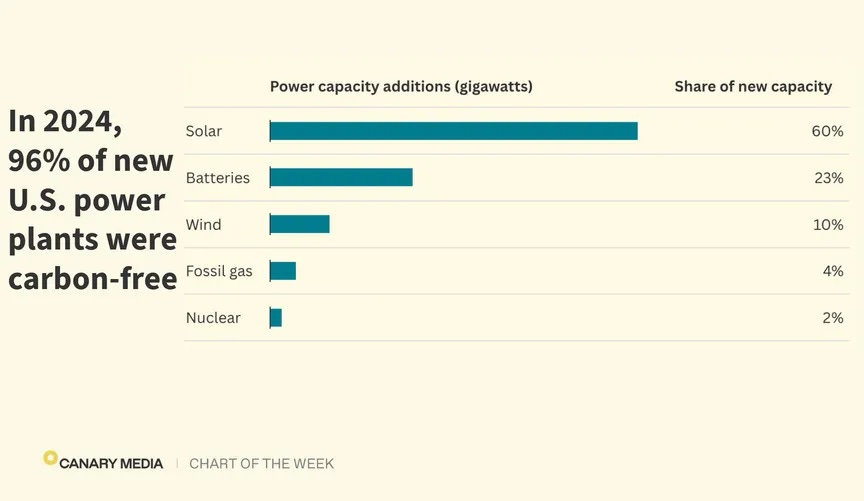
Solar installations dominated power plant additions — 34 gigawatts of utility-scale solar were constructed across the U.S., a 74 percent jump from 2023’s record-high year. Texas and California drove most of this surge.
Grid batteries were the next-biggest new source of power capacity — and saw the fastest growth. The U.S. built 13 GW of energy storage last year, almost double 2023’s record-shattering 6.6 GW. Texas and California led the way here as well.
The amount of new wind resources coming online dropped for the fourth straight year, however. The pandemic’s supply chain disruptions, followed by high inflation and the Fed’s high interest rates meant to combat inflation, really did a number on wind, far more than on solar and storage. Wind has also been hit hard by the slow process of connecting new generation capacity to the grid, a huge problem for all new energy. Donald Trump’s bizarre hatred of wind is likely to seriously slow wind growth in the US in the next few years, as will astroturfed rightwing opposition in red states. Stupid, stupid Right creatures!
We still need to do a good deep dive on just how idiotic Trump’s “energy emergency” declaration is, since it leaves out renewables, the least expensive and fastest-growing energy sector, for the sake of trying to boost fossil fuels — even as his idiotic tariffs will play hell with fossil fuel prices, too! But today is climate nice time, so that deep dive remains on our to-do list.
Hey, speaking of nice, here’s another fun fact, also from Canary Media and Ember: March was pretty sunny and windy in the USA, and that meant that for the first time ever, America’s energy grid had more clean energy on it than electricity generated by fossil fuels. A decade ago, the US electric grid relied on fossil fuels for two-thirds of its power, and a good chunk of that (34 percent) was still coal, the most carbon-intensive source, and one that’s far more expensive than renewables. It’s down to just 15 percent of the energy mix today, and fuck you, Donald Trump, we ain’t going back. (Fuck Trump is always in the “nice” category). [Canary Media / Canary Media again]
Just a few random nice climate moments, Tabs-style:
Two years ago, Helsinki, Finland, decided to ditch coal power, which at the time made up 64 percent of the city’s electric power. The effort to reach the decision took a decade, but once made, it’s gone into effect quickly. Thanks to being ideally situated for wind power (resulting in absurdly low electric rates that approached zero Euros per kilowatt hour) and having a huge distributed heating system that warms homes and businesses with hot water pipes, Helsinki has largely shut down the coal plants that it used to run on. [Fast Company (paywalled); archive link]
For Earth Day (April 26) this month, 54 streets in New York City will be closed to cars so people can stroll and bike and generally see what living without cars could look like. It’s a one-day cleaner, quieter, Euro-style socialist hellhole celebration that the city has been doing since 2016! [Time Out New York]
Thanks to aggressive socialist hellhole government regulations and oppression, plastic pollution along Australia’s coastlines has dropped nearly 40 percent since 2013, and the sea turtles and people walking and doing recreation On the Beach are pretty damn glad to see it. The number of surveyed sites that had no plastic debris at all increased by an impressive 16 percent in the same period. [The Independent]
Lego this week opened a $1 billion factory in Vietnam that will by 2026 be making the popular building bricks using entirely clean energy, primarily solar panels and battery storage. The playsets produced there will be almost entirely for the booming Asian market, although Crom only knows how stupid US tariffs on Vietnam and the rest of the world may affect that rollout. Possibly some! And yes, Lego bricks are made with oil-based plastic; the company is spending big on researching more sustainable materials, but so far with only mixed success. [AP]
Go have you a great weekend, keep your activist batteries charged, and remember that the bastards only win if we let them! (snip)
They’re still Republicans, still anti-trans, but lives have been saved because they voted to protect those lives, so there’s that. Not a small thing.
“I don’t like the thought of criminalizing parents.”
By Henry Carnell and Sarah Szilagy, Mother Jones
April 10, 2025
This post originally appeared on Mother Jones.
Five days after President Donald Trump declared “gender ideology” to be “one of the most prevalent forms of child abuse,” Montana’s Republican-controlled House of Representatives killed a bill that would have enshrined much the same idea into state law by criminalizing parents and medical providers.
Montana Senate Bill 164 would have made it a felony for any adult to help transgender children under 16 to gain access to gender-affirming medical care—including hormones, puberty blockers, and surgeries—classifying such help as child endangerment. On Tuesday, House lawmakers voted 58-40 to reject the proposed law, with 17 Republicans joining Democrats to block the bill from advancing to its final reading.
“I think it’s overly broad,” the lone Republican to speak against the bill, Rep. Brad Barker, said Tuesday. Barker said that while he generally opposes gender-affirming care for trans youth, SB164 was “the wrong approach.”
“I don’t like the thought of criminalizing parents,” Barker said, entreating fellow Republicans to “vote with your conscience.”
The bill carried penalties of up to five years in prison and $10,000 in fines for any adults, including parents and doctors, who provided children with surgery, puberty blockers, or hormone replacement therapy for the purpose of “altering the appearance” of the child or affirming the child’s gender. If “serious bodily injury” occurred, the maximum punishment was 10 years imprisonment and $25,000 in fines.
“Turning parents and doctors into felons is absolutely not the approach that best serves this state,” Democratic Rep. SJ Howell, the first non-binary person to be elected to the Montana legislature, said on the House floor.
The bill cleared the Senate in February, 30-20, with two Republicans voting against it. In that floor debate, the legislation’s sponsor, Republican Sen. John Fuller, called it a “simple bill” to protect Montana’s children. “The state does have a compelling interest, a very compelling interest, to avoid the sterilization and sexual mutilation of children,” he said. In 2023, Fuller sponsored a law that threatened medical providers’ licensing if they offered gender-affirming care to minors, a law that courts have blocked while litigation proceeds.
Tuesday’s vote was the second time this year a large swath of Republicans crossed party lines to block an anti-trans bill.
“This bill is not about politics, it’s about safeguarding the health and innocence of Montana youth,” one of SB164’s House supporters, Republican Rep. Braxton Mitchell, said Tuesday. But more than a quarter of members of his own party disagreed, suggesting a potential turning point for the Montana legislature, at least on trans issues.
Tuesday’s vote was the second time this year a large swath of Republicans crossed party lines to block an anti-trans bill. Last year, Montana’s first openly transgender lawmaker, Rep. Zooey Zephyr, said her Republican colleagues often privately bemoan the transphobic culture wars and apologize to her for their votes on anti-LGBTQ legislation.
Even so, Republican Gov. Greg Gianforte signed two anti-trans bills into law last month—a bathroom ban and a law prohibiting trans girls and women from playing on women’s sports teams from kindergarten through college. The bathroom ban has been temporarily blocked. A state law that prohibited trans women from participating in female collegiate sports was ruled unconstitutional in 2022.
The right to privacy is enshrined in the Montana constitution, and state courts have strongly affirmed its application to healthcare laws. Last December, the Montana Supreme Court upheld a lower court’s preliminary injunction on a law that would have made gender-affirming medical care providers vulnerable to licensing board disciplinary proceedings. And last summer, it ruled that a parental consent law for minors seeking abortion was unconstitutional. (In January, Montana Attorney General Austin Knudsen asked the U.S. Supreme Court to declare that ruling an unconstitutional infringement on parental rights. The Supreme Court has not decided whether to hear the case.)
If it had passed, SB164 would have become the first law in the country defining gender-affirming care as a form of felony child endangerment. (Child endangerment and abuse fall under different statutes, but both evoke the same myth that gender-affirming care is dangerous for youth.)
Montana, however, wouldn’t have been the first state to direct child welfare workers to investigate families of trans children. In 2022, Texas Republican Gov. Greg Abbott ordered the state’s Department of Family and Protective Services to open child abuse investigations into parents who seek gender-affirming care for their children. That directive remains partially blocked after families of trans children and the LGBTQ advocacy group PFLAG sued.
 Scottie's Playtime