nazis Punish Oslo For Norway Milk Strike, AWOC Strikes In US, US Military Destroys Native Village In Peace & Justice History For 9/8

September 8, 1756
Colonel John Armstrong and troops under his command destroyed the Indian village of Kittanning. The Corporation of the City of Philadelphia awarded a silver medal to Armstrong and his officers for their action.
September 8, 1941
In Norway, 2000 workers in the shipyards went on strike against diversion of milk, “depriving mothers and babies,” to military use by the German soldiers in Finland. In retaliation, Oslo was placed under a 7 o’clock nightly curfew, after which transportation was stopped, public meetings prohibited, radios seized, dancing forbidden. Boy Scouts, Girl Guides and Salvation Army organizations were all dissolved.
More about the Milk strike 
September 8, 1965

Table grape pickers, the mostly Filipino members of the Agricultural Workers Organizing Committee (AWOC), led by Larry Itliong, went on strike for higher wages in Delano, California.
 
Larry Itliong
More about Larry Itliong 

https://www.peacebuttons.info/E-News/peacehistoryseptember.htm#september8

Knights of Labor, 1st Day Of School In Grenada, MS, & More, In Peace & Justice History for 9/2

September 2, 1885
A mob of white coal miners, led by the Knights of Labor, violently attacked their Chinese co-workers in Rock Springs, Wyoming, killing 28 and burning the homes of 75 Chinese families. The white miners wanted the Chinese barred from working in the mine. The mine owners and operators had brought in the Chinese ten years earlier to keep labor costs down and to suppress strikes.

Chinese fleeing Rock Springs
The unfortunate story and illustrations of the scene  (scroll down)
September 2, 1945

note: Ho Chi Minh translates to ‘He Who Enlightens’
Revolutionary leader Ho Chi Minh declared Vietnam a republic and independent from France (National Day). Half a million people gathered in the capital of Hanoi to hear him read the Vietnamese Declaration of Independence, which was modeled on the U.S. Declaration of Independence.
Read about how it was influenced by the U.S. Declaration 
September 2, 1966
On what was supposed to be the first day of school in Grenada, Mississippi—and the first day in an integrated school for 450 Negro children—the school board postponed opening of school for 10 days because of “paperwork.” Nevertheless, the high school played its first football game that night. Some of the Negro kids who had registered for that school tried to attend the game but were beaten and their car windows smashed.
September 2, 1969
Vietnamese revolutionary and national leader Nguyen Tat Thanh (aka Ho Chi Minh), 79, died of natural causes in Hanoi.
 
 Uncle Ho  Ho Chi Minh
Ho and his struggle for Vietnamese independence 

https://www.peacebuttons.info/E-News/peacehistoryseptember.htm#september2

Eugene V. Debs & the Pullman Palace Car Co. Strike & Boycott, plus More, in Peace & Justice History for 5/22

May 22, 1894

Eugene V. Debs, president of the American Railway Union, was imprisoned in Illinois for his role in the Pullman Palace Car Company strike and boycott, which had stalled most rail traffic west of Detroit.
Read more about the Pullman strike
May 22, 1968
Federal marshals entered Boston’s Arlington Street Unitarian-Universalist Church to arrest Robert Talmanson, who had been convicted of refusing induction into the U.S. Armed Forces. He had been offered sanctuary there by the leaders of the church who shared his opposition to the Vietnam War.
When the marshals tried to remove him, access to their car was blocked by 200-300 nonviolent sanctuary supporters.


Draft resister Robert Talmanson dragged by authorities from Arlington Street Church. 
May 22, 1978
Four thousand protesters occupied the site of the Trident nuclear submarine base in Bangor, Washington. The base was built for the maintenance and resupply of Ohio-class submarines.
Though built as part of the U.S. nuclear deterrent, they were perceived by some as giving the U.S. a nuclear first-strike capability with their ability to each deliver 24 missiles with multiple warheads from very close to the borders of other countries. The 14 vessels are at sea 2/3 of the time and can travel as deeply as 800 feet for a time limited only by its food supply
.
Read more about Ground Zero  
May 22, 2001
Delegates from 127 countries formally voted approval of the Stockholm Convention on Persistent Organic Pollutants (POPS), a treaty calling for the initial elimination of 12 of the most dangerous manmade chemicals, nine of which are pesticides.

POPS are often toxic at very low levels, resist degradation and thus persist for decades or longer, because they become concentrated in living tissue, are readily spread by atmospheric and ocean currents.Swedish Prime Minister Goran Persson, lauding the agreement, said,
“. . . we have to go further. Dangerous substances must be replaced
by harmless ones step by step. If there is the least suspicion that new chemicals have dangerous characteristics it is better to reject them.”

POPS background  

https://www.peacebuttons.info/E-News/peacehistorymay.htm#may22

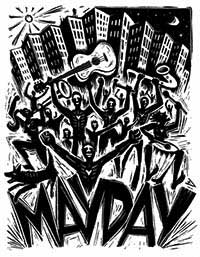
May Day, Original Memorial Day, Emancipation Day, “Mission Accomplished” Day, and Much More, all 5/1 in Peace & Justice History

My annual May Day musical offering. Enjoy!

May 1, 1865
Memorial Day was started by former slaves in Charleston, South Carolina to honor 257 dead Union Soldiers who had been buried in a mass grave in a Confederate prison camp.
They dug up the bodies and worked for 2 weeks to give them a proper burial as gratitude for fighting for their freedom.
They then held a parade of 10,000 people led by 2,800 Black children where they marched, sang and celebrated.
 
More of the story 
May 1, 1886

May Day was called Emancipation Day in 1886 when 340,000 went on strike (though it was Saturday it was a regular day of work) in Chicago for the 8-hour workday.

May 1, 1890
May Day labor demonstrations spread to thirteen other countries; 30,000 marched in Chicago as the newly prominent American Federation of Labor threw its weight behind the 8-hour day campaign.
 
More May Day info 
May 1, 1933

Dorothy Day
The Catholic Worker newspaper was founded by Dorothy Day and Peter Maurin. Dorothy Day said, “God meant things to be much easier than we have made them,” and Peter Maurin wanted to build a society “where it is easier for people to be good.”

Peter Maurin

Read more about the Catholic Worker 
May 1, 1948

Senator Glen Hearst Taylor
Senator Glen Hearst Taylor (D-Idaho) was arrested in Birmingham, Alabama, for trying to enter a meeting through a door marked for “Negroes” rather than using the “whites only” door, and convicted of disorderly conduct.
Taylor was the Progressive Party candidate for Vice President, running mate of Henry Wallace. He was in Birmingham to address the Southern Negro Youth Congress.
May 1, 1965
Second Factory for Peace opened in Onllwyn, Dulais Valley, in south Wales, employing disabled miners. Tom McAlpine, active in the Committee for Nuclear Disarmament, and a supporter of cooperatives and industrial democracy, established Rowen Engineering in both Wales and Glasgow, Scotland.
May 1, 1966
500,000 Vietnamese marched for an end to the war dividing their country.
May 1, 1967
Soviet youths openly defied police and danced the twist in Moscow’s Red Square during May Day celebrations. In the early ‘60s the Twist had been banned in Buffalo, New York, and Tampa, Florida. The religious right claimed the Twist was actually a pagan fertility dance.

Are you old enough to remember Chubby Checker?
May 1, 1971
Five days of anti-war May Day protests began in Washington, D.C., resulting in over 14,000 arrests—the largest mass civil disobedience in U.S. history.
May 1, 1986
 
One million South Africans demonstrated their opposition to apartheid in a strike organized by the Congress of South African Trade Unions (COSATU)
COSATU: a brief history
May 1, 2003
President George W. Bush landed in a jet on the aircraft carrier USS Abraham Lincoln off the California coast and, in a speech to the nation, declared major combat in Iraq over. The banner his staff posted on the ship read, “Mission Accomplished.”

Since that presidential declaration more than 4500 American and allied troops and nearly 9000 members of Iraqi security and police forces (Jan. 2005 through July 2011) have lost their lives. In addition, tens of thousands (more than 32,000 Americans) injured in the hostilities.
The number of Iraqi civilian deaths is open to dispute, but minimally stands at well over 100,000.

Details of Iraq military casualties
 Civilian casualties 

https://www.peacebuttons.info/E-News/peacehistorymay.htm#may1

Peace & Justice History for 2/27

February 27, 1939
 
Flint sit-down strikers, 1937
The Supreme Court outlawed sit-down strikes in its decision NLRB v. Fansteel Metallurgical Corp. Such strikes had become a very effective strategy employed by workers to organize unions. The 1937 Flint sit-down strike of autoworkers against General Motors forced GM to recognize the United Auto Workers as the representative of its hourly employees, and negotiate wages and working conditions.
The text of the Supreme Court’s decision: 
February 27, 1973
Hundreds of Oglala Lakota Sioux and members of the American Indian Movement (AIM) occupied the village of Wounded Knee, South Dakota.
Angered over a long history of violated treaties, mistreatment, family dismemberment, cultural destruction, discrimination, and impoverishment through confiscation of resources, they particularly demanded the U.S. live up to the terms of the 1868 Fort Laramie Treaty. That treaty recognized the Sioux as an independent nation in the western half of South Dakota. Additionally, there had been a recent campaign of harassment and violence by tribal and FBI officials. Wounded Knee was chosen because of the 1890 massacre there of several hundred men, women and children by U.S. troops. The occupation lasted until May.


The Fort Laramie Treaty
 What happened at Wounded Knee

https://www.peacebuttons.info/E-News/peacehistoryfebruary.htm#february27

Peace & Justice History for 1/14

January 14, 1601
Roman Catholic church authorities burned sacred Hebrew books in Rome during the papacy of Clement VIII. He had forbidden Jews from reading the Talmud (a collection of centuries of interpretation of Jewish law). He had confirmed Pope Paul III’s relegation of Jews to a Roman ghetto (a walled-in portion of the city), and their banning from residence in papal-controlled states by Pope Pius V.
Other papal enemies of Jewish books included Innocent IV (1243-1254), Clement IV (1256-1268), John XXII (1316-1334), Paul IV (1555-1559), and Pius V (1566-1572).
January 14, 1784
The Confederation Congress, meeting in Annapolis, Maryland, ratified the Treaty of Paris with England, ending the Revolutionary War
.
Signing the Treaty of Paris
By its terms, “His Britannic Majesty” was bound to withdraw his armies without “carrying away any Negroes or other property of American inhabitants.”
The treaty was negotiated by John Adams, John Jay and Benjamin Franklin for the colonies, and David Hartley representing the King of England, George III.
January 14, 1918
The U.S. Supreme Court upheld the constitutionality of the selective service law, affirming all criminal charges arising from non-compliance with the draft during World War I. In Arver v. United States, the Court found that a draft does not violate the 13th Amendment’s prohibition of involuntary servitude.
January 14, 1941
A. Philip Randolph, president of the Brotherhood of Sleeping Car Porters union, and widely considered de facto chief spokesperson for the African-American working class, called for a march on Washington, demanding racial integration of the military and equal access to defense-industry jobs.

Detail from painting by Betsy G. Reyneau, Asa Philip Randolph
“On to Washington, ten thousand black Americans!” Randolph urged. He said in the fight to “stop discrimination in National Defense . . . While conferences have merit, they won’t get desired results by themselves.”
January 14, 1942
President Franklin D. Roosevelt issued Presidential Proclamation No. 2537, which required aliens from World War II enemy countries – Italy, Germany and Japan – to register with the United States Department of Justice.
Registered persons received a “Certificate of Identification for Aliens of Enemy Nationality.” This proclamation facilitated the beginning of large-scale internment of Japanese Americans the following month.

January 14, 1963
George Wallace was sworn in as Governor of Alabama. In his inaugural address he called for “segregation now; segregation tomorrow; segregation forever!”
“The true brotherhood of America, of respecting the separateness of others — and uniting in effort — has been so twisted and distorted from its original concept that there is a small wonder that communism is winning the world.
We invite the negro citizens of Alabama to work with us from his separate racial station — as we will work with him — to develop, to grow in individual freedom and enrichment. We want jobs and a good future for BOTH races — the tubercular and the infirm. This is the basic heritage of my religion, of which I make full practice — for we are all the handiwork of God.”

The entire speech: 
January 14, 1966

A march in Atlanta was held to protest the ouster of Julian Bond, an African American, from the Georgia House of Representatives. Members of the General Assembly considered him unfit to serve after he endorsed a statement critical of U.S. involvement in Vietnam issued by the Student Non-Violent
Coordinating Committee (SNCC).
January 14, 1994
An agreement was signed for Russia and the U.S. to assist newly independent Ukraine in ridding itself of nuclear weapons.Following the break-up of the Soviet Union, Ukraine’s leader Leonid Kravchuk found his country with the world’s third largest nuclear arsenal, including multiple-warhead long-range missiles and bombers, and 3000 tactical (battlefield or short-range) nuclear weapons.

former Ukranian missile silo

Leonid Kravchuk
Kravchuk and his government had decided to eliminate all nuclear weapons from Ukrainian territory. Ukraine was the first country to go non-nuclear.
January 14, 1996
Sixteen protesters were arrested in a winter blockade of the rural Wisconsin site (in the Chequamegon National Forest) of the U.S. Navy’s ELF (Extremely Low Frequency) transmitter, which communicated (one-way) with deeply submerged U.S. submarines. Nearly 400 were arrested in 24 actions opposing ELF between 1991 and 1996.

https://www.peacebuttons.info/E-News/peacehistoryjanuary.htm#january14