In Major Win For Trans Students, New Jersey Court Rules Against Forced Outing Policies by Erin Reed
The pair of rulings came in an environment where Trump and red states are pushing anti-trans policy across the United States.Read on Substack
Yesterday, the New Jersey Superior Court’s Appellate Division issued two unanimous rulings blocking forced outing policies in school districts across Morris and Monmouth counties. In mid-2023, Hanover Township Public Schools in Morris County, Marlboro Township Public Schools in Monmouth County, Middletown Public Schools in Monmouth County, and Manalapan-Englishtown Regional School District in Monmouth County implemented policies mandating the disclosure of a student’s transgender status to their parents. The policies varied in scope—some required notification only if a student formally changed their gender identity at school, while others mandated disclosure if a student merely mentioned being transgender in counseling sessions. Shortly after the policies were enacted, they were challenged in court and met with preliminary injunctions, preventing their enforcement. The appellate court upheld these injunctions yesterday.
The plaintiffs in both cases are New Jersey Attorney General Matthew Platkin and Sundeep Iyer, Director of the New Jersey Division on Civil Rights. The Attorney General’s office represented them in both cases. However, in Platkin et al. v. Middletown Township Board of Education et al., the American Civil Liberties Union and LGBTQ+ rights organization Garden State Equality filed amicus briefs in support of the plaintiffs. In Platkin et al. v. Hanover Township Board of Education et al., no amicus briefs were submitted. The cases were overseen by Judges Robert J. Gilson, Avis Bishop-Thompson, and Lorraine M. Augostini. Gilson was appointed by Democratic Governor Jon Corzine, while Bishop-Thompson and Augostini were appointed by Republican Governor Chris Christie. (snip-MORE)
Corewell, Largest Michigan Provider, Resumes Trans Youth Care Despite Illegal Trump EO by Erin Reed
On Wednesday, the hospital system announced that it was resuming gender affirming care after a brief pause due to Trump’s executive order attempting to ban it for those under 19.Read on Substack
In an announcement on Wednesday, Corewell Health, the largest healthcare provider in Michigan, stated that it would resume gender-affirming care for transgender youth under the age of 19. The decision follows a temporary halt in services to new patients after President Trump issued an executive order unlawfully claiming the authority to withhold federal funding from hospitals providing such care. Corewell Health is the first—and the largest—hospital system to reverse course after initially pausing treatment, a move that sparked nationwide protests against other healthcare providers that have yet to reinstate care.
The hospital, in a statement released Wednesday, said that its decision was always meant to be temporary, and that decisions around transgender healthcare best belong to patients and their doctors.
“We are lifting our pause on new hormone therapies for pediatric patients seeking gender affirming care. Care decisions are best made between physicians and their patients and families.
We briefly paused beginning these therapies to allow us time to assess the potential impact that recent policy changes might have on our patients and their health. Contrary to some inaccurate reports, we never suspended any gender affirming care for any of our patients.”
The decision to reinstate care is huge for Michigan transgender patients. The hospital system is the largest in the state, employing over 60,000 people. The LGBTQIA+ adolescent page for one of the member hospitals states, and stated through the closure, “The adolescent and young adult medicine team at Helen DeVos Children’s Hospital takes a holistic, individualized approach to patient care. We guide Michigan patients and their families through comprehensive education and an evidence-based approach. We know this is a challenging time for many of our patients and their families. No matter what is happening around us, we will always remain committed to providing high-quality care for all of our patients.” (snip-MORE)
But please don’t delete without scrolling down to the Extra Credit item, which is of particular and specific pertinence to our interests here on Playtime, and just do that one if you can’t stomach bothering your congresscritters today. Seriously, just do the Extra Credit item-you won’t be sorry, and you will make a difference!!!Thanks, A.
I hope you’re hanging in there today. I know things remain gobsmackingly awful, but I remain cautiously optimistic that the opposition is at last finding its sea legs.
A few reasons for this are:
1) House Democrats announced this morning that they have formally established a Rapid Response Task Force and Litigation Working Group! Good! We need a committee specifically dedicated to this fight, and this one, it seems, will be. I also happen to know that a huge political influencer is meeting with the Democrats this morning (and all week) to teach them how to make effective posts for social media. It’s overdue, and I’m very glad it’s happening.
2) There are now several big rallies or actions in the works—a nationwide protest on February 17, a one-day general strike on February 28, and a “total shutdown” on March 15. I’m sure many more things are being planned. There’s also now a website for a General Strike, and 200K people—including me—have already signed a strike card. The organizers offer a weekly Discord discussion, by the way, if you have questions about how a general strike might work. All are welcome.
3) Finally, my sister Lily went to her first Indivisible meeting last night. She called me from her car—in high excitement, I might add—to tell me that the meeting, which was hosted by a brand new Indivisible group, Rockland Indivisible, was so full that she couldn’t even get into the parking lot of the library where it was being held! Cars were backed up on the freeway trying to get in! She eventually found parking a ways away and walked over, but the room was so full she couldn’t get inside. She listened from the hallway and was blown away by the energy and enthusiasm of the 300 people (!!) in the room. More were watching on Zoom. This kind of out-of-control enthusiasm for (and turnout at) a new Indivisible group is just wildly encouraging.
I could go on. It’s building. It’s coming. I feel it. We just need to keep fanning the flames.
Our job is to not quit while it’s hard. They want us to. They’re counting on it. They literally think we’re snowflakes. They think their orgy of destruction will force us to walk away in exhaustion.
They’re going to find out that they’re very wrong.
Breathe in strength. Breathe out fear. I’m not downplaying the danger. It’s real. I simply believe in our power more than I fear their malevolence. You should too.
Hi, I’m a constituent calling from [zip]. My name is ______.
I’m calling to demand that the Senator vocally support the Consumer Financial Protection Bureau and protect it from being dismantled by the Trump administration. The CFPB does vital work to protect consumers like me from being scammed by predators. A block to its funding is both illegal and also puts me at direct risk for financial harm. [H/T]
Speaking of which, almost everything Elon Musk is doing is illegal. Does the Senator stand for law and order or doesn’t s/he? If s/he does, then s/he needs to fight to take Congress’s power back. Agencies like the CFPB and USAID can’t be shut down without Congressional approval. That’s the LAW. Standing up for it is literally the Senator’s job. Thanks.
Hi, I’m a constituent calling from [zip]. My name is _______.
[If Republican:]
I’m calling in strong opposition to defunding USAID. Why is Congress letting Musk do this? It’s illegal. Any closing of an agency established by Congress can only be approved by Congress. Also, USAID gives the US massive influence overseas, it keeps diseases at bay, and it gives U.S. farmers a place to sell their produce. By gutting it you are hurting Americans. Please restore support for USAID immediately. I didn’t vote for Elon Musk and I’ll be damned if I’m going to let him hurt my country. Thanks.
[If Democrat]
I’m upset about the gutting of USAID. I appreciate Democrats’ support for it, but the message needs to be stronger, louder and more effective. Congress needs to take its power back—any major reform or closing of an agency established by Congress can only be approved by Congress. More needs to be done now to stop the dismantling of USAID and other vital agencies, and to provide appropriate protections to the federal workforce. Thanks.
The Children’s Hospital of Los Angeles, a former leader in gender-affirming health care in the bluest of blue states, has stopped offering vital health care to new patients, cancelling scheduled appointments for hormone treatments. We know that a lack of access for trans kids leads to higher rates of depression and suicide so we must call this out for what it is, a callous and fear-based decision to capitulate in advance to a transphobic White House trying to rule by Executive Order. Gender affirming care is protected under California state law so denying this care is also illegal.
CHLA’s patient relations line is 323-361-4682 (you have to let the entire outgoing message play to get to the VM. The “press pound” function doesn’t work.
Say something like:
My name is ____ and I am deeply disappointed by CHLA’s decision to stop providing gender-affirming care to new patients. This sends a terrible message to the rest of the country that even hospitals in blue states are unwilling to provide vital healthcare for trans patients. It also goes against California State Law. Please reverse this horrible decision. It will only lead to increased rates of depression and suicide for trans children. Thank you.
You can also call California Attorney General Rob Bonta. He’s written a letter to put CHLA on notice, but needs to know that is not enough. His office’s number is 1-800-952-5225 (press 1 for English, then 7 to leave a message). If you live in CA be sure to say that but you can call even if you don’t.
My name is ____ and I want to make sure you’re doing everything you can to protect trans kids in our communities. I was extremely disappointed to hear that Children’s Hospital of LA recently stopped providing gender-affirming care for new patients. This sets a dangerous precedent for other medical providers in California and violates the Unruh Civil Rights Act. I understand your office has put CHLA on notice but we need you to do more until this dangerous decision is reversed. Thank you.
Get Organized
Join Indivisible’s weekly discussion with co-founders Ezra Levin and Leah Greenberg on Thursdays, 3pm ET/12pm PT.
When horrendous news comes at us as fast as it has the last few weeks, the only way to process it and stay grounded is to come together in community and discuss what’s happening. And, more importantly, discuss how we fight back. I can’t adequately describe how helpful these weekly Indivisible calls are to me. Ezra and Leah are so smart, so strategic, and so tough. They give me a lot of hope.
Want to stay apprised of what’s happening in the news but need it in a not-overwhelming format? I really like Matt Kiser’s Substack “What the F**k Just Happened Today?” (The actual name contains the full curse word, so if that’s a dealbreaker don’t click on it.)
Matt describes it this way:
WTF Just Happened Today? is a clear, once-a-day newsletter helping normal people make sense of the news. It’s curated daily and delivered every afternoon around 3 pm PT.
My job is to help distill news that deserves attention into a clear, understandable, and accurate first draft of history for normal people who might not otherwise engage with the news. WTFJHT covers the news through the lens of the executive branch specifically – and the president in particular – followed by the legislative and judicial branches in general, and in that order.
I find it to be a useful way of keeping track of the top headlines without drowning in information overload. Maybe you will, too. Check it out here.
Messaging! Messaging! Messaging! 📣
Truth Bombing is a new means of communicating that tackles the misinformation problem. Learn to use your creativity and social media to create & distribute pro-democracy messaging where it will do the most good.
This is Civic Sunday’s 6th zoom about it, by popular demand. Thursday Feb 13, 2pm PST/5pm EST.
Join Grassroots Democrats HQ and WisDems to make calls to voters for the Wisconsin Supreme Court election! Join them every week on Wednesdays to recruit volunteers from 3-5pm PT/6-8pm ET and Sundays to contact voters from 10am-12pm/1pm-3pm ET.
You’ll be making calls to talk to voters in Wisconsin about what issues are important to them & the importance of the Supreme Court Race and Spring Elections!
First time making calls? Phone banking is easy, fun, and rewarding! You’ll receive comprehensive training at the start of your shift.
Right now, ICE agents and other federal immigration officers are racially profiling and detaining U.S. citizens and people with valid visas because of how they look. For example, some Native residents of Arizona and New Mexico have already been questioned or detained by federal immigration agents. Some federal agents have also rejected Tribal ID cards or Certificates of Degree of Indian Blood (CDIB) as proof of citizenship. In response to these civil rights violations, Tribal leaders across the country are encouraging their members to carry documentation and to know their rights if ICE agents stop them on the street or knock on their door.
In these ICE roundups, federal agents are also violating people’s constitutional rights — which apply regardless of immigration status — by arresting people without reasonable suspicion. Additionally, although being here as an undocumented person is a civil violation and not a crime, federal agents are arresting undocumented people who have no criminal records.
Please do everything in your power to stop the presidential administration’s illegal and unconstitutional actions, including by rejecting Trump nominees who plan to break the law, speaking out forcefully to pressure the White House to walk back violations of the law, refusing to fund immigration raids and detention, and conducting oversight visits of immigration detention centers. Immigrants and Indigenous people make America great. Thanks.
OK, you did it again! You’re helping to save democracy! You’re amazing.
(From A: I got a big laugh, thinking about how dumb the Republicans are being about such things, especially due to actual human biology at conception.)
Katelyn Burns explains the personal and professional toll of Trump’s anti-trans executive orders.
Katelyn Burns February 04, 2025
Source
A note from Marisa:Hi all. I’m proud to share the first-ever guest column on The Handbasket. It’s written by Katelyn Burns, a talented journalist and longtime internet pal of mine who has deeply covered trans rights and her experience as a trans journalist for nearly a decade. Trans people in this country are under direct attack by the Trump administration, and her perspective on navigating it all personally and professionally is crucial. Now I’ll hand it over to Katelyn…
I’ve covered trans issues for nine years now, going back to 2016. As a trans freelance journalist, I was there when the US right wing shifted from attacking gay marriage to attacking trans rights. I was there for the North Carolina bathroom bill and Trump’s first election. I covered every awful anti-trans policy introduced in the first Trump term in the White House, and I saw hundreds of red states pass bill after bill targeting people like me over the last few years.
But these first two weeks of Trump’s new term and the extensive executive orders removing nearly every right I have as a trans American have been by far the worst in all my professional years. Trump has already rolled trans rights back further than he did in his first term, and it’s only been two weeks. He sprayed the anti-trans firehose at us, obliterating the rights of my community immediately upon assuming office.
At the same time, I haven’t been this busy as a journalist since Trump was last in office. I’m hearing from editors who are looking for stories from me again. I’m sending my poor editors at MSNBC multiple column pitches each week, and my Patreon has hit a new record for subscribers. As I was writing about Trump’s new passport policy—one which will affect me when my own passport expires in two years—I noticed my Patreon broke 500 paid subscribers for the first time. Since then it has grown to more than 570 paid subsriptions and nearly 1,000 total subscribers.
Watching my own civil rights disappear while my bank account and workload grow is a total mindfuck.
I can’t help but feel guilt at profiting from the suffering of my community, while also feeling like I deserve to be fairly compensated for my work covering all of these horrible new policies—policies that I had predicted would come into being before the election (before being dismissed as “hysterical” by the centrist cabal of pundits that currently dominate American media).
I wrote a piece published the day before Election Day detailing all of the things I feared would happen should Trump get re-elected. In the piece, I said Trump would attempt to ban trans athletes from women’s sports, ban trans teens from accessing medically necessary transition care, punish doctors who administer that care, and crack down on trans inclusiveness in schools.
“Beyond the executive branch, a Trump win and an accompanying Republican-controlled Congress would be likely to try to nationalize the anti-trans efforts that were previously undertaken at the state level,” I wrote in that piece. “Over the last several years, hundreds of anti-trans bills have been proposed and passed in red states.”
Little did I know how quickly those national attacks would crystalize. In Trump’s first two weeks, he’s already pushed through anti-trans executive orders on all the topics I predicted he would, and has quickly gone significantly further than I anticipated.
It started on inauguration day when he signed an executive order defining male and female as “determined at conception” (a nod to the language used by anti-abortion activists). The order impacted trans people in two significant ways: trans women were now to be kept in men’s federal prison, where they would be subject to rampant prison rape; and the State Department would no longer allow gender markers to be changed on US Passports.
The passport rules were clarified shortly thereafter to say that passports with an X gender marker would be invalidated, and any previously issued passport would be reverted to birth sex upon renewal. Since then, there have been numerous anecdotal reports of trans people having their passports confiscated by passport office personnel who refuse to reissue a new one—even with their birth sex. With no official word from the State Department, trans people right now could be experiencing a shadow travel ban.
Over at the Equal Employment Opportunity Commission (EEOC), they stopped all anti-LGBTQ bias claims and declared that they would investigate employers who allowed trans employees to use the work bathroom of their gender identity. Last week, Trump re-instituted his trans military ban, an action that he took during his first term and one I’ve covered deeply. This time, instead of arguing that trans people are medically unfit to serve, the Trump administration has accused all trans service members of being untruthful and dishonorable in claiming a trans identity.
Later on last week, Trump issued yet another anti-trans executive order, this time about education. Not only did this order ban trans women from women’s school sports, it threatened to investigate and cut off federal funding for any school that allowed a trans student to use the bathroom of their gender identity, or even teachers who use a student’s names and pronouns consistent with their gender identity.
Earlier today, The Wall Street Journal reported that Trump will be signing his 10th anti-trans executive order since taking office. This one explicitly bans trans girls and women from girls’ and women’s school sports, and was perhaps the heaviest blow to me personally and to my career. I posted a thread on Bluesky of some of my most significant work on trans athletes, and it’s safe to say that coverage of trans athletes—more than any other issue—is what built my career as a journalist. It’s hard not to feel like my words have failed the trans girl athletes of this country.
In perhaps the cruelest order, last week Trump ordered that federal funding be denied to any medical facility that provides gender affirming care to anyone under the age of 19. In response, several major hospital systems suspended their trans-related practices, including NYU Langone in New York City and DC Children’s Hospital in Washington, DC.
I’d like to be running deep investigations on how each of these orders are impacting the estimated 1.6 million trans people in the US, but doing all of them at once is too much for just one person. There’s a common misconception pervading the editors in the American press industry that trans reporters are simply too biased to fairly cover trans issues, which means I am one of the few trans reporters who is able to actually cover national trans issues for mainstream press outlets. But that also means I feel the weight of my whole community. I want to cover every new problem with the depth my people deserve.
In the first Trump term, each new anti-trans action came months apart from each other, allowing me to cover one at a time with a much needed depth that I worry isn’t possible anymore. By piling all of these orders into a two week period, the Trump administration has effectively strangled the press from covering all of them.
By the time I finished my piece about Trump’s first anti-trans order of his second term, two more had been issued—and my editors didn’t have time to run a piece about the second. I managed to farm out a piece about the third executive order about the trans military ban to the San Francisco Chronicle, and I have a piece coming out soon about the puberty blocker ban. But the news hook on the education and employment orders is already expiring, and bigger problems within the Trump administration are taking up valuable journalistic time.
I will never stop covering the harm done by Trump’s anti-trans orders, but there is already so much of it. I learned in the first Trump term how to separate the personal from the professional, at least when on deadline. But once the draft is done, and edits are in the can, and I’m laying in bed at night trying to fall asleep, it all comes back to me:
Do I need to plan for a quick getaway if some Trump lackey decides the loudmouth tranny journalist needs to go? How do I prevent myself from burning out again like I did during the first Trump term? How do I deal with the guilt of not being able to cover everything? These are the thoughts that haunt me when I’m not pouring myself into work or whatever movie or video game I’m playing to distract myself.
During the first Trump administration, there were at least a dozen openly trans journalists scattered about the liberal online media covering trans issues. Now we are few and far between. The 19th has both Orion Rummler and Kate Sosin, two powerhouses of the trans reporting field, and beyond them, Erin Reed and Evan Urquhart are doing great work. So many of us are trying to make it on our own as freelancers or bloggers, but the headwinds are strong.
I worry about the future of my community, but there’s no time for that now. There are too many stories to write.
Katelyn Burns is a freelance journalist and columnist at MSNBC. She’s co-host of the Cancel Me, Daddy podcast, and a co-founder of The Flytrap. In a previous role she was the first ever openly trans Capitol Hill reporter in US history. You can find her on BlueSky and Patreon.
(There’s a slideshow on the user-friendly page; click through here.Some of these companies have been sued by Stephen Miller’s lawyer group, but were found by the Justice Dept. to be well within law. So there’s a thing I guess we watch, also…)
Despite a slew of companies like Walmart, Meta and Amazon rolling back their diversity, equity and inclusion efforts, other companies have remained firm in continuing these vital initiatives. Donald Trump has attacked diversity on both the campaign trail and now during his second presidential term. Even though Trump set on getting rid of inclusive practices, here’s a list of places advocating for marginalized communities to be part of their workforce.
It’s an interactive site, and it looks like a fine resource. I’m not aware of problematic things with GLAAD, but am aware I don’t see them mentioned here, so if there is something I’ve missed about them, please let us know. Also then, my apologies. But this looks like an excellent resource, so I hope they haven’t messed up anything for people. The blue GLAAD Weather Watch below is the link.
This year, anti-LGBTQ extremists are continuing their dangerous mission to ban LGBTQ people from access to bathrooms, schools, sports, and medical care. We need your help to defeat bad legislation, and to celebrate wins: Tune in to the GLAAD Weather Watch and sign up to receive updates of how you can take action!
Historic lesbian activist Sally Gearhart is featured in Deborah Craig’s new award-winning documentary Sally!
Most people have heard of Harvey Milk. Sally Gearhart—not as much. But in fact, Gearhart sat right beside Milk as his debate partner in 1978 when they disputed—and ultimately defeated—Proposition 6, the Briggs Initiative that would have banned lesbian and gay teachers and topics in California’s public schools. When their opponents quoted the Bible, Milk was at a loss. Gearhart, on the other hand, could quote it right back at them. Born in 1931 into a Christian household in Virginia, Gearhart charted her own unconventional path from a career as a teacher at Christian colleges in Texas until she determined …
Women’s entry into public life around the turn of the twentieth century was a major catalyst for the creation of sex-segregated public restrooms. As scholar Daphne Spain writes, female civic reformers lobbied municipal governments to make cities more inclusive places for women, pushing for amenities such as health clinics and kindergartens. And in both small towns and big cities, notes historian Peter C. Baldwin, women worked to ensure the availability of public toilets. The first gender-segregated public bathrooms afforded women privacy, safety, and autonomy—if, that is, the women were white and of means; otherwise, access to bathrooms served as a tool of segregation. The history of the women’s bathrooms in the United States is a story of who does—and who doesn’t—get to belong in public life.
The first public bathrooms in the United States appeared in the late 1800s. Pub owners offered them to paying customers to drum up business and keep drinkers drinking. But, as Baldwin notes, pubs and saloons were improper, unwelcoming, and sometimes dangerous environments for women, and were effectively male-only establishments whose facilities only catered to men.
Just a few decades later, according to Spain, women had begun to challenge their “proper place” in society. While middle- and upper-class women increasingly ventured out of the home into the burgeoning urban environment to shop and to socialize, their lower-class counterparts increasingly found work in factories and other non-domestic environments where they could earn their own money. And some, many of whom belonged to the upper classes, forced their way into political and civic life, lobbying for, and winning, suffrage. Changing social stations pushed women and men together in public. They shared sidewalks, transportation, parks, stores, and restaurants. Women entered public life, and standards of decorum shifted to accommodate them, though certainly not to include them—gender segregation became a paramount concern, according to Baldwin, for preserving the modesty and propriety of women. Still, a dramatic shift had occurred: Men no longer wielded a monopoly on public life.
In the absence of an available pub bathroom, men were accustomed to relieving themselves in the street. Not only did that suddenly seem crass in mixed company, but the new science of germ theory made it clear that using the city as a toilet posed a health hazard, Baldwin says. Urban designers, physicians, and civic groups lobbied municipal governments in Chicago, Boston, New York, and elsewhere to provide a sanitary solution to the problem of human waste.
The first public toilets, euphemistically called “comfort stations,” appeared in American cities in the 1890s, according to Baldwin. By 1919, roughly one hundred cities, including Denver, Cleveland, Detroit, Philadelphia, and Seattle made toilet facilities available to the public for free or a small fee. Some were funded by health-minded philanthropists and reformers concerned not only with physical cleanliness, but “moral cleanliness,” writes sociologist Alexander K. Davis. They believed the two were intrinsically linked.
Comfort stations were gender segregated but not gender equal. While men were afforded the opportunity to take care of their most basic needs—the need to relieve themselves—women were not given the same. Women’s facilities were often smaller and had fewer toilets than the men’s, writes Baldwin, and were consistently inferior to the semi-private “customers only” bathrooms available in the “Adamless Eden” of a department store, as one such store owner Spain quotes called them; these were available only to patrons.
For those women denied the privilege of department store entry owing to race or lack of means, the comfort station was the only option for getting some privacy in public. Businesses, manufacturing plants, offices, and government buildings almost entirely lacked gender-segregated bathrooms, and because it was scandalous for a woman to enter a bathroom that men used, the lack of women’s toilets sent a clear signal about who was and wasn’t welcome in a particular space. Without equitable access, women were not able to fully participate in life outside the home. If you can’t empty your bladder or your bowels with dignity, it’s hard to be away from home for long.
Public stations were expensive to maintain and quickly became dirty and malodorous. Many were underground or in secluded areas and were dangerous for female users. Baldwin points out that by the early 1920s, cities cut budgets and patrons abandoned the cause, so stations fell into disrepair almost as soon as they appeared, and some of the same women’s groups that had petitioned for their creation eventually pressed for their closure. The provision of bathrooms became largely the remit of private business owners who could provide or restrict access as they pleased.
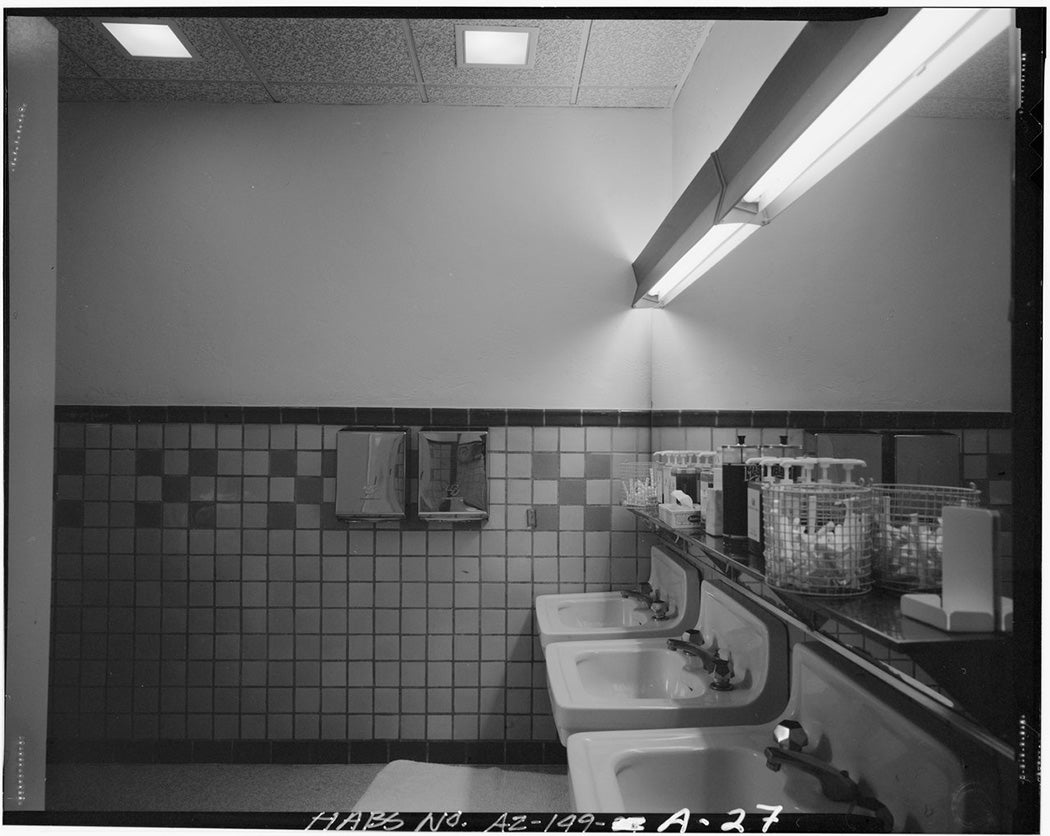
Women’s restroom at the Arizona Biltmore in Phoenix, AZ, 1930s via Wikimedia Commons
Though the truly public bathroom—where access is free to all—is increasingly rare today, the semi-public toilet is taken for granted. The ladies’ room in restaurants, bars, airports, train and bus stations, hotel lobbies, schools, and event venues remains one of the few spaces where men are strictly prohibited. Though many are accessible only to those who can patronize a business or afford a ticket for travel.
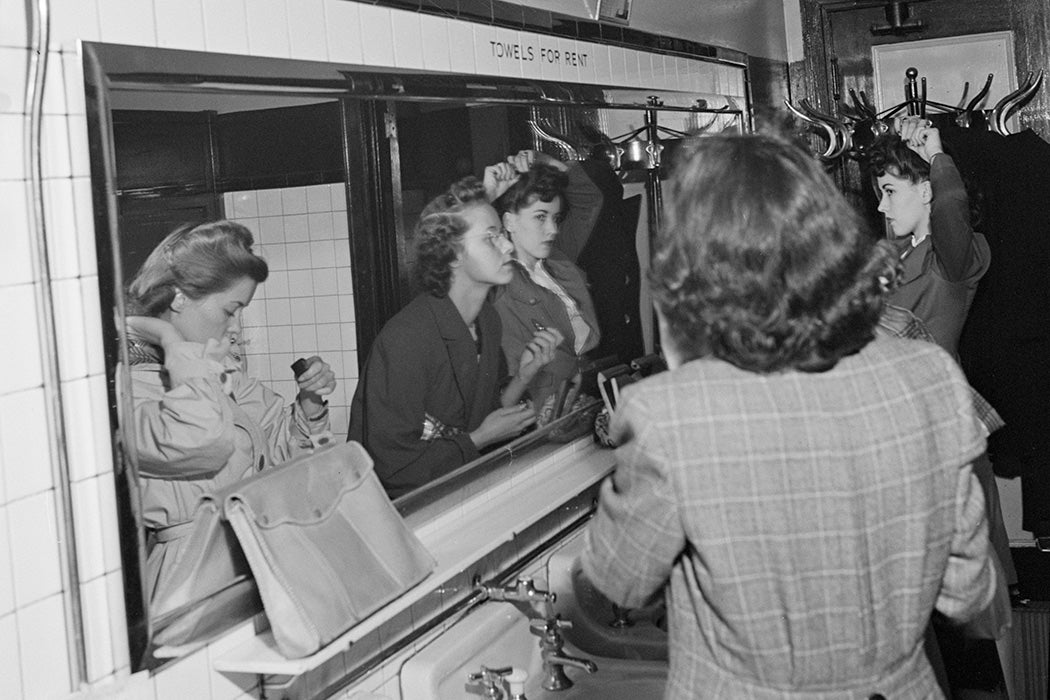
It’s such an important part of female culture that the women’s bathroom is a convenient prop in movies, TV, and books. Writers set a scene in the ladies’ room, where women gather to complain, cry, confide, confess, gossip, preen, or bully. And though such scenes sometimes lean on tired tropes of female behavior, the gender-segregated bathroom is a place to exist beyond the gaze and reach of men. Here, women speak candidly about feelings, bodies, periods, sex, romantic partners, friends, jobs, and family.
“They offer a space for bonding, the exchange of information, and personal recovery,” writes scholar Christine Overall. “Sex-segregated toilets provide ‘the element of sociability important to many women, who also use the women’s room as a refuge, ‘a place to feel safe, both physically safe but also psychologically safe.’” On the wall and in stalls, it’s not uncommon to see phone numbers for domestic violence helplines or, in bar bathrooms, instructions for ordering an “angel shot”: a coded way to ask a bartender for help in the face of harassment.
Of course, the ladies’ room by design isn’t a safe space for all women.
“At various points in US history, the absence of toilet facilities has signaled to [B]lacks, to women, to workers, to people with disabilities, to transgender people, and to homeless people that they are outsiders to the body politic and that there is no room for them in public space,” writes the feminist scholar Judith Plaskow. If these bathrooms are supposedly for the public, then by virtue of excluding certain people, the message is that their needs are not for consideration.
Access to public space in the US has even been explicitly exclusionary. When the Boston-based advocacy organization Women’s Educational and Industrial Union pressed for the creation of health clinics and lunch rooms in the early twentieth century, it made it clear that their goal was to segregate classes and create spaces, Spain explains, where only “middle-class and elite women could appear without being declassed and working women could appear in public without having their virtue questioned by being ‘on the streets.’”
In the Jim Crow south, writes Baldwin, Black women had to use separate bathrooms, typically older and poorly maintained, and were not afforded the privacy of gender-segregated facilities. In some cases, Black people in the segregated South had no access to public bathrooms at all.
Now, the current campaigns of exclusion seek to bar transgender women from accessing the ladies’ room. In 2016, the North Carolina state legislature passed “the bathroom bill,” which forced people to use the bathroom that corresponds to the gender they were assigned at birth. The next year, eight more states moved to impose similar restrictions. North Carolina’s bill was met with such anger on behalf of the LGBTQ community that some elements were quickly scrapped, and the remainder was left to lapse in 2020. While campaigns for equity have made such laws and restrictions exceedingly unpopular, they have not yet made them extinct.
Throughout the 1970s I was in love with Keith McDermott, ten years younger than me. When I first met him, I was living in a third-floor walk-up studio on Horatio Street in the West Village. He was living across the street with Larry Kert (he’s dead), the original young male lead in West Side Story. I was one of Larry’s rainy-day fucks—he’d call me midday or early evening when he was horny and the weather forbade open-air cruising (snow, rain, or tropical heat).
Maybe I met Keith at Larry’s or through someone else; I don’t remember. Keith was living rent-free with Larry. They’d started out as lovers but now, after a year, Keith was expected to help in maintaining their big, luxurious apartment by cleaning and doing chores—and disappearing when Larry had a trick he was bringing home.The sound of the whirring wheels as he came racing around the corner and glided to a halt became the very whisper of desire for me.
Keith wanted to move and I had a lead on an eight-room prewar apartment on the Upper West Side, a block away from Central Park and just four hundred dollars a month. The landlady lived downstairs from us and had decided to rent only to gays—but, what narrowed the field, gay men without dogs. In those days gay couples had dogs, not yet children. We were too poor and unsettled to think of wanting a dog. It never crossed our minds.
Keith was a famous beauty (famous in the West Village and Fire Island among gay men). He was blond, blue-eyed, just twenty-one, and perfectly formed (an expert gymnast). In good weather he rode his bike everywhere. The sound of the whirring wheels as he came racing around the corner and glided to a halt became the very whisper of desire for me. He was fleet, funny, and so handsome that Bruce Weber, the most famous photographer of handsome men back then (Abercrombie & Fitch, GQ, Calvin Klein), took his picture. Weber’s men, often nude or in wet white underpants, were twenty-something, athletic, Ivy League, and passably heterosexual—perfect eye candy for gay men of the period, who liked their men to be iconic and unobtainable, i.e. straight.
Of course I wanted to sleep with this beauty, but he found a way to forestall my lust. He said he was sick of “meaningless” sex and invited me to join his chastity club. We could sleep side by side as long as we never touched. I was content to have that constant access to his beauty and company—and he was happy, I guess, to reap the devotion of a fit, charming, bewitched man in his early thirties who was just publishing his first novel. Before long we were living in our vast eight-room apartment. Whenever I would buy an ugly but big dining room table and six high-backed chairs at Goodwill, Keith would be so outraged that he would drag the furniture out the front door into the hallway. He was a resolute artist and had a horror of looking or being middle-class.
Keith was careful with his “instrument,” i.e., his body. He drank tiny cups of liquid buffalo grass, ate sparingly, mainly vegetables, and visited the gym daily for two hours, where he’d twist and turn on the exercise rings, climb ropes, and strengthen his arms and core, his shoulders and legs, but he never wanted to become a heavily built muscleman. He was a Peter Pan, the puer aeternus. I was abject in my longing for him. I can’t bear to recall the scenes of my crawling toward him, arms outstretched, or the moment when I saw him as an emanation of God. Once I organized an orgy of several guys I dragged back from the Candle Bar in the neighborhood, hoping to be able to touch Keith in the melee. It worked.I can’t bear to recall the scenes of my crawling toward him, arms outstretched, or the moment when I saw him as an emanation of God.
Larry Kert had had a cruel streak—maybe that had rubbed off on Keith. Or maybe my idolatry was just that absurd and I needed vinegar poured in my wounds. I suppose some of the mystical strains in Nocturnes for theKing of Naples, the book I was writing then, were a spillover from my almost religious love for Keith.
And then Keith was cast in the Broadway hit Equus, in which he was naked onstage eight performances a week for years. Dirty old men would sit with binoculars in the front row night after night. A pimple on his ass would send Keith into an anxiety attack. He was brilliant in the role; I saw him in the play dozens of times opposite Richard Burton or Anthony Perkins. It was such a titanic strain (no colds, no hemorrhoids, no weight gain or perceptible loss), thousands of lines, gymnastic feats blinding the “horses” (dancers dressed as stylized horses), rowdy adolescents seated in the cheap seats onstage making wisecracks, kids who were so used to TV that they thought these performers, too, couldn’t hear their remarks. His life became one of iron discipline. I like to think he even came to appreciate our domestic life.
He moved to Los Angeles but was a little too openly, rebelliously gay for Hollywood in those days (no one wanted to see the fag kiss the girl and there were almost no gay roles in the seventies). Then I moved to Paris for sixteen years. When I came back to New York in the late nineties, Keith was living with a sweet, talented Israeli painter; he’d mellowed, was just as funny as ever, became a close associate of the avant-garde director Robert Wilson.
Keith himself directed plays at La MaMa and had published a book. We’re great friends. He insists that I helped form some of his tastes in music and literature. His own curiosity and experience in so many domains of the arts, however, didn’t need my influence, I’m sure. When I told him I’d be writing about him in my sex memoir, he said, “Just say I have a big dick.” That’s easy—his dick is huge.