The state’s ban on gender-affirming pediatric care “cannot be justified” by science, a two-year review concluded.
Madison PaulyMay 27, 2025, 3:00 pm EDT
Spencer Cox of Utah answers a question during a discussion about how our society can learn to disagree in a way that allows us to find solutions on Wednesday, Nov. 15, 2023. | Logan Newell/The Coloradoan / USA TODAY NETWORK
In 2022, Utah Gov. Spencer Cox was the rare Republican governor who seemed to truly care about the well-being of transgender kids. “I don’t understand what they are going through or why they feel the way they do. But I want them to live,” he wrote in a letter that year, explaining why he was vetoing a bill that would have banned four trans middle- and high schoolers in Utah from playing on sports teams with classmates who shared their gender identity. “All the research shows that even a little acceptance and connection can reduce suicidality significantly.”
Meanwhile, nationally, Republican politicians were making opposition to trans rights a core tenet of their platforms, filing hundreds of bills attacking trans kids at the doctor’s office, at school, and on the field. Early in the 2023 legislative session, Cox capitulated, signing a bill that placed an indefinite “moratorium” on doctors providing puberty blockers and hormone therapy to trans kids with gender dysphoria. The bill ordered the Utah health department to commission a systematic review of medical evidence around the treatments, with the goal of producing recommendations for the legislature on whether to lift the moratorium. “We sincerely hope that we can treat our transgender families with more love and respect as we work to better understand the science and consequences behind these procedures,” Cox said at the time.
Now, more than two years later, that review is here, and its conclusions unambiguously support gender-affirming medical care for trans youth. “The conventional wisdom among non-experts has long been that there are limited data” on gender-affirming pediatric care, the authors wrote. “However, results from our exhaustive literature searches have lead us to the opposite conclusion.”
The medical evidence review, published on Wednesday, was compiled over a two-year period by the Drug Regimen Review Center at the University of Utah. Unlike the federal government’s recent report on the same subject, which was produced in three months and criticized gender-affirming pediatric treatments, the names of the Utah report’s contributors are actually disclosed on the more than thousand-page document.
The authors write:
The consensus of the evidence supports that the treatments are effective in terms of mental health, psychosocial outcomes, and the induction of body changes consistent with the affirmed gender in pediatric [gender dysphoria] patients. The evidence also supports that the treatments are safe in terms of changes to bone density, cardiovascular risk factors, metabolic changes, and cancer…
It is our expert opinion that policies to prevent access to and use of [gender-affirming hormone therapy] for treatment of [gender dysphoria] in pediatric patients cannot be justified based on the quantity or quality of medical science findings or concerns about potential regret in the future, and that high-quality guidelines are available to guide qualified providers in treating pediatric patients who meet diagnostic criteria.
In a second part of their review, the authors looked specifically at long-term outcomes of patients who started treatment for gender dysphoria as minors:
Overall, there were positive mental health and psychosocial functioning outcomes. While gender affirming treatment showed a possibly protective effect in prostate cancer in transgender men and breast cancer in transgender women, there was an increase in some specific types of benign brain tumors. There were increased mortality risks in both transgender men and women treated with hormonal therapy, but more so in transgender women. Increase risk of mortality was consistently due to increase in suicide, non-natural causes, and HIV/AIDS. Patients that were seen at the gender clinic before the age of 18 had a lower risk of suicide compared to those referred as an adult.
Submitted with the review was a set of recommendations—compiled by advisers from the state’s medical and professional licensing boards, the University of Utah, and a Utah non-profit hospital system—on steps the state legislature could take to ensure proper training among gender-affirming care providers, in the event it decides to lift the moratorium.
But according to the Salt Lake Tribune, legislators behind the ban are already dismissing the findings they asked for. In response to questions from the Tribune, Rep. Katy Hall, who co-sponsored the 2023 ban, issued a joint statement with fellow Republican state Rep. Bridger Bolinder, the chair of the legislature’s Health and Human Services Interim Committee, that dismissed the study’s findings. “We intend to keep the moratorium in place,” they told the Tribune. “Young kids and teenagers should not be making life-altering medical decisions based on weak evidence.”
Why ignore their own review? Polling, the legislators’ statement suggests. “Utah was right to lead on this issue, and the public agrees—polls show clear majority support both statewide and nationally,” Hall and Bolinder added in their statement. “Simply put, the science isn’t there, the risks are real, and the public is with us.”
Subscribe to the LGBTQ Nation newsletter and be the first to know about the latest headlines shaping LGBTQ+ communities worldwide.
“In almost every single case, the reason was anti-trans discrimination in the form of pressure to ‘detransition’ from one’s family, friends, or community.”
Erin In The Morning is a reader-supported publication. To receive new posts and support my work, consider becoming a subscriber.
Upgrade to paid
A report on the largest survey ever of trans Americans’ health was released on Wednesday, June 11, and its findings reaffirmed what many academics, health care providers and trans people already know: gender-affirming care saves and improves lives, but transphobia often dissuades people from pursuing or continuing it when they need it most.
Over 84,000 trans, nonbinary and gender nonconforming people aged 18 and up responded to the 2022 U.S. Transgender Survey, spearheaded by Advocates for Trans Equality (A4TE). Of respondents who had transitioned, 9% had gone back to living as their sex assigned at birth at some point in their lives, at least for a short while—but in almost every single case, the reason was anti-trans discrimination from one’s family, friends, or community.
“Social and structural explanations dominated the reasons why respondents reported going back to living in their sex assigned at birth at some point,” the report found. “Only 4% of people who went back to living in their sex assigned at birth for a while cited that their reason was because they realized that gender transition was not for them. When considering all respondents who had transitioned, this number equates to only 0.36%.”
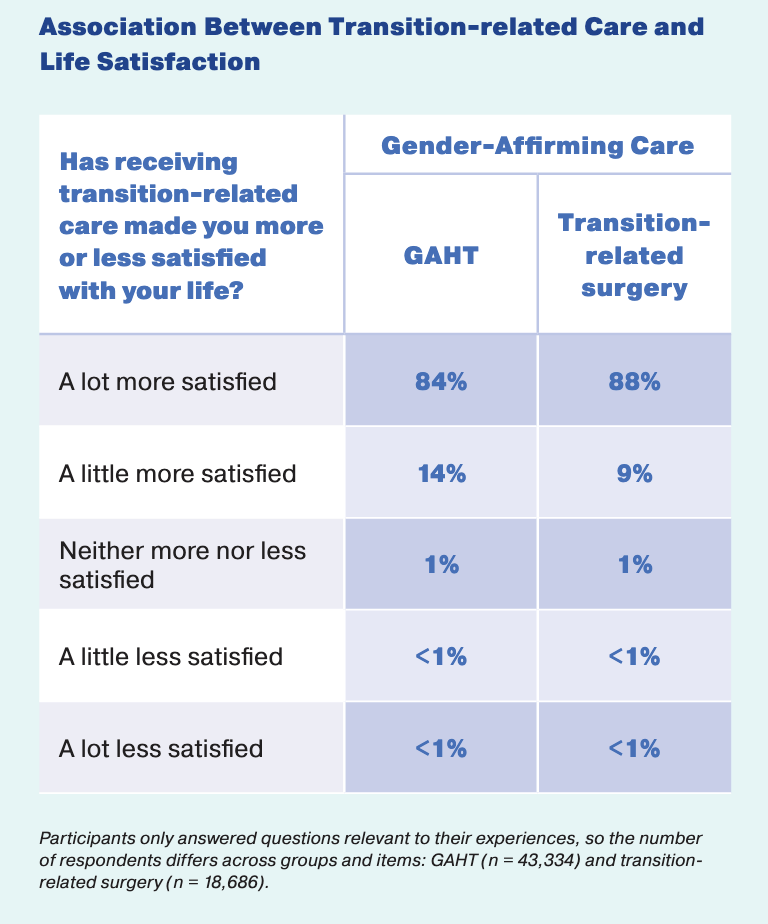
Meanwhile, respondents who received gender-affirming hormone therapy (GAHT) or gender-affirming surgery overwhelmingly reported feeling “more satisfied” with their lives—98% and 97% respectively.
Graphic courtesy of the 2022 U.S. Transgender Survey – Health and Wellbeing Report
This watershed report contradicts the popular narrative being circulated by mainstream media, far-right politicians and anti-trans groups that transgender people are “detransitioning” en masse due to life-shattering “transition regret.” In reality, it shows gender diverse people are living rich and vibrant lives—so long as they are provided the space, support and care they need from their health care providers and communities.
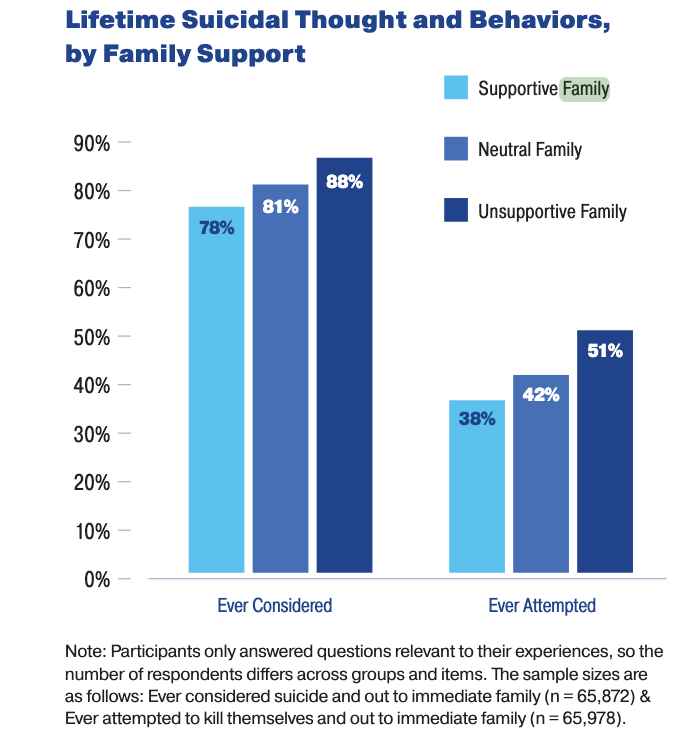
The survey found a trans person’s overall health and wellbeing also heavily depends upon rates of familial support, a factor that has a profound influence over a trans person’s lifetime experience of suicidality.
Graphic courtesy of the 2022 U.S. Transgender Survey – Health and Wellbeing Report
The survey has been released in increments as researchers at A4TE wade through the unprecedented amounts of data from trans people who lent their voice to the project. It is a much-needed, comprehensive overview on the challenges—and victories—seen in trans health care since the prior iteration of the study. The report is especially vital considering the Trump Administration moved to remove transgender people from the U.S. Census and other government websites, rendering trans communities potentially invisible, and robbing researchers of crucial data informing public policy decisions.
“Having real concrete and rigorous data about the realities of trans people’s day-to-day lives is also a vital part of dispelling all of those assumptions and stereotypes that plague the public discourse about our community,” said Olivia Hunt, A4TE’s Director of Federal Policy, during a press briefing this week.
The report also touched upon trans people’s access to health care, which increased between 2015 and 2022; the quality of care, as trust between doctors and trans patients has improved; disparities between trans people across racial groups, which showed trans people of color are generally more prone to experience discrimination compared to white trans people; and the mental health challenges facing the trans community, as 44% of respondents met the criteria for serious psychological distress, compared to less than 4% of the general U.S. population.
Many of these issues have likely been exacerbated since the data was collected. The lead-up to President Donald Trump’s return to the Oval Office incited a new wave of anti-trans animus, impeding access to care and stirring up transphobic vitriol and harassment.
“From 2015 to 2022, state-level policy environments became more protective in some ways for trans people; however, in 2022 alone, when the USTS was administered, 315 anti-LGBTQ bills were introduced across the country, many of which harm trans and nonbinary people’s access to healthcare, participation in sports, access to public facilities, or other facets of public life,” the report says.
“This political landscape has only worsened since the administration of the 2022 USTS, with the introduction of 571 anti-LGBTQ nationwide in 2023 and 489 in 2024,” it continues. “At the time of writing, data on trans and nonbinary people has been erased from federal health surveys. As funding for LGBTQ research is stripped away, the USTS has become an ever more critical resource on the lived experiences of trans and nonbinary people.”
Nonetheless, trans life and trans joy has persisted, as testimonies featured in the U.S. Trans Survey demonstrate.
“I have thrived in the past 12 months in transition, I have a genuine smile on my face most days & laugh with genuine joy,” wrote Charlotte, a trans woman, in her survey response. “I have grown into the woman I was meant to be.”
And as Roo, a nonbinary person, wrote: “Once I learned what it meant to be trans, I never looked back. I traded in my Regina George-esque life for a future with a balding head and a predisposition for a beer gut. I’ve never been more happy to be alive—every single day. ”
Erin In The Morning is a reader-supported publication. To receive new posts and support my work, consider becoming a subscriber.
I admit my life was different but from the time I was five I knew I was attracted to males. Specifically both sexually and emotionally. One of the hell spawn female siblings even held me down to pound the point that I was “queer” into me. I did not understand why it was wrong, after all they were the ones telling me what to do and farming me out to their teen boyfriends. I craved being held by the boys and not so much the girls. But all the other gay and lesbian people I have talked to knew early also. Preteen time frame. 7 or 8 and up they knew they were gay and either knew they had to hide it or knew they couldn’t so had to live with being attacked for it. These people who think it is a choice, a fad, or a phase need to ask themselves the famous question. When did they know they were cis and straight and was it a choice they made. No they just felt it all their lives, they simply knew it. Same for the LGBTQ+. The only difference is straight cis kids see themselves everywhere from birth. Mommies and daddies, they see themselves in the older kids around them, in the news, movies, TV shows, and the books they read. It feels so natural to them they just don’t question it. They are lucky. Until recently like in the last decade LGBTQ+ kids did not see themselves reflected in society. No movies had kids like them, no books in the library had kids like them. Some kids did not even know the words for how they felt. It was changing in the last ten years. Schools made a push for inclusion and tolerance, movies showed LGBTQ+ kids, books had them as plots or characters. Kids could see themselves and be proud. That is what the haters, the anti-trans / anti-gay bigots want to remove. The ability of kids who are different from the majority to see themselves represented positively in society. It is why they write and pass don’t say gay bills, and why they ban books. It is why they try to ban drag shows and pride events. These people who demand a straight cis world with only them showing in public are terrified of a world where people can be different. To them those who are the other must be destroyed, ideas of acceptance and tolerance must be erradicated and removed. All because they don’t feel different from the majority so the difference must not be real. But it is and we need to realize the scars left on kids who grew up in the times when they never seen themselves represented in society. We must not go backward in time, regressing to a time of hate. Hugs
LGBTQ+ youth advocates gathered outside the Monmouth County Courthouse in Freehold on Tuesday, Aug. 15, 2023, where a school policy that would impact lesbian, gay, bisexual, transgender and queer youth was being reviewed in Superior Court. | Amanda Oglesby / Asbury Park Press / USA TODAY NETWORK
A new poll from Pew Research Center sheds some light on just how early LGBTQ+ people are aware of their identities. The study of LGBTQ+ adults in the U.S. found that most respondents understood their identity before the age of 14, with a substantial portion knowing about their identities before the age of 10.
Among gay and lesbian adults, 36% said that they felt they were gay or lesbian before the age of 10 and 35 first felt they were gay or lesbian from ages 10 to 13. Only a minority – 29% – had their first feelings about their sexuality after the age of 14.
The numbers were similar for transgender people. Approximately 33% felt they might be transgender before age 10, and 25% felt the same way between ages 10 to 13. Only 19% had their first feelings about being transgender after the age of 18.
Bisexual people tended to know the latest, but even a majority of bisexual people said that they had their first thoughts about being queer before age 18. Half – 50% – had their first feelings of being bisexual before age 14.
The question often comes up in discussions of LGBTQ+ youth, with many on the right insisting that people can’t know their identities before adulthood. Often, these people claim that only LGBTQ+ people can’t know their identities before adulthood, but then support heterosexuality and cisgender identities in young people.
But these statements fly in the face of LGBTQ+ people’s lived experiences, which often include years of hiding their identities before they create a safer space for themselves to live authentically as adults.
While LGBTQ+ respondents generally first thought about their queer identities when they were very young, most waited until they were older to tell others. While 71% of gay and lesbian people said that they first knew about their sexuality before age 14, only 13% said that they told someone before that age. Approximately 58% of trans people first thought they might be trans before age 14, but only 15% told someone before that age.
This also contradicts the rightwing narrative that young people are saying that they are trans or gay to gain social acceptance and not because they actually identify as such. In reality, young people are saying that they’re straight or cisgender when they actually aren’t, likely to try and get social acceptance.
Pew broke down the results even more and showed that gay men generally felt that they were gay at a younger age than lesbian women, with 40% saying they were younger than 10 years old when they first thought they were gay, as opposed to 29% of lesbian women.
| Pew Research Center
Bisexual women, on the other hand, likely knew earlier than bisexual men. 53% of bi women said they felt they might be bi before they were 14 years old, while just 40% of bi men said the same.
| Pew Research Center
The poll was conducted in January of this year and involved a sample of 3,959 adult LGBTQ+ Americans. The survey asked about a wide variety of topics, including support from family and friends, ties to the larger LGBTQ+ community, and social acceptance.
Subscribe to the LGBTQ Nation newsletter and be the first to know about the latest headlines shaping LGBTQ+ communities worldwide.
By: Susan J. Kressly, MD, FAAP, president, American Academy of Pediatrics
“The American Academy of Pediatrics (AAP) is deeply alarmed by the report released by the U.S. Department of Health and Human Services (HHS) today on medical care for transgender and gender-diverse individuals and the process that informed its development. For such an analysis to carry credibility, it must consider the totality of available data and the full spectrum of clinical outcomes rather than relying on select perspectives and a narrow set of data.
This report misrepresents the current medical consensus and fails to reflect the realities of pediatric care.
As we have seen with immunizations, bypassing medical expertise and scientific evidence has real consequences for the health of America’s children. AAP was not consulted in the development of this report, yet our policy and intentions behind our recommendations were cited throughout in inaccurate and misleading ways. The report prioritizes opinions over dispassionate reviews of evidence.
Patients, their families, and their physicians—not politicians or government officials —should be the ones to make decisions together about what care is best for them based on evidence-based, age-appropriate care.
We urge government officials and policymakers to approach these conversations with care, humility, and a commitment to considering the full breadth of peer-reviewed research. The AAP remains focused on supporting pediatricians in delivering the best possible care to every child, informed by science and the lived experiences of patients and families. We will continue to support the well-being of all children and access to high-quality care that meets their needs.”
I’ve masked consistently since the beginning of the ongoing COVID-19 pandemic, first with a cloth mask, before I knew better, and then for the last few years with KN95s or N95s. And I have, to my knowledge, continued to avoid catching the virus. In fact, I haven’t been sick for at least 4.5 years, and I attribute that in large part to masking. I also opt for patios if I go out to eat, if at all possible, so that’s also part of why I haven’t been sick. But it’s also definitely the masking. Needless to say, I’m already a huge believer in the science of masking. In simple terms: masks work.
However, it’s hard to convince folks who have swallowed the fake news that masking is harmful or that masks don’t work. I won’t link to those (flawed) “studies” because I definitely don’t want to share more misinformation, but suffice it to say, folks who believe masks don’t work are either not reading actual science, or aren’t actually masking, or aren’t using high quality masks, or if they are wearing masks, aren’t wearing them properly (yeah, you’re right, masks around your chin don’t actually work!).
In case you still have the patience to try to convince a mask skeptic—or even a rabid anti-masker—that masks *do* actually work, here’s a great, brand-new, peer-reviewed study to share with them. The paper, which is based on a narrative review and meta-analysis research project, was written by an international team of 13 researchers from universities including University of Oxford (UK), University of New South Wales (Sydney, Australia), University of Toronto (Canada), University of Otago (Wellington, New Zealand), and University of Calgary (Alberta, Canada).
The paper synthesizes evidence from over 400 studies in total, including 100 published reviews, as well as primary studies from disciplines such as epidemiology, public health, engineering, and social studies—all of which focused on the exploring the efficacy of masking. The authors explain that they even re-analyzed “contested meta-analyses of key clinical trials”—including the infamously controversial Cochrane review. In fact, the authors state specifically that their review “was commissioned partly because of controversy around a Cochrane review which was interpreted by some people as providing definitive evidence that masks don’t work.” However, that’s never what the Cochrane review actually stated, as explained by the authors of this current review:
The need for a new review on masks was highlighted by a widely publicized polarization in scientific opinion. The masks section of a 2023 Cochrane review of non-pharmaceutical interventions (9) was—controversially—limited to randomized controlled trials (RCTs). It was interpreted by the press and by some but not all of its own authors to mean that “masks don’t work” and “mask mandates did nothing” (10). Cochrane’s editor-in-chief felt the need to state publicly that in Cochrane’s view, the review’s findings did not support such a conclusion (11). Some scholars were quick to question the review’s methodology, especially key flaws in the meta-analysis and omission of a vast body of non-RCT evidence (12–16).
I, for one, am thrilled that this study explicitly addresses—and debunks—the Cochrane review, because that single study probably did more damage than almost anything else to widespread attempts to get people to mask to keep themselves and others safe from COVID-19.
The authors of this new review found evidence that led them to seven main findings:
First, there is strong and consistent evidence for airborne transmission of severe acute respiratory syndrome coronavirus 2 (SARS-CoV-2) and other respiratory pathogens.
Second, masks are, if correctly and consistently worn, effective in reducing transmission of respiratory diseases and show a dose-response effect.
Third, respirators are significantly more effective than medical or cloth masks.
Fourth, mask mandates are, overall, effective in reducing community transmission of respiratory pathogens.
Fifth, masks are important sociocultural symbols; non-adherence to masking is sometimes linked to political and ideological beliefs and to widely circulated mis- or disinformation.
Sixth, while there is much evidence that masks are not generally harmful to the general population, masking may be relatively contraindicated in individuals with certain medical conditions, who may require exemption. Furthermore, certain groups (notably D/deaf people) are disadvantaged when others are masked.
Finally, there are risks to the environment from single-use masks and respirators.
The authors also provide some recommendations for future research:
We propose an agenda for future research, including improved characterization of the situations in which masking should be recommended or mandated; attention to comfort and acceptability; generalized and disability-focused communication support in settings where masks are worn; and development and testing of novel materials and designs for improved filtration, breathability, and environmental impact.
University of Calgary News recently published an overview of the study which included some discussion of the study by lead author Professor Trisha Greenhalgh from the Nuffield Department of Primary Care Health Sciences, University of Oxford, who stated, “Our review confirms that masks work, with a clear dose-response effect. . . The more consistently and correctly you wear a mask, the better protected you are. Respirators, when worn continuously, provide even greater protection than ordinary masks.”
Co-author Dr. Joe Vipond, MD and Associate Professor at University of Calgary’s Cumming School of Medicine also commented on the study, stating that it is the “definitive answer on masks”:
“In a world of misinformation, questioning the effectiveness of everything from masking to vaccines, it’s important to have solid science to support any assertion . . . This is the definitive answer on masks, looking beyond the narrow view of randomized controlled trials to the entirety of the evidence. And behold, the current science upholds the standards and protocols that for decades have protected health care workers, and more recently the public, from biohazards.”
I know it would be naive to think that this robust study on the efficacy of masking will change die-hard anti-maskers’ minds. But perhaps it will persuade some people who are still open to learning from actual data. Here’s hoping, anyway! Mask up, folks! And if you’re looking for me, I’m the one in the hot pink mask!
Click here to read the full study and here to read the rest of the summary and interviews with several of the authors from University of Calgary News

Spencer Cox of Utah answers a question during a discussion about how our society can learn to disagree in a way that allows us to find solutions on Wednesday, Nov. 15, 2023. | Logan Newell/The Coloradoan / USA TODAY NETWORK


 Alex Bollinger (He/Him)May 29, 2025, 3:30 pm EDT
LGBTQ+ youth advocates gathered outside the Monmouth County Courthouse in Freehold on Tuesday, Aug. 15, 2023, where a school policy that would impact lesbian, gay, bisexual, transgender and queer youth was being reviewed in Superior Court. | Amanda Oglesby / Asbury Park Press / USA TODAY NETWORK


Masks WORK! Photo: Jennifer Sandlin

