A Few Bits I’ve Run Across This Week

Cohesive only in that each is about people. Enjoy as you will.

The stranger in the mirror: how will a hotter earth change humanity?

Two apes sitting on a branch of a tree in a forest.

Mesopithecus pentelicus thrived in the rainforests of the late Miocene, 7 million years ago. Credit: Mauricio Antón

Small, slender and short-lived, with broad noses, big, dark-adapted eyes, living underground, and in the shadows of a shattered, steamy, chaotic world.  Richard Musgrove asks: will this be us in 10,000 years?

Climate change is the greatest challenge in human history – current trends could have us eventually approaching extremes not seen on our planet for 15 million years. Will a destabilised global climate wreak economic havoc, leading to societal collapse, mass mortalities, even extinction? Or will we pull ourselves out of this spectacular self-imposed nose-dive?

Which raises the question – what if we don’t? How will humanity change on a much hotter Earth?

Numbers matter

Uncharted territory approaches as we nudge the Paris Agreement’s 1.5°C above preindustrial levels, on track for a potentially catastrophic 2.7°C by 2100. What about 2200, or 3200?

Globally, days above 50°C have doubled since the 1980s – in Australia, Pakistan, India and the Persian Gulf – with the ‘feels-like’ temperature often higher.  Even immediately reduced carbon emissions will still mean lingering planet-wide heating and associated effects for many thousands of years. 

Our adaptability has led us this far, but what does evolution have in store for our species if we don’t rise to face our greatest challenge?   The answer is unlikely to be in the mirror.

Nothing sweats like us  (snip-MORE)

===========

Medicaid ‘gamers’ are the new ‘welfare queens’ by Aaron Rupar

Republicans are taking strawman arguments to absurd extremes. Read on Substack

Earlier this month, Donald Trump and congressional Republicans passed a grotesque budget bill that (partially) funds massive tax breaks for the wealthy and a ramped-up ICE goon squad by cutting cutting $1.1 trillion from Medicaid and an additional $185 billion from federal food assistance programs, all while adding $2.8 trillion to the deficit.

Not surprisingly, the bill is massively unpopular. As a result, Republicans are gaslighting Americans about its impact, particularly regarding the cuts to Medicaid, which are expected to cost 10 million Americans their health coverage.

The Medicaid cuts could result in more than 16,000 extra deaths per year, researchers say. Republicans have tried to distract from that reality with a combination of blatant lies and misdirecting rhetoric. To hear them tell it, they’re only cutting supposed waste, fraud, and abuse. So when you lose benefits, they’re here to explain why it’s probably your own damn fault.

The lazy gamer myth

Republican messaging surrounding Medicaid cuts borrows heavily from Ronald Reagan’s playbook. (snip- MORE)

======================

Living FaithWomen and Girls

What Does the Bible Say About Gender?

By Heather Brady

The Bible has a lot to say about gender.

Of course, there are innumerable instances when the Bible has historically been used to enforce the idea that gender is a divinely ordained binary, with male and female genders that are distinct, complementary, and assigned at birth. 

But by going back to the original languages of the Bible and examining modern translations more closely a much more complex spectrum of biblical gender is revealed. At some rabbinical colleges, scholars have identified as many as eight genders represented in the original Hebrew.

Indeed, the Bible’s general attitude toward gender is expansive, with verses exploring God’s focus on the interior over the exterior, the distinction between sex and gender, the role of eunuchs in scripture, and more.

Here are 10 Bible verses that show a biblical approach to gender that is as varied as the colors in a rainbow. 

Genesis 1:27
So God created humans in his image, in the image of God he created them; male and female he created them.

Day and night. Water and dry land. Male and female. The creation poem might sound like it’s dealing in binaries, but we know that all of these things have transitional elements. Day and night contain transitions at dawn and dusk; the spectrum of water and dry land includes tidal plains and coral reefs; and people who are intersex, genderqueer, nonbinary, and more can be found between “male and female”.

Genesis 25:27
When the boys grew up, Esau was a skillful hunter, a man of the field, while Jacob was a quiet man, living in tents.

Jacob is described as “smooth” (Genesis 27:11) and stays in the tent where he cooks – traditional female attributes in the ancient world. Yet he is chosen over his “hairy” brother Esau, a skilled hunter, to lead God’s people, showing that God does not place value on traditional gender norms.

Isaiah 56:4-5
For thus says the Lord: To the eunuchs who keep my Sabbaths, who choose the things that please me and hold fast my covenant, I will give, in my house and within my walls, a monument and a name better than sons and daughters; I will give them an everlasting name that shall not be cut off.

Eunuchs were men who had been castrated, especially those employed to guard the women’s living areas. They represent clear historical examples outside of the gender binary in the Bible and are welcomed into the temple and to the community of worship.

Matthew 19:11-12
But [Jesus] said to them, “Not everyone can accept this teaching, but only those to whom it is given. For there are eunuchs who have been so from birth, and there are eunuchs who have been made eunuchs by others, and there are eunuchs who have made themselves eunuchs for the sake of the kingdom of heaven. Let anyone accept this who can.”

The disciples ask Jesus to clarify the explanation of gender in Genesis 1 as it relates to divorce. In answering them, Jesus offers this non-judgmental example of eunuchs that invokes a range of genders. This indicates the law should be flexible enough to allow for this range, instead of being too narrow to recognize its existence. 

Galatians 3:27-28
As many of you as were baptized into Christ have clothed yourselves with Christ. There is no longer Jew or Greek; there is no longer slave or free; there is no longer male and female, for all of you are one in Christ Jesus.

The apostle Paul explains that unity in Christ is what’s important, superseding the concept of gender and other identity markers.

Mark 11:17
[Jesus] was teaching and saying, “Is it not written, ‘My house shall be called a house of prayer for all the nations’? But you have made it a den of robbers.”

In this verse, Jesus is referencing Isaiah 56, when eunuchs are welcomed into the community at temple. He prioritizes welcoming all people, regardless of gender.

Acts 8:38-39
He commanded the chariot to stop, and both of them, Philip and the eunuch, went down into the water, and Philip baptized him. When they came up out of the water, the Spirit of the Lord snatched Philip away; the eunuch saw him no more and went on his way rejoicing.

The baptismal inclusion by Philip of the Ethiopian eunuch in the early church echoes the affirmation of eunuchs who are welcomed to the temple in Isaiah 56. “In neither case [both in Isaiah and Acts] is change required of them before they can join the community in worship,” writes Robyn J. Whitaker for The Conversation.

1 Samuel 16:7
But the Lord said to Samuel, “Do not look on his appearance or on the height of his stature, because I have rejected him, for the Lord does not see as mortals see; they look on the outward appearance, but the Lord looks on the heart.”

When the prophet Samuel was charged by God to look for a new king, David didn’t seem as king-like as the other options presented to Samuel — but he was still the right choice. Once again, we see that God does not share the human preoccupation with external biological features. Our physical bodies do not determine deeper matters of our identity.

Romans 2:29
Rather, a person is a Jew who is one inwardly, and circumcision is a matter of the heart, by the Spirit, not the written code. Such a person receives praise not from humans but from God.

As with the example of God choosing David because of what was in his heart, here the Bible says that physical alteration (like being circumcised) isn’t what matters to God — it’s what’s in the heart. 

Genesis 16:13
So [Hagar] named the Lord who spoke to her, “You are El-roi,” for she said, “Have I really seen God and remained alive after seeing him?”

Hagar changes the name she uses for God, reflecting a change in how she recognizes who God is — not a change in God’s own identity, but an uncovering that leads to a fuller understanding and affirmation of God’s identity. Similarly, someone may choose to change the gender (and the name that goes with it) that they identify with as a reflection of a greater understanding and affirmation of who they are, out of a desire that the world may better know and understand them, too.

Heather Brady Heather Brady is the audience engagement manager at Sojourners.

Bruce Gerencser Brings Us Alan Cumming!

I’m a huge admirer of Alan Cumming the human, as well as the talented star.

Sacrilegious Humor: Alan Cumming on Jesus, Kindness, and Trans People

 Bruce Gerencser  Evangelicalism 

This is the latest installment in the Sacrilegious Humor series. This is a series that I would like readers to help me with. If you know of a comedy bit that is irreverent towards religion, makes fun of religion, pokes fun at sincerely held religious beliefs, or challenges the firmly held religious beliefs of others, please email me the name of the bit or a link to it.

Today’s video is of Alan Cumming guest hosting Jimmy Kimmel Live!

Transcript:

Jesus Christ.

And talking of Jesus . . .

Even as an atheist, I’m a big fan of Jesus. I really am. What’s not to like? A tall, gorgeous man with great abs and flowing hair getting his feet washed by prostitutes. And encouraging people to love their neighbors while slaying in a loose kaftan. And Jesus was an immigrant, by the way. Let’s not forget . . .

Jesus would have loved trans people. He changed water into wine; is that not itself an act of transition? And you know how I know Jesus would love trans people? Because he loved people. He loved all people. So, of course, he would love trans people and all queer people. I mean, Jesus was followed around at all times by 12 single hot guys, all of them also sporting kaftans. You do the math. Jesus loved the gays, America. Deal with it.

The only thing our current president has in common with Jesus is that they both owe their career to their dads.

Seriously, just think to imagine what it must feel like to be trans person in America today. Our government has legislated that trans people do not exist. It is trying to erase them completely. Imagine having to stockpile your essential lifesaving medicine because your president might cut off access to it for no other reason than it makes him look strong to his base. If the government is going to declare a whole group of people shouldn’t exist, why can’t it be truly a dangerous group of people like those who take off their socks and shoes on airplanes and then go into the bathroom? Why can’t it be people who use leaf blowers at unearthly hours in the morning? Why can’t it be unkind people? Which brings us back to Jesus. Yes, of course. Jesus just wants all of us to be kind. So, for once, America, I beg you, let’s all really try to give kindness a go. Like my little mom says, “It doesn’t cost anything to be kind.” And I guarantee you any situation you find yourself in will go better with a little kindness.

Bruce Gerencser, 68, lives in rural Northwest Ohio with his wife of 47 years. He and his wife have six grown children and sixteen grandchildren. Bruce pastored Evangelical churches for twenty-five years in Ohio, Texas, and Michigan. Bruce left the ministry in 2005, and in 2008 he left Christianity. Bruce is now a humanist and an atheist. (snip)

An Interview With One of My Favorite Legislators

Carol Moseley Braun, first black female senator: ’Sexism is harder to change than racism’

David Smith in Washington

Trailblazing Illinois Democrat reflects on political career and says party is ‘in a daze’ about how to combat Trump

Carol Moseley Braun speaks after Rahm Emanuel wins Chicago’s mayoral race in February 2011. Photograph: Nam Y Huh/AP

“Oh, I wish I was in the land of cotton … ”

Carol Moseley Braun was riding a lift in the US Capitol building when she heard Dixie, the unofficial anthem of the slave-owning Confederacy during the civil war. “The sound was not very loud, yet it pierced my ears with the intensity of a dog whistle,” Moseley Braun writes in her new memoir, Trailblazer. “Indeed, that is what it was in a sense.”

The first African American woman in the Senate soon realised that “Dixie” was being sung by Jesse Helms, a Republican senator from North Carolina. He looked over his spectacles at Moseley Braun and grinned. Then he told a fellow senator in the lift: “I’m going to make her cry. I’m going to sing Dixie until she cries.”

But clearly, Moseley Braun notes, the senator had never tangled with a Black woman raised on the south side of Chicago. She told him calmly: “Senator Helms, your singing would make me cry even if you sang Rock of Ages.”

Moseley Braun was the sole African American in the Senate during her tenure between 1993 and 1999, taking on legislative initiatives that included advocating for farmers, civil rights and domestic violence survivors, and went on to run for president and serve as US ambassador to New Zealand.

In a wide-ranging interview with the Guardian from her home in Chicago, she recalls her history-making spell in office, argues that sexism is tougher to crack than racism and warns that the Democratic party is “walking around in a daze” as it struggles to combat Donald Trump.

As for that incident with Helms, she looks back now and says: “I had been accustomed to what we now call microaggressions, so I just thought he was being a jerk.”

Moseley Braun was born in the late 1940s in the post-war baby boom. Her birth certificate listed her as “white” due to her mother’s light complexion and the hospital’s racial segregation, a detail she later officially corrected. She survived domestic abuse from her father, who could be “a loving advocate one minute, and an absolute monster the next”, and has been guided by her religious faith.

In 1966, at the age of 19, she joined a civil rights protest led by Martin Luther King. She recalls by phone: “He was a powerful personality. You felt drawn into him because of who he was. I had no idea he was being made into a modern saint but I was happy to be there and be supportive.

“When it got violent, they put the women and children close to Dr King in concentric circles and so I was close enough to touch him. I had no idea at the time it was going to be an extraordinary point in my life but it really was.”

Moseley Braun was the first in her family to graduate from college and one of few women and Black students in her law school class, where she met her future husband. In the 1970s she won a longshot election to the Illinois general assembly and became the first African American woman to serve as its assistant majority leader.

But when she planned a historic run for the Senate, Moseley Braun met widespread scepticism. “Have you lost all your mind? Why are you doing this? But it made sense to me at the time and I followed my guiding light. You do things that seem like the right thing to do and, if it make sense to you, you go for it.

Moseley Braun’s campaign team included a young political consultant called David Axelrod, who would go on to be a chief strategist and senior adviser to Obama. She came from behind to win the Democratic primary, rattling the party establishment, then beat Republican Richard Williamson in the general election.

She was the first Black woman elected to the Senate and only the fourth Black senator in history. When Moseley Braun arrived for her first day at work in January 1993, there was a brutal reminder of how far the US still had to travel: a uniformed guard outside the US Capitol told her, “Ma’am, you can’t go any further,” and gestured towards a side-entrance for visitors.

At the time she did not feel that her trailblazing status conferred a special responsibility, however. “I wish I had. I didn’t. I was going to work. I was going to do what I do and then show up to vote on things and be part of the legislative process. I had been a legislator for a decade before in the state legislature so I didn’t at the time see it as being all that different from what I’d been doing before. I was looking forward to it and it turned out to be all that I expected and more.”

Woman looks at television
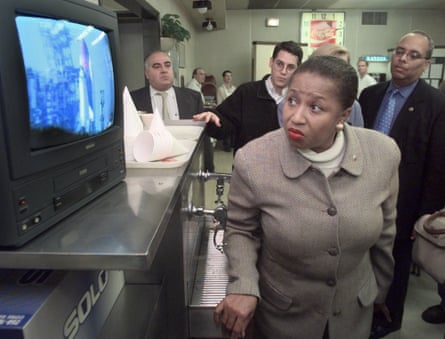
Carol Moseley-Braun watches the delayed launch of the space shuttle Discovery in Chicago in October 1998. Photograph: Michael S Green/AP

But it was not to last. Moseley Braun served only one term before being defeated by Peter Fitzgerald, a young Republican who was heir to a family banking fortune and an arch conservative on issues such as abortion rights. But that did not deter her from running in the Democratic primary election for president in 2004.

“It was terrible,” she recalls. “I couldn’t raise the money to begin with and so I was staying on people’s couches and in airports. It was a hard campaign and the fact it was so physically demanding was a function of the fact that I didn’t have the campaign organisation or the money to do a proper campaign for president.

“I was being derided by any commentator who was like, ‘Look, this girl has lost her mind,’ and so they kind of rolled me off and that made it hard to raise money, hard to get the acceptance in the political class. But I got past that. My ego was not so fragile that that it hurt my feelings to make me stop. I kept plugging away.”

Eventually Moseley Braun dropped out and endorsed Howard Dean four days before the opening contest, the Iowa caucuses. Again, she had been the only Black woman in the field, challenging long-held assumptions of what a commander-in-chief might look like.

“That had been part and parcel of my entire political career. People saying: ‘What are you doing here? Why are you here? Don’t run, you can’t possibly win because you’re not part of the show and the ways won’t open for you because you’re Black and because you’re a woman.’ I ran into that every step of the way in my political career.

Since then, four Black women have followed in her footsteps to the Senate: Kamala Harris and Laphonza Butler of California, Angela Alsobrooks of Maryland and Lisa Blunt Rochester of Delaware.

Moseley Braun says: “I was happy of that because I was determined not to be the last of the Black women in the Senate. The first but not the last. That was a good thing, and so far the progress has been moving forward. But then we got Donald Trump and that trumped everything.”

Harris left the Senate to become the first woman of colour to serve as vice-president, then stepped in as Democrats’ presidential nominee after Joe Biden abandoned his bid for re-election.

Moseley Braun comments: “I thought she did as good a job as she could have. I supported her as much as I knew how to do and I’m sorry she got treated so badly and she lost like she did. You had a lot of sub rosa discussions of race and gender that she should have been prepared for but she wasn’t.”

Trump exploited the “manosphere” of podcasters and influencers and won 55% of men in 2024, up from 50% of men in 2020, according to Pew Research. Moseley Braun believes that, while the country has made strides on race, including the election of Obama as its first Black president in 2008, it still lags on gender.

“I got into trouble for saying this but it’s true: sexism is a harder thing to change than racism. I had travelled fairly extensively and most of the world is accustomed to brown people being in positions of power. But not here in the United States. We haven’t gotten there yet and so that’s something we’ve got to keep working on.”

Does she expect to see a female president in her lifetime? “I certainly hope so. I told my little grandniece that she could be president if she wanted to. She looked at me like I lost my mind. ‘But Auntie Carol, all the presidents are boys.’

Still, Trump has not been slow to weaponise race over the past decade, launching his foray into politics with a mix of false conspiracy theories about Obama’s birthplace and promises to build a border wall and drive out criminal illegal immigrants.

Moseley Braun recalls: “It was racial, cultural, ethnic, et cetera, backlash. He made a big deal out of the immigration issue, which was racism itself and people are still being mistreated on that score.

“They’ve been arresting people for no good reason, just because they look Hispanic. The sad thing about it is that they get to pick and choose who they want to mess with and then they do. It’s too destructive of people’s lives in very negative ways.”

Yet her fellow Democrats have still not found an effective way to counter Trump, she argues. “The Democratic party doesn’t know what to do. It’s walking around in a daze. The sad thing about it is that we do need a more focused and more specific response to lawlessness.”

Five years after the police murder of George Floyd and death of Congressman John Lewis, there are fears that many of the gains of the civil rights movement are being reversed.

Over the past six months Trump has issued executive orders that aim to restrict or eliminate diversity, equity and inclusion (DEI) initiatives. He baselessly blamed DEI for undermining air safety after an army helicopter pilot was involved in a deadly midair collision with a commercial airliner. Meanwhile, Washington DC dismantled Black Lives Matter Plaza in response to pressure from Republicans in Congress.

None of it surprises Moseley Braun. “It should have been expected. He basically ran on a platform of: ‘I’m going to be take it back to the 1800s. Enough of this pandering and coddling of Black people.’”

But she has seen enough to take the long view of history. “This is normal. The pendulum swings both ways. We have to put up with that fact and recognise that this is the normal reaction to the progress we’ve made. There’s bound to be some backsliding.

More than 30 years have passed since Moseley Braun, wearing a peach business suit and clutching her Bible, was sworn into the Senate by the vice-president, Dan Quayle. Despite what can seem like baby steps forward and giant leaps back, she has faith that Americans will resist authoritarianism.

“I’m very optimistic, because people value democracy,” he says. “If they get back to the values undergirding our democracy, we’ll be fine. I hope that people don’t lose heart and don’t get so discouraged with what this guy’s doing.

“If they haven’t gotten there already, the people in the heartland will soon recognise this is a blatant power grab that’s all about him and making a fortune for himself and his family and has nothing to do with the common good. That’s what public life is supposed to be about. It’s public service.”

Pres. Reagan Signs Stewart B. McKinney Homeless Assistance Act, & More in Peace & Justice History for 7/22

July 22, 1756

The “The Friendly Association for gaining and preserving Peace with the Indians by Pacific Measures.” was founded in Philadelphia. It was comprised primarily of Quakers (members of the Society of Friends who wished to pursue peaceful coexistence between the native peoples and the European immigrants to the Pennsylvania region.
Quakers and Indians 
July 22, 1877
A general strike, part of the railroad strike that had paralyzed the country, was called in St. Louis, where workers briefly seized control of the city. Within a week after it began in Martinsburg, West Virginia, the railroad strike reached East St. Louis, Illinois, where 500 members of the St. Louis Workingmen’s Party joined 1,000 railroad workers and residents.

Strikers in St. Louis continued operation of non-freight trains themselves, collecting the fares, making it impossible for the railroads to blame the workers for loss of passenger rail service.
More about the 1877 general strike 
July 22, 1966
Federal Judge Claude Clayton issued an injunction ordering the police of Grenada, Mississippi, to stop interfering with lawful protest, ordering them instead to protect demonstrations, and requiring certain rules to be set down for the conduct of marches.
This ruling followed weeks of arrests and beating of demonstrators who had been attempting to integrate all the businesses and other institutions in their town.
July 22, 1987
President Ronald Reagan signed into law the Stewart B. McKinney Homeless Assistance Act (named for a member of Congress from Connecticut) which provided emergency relief provisions for shelter, food, mobile health care, and transitional housing for homeless Americans.
More about the act 

https://www.peacebuttons.info/E-News/peacehistoryjuly.htm#july22

Peace & Justice History for 7/21

https://www.gocomics.com/lards-world-peace-tips/2025/07/20

July 21, 1878
Publication of “Eight Hours,” written by Reverend Jesse H. Jones (music) and I.G. Blanchard (lyrics), the most popular labor song until “Solidarity Forever” was published by the IWW (Industrial Workers of the World) in 1915.
“Eight hours for work,
Eight hours for rest;
Eight hours for what we will.”

All the lyrics
(The eight-hour was an established concept before the song.)
July 21, 1925
The so-called “Monkey Trial” ended in Dayton, Tennessee, with high school teacher John T. Scopes convicted of violating a state law against teaching Darwin’s theory of evolution. It was considered illegal to contradict the Bible’s description of God’s seven-day creation of the world in Genesis.
The trial pitted two of America’s leading advocates as the opposing lawyers: William Jennings Bryan, thrice the Democratic presidential candidate (1896, 1900, 1908) and the state’s prosecutor; Clarence Darrow, a lawyer famous for representing the underdog, at the defense table. Referred to as “the trial of the century” even before it began, it was the first trial ever broadcast (on radio).
Bryan became ill and died shortly after the trial’s end; the conviction was later overturned by Tennessee’s Supreme Court.

 
The Defendant John T. Scopes
 
 The Attorneys: Darrow & Bryan/ The Verdict: Thou Shall Not Think
Interest in the trial by the populace and the media (and the heat in the courtroom) prompted Judge John T. Raulston to move the trial outdoors to the courthouse lawn. Bryan himself was called as a witness on the literal interpretation of scripture.
Attorney General Thomas Stewart, in response to Darrow’s questioning, asked, 
“What is the meaning of this harangue?” “To show up fundamentalism,” shouted Mr. Darrow, “to prevent bigots and ignoramuses from controlling the educational system of the United States.”
Mr. Bryan sprang to his feet, his face purple, and shook his fist in Darrow’s face:

“To protect the word of God from the greatest atheist and agnostic
in the United States.”

ACLU History: The Scopes ‘Monkey Trial’
More about the Monkey Trial 
July 21, 1954
Major world powers, meeting in Geneva, Switzerland, reached agreement on the terms of a ceasefire for Indochina, ending nearly eight years of war. The war began in 1946 between nationalist forces of the Communist Viet Minh, under leader Ho Chi Minh, and France, the occupying colonial power after the Japanese lost control during World War II.
The Geneva conference included France, the United Kingdom, the U.S., the U.S.S.R., People’s Republic of China, Cambodia, Laos, and both Vietnamese governments (North and South).


The peace treaty called for independence for Vietnam and a 1956 election to unify the country. However, only France and Ho Chi Minh’s DRV (Democratic Republic of Vietnam (North)) signed the document.
The United States did not approve of the agreement. Instead, they backed Emperor Boa Dai and Prime Minister Ngo Dinh Diem’s government in South Vietnam and refused to allow the elections, knowing, in President Eisenhower’s words, that “Ho Chi Minh will win.” The result was the Second Indochina War, more commonly known as the Vietnam War.

The treaty is signed 
July 21, 1976

Plaza de Mayo mother
A military junta under General Jorge Rafael Videla took power in Argentina on March 24, disbanding parliament and taking over all labor unions. The military kidnapped hundreds of people from two villages of Jujuy province in northern Argentina, thirty of whom never returned from a clandestine detention center. Most of those disappeared worked for the Ledesma sugar refinery.
Since 1983, on the Thursday closest to July 21, Madres de Plaza de Mayo (an organization of mothers and wives of the missing) are joined by others, and walk the 7 km (4.3 miles) from Calilegua to San Martin, demanding answers about their loved ones. Madres de Plaza de Mayo is supported by Amnesty International and the United Nations Human Rights Commission.

Read more 

https://www.peacebuttons.info/E-News/peacehistoryjuly.htm#july21

Frederick Douglass Does Some Great Work at Seneca Falls, Dockum Drug Store Sit-Ins, & More, in Peace & Justice History for 7/19

July 19, 1848 
The first Women’s Rights Convention in the U.S. was held at Seneca Falls, New York. Its “Declaration of Sentiments” launched the movement of women to be included in the constitution.The Declaration used as a model the U.S. Declaration of Independence, demanding that the rights of women as individuals be acknowledged and respected by society. It was signed by sixty-eight women
and thirty-two men.
The impetus came from Elizabeth Cady Stanton and Lucretia Mott, both of whom had been excluded, along with all the other female American delegates, from the World Anti-Slavery Convention (London, 1840) because of their sex.


Frederick Douglass, the former slave and abolitionist leader attended the convention and supported the resolution for women’s suffrage.
When suffrage finally became a reality in 1920, seventy-two years after this first organized demand in 1848, only one signer of the Seneca Falls Declaration, Charlotte Woodward, then a young worker in a glove manufactory, had lived long enough to cast her first ballot.
The Seneca Falls Convention and the Early Suffrage Movement 
The Declaration of Sentiments
July 19, 1958
Several black teenagers, members of the local NAACP chapter (National Association for the Advancement of Colored People), entered downtown Wichita’s Dockum Drug Store (then the largest drugstore chain in Kansas) and sat down at the lunch counter.

Wichita sit-in sculpture
The store refused to serve them because of their race. They returned at least twice a week for the next several weeks. They sat quietly all afternoon, creating no disturbance, but refused to leave without being served. Though the police once chased them away, they were breaking no law, only asking to make a purchase, a violation of store policy.
This was the first instance of a sit-in to protest segregationist policies. Less than a month later, a white man around 40 walked in and looked at those sitting in for several minutes. Then he looked at the store manager, and said, “Serve them. I’m losing too much money.”
That man was the owner of the Dockum drug store chain.
That day the lawyer for the local NAACP branch called the store’s state offices, and was told by the chain’s vice president that “he had instructed all of his managers, clerks, etc. (statewide), to serve all people without regard to race, creed or color.”
July 19, 1974 
Martha Tranquill of Sacramento, California, was sentenced to nine months’ prison time for refusing to pay her federal taxes as a protest against the Vietnam War.
July 19, 1993
President Bill Clinton announced regulations to implement his “Don’t Ask, Don’t Tell” policy regarding gays in the military, saying that the armed services should put an end to “witch hunts.” The policy was developed by General Colin Powell, then Chair of the Joint Chiefs of Staff, and eventually summarized as “don’t ask, don’t tell, don’t pursue, don’t harass.”
July 19, 2000
A federal administrative law judge ordered white supremacist Ryan Wilson to pay $1.1 million in damages to fair housing advocate Bonnie Jouhari and her daughter, Dani. The decision stemmed from threats made against Jouhari by Wilson and his Philadelphia neo-Nazi group, ALPA HQ.


Bonnie and Dani Jouhari

https://www.peacebuttons.info/E-News/peacehistoryjuly.htm#july19

Secret Ballot Voting In Great Britain, & Nelson Mandela Is Born, In Peace & Justice History for 7/18

July 18, 1872
Great Britain, under the leadership of William Gladstone, passed a law requiring voting by secret ballot. Previously, people had to mount a platform in public and announce their choice of candidate to the officer who then recorded it in the poll book. Secrecy served to prevent the possibility of coercion and retaliation for one’s vote.

A ballot box used in the 1872 election.
————————————————————————–
July 18, 1918
Nelson Mandela was born. He was one of the leaders in the successful fight against apartheid in South Africa and became its first black president. In 1993 he was awarded the Nobel Peace Prize.

  
Mandela at 19
Mandela photo gallery 
A short bio of Nelson Mandela by the Nobel Committee 

https://www.peacebuttons.info/E-News/peacehistoryjuly.htm#july18

Good Trouble Today, The Young Lords Begin To Repair A Hospital, & More In Peace & Justice History for 7/17

Good Trouble demonstrations today, all. Let’s do what we can to make a visible stand for democracy!

July 17, 1927
In a significant early use of close air support, a U.S. Marine squadron of seven airplanes dive-bombed rebels and peasants surrounding Marines and Nicaraguan military (then under direct U.S. control) in Ocotal, Nicaragua, killing more than 100. The rebels were opposed the presence of U.S. forces, essentially continuously in their country since 1909. 
Why was the U.S. in Nicaragua? 
July 17, 1970

The Young Lords Party entered the Lincoln Hospital in the South Bronx, NYC. The hospital, located in a condemned and dilapidated building, was filled with pain, degradation, neglect, flies, and humiliation. The YLP set up care units in the Hospital, and drew attention to the abysmal conditions.
The direct-action takeover prompted a response by the government, and the building of a new Lincoln Hospital.
The Lincoln Hospital Offensive 
=July 17, 1976

The opening ceremony of the 21st Olympic Games in Montreal was marked by the withdrawal of more than twenty African countries, Iraq and Guyana, and their 300 athletes. They had demanded that New Zealand be banned from participation because its national rugby team had toured South Africa, itself banned from the Olympics since 1964 for its refusal to end the racially separatist policy of apartheid.
The Soweto Massacre, in which 150 children were killed by South African troops, had occurred just one month earlier. The apartheid government had been using international sport as a means to build respectability. The following year, however, in reaction to the Olympic boycott, the nations of the British Commonwealth (which includes New Zealand) adopted the Gleneagles Agreement, discouraging all sporting contacts with South Africa.
African countries boycott Olympics 
Gleneagles Agreement  (It’s a .pdf)
July 17, 1979
Fighters of the Sandinista National Liberation Front overthrew the U.S.-supported dictatorial regime of Anastasio Somoza in the Central American republic of Nicaragua and forced him to flee the country. The notorious and feared U.S.-trained National Guard crumbled and its surviving commanders negotiated a surrender, despite their superiority in armaments.
The Sandanista Revolution
  
Anastasio Somoza
 
Girls born after the historic Sandinista victory. Legal voting age in Nicaragua is 16 years.
The overthrow: Sandinista rebels take Nicaraguan capital

https://www.peacebuttons.info/E-News/peacehistoryjuly.htm#july17

Busy Day In Peace & Justice History, from Crusaders Sacking Jerusalem To Strikers To Nukes, & More:

July 16, 1099
 
The Sacking of Jerusalem
Soldiers from all over Catholic Europe, known as Crusaders, overtook the defenses of Jerusalem and slaughtered both the Jewish and Muslim populations. According to Fulk of Chartres in his contemporaneous account, “Many fled to the roof of the Temple of Solomon, and were shot with arrows, so that they fell to the ground dead. In this temple almost ten thousand were killed. Indeed, if you had been there you would have seen our feet colored to our ankles with the blood of the slain. But what more shall I relate? None of them were left alive; neither women nor children were spared.”
Pope Urban II initiated this effort to wrest the Holy Land from the hands of the “Infidel” (the city had been under Islamic rule for 460 years) and assured those who joined the first crusade that God would absolve them from any sin associated with the venture.
———————————————————————————————————-
July 16, 1877

Firemen and brakemen for the Pennsylvania and Baltimore & Ohio Railroads refused to work, and refused to let replacements take their jobs. They managed to halt all railroad traffic at the Camden Junction just outside of Baltimore. The railroad companies had cut wages and shortened the workweek.

A contemporary artist’s rendering of the clash in Baltimore between workers
and the Maryland Sixth Regiment during the Great Railroad Strike of 1877. The governor had called out the troops on behalf of the railroad company.
After a second pay cut in June, Pennsylvania RR announced that the same number of workers would be expected to service twice as many trains. The work stoppage spread west and eventually became the first nationwide strike
Background and growth of the Strike 
——————————————————————————————————–
July 16, 1945

The U.S. Army’s Manhattan Project succeeded as its first hand-made experimental atomic bomb, known as the “Gadget,” was successfully detonated at the top of a 30m (100 ft.) tower in the desert near Alamogordo, New Mexico (at the Trinity test site now part of the White Sands Missile Range). The original $6,000 budget for the intensive and secret weapons development program during World War II eventually ballooned to a total cost of nearly $2 billion (more than $25 billion in current dollars).


“Gadget” explodes

The “Gadget” just before the Trinity test July 16, 1945.
Assembled in the McDonald Ranch house nearby, the orange-sized plutonium core, weighing 6.1 kg (13.5 lbs.), yielded an explosive force of more than 20 kilotons (equivalent of 20,000 tons of TNT).
Trinity Atomic Bomb  (A good read -A.)
What it’s like there today: “My Radioactive Vacation” 
———————————————————————————————————-
July 16, 1979

The largest release of radioactive material in the U.S. occurred in the Navajo Nation. More than 1200 metric tons (1,100 tons) of uranium tailings (mining waste) and 378 million liters (100 million gallons) of radioactive water burst through a packed-mud dam near Church Rock, New Mexico. The river contaminated by the spill, the Rio Puerco, showed 7,000 times the allowable standard of radioactivity for drinking water downstream from the broken dam shortly after the breach was repaired.

A month later, only 5% of the tailings had been cleaned out.
Warnings not to drink the contaminated water were issued by officials, but non-English-speaking Navajo never heard them, having no electrical power for TV or radio. Humans and livestock continued to drink the water.

———————————————————————————————————-
July 16, 1979


Saddam Hussein became president of the Iraqi republic, secretary general of the Ba’ath Party Regional Command, chairman of the Revolutionary Command Council, and commander-in-chief of the armed forces. He had been the ambitious protegé of Ahmed Hassan al-Bakr, who resigned on this day.

———————————————————————————————————-
July 16, 1983

During a time of increasing tension between the U.S. and the U.S.S.R. (Union of Soviet Socialist Republics), and an escalating nuclear arms race, 10,000 peace activists formed a human chain linking the two superpowers’ embassies in London, England.
The same day, members of the Greenham Common Women’s Peace Camp painted the U.S. spy plane, Blackbird, and composed this song for their activities:
[to the tune of Count Basie’s “Bye, Bye, Blackbird”]
“Here I stand paint in hand
Speaking low, here I go
Bye bye blackbird
Just a dab of paint or two
Here I stand paint in hand
Speaking low, here I go
Bye bye blackbird
Just a dab of paint or two
Grounds you for a week or two
Bye bye blackbird.
 No one in the base could undermine you
Till we did some countersigning on you
Now you’re just a silly joke
Invented by some macho bloke
Blackbird bye bye.”

https://www.peacebuttons.info/E-News/peacehistoryjuly.htm#july16

The Longest Walk, & More, In Peace & Justice History for 7/15

July 15, 1834
The Spanish Inquisition, a centuries-long brutal effort by the Catholic Church to root out heresy, begun in 1481, was officially abolished by King Bonaparte. Spain’s King Ferdinand and Queen Isabella had chosen Catholicism as their religion and asked the pope to help purify the people of Spain. Many thousands were forced to convert, were tortured to encourage confession, or burned at the stake.

Witch burning during the Inquisition
More on the Inquisition 
July 15, 1919
Following World War I, the U.S. War Department announced that it had classified more than 337,000 American men as “draft dodgers.”
Read a brief history of Conscientious Objection in America 
July 15, 1978
The Longest Walk, a peaceful transcontinental trek for Native American justice, which had begun with a few hundred departing Alcatraz Island, California, ended this day when they arrived in Washington, D.C. accompanied by 30,000 marchers.

They were calling attention to the ongoing problems plaguing Indian communities throughout the Americas: lack of jobs, housing, health care, as well as dozens of pieces of legislation before Congress canceling treaty obligations of the U.S. government toward various Indian tribes.
They submitted petitions signed by one-and-a-half million Americans
to President Jimmy Carter.


The Longest Walk Zinn Project

https://www.peacebuttons.info/E-News/peacehistoryjuly.htm#july15