
Tag: Peace
Well Done, Personnelente:
Peace & Justice History for 6/20
| June 20, 1960 Nobel Prize-winner in Chemistry Linus Pauling [for study of the nature of the chemical bond and the determination of the structure of molecules and crystals] defied the U.S. Congress by refusing to name circulators of petitions calling for the total halt of nuclear weapons testing. Pauling later won a second Nobel, a Peace Prize, for his work championing nuclear disarmament.  Linus Pauling Interview with Linus Pauling on the peace movement, 1983 |
| June 20, 1965 Hundreds protested following a military coup in Algiers, the capital of Algeria. The military, under chief of the armed forces Colonel Houari Boumedienne and his National Revolutionary Council, had deposed President Ahmed Ben Bella, the first president of an independent Algeria (following the withdrawal of French colonial control). On the news at the time |
| June 20, 1967 Boxer Muhammad Ali was convicted in Houston, Texas, of violating the Selective Service law by refusing induction into the U.S. Army (during the Vietnam War). The World Heavyweight Champion had claimed conscientious objector status on the basis that he was a Muslim minister. The conviction, for which Ali was sentenced to five years in prison and a $10,000 fine, was later overturned by the Supreme Court.  “I ain’t got no quarrel with those Vietcong.” |
| June 20, 1982 2500 were arrested during a two-day blockade of Lawrence Livermore National Laboratory, about 50 miles east of San Francisco, the principal American nuclear weapons research facility, operated by the University of California. |
| June 20, 1995 Shell Oil gave in to international pressure and abandoned its plans to dispose of the Brent Spar oil-drilling platform and its contents into the North Atlantic. The environmental group Greenpeace spearheaded the effort to prevent Shell from sinking the rig, its members boarding and occupying it as a tactic to stop the deep sea disposal, and to call attention to the issue peacefully. Shell’s plan would have dumped toxic and radioactive sludge into the ocean just west of the British Isles. A month later, at the Oslo and Paris Commission (OSPARCOM) meeting, 11 out of 13 countries agreed to a moratorium on the “dumping” of offshore installations, pending agreement on an outright ban.  Greenpeace climbers on Brent Spar platform  Shell ships use water cannons against Greenpeace activists on board the rig. Read more about Greenpeace and Brent Spar |
| June 20, 2002 The U.S. Supreme Court declared executing mentally retarded individuals convicted of capital crimes to be unconstitutionally cruel [Atkins v. Virginia]. Besides being in line with a consensus among state legislatures, the court found that “Their deficiencies [the mentally retarded] do not warrant an exemption from criminal sanctions, but diminish their personal culpability.” |
https://www.peacebuttons.info/E-News/peacehistoryjune.htm#june20
Juneteenth & More, in Peace & Justice History for 6/19
June 19, 1865 Known among African Americans as Juneteenth (also Freedom Day, Jubilee Day, Liberation Day, or Emancipation Day), this is the day enslaved people in Texas and parts of Louisiana learned they had been freed by President Abraham Lincoln’s Emancipation Proclamation. U.S. Major General Gordon Granger landed at Galveston, Texas, and announced the order that the slaves had been freed. This was two-and-a-half years after the Proclamation had taken effect January 1, 1863. It had stated, “that all persons held as slaves” within the rebellious (Confederate) states “shall be then, thenceforward, and forever free.” This had been kept from the slaves so the slaveowners could reap additional harvests, or because there weren’t enough Union soldiers to enforce the order until Granger arrived, but Juneteenth is the celebration of that day….  A Junetheenth celebration Richmond. Photo from Library of Congress (maybe 1921) Learn More About Juneteenth? New York Times “Black Joy—Not Corporate Acknowledgment—Is the Heart of Juneteenth” The Atlantic |
June 19, 1964 Two hundred college students left Oxford, Ohio’s Western College for Women to join hundreds of other civil rights volunteers in Mississippi as part of “Freedom Summer.” Under the umbrella organization of COFO(Council of Federated Organizations) they worked on projects across the state.Led by SNCC (Student Non-Violent Coordinating Committee) and CORE (Congress of Racial Equality) field secretaries, they helped Negroes try to register to vote, they taught in Freedom Schools, participated in community organizing and, in doing so, endured the hostility toward civil rights work among whites in the deep South. “If we can crack Mississippi,” the students said, “we can crack segregation anywhere.”  Mississippi Freedom Summer Volunteers singing We Shall Overcome, 1964  < <Student protestors are photographed by a policeman on Freedom Day in Greenwood, Mississippi in 1964.  ROBERT MOSES, director of the 1964 Mississippi Summer Project and leader of the training program in Oxford, is shown here during a break in a session which he conducted in Jackson, Mississippi, to prepare African-Americans for politically effective action. more photos Good background on the need for a “Freedom Summer” |
| June 19, 1964 The Civil Rights Act of 1964 was approved after surviving an 83-day filibuster in the United States Senate. The new law, initiated and passed through the determination of President Lyndon Johnson and Senate Republican leader Everett Dirksen of Illinois, guaranteed for the first time equal access to public accommodations “without discrimination or segregation on the ground of race, color, religion, or national origin.”  Massive demonstrations a year earlier ensured passage of the Acts The Senate had never before voted to end the filibuster of a civil rights bill, all of which were consistently opposed by the bloc of senators from the South. Following Senator Robert Byrd’s (D-West Virginia) 14+ hour-long speech, Senator Dirksen rose to speak, “We dare not temporize with the issue which is before us. It is essentially moral in character. It must be resolved. It will not go away. Its time has come.”  About the Civil Rights Act |
| June 19, 1982 One thousand landowners occupied key islands in protest against French nuclear weapons tests at Kwajalein Atoll.The atoll, part of the Marshall Islands in the western Pacific Ocean, is about 2100 miles [3400 km] southwest of Hawaii and 1400 miles [2250 km] east of Guam. The island is now home to USAKA (United States Army Kwajalein Atoll), the Ronald Reagan Ballistic Missile Defense Test Site, and about 2000 support personnel and family members on Kwajalein and the islands Roi and Namur.  Kwajalein Atoll Struggles of Pacific Islanders to stop nuclear testing |
| June 19, 1987 U.S. Supreme Court ruled teaching of creationism in public schools to be a violation of the U.S. constitution’s prohibition on establishment of religion by the government [Edwards v. Aguillard]. Students, parents and teachers had contested the Louisiana “Balanced Treatment for Creation-Science and Evolution-Science in Public School Instruction” law (Creationism Act). It required schools that taught evolution to also teach creation science. “The preeminent purpose of the Louisiana Legislature was clearly to advance the religious viewpoint that a supernatural being created humankind,” concluded Justice William Brennan in his majority opinion. |
| (I’m inserting this, because it’s not yet made it into the newsletter. -A) June 17, 2021 (for June 19) President Joe Biden declared Juneteenth a national holiday. Read a bit about the significance here, from the National Museum of African American History & Culture: “This year marks the second anniversary since President Joe Biden named Juneteenth a federal holiday in 2021. “As more Americans celebrate Juneteenth with family and community, it is vital to share the important historical legacy behind Juneteenth and recognize the long struggle to make it an officially recognized holiday. It is an opportunity to honor our country’s second Independence Day and reflect on our shared history and future. “The origins of Juneteenth date to June 1865. Even though the Emancipation Proclamation was signed by President Abraham Lincoln in 1863 and the Confederate army surrendered to the Union army in April 1865, enslaved people in Texas — the westernmost Confederate state — could not exercise their freedom until June 19, 1865. ‘On that date, Union General Gordon Granger led some 2,000 Union troops, many of whom were Black, into Galveston Bay, where they announced that the more than 250,000 enslaved Black people in the state were free by executive decree. This day came to be known as ‘Juneteenth,’ deriving its name from combining ‘June’ and ‘nineteenth.’” Read More |
https://www.peacebuttons.info/E-News/peacehistoryjune.htm#june19
It’s Still PRIDE Month! Here’s Peace & Justice History for 6/18. Now Have Some Big Fun!

| June 18, 1571 King Sebastian of Portugal enacted penalties for violation of censorship legislation. The fines could be as much as a quarter or half of the violator’s legal possessions, plus the threat of exile to Brazil or an African colony. Death sentences were also not uncommon. Seized books were burned and burnings were supervised by Roman Catholic priests. |
| June 18, 1840 The Oberlin Non-Resistance Society was formed at the Ohio college by students who believed “that the Gospel of Jesus Christ inculcates the duty of peace and good-will.” They were inspired by abolitionist William Lloyd Garrison’s New England group of similar name. They rejected all use of violence even in the name of duty to country. “We must submit to the ‘powers that be,’ and ‘obey magistrates,’ except when their requirements conflict with God’s laws; when we are meekly to endure the penalty of disobedience ‘threatening them not.’ ” Though denounced by the faculty and ignored by the student newspaper, the group was among the first in a succession of peace- and justice-oriented organizations begun at Oberlin. Oberlin’s peaceful tradition |
| June 18, 1941 Less than two weeks before a scheduled march on Washington, its chief organizer, (Asa) A. Philip Randolph, was invited to the White House by President Franklin Roosevelt. Randolph was the president of the Brotherhood of Sleeping Car Porters, the first successful black trade union. He, along with activist and singer Bayard Rustin, had issued a “Call to Negro America to March on Washington for Jobs and Equal Participation in National Defense on July 1, 1941.”  Roosevelt was wary of the prospect of such a demonstration and desirous of developing support for a war effort. Randolph told Roosevelt he would abandon the march plans only if the president would stop job discrimination in both the defense industry and the government. Before the end of the month, Roosevelt signed Executive Order 8802, which barred government contractors from discriminating in hiring on the basis of race, color, creed or national origin.  A. Philip Randolph and Eleanor Roosevelt The order, sometimes called a second emancipation proclamation, was the federal government’s most significant action on behalf of the rights of African Americans since post-Civil War reconstruction of the 1870s. |
| June 18, 1948 A United Nations commission approved and recommended to the General Assembly an International Declaration of Human Rights, recognizing that “the inherent dignity and . . . the equal and inalienable rights of all members of the human family is the foundation of freedom, justice and peace in the world . . . .” Text of the Declaration: . . . |
| June 18, 1970 The U.S. Congress passed the 26th amendment to the constitution, lowering the voting age to 18 for all elections—federal, state and local. The amendment went into effect just 100 days later after 38 state legislatures had ratified the amendment. |
| June 18, 1979 SALT II (Strategic Arms Limitation Treaty), an agreement to put limits on both America’s and the Soviet Union’s long-range missiles and bombers, was signed by Presidents Jimmy Carter and Leonid Brezhnev. This was the first arms-reduction treaty between the two superpowers. It was signed despite the Soviet invasion of Afghanistan the previous year.  Read more on SALT II’s control of weapons of mass destruction |
https://www.peacebuttons.info/E-News/peacehistoryjune.htm#june18
The Best Way To Learn About Autistic Pride Is To Learn It From Autistic People

That’s a thing I began learning during my years working in schools, but I’ve really picked up a great deal more from fellow blogger Barry. Here is his Autistic Pride Day blog post!
Starry, Starry Night … & Happy Birthday, APOD!

APOD is 30 Years Old Today
Image Credit: Pixelization of Van Gogh’s The Starry Night by Dario Giannobile
Explanation: APOD is 30 years old today. In celebration, today’s picture uses past APODs as tiles arranged to create a single pixelated image that might remind you of one of the most well-known and evocative depictions of planet Earth’s night sky. In fact, this Starry Night consists of 1,836 individual images contributed to APOD over the last 5 years in a mosaic of 32,232 tiles. Today, APOD would like to offer a sincere thank you to our contributors, volunteers, and readers. Over the last 30 years your continuing efforts have allowed us to enjoy, inspire, and share a discovery of the cosmos.
IOKIYAR, & More, In Peace & Justice History for 6/16
| June 16, 1961 Following a meeting between South Vietnamese envoy Nguyen Dinh Thuan and President John F. Kennedy, the United States agreed to increase the presence of American military advisors in Vietnam from 340 to 805, and to provide direct training and combat supervision to South Vietnamese troops. The number of U.S. personnel rose to 3,200 by the end of 1962.  President Ngo Dinh Diem and President Eisenhower in DC, five years earlier |
| June 16, 1965 A planned civil disobedience turned into a five-hour teach-in on the steps and inside the Pentagon about the escalating war in Vietnam. In two days, more than 50,000 leaflets were distributed without interference at the building that houses the U.S. Department of Defense. A World War II artillery officer, Gordon Christiansen, turned in his honorable discharge certificate in protest. |
June 16, 1976 South African police opened fire on black students peacefully protesting the requirement to learn Afrikaans, the language of the small white minority that enforced the racially separatist regime known in Afrikaans as apartheid. Neither black nor colored (other non-white or mixed race) South Africans could vote or live where they chose. Over 150 South African children were killed and hundreds more were injured in the shooting—what became known as the Soweto Massacre. fact: Soweto stands for: SOuth WEst TOwnships The History of Apartheid in South Africa Read more on Soweto |
| June 16, 1992 Former Reagan Defense Secretary Caspar Weinberger was indicted for his participation in the Iran-Contra affair, charged with four counts of lying to Congress and prosecutors. He had concealed the secret arrangement to provide funds to the Nicaraguan insurgent contra rebels with profits from selling arms to Iran, which in turn were to encourage the release of hostages held by groups allied with Iran.  President Ronald Reagan with Caspar Weinberger, George Shultz, Ed Meese, and Don Regan, discussing the President’s remarks on the Iran-Contra affair. The Reagan administration (1981-1989) had been circumventing the legal ban on material support for the terrorist activities of the contras. Iran had needed the weapons for its war with Iraq, and it was hoped that Iran would respond by encouraging the release of hostages being held by Islamist groups in Lebanon. President Reagan had publicly and repeatedly promised never to negotiate with terrorists, and had maintained the break in diplomatic relations with the Iranian revolutionary government. Weinberger and the five others charged were all pardoned by President George H.W. Bush six months later, days before the trial was to start, and shortly before President Bush would be leaving office. More on Iran-Contra pardons |
https://www.peacebuttons.info/E-News/peacehistoryjune.htm#june16
Monday AM Greeting-
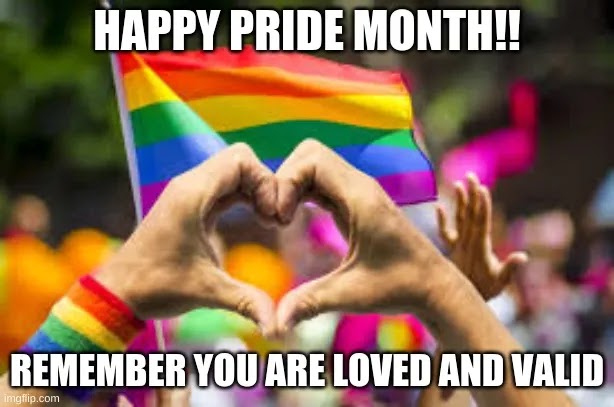
Some Meme’s
Hello All. Life has been very busy lately, but here are some meme’s that I hope you can enjoy and use.



 Scottie's Playtime