Ever since Donald Trump came down his racist escalator and vaulted himself to become leader of the Republican Party in 2015, a popular theory has taken hold in liberalism and particularly at the highest levels of the Democratic Party: “Distraction.”
The idea goes something like this: Because Trump is a creature of the modern media environment and because we are constantly bombarded with narrative after narrative, Trump and his acolytes within the GOP are regularly setting off distraction bombs, meant to keep us occupied while they’re up to no good behind closed doors.
There were two recent invocations of distraction theory worth noting. First, the fight between Elon Musk and Donald Trump was purportedly a distraction from the harm of the “Big Beautiful Bill” that intends to destroy the social safety net. A few days later, some Democratic leaders argued that the attempted military incursion of Los Angeles over immigration was also a “distraction” from the bill. It was also argued by California Gov. Gavin Newsom – who is directly involved in the Los Angeles “distraction,” ironically – that the deportation of Kilmar Abrego Garcia to El Salvador was also a “distraction.”
If it isn’t already clear, I think this theory of the world is very stupid and frankly counterproductive. It operates as if we are still somewhere in the distant past, when only a few narratives could ever operate at one time, usually with a clear “A” story and one or more less important “B” stories. But it is 2025 and that method of operation has long been obsolete.
We are in an ideological war with the American right. They are attacking everything good and right about America and are trying their damnedest to drag us back to the stone age when women, minorities, and LGBTQ people were a subordinate slave class to the whims of wealthy, straight, white men.
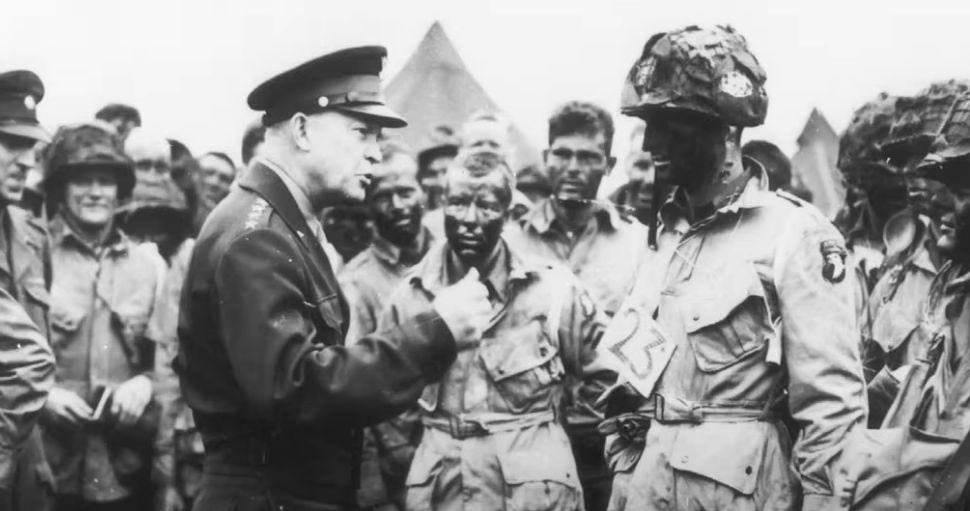
These things aren’t distractions. They are fronts. America fought war on two fronts during World War II, taking on the Axis powers in the European and Pacific theaters. There wasn’t any choice in the matter. There were American soldiers island hopping toward Japan and there were soldiers landing on the beaches of France and Italy on their way to Berlin. Leaders like Franklin Roosevelt and General Dwight D. Eisenhower, while they had to prioritize targets and objectives, didn’t have the luxury of saying the war couldn’t be fought on either side of the U.S. It was an existential battle for survival and they were victorious on both sides.
That is the situation we are in now against conservatism and Republicans. Liberals have to make the case, over and over, that these people are unfit to rule and shouldn’t be allowed anywhere near the levers of power. Every action that liberals and its representatives within the Democratic Party undertake should underscore that clear goal.
That means war on multiple fronts. Sometimes that means pushing legislation and investigation. Sometimes that means a press conference or media briefing. And yes, sometimes that means childish insults, memes, and trash talk.
June 10, 1917 The Women’s Peace Crusade in Scotland launched a three-week campaign of street meetings and demonstrations in dozens of towns to build support for peace in the midst of what was then called The Great War (now known as World War I). More about the Womens’s Peace Crusade
June 10, 1937 The mayor of Monroe, Michigan, organized a citizens’ posse of some 1400 vigilantes, armed with baseball bats and tear gas, to combat the union organizing drive at local Newton Steel. The mob threw a dozen of the picketers’ cars into the River Raisin. Steelworkers’ cars were rolled into Monroe, Michigan’s River Raisin by strike breakers recruited by the mayor. The 120 striking steelworkers and their supporters were working to form unions in the “Little Steel” companies which, unlike U.S. Steel, continued to resist unionization. Newton had just been purchased by Republic Steel [see Chicago’s Memorial Day Massacre [May 30, 1937]. The whole story (Note from Ali: the link in the newsletter was no longer functional. Doing a search of cars going into the River Raisin is really interesting, even simply in modern times! I had to search the specific date to get this report. Seems like an “active” place, there in Monroe!)
June 10, 1963 The “Equal Pay Act of 1963” was passed and signed into law; it guaranteed women equal pay for equal work. The legislation was a result of the recommendations of President John F. Kennedy’s Commission on the Status of Women. The law itself
June 10, 1980 Nelson Mandela’s first writings, and those of other imprisoned anti-apartheid leaders, were smuggled out and made public while they were imprisoned on South Africa’s Robben Island. “ As I read these fascinating essays, I was struck so forcibly by the importance of memory, of history, for both the individual and the community. . . . I pray that our people and especially our children will, by reading this collection of essays, remember the very high price that has been paid to achieve our freedom.” – Desmond Tutu, from the foreword Nelson Mandela’s cell on Robben Island, where he spent 17 years Review of Reflections in Prison Portions of the book
So many old friends in Wichita deplore the conservatism, and yes, there are more voters voting Republican than Dem (though their Dem party is healthy.) Yet, Wichita loves everyone, and I love that! If you’re lucky the little video player on the page will work, and you can watch the broadcast. https://www.ksn.com/video/ict-big-gay-market-hosts-event-for-3rd-year/9749633
June 9, 1872 Julia Ward Howe, an abolitionist and the composer of “Battle Hymn of the Republic,” tried to establish the Mothers’ Peace Day Observance on the second Sunday in June. In 1872 the first such celebration was held and the meetings continued for several years. Her idea was widely accepted, but she was never able to get the day recognized as an official holiday. Mothers’ Peace Day was the predecessor of the Mothers’ Day holiday in the United States now celebrated on the third Sunday of May. Julia Ward Howe ca.1898 Her proclamation read in part: “As men have often forsaken the plough and the anvil at the summons of war, Let women now leave all that may be left of home For a great and earnest day of counsel. Let them meet first, as women, to bewail and commemorate the dead. Let them solemnly take counsel with each other as to the means Whereby the great human family can live in peace….”
June 9, 1954 Special Counsel for the U.S. Army Joseph N. Welch confronted Senator Joseph P. McCarthy (R-Wisconsin) during hearings into alleged communist infiltration of the Army Signal Corps.McCarthy had attacked a member of Welch’s law firm, Frederick G. Fischer, among many others, as a communist. This was alleged due to Fischer’s prior membership in the National Lawyers Guild. The Guild was the nation’s first racially integrated bar association. Army counsel Joseph N. Welch (l) confronts Senator Joseph McCarthy (r) Welch was outraged by the attempt to destroy the reputation and career of someone of whose integrity he had no doubt: “Until this moment, senator, I think I never gauged your cruelty or recklessness . . . . Have you no sense of decency, sir? At long last, have you left no sense of decency?” The entire hearings and this encounter were seen live on television, the first congressional committee hearings ever to be broadcast. McCarthy’s ability to make such accusations was soon greatly diminished. Watch the confrontation National Lawyers Guild, since 1937 and today
June 9, 1984 150,000 marched in London, England, for nuclear disarmament, protesting the presence of U.S. cruise missiles on British soil.
June 9, 1993 Police banned a vigil by Women in Black (Zene u Crnom) in Belgrade, Serbia. Who are the Women in Black? Women in Black demonstrations combine art & politics
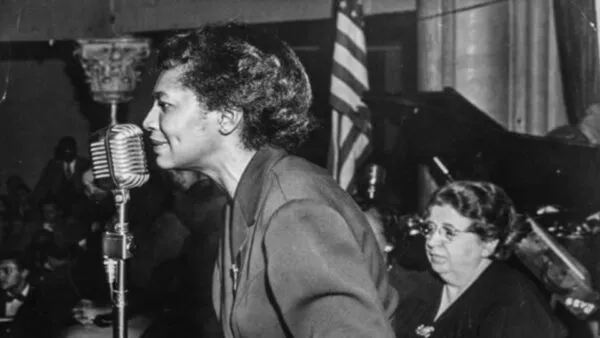
“Her insistence that the rights of women, people in poverty, people of color, and immigrants all be upheld within the political Left, as well as without it, left a legacy of intersectionality that was ahead of its time.”
June 7, 1712 The Pennsylvania Assembly banned the importation of slaves into the colony.
June 7, 1892 Homer Plessy, a Creole of European and African descent, was arrested and jailed for sitting in a Louisiana railroad car designated for white people only. Plessy had violated an 1890 state law, the Louisiana Separate Car Act, that called for racially segregated rail facilities. He then went to court, claiming the law violated the 13th and 14th amendments, but Judge John Howard Ferguson found him guilty anyhow. The U.S. Supreme Court allowed Plessy’s guilty verdict to stand by an 8-1 majority. The decision, Plessy v. Ferguson, established the doctrine of “separate but equal” [separate facilities for white and black people,] institutionalizing and legalizing segregation in the United States public transportation until 1946 in Morgan v. Virginia [see June 3, 1946]. More about Homer Plessy Read the decision
June 7, 1997 Seven activists are arrested for distributing copies of the Bill of Rights outside the Bradbury Science Museum, part of Los Alamos National Laboratory in New Mexico, the primary nuclear research facility in the U.S.
June 6, 1936 First issue of Peace News published in England. PeaceNews home page (Peace News subscriptions are no longer available. See this blog entry. -A. There is still useful information on its home page, etc.)
June 6, 1949 George Orwell’s dystopian novel, Nineteen Eighty-Four, was published. It described a world in which totalitarian government controls the behavior of all, including the way one thinks.
This was summed up in the government’s slogans: War Is Peace, Freedom Is Slavery, Ignorance Is Strength.
June 6, 1966 James H. Meredith, the first African American ever to attend the University of Mississippi, was shot by a sniper in the back and legs while on a lone “March Against Fear.” He was walking the 220 miles from Memphis, Tennessee, to Jackson, Mississippi, to encourage others to stand up for their rights and self-respect, and to register to vote. Law enforcement officers and reporters following him witnessed the attack, and the shooter was arrested. Read more
June 6, 1968 Comedian Dick Gregory began a hunger strike in the Olympia, Washington, jail after his arrest with others at a fish-in, an act of civil disobedience in support of the fishing rights of the Nisqually Indian Tribe. See what happened after his arrest
June 6, 1971 40 members of the American Indian Movement camped in the sacred Black Hills, or Paha Sapa, atop Mount Rushmore; 20 were arrested. They were demanding the U.S. honor the terms of the 1868 treaty with the Sioux Nation granting them the Black Hills territory. Read more
June 6, 1989 The FBI and the Department of Energy, tipped off by plant workers, raided the Rocky Flats nuclear production facility. They found numerous violations of federal anti-pollution laws including massive contamination of water and soil. Rockwell International, the operator of the facility, was fined $18.5 million.
“Queer” is not about who you’re having sex with (that can be a dimension of it), but “queer” as being about the self that is at odds with everything around it and has to invent and create and find a place to speak and to thrive and to live.” —bell hooks
I’ve always been queer, but it took me a while to realize it. Even after coming out as gay, I still struggled with the language of “queer” because I grew up hearing it used as a slur. In many places, it still is. I remember the shocked look on the faces of a lecture audience in rural England when I said “queer” — as if I had uttered a curse word.
This is how the word sits with many people — even within the LGBTQIA+ community. But over the years, as I’ve wrestled with my identity, learned the history of LGBTQIA+ liberation, and developed my beliefs, I’ve come to resonate deeply with being queer, just as much as with being Christian.
In fact, for me, to be an authentic Christian — one who seeks to follow the life and teachings of Jesus — is to be queer. Let me explain.
To be queer generally means one of two things. First, it’s a catch-all phrase for the LGBTQIA+ community — those who embrace a non-heterosexual orientation and/or non-cisgender identity. Second, queer also means to disrupt arbitrary norms, making space for diverse, often marginalized, expressions to flourish.
To be queer means resisting the repression of our true selves and the forces that demand we conform to others’ ideas of who we should be. It’s a declaration of our commitment to live authentically — who God created us to be — not who society or religion says we must become.
In this sense, queerness is holy. It affirms that God doesn’t make mistakes — that our unique expression reflects God’s creativity — and refuses to blaspheme the Creator by suppressing that divine image. When seen this way, queerness is a calling every person should aspire to.
To follow Jesus is to refuse conformity, as Paul wrote: “[to] be transformed by the renewing of your mind” (Romans 12:2). This means shifting how we see ourselves and others — removing the masks we were taught to wear, the roles we were conditioned to play. In this way, queerness is deeply aligned with the way of Jesus.
bell hooks defines queerness as “being at odds with everything around it.” That feels exactly right. We live in a world shaped by systems built to benefit particular people. What’s considered “normal” is often an invention — crafted to maintain control and marginalize difference. Nothing has always been the way it is, and it shouldn’t remain the same.
Today, there’s a rising awareness of the value of diversity and pluralism by many in society (while diversity is also demonized by many). More people are becoming suspicious of those who demonize difference and cling to the status quo. The past century has shown us that the status quo is often built on lies that lead to oppression.
Our society was set up by people who established norms to benefit themselves. But as the world grows more connected and aware of diverse ways of being, movements of resistance have chipped away at this conformity and demanded a new, inclusive path. These movements are “queering” society — questioning and resisting what’s been called normal — and they’ve made the world more just and diverse.
One of the most resistant institutions to queering has been Christianity. This isn’t surprising. Religion resists change, and Christian institutions have fought nearly every cultural shift from desegregation to women’s voting rights to rock music. Those willing to reform are often labeled heretics and excluded from church power. But every so often, resistance sparks reform in the church. The Protestant Reformation, the abolitionist movement, and the fight for women’s rights have all queered Christianity by disrupting norms and pushing forward new expressions of faith.
The inclusion of queer people in Christianity is another such movement. Today, nearly every mainline Protestant denomination in the U.S. officially affirms queer people. We can serve as clergy, marry, and be fully embraced. While there are many local congregations in each denomination that resist these changes, the movement for inclusion is well underway. This is a remarkable shift.
Just last year, Pope Francis announced that Catholic priests may bless same-sex couples. A few months before, he said transgender people could be baptized and serve as godparents. Though these don’t change Catholic doctrine, they marked major steps forward that made many lay queer Catholics feel more included in their churches.
Still, there is much work to do. The truth remains that most Christians worldwide still uphold anti-queer theology. Many still preach that homosexuality is an abomination. Many still teach that women must submit to men and cannot lead.
Progressive Christians sometimes believe the church is rapidly changing, but that’s often just the view from our bubble. Most Christians still cling to rigid, patriarchal theology. And I’ve come to believe that the only way to challenge that resistance is through queering.
Not every LGBTQIA+ Christian agrees with this strategy. There are many queer Christians who would prefer to simply shift the church’s understanding of the six clobber passages and be accepted into the traditional Christian institution with its traditional sexual ethics, understanding of relationships, and devotion to conservative theology otherwise. I understand that desire; I once had it too. But I’ve come to believe it’s actually counterproductive to our flourishing as queer people.
The more I’ve studied Scripture and listened to queer stories, the more convinced I’ve become: The issue isn’t a few misinterpreted Bible verses — it’s that Christianity was institutionalized. A few hundred years after Jesus, his radical movement was merged with the Roman Empire and transformed into rules, dogma, and rigid orthodoxy.
Other perspectives were labeled heresy, punished, and driven underground. What remained became dominant: a version of Christianity that, frankly, looks nothing like Jesus.
When I became a Christian, it was because I wanted to follow Jesus — not an institution. But I was quickly taught that faithfulness to Jesus meant faithfulness to the church. I learned the doctrines and ethics of my church and saw that the more I conformed, the more I was accepted — and even celebrated.
From adopting the politics of my pastors to unquestioningly espousing conservative theology, to even dressing in ways that mirrored the evangelical subculture, I learned that through conforming and contorting myself to look, believe, vote, and act like what was seen as normative for evangelical Christians, my inclusion would be solidified.
I gained status and privilege. I was affirmed by my church and I believed that this meant I was close to God. But I felt uneasy, even early on. As I read Scripture, I struggled to see our theology or ethics reflected in Jesus’ life. Jesus lived on the margins of religious and political power. He constantly challenged the status quo and resisted exclusionary doctrine.
I came to see that neither I nor my church looked like Jesus. That realization was unsettling. Eventually, it led me to believe that queering Christianity wasn’t just permissible — it was necessary. Not only for LGBTQIA+ inclusion, but for everything and everyone.
Rather than blindly accepting church authority, I began to pursue truth wherever it led and invited others to do the same. My ministry became about queering Christianity, not just including queer people in the traditional frameworks of the church.
That meant challenging every theology and ethic that doesn’t reflect Jesus’ ethic of love. It meant reimagining how we follow Jesus — beyond traditional Christianity.
This is, I believe, the most faithful path. But it’s also the hardest. It requires us to stop seeking the affirmation of and inclusion in the old structures and instead focus on building subversive, queerly spiritual communities that reflect the Spirit of Christ.
It means being open to truth from everywhere and everyone — because all truth is God’s truth — and letting it shape our spiritual journeys.
It means getting used to being called heretics. Excluded even from some so-called affirming churches that find our vision too radical. But our goal isn’t to be welcomed because we conform — it’s to create a community that welcomes all expressions and beliefs, grounded in the love and example of Jesus in whatever form that takes.
Our goal isn’t even to be “Christians,” really. Jesus never used that word. Never spoke a Christian doctrine. Never stepped inside a Christian church. So inclusion in the traditional institutions of Christianity isn’t the point.
The point is a truly queer revolution of faith that liberates us all to show up authentically, that remains open to the voice of our still-speaking God in the most unlikely people and places, and that understands that the Kingdom of God that Jesus preached and embodied can never be contained in the rigid boundaries of any institution, but is found among the diversity, complexity, and beauty of all of our human experiences.
Editor’s note: This essay is an adaptation from Queer & Christian: Reclaiming the Bible, Our Faith, and Our Place at the Table. It has been adapted with the permission of St. Martin’s Essentials.
June 5, 1851 Uncle Tom’s Cabin or, Life Among the Lowly began to appear in serial form in the Washington National Era, an abolitionist weekly. The novel by Harriet Beecher Stowe, a tear-jerking tale of the hardships of slavery, became a central reference point in the national debate over the issue. Read more
June 5, [since 1972] World Environment Day was established by the U.N. General Assembly to commemorate the opening of the Stockholm Conference on the Human Environment in Sweden. The United Nations Environment Program (UNEP) was established as a result of the conference. The 1972 Stockholm conference UNEP’s mission: To provide leadership and encourage partnership in caring for the environment by inspiring, informing, and enabling nations and peoples to improve their quality of life without compromising that of future generations. Each year World Environment Day adopts a different theme.
June 5, 1989 Just a few days before the first fission reaction was to be allowed at New Hampshire’s Seabrook Station nuclear power plant, hundreds breached the security fence, leading to 627 arrests. They carried signs reading, “In Mourning for the Late, Great State of New Hampshire,” and “Remember Chernobyl.” Led by the Clamshell Alliance, their concern was for the safety of local residents in the event of a nuclear accident, as well as environmental pollution and the unsolved problem of safe disposal of nuclear waste generated by the reactor. There were also concerns for increased electricity rates to cover the costs of the project. Repeated significant protests occurred as early as 1976 at the beginning of construction when sometimes more than a thousand would be arrested. Ron Sher, a Seabrook spokesman, termed the demonstrators “very vocal but a small minority . . . They don’t represent the millions of people in New England that recognize that nuclear energy is a viable energy option.” The plant was projected to produce up to 1.15 gigawatts, enough for one million homes.
June 5, 1993 Thousands marched to protest neo-Nazi violence against foreigners, particularly ethnic Turks, living in Germany.



 “
“






 Scottie's Playtime