Rock Wren
“Pebbled Pathways”

“Pebbled Pathways”
Marisa Kabas October 11, 2024

A poster created by Halachic Left
Monday marked the one year anniversary of the October 7th massacre in Israel, and at sundown Friday, the Jewish day of atonement—Yom Kippur—begins. It’s the holiest day of the Hebrew calendar, saddled with even more gravity given the past year of intra and inter-community turmoil. It’s meant to be observed with deep self-reflection.
Rabbi Jason Rubenstein, Executive Director of Harvard University’s Hillel (an international Jewish student organization) endeavored to do just that with a searching letter posted to his chapter’s website Thursday evening. The nearly 2,600 word missive was published in response to a fairly confusing fracas on campus earlier this week. The details are important, so I’ll break it down for you:

Another poster from Halachic Left
I’d like to share some additional language from Rubenstein’s letter so that my criticism makes sense. He writes that the poster images from Gaza, “depict, in ways that are painful to confront, effects of the IDF’s campaign against Hamas there on Palestinian civilians. It is vital that we, as Jews, not evade the effects of the Jewish state’s army’s actions on others.”
The framing in that first sentence feels especially important. It’s a reminder that from a Zionist perspective, Israel’s government and army have killed tens of thousands of people in Gaza for a reason: to eradicate Hamas. The Palestinian civilians are simply bystanders caught up in war, and while their pain should cause us pain, it doesn’t mean that all Jews should have to repent for it.
I as much as anyone have consistently made it clear that the conflation of Zionism with Judaism is dangerous and harmful. The trouble is, however, that from the perspective of the world, the atrocities being committed against Palestinians are being done in our name–therefore, we’ve become part of the story, whether we agree with the premise or not. And so from my perspective, the posters are not trying to say that every Jew should atone this Yom Kippur for the sins of the IDF, but that we should atone for what is seen as violence carried out to protect our religion. After all, “not in our name” is a phrase that has been used by Jews long before, but especially since, October 7, 2023.
But what’s perhaps even more troubling on a micro level is the involvement of law enforcement and the idea that certain freedoms be curtailed in the name of safety.
“Jewish institutions have a tremendous amount of power, and it hurts my heart that they so often use it to gate-keep and exclude rather than enfranchise,” Rabbi and author Danya Ruttenberg, who publishes the newsletter Life is a Sacred Text, told me. “That Harvard Hillel decided to engage law enforcement on a matter of…postering (never mind that they were posters with…our sacred liturgy? Inviting us to collective moral reflection?) speaks to just how profoundly some corners of our institutional life have lost the thread here.”
A Jewish Harvard student I spoke with Friday morning, whose name I’m not sharing to protect their privacy, pointed out that the situation could have turned out even worse had the JStreet U-affiliated student been a person of color. They felt that involving the cops rapidly escalated the situation, when it could have easily been an opportunity for community building handled privately between groups.
And, as Ruttenberg pointed out, there was no actual crime was committed.
The impact of Hillel’s rush to suspend and punish JStreet U, another Jewish student organization—never mind the fact that they didn’t have an active chapter on campus or that Hillel doesn’t have any apparent authority over other student organizations—goes beyond this one incident. The student told me how they feel this represents something larger about how Hillel views left of center Israel activism, and that even the actions of an organization as close to the center as JStreet is unacceptable.
Harvard has been no stranger to controversy (legitimate and manufactured) since last October, which is why this seemingly niche story captured my interest. While one elite university campus is not representative of the country or world at large, much like Judaism and Zionism, the school’s experience and reality have been conflated. And so even a relatively small event looms large.
“How ready are our institutions to criminalize young people who simply seek to engage about horrific moral questions with the community, and with those in power?” Ruttenberg wondered. “This was a moment for communal conversation, for drawing in and speaking to. Is this who we want to be?”
If you’re observing Yom Kippur, I hope that however you choose to observe is meaningful to you. I will be attending a Yizkor service tomorrow organized by Rabbis for Ceasefire. And, in keeping with Jewish tradition, I want to apologize to anyone I may have hurt by my words or actions this past year. I hope you can accept my sincere forgiveness.
https://www.thehandbasket.co/p/harvard-student-posters-yom-kippur-hillel-cops
It’s National Coming Out Day!

| October 11, 1987 More than half a million people flooded Washington, D.C., demanding civil rights for gay and lesbian Americans, now celebrated each year as National Coming Out Day. Many of the marchers objected to the government’s response to the AIDS crisis, as well as the Supreme Court’s 1986 decision to uphold sodomy laws in Bowers v. Hardwick.   The AIDS quilt, first displayed in 1987 in Washington, DC The NAMES Project AIDS Memorial Quilt was first displayed there, bringing national attention to the impact of AIDS on gay communities, a tapestry of nearly two thousand fabric panels each a tribute to the life of one who had been lost in the pandemic. |
| Brief history of National Coming Out Day https://www.advocate.com/exclusives/2019/10/11/coming-out-day-brief-history |
https://www.peacebuttons.info/E-News/peacehistoryoctober.htm#october11
| October 10, 1699 The Spanish issued a royal decree which stated that every African-American who came to St. Augustine, Florida, and adopted Catholicism would be free and protected from the English. |
| October 10, 1963 The Limited Test Ban Treaty—banning nuclear tests in the oceans, in the atmosphere, and in outer space—went into effect. The nuclear powers of the time—the United States, Great Britain, and the Soviet Union—had signed the treaty earlier in the year. In 1957, Nobel Prize-winner (Chemistry) Linus Pauling drafted the Scientists’ Bomb-Test Appeal with two colleagues, Barry Commoner and Ted Condon, eventually gaining the support of 11,000 scientists from 49 countries for an end to the testing of nuclear weapons. These included Bertrand Russell, Albert Einstein, and Albert Schweitzer.  Linus Pauling Pauling then took the resolution to Dag Hammarskjöld, then Secretary-General of the United Nations, and sent copies to both President John F. Kennedy and Soviet Premier Nikita Kruschev. The final treaty had many similarities to Pauling’s draft. It went into effect the same day as the announcement of Pauling’s second Nobel Prize, this time for Peace. |
| October 10, 1967 The Outer Space Treaty (Treaty on Principles Governing the Activities of States in the Exploration and Use of Outer Space, Including the Moon and Other Celestial Bodies) demilitarizing outer space went into force.It sought to avoid “a new form of colonial competition” as in the Antarctic Treaty, and the possible damage that self-seeking exploitation might cause. Discussions on banning weapons of mass destruction in orbit had begun among the major powers ten years earlier.  1949 painting by Frank Tinsley of the infamous “Military Space Platform” proposed by then Secretary of Defense James Forrestal in the December 1948 military budget. Read more |
| October 10, 1986 Elliott Abrams, then assistant secretary of state for inter-American affairs, testified before the Senate Foreign Relations Committee (in closed executive session) that he did not know that Marine Lt. Col. Oliver North, a White House employee in the Reagan administration, was directing illegal arms sales to Iran and diverting the proceeds to assist the Nicaraguan contras. Abrams pled guilty in 1991 to withholding information on the Iran-contra affair during that congressional testimony, but was pardoned by President George H.W. Bush.  Elliott Abrams  Presidents George W. Bush & George H.W. Bush  Oliver North Read more about the pardons |
| October 10, 1987 Thirty thousand Germans demonstrated against construction of a large-scale nuclear reprocessing installation at Wackersdorf in mostly rural northern Bavaria. |
| October 10, 2002 The House voted 296-133 to pass the “Joint Resolution to Authorize the Use of United States Armed Forces Against Iraq,” giving President George W. Bush broad authority to use military force against Iraqi leader Saddam Hussein, with or without U.N. support.  |
https://www.peacebuttons.info/E-News/peacehistoryoctober.htm#october10
| October 9, 1919 The International Fellowship of Reconciliation was founded in Bilthoven, the Netherlands. Its members have since been active in promoting programs and activities for reconciliation, peace-building, active nonviolence, and conflict resolution.  More about FOR history |
| October 9, 1990 The U.S. began making reparations payments to survivors and families of Japanese-Americans taken from their homes put into internment (or concentration) camps during World War II.The payments were a result of the Civil Liberties Act of 1988 signed by President Reagan. Popularly known as the Japanese American Redress Bill, this act acknowledged that “a grave injustice was done” and mandated Congress to pay each victim of internment $20,000 in reparations.  Some of the housing in the concentration camps was in former horse stalls. The first nine redress payments were made at a Washington, D.C. ceremony. 107-year-old Reverend Mamoru Eto of Los Angeles was the first to receive his check. A chronology of internment during WWII Note: In the entire course of the war, 10 people were convicted of spying for Japan, all of whom were Caucasian. |
| October 9, 1991 Women In Black in Belgrade (Zene u Crnom) began regular weekly silent vigils in Republic Square. They stood to protest the nationalist violence that had erupted in the disintegration of Yugoslavia. They encouraged men who refused to serve in the military, and engaged in many educational efforts. They were initially encouraged by “Women Visiting Difficult Places,” a group of Italian women who encouraged women on both “sides” in conflict-ridden countries to communicate. They in turn were inspired by Israeli Jewish women who organized in 1988 during the first intifada to protest their country’s occupation of Palestinian territories, and held vigils in as many as forty locations, later joined by Israeli Palestinians.  Women In Black • New York City |
| October 9, 2007 The Imagine Peace Tower, a work conceived by Yoko Ono and dedicated to John Lennon’s memory, was dedicated on the island of Videy, within sight of Reykjavik, Iceland. The LennonOno Grant for Peace will be awarded there each year. Iceland was chosen because Iceland has no standing army and it is a world leader on the environment. The installation bears the inscription, Imagine Peace, in 24 languages. more photos The Tower is lit the first week of Spring, on October 9 and December 8 (the dates of Lennon’s birth and death) and on New Year’s Eve. The electricity comes solely from the Hellisheidi Geothermal Power Plant. The Imagine Peace Tower live feed Note: A few peace buttons from peacebuttons.info were buried in a time capsule at the base of the Imagine Peace Tower. < get some for yourself and friends |
https://www.peacebuttons.info/E-News/peacehistoryoctober.htm#october9
| October 8, 1945 President Harry S. Truman announced that the secret of the atomic bomb would be shared only with Great Britain and Canada.  |
| October 8, 1982 The Polish Parliament overwhelmingly approved a law banning Solidarnos´c´ (Solidarity), the independent trade union that had captured the imagination and allegiance of nearly 10 million Poles.  Solidarnosc leader Lech Walesa, 1982 Solidarnosc leader Lech Walesa, 1982The law abolished all existing labor organizations, including Solidarity, whose 15 months of existence brought hope to people in Poland and around the world but drew the anger of the Soviet and other Eastern-bloc (Warsaw Pact) governments. The parliament created a new set of unions with severely restricted rights. |
https://www.peacebuttons.info/E-News/peacehistoryoctober.htm#october8
An especially sad item within.
| October 7, 1989 Tens of thousands (estimates ranged from 40,000 to 150,000) from all over the country marched on Washington, lobbied Congress and Housing Secretary Jack Kemp to provide affordable housing for the homeless. Some of the signs read, “Build Houses, Not Bombs.” Kemp signed a letter committing the George H.W. Bush administration to several steps to help the homeless, including setting aside about 5000 government-owned single-family houses for them. =============== October 7, 1998  Matthew Shepard Matthew Shepard, a gay student at the University of Wyoming, was beaten, robbed and left tied to a wooden fence post outside Laramie, Wyoming; he died five days later. His death helped awaken the nation to the persecution of homosexuals and their victimization as objects of hate crimes. A play about the incident, and later an HBO movie, “The Laramie Project,” has been performed all over the country. Watch a preview MatthewShepard.org Matthew’s Place |
https://www.peacebuttons.info/E-News/peacehistoryoctober.htm#october7
Brain drain could undermine the country’s hi-tech economy as liberal families conclude social contract has been broken
This summer, the Nobel laureate Prof Aaron Ciechanover joined a group of prominent Israelis gathered in the ruins of the Nir Oz kibbutz to demand a hostage release and ceasefire deal.
Nir Oz was the worst hit of all the communities targeted by Hamas on 7 October, with a quarter of its residents kidnapped or killed. Twenty-nine are still in Gaza.
If the hostages were not brought back, the basic social contract that underpinned Israeli society would unravel, the 77-year-old professor of medicine warned – with catastrophic consequences for the entire country.
He cited an accelerating “brain drain” of doctors and other professionals as a worrying sign that some of Israel’s elite already feel they no longer have a future in the country. And without them, Israel itself might struggle to have a future.
Ciechanover is a long-term critic of Benjamin Netanyahu and joined protests against his government before the war. But concern about this trend is not limited to political opponents of the Israeli leader. Earlier this year, Netanyahu’s former chair of the National Economic Council, Eugene Kandel, joined forces with the administrative expert Ron Tzur to warn that Israel faces an existential threat.
In a paper calling for a new political settlement, they warned that under a business-as-usual scenario “there is a considerable likelihood that Israel will not be able to exist as a sovereign Jewish state in the coming decades”. (snip)
The problem precedes the 7 October attacks and the war that followed, as demographic and political shifts have prompted some secular, liberal Israelis to question their future in a state increasingly dominated by religious traditionalists.
Noam is a father of three with businesses that include a PR consultancy and a cannabis pharmacy. He expected that his 40s would be a time of “less doing, more enjoying”, after decades of hard work.
Instead, he and his wife spend evenings poring over school options in European countries as they weigh up where to start a new life. The war increased the urgency of the search, but it has been a decision born out of longstanding concerns.
“The main reason we are leaving is that we are seeking a better future for our children. Even if peace can be brokered tomorrow, we still can’t see a future we want to be a part of,” Noam said. “The demographics speak for themselves.”
(snip-MORE- not tl;dr)
(Peace History’s links were misdirected for a few days, but the links are back now.)
| October 6, 1683 Thirteen Mennonite families from the German town of Krefeld arrived in Philadelphia on the ship Concord. Having endured religious warfare in Europe, the Mennonites were pacifists, similar to the Society of Friends (often known as Quakers) who opposed all forms of violence. The first Germans in North America, they established Germantown which still exists as part of Philadelphia. Modern Mennonite peace activism: |
| October 6, 1955 Poet Allen Ginsberg read his poem “Howl” for the first time at Six Gallery in San Francisco. The poem was an immediate success that rocked the Beat literary world and set the tone for confessional poetry of the 1960s and later. “Howl and Other Poems” was printed in England, but its second edition was seized by customs officials as it entered the U.S. City Lights, a San Francisco bookstore, published the book itself to avoid customs problems, and storeowner (and poet) Lawrence Ferlinghetti was arrested and tried for obscenity, but defended by the American Civil Liberties Union (ACLU).  Working on Howl in San Francisco, circa June, 1956 Following testimony from nine literary experts on the merits of the book, Ferlinghetti was found not guilty.  Lawrence Ferlinghetti outside City Lights More about City Lights Read Howl Read more about Allen Ginsberg |
| October 6, 1976 An airliner, Cubana Airlines Flight 455, exploded in midair, killing 73 mostly young passengers including the entire Cuban youth fencing team. The plot was engineered by Orlando Bosch and Luis Posada Carriles, a Cuban former CIA agent, who was based in Venezuela at the time. The Posada Carriles file from the National Security Archive |
| October 6, 1978 346 protestors were arrested at the site of the proposed Black Fox Nuclear Power Plant in Inola, Oklahoma. In 1973 Public Service of Oklahoma announced plans to build the Black Fox plant about 15 miles from Tulsa. It was also near Carrie Barefoot Dickerson’s family farm. She became concerned as a nurse and a citizen about the potential health hazards.  Carrie Barefoot Dickerson Carrie Barefoot DickersonThrough her group, Citizens’ Action for Safe Energy (CASE), and the consistent opposition of informed and persistent allies, the project was canceled in 1982. There are no nuclear plants in the state of Oklahoma, and no nuclear plant has been built in the U.S. since then. Carrie Dickerson Foundation |
October 6, 1979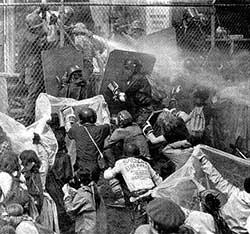 Seabrook Nuclear Power Plant protest – late 1970s Over 1400 were arrested at Seabrook, New Hampshire, the construction site of two new nuclear power plants. The occupation was organized by the Clamshell Alliance. Clamshell history |
https://www.peacebuttons.info/E-News/peacehistoryoctober.htm#october6
| October 3, 1967 Thich Nu Tri, a Buddhist nun, immolated herself in protest of the repression of the Government of (South) Vietnam. It had denied participation in recent elections of peace and neutralist elements. Buddhist leaders thus boycotted the elections, and the Ngo Dinh Diem regime received only 35% of the vote. Within four weeks, three more nuns followed Thich Nu Tri’s example (among them Thich Nu Hue and Thich Nu Thuong), all in an effort to bring peace to the their country, split in two and caught up in a war with their countrymen in the North, and the escalating presence of U.S. troops. |
October 3, 1967 Woody Guthrie, 1912-1967 Woody Guthrie, 1912-1967Folksinger/songwriter Woody Guthrie died in New York City at the age of 55. He had spent the last decade of his life in the hospital, suffering from Huntington’s chorea. Woody called his songs “people’s songs,” filled with stinging honesty, humor and wit, exhibiting Woody’s fervent belief in social, political, and spiritual justice.  Extensive bio with photos and Woody’s writing |
| October 3, 1972 The SALT I treaties, which placed the first limits on nuclear arsenals, went into effect. The Strategic Arms Limitation Talks succeeded when U.S. President Richard Nixon and Soviet General Secretary Leonid Brezhnev agreed to limit anti-ballistic missile systems, and to freeze the number of intercontinental and submarine-based missile launchers (1,710 for the United States, some of which had multiple warheads, and 2,347 for the Soviet Union). |
| October 3, 1981 Irish republicans at the Maze Prison near Belfast, Northern Ireland, ended seven months of hunger strikes that had claimed 10 lives. The first to die was Bobby Sands, the imprisoned Irish Republican Army (IRA) leader who initiated the protest on March 1—the fifth anniversary of the British policy of “criminalisation” of Irish political prisoners.  Prior to 1976, Irish political prisoners were incarcerated under “Special Category Status,” which granted them a number of privileges that other criminal inmates did not enjoy. Despite Sands’s election (while an inmate) as member of Parliament from Fermanagh and South Tyrone after the first month of his hunger strike, and his death from starvation a month later, the government of British Prime Minister Margaret Thatcher would not give in, and nine more Irish republicans perished before the strike was called off. The dead included Kieran Doherty, who had been elected to Parliament in the Irish Republic during the strike. In the aftermath, the British government quietly conceded to some of the strikers’ demands, such as the rights to wear civilian clothing, to associate with each other, to receive mail and visits, and not to be penalized for refusing prison work. |
| October 3, 1994 The United States and South Africa signed a missile non-proliferation agreement committing South Africa to abide by the The Missile Technology Control Regime, and to end its missile program and its space-launch vehicle program. More about MTCR |
https://www.peacebuttons.info/E-News/peacehistoryoctober.htm#october3
 Scottie's Playtime