
Tag: Political
Peace & Justice History for 1/26
| January 26, 1784 Benjamin Franklin, noting the bald eagle was “a bird of bad moral character” who lived “by sharping and robbing,” expressed regret it had been selected to be the U.S. national symbol.  Benjamin Franklin Franklin proposed the wild turkey, “a much more respectable Bird and a true original Native of America.” He said the eastern wild turkey, known for its intelligence, cunning and boldness, was a far better symbol of the United States. In a 1775 letter published in a magazine, Franklin made a good case for the rattlesnake as an appropriate symbol of “the temper and conduct of America.“ How the bald eagle became our national bird (Interestingly, the link on the P&J History page leads to “Forbidden.” I thought I oughta make a note of it. The link here is on History.com, not forbidden when I posted.) Frankin’s letter on the rattlesnake |
| January 26, 1930 Mohandas Gandhi, Jawaharlal Nehru and other leaders of the anti-colonial movement in India pledged to achieve complete independence, or Purna Swaraj, from Great Britain. Nehru said: “The British Government in India has not only deprived the Indian people of their freedom but has based itself on the exploitation of the masses, and has ruined India economically, politically, culturally and spiritually . . . We hold it to be a crime against men and God to submit any longer to a rule that has caused this fourfold disaster to our country.” |
| January 26, 1950 The Indian Constitution became law and India proclaimed itself a republic. The new president replaced the King of England as head of state after nearly 100 years of British colonial rule. The Republic of India considered its sovereignty derived from the people, becoming the most populous democracy in the world. The day is now celebrated as Republic Day. The new President, Dr. Rajendra Prasad, after taking the oath of office: “Today, for the first time in our long and chequered history, we find the whole of this vast land . . . brought together under the jurisdiction of one constitution and one union which takes over responsibility for the welfare of more than 320 million men and women who inhabit it.” More About Republic Day |
| January 26, 1956 The Reverend Martin Luther King, Jr. was arrested for the first time, for driving 30 mph (48 kph) in a 25 mph (40 kph) zone in Montgomery, Alabama. This occurred shortly after the beginning of the citywide bus boycott he had helped organize. His home was bombed a few days later. |
January 26, 1962 Bishop Joseph A. Burke of the Buffalo, New York, Catholic Diocese banned a new song and dance, “The Twist,” by Chubby Checker. It couldn’t be danced, sung, or listened to in any Catholic school, parish, or youth event. Later in the year, the Twist was banned from community center dances in Tampa, Florida, as well. It was claimed the Twist was actually a pagan fertility dance. “The Twist” by its originator |
| January 26, 1969 Police wielding truncheons and firing tear gas from pressure canisters broke up a march by hundreds of demonstrators in central Prague.  Jan Palach The violence erupted as officers tried to disperse the crowd gathered at the foot of the Wenceslas Statue to pay tribute to Jan Palach, the student who burned himself to death in protest at the Soviet invasion the previous summer, and their ongoing occupation of Czechoslovakia. More about Jan Palach |
| January 26, 1991 Germans protested their country’s membership in the coalition prosecuting the first Gulf War against Saddam Hussein’s Iraq after he invaded Kuwait. Rallying out in many cities, the largest turnout brought 200,000 to Bonn. The number of those claiming conscientious objector status jumped 35% in that month to 30,000. |
https://www.peacebuttons.info/E-News/peacehistoryjanuary.htm#january26
Peace & Justice History for 1/24
Also, in the early 2000’s as my Dem. county party chair, I had the great honor of representing Kansas St. Senator David Haley-a very gracious man!-at a local candidate’s forum as he was running for Secretary of State (he came close but did not prevail. I tried to take the blame, but he would not let me.) KS is a red state, but he ran against the Republicans anyway. At that time, Republicans loved the computerized voting machines with no chits, but Sen. Haley wanted verification. He is author Alex Haley’s nephew.
| January 24, 1970 John Lennon & Yoko Ono cropped their hair short for the first time in years, declaring 1970 “Year One for Peace” and helped organize a Toronto Peace Festival.  John and Yoko An interview with John later that year |
| January 24, 1977 The TV mini-series ”Roots,” based on the Alex Haley novel, began airing on ABC.  LeVar Burton portrayed Kunta Kinte, a young man captured in Africa and shipped to America to be a slave, in “Roots.” The story followed an African sold into slavery, and his family’s history through emancipation. It won numerous awards and drew an enormous and broad-based audience (third-highest Nielsen ratings ever for its final episode). 85 percent of all Americans watched at least some part of the series. Listen to thoughts on Roots 30 years later |
https://www.peacebuttons.info/E-News/peacehistoryjanuary.htm#january24
OK, So There Is Bad News Within,
but the reason I’m posting it is so we can be aware, and be better able to help our own neighbors locally. It may not be ours to start writing letters and calling on ACLU or any of those things, but maybe simply keeping our eyes open for the regular people we know or interact with. So here is this, which came to me from Death Penalty Action. It’s the first 10 EO’s issued today, plus some policy info.
All of the Day 1 executive actions Trump has announced so far
Updated January 20, 20251:50 PM ET By Lexie Schapitl Franco Ordoñez
For updates, context and analysis of Donald Trump’s 2025 inauguration, check out NPR’s live blog throughout the day Monday.
President Trump is expected to sign a flurry of executive orders, memorandums and proclamations after his inauguration on Monday, reversing many of his predecessors’ policies and reinstating actions from his first term in office.
The actions are expected to address a range of issues, including campaign priorities like border security and culture war issues like DEI policies.
Here’s what we know so far:
Immigration
Trump is expected to declare a national emergency at the U.S. southern border, designate criminal cartels as terror groups and end birthright citizenship for children born to immigrant parents without legal status, according to incoming White House officials who spoke to reporters on a call on condition of background.
Trump will also reinstate the “Remain in Mexico” policy, which would require some asylum seekers at the southern border to wait in Mexico for their hearings in U.S. immigration court, the officials said.
The moves are some of 10 sweeping executive actions on border security that incoming officials say Trump plans to sign on Monday:
- Declare a national emergency at the border: The officials on the call said this action will allow U.S. armed forces to finish the border wall and allow the secretary of defense to deploy members of the armed forces and National Guard to the border.
- “Clarify” the military’s role in border security: This action “directs the military to prioritize our borders” and protect territorial integrity “by repelling forms of invasion, including unlawful mass migration, narcotics trafficking, human smuggling and trafficking and other criminal activities,” the officials said.
- End “catch and release,” continue building the wall, and end “Remain in Mexico”
- Designate criminal cartels as terrorists: This will allow the U.S. to more easily remove members of groups like Tren de Aragua, a transnational criminal organization from Venezuela, and MS-13.
- Suspend refugee resettlement: The official said the U.S. would suspend refugee resettlement for at least four months.
- End asylum and close the border to those without legal status via proclamation: Officials said they are planning to end asylum entirely and close the border to those without legal status via proclamation, “which creates an immediate removal process without possibility of asylum.”
- End birthright citizenship: The officials said the White House plans to end birthright citizenship, which is enshrined in the 14th Amendment. They argued the amendment does not recognize automatic birthright citizenship for children born in the United States to parents without legal status. This action is likely to see immediate legal challenges.
- Enhance vetting and screening: The officials said they are going to “enhance vetting and screening of illegal aliens.”
- “Protect American citizens against invasion”: Officials said this “equips agents and officers of ICE and CBP with the authorities” they need to deport people from the U.S.
- Restore the death penalty: “This action in particular, directs the Attorney General to seek capital punishment for the murder of law enforcement officers and capital crimes committed by illegal aliens. It encourages state agencies and district attorneys to bring capital state charges for these crimes,” the officials said.
Read more from NPR’s Ximena Bustillo.
Defining ‘sex’ and ending DEI programs
Trump will sign an executive action on Monday that says it’s the policy of the United States to recognize two biologically distinct sexes — male and female — an incoming White House official speaking on background told reporters Monday.
“These are sexes that are not changeable, and they are grounded in fundamental and incontrovertible reality,” the official said.
The change will require government agencies to use the definitions on documents like passports, visas and employee records the official said. Taxpayer funds will not be allowed to be used for “transition services,” the official said.
A second action will end diversity, equity and inclusion programs in the federal government, the official said, giving as examples environmental justice programs in the U.S. Department of Agriculture, as well as diversity training.
National energy emergency and “electric vehicle mandate”
Trump intends to declare a national energy emergency on Monday, aiming to cut red tape and regulations for the energy industry, and a second one specific to Alaskan resources, an incoming White House official told reporters on a background conference call.
“That national energy emergency will unlock a variety of different authorities that will enable our nation to quickly build again, to produce coal and natural resources, to create jobs, to create prosperity and to strengthen our nation’s national security,” the official said. The official said energy prices are too high, but declined on the call to name a lower target price.
The action will end what incoming Trump officials call the “electric vehicle mandate” and will end “efforts to curtail consumer choice on the things that consumers use every single day, whether it be showerheads, whether it be gas stoves, whether it be dishwashers and the like,” the official said.
Trump has long railed against energy efficiency standards on the campaign trail, and specifically taken aim at “electric vehicle mandates,” a term he uses to encompass all policies designed to encourage a transition to battery-powered cars. Rules actually requiring 100% of vehicles to be electric do not exist on the federal level.
Inflation
Trump will sign a presidential memorandum on inflation Monday, an official from the incoming administration said. The official did not provide additional details.
NPR correspondents Tamara Keith, Ximena Bustillo and Camila Domonoske contributed to this report.
Peace & Justice History for 1/20
ACLU will be needed like few times before now.
January 20, 1920 American Civil Liberties Union (ACLU) was founded by Roger Baldwin, Congresswoman Jeannette Rankin, labor leaders Rose Schneiderman and Duncan McDonald, Rabbi Judah Magnes, and others.The ACLU was organized to protect the rights guaranteed in the the Constitution, particularly the Bill of Rights. Prior to this the first ten amendments had not been enforced. The ACLU has paid particular attention to • First Amendment rights: freedom of speech, association and assembly, freedom of the press, and freedom of religion as well as a bar against establishment of a state religion. • One’s right to equal protection under the law – equal treatment regardless of race, sex, religion or national origin. • One’s right to due process – fair treatment for citizens by the government whenever the loss of liberty or property is at stake. • One’s right to privacy – freedom from unwarranted government intrusion into one’s personal and private affairs. ACLU history The ACLU today |
| January 20, 1942 Nazi Party and German government officials arrived at what they called the “final solution to the Jewish question in Europe.” They developed plans for the coordinated and systematic extermination of all Europe’s Jews during a meeting at a villa near Lake Wannsee in Berlin. Notes of the meeting recorded by Adolf Eichmann used vague terms such as “transportation to the east” or “evacuation to the east” (nach dem Osten abgeshoben). But at his trial for genocide Eichmann testified of the meeting that “the discussion covered killing, elimination, and annihilation.”  The villa on Lake Wannsee, now a holocaust museum. More on the Wannsee conference |
| January 20, 2001 Tens of thousands lining Pennsylvania Avenue to protest the legitimacy of the inauguration of President George W. Bush were systematically excluded from almost all media coverage of the event. They called attention to the election irregularities in Florida, the dispute over a recount, and the ultimate effective choice of the president by a 5-4 majority of the Supreme Court.  |
https://www.peacebuttons.info/E-News/peacehistoryjanuary.htm#january20
MLK day
by Ann Telnaes
A quick reminder who deserves to be celebrated on Monday Read on Substack
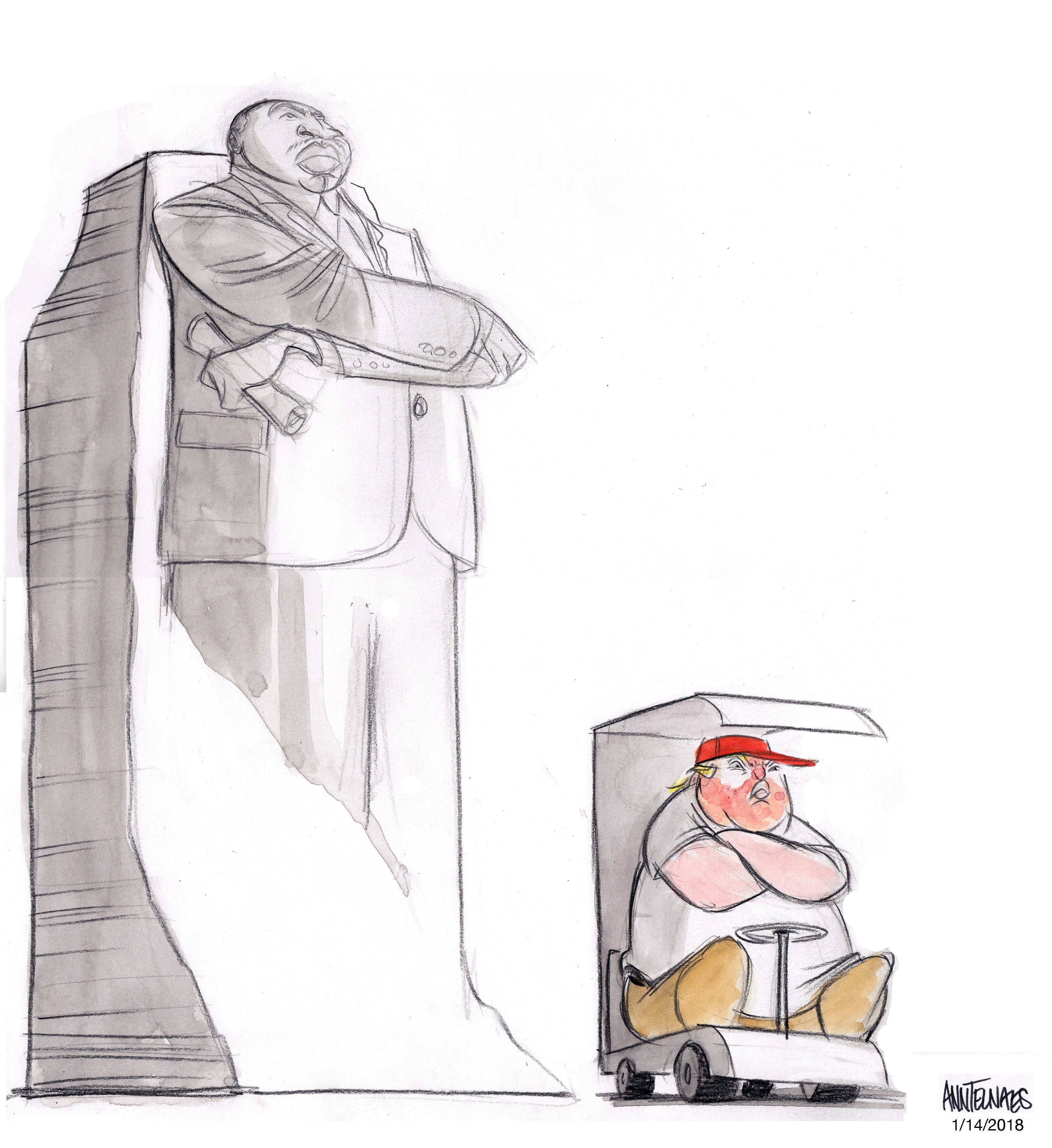
(cartoon from 2018)
I thought this one could be interesting for us to read here.
Also, all of us has a state legislature, and, well, they need our attention.
As Kansas legislators jollily jostle into Statehouse, a low-budget Harry Potter film begins
Clay Wirestone

Members of the Kansas House of Representatives are sworn in on Jan. 13, 2025. (Grace Hills/Kansas Reflector)
Watching senators and representatives traipse merrily into the Statehouse on Monday morning was like watching the beginning of a knockoff Harry Potter movie, one in which lawmakers returned to their majestic chambers full of excitement for the year to come.
Of course, Harry Potter movies feature fewer magical tax cuts for corporations, fantastical abortion messaging bills and terrifying anti-trans legislation.
I felt excitement in the air, as freshly elected supermajority Republicans licked at their lips at the prospect of enacting their agenda without having to pay pesky Democrats the slightest notice. House GOP members were heading out to a caucus meeting across the street — one closed to journalists — and hellos and backslaps echoed throughout the entrance.
It’s going to be a long three months. But don’t worry. I’ll be here writing this weekly roundup to collect bits and bobs that we didn’t get to over the week.
Think of me as Topeka’s own J.K. Rowling, only not transphobic.

Press restrictions
I’ll have more about this Monday, but despite embarrassed protestations from some Republican House members, leadership indeed banned reporters from the chamber’s floor. Either have the decency to own the fact (it’s spelled out on a document sent to journalists) or voice your opposition, but don’t lie.
In the meantime, word of the new restrictions spread across the state and nation.
The U.S. Press Freedom Tracker covered the situation here: Kansas House bans reporting from floor, mirroring move in Senate. Reflector editor Sherman Smith appeared on KCUR’s Up to Date on Tuesday to talk about the situation. TV stations KSNT out of Topeka and KWCH from Wichita also wrote about the changes.

Making money moves
Senators and representative have a good reason for the positive attitudes I saw Monday: They’re making a lot more money.
Thanks to a convoluted process involving an independent commission and its binding recommendations, rank-and-file lawmakers’ base pay more than doubled, from $21,000 to $43,000, for the session. If you include per diem reimbursements, that brings the average salary to $57,000. Leadership in both chambers saw their pay increase as well.
I’m on the record praising this idea. Given the aging demographics of our Legislature, these heftier salaries could attract younger talent. Hopefully, they will also cultivate a more professional attitude toward doing the people’s work. We shall see.

Conservative check-ins
We can’t ignore the various conservative lobbying groups that often have lawmakers’ ears, so today let’s check in with Americans for Prosperity and the National Federation of Independent Business.
AFP this week touted a new campaign calling on legislators in Washington, D.C., to renew former and future President Donald Trump’s signature tax cuts. The group claims in a news release that it will spend $20 million across 50 states to spread the word.
“If Congress fails to renew the TCJA, Kansans will be left paying $2,228 more in taxes,” claimed AFP-Kansas director Elizabeth Patton. “Along with increasing the burden of inflation on working families, the expiration of these tax cuts would cripple local businesses with a $988 tax increase and ultimately cost over 6,760 jobs.”
Meanwhile, the NFIB surveyed Kansas members and revealed the results, which mysteriously track with Topeka Republicans’ priorities.
The group writes in its own news release that more than 88% want state property taxes lowered. It also notes that 86% “believe Kansas should require the disclosure of third parties with financial interest in litigation,” and that 62% “support waiving fines and penalties for first-time regulatory errors.”

Kassebaum addendum
In my Monday column about former U.S. Sen. Nancy Kassebaum receiving the Presidential Citizens Medal, I noted that other state news organizations had only skimmed the surface in reporting on the honor.
Right on time, Marion County Record reporter Finn Hartnett popped up Wednesday with a lovely profile of Kassebaum at home. Read and enjoy.

Calling contributors
With a new year and new legislative session comes a new call from yours truly for contributors to the opinion section. We have a page of guidelines about what we’re looking for, but the short version is this: If you want to write about Kansas, and you live in Kansas, please drop me a line.
We don’t run traditional letters to the editor (he said politely, so please don’t send them), but I would love to see pieces in the 650-850 word range about the Sunflower State and its extraordinary residents. Take a look at our opinion section to see more.
Who knows, perhaps you can be the next non-transphobic J.K. Rowling along with me.
Clay Wirestone is Kansas Reflector opinion editor. Through its opinion section, Kansas Reflector works to amplify the voices of people who are affected by public policies or excluded from public debate. Find information, including how to submit your own commentary, here.
I’ve Got More Work to do on the Health Care Issue Here in my State-
Probably the taxes, too. There is a sense that they’re about to decide to try yet another Brownback ‘grand experiment’ while not addressing their work on funding the state. It’s a thing everyone with a state legislature has to do, though; monitor and lobby.
Kansas lawmakers will debate the taxes you pay and access to trans health care this session
Big fights on issues like transgender health care access will be repeated again this session as Republicans lead with a stronger majority.
Property tax cuts and access to care for young, transgender people are likely to be top issues in the Kansas Statehouse this year.
Top Kansas Republicans said they’ll look at amending the state constitution to put a cap on appraised values used to determine property taxes.
“People see these rapid appraisal increases, which turn into rapid tax increases,” Kansas Senate President Ty Masterson said. “Our hand in that is really giving the people the choice (as) to whether or not they want to have a cap.”
Masterson and Republican House Speaker Dan Hawkins spoke to KCUR’s Up to Date about their priorities heading into the 2025 legislative session. They said they want to eliminate the small chunk of property taxes that go towards the state’s construction and maintenance fund.
There are 21.5 mills levied for statewide property taxes. One-and-a-half mills go to the state; the rest goes to local governments.
Meanwhile, Democratic Gov. Laura Kelly is advising caution as the Legislature considers more tax cuts. The state has a budget surplus, but Kelly argues too many cuts at once could negatively impact state infrastructure like schools and roads.
Kelly vetoed several attempts at tax cuts last year that she said would be too costly for the state in the future. She wants to wait a year before pursuing further property tax cuts.
Democratic leaders in the House and Senate, however, said they would be open to some cuts this session, as long as they’re sustainable and benefit low-income Kansans.
“If we’re just talking about homeowners, and not helping our renters, that’s not going to be fair,” Democratic Senate Minority Leader Dinah Sykes said.
To help renters, they want the state to consider limiting rent increases and reinstating a tax credit for renters that was eliminated under then-Gov. Sam Brownback, a Republican.
Republicans also said they plan to pursue a ban on gender-affirming care for transgender minors.
Advocates for gender-affirming care say an early transition can reduce the risk of suicide in transgender teens. But critics say it amounts to mutilation.
Kelly successfully vetoed similar bans in years past. But with Republicans gaining seats in the November election, they have better odds of overriding a potential veto.
“I will tell you with 100% certainty that that will be back,” Hawkins told the Kansas News Service. “And we will have votes on it, and (Kelly will) veto it again, and we’ll override that veto.”
House Minority Leader Brandon Woodard said Democratic leaders are willing to negotiate with Republicans on the topic this session.
“This is a much more complex issue than many of the legislators really understand,” he said.
“I think there is a way to hear the concerns without invading parental rights, without inserting ourselves into physician offices, and I know that we are open to having those discussions with leadership,” Woodard added.
Peace & Justice History for 1/18
An example of actual “cancel culture” within, plus more.
| January 18, 1919 The peace conference to negotiate the end of the Great War (now know as World War I) opened in Paris, France. President Woodrow Wilson spent several months in Europe personally negotiating details of what became the Treaty of Versailles with heads of the allied powers or their foreign ministers. |
| January 18, 1962 The U.S. began spraying herbicides on foliage in Vietnam to eliminate jungle canopy cover for Viet Cong guerrillas (a policy known as “territory denial”).The U.S. ultimately dropped more than 20 million gallons of such defoliants, sparking charges the United States was violating international treaties against using chemical weapons. Many of the herbicides, particularly Agent Orange, manufactured by Dow Chemical, Monsanto and others, were later found to cause birth defects and rare forms of cancer in humans.  Agent Orange: An Ongoing Atrocity |
| January 18, 1968 Invited to a Women Doers luncheon at the Johnson White House, Eartha Kitt, singer and actor, spoke out about the effect of the Vietnam War on America’s youth. Lady Bird Johnson had convened 50 whites and Negroes to discuss President Lyndon Johnson’s anti-crime proposals. Ms. Kitt first asked the President, “what do you do about delinquent parents, those who have to work and are too busy to look after their children?” He said that there was Social Security money for day care, and the group should discuss such issues. Later, she told the women that young Americans were “angry because their parents are angry . . . because there is a war going on that they don’t understand . . . You send the best of this country off to be shot and maimed. They rebel in the street. They will take pot . . . and they will get high. They don’t want to go to school because they’re going to be snatched off from their mothers to be shot in Vietnam.”  Eartha Kitt and Lady Bird Johnson Eartha Kitt’s career took a severe downturn after this; for years afterward, Kitt performed almost exclusively overseas, while being investigated by several federal agencies. “The thing that hurts, that became anger, was when I realized that if you tell the truth – in a country that says you’re entitled to tell the truth – you get your face slapped and you get put out of work,” Kitt told Essence magazine two decades later. |
| January 18, 1971 In a televised speech, Senator George S. McGovern (D-South Dakota) began his anti-war campaign for the 1972 Democratic presidential nomination. He vowed to bring home all U.S. soldiers from Vietnam if elected. McGovern had served in the Army Air Corps during World War II, earning the Silver Star and the Distinguished Flying Cross.  George McGovern “. . . we must have the courage to admit that however sincere our motives, we made a dreadful mistake in trying to settle the affairs of the Vietnamese people with American troops and bombers . . . . “ But while our problems are great, certain steps can be taken to recover the confidence of the nation. The greatness of our nation is not confined to the past, but beckons us to the future. |
| January 18, 1985 Though a member of the World Court since 1946, the United States walked out during a case. The Court had charged the U.S. was in violation of international law through its support of paramilitary (Contra) activities against the Nicaraguan government. Efforts to undermine the Sandinista government in Nicaragua had been a keystone of Pres. Reagan’s anti-communist foreign policy from its inception. Congressman Michael Barnes (D-Maryland) said he was “shocked and saddened that the Reagan Administration had so little confidence in its own policies that it chose not even to defend them [in the World Court].” The Court still heard Nicaragua’s case and decided against the United States, and ordered it to pay reparations to Nicaragua in June 1986. |
| January 18, 1996 The Zapatista National Liberation Army (EZLN) and the Mexican government reached an agreement in San Andres to recognize and guarantee the constitutional, political, social, cultural, and economic rights of indigenous peoples in Mexico. Treated as second-class citizens since the first colonial entry into their country, the document guaranteed the autonomy and right to self-determination of native communities within the pluricultural Mexican nation. The Zapatistas took their name from Emilano Zapata who played a major role in the Mexican Revolution early in the 20th century.When they began their revolt in Chiapas state on New Year’s Day of 1994, They wrote: “We have nothing to lose, absolutely nothing, no decent roof over our heads, no land, no work, poor health, no food, no education, no right to freely and democratically choose our leaders, no independence from foreign interests, and no justice for ourselves or our children. But we say enough is enough! We are the descendants of those who truly built this nation, we are millions of dispossessed, and we call upon all our brethren to join our crusade, the only option to avoid dying of starvation!” The Mexican government, despite their signature on the agreement, refused later to implement it.  More background on the Zapatistas |
January 18, 2003 In frigid temperatures, 500,000 converged on Washington, D.C. There were also joined by many more elsewhere around the world to oppose the threatened U.S. war on Iraq.  Anti-war protesters march past the U.S. Capitol during the start of an anti-war protest that will culminate by a march to the Washington Naval Yard.Egyptian riot police and anti-war demonstrators face off in Cairo, Egypt. Banners at top read, ” Iraq . . . Another war for oil and American supremacy. “This was the largest U.S. peace demonstration since the Vietnam era.   < Pakistani peace activists hold a rally in Karachi. > Crowds estimated at 80,000 fill the civic center of San Francisco, California |
https://www.peacebuttons.info/E-News/peacehistoryjanuary.htm#january18
Friday Links
Last night, it got to be bedtime and I didn’t even realize I’d set nothing up for today, until I got up this morning. Scottie’s posted some important news here already, and I don’t want to knock it off the top, so instead of the posts I thought I’d make, I’m just gonna link ’em, and readers can just read whatever they like and still not miss those posts of Scottie’s.
Peace & Justice History for 1/17
The Way of Water: On the Quiet Power of Ursula K. Le Guin’s Activism
Explore the Newly-Launched Public Domain Image Archive with 10,000+ Free Historical Images
SCOTUS Takes Up Case Challenging the ACA’s No-Cost Coverage of PrEP

