
50 Years Ago, Dykes on Bikes Rode to the Front of Pride. Their Engines Are Still Hot
We ride along with the legendary, leather-clad lesbians — and take a trip through their history.
By Ana Osorno
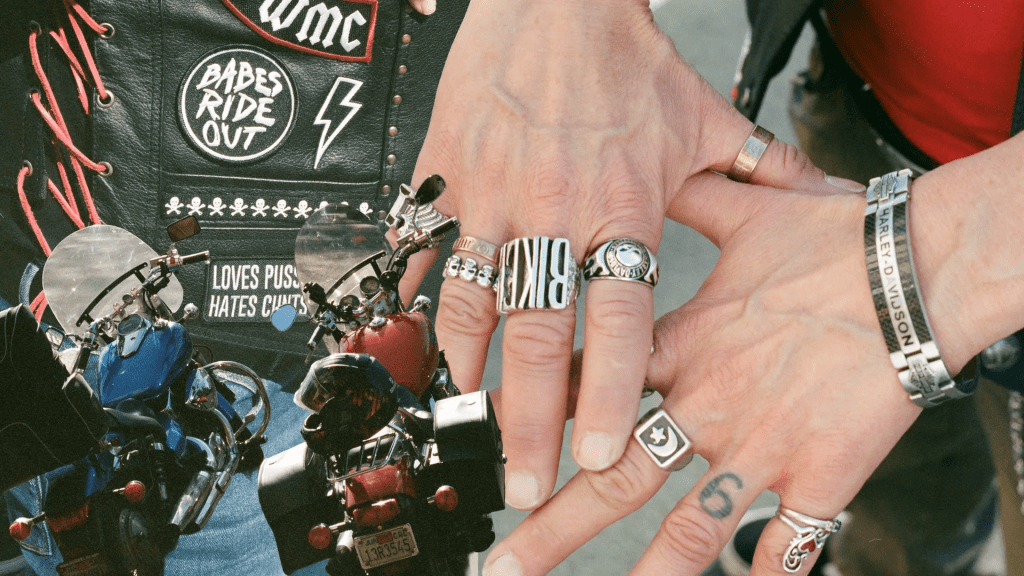
The first sound you hear at San Francisco’s annual Pride Parade is the revving of hundreds of motorcycles. Atop them the most glorious dykes you’ve ever seen, bedecked in leather. They slowly coast down Market Street, as joyful as they are queer, waving to thousands of spectators as they kick off the procession. But that wasn’t always the case.
In 1970, San Francisco’s first-ever Pride celebration took place on Polk Street, with a small group of LGBTQ+ people organizing to mark the first anniversary of the Stonewall Riots in New York City. What began as a small word-of-mouth event grew rapidly, turning into the Christopher Street West celebration by 1972 — which drew some 2,000 participants and 15,000 spectators — and then the Gay Freedom Day Parade.
But in 1976, something magical happened that would forever change the trajectory of queer history. During the Gay Freedom Day Parade, a group of brave, motorcycle-riding lesbians made a seemingly inconsequential and impromptu decision to move their bikes to the front and claim their space.
“There were some women on motorcycles and they were in the middle of the parade, behind a bunch of men, and they wanted to be at the front,” current Dykes on Bikes president Kate Brown, who uses she/they pronouns, tells me. “It was that movement of just being up and in front and loud and proud. And it was a moment of courage and lesbian dignity and owning that. Somebody coined the name Dykes on Bikes and our paper, the San Francisco Chronicle, picked it up and ran with it. And we have been known as Dykes on Bikes ever since.”
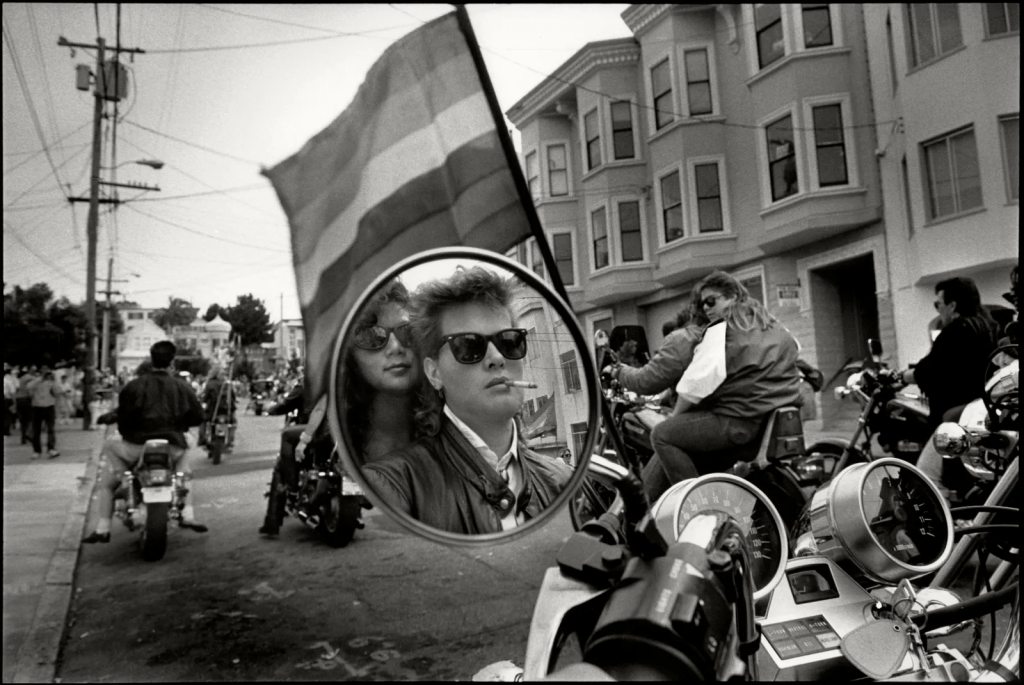
Their faces reflected in the motorcycle mirror under a Pride flag, a pair of women in the ‘Dykes on Bikes’ group wait, in the Castro District, for the start of the International Lesbian & Gay Freedom Day Parade, San Francisco, California, June 26, 1988. (Photo by Bromberger Hoover Photography/Getty Images)Bromberger Hoover Photography/Getty Images
Today, the San Francisco Pride has grown far beyond its humble beginnings, with an estimated one million people celebrating, protesting, and marching in 2025. The rainbow Pride flag — the global symbol of LGBTQ+ joy and resistance — flies over all the proceedings, first raised by creator Gilbert Baker in 1978 in this very city and now ubiquitous around the world. The Dykes on Bikes have multiplied as well.
The first time I ever glimpsed a group of queer women on bikes — whom I would later learn were affiliated with The Sirens MC — was in June 2025, but to say that I “saw” them would be an understatement. I was attending the Brooklyn Pride parade with friends when a group of older butches on motorcycles rolled up, engines humming, and invited younger lesbians to hop on the back of their bikes. It was thrilling to witness.
But you don’t just see Dykes on Bikes. No, you hear and feel them throughout your entire body. It’s an all-consuming experience. The noise of the engines fills your ears, and your legs feel like jelly beneath you as they make the ground shake through their sheer numbers. “You can’t look away, it’s so powerful,” Brooke Oliver, the lawyer for Dykes on Bikes, says. And then there’s the joy radiating off both the riders and the spectators who are lucky enough to be in their presence — a pure feedback loop of mutual admiration. As someone who had grown up desperately wanting to ride a motorcycle when she was older — thanks in large part to childhood joyrides around my uncle’s neighborhood — I was immediately in awe.
Little did I know that this would be the start of a thrilling adventure which would eventually lead to me sitting on the back of Big Butch’s bike, coasting over the Golden Gate Bridge. But I’m getting ahead of myself.
That night in June of last year, as I was riding the subway home after the Brooklyn Pride Parade, still coming down from the exhilaration of the evening, I pulled my phone out, and like any good journalist would, began doing research. I learned that Dykes on Bikes would be celebrating its 50th anniversary in 2026 — a major milestone packed with so much history, including a legal battle over the use of the term “dyke” that made it all the way to the Supreme Court.
“It’s incredible history, and I think every time we ride, whether it’s in a Pride parade or whether we’re putting our jacket with its patch on, it just resonates with us what that group of small women did,” Brown says. “Twenty Dykes on Bikes just moved to the front and said, ‘We’re here. We’re not going anywhere. I’m a dyke and I’m riding this motorcycle and nobody’s going to tell me I can’t ride it.’” (snip-MORE, and it’s a Great read!)
 Scottie's Playtime