Trump’s failure with the Lincoln Memorial Reflecting Pool is a perfect example of how this regime operates.
He said he wants to beautify Washington DC, though the city is already beautiful. This is like when he came into office in 2017, and before the afternoon was over, he took credit for rebuilding the military. We were spending over $800 billion a year on our military before Donald Trump came into office, so trust me…. We already had a military. If anything, our military is weaker today because Donald Trump just wasted a lot of its armaments on his stupid chosen illegal war. It’s also being led by a chauvinistic, racist, white Christian nationalist with the brain of a moldy sponge.
Back to the pool. Trump wanted to beautify it before July 4, when our nation celebrates its 250th birthday, not to be confused with June 14, which is Donald Trump’s birthday, which will now be commemorated every year by having shirtless men pummel each other in your backyard. (snip-MORE)
The UFC event at the White House last Sunday was not supposed to be political, even though it was held on Donald Trump’s birthday. But after winning his fight, UFC fighter Josh Hokit was being interviewed by podcaster and ring announcer, Joe Rogan, when he grinned and looked into the camera, and said, “And lastly, Michelle Obama is a man! Am I right, America?”
Of course, he is not right, and his racist and sexist conspiracy theory shouldn’t be given the dignity of a defense because it is just too ridiculous and stupid. But what Hokit did wasn’t just disrespectful to Michelle Obama and President Obama, but also to the White House, where he made the comment (hasn’t that place suffered enough during Trump 2.0?), and the country, as this was supposed to be for America’s 250th birthday.
The event itself was disrespectful enough to the White House and the Oval Office without Hokit’s hateful comment. (snip-MORE)
his summer, we are spoiled for choice when it comes to queer movies. From the long-awaited adaptation of Hayley Kiyoko’s novel Girls Like Girls — which was itself an adaptation of the music video of the same name — to Jane Schoenbrun’s Teenage Sex and Death at Camp Miasma, every vibe is covered, from romance to horror to comedy and beyond. Rarely has a summer movie season felt this varied and interesting when it comes to LGBTQ+ fare. To help you keep track of it all, we’ve compiled this helpful list, complete with release dates and information about where you can catch each title. After all, there’s no better way to beat the heat than in an air-conditioned movie theater.
She’s the He (2026) — in select theaters now, VOD to follow
She’s the He is a gender swap comedy about two cisgender boys who pretend to be trans girls in order to get laid before high-school graduation. If that sounds like a horribly regressive premise, fear not. This is a movie made by and for trans people, with the sort of knowing, raunchy comedy we’ve long been denied in the name of Representation.™ It’s riot, and you should see it, if not at this current moment, then during the promised summer VOD release window.
Blue Film (2026) — June 12, VOD
Although it premiered in the U.S. in May, the controversial Blue Film was only shown in a smattering of theaters and will finally arrive on VOD June 12. The movie, directed by Elliot Tuttle, follows a queer fetish camboy who shows up to an older john’s house, only to discover that his client is his former English teacher. It’s a film unafraid to touch the third rail, diving deep into both men’s loneliness and insecurities. We called it the best queer film of the year so far back in May, and that distinction still holds up.
Stop! That! Train! (2026) — June 12, theaters
If you love Airplane! and the Naked Gun but wish they were (even) gayer, Stop! That! Train! should scratch an itch. Starring a who’s who of Drag Race girls on a runaway train, along with Crazy Ex Girlfriend’s Rachel Bloom and RuPaul herself as President Judy Gagwell, the film is filled with the sort of inane jokes and sight gags that we don’t see nearly enough of in contemporary comedies. We should note the film has become embroiled in controversy about whether it used generative AI for certain VFX shots. Director Adam Shankman has stated on Instagram that every shot is “made by human hands” and that there are no shots “conceived by AI.”
The bar she drank at, the bed she recuperated in, the canals she daytripped to, the studio she stormed out of, the easel she painted her final masterpiece at … ahead of a major Tate show, our writer finds Kahlo’s spirit alive in Mexico City
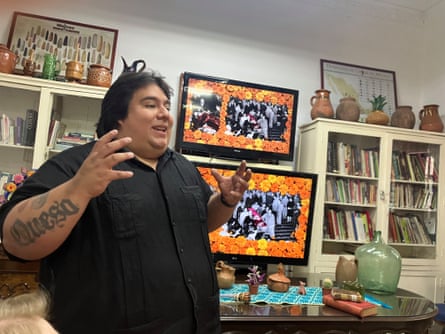
Today you’re going to eat art,” says Federico Valdez, a chef at the School of Mexican Cuisine and a man so passionate about food he has the word Queso (Cheese) tattooed on his forearm. “Today,” continues Valdez, “you’re going to eat history.” What unfolds, in a sun-filled dining room lined with Mexican flowers, books and artefacts, is a three-course feast inspired by Frida Kahlo, her life, her art and her loves, including her first lesbian affair.
The starter, rooted in her childhood fascination with revolution, is a lightly spiced Mexican take on Russian pirozhki. The main dish – served with pulque, an agave-derived drink Kahlo loved – taps into her rebellious spirit. “It’s called Frida Against the World,” says Valdez, as we are presented with a giant stuffed chilli that sits amid a nutty, beany sauce similar to the one eaten at Kahlo’s wedding to Diego Rivera, then the most famous artist in the world, now firmly in her shadow.
“I wanted this to be hot and horny,” says Valdez, explaining that halved figs were added to reference Kahlo’s sexuality. “Her first love, with a female teacher, happened at a time when Mexico wasn’t so open. I wanted to get in all that spicy gossip. I’m not a big fan of playing it safe.”
I’m in Mexico City with a Tate delegation just as the huge jacaranda trees are blooming purple and violet across its parks and boulevards – to follow in Kahlo’s footsteps ahead of Frida: The Making of an Icon, a show of more than 30 of her works at Tate Modern in London that seems destined to be a summer blockbuster, adding yet more fuel to Fridamania.
‘This is going to blow your mind’ … chef Federico Valdez. Photograph: Courtesy Andrew Gilchrist
One work, Self Portrait With Thorn Necklace and Hummingbird, was painted in 1940 after her painful divorce from Rivera. A spider monkey, similar to the one he gave her as a present, is pulling on her thorn necklace, drawing blood. The two soon remarried, Kahlo inscribing the clocks in their house with the years of their separation and reunion.
“The exhibition is like a movie,” says Tobias Ostrander, its curator. “Frida is the star but it’s also about her life, her people, her impact.” Charting Kahlo’s rise from unknown painter to global phenomenon, the show will also examine merch (expect a Kahlo Barbie) and gauge her influence on later artists.
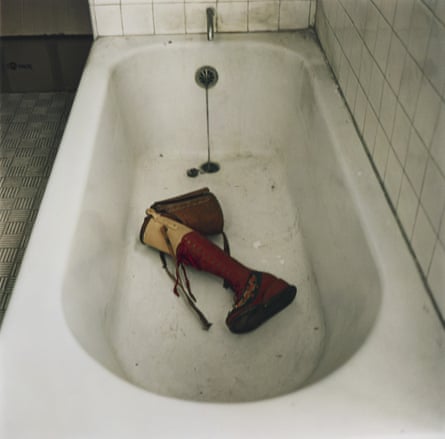
On display, too, will be many of the artist’s treasured possessions, including her brilliantly patternedtehuana dresses. Graciela Iturbide’s ghostly photographs of her crutches, customised medical corsets and prosthetic leg will also feature. These were taken 50 years after Kahlo’s death, when all her belongings were finally freed from the bathroom in which Rivera had ordered them to be locked away.
Unseen for 50 years … Kahlo’s prosthetic leg, captured in Graciela Iturbide’s photograph. Photograph: Courtesy of the artist
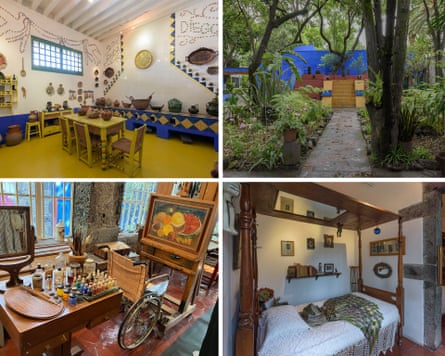
This took place at Casa Azul, the house in Coyoacán (The Place of the Coyote Owners) where Kahlo was born and spent most of her 47 years. It’s now a beautiful, beguiling museum with smooth exterior walls painted a gorgeous blue. These border shiny red concrete paths that thread through fountains and lush gardens bursting with palm, yucca, cactus and bougainvillaea. Off in a corner, seen through trees, a maroon pyramid with yellow steps displays on its ledges Rivera and Kahlo’s pre-Hispanic, Aztec and Toltec artefacts.
“We don’t know exactly where the blue came from,” says Perla Labarthe Álvarez, the museum director. “But in her diary, Frida expressed what the colour meant to her: purity, electricity and love. Because of her health – she had surgery all her life, more than 30 operations – she was at home a lot so it had to be a comfortable place where she could rest. Many of her still lifes were done in the garden. She called her home A Place Full of Places.”
It’s a perfect description. For this is a breathtakingly evocative location, even leaving aside the fact that Trotsky lived here for two years with his wife, having a brief affair with Kahlo.
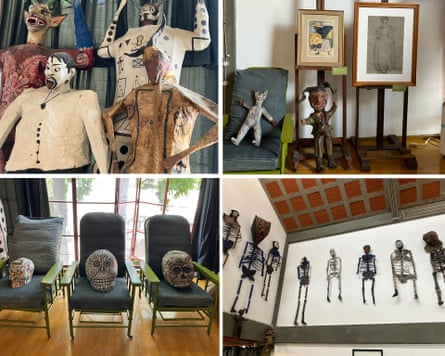
‘A place full of places’ … Kahlo’s kitchen and garden at Casa Azul; her bed with its overhead mirror; and the easel adapted so she could paint on her back or in her wheelchair. Composite: Bob Schalkwijk/Andrew Gilchrist
Tours begin in the living room, with its hefty pyramid-style fireplace designed by Rivera and, as an old photo shows, once flanked by two of his macabre Judas dolls, papier-mache devils that are stuffed with fireworks and set alight at festivals. Opposite is Kahlo’s mesmerising portrait of her beloved photographer father, painted 15 years after he died, his eyes as captivating as hers.
On the walls, photos and texts detail the polio Kahlo contracted at the age of six, leaving her with one shorter leg, and the trolley-bus crash at 18 that impaled her on an iron handrail and left her in pain for much of her life, as well as unable to have children.
She could never paint this accident, even though what she did paint was often deeply painful and personal – and these works were largely created at Casa Azul, upstairs in her studio, where visitors can see the easel adapted to allow her to use brushes lying on her back or seated in her wheelchair.
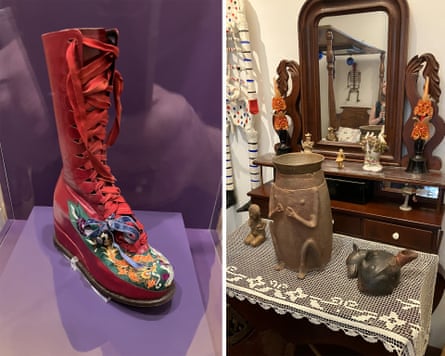
‘One kick and it could take the house down’ … Kahlo’s customised boot and her ashes in an urn. Composite: Courtesy Andrew Gilchrist
In the next room is the four-poster single bed in which her mother placed an overhead mirror, giving Kahlo, frequently confined there, both a distraction and a subject. “I paint myself,” she once said, “because I am so often alone and I am the subject I know best.”
As well as her corsets, she customised her orthopaedic footwear, turning one stepped-up mid-calf red boot into a work of art. Embroidered with patterns and adorned with a blue ribbon, the chunkily laced boot now proudly stands in its own case, extraordinarily alive, looking like it could take the whole house down with one kick. Meanwhile, on a dresser, Kahlo’s ashes sit in a delightfully playful ancient urn. Boasting cartoon-like arms and legs, it’s shaped like a toad, a nod to her affectionate term for Rivera. “You found me torn apart,” says a sign, “and you took me back full and complete.”
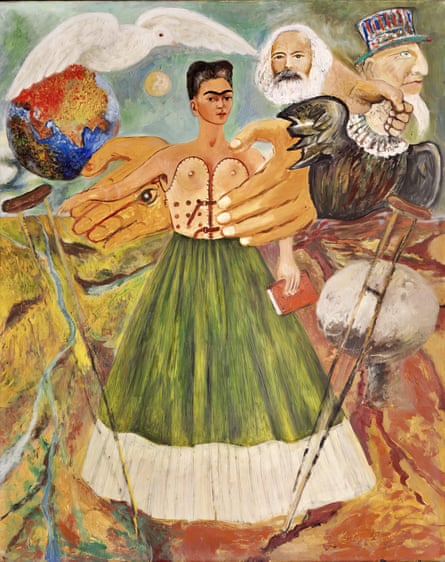
Across the courtyard, you can see Kahlo’s crutches and corsets, one decorated with a hammer and sickle. She painted herself in these corsets, too. In Marxism Will Give Health to the Sick, a 1954 work that hangs close by, the garment has morphed into her skin, her bare breasts. A bald eagle wearing an Uncle Sam hat is being throttled while Marx’s enormous hands reach out to cradle Kahlo. As ever, her penetrating, all-seeing eyes stare out beneath that monobrow.
Throttling Uncle Sam … Marxism Will Give Health to the Sick. Photograph: Artium/Alamy
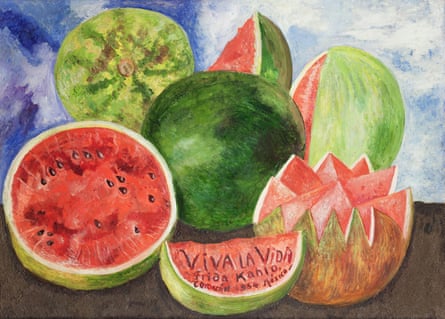
The most stunning work at Casa Azul, though, is the last one she ever painted, completed eight days before her death in 1954. Called Viva la Vida, or Long Live Life, it portrays several sun-drenched watermelons, the de facto national fruit of Mexico. In some places, their flesh is as red as blood. One has been cut in half in a crisscross pattern, echoing the Vs of the title, which appears in big black letters on another slice. It’s as if the fruit itself, life itself, is talking to you, imploring you. Live, live.
What you take from Casa Azul is an almost overwhelming sense of Kahlo’s talent, resilience and rebelliousness. “Tell us about the bomb,” someone says to Álvarez at one point, but she is out of earshot. “Is it true Frida bombed her school?” Actually, what she and her friends planted was more of a firecracker, albeit one powerful enough to blow out several windows. No one was hurt and, unlike some, Kahlo escaped expulsion.
‘It’s as if the fruit – life itself – is imploring you’ … Kahlo’s final painting, Viva la Vida. Photograph: The Artchives/Alamy
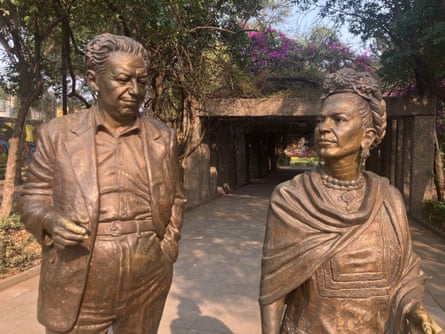
There’s a park not far off, now named after her, with a pyramid by a fountain and lifesize bronze statues of Rivera and Kahlo. She’s ahead of him, purposeful, her head half-turned, as he follows happily in her wake, smiling gently and clearly in awe of this woman, despite all his affairs. The bar they liked, La Guadalupana, still stands, a shrine to el toreo with the heads of bulls on its walls, as well as paintings and posters of fighters. Perhaps it’s more appealing if you’ve had, as Rivera and Kahlo sometimes did, “a tequila or 10”.
Downtown, we find, the streets are not so tranquil. Some are barricaded and hoarding has been placed around national monuments. These were erected in response to a recent march of 180,000 women, furious at the rates of femicide in Mexico. About 2,500 women are murdered a year, but less than a third are categorised as femicides even though there is evidence they should be. Less than a quarter of femicides are punished.
‘Clearly in awe of this woman’ … statues of Diego Rivera and Kahlo in the park named after her. Photograph: Courtesy Andrew Gilchrist
Would Kahlo have painted this outrage if she were alive today? She already did. In 1935’s Unos Cuantos Piquetitos, or A Few Small Nips, Kahlo recreates a story she read in the paper that left her incensed. A woman lies slashed and naked on a blood-splattered bed, murdered by her husband, who holds a knife and would later dismiss his crime to the police with the words of the title. Initially, Kahlo put the children in, as they witnessed the entire horror, but this was just too brutal and they have now gone.
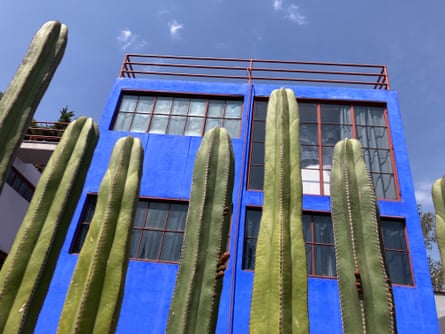
Kahlo also painted in a studio across town, in the bohemian neighbourhood of San Ángel. It’s a beautiful, boxlike, three-storey building painted that signature blue. A rooftop bridge links it to Rivera’s much bigger workplace, a white-and-ochre structure where he would often put in 15-hour days.
Built on modernist Le Corbusier lines and now part of a museum, these studios caused a sensation when they first appeared, unadorned constructivist creations sitting among the elaborate residences of San Ángel. They’re still ringed by a superb perimeter fence of tall, perfectly placed pole-like cactuses, this being a way for both artists to bring Mexico and nature into their workplaces.
At one with nature … Kahlo’s studio with its cactus fence. Photograph: Courtesy Andrew Gilchrist
Rivera’s studio is magnificent, overflowing with ceramics and artefacts from his folk-art collection, all arranged alongside paintings and paintpots. There’s an almost party vibe: death masks sit grinning on chairs, crowds of Judas dolls leer conspiratorially around the windows, while chorus lines of strangely joyous skeletal figures dance wildly across the walls above. It feels appropriate: the parties here were legendary, attended by presidents, revolutionaries and exiles alike, as well as Hollywood stars such as Charlie Chaplin.
Over the bridge, above the bath in Kahlo’s studio toilet, you can see a copy of What the Water Gave Me, her 1938 painting of her feet as she bathed, with elements adrift on the water symbolising events in her life, from exotic plants to nude figures on a bed to an erupting volcano. There’s not a whole lot else to see in her studio, Kahlo having packed everything up and left after catching Rivera in bed with her sister. According to the museum guide, she told him: “I am going to get all my furniture and get out of here because I hate you.”
What the Water Gave Me is the favourite Kahlo painting of Helena Chávez Mac Gregor, writer of The Ribbon and the Bomb, a book about the artist’s continuing and even growing relevance. Its title refers to the words French surrealist André Breton used to describe Kahlo’s work – “a ribbon around a bomb” – although Mac Gregor thinks there’s “maybe no ribbon, only bombs” and they’re still exploding through times beyond her own, as new generations of (largely) women see themselves, their bodies, their sexualities and their struggles mirrored in her masterpieces.
“There’s the bomb of her illness,” says Mac Gregor, as she joins us for lunch at the fabulous San Ángel Inn, a former Carmelite monastery opposite the studios famed for its gardens and margaritas. “She’s vulnerable yet she’s strong and erotic, not what you might expect of someone so ill. And she was so ahead of her time, making the personal political, living on her own terms, playing with gender roles and cutting her hair. Then there are the bombs of femicide and abortion, her own.” This was chiefly to safeguard her damaged pelvis. “Frida painted these things people didn’t talk about. Even with this illness – and one year she managed only one work – she created such beauty.”
‘The parties were legendary’ … Judas dolls, paintings, skeletons and death masks at Rivera’s studio. Photograph: Courtesy Andrew Gilchrist
Clearly delighted, Mac Gregor adds: “Frida is more important than Diego Rivera now, which is weird because she was the artist she was because of him. He was a macho Mexican womaniser but he loved and supported her. And the essays he wrote about her work are amazing, talking about her representations of the interior and the exterior. He said she was going to be the most important artist in Mexico.” Kahlo didn’t stop there. When The Dream (The Bed) fetched $54.7m in 2025, this set a new world record for a female artist.
The Tate has been lucky to get any works at all, given how proud and protective Mexicans are of Kahlo, especially with the World Cup having just kicked off in their country. This was brought home to me at the Museo de Arte Moderno, where you can linger all you want in front of, say, a María Izquierdo – but gaze too long at a Kahlo and you’ll soon start to feel the pressure from other visitors to move on.
This happened to me twice: first in front of The Two Fridas, in which she explores her mixed heritage, dressing one self in European attire, the other in Mexican; and secondly at Self-Portrait with Monkeys (see top), in which Kahlo, faintly moustached, is seen with four of the creatures she kept as pets. They are often seen to represent the four pupils, nicknamed Los Fridos, who stuck with her even as her health made teaching harder and harder. Kahlo would also say that the monkeys in her work symbolised the children she could not have.
No visit to Mexico City is complete without a trip south to the floating gardens and canals of Xochimilco, for a voyage on one of the 500 colourful big gondola-like boats that ply its busy waterways. Kahlo loved to come with her family to these canals, which were created by the Aztecs. There’s a famous photo of her face hovering over the water, looking serene as she dips her arm in up to the elbow.
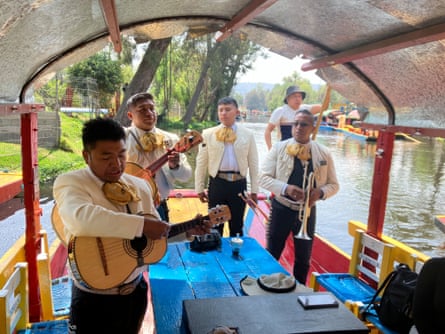
A song for £10 … the Axolotls board Rosamaria. Photograph: Courtesy Andrew Gilchrist
“Every boat has a female name,” says the captain of Rosamaria, our vessel, “because they are like flowers.” As we set off, smaller, faster boats speed by, bearing vendors of pulque and tacos. Before long, we are being pursued by two very loud mariachi bands, one called the Pintorescos, meaning the Picturesques, the other the Axolotls, named after the tiny, endangered and ridiculously cute species of salamander native to these waters. The Axolotls win, boarding our boat in seconds and performing for £10 a song, first Cielito Lindo (Lovely Sweet One) with its rousing singalong chorus, and then of course La Bamba.
As the Axolotls speed off in a blur of strings, brass and tight trousers, peace returns and we idle along as the afternoon sun beats fiercely down. I dangle my arm into the cool water, just like Kahlo did, and remember something Federico Valdez said as he unveiled the final course of his feast, a rice-pudding-like dish in a watermelon sauce, washed down with a liquor made from Chihuahua apples.
“This dessert is going to blow your mind,” he said, as a picture of Kahlo’s funeral appeared on the screen behind him. “Frida died – but she didn’t pass away. She was like a rocket. She just went up and up.”
David Wise’s new experimental play, “Fight Back,” opens a portal to an earlier era of organizing and spotlights the enduring power of slow-moving consensus building.
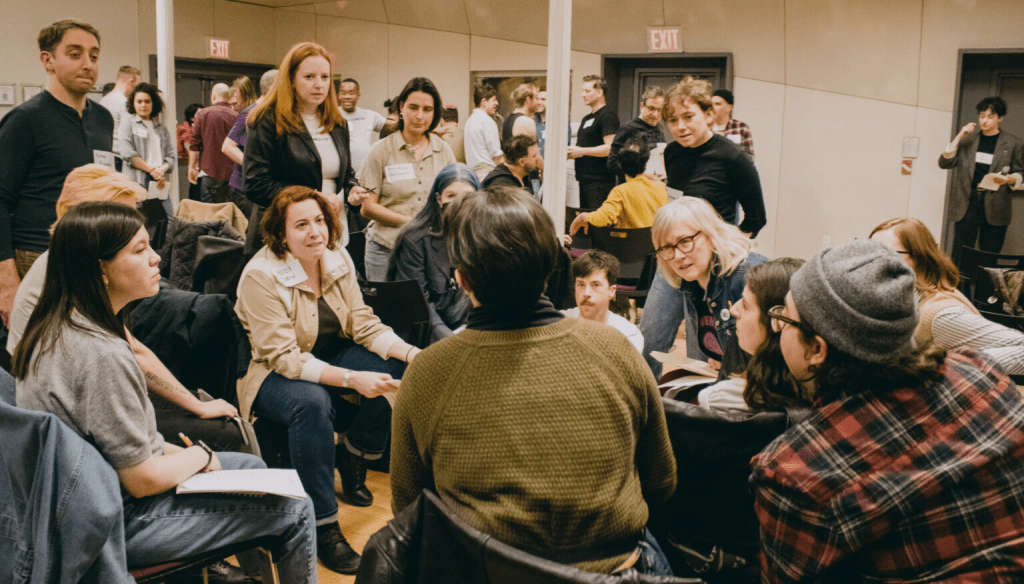
Imagine a murder mystery dinner party, where everyone sheds their true identity at the door and assumes a role to play in the night’s events — only instead of solving a crime, they must reenact a contentious activist meeting. That’s what artist David Wise tasks participants with in his immersive theater piece “Fight Back.” He recreates the AIDS Coalition to Unleash Power, or ACT UP, meeting on March 13, 1989 in the same room where it happened nearly 40 years ago.
It’s impossible to sit in the same room in New York City’s LGBT Community Center where their meetings happened nearly 40 years ago without feeling the echoes of today’s governmental failures, and the urgent need for both resistance and mutual aid.
At the May 18 performance of “Fight Back” — which takes its title from ACT UP’s chant: “Act up! Fight Back! Fight AIDS!” — I did something we rarely have to do these days: relinquish checking and doomscrolling on my phone to spend uninterrupted time face-to-face with strangers, co-creating something from scratch. Nearly 40 of us had two and a half hours to make our way through a 26-item agenda, an education in ACT UP’s work.
ACT UP is a direct action group formed during the AIDS epidemic to fight for visibility, healthcare access and an end to the crisis. To mark the second anniversary of the group’s formation, they were in the midst of planning Target City Hall — the kind of creative, high-profile direct action for which the group had become known — to protest Mayor Ed Koch’s failure to adequately address the AIDS crisis in New York City.
By the beginning of 1989, more than 18,000 New Yorkers had been diagnosed with AIDS and over 12,500 had died. ACT UP was demanding affordable access to the highly toxic but potentially life-saving drug AZT, which had just come on the market a year earlier. They also demanded housing for people living with AIDS and changes to the Food and Drug Administration’s drug trial policy to give more patients hope. They demanded dignity for the living and the dead. In the midst of all this, members still found the time and space to plan fundraising parties and, more importantly, to flirt.
The 1980s was an era of phone trees and answering machines. We checked our cell phones at the door. The experience is an invitation to follow the advice writer Mira Jacob gave on Instagram earlier this year: “Stop scrolling. Do literally anything else … We’re going to prevail, but only if you don’t let this app scare you numb.” If you were mad in 1989 because your friends were dying at the hands of the government and you wanted to yell at someone about it, you had to show up to a meeting or participate in a phone zap or volunteer to surreptitiously print flyers at your office denouncing Mayor Koch as a closet case. (One attendee politely corrected our pronunciation of “Koch” — no relation to the present-day billionaire brothers who pronounce their last name “coke.”)
A smaller group within ACT UP gathers during David Wise’s experimental theater piece, a reminder that the organization was not a monolith. (Hong-An Tran)
The atmosphere in the room was tentative. Every question opened up a minefield that only the basic tenets of improv could answer: Say “yes, and” to help the scene unfold; make bold choices, even when you are unsure of them, and don’t “break” the illusion. Most of us had brought hastily scribbled notes about our assigned historical personas, pulled from summaries and the ACT UP oral history archive. This background helped with questions like, “What affinity groups are you in?” and “Is this your first meeting?” But they offered little to lean on when it came to more quotidian conversation starters, “Are you coming from work?” or “Are you out to your family?” Those we stumbled through, together.
I had been assigned the role of Bill Bahlman, my first part since a non-speaking role in the middle school production of “Schoolhouse Rock!” A lifelong New Yorker and a music journalist, Bill had been a part of the Gay Activists Alliance and the Gay and Lesbain Alliance Against Defamation, or GLAAD. A self-described anarchist, he sometimes found the groups to be too soft, particularly the Gay Activists Alliance’s discussions of whether to drink mixed drinks or soft drinks at their dances. He splintered off from GLAAD into the Lavender Hill Mob, a direct action group formed in 1986 and named after a British comedy film. The dozen members focused on AIDS activism and organized disruptive “zaps,” interrupting a CDC meeting, a Catholic mass and other high-profile events with leaflets and banners bearing slogans like, “Gays and lesbians will not be silenced!”
When ACT UP formed in March 1987, Bill and many other Lavender Hill Mob members joined, but their affiliation and camaraderie with one another remained. While ACT UP is often remembered as a monolith, it was in practice a true coalition under which many smaller groups coalesced, including affinity groups like Delta Queens, La Cocina or Wave 3 that demonstrated together at actions.
Bill was slated to speak late in the agenda. The items were laborious in their minutia. Should the flyers Wave 3 planned to wheat paste around the city to gather people for Target City Hall in two weeks be printed in color, or black and white? Should we send three or four people to the Lesbian and Gay Health Conference in San Francisco? We rose from our chairs for civil disobedience training, half of us playing cops and half of us playing protesters gone limp to resist arrest, but then it was butts right back in seats.
By the two-hour mark, I could no longer stifle my yawns. There may have been flirting at meetings, and even a little in our reenactment, but the agenda was a reminder that there is little instant gratification in organizing. It took much longer than an Amazon delivery or a ChatGPT response. This focus on consensus decision making has undergirded some of the most visible movements and organizations, like Occupy Wall Street, Jewish Voice for Peace and the Democratic Socialists of America. While they don’t offer an instant dopamine hit, the memorable actions and ballot wins delivered by these groups are clear evidence of their effectiveness.
There are no professional actors associated with the production. Every meeting member was a stranger assigned to play their role for one night only. That said, I recognized an actor from an old TV show who attended as a curious citizen. She had been assigned the role of our chant leader Ron Goldberg, and I expected that, given her background, she might be the one to voice the most objections. Or, I thought, they might come from the tall, brawny and bespectacled man who wore a Larry Kramer name tag, a historical figure whose outspoken anger and divisive politics had been a catalyst for ACT UP’s formation. Instead, the objections came from Karen Ramspacher, a 24-year old curatorial assistant played by a middle-aged white woman seated in the back row with a bun on top of her head. “People are dying and we can’t cobble together the money for color printing?”
The meeting’s facilitators, one of whom I assumed must be Wise himself, tried to keep us on track. I kept glancing at my watch, hoping that time would run out before it was my turn to speak. When my name was called, my hands shook. I stood at the front of the room and looked out at the gathered crowd, some in their 50s, some in their 20s, many filling out the ages in between. I held the mic and spoke about Steve Zabel, my friend who I had found murdered in his apartment at the beginning of the month. The police had done nothing. What could we do to put pressure on them? Steve was just one man, but we all knew a Steve. To my surprise, everyone had ideas. The Media Committee wanted to take it to the press. The woman with the bun wanted to agitate with the neighbors. They had Bill’s back.
When the bell rang to return us to 2026, I made my way over to the outspoken woman, who in real life looked closer to 54 than 24.
“You were great!” I said, relieved to speak as myself again. “Really channeled the anger of the time.”
“I was there,” she said.
“What?”
The woman who had interjected so many times during “Fight Back” had attended ACT UP meetings as a teenager. She had a job in the 80s in Philly calling men to let them know where they were on the wait list to see the only doctor in the city who would treat AIDS patients. Many had died before their turn came.
A little group gathered around to hear her story. One man shared that he had come to the center that night with a friend who had also been a part of ACT UP, but he had turned around at the door because she wasn’t ready to reopen the emotions of that time. Wise revealed himself to have been Iris Long from the Treatment and Data Committee, a cancer researcher determined to publicize the life-saving uses of aerosolized pentamidine. The reenactment of the meeting had, in fact, been facilitated by everyday people.
Later, the woman continued, she had worked as a social worker in New York City with young transvestites, as they called themselves then, and sex workers. At one point she was given one dose of AZT and had to choose who to give it to in her community. She didn’t realize at the time that the medication had to be taken once every 12 hours to be effective. Of course she was still angry.
After everyone else dispersed, I lingered. The woman pointed across the room at her adopted daughter, a young Black woman whose biological parents had died of AIDS in Africa. She had remained in the global AIDS fight her whole life.
“If the AIDS crisis happened in New York today, we’d all be dead already,” she told me. “You had to be out there, you had to be visible, you had to be risking arrest to make yourself heard. Today everyone is stuck at home. You know what you have to do?”
I leaned in closer.
“Host a dinner party of strangers. You don’t even have to cook. Tell everyone to bring their favorite dish. People love to show off their culinary skills. Think about the seating arrangements. You don’t even need to set an agenda. That’s where political action comes from, talking to people.”
Wise had laid the groundwork for such unexpected offline encounters. His theatrical experiment will take place again on June 15, but Wise hopes to make his impressive research on these figures widely available someday, so school groups and others can try to reenact the meeting on their own.
Art about AIDS abounds. For starters, there’s “Rent”and there’s “Angels in America,” there’s Sarah Schulman’s “People in Trouble,” Rebecca Makkai’s “The Great Believers,”and, more recently, Natalie Adler’s “Waiting on a Friend.” Those pieces invite sorrow and rage, empathy and memory in equal measure. “Fight Back” invites you to act.
Amelia Possanza is a writer and book publicist who lives in Brooklyn. Her book “Lesbian Love Story: A Memoir in Archives” was the winner of a 2023 Lambda Literary Award.
Roller derby was already queer-friendly. Then it got more inclusive.
Years before trans athletes in sports embroiled national politics, roller derby — the five-player high-contact sport with punk rock nicknames — tackled the question of who could play.
For Juniper Simonis, that night in 2012 replays like the start of a favorite movie. It’s a warm summer evening, and she’s speeding through Ithaca, New York, on her bike. The wind is in her hair — at least as much as it could be under a bike helmet. Mariee Siou, the American folk singer, is blasting through her headphones.
The moment is memorable because of the feelings of freedom and hope sparked by an email she has just received. It says that the Ithaca League of Women Rollers derby team voted to allow her to play.
“As somebody who played sports and was queer, but those were two very separate parts of my life, the promise and the opportunity … to integrate those was very hopeful for me.”
Simonis is transgender. She had been voted on by an all-women’s team.
“Getting a message that was like, ‘You are welcome,’ was very, obviously, very uplifting.”
While Juniper Simonis fondly recalls the day she was accepted into an all-women’s roller derby team, she says there have also been challenges. (Alyson Works Photography)
Years before trans athletes in sports embroiled national politics, roller derby — the five-player high-contact sport with punk rock nicknames — tackled the question of inclusion. The policies and practices are often imperfect. Transgender women and men as well as athletes of color still face discrimination in the sport. But time and again, its athletes have opted to remain inclusive.
Nicole Williams, known as Bonnie Thunders on the track, is widely considered to be the greatest derby skater of all time and often referred to as the “LeBron James” of the sport. She’s been skating for 20 years and has seen the sport evolve on trans issues.
She acknowledges that there was a time when she and other skaters knew less about trans women and what it might mean to skate with them, but the experience of actually playing with them changed minds over the years. She says a sport that excludes trans people just doesn’t make sense to her.
“When I see, ‘protect women’s spaces,’ that feels so repressive,” she said. “I don’t want to discount that women’s spaces are important. They are, but I don’t really identify with that in the way that I used to.”
The history of derby
Roller derby traces its roots back to the 1930s, when sports promoter Leo Seltzer got the idea to hold a roller skating endurance race on a banked track. Even in its first iteration, roller derby was co-ed, according to the Smithsonian — though men made more money than women.
That endurance race that Seltzer started gave rise to the contact sport we know today, according to derby veteran and Angel City League Derby Director Rachel “Rotten” Johnston.
“Over the course of these races, people start to run into each other. They get tired, they try to sabotage each other,” Johnston said. “And so that’s the thing that people started to get really into.”
Derby evolved from the 1960s through the 1980s into a five-player sport and a highly produced televised spectacle. But it wouldn’t become nationally governed until the early aughts. As it evolved, it also became heavily centered on women, though the sport has some men’s teams.
In 2001, a group of women in Austin, Texas, decided to give the sport organization and structure. Some believed it should be held on a banked track, like the early days. Others favored a flat track because it didn’t have to be specially built. But largely, they shared a common culture.
“There was definitely something really cool about a tough punk rock chick of that era. And, roller derby in its earliest form was as much about the bar fights and the black eyes as it was about the skating,” Johnston said. “It was, it was like, I get to wear this badass outfit that’s also kind of sexy. … It was post riot grrrl kind of coming into the 2000s, a direct rebuttal of the pop culture that was happening.”
Out with Britney Spears and Paris Hilton. In with “Beyonslay,“ “Iron Maven” and “belle right hooks.”
The question of inclusion
This freaky feminist counter-culture prided itself on skating outside the rules of femininity and gender norms. It was decidedly queer and queer-friendly, a sport that celebrated the strength of women and welcomed all kinds of bodies. Most sports had been made for men and adjusted to include women. Derby, however, had been dreamed into existence by women, and women ruled the track.
Its popularity exploded. The sport went from a handful of skaters, shaky on their skates, to hundreds of teams operating under the Women’s Flat Track Derby Association (WFTDA) and the Roller Derby Coalition of Leagues (RDCL). The former swelled to over 400 leagues across six continents. The RDCL stayed smaller, with just eight teams.
At no point did the WFTDA ever actively ban trans athletes, but its early policies created some barriers and confusion for trans people looking to play. Williams notes that in the early aughts skaters wanted a safe space to compete away from men.
“At the time, ‘cis’ wasn’t really even a term we were using,” Williams said. “And it was cis men that we didn’t want.”
Early WFTDA policy around trans participation generally mirrored that of the Olympics at the time: Transgender women were allowed to skate if they had undergone hormone replacement therapy for two years.
But trans skaters said this was applied unevenly at best. Some teams allowed trans women to skate even if they hadn’t met the medical requirements.
“The gender policy that we were working from was well-intentioned, but certainly not iron-clad,” Johnston said.
In the 2010s some trans skaters started asking questions about the policy.
One of them was Penelope Nederlander, known as Fifi Nomenon on the track. Nederlander decided to try out for the LA Derby Dolls in 2010. At the end of her tryout, she sat down with a mentor who was showing her the ropes.
“I was like, ‘I know it’s pretty obvious, but you know I’m trans, right?’” she asked. “She’s like, ‘Oh, I had no idea.’”
The following day, the mentor pulled Nederlander aside. Did her driver’s license have an “F” on it for “female”? Yes, Nederlander said.
Cool. She was good to go.
“That was wild, that was unbelievable,” Nederlander said of the ease with which she was accepted.
Everyone else in Nederlander’s life had to be taught her new name and pronouns and coached on how to talk about her. Derby gave her a community she belonged to as her authentic self.
“It was the first group of friends who I met who only knew me as Penny, and that was huge,” she said.
An open door
This policy of vague acceptance on a case-by-case basis, however, would not stand forever. Eventually players demanded a policy of full inclusion for trans skaters. In 2015, WFTDA updated its policy to say that anyone of a marginalized gender is welcome and encouraged to skate, regardless of how they look or their transition status.
This policy opened the door for people early in the transition. It also created space for athletes assigned female at birth who wanted to medically transition to remain part of the sport.
Among them was Drew Flowers, whose Derby name is OMG WTF. Flowers has been skating since 2008 and is nonbinary.
“I identified so hard with this being a female sport, a woman’s only sport,” Flowers said.
Bonnie Thunders, who plays for Rose City, has been skating for 20 years and says she has seen the sport evolve on trans issues. (Jase Sanders)
“I really kind of didn’t give the benefit of the doubt to my teammates, to my community, that they were going to be supportive of me.”
It was not only derby that was at stake for Flowers. They owned a skate shop with their partner, who happens to be Nicole Williams. Their livelihood depended on the community’s embrace. Williams assured Flowers it would be OK.
“It was definitely a scary time, for sure,” they said. “I will say, the moment that I did decide, ‘I’m going to do this,’ I had reached a point in my life where I was like, ‘I have to do this.’”
Today, both skate for the Rose City Rollers Wheels of Justice.
More work to be done
Of course, derby is far from ideal. Flowers, Simonis and Nederlander have all faced substantial challenges as trans people in the sport.
Donita Green, known as Blaxyl Rose on the track, said that gender-diverse skaters regularly report facing harsher penalties from referees. It’s even more pronounced for Black skaters like Green, who plays for Angel City Derby in Los Angeles.
“I’ve seen firsthand how much worse some of these microaggressions and problems happen when you are a dark-skinned Black skater. … You add knowledge of trans identity, and it’s just it tends to be even worse,” Green said. “We talk often about skating while Black. It just happens.”
Simonis said she has been assaulted by other players because she is transgender.
A way forward
But for all of its shortcomings, derby has at least attempted something most sports have not: It has prioritized inclusion above its perceived legitimacy.
That’s not because roller derby is not a serious sport. For several Olympic cycles, derby was on the consideration list for inclusion, but WFTDA skaters had reservations. For one, the Olympic Committee recognized USA Roller Sports as the official governing body, not WFTDA, even though WFTDA housed the lion’s share of teams and players. But more importantly, roller derby players were reluctant to engage in international games that parachuted into host countries and imposed strict gender rules on athletes. Eventually, they abandoned the idea.
Nederlander wants it to be OK for athletes to talk openly about how cisgender men and cisgender women might have different advantages or disadvantages in sports.
It doesn’t have to mean transgender women aren’t women or don’t deserve safe places to play or that they represent a threat to their teammates.
“I want to arrive at the same conclusion, but with honesty about it,” she said, adding that trans women should still get to compete even if some are taller than some cisgender women. “In roller derby, there doesn’t seem to be an important difference. We really don’t have any complaints about trans skaters. So that’s awesome. … And I think that that’s just a more honest, accepting way, and it keeps the other side from using that stuff against us.”
Many argue that including transgender women in sports would compromise fairness and safety. Johnston said that years of derby have proven otherwise.
“I think that people who are concerned about people getting hurt are missing the fact that we’re playing a full contact sport. You’re going to get hurt no matter what,” she said. “You know, life isn’t fair, and sports most certainly are not fair.”
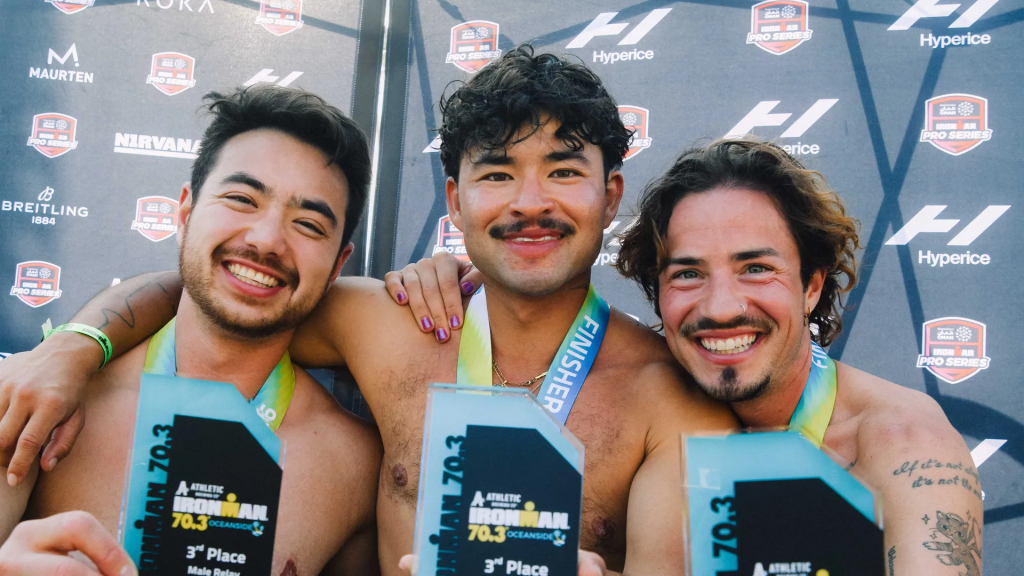
In March, the trio took third place at the 2026 Athletic Brewing Ironman 70.3 Oceanside competition, beating over 200 other teams.
Read Hiltz’s letter to the team below:
Schuyler, Chella, and Cal,
Congratulations on your podium finish at one of the toughest endurance events in the world! An Ironman podium is no joke. Beyond the months of training, sacrifice, and trust in your fellow teammates, a performance like that requires so much heart and grit. And it’s no surprise to me that you three embody those qualities so well.
Team Iron Transmasc represents so much to so many. Sometimes in sports, believing you can do something is supported by seeing someone else do it first. And when that someone looks like you, shares the same identity, pronouns, hairstyle, or top surgery scars, it can ignite a hope and fire to believe in yourself, and chase your dreams like never before.
As a nonbinary and endurance athlete myself, it was very special to see three out and proud transmasculine athletes execute a fantastic team effort and earn a podium performance together.
Thank you for your visibility and representation, and for inspiring me and so many others to believe that there’s a place for transmasculine people on podiums in endurance sports and beyond. — Nikki Hiltz
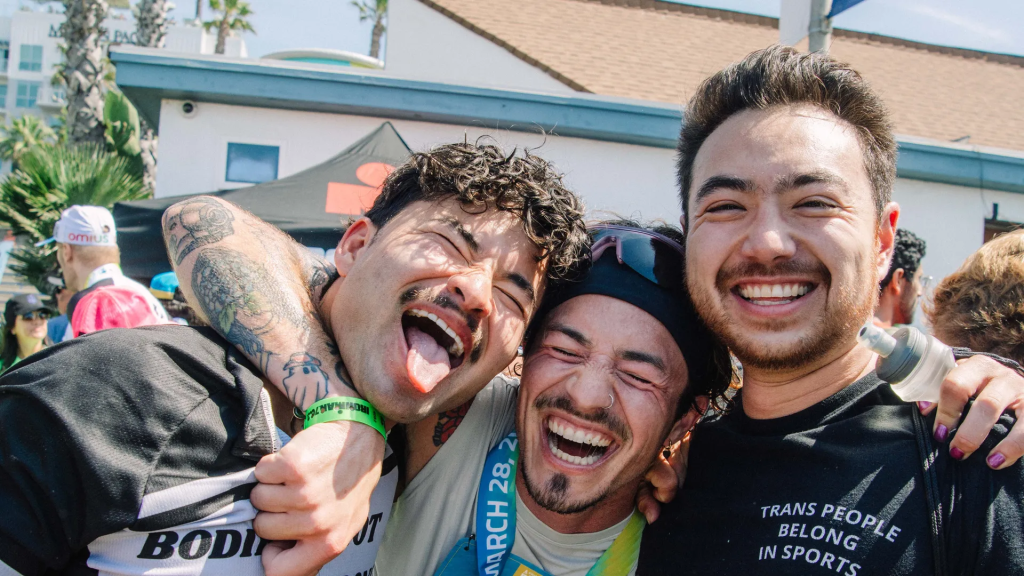
Congratulations are in order for Team Iron Transmasc, who won third place at the 2026 Athletic Brewing Ironman 70.3 Oceanside competition.
On Saturday, March 28, Team Iron Transmasc nabbed the third place spot in an ironman competition, a team sport that includes swimming, bike riding, and running. The team included champion trans swimmer Schuyler Bailar, deaf nonbinary cyclist Chella Man, and trans nonbinary marathoner Cal Calamia.
In an Instagram post celebrating their win, the trio wrote that they wanted to compete “without losing our love of the sport and synchronizing as friends.”
They continued, “In a world that is increasingly hostile toward trans people with an undue emphasis on athletics, we came together to showcase trans excellence, trans collaboration, and trans joy.”
The trio said they competed “for every person disenfranchised by transphobia, white supremacy, ableism, colonialism. For Palestinians, Iranians, Sudanese, Congolese. For every human’s right to exist exactly as we are, everywhere we are.”
The trio bested over 200 other teams to win their third place victory, per Out.
As part of the caption, the champions also pointed out that their victory took place just a few days after the IOC banned trans women from competition in female events.
“Sports are a human right of which so many people are deprived,” they wrote.
Bailar spoke further about trans participation in sports in an interview with Out given prior to the trio’s victory.
“One of the reasons that the recent IOC decision is so devastating is because it sends a message that sports are going to lead through discrimination, as opposed to being on a progressive way of moving humanity forwards, which is what they should be doing,” Bailar said.
Calamia told Out that the trio “kind of crushed it.” The running portion of the race was the third leg of the competition. Calamia said that, in their final moments, they passed a runner to nab a podium spot.
“There was a runner that was also competing in the relay that I passed at the very, very end of the whole thing, within the last 10 meters,” they said. “I had to close the deal. There was no part of me that would quit. And we got that spot on the men’s podium! It was amazing!”
Each competitor included a visual signifier of their trans identity on their uniform, Calamia mentioned. They had a trans flag on their running shorts, Schuyler had trans-colored goggles and Chella had a sign that said “bodies are not bans.”
Calamia said the trio have their eyes on future competitions, as well. “We’re already talking about what we’re going to do next,” they said. “We want to scale this up and get more trans athletes doing relays like this. We’re just excited to keep inspiring people and providing a counterweight to the other conversations about trans athletes.”