Amid the Trump administration’s ongoing attempts to erase queer and trans history, a University of California Berkeley professor’s students are working to right these wrongs — through Wikipedia edits.
Over the past decade, students in ethnic studies, gender and women’s studies, and performance studies professor María Rodríguez’s courses have edited and even created Wikipedia articles about LGBTQ+ history, with an emphasis on queer and trans people of color. The assignment currently replaces a final paper in three of her classes: “Documenting Marginal Lives,” “Queer of Color Cultural Production,” and “Queer of Color Critique.”
Rodríguez’s Wikipedia assignments take place in partnership with Wiki Education, a nonprofit that works with university professors in the United States and Canada. The professors’ students add content to course-related Wikipedia articles, which, according to the organization’s website, helps them gain skills like “media literacy, writing and research development, and critical thinking,” while simultaneously filling Wikipedia “content gaps.”
“Wikipedia is a public-facing project — it’s the largest encyclopedia in the world,” Rodríguez told UC Berkeley News in a December interview. “In a political moment where these histories are actively being erased from public view, having students work on a platform like Wikipedia becomes even more important.”
According to The Daily Californian, as of January 26, Rodríguez’s students have contributed over 300,000 edits and 3,000 citations to Wikipedia. At the time of writing, their work has garnered a whopping 96 million-plus views. Her students’ topics run the gamut, touching upon local history like the resonance of queer life in San Francisco’s Chinatown, as well as more international focus areas (for instance: worldwide sex worker movements).
As Rodríguez explained to UC Berkeley News, her students’ edits often help address the disparities between the amount of Wikipedia information about white, Anglo LGBTQ+ populations versus LGBTQ+ populations of color.
“It becomes particularly important to document these subcultures within these communities,” she said. “Because it’s not just queer Latinas — it’s queer goth Latinas, it’s queer comics of color, it’s African American slaying, right? It’s very specific topics that might really vary by region, by historical moment, and of course at different places around the world. Those topics, in Wikipedia and in real life, remain really under-studied and really under-researched.”
These contributions carry a newfound weight during the second Trump administration, in which officials have repeatedly attempted to erase references to queer and trans history. In February 2025, National Park Service websites removed the word “transgender” from multiple pages for historical programs and monuments, as well as references to trans figures such as Marsha P. Johnson. Meanwhile, in June, an unnamed Defense Department official told Military.com that Trump timed an order to remove LGBTQ+ icon Harvey Milk’s name from a military ship to coincide with Pride Month.
“Right now, the Trump administration is trying to erase the very existence of transgender people, so having information about those histories, as well as present challenges facing queer and trans communities, is particularly urgent,” Rodríguez told The Daily Californian via email. “Queer and trans people have always been here, and adding that information to the world’s largest open access encyclopedia is one way to make sure that these stories remain available.”
No doubt we’ve all seen that AG Bondi has contacted Gov. Waltz stating that if he will forward the MN voter rolls to her, the federal government violence will stop in MN. Last I knew, that offer was declined. Meanwhile, they’re still in MN, and now they’re raiding in Maine (I’m certain their Republican US Senator is deeply concerned, though not concerned enough to demand a turnaround.) Anyway, below are some links and snippets about preparation. The fact is that immigration enforcement has been around in every state for years, but they mostly haven’t been Gestapo-awful, or not at the massive numbers of people abused and killed, as they are currently. So, it isn’t as if things can’t happen instantaneously anywhere. If we still haven’t begun building local community, it’s definitely time. Aside from making sure we can take care of our neighbors and vice-versa, here are some good guidelines for dealing with our reality. We can do this. There is a place for everyone.
snippet: Today, after a year of rapid, large-scale mobilizing, resistance to rogue immigration agents is seeing its own set of commandments emerge. From compiling strategies from across the United States, 10 Rules of Resistance for #ICEOut can be identified. Taken as a whole, they offer all of us a robust approach to denying ICE the basic necessities of their operation.
10 Rules of Resistance for #ICEOut
No silence.
No selling.
No service.
No hotel rooms.
No entry.
No informing.
No looking away.
No collaboration.
No transporting.
No detention centers.
(You can add to this list, of course. There’s no limit to the ways we can resist.)
Nonviolent movements succeed by strategically pressuring the pillars of support for an injustice to withhold or withdraw things like information, cooperation, funding, labor and more. These 10 Rules of Resistance for #ICEOut offer ways to deny immigration agencies the key resources they need to function effectively. ICE cannot function without detention centers, transportation of detainees, access to businesses and properties, staging areas in parking lots, surveillance, telecommunication, recruitment ads, deliveries, or even quiet and uninterrupted sleep at hotels. (snip-more at link-the title above)
General strikes can have a tremendous impact, but to succeed they require an organized majority, networks of solidarity and resources to weather repression.
The call is coming from a rapidly growing coalition that includes the Amalgamated Transit Union Local 1005, Service Employees International Union Local 26, UNITE HERE Local 17, Communications Workers of America Local 7250, the Saint Paul Federation of Educators, the Minneapolis Federation of Educators, the Minnesota AFL-CIO, Sunrise Movement, and grassroots groups like Tending the Soil, among others.
That breadth matters — it’s not just a tiny group but an array of organized, powerful entities.
The action carries momentum. It follows the extreme violence carried out by ICE and other immigration agents in Minnesota — and the courageous, sustained pushback by Minnesotans who have stepped in to protect one another. The Jan. 23 one-day economic blackout is not the only tactic on the table. It sits alongside legal challenges, corporate pressure campaigns targeting ICE enablers, mutual aid and direct services, physical interventions, and more.
This is how real movements tend to move: not in a straight line, but through overlapping experiments. (snip-see the rest by clicking the title above)
The movement for justice and democracy is growing and has displayed significant political clout: mobilizing unprecedented millions in mass protest, resisting ICE attacks in Minneapolis and other cities, turning interim electoral outcomes against MAGA policies, and building pressure for National Guard withdrawals. Trump’s ratings have slumped to the lowest level of his second term. A recent poll shows a majority of Americans opposed to ICE’s aggressive tactics.
Now we are at a critical juncture, a moment of escalating risk, but also opportunity for political gain. Protests and protective actions have surged in Minneapolis, especially following the murder of Renee Nicole Good. Citizens and public officials in Minneapolis have condemned the brutality of ICE and Border Patrol operations and their blatant acts of racial and ethnic profiling. They are demanding the withdrawal of federal forces and a halt to the de facto military siege of city neighborhoods.
After all, George Washington and all were just regular people before they became part of the government. It really is up to all of us. If you click the article title just below this, all the embeds are there. This is from The Root.
From where you stand, it may look like you’re just watching unimaginable stuff go down, and nobody’s stepping in to stop it. In only eight months of his second term, President Donald Trump has managed to undermine the Constitution, disrupt the economy, send military troops to cities without congressional approval and divide the country over immigration, civil rights and more. It seems like there’s nothing regular Americans can do to stop him as he continues to complete the missions of his 2024 campaign, but many political leaders are offering suggestions to fight back in ways never seen before.
From journalist Toure to former Texas Rep. Beto O’Rourke, these powerful voices are urging folks to rebel against the Trump administration, and here’s exactly how they say it needs to be done.
Former Congressman Beto O’Rourke
(snip-Insta on the page linked above; text continues)
“If we’re not willing to play hardball right now, it is over,” former Texas Rep. Beto O’Rourke said during an interview. The Democrat continued comparing the rise of German dictator Adolf Hitler to how American society is handling President Trump now. He urged the Press, opposing political parties and every American to pay attention to Trump’s attempt to rewrite the Constitution, defy the federal courts and attack U.S. citizens before something unredeemable happens. “I don’t know if I’m saying that is going to happen in America,” O’Rourke said referring to Nazi Germany. “But this moment sure as hell rhymes with the 1930s, and if we don’t pay attention, we’re going to lose it.”
Roland Martin
(snip-again, Insta embedded on the page linked above, text continues)
Journalist Roland Martin has told Americans to put down the Tiktoks and fight back. During one video clip, he says “What we are talking about is a battle that’s generational,” Martin passionately began. As Trump continues to suggest red states move to redistrict their congressional seats in Republicans’ favor, Martin called out exactly how this will erase Black voices. “They could wipe out with one Goddamn ruling more than 30 Black Congressional seats,” he said.
Former Vice President Al Gore
On the list of avid critics of Trump is former Vice President Al Gore. During an event in April, Gore didn’t hold back his critiques, and like some others on this list, he compared the Trump administration to Hitler’s regime. He said Trump’s team is “trying to create their own preferred version of reality” to achieve their objectives similar to the Nazi Party. “It was uniquely evil, full stop,” Gore continued. But there are important lessons from the history of that emergent evil.”
Director Marshall Herskovitz
(snip-Insta, etc.)
“We must have what they call a popular uprising,” American director Herskovitz said before adding that in order for this movement to be successful, it would have to be peaceful. “This is not a revolt,” he continued. The producer mapped out his proposed plan. According to him, it would only take 12 to 15 million Americans to protest in the streets “day after day after day,” he said. Step two of the plan includes a “general” strike. “I’m not going to work… My store’s not open; my resturant’s not open. I’m not paying my taxes.” Only then would the country see true change similar to the results of the Arab Spring in 2011– the series of pro-democracy and anti-government uprisings which spread across the Middle East.
Congressman Jerry Nadler
NEW YORK, NEW YORK – JUNE 18: Rep. Jerrold Nadler (D-NY) arrives to view proceedings in immigration court at the Jacob K. Javitz Federal Building on June 18, 2025 in New York City. Rep. Jerrold Nadler (D-NY), Rep. Dan Goldman (D-NY), NYC Comptroller and Mayoral Candidate Brad Lander and Council Member Alexa Avilés visited immigration courts to watch proceedings a day after NYC Comptroller and Mayoral Candidate Brad Lander was arrested by federal agents while accompanying a person out of a courtroom as people continue to be detained following immigration court hearings. (Photo by Michael M. Santiago/Getty Images)
N.Y. Rep. Jerry Nadler released a six-page letter to the American people urging them to take action against Trump. “We cannot wait four years to vote Mr. Trump out of office,” he said before adding, “To achieve this, we must keep our eyes on two important goals: depressing Trump’s public support and dividing the Congressional GOP from him and from each other.” Nadler’s plan focuses on holding the administration accountable for unconstitutional acts and “exposing his Republican enablers in Congress.”
Former U.S. AG Eric Holder
(snip-Insta, etc.)
During an interview with MSNBC, former U.S. Attorney General Eric Holder said Trump’s current actions are “remarkably similar” to that of Europe in the 1930s– when Hitler rose to power. Because of this, Holder said all Americans need to be on high alert. “There’s a treadmill that we’re potentially getting on here that could result in the erosion of rights for American citizens,” he told the network.
Rep. Alexandria Ocasio-Cortez
N.Y. Rep. Alexandria Ocasio-Cortez stands strong as a controversial yet influential Democrat. Like many of her colleagues, she has remained steady in her criticism towards Trump, and during a rally in California, she said the key to defeating him rest in the hands of Americans. “Community is the most powerful building block we have to defeat authoritarianism and root out corruption,” she told the crowd.
NYT Columnist Charles M. Blow
(snip-TikTok embedded on page linked above, text continues)
Charles M. Blow of the New York Times referenced esteemed author Toni Morrison in his advice to fight back. “If you are taking a break from politics right now… good for you. There’s nothing to be ashamed of,” he began on TikTok. “You’re actually going to need the energy that you’re storing now for the fight to come in the next four years.” He added, “You can’t always stay in the crisis,” quoting Morrison from a 1977 interview. The writer encouraged Americans to “recenter what you love” in order to “remember why you fight.”
Congresswoman Lois Frankel
WASHINGTON, DC – MAY 12: Rep. Lois Frankel (D-FL) speaks during a news conference to celebrate the passage of legislation that will place statues of former Supreme Court associate justices Ruth Bader Ginsburg and Sandra Day O’ Connor in the U.S. Capitol on May 12, 2022 in Washington, DC. The Democratic leaders were joined by Scott O’ Connor, son of Justice O’ Connor, and Professor Kelsi Corkran, former clerk for Justice Ginsburg. (Photo by Chip Somodevilla/Getty Images)
Fla. Rep. Lois Frankel has an entire page on her website dedicated to ways Americans can help rebel against Trump. “He promised to lower costs, instead, he’s unleashing chaos and cruelty while his rubber-stamp Republicans in Congress are pushing a draconian budget that slashes Medicaid and food assistance—programs millions rely on to get by,” she said. Frankel continued telling folks to call and email their local representatives to voice their complaints, attend town halls and even share their own personal stories.
Greed v. Young Americans
(snip-TikTok etc.)
@geiggfcg on TikTok told younger Americans (ages 45 and younger) to wake up and get to the streets to protest. Why? Because older generations like the baby boomers– including Trump– have ruined the county with their greed, according to the TikToker. “You have been screwed over royally,” he told his followers. From the lack of affordable colleges to the growing cost to buy a home, @geiggfcg said young Americans will deal with the consequences of their parent’s greed. He went on to reference Trump “Big Beautiful Bill Act,” which promised to make major cuts to medicaid, add trillions to the national debt and also cut food stamps for millions by 2027.
Local Resistance Movements
(snip-TikTok, etc.)
“Donald Trump’s unpopularity is growing, and this era is going to end,” declared @indivisibleguide on TikTok. In order to ensure this happens, the movement is urging folks to get involved in their local communities and to organize. “You should host a community resistance gathering,” the TikToker said.
FEMA Fights Back
WASHINGTON, DC – OCTOBER 8: The Federal Emergency Management Agency Headquarters, in Washington is photographed on October 8, 2024 in Washington, DC. FEMA is running low on personnel, with only 9% of staff available as Hurricane Milton, with 175 mph winds, approaches Tampa, FL; Compared to 25% availability in previous years. (Photo by Kent Nishimura/Getty Images)
Nearly 200 employees at the Federal Emergency Management Agency (FEMA) signed a written letter expressing concerns that Trump’s “unqualified” government appointees could have long-lasting impact on Americans everywhere. NBC reported that 21 of those employees have been put on leave in response.
Peaceful March Against Trump
(snip-TikTok etc.)
ack in April, thousands of Americans across the nation flooded the streets in order to protest against Trump. In this video, a large group of demonstrators are gathered in Milwaukee all against the 47th president.
Army General Mark Milley
(snip-TikTok etc.)
Retired Army Gen. Mark Milley has been an avid critic of the Trump administration for years. In fact, his critiques of Trump even prompted Defense Secretary Pete Hegseth to pull Milley’s security clearance and protective detail back in January. Still, Milley has remained outspoken about why Americans need to stand strong against Trump. “We don’t take an oath to a tribe… We don’t take an oath to a king or queen or to a tyrant or a dictator,” Milley said. “And we don’t take an oath to a wannabe dictator.”
Journalist Toure
(snip-TikTok etc.)
For journalist Toure, the key to fighting back against Trump and his administration is to hold those doing his bidding accountable. “The pathway out of this is accountability– Not for Trump but for everybody who holds up his order,” he said on TikTok. “‘I was just following orders’ is not sufficient.” Instead, he said the licensed lawyers and licensed pilots who carry out Trumps wishes– such as deporting migrants against court orders and defending the president’s alleged unconstitutional actions in court– need to lose their licenses.
Calif. Gov. Gavin Newsom
SACRAMENTO, CALIFORNIA – AUGUST 21: California Gov. Gavin Newsom looks on during a bill signing event related to redrawing the state’s congressional maps on August 21, 2025 in Sacramento, California. In a move to counter Texas House Republicans’ plan to redraw the state’s congressional maps ahead of the 2026 midterm elections, California Democrats took up a proposed constitutional amendment to temporarily redraw their own congressional maps, potentially creating five additional U.S. House seats for their party. (Photo by Justin Sullivan/Getty Images)
While many Democrats are conflicted about going as low as Trump, who is known for ripping into his enemies with low blows and jabs online– Calif. Gov. Gavin Newsom seems to have no mercy. The two men have gone back and forth for years, but ever since Trump returned to the White House, Newsom has been fighting the president’s fire with fire, we previously reported. Most recently, Trump has encouraged red states to rezone their voting districts in order to gain more Republican seats come the 2026 midterms. In direct response to that, Newsom promised to do the same in his state.
May 10, 1857 The Sepoy Rebellion was triggered in Meerut, India, when native troops (known as Sepoys, which also designated a rank equivalent to private) turned on their British officers.It was the first instance of armed resistance against colonial rule. Indians constituted 96% of the 300,000-man British Army.Loading the Lee-Enfield Rifled Musket assigned to the Sepoys involved biting the end of a cartridge greased in a combination of pig fat and beef tallow. “Attack of the Mutineers,” a British illustration of the Sepoy Rebellion The former is haraam (forbidden) under Islamic law, the latter offensive to Hindus who consider the cow as aghanya (that which may not be slaughtered). When the Sepoys, including both Hindu and Muslim Indians, became aware of this, some refused to load their weapons. Mangal Pandey, a soldier in the Army shot his commander for forcing the Indian troops to use the controversial rifles. When others were charged with mutiny for refusing, Sepoys turned on their officers and released the imprisoned soldiers. The rebellion is now considered the first Indian war for independence. More on the rebellion
May 10, 1967 Army Captain Howard Levy, a physician, was imprisoned three years for refusing to train U.S. Special Forces soldiers for Vietnam. He refused an order to perform the training as he considered it a violation of his medical ethics. “The United States is wrong in being involved in the Viet Nam War. I would refuse to go to Viet Nam if ordered to do so. I don’t see why any colored soldier would go to Viet Nam: they should refuse to go to Viet Nam and if sent should refuse to fight because they are discriminated against and denied their freedom in the United States, and they are sacrificed and discriminated against in Viet Nam by being given all the hazardous duty and they are suffering the majority of casualties.” – From the Supreme Court case, Parker, Warden, et al. v. Levy.
May 10, 1968 Peace talks began in Paris between the U.S. and North Vietnam with businessman, former New York governor, ambassador and cabinet secretary W. Averell Harriman representing the United States. Former Foreign Minister Xuan Thuy, heading the North Vietnamese delegation, immediately demanded cessation of U.S. bombing.
May 10, 1972 Jane Briggs Hart, the wife of Senator Philip A. Hart (D-Michigan), informed the Internal Revenue Service that she wouldn’t pay some of her taxes; instead, she deposited her quarterly estimated tax of $6,200 in a special bank account. She wrote: “I cannot contribute one more dollar toward the purchase of more bombs and bullets.” Jane Briggs Hart More about Jane Briggs Hart
May 10, 1980 A federal judge in Salt Lake City, Utah, found the U.S. government negligent for its above-ground testing of nuclear weapons in Nevada from 1951 to 1962. The land of the Nevada Test Site is scarred with craters from nuclear testing.
May 10, 1994 Nelson Mandela was inaugurated as South Africa’s first black president. He had won the country’s first election in which all South Africans could vote, regardless of race. Mandela had spent nearly three decades imprisoned for his part in the struggle to attain political and civil rights for black and colored citizens. This ended more than three centuries of white rule, beginning with the Dutch in 1652. Biography of Nelson Mandela South African chronology
This blogger visits us here; I’ve seen likes on our posts. I checked out the blog and subscribed. I admit, I read with the Translate turned on, so I’ve copy-pasted a snippet here, in English. It’s not too long to read, so please do! It’s motivating.
The government’s instructions on the “sobriety” to be maintained in the celebrations of April 25 have led to the cancellation of celebrations and concerts, even in municipalities administered by left-wing councils. An indication is not a ban, but many mayors have preferred to avoid being accused of having violated the sobriety required during the five days of national mourning proclaimed for the death of the Pope. As in the case of Foligno, they even cancelled the performance of the philharmonic that was supposed to play the national anthem.
In Lastra a Signa, on the outskirts of Florence, the municipal council has decided to cancel the concert of Quarto Podere , a historic Tuscan band that has always combined commitment, tradition and irony in its long artistic career. In response to this absurd decision, the members of the group wrote a letter in which they expressed deep dismay and asked for a reconsideration. Here is a significant passage:
“ April 25, Liberation Day from Nazi-fascism, is a cornerstone of our Republic. We therefore consider it unacceptable that a left-wing government, in a secular State (as established by Article 1 of the Constitution), chooses to deny the possibility of adequately commemorating such a significant day, outraging the memory of those who sacrificed their lives for our freedom. This choice appears even more serious at a time in history when our dignity, workers’ rights and the founding values of the Republic are under attack by a far-right government, clearly of neo-fascist origin; a government that, since it has been in office, has undertaken a systematic demolition of political rights, limiting the possibility of dissent and resistance, as demonstrated by the latest Security Decree. The proclamation of five days of national mourning represents yet another opportunity to exploit a contingent event and silence any form of dissent. We are convinced that Pope Francis – a figure we deeply respect – would have been opposed to a cancellation that betrays the inclusive and profound spirit of a celebration that, for our country, is sacred .”
Music, singing, artistic expression have always been perceived as dangerous by totalitarian regimes. (snip-MORE)
Collective action, even on the tiniest scale, is still pretty damn terrific Read on Substack
Many of you know the backstory here, but stick with me. It’s unremarkable on its face, but that’s how metaphors work.
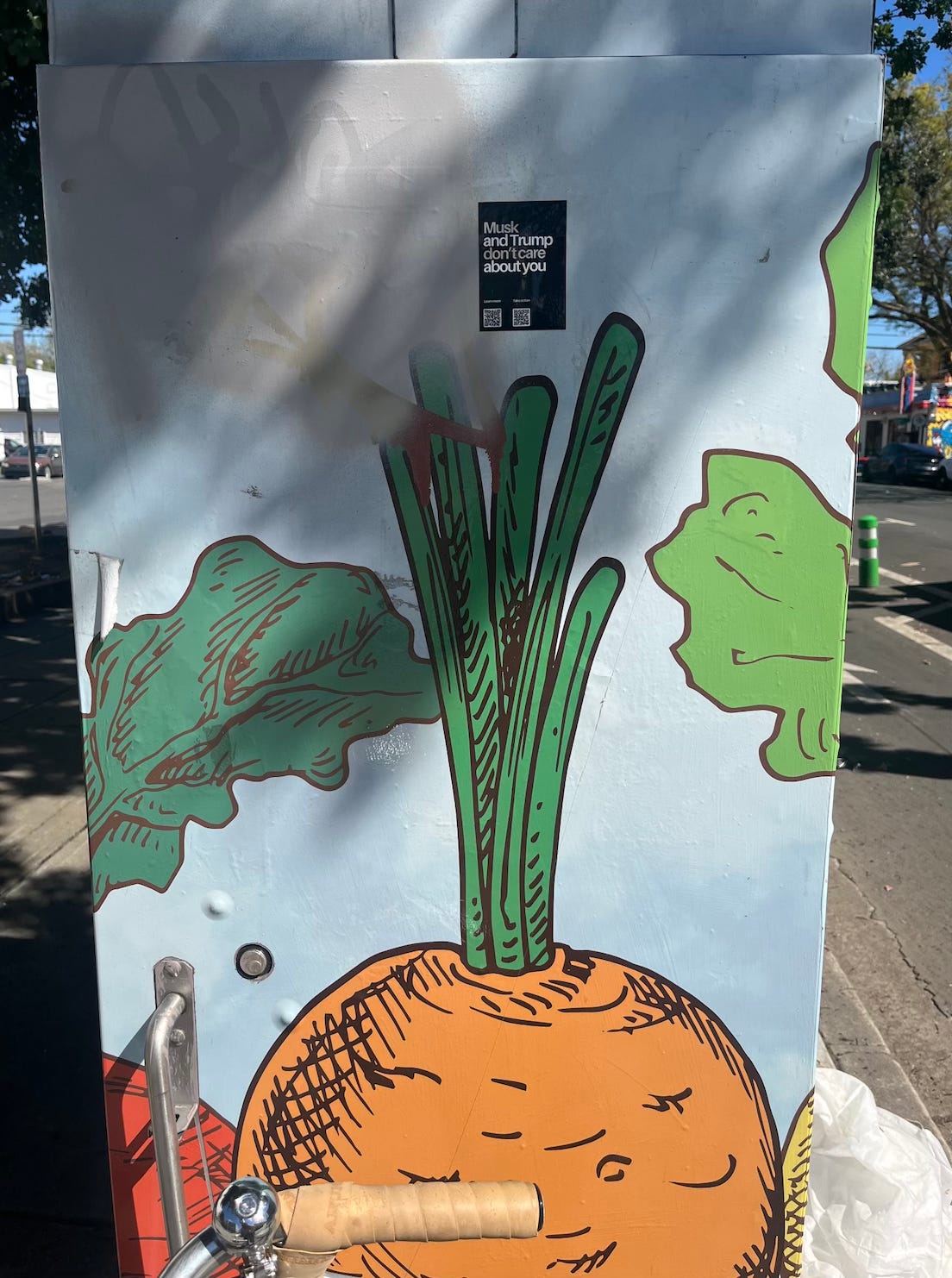
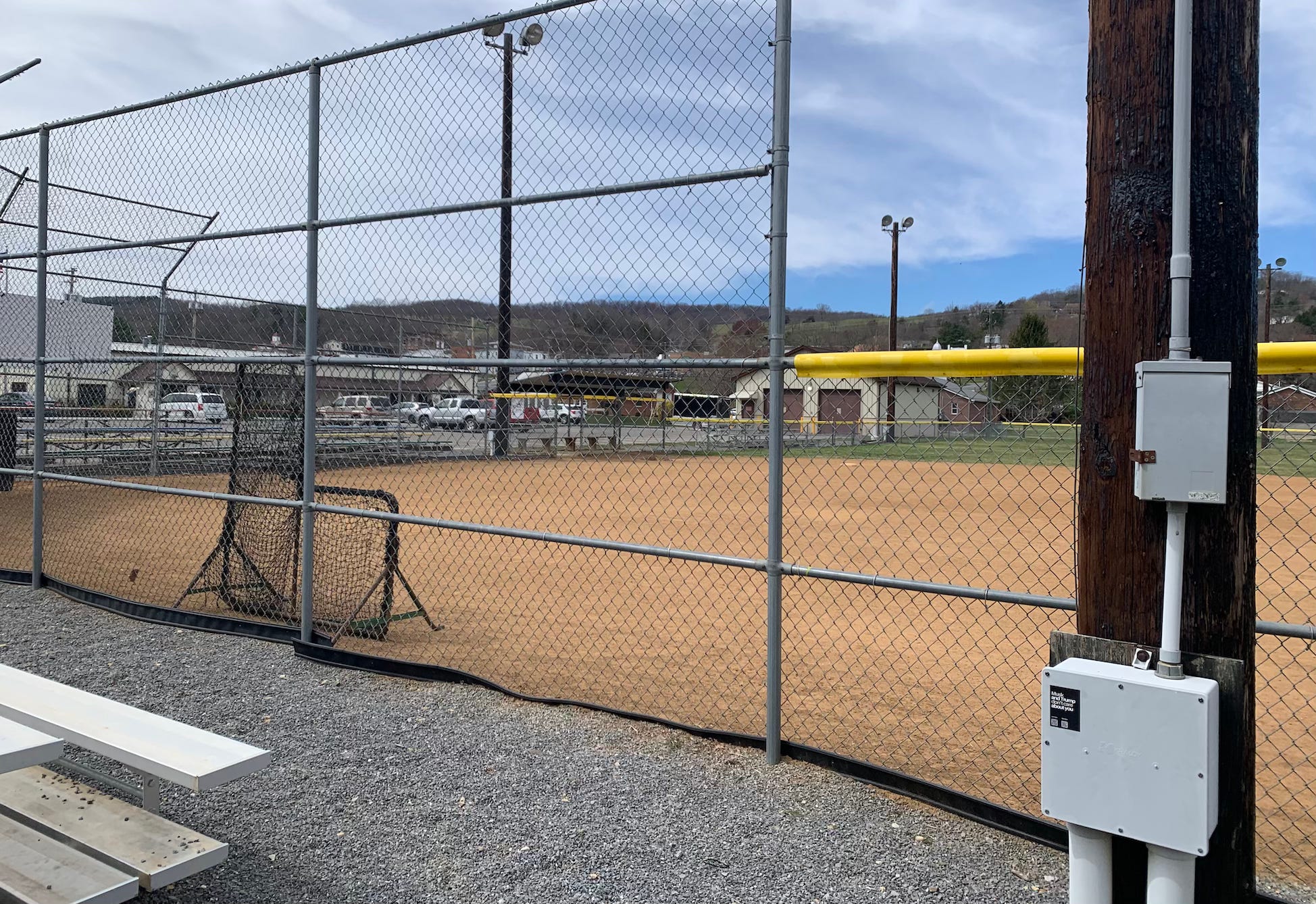
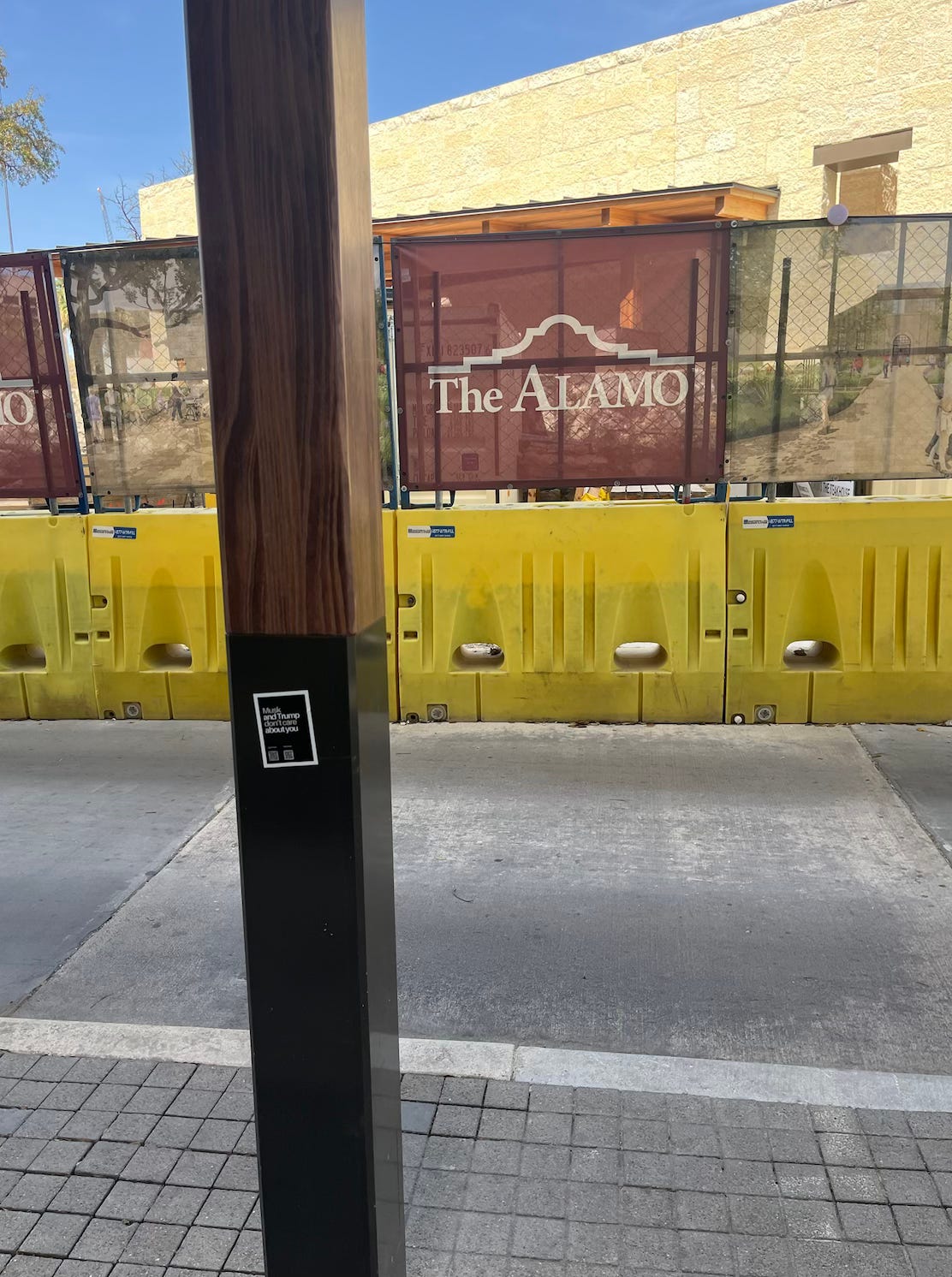
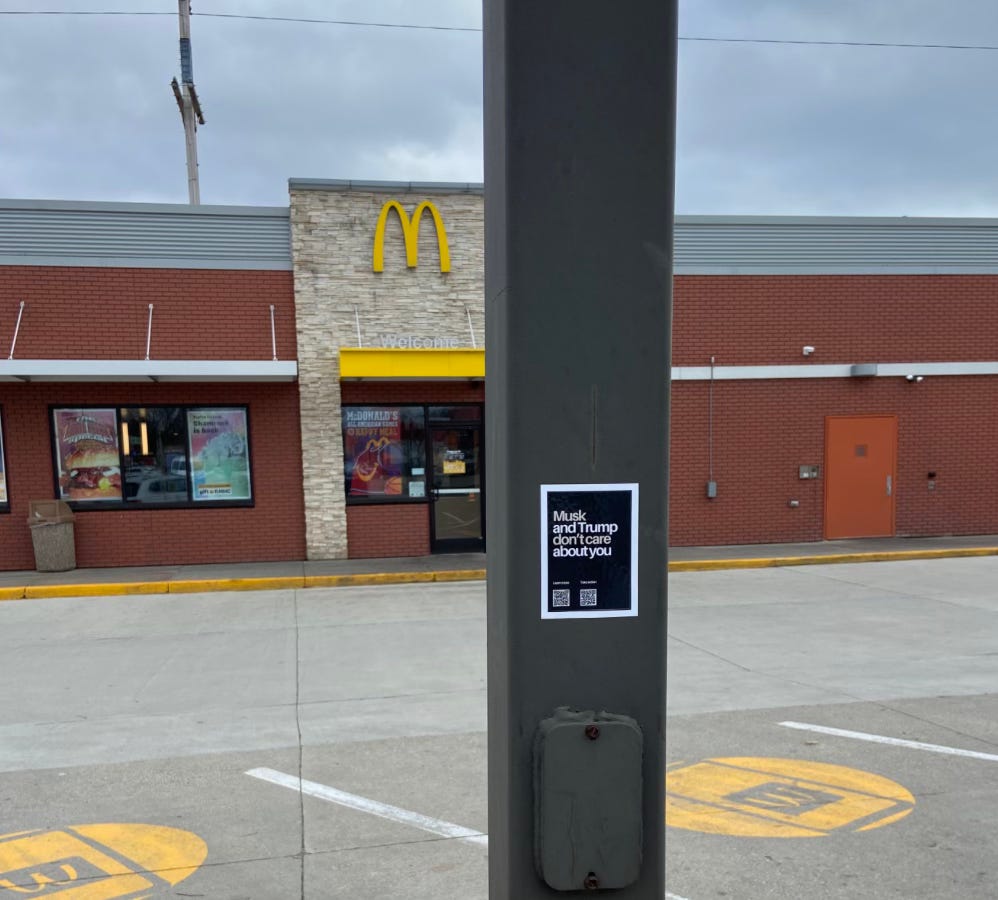
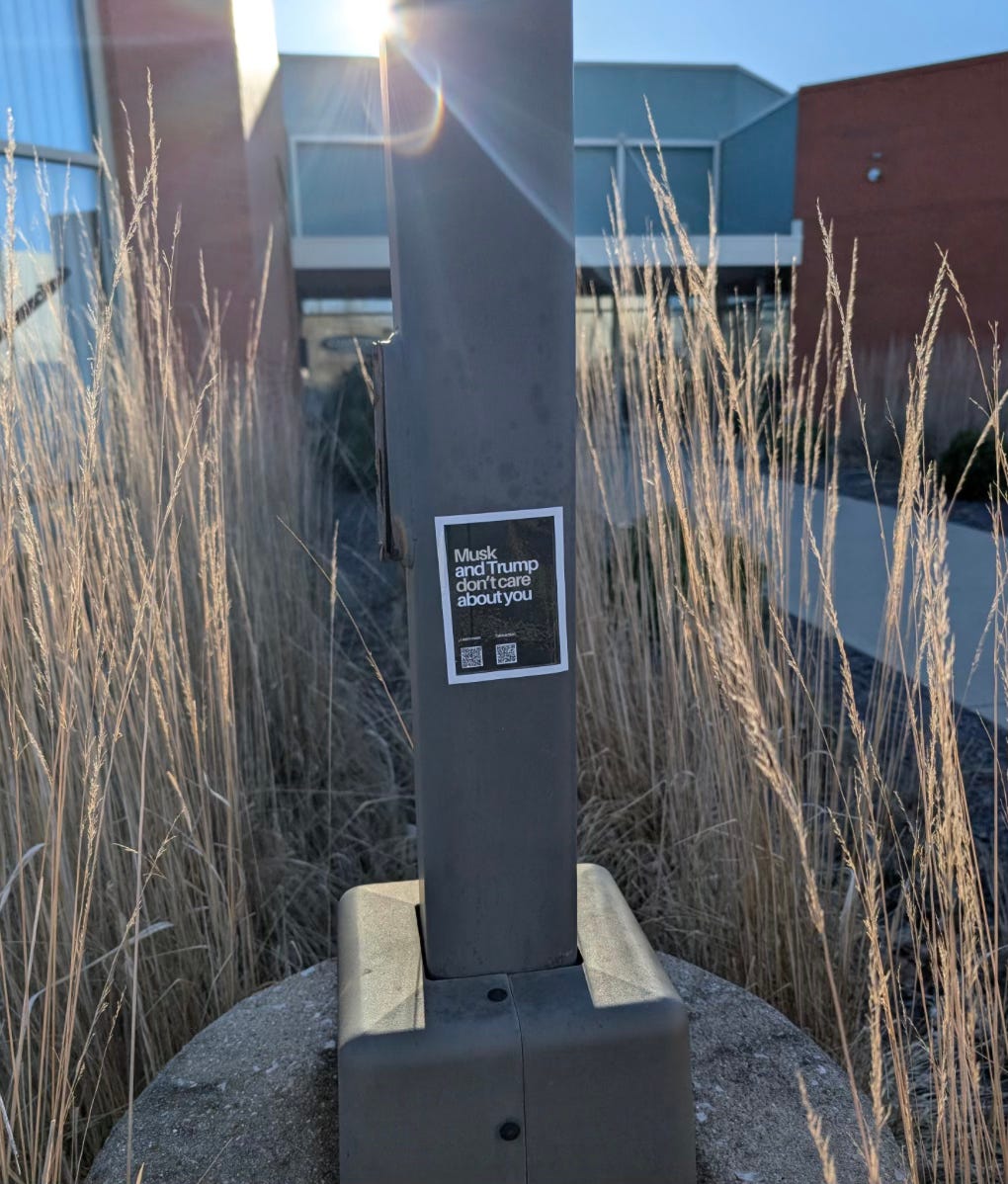
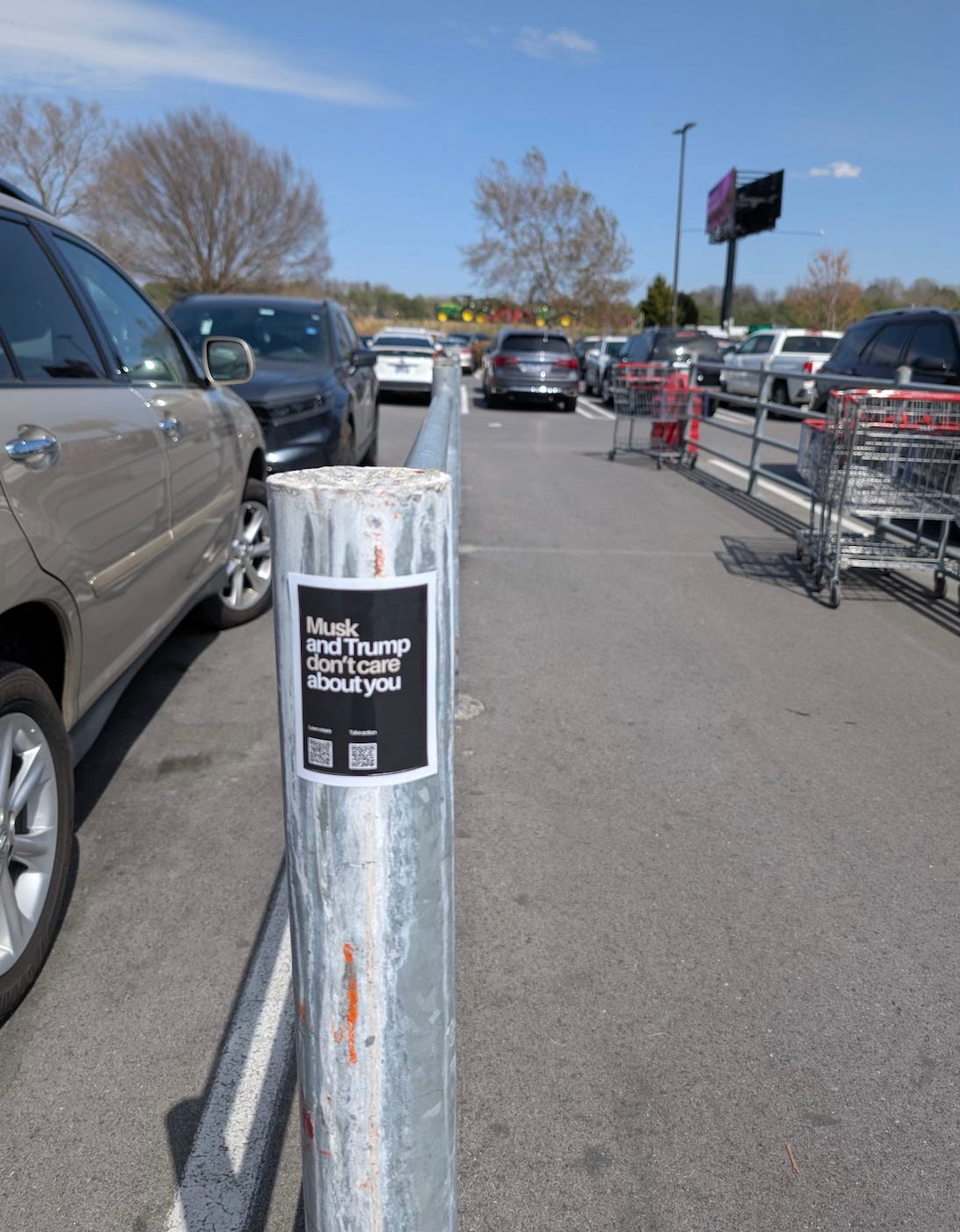
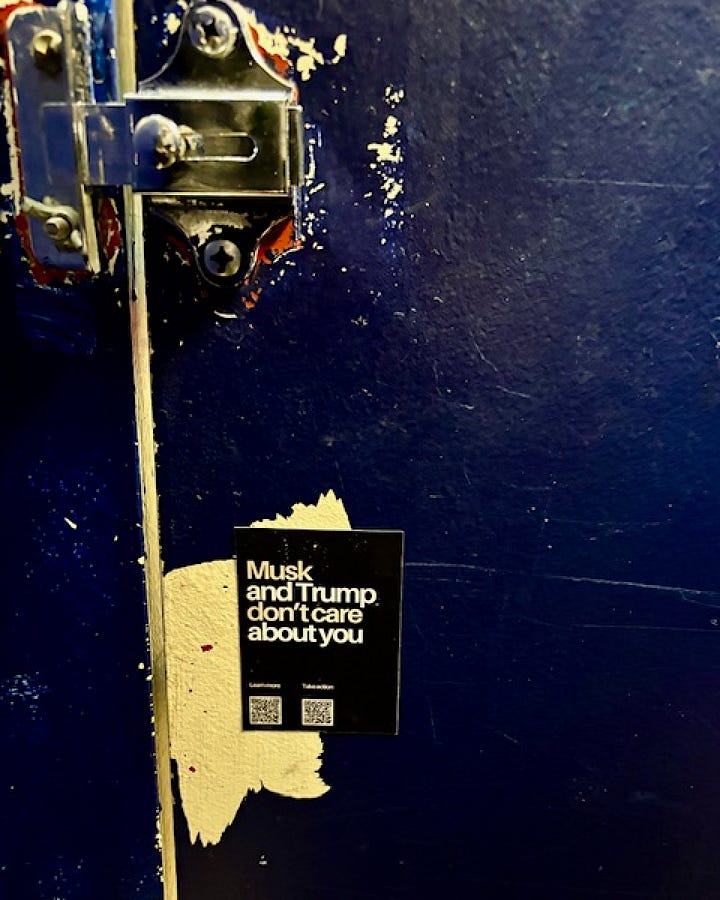
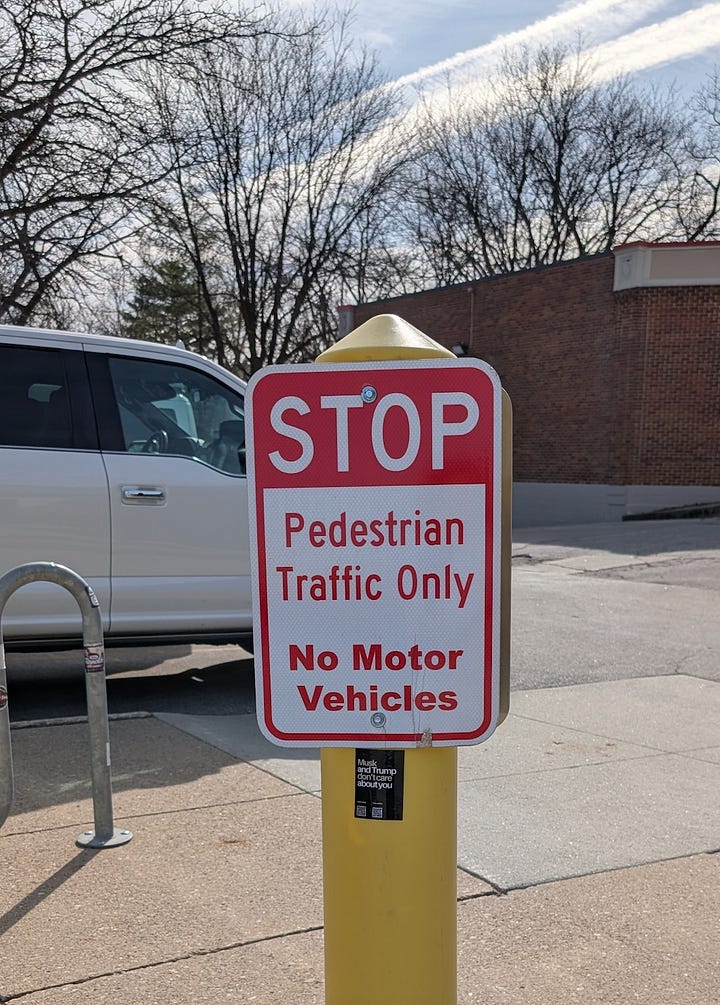
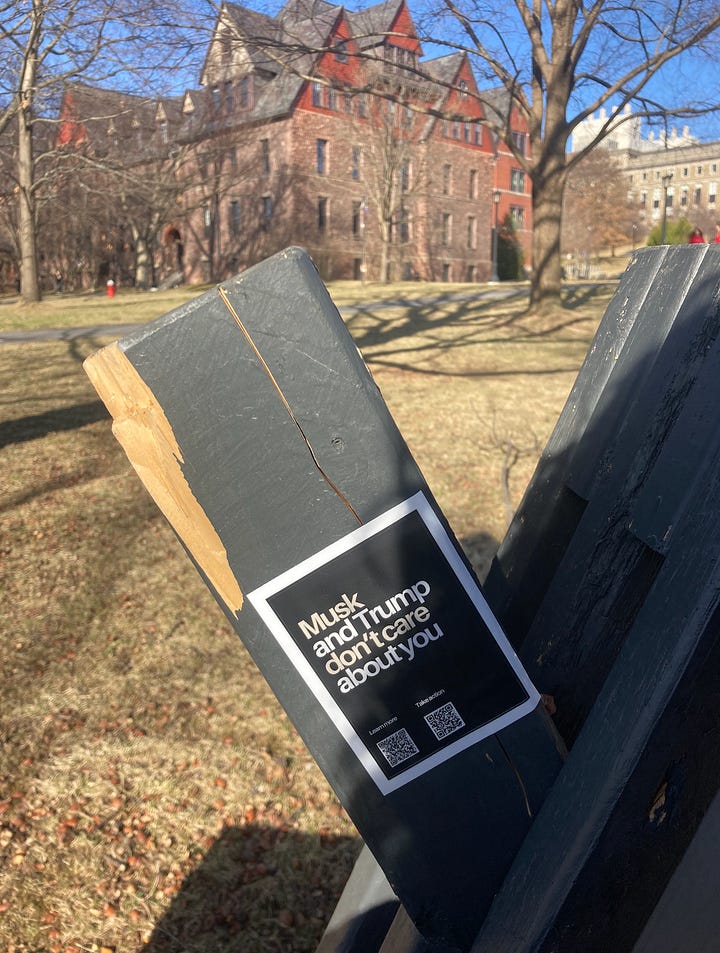
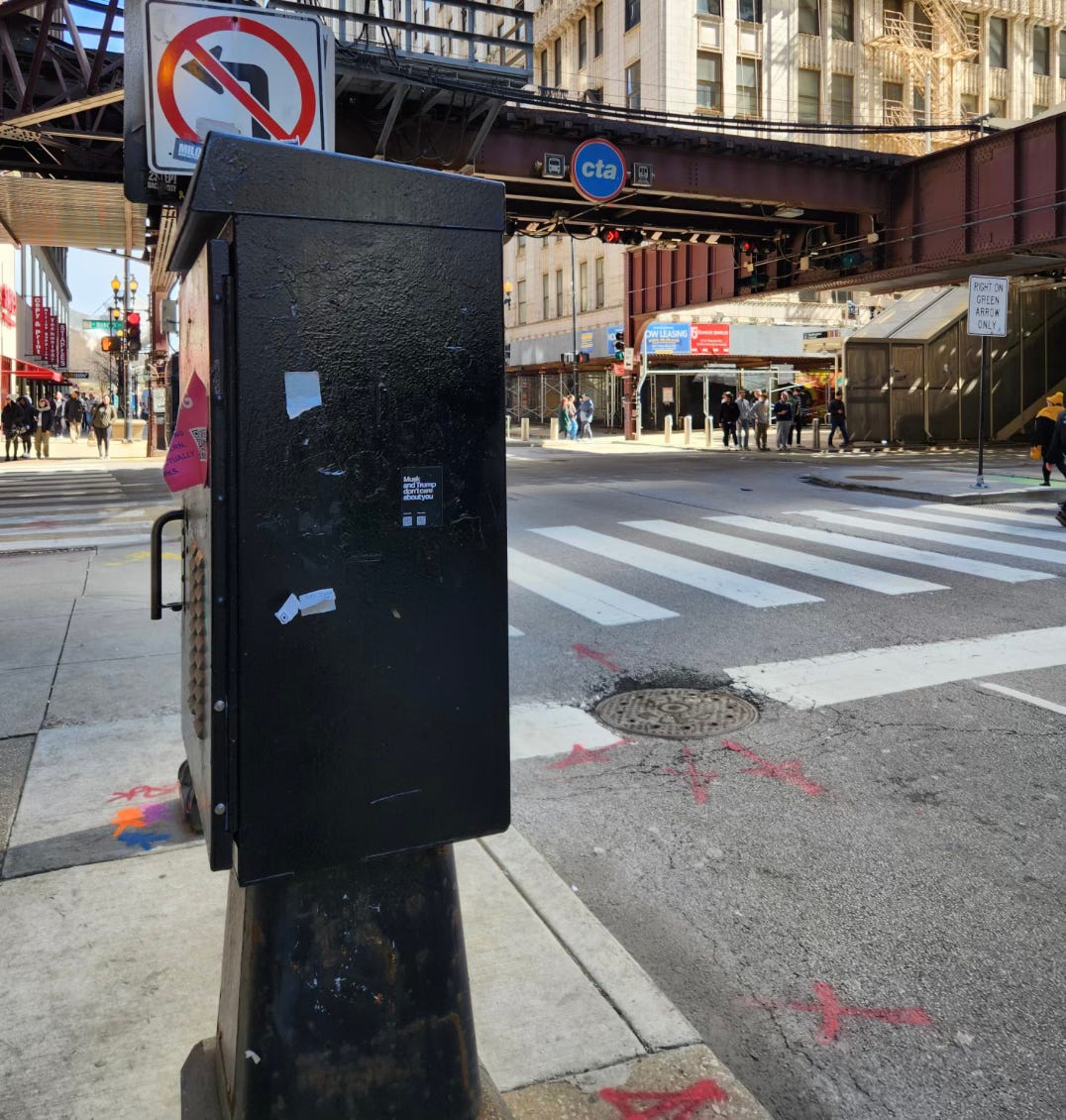
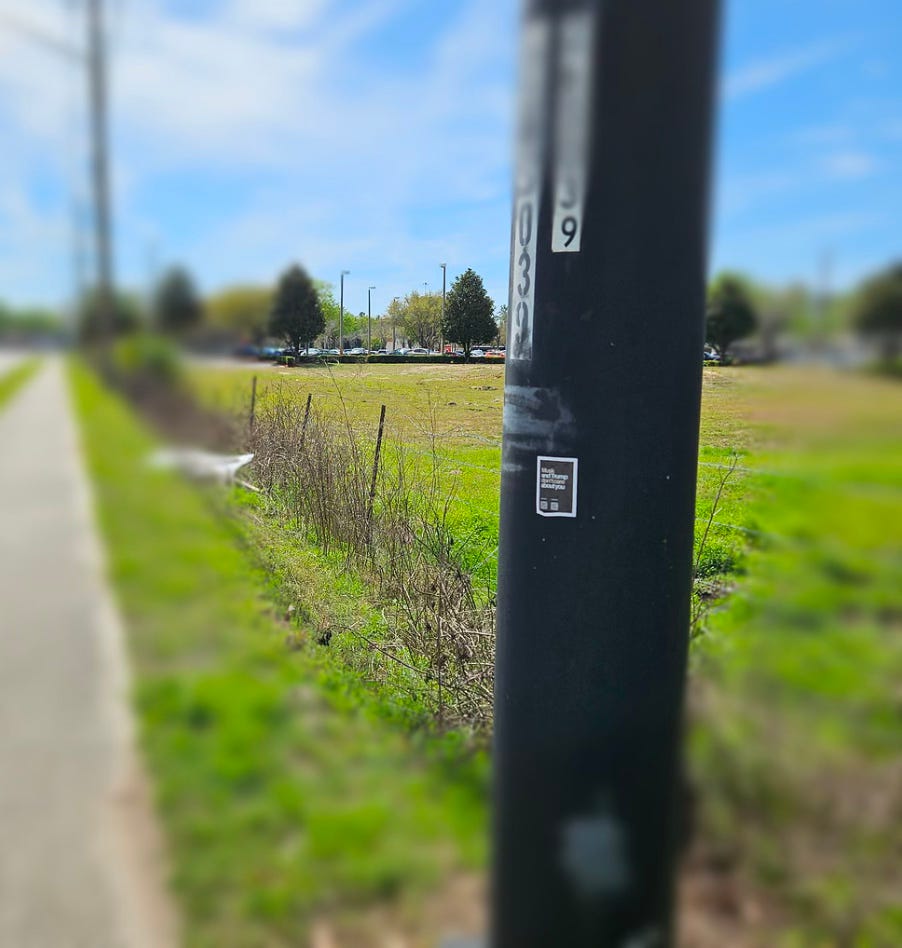
For the last couple weeks, I’ve been the joyful recipient of a steady stream of pictures. They’re all of the same sticker, one that I designed and ordered and likely should have made bigger than I did (I’ve received feedback). The sticker says “Trump and Musk don’t care about you.” There are a couple QR codes— links to learn more and take action— but not much else. It was an extremely simple project, just one of thousands that have been launched across the country since Trump was inaugurated. It will, I’m sure, not bring down a government or prevent a deportation or stop a bomb from falling.
I adore these stickers. They are tiny, on more than one level, but that’s how all impactful things start. Designing them wasn’t hard, nor was tossing off a few messages asking others if they wanted one as well. I said, in essence, “hey you all, this is a thing that I’m doing” And then, when hundreds of people across the country indicated that they would, in fact, like a sticker, they added their voice to mine. “This is a thing I can do as well,” they said, a chorus of beating hearts and frayed nerves. They shouted their reply from tiny towns and large cities, from places where they struggled to find a location that wouldn’t just preach to the choir, as well as places where Trump is worshipped like a God.
They answered, and I felt less alone in hearing their reply.
And then, because this is how trust is built, we kept our promises to one another. I sent out the stickers and they put them up and snapped a picture and then… well, we’ll see. I have no proof whatsoever if the chain will continue, if a teenager playing baseball or a mom returning her cart at Target or a trucker taking a rest break after a long day on the road will see them and be reminded that they too can do something, but if we limited our political imagination to actions whose ripples we could foresee without a shadow of the doubt, we would do so very little.
I have made a number of challenges to myself since Trump’s inauguration. I have challenged myself to counter the false faith of isolation and inhumanity with one of connection and care. I have challenged myself to remember every day how in love I am, how grateful I am, how much I believe in the beautiful counterpoints we have already shouted and the even more beautiful world we will build.
I don’t think I’ve answered any of those challenges in profound ways, but I am trying. And since I am trying, if my heart beams every time I receive another picture of a sticker out in the world, then the least I can do is to share that feeling with you as well.
Do you want to see some of the stickers? I hope so, because if they are out there, that means that we are out there, even when it feels like we aren’t, even if we convince ourselves so frequently that being out there isn’t enough, even when we don’t yet understand why or how our being out there adds up to the world we want to live in together.
So, my friends, here are a few of them…
…on top of a carrot in Sacramento.
..preparing to play ball in a West Virginia County that gave 78% of its vote to Trump in November.
…remembering the Alamo.
…as well as another complicated American icon (in Iowa).
…welcoming visitors to a farm bureau in Illinois.
…and what I’m assured is a “surprisingly scenic” Costco parking lot in Fort Oglethorpe, Georgia.
… in bathrooms (in South Carolina and Phoenix).
…and on signs that, if you read them the right way, also feature messages of opposition (in Des Moines, Iowa and Springfield, Illinois).
…on campus (at Cornell and the University of Tennessee).
…and rivers (the Fox, in Wisconsin).
…and rails (in Chicago).
…and roads (in rural Florida).
As of this writing, there are hundreds of stickers, but millions of American places. A drop in the bucket if ever there was one. But there they are, proclaiming that we’re still here. Connected to each other. Shouting out, “I am doing something. We are doing something. We are here today and we will be here tomorrow.”
I love them, because I love us.
End notes:
I’m letting most of the siblinghood of stickering remain blessedly anonymous, but I hope you read this lovely reflection from Lyndsey Medford (esteemed stickerer of Costco parking lots and one hell of a writer to boot).
It isn’t just stickering, of course. I truly believe that my inbox is one of the most hope-giving spaces on the planet, because it’s full of people telling me about how damn amazing it felt going to one of those (massive) Bernie-AOC rallies or how their Tesla protest tripled in size week to week or how they never expected to find such a powerful political home when they moved to East Tennessee. You all, get a load of us! Trying! Building!
Yes, I have a few more stickers left (though please be patient, I’m away from home this week so will send them out when I get back).
And yes, I don’t just send stickers. I also run trainings (free and virtual!) on how to organize and build community in your part of the world, and next week I’ll be announcing dates and times for the next round so if you’re not on the interest list please get there. (snip-More)
the post along with the comments beneath it are important to read. There are ways to make our directions to our government known. Even if a person can’t show up, a person can send a pizza or some cold drinks to a group who’s out speaking out. We can each do a thing. Meanwhile, please read Tengrain’s post, and the comments, as they’re important to know.
From George Orwell to Hannah Arendt and John le Carré, thousands of blacklisted books flooded into Poland during the cold war, as publishers and printers risked their lives for literature
The volume’s glossy dust jacket shows a 1970s computer room, where high priests of the information age, dressed in kipper ties and flares, tap instructions into the terminals of some ancient mainframe. The only words on the front read “Master Operating Station”, “Subsidiary Operating Station” and “Free Standing Display”. Is any publication less appetising than an out-of-date technical manual?
Turn inside, however, and the book reveals a secret. It isn’t a computer manual at all, but a Polish language edition of Nineteen Eighty-Four, George Orwell’s famous anti-totalitarian novel, which was banned for decades by communist censors in the eastern bloc.
This copy lives now in the library of Warsaw University, but for much of the cold war it belonged to the Polish writer and dissident Teresa Bogucka. It was Teresa’s father, the art critic Janusz Bogucki, who first brought it to Poland. In 1957, during a window of liberalisation that opened after Stalin’s death, Janusz picked up the Orwell translation from a Polish bookshop in Paris, smuggled it back through the border and gave it to his daughter. Teresa was only 10 or 11 years old then, but she was a precocious reader, and recognised the ways in which communist Poland mirrored Orwell’s fictional dystopian state: “It absolutely traumatised me,” she remembered.
Years later, in 1976, when Bogucka joined the emerging Polish opposition movement, she decided to create a library of books that had bypassed the state censor, and donated her own small collection, including this Nineteen Eighty-Four. The SB security service, Poland’s KGB, kept continual watch on her, eavesdropping on her conversations, arresting her and searching her apartment, so she asked neighbours to store the forbidden books. Much of the time, though, they would be circulating among readers, since this would be a “Flying Library”, which rarely touched the ground.
Bogucka’s system of covert lending ran through a network of coordinators, each of whom was responsible for their own tight group of readers. She sorted the books into categories – politics, economics, history, literature – and divided them into packages of 10, before allocating each coordinator a particular day to pick up their parcel, which they carried away in a rucksack. The coordinator would drop the books back the following month at a different address, before picking up a new set.
The demand for Bogucka’s books was such that soon she needed more, and these could only come from the west. Activist friends passed word to London, where émigré publishers arranged shipments of 30 or 40 volumes at a time, smuggling them through the iron curtain aboard the sleeper trains that shuttled back and forth between Paris and Moscow, stopping in Poland along the way. By 1978, Teresa Bogucka’s Flying Library had a stock of 500 prohibited titles.
How many people read her copy of Orwell’s book in those crucial cold war years? Hundreds, probably thousands. And this was just one of millions of titles that arrived illegally in Poland at that time. As well as via trains, books arrived by every possible conveyance: aboard yachts; in secret compartments built into vans and trucks; by balloon; in the post. Mini-editions were slipped into the sheet music of touring musicians, or packed into food tins or Tampax boxes. In one instance, a copy of Aleksandr Solzhenitsyn’s The Gulag Archipelago was carried on a flight to Warsaw hidden in a baby’s nappy.
What some in the east suspected, but very few knew for sure, was that the uncensored literature flooding the country wasn’t reaching Poles by chance. It was sent as part of a decades-long US intelligence operation, known in Washington as the “CIA book program”, designed, in the words of the programme’s leader, George Minden, to assault the eastern bloc with an “offensive of free, honest thinking”. Minden believed that “truth is contagious”, and if they could only deliver it to the oppressed peoples of the Soviet zone, it was certain to have an effect.
From today’s vantage point, when disinformation threatens western liberal democracy as never before, and censorship and book bans are once again turning schools and libraries into ideological battlegrounds, the CIA literary programmes appear almost quaint. Although they had political goals, they must rank among the most highbrow of psychological warfare operations. Along with copies of the Manchester Guardian Weekly and the New York Review of Books, the CIA sent works by blacklisted authors such as Boris Pasternak, Czesław Miłosz and Joseph Brodsky, anti-totalitarian writings by Hannah Arendt and Albert Camus, literary fiction from Philip Roth and Kurt Vonnegut, writing advice from Virginia Woolf, the plays of Václav Havel and Bertolt Brecht, and the spy thrillers of John le Carré.
Later, as well as smuggling books, the CIA would fund and ship presses and printing equipment into Poland, so that the banned titles could be reproduced in huge quantities by underground printers in situ. Few individuals were more central to these latter operations than the dissident publisher Mirosław Chojecki, known to the CIA by the cryptonym QRGUIDE.
On a Tuesday evening in March 1980, the police came to arrest Chojecki for the 43rd time. Chojecki was 30 years old that night – a tall man, with a mane of red-brown hair. He lived with his family in a third-floor apartment in Żoliborz, a suburb of northern Warsaw, and was cooking dinner for his young son and talking to his father-in-law when they heard the door. There were three men outside, a local cop in the jackboots and grey tunic of the citizen’s militia, and two plainclothes SB agents. They flashed their badges and told him to get his coat. There was no explanation. He had just enough time to calm his crying son, grab a toothbrush and a pack of cigarettes, then they clapped handcuffs on his wrists and took him down to the police Fiat waiting on the road below.
They brought him to Mokotów jail, a house of terror to rival the KGB’s Lubyanka headquarters in Moscow, and put him in block III, a wing reserved for political prisoners. He had been here before, once for “vilifying the Polish People’s Republic” and again for “organising a criminal group with the aim of distributing illegal publications” – at least then he had known the reason for his detention. As the days dripped by, he and his cellmates talked politics and played chess with a set made from heavy black prison bread. He wasn’t allowed a lawyer.
At Easter, when he had been locked up for 10 days without being summoned to court or allowed to contact his family, he decided to take the path chosen by political prisoners everywhere: he would go on a hunger strike. Eight days later, when he had lost 8kg (17lb), the prison doctor announced that they would force-feed him. They inserted a hose into his mouth, pushing it in deep so that it scratched his oesophagus and made him gag, and poured in a sweet, fatty mush. Tears ran down his face, of helplessness, rage, revulsion. When the food was gone, the doctor whipped out the tube and left without a word.
Chojecki had not yet recovered when the guards returned and forced him to climb three landings to an interrogation room, where an intelligence officer was waiting. It was Lieutenant Chernyshevsky, an old sparring partner.
How was he feeling, Chernyshevsky asked?
“Bad.”
“Do you know that there is a printing house on Reymonta Street?”
Chojecki didn’t answer.
“Do you have Jan Nowak’s book Courier from Warsaw? If so, where, when and how did you come into possession of it and what is your relationship with the author?”
There were more questions in this vein, all about the underground press. Chojecki gave the same response to each: as long as he didn’t know what the evidence was against him, they had nothing to discuss.
Realising the interrogation was pointless, Chernyshevsky brought it to an end. He offered the prisoner a cigarette, then the guards took Chojecki back to his cell.
Of course he knew all about Nowak’s outlawed text. His publishing house had just printed it. It was, he said later, one of the best books they had ever produced.
Unlike the Nazis, who burned books as a public ritual, in the Soviet system the destruction of literature was designed to be invisible. The lists of banned titles sent round to libraries and bookstores every year were secret. Works were pulped covertly. Allusions to censorship were not allowed. A list of prohibited publications from 1951 details 2,482 items, including 238 works of “outdated” sociopolitical literature and 562 books for children. Mostly these were proscribed for ideological reasons, but some rulings made little sense even within the bizarre logic of the party: a book about growing carrots was destroyed for implying that vegetables could sprout in individuals’ gardens, as well as in those run by collectives.
Chojecki was introduced to the idea of uncensored literature by Krystyna Starczewska, a teacher at his high school. “She got me interested,” he remembered. “She got me reading.” It wasn’t hard for Chojecki to find banned books, as his parents – war heroes who fought against the Nazis – were already plugged into dissident intellectual circles. He was never allowed much time with these publications as they had to be passed on to other readers. But the fragments he read, often overnight, were enough to sow the seeds of dissent.
The Main Office for the Control of the Press, Publications and Public Performances in Warsaw. Photograph: Zbyszko Siemaszko/National Digital Archive
In 1976, when the government announced drastic increases in the state-controlled prices of food, workers went on strike, and the party responded as it always did, with violence. One victim recalled waking up from a beating with a broken nose and no teeth; another remembered seeing men beat a pregnant woman. The 1976 events turned a group of bookish young graduates into hardened opposition activists, and it didn’t take them long to realise they needed a public voice.
In spring 1977, Chojecki decided to focus on underground publishing. He wasn’t the only pioneer of illicit printing techniques, but the operation he led, the Independent Publishing House NOWa, grew to be the biggest and most successful in the underground. By Christmas they had published short runs of half a dozen books by blacklisted writers in Poland. Crucially, they also began to reprint editions of titles that were arriving from the west. The same books that were actively pushed by the CIA.
By the third week of his hunger strike, Chojecki’s body was shutting down. On 27 April 1980, the warden came to see him. This was a first: he had never heard of the head of the prison visiting an inmate in their cell before.
“How’s the starvation?” the warden asked.
“Very well.”
“Do you intend to starve for a long time?”
“Until I leave prison.”
“That’s five years.”
“Less.”
“Four and a half years?”
“A few days, Citizen Warden.”
The warden was wrong, as it turned out. Two weeks later, on Saturday 10 May, the order came through that Chojecki was to be released. He had been arrested in the snow; now the season had turned. As he squinted out from the shadow cast by the prison wall at the sunshine blazing down, he could pick out green shoots on the branches of the trees.
He had no appetite, but he knew he needed to eat. He struggled round the corner to a cafe, where he bought a small coffee and two doughnuts, and sat at a window table. He ate very slowly, savouring the sweet pastry with absolute delight. People passed by on the other side of the glass.
“They think they are free,” he thought.
The regime might have released him, but it was still determined to prosecute Chojecki. As he prepared for his moment in the dock, it was more important than ever for the dissidents to show that underground publishing operations would not be stopped. Five days before the court date, two young NOWa printers set out on a job that would turn into a cat-and-mouse game with the secret police.
The night before leaving for work, Jan Walc went through his pockets. In this line of business, you had to assume you would be caught, searched and interrogated, and he couldn’t be found with anything that would incriminate him or his friends. Next he packed a few essentials and took a long bath, knowing it would be his last for some time.
He knew where to meet his partner, Zenek Pałka. The only extra piece of information he needed was the time, and Pałka had given him that over the phone. Without saying his name, he had announced that they should get together at 11am on Monday 9 June. Walc recognised the voice. He also knew what the wiretap sergeant listening in didn’t: namely, that he had to subtract two from everything, so the rendezvous was set for 9am on Saturday 7 June. That morning, he said goodbye to his wife and young son and walked out into a humid Warsaw day.
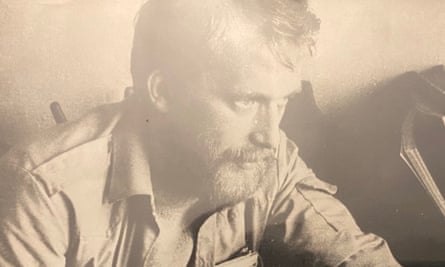
Dissident publisher Mirosław Chojecki. Photograph: Chojecki family
Leaving the building, Walc discreetly scanned the street. As a rule the secret police liked to watch your apartment or place of work and follow you from there, so if you didn’t pick up a tail right away, the prospects of avoiding one were good. All the same, he kept checking until he reached the cafe. Soon Pałka, a giant of a man with frizzy red hair, was settling into the seat next to him.
“Is the place far away?” Walc asked. Pałka took a paper serviette and wrote down an address before burning through the words with his cigarette. Then he passed on a few more details. Water came from a well, but they would need a week’s worth of food, since they couldn’t risk leaving the job to go shopping. The printing machine was a mimeograph made by AB Dick of Chicago. It had already been delivered to the house, along with a tonne and a half of paper, six full carloads. The job was to print several thousand copies of the civil society newsletter Information Bulletin, plus some pages for NOWa’s literary journal Pulse. They would need to buy 10 bottles of turpentine to run and clean the press.
By the time they’d packed all the food, they had no room for the solvent, so they stopped by at a friend’s place to borrow an extra bag. They didn’t realise he was under surveillance, and when they left his building they spotted a boxy grey Fiat saloon with three men inside which shadowed them as they walked along the road.
Reaching a tram stop, they saw the Fiat pull into a side road and park illegally, a sure sign it was the secret police, and when the tram arrived and the printers boarded, two plainclothes agents jumped out of the car and ran across the street, climbing up behind them. All four men now sat in the same streetcar as it rattled towards Zawisza Square. The Fiat kept pace alongside.
How to get rid of them? As they reached a stop, the printers saw the Fiat was boxed in at the traffic lights, and they took their chance, leaving the tram at the last minute. When the lights changed and the unmarked car had to pull away, Walc and Pałka were hurrying in a different direction, towards the railway station. A part of their tail was lost, but the other two agents had been alert and were keeping pace behind them as they ran down the station platform.
The agents were close as they boarded a train for Warsaw Central. Walc made a show of placing his bags on the luggage rack, but as the doors closed Pałka jammed his leg between them and slipped out. Walc now had the two remaining agents to himself. His job was to drag them around long enough for Pałka to prepare the next move. The men were behind him as he left the train at Warsaw Central and ducked into the warren of passages beneath the station. He knew police radios wouldn’t work down here. He ordered a Coke at a bar, bought some cigarettes, browsed the shops. When 20 minutes had passed, he emerged and headed for the taxi rank. He could see one of the men talking into his lapel as he climbed into a cab.
Warsaw’s Poniatowski Bbridge is as much a viaduct as a river crossing, the roadway linked to the streets below by a series of stone staircases. Speeding east, Walc gave the driver his instructions. Midway along the viaduct, the taxi came to a sudden halt, and the printer dived out and ran down the steps to the street below.
The chasing agents pulled up behind and raced down in pursuit, but as they reached the lower level Walc was already climbing into another cab, where Pałka was waiting. The policemen watched as their quarry pulled away. Knowing they would now be radioing in the cab’s licence plate, a few hundred yards up the road the printers swapped into another taxi. They transferred their bags, left a generous tip and gave the new driver an address on the far side of the city.
Around 3pm, they caught the train to Rembertów The place looked ideal. It was set back from the street, at the far end of a large, overgrown garden. The printing machine and the paper were hidden in an outhouse, 500 reams stacked almost to the roof. The paper was damp, which was far from ideal, but they would make it work somehow.
By evening their small room was filled with the fumes of cigarettes and turpentine, and the sound of the duplicating machine beating out its regular, soporific rhythm, bad-dum bad-dum bad-dum bad-dum. Underground printing was filthy, exhausting work. The duplicators were old and the paper was poor. Bibula, the Polish word for uncensored publications, means “blotting paper”, which reflected the stock they had to work with, which had to be hand-fed into the machine, three pages a second, hour upon hour. This meant they worked round the clock, in shifts, for days, until the job was done.
Pałka had brought along a transistor. They tuned it to Radio Free Europe, which maintained a regular commentary on Chojecki’s upcoming trial. American printers and British lawyers were protesting at what they called a show trial. Amnesty International was sending a legal representative. “A great day is coming,” Walc thought, “and we are stuck in a printing shop!” If they hurried the job, they might still be able to get to court.
Early on Thursday morning they had 20 reams left to print. By 8pm, Pałka was finishing the last stencil and Walc was burning misprints in the garden. Before leaving they had to strip down the machine, wash all the parts and lubricate them.
At last, carrying 50 copies of the Bulletin, they found a taxi and gave the driver the address of the apartment where they had been told to collect their pay. They arrived around 11pm. It was crowded with people, including half the Bulletin’s editors. Walc asked about the trial. He was astonished to hear it was already over. The sentence had been read an hour ago. One of the editors had just come back from the court, where they saw Chojecki deliver an excoriating indictment of the communist system. He told the court that his flat had been searched 17 times in the past four years, on a litany of pretexts: they were looking for a murderer, they had said, or a poisoner or a thief, but all they ever took away for evidence were books, typewriters and manuscripts.
“Why are such accusations levelled against people who fight against the pillaging of our culture? Officially, half of our recent history is erased from textbooks, studies, encyclopedias,” said Chojecki. It was the same in literature, where the state gave itself a “monopoly of thought” and a “monopoly of the word”. The lists of banned authors contained some of world’s best writers, he said. That was why he and his colleagues had set up NOWa, to fill the silences and correct the falsification.
Reaching a rousing finale, Chojecki announced that the trial was not about the accused at all, but about “free speech and thought, about Polish culture, about the dignity of society”.
Of course, none of this would change the verdict. The court duly convicted Chojecki and his co-defendants of theft of state property. He was sentenced to 18 months in prison, suspended for three years. But to everyone gathered in the editors’ apartment, this was a tremendous victory and Chojecki was a hero.
“Everybody around us rejoices,” Walc wrote in his account of that week’s events, which would be published in the following month’s Bulletin.
Someone pressed a cold beer into his hand. It was midnight.
Chojecki’s parents had fought for Polish independence with guns and bullets. He continued the struggle through literature and publishing. At times, his father, Jerzy was sceptical of his son’s tactics. “Do you think, Mirek, that you’ll be able to bring down the communist system with your little books?” he would ask. “Do you think your little words will make a difference?”
In fact, the impact of the CIA-sponsored literary tide was huge. By the mid-1980s the so-called “second circulation” of illicit literature in Poland grew so large that the system of communist censorship began to break down. Poland was the most crucial of eastern bloc nations: when communism collapsed in 1989, this was the first domino to fall. As the leading Polish dissident Adam Michnik put it: “It was books that were victorious in the fight. A book is like a reservoir of freedom, of independent thought, a reservoir of human dignity. A book was like fresh air. We should build a monument to books … they allowed us to survive and not go mad.”
Teresa Bogucka didn’t know for sure who was paying for the literature she received from the west, but she was aware that the Polish regime claimed that American intelligence supported émigré publishers, and the idea didn’t concern her at all.
“I thought, wow, a secret service supporting books,” she said. “That’s fantastic.”
This is an edited extract from The CIA Book Club: The Best Kept Secret of the Cold War by Charlie English, published by William Collins on 13 March.



 Scottie's Playtime