Ron has followed this young man for a while. This morning he was telling me how smart and well grounded he was. I decided to check him out. I found out I really like his content. Here are a few clips. Hugs
Adam Mockler with MeidasTouch Network breaks down Donald Trump’s botched Ukraine meeting.
Adam Mockler with MeidasTouch Network breaks down Donald Trump and JD Vance throwing a fit while meeting with President Zelenskyy.
This story was originally reported by Mel Leonor Barclay and Jasmine Mithani of The 19th. Meet Mel and Jasmine and read more of their reporting on gender, politics and policy.
Organizations that provide services to LGBTQ+ victims of domestic and intimate partner violence expect much of the federal funding they rely on to dry up as the Trump administration’s executive orders target the work they have been carrying out for years.
Some received direct notices from the federal government to stop work that promotes what the administration is calling “gender ideology extremism” and to include disclaimers on their websites that the federal government doesn’t support their mission.
Federal grants make up significant shares of operating budgets for many domestic violence nonprofits, and losing that funding puts their continued existence at risk.
Groups that focus specifically on LGBTQ+ victims are part of a broader network of federally funded nonprofits that provide life-saving counseling, housing and legal aid to people experiencing violence from spouses, partners or family members. Some nonprofits also train social workers, therapists and lawyers in how to work sensitively with LGBTQ+ victims of violence.
The White House has promised to slash funding for programs that don’t align with the administration’s ideology on gender, race and immigration.
Domestic violence groups and the broader network of gender-based violence nonprofits have been on high alert since a temporary federal freeze in late January, as The 19th reported this month. The vague language of President Donald Trump’s executive orders — “illegal” diversity, equity, inclusion and accessibility activities; “gender ideology extremism” — has left organizations scrambling to figure out if they stand to lose federal funding.
Some are trying to protect their funding by removing language or resources that they fear may be at odds with the executive orders. The people leading groups founded specifically to support LGBTQ+ people say that for them, there is no hiding: The executive orders specifically target the people they are focused on serving.
“Some groups are making an effort to kind of change the way they talk about their services and the populations they serve. Our organization literally has the words gay and lesbian in our IRS name — we’re not fooling anybody. And obscuring what we do and who we serve doesn’t help those services stay accessible,” said Audacia Ray, the interim executive director of the New York City Anti-Violence Project, officially the New York City Gay And Lesbian Anti-Violence Project Inc., which supports LGBTQ+ and HIV-affected victims of violence.
LGBTQ+ Americans, with the exception of gay men, are more likely to have experienced domestic violence, partner abuse or dating violence than cisgender and heterosexual people. Queer women are significantly more likely to have experienced intimate-partner violence in their lifetime than straight women, according to an analysis of federal survey data by the Human Rights Campaign.
Transgender people are four times more likely to be victims of violent crime than cisgender people, according to research from the Williams Institute at UCLA. Fifty-four percent of respondents to the 2015 U.S. Trans Survey — the most recent data available — said they have experienced intimate partner violence, and 47 percent reported being sexually assaulted. Transgender people are also more likely to experience severe physical intimate partner violence than the average American.
Nonprofits serving victims of violence have long relied on federal funding, especially since the Violence Against Women Act created specialized grant programs 30 years ago. They receive little support from private philanthropy: Most recent data from the Equitable Giving Lab shows about 0.1 percent of charitable giving in the United States goes toward LGBTQ+ causes, and less than 2 percent goes toward women and girls.
“The danger of this moment is that it becomes very nebulous to people how federal funding contributes to the basic social safety net. There aren’t donors. There isn’t all this money,” said the executive director of a regional nonprofit serving LGBTQ+ victims of violence that receives about 40 percent of its funding from the federal government. The organization helps offer shelter and direct cash assistance, among other services, to LGBTQ+ people fleeing violence.
The executive director spoke on condition of anonymity out of fear that their organization would be targeted further by the Trump administration.
“When people are facing imminent threat of being murdered, and there are no resources to give people funding to flee that situation … it is going to result in more death. Truly, I believe that.”
The need for targeted LGBTQ+ services
Nonprofits focused specifically on LGBTQ+ communities sprung up to meet the specific needs of this population, which experiences higher incidences of violence and also discrimination based on gender-identity and sexual orientation.
LGBTQ+ people are vulnerable to abuse related to their identity, including threats of outing that could cost them housing, jobs or other relationships. Queer survivors are often isolated from typical support systems like family who could help them in an abusive situation. Transgender people are more likely to be killed by intimate partner violence, and the risk is increased for people of color, especially Black trans women.
Groups focused on LGBTQ+ survivors serve as a critical safety net for LGBTQ+ victims, often accepting referrals from national and local groups without tailored resources. The Hotline, a national nonprofit that supports victims of domestic violence, describes the “fear of not receiving services” as an obstacle “to reaching safety that LGBTQ+ people might confront.” It offers referrals to service providers focused on LGBTQ+ people – the same providers that are now staring down the loss of federal funding.
Given the executive orders, “there’s no universe in which some of the work doesn’t take a hit. I feel very clear about that,” said Ray of the New York City Anti-Violence Project. And at the same time, “we have to be able to answer the phone and support our community, who’s directly impacted by all this violence.”
NYCAVP runs a 24/7 hotline for victims of violence, as well as free long-term counseling, legal services and connections to support groups. About two-thirds of the organization’s budget comes from a mix of federal, state and local government grants. Most of its funding comes from programs targeting “underserved communities.”
Ray said that the New York City Anti-Violence Project, in addition to offering direct services to victims, including through its hotline, also spends resources advocating and advising lawmakers on legislation affecting LGBTQ+ people. For example, NYCAVP helped shape the 2013 reauthorization of the Violence Against Women Act, the first federal funding statute that banned discrimination based on actual or perceived gender identity and sexual orientation.
“My immediate thought was we will do what we do as long as we can, and we’re not preemptively laying people off or shutting anything down,” Ray said.
“We have a couple different contingency plans around, ‘What are the services that we need to prioritize and center, and how do we continue to do that as long as possible?’”
The executive director who spoke on condition of anonymity said their organization connected with more than 600 LGBTQ+ people facing abuse and violence in the past year. Some came as referrals from domestic and intimate partner violence organizations that weren’t equipped to serve them, or who were working with a victim needing relocation to a state less hostile to LGBTQ+ people. “It’s kind of like an informal witness protection program,” they said.
Without federal funding, they said, their ability to help these victims will significantly shrink.
How nonprofits are fighting back
In a lawsuit filed Thursday by Lambda Legal on behalf of nine nonprofits that receive federal funding, the plaintiffs argue that the Trump administration’s executive orders, including the order calling for the end of federal funding for activities that promote “gender ideology extremism,” amount to “an existential threat to transgender people.” They argue the orders are unconstitutional because they violate the groups’ free speech, due process and equal protection rights.
“The executive orders force plaintiffs to silence their speech and viewpoints… that are not only of great societal importance but also central to plaintiffs’ missions… or forgo federal funding,” the complaint reads. “That choice is an impossible one.”
Among the plaintiffs suing Trump is FORGE, one of the only organizations in the country focused on supporting transgender people experiencing intimate partner violence. FORGE trains providers who assist transgender and nonbinary survivors of sexual assault, intimate partner violence and hate crimes. The 30-year-old organization also connects victims with wellness services.
According to the case filing, 90 percent of FORGE’s funding is derived from federal grants, the highest out of any listed plaintiff. It has received grants from a wide range of agencies including the Department of Justice, the Department of Health and Human Services (HHS) and the National Institutes of Health.
Several other plaintiffs that received funds from HHS programs, according to the complaint, were sent notices in late January to “immediately terminate, to the maximum extent, all programs, personnel, activities, or contracts promoting ‘diversity, equity, and inclusion’” or, separately, “gender ideology.”
“Trans and nonbinary people are scared and hurting – not only from the high levels of violence so many of us experience every day, but also because of the dehumanizing, erasing, and damaging impact of the Executive Orders. For the past 30 years, FORGE has been committed to serving trans survivors of sexual assault, stalking, and hate-fueled harm. We are not going anywhere,” michael munson, executive director of FORGE, said in a statement. “Conditioning federal funding on rejecting transgender identity and DEI not only harms trans people, but it also creates a world that is less safe and less free for us all.”
Deleting language and resources
The National LGBTQ Institute on Intimate Partner Violence urged fellow providers to “hold the line together” and stand in solidarity with LGBTQ+, immigrant and BIPOC survivors in an email obtained by The 19th. The missive explicitly called upon organizations to continue serving LGBTQ+ survivors, to not take down materials tailored to the queer community and to keep pronouns on public-facing materials. It also cited previous reporting from The 19th detailing how some groups removed mentions of LGBTQ+ people from their websites.
“For organizations that have removed LGBTQ+ materials, we encourage that these materials be restored,” the statement read. “We urge organizations to not cede our collective power as a movement and back down in our work to protect LGBTQ+ survivors.”
The group reminded organizations in its network that federal law — the same law that the New York City Anti-Violence Center helped pass — makes it illegal to discriminate based on actual or perceived gender identity or sexual orientation. “These federal non-discrimination policies remain in place and give us power to protect transgender survivors in the work that we do,” the organization said.
The Los Angeles LGBT Center, where the institute is housed, declined to speak on the record, citing the current lawsuit.
Several days later, Respect Together, the umbrella organization of the National Sexual Violence Resource Center and the Pennsylvania Coalition to Advance Respect, publicly apologized for removing resources for LGBTQ+ people from their websites.
“Federal and state funding accounts for the vast majority of our operational budget, and as a result, we acted too swiftly to the news from the current administration,” the apology reads. “We heard you, and recognize that this was the wrong choice,” CEO Yolanda Edrington said in the statement. “We are committed to rebuilding trust, learning from this experience, and ensuring that our actions align with our mission to support survivors of all communities, their allies, and advocates.”
The Hotline, which had deactivated a page on LGBTQ+ resources earlier this month, has now restored it. The organization did not respond to a request for comment on the restoration, but told The 19th earlier this month that it was reviewing its website to protect its federal funding.
Even if groups commit to still serve all people in need, regardless of identity, removing resources adds friction. Visibility and ease of navigating resources when you are in need of services is important, said Tandra LaGrone, the CEO of In Our Own Voices, a nonprofit supporting LGBTQ+ people of color in upstate New York, which has received a grant from the Office on Violence Against Women.
The erasure of information can lead victims to feel like they are at fault, LaGrone said.
Ray said that it’s a big risk to not change their organization’s public-facing content in anticipation of a potential loss of funding, but they think holding steady is the right thing to do. Backing down won’t reduce violence, they said.
“I really believe that complying in advance of direct demands and being forced to change those programs is contributing to the overall violence against LGBT people,” Ray said. “That sort of advance compliance is extremely worrisome to me, because it shows that those orgs are concerned about the org as an institution more than they’re concerned about the community as a directly impacted population.”
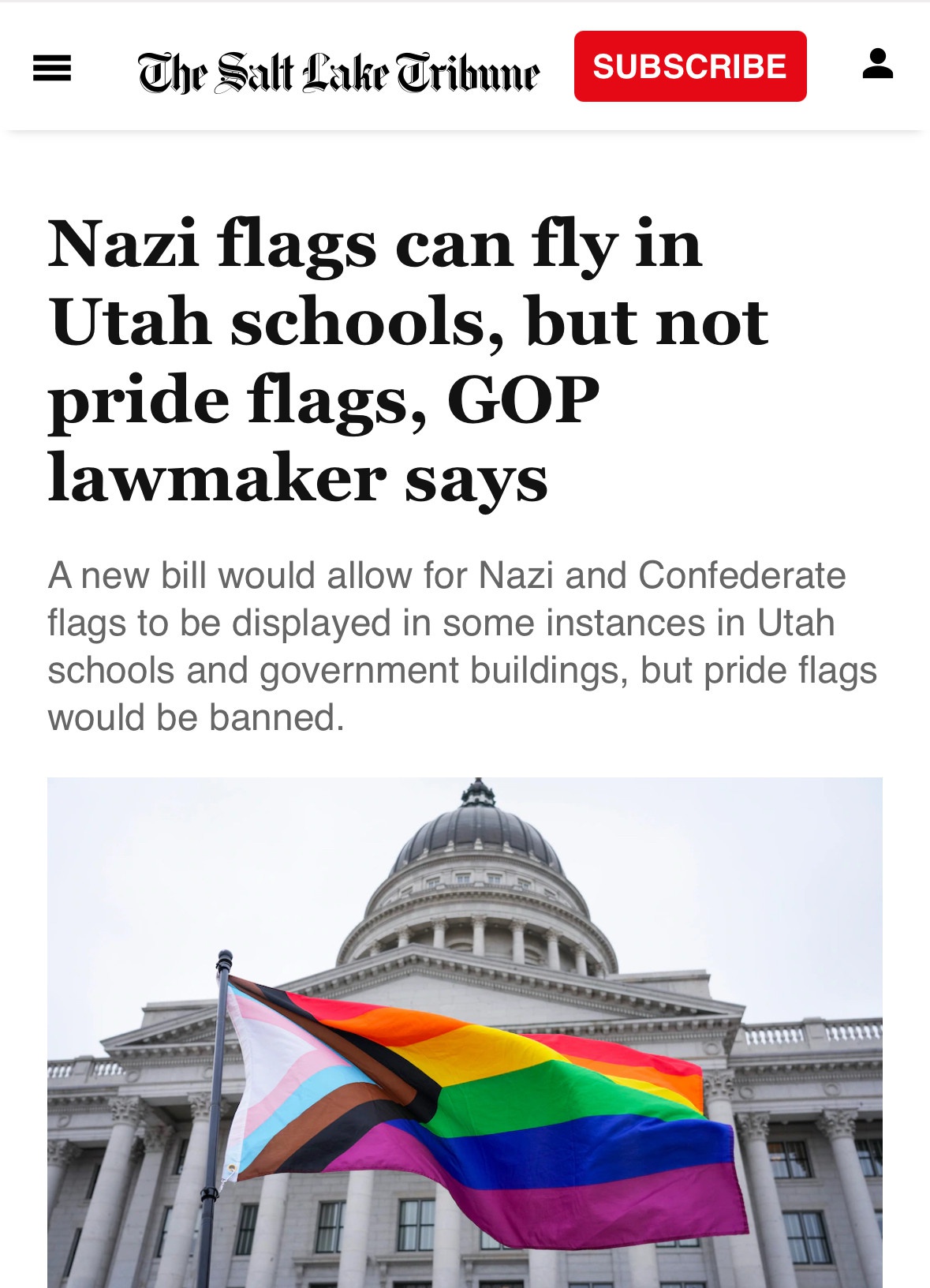
An ongoing fight in Utah to ban pride flags in schools entered new territory Thursday after Rep. Trevor Lee proposed new legislation to ban the flags not just in public schools, but in any government building or on any government property. The bill, HB0077, originally applied only to schools. But an update to the bill released ahead of Thursday’s House Education Committee hearing expands the ban to all government buildings or property.
Approved flags for display in government buildings and schools would include the Utah state and U.S. flags, military flags, flags for other countries, flags for Native American tribes and official flags for colleges and universities. The bill also allows for the flying of a “historic version of a flag … that is temporarily displayed for educational purposes,” which Lee, R-Layton, said would include the Confederate and Nazi flags.
Read the full article. In his floor speech, Lee said, “You may have a Nazi flag. You may have a Confederate flag, and so you are allowed to display those flags as part of the curriculum, and that is okay.” An attempt to ban Pride flags failed in 9-20 Utah Senate vote last year. As you’ll see in the video report below, Lee has a history. His X feed is mostly retweets of prominent cultists and extremists. He’s also attacking the “dumb” report linked above.
A new bill would allow for Nazi and Confederate flags to be displayed in Utah schools and government buildings, but pride flags would be banned. https://t.co/Itdt9Ldocl
Sorry this may be the last post I make today. I am not doing well. I have had 3 hours sleep in two days. Monday I got a steroid shot in each shoulder so I could move them again. My bones ache so bad I wondered if I had gotten a cold or flu again. Steroids do depress my already depressed immune system. But I can hardly stand the pain in my hands, arms, legs, and I am not a jolly fellow today. Tomorrow I have my allergy shots. That should be great, right, what could go wrong with how I feel. Ron is going with me and we are going to buy the flooring for the Florida room Ron built and that will be my new office. As I have said before it is to give me more light and not feeling so isolated and will give us a spare bedroom for visitors. Hugs
Reviewing a directive from DCPAS Director Daniel J. Hester. This applies to DOD civilian personnel. On Friday the 28th, they “must terminate the employment of all individuals who are currently serving probationary or trial periods in the DOD.” The document lists categories of exception: positions “designated mission critical,” “political appointees.” There are a few other technical exception categories. Document signed yesterday.
Yesterday I saw a video from VA Secretary Doug Collins (former member of Congress from Georgia) bragging about how they were cutting $2 billion worth of what were clearly, in his estimation, worthless and stupid contracts. They were in fact almost one thousand different contracts tied to everything from medical and burial services to cancer prevention and doctor recruiting programs. I’ve posted that video below. This afternoon I received this email from a longtime reader …
I’m a contractor working for a service-disabled veteran-owned small business (SDVOSB) for 15 years. I’ve worked on projects with the Veterans Benefit Administration and the Veterans Health Administration. During that time, I’ve run marketing campaigns to get veterans to enroll in healthcare, conducted program evaluations and process improvement efforts, and provided strategic communications support.
I’ve been very proud of my work and the VA mission. But today I’m devastated. My contract was one of more than 800 that were canceled last night. The cancellations were not based on any evaluation. DOGE appears to have simply identified all professional services contracts and canceled them.
The cancellations will not only have a terrible impact on VHA healthcare, it will destroy hundreds of SDVOSBs because a great deal of VA contracts go to SDVOSBs. I don’t know how Republicans in Congress can let this destruction continue when so many of them profess to care deeply about veterans.
This afternoon, VA appears to have reversed course, now saying their going to review and potentially reverse at least some of the cancellations. “Under pressure, VA halts contract cancellations in major reversal” reads the WaPo headline. It goes on: “Records show the 875 contracts at issue included support for medical and burial services, cancer programs, and efforts to recruit doctors for critical vacancies.”
“I don’t have a lot of hope that they’ll reverse many,” the TPM Reader followed up.
The last Trump administration might not have introduced the concept of disinformation, but 2.0 has taken propaganda to a new dangerous level. Are we better equipped to combat it this time around?
But I have some ideas that might help. Here is what I have learned from my work as a debunker and a cross-border reporter with a background in breaking news, where you have to learn to protect yourself and your information:
Limit the time you spend consuming news. The news cycle is being deliberately weaponized to make you feel hopeless in ways that many journalists are unable or unwilling to understand and mitigate at the moment.
Limit your time on social media unless you can have trusted private networks. And even then don’t talk about anything unlawful. Save those conversations for face-to-face meetings.
Embrace physical media. Write things down. Send letters to each other. No, really.
It’s possible to step up and help when others won’t. We can learn from previous disasters and do better, if we work together.
Find and form trusted mutual aid networks.
Support your local libraries.
Do not waste your time appealing to authority that has demonstrated they are unwilling to fight for you. Fact-checking is always important, but it is only effective on its own in a healthy democracy. We are not in a healthy democracy.
Learn your regional history, particularly unresolved crimes against humanity such as slavery and genocide. Learn about vulnerable groups and how they are treated. Often, those painful histories are leveraged in the service of disinformation campaigns. Listen to marginalized people.
Follow people online who you have already observed having integrity. Give people the benefit of the doubt if you hear rumors. Do not give them the benefit of the doubt if you observe them engaging in bad behavior.
Toss toxic people out of your trusted networks.
Keep a journal. Write a few words in it every day, if you can; it doesn’t need to be a long letter to yourself. Writing down your thoughts will help you remember what you want to remember, and it will also provide you with a bulwark against weapons-grade gaslighting.
Take breaks and find joy somehow. This is going to really suck. Find or make a haven for yourself if you possibly can.
Take care of your health. Don’t forget to rest, eat, and hydrate. Find a place you can retreat and shut out the rest of the world if you have to.
Spend time with your loved ones.
Stand up for each other, even when it’s hard. (And it will be hard.)
We can get through this. But in order to do so, we all have to work together to debunk poisonous lies and preserve our memories and our thoughts, because that’s how we build resilience, real resilience, the type that gives us what we need in order to bounce back from the heartbreak and tragedies of the last few years and whatever is to come. We can do that if we work together, and the time to do so is now.
Fox host and loyal Trump ally Sean Hannity told a listener who was pleading for the jobs of military vets in the federal government that “there will be other opportunities.” The caller elaborated on their experience: “One of our tenants just recently got laid off from the USDA, and he’s a stable vet, multiple deployments overseas. And yeah, the guy is without a job now, and I’m just afraid that, you know, stuff like this is going to get out there.” The caller noted Hannity’s “soft spot for military and police and EMS and all those guys” and said that it’s “just a little concerning that we don’t let these guys, you know, fall off the wagon here and get neglected, because they’ve done so much for our country.” [Premiere Radio Networks’ The Sean Hannity Show, 2/21/25]
Another caller to Hannity’s show asked him to stand up for “rank and file” agents: “This appears to be a misstep in the wrong direction.” Hannity responded by saying, “There are going to have to be hard questions for rank and file members in terms of their priority and whether or not they challenged some of the higher-ups.” [Premiere Radio Networks’ The Sean Hannity Show, 2/5/25]
A listener called into The Clay Travis and Buck Sexton Show to say that they are “not happy with his [Trump’s] recent comments on Ukraine.” Travis appeared to cut the caller off, asking of Russia’s war with Ukraine, “How do you think this should end?” [OutKick, The Clay Travis and Buck Sexton Show, 2/21/25]
A caller into Hannity’s show who described themselves as a “strong supporter of this administration” pleaded for advice with the firings: “How do you make life decisions?” Hannity responded by saying, “The main focus is going to be on limiting the bureaucracy. How many of these jobs are redundant? … Just make yourself as essential as possible.” The caller elaborated: “Mr. Musk talks about cutting, you know, $2 trillion. Well, that’s beyond what the entire discretionary budget every year is, you know, roughly 1.7, 1.8 for discretionary. You would have to eliminate everything, the entire federal government to hit that.” [Premiere Radio Networks’ The Sean Hannity Show, 2/6/25]
A caller to The Alex Jones Show accused Trump of “lying” about birthright citizenship: “If they want to pass this, we’re going to get rid of 150 million U.S. citizens.” Jones responded by asking the caller if they like the “Chinese flying here one week before they have their baby, getting all their health care paid for?” The caller expressed that their “concern is I was born in this country.” [Infowars, The Alex Jones Show, 2/20/25]
A Canadian listener called into Hannity’s radio show to discuss boycotts there against the U.S.: “You’ve disrespected us to this point, and we have to respond.” The caller told Hannity that Canadians are “buying Canadian” and are not going to Florida for vacation, concluding that the “boycott’s already begun.” Hannity retorted: “Who would be hurt worse by” a “boycott war” between the U.S. and Canada? [Premier Radio Networks, The Sean Hannity Show, 2/25/25]
A caller told Hannity, “I cannot agree with you on the Gaza situation.” They continued, “As far as making those people leave their land and not being able to return, that’s just totally wrong.” Hannity defended Trump’s plan as “rebuilding Gaza, creating jobs, [and] building innovation,” to which the caller responded “that’s not innovative. That’s racist,” because “the president said those people cannot return” and “most of these people don’t have anything to do with Hamas.” When Hannity claimed that “the people in Gaza voted in Hamas’ leadership,” the caller told him that “what you’re saying is that everybody there is a terrorist, and that’s racist.” [Premiere Radio Networks, The Sean Hannity Show, 2/13/25]
A listener called into Hannity’s show to discuss their child’s cancer diagnosis and advocate for cancer research funding: “With the lack of funding, basically, all you get is parents like me who have had a kid with this, starting organizations and coming up with money to carry on the research for them. So that’s why I wanted to call and … advocate for research.” Hannity responded by arguing that “most of the solutions for cancer are going to be found in the private sector, not with public money.” The caller noted that “with such a small number of kids getting this [cancer diagnosis], yeah, it’s definitely something that doesn’t get looked at as much.” Hannity responded that “even if the government spent … $300 million on this particular cancer tomorrow, it’s not going to be your answer.” [Premiere Radio Networks, The Sean Hannity Show, 2/12/25]
Chris Stigall, host of The Chris Stigall Podcast, noted that he’s received “quite a bit of outreach from you federal workers.” He read one email from a listener who remarked that “it’s difficult to get beyond your disrespect and disregard for federal employees.” Stigall noted that the email is “not the only one of these that I got on both X and in email.” Stigall responded to the reader’s email: “I’m going to talk to you like an adult here for a minute. Grow up. Grow up. If you work for the federal government, you need to grow up, respectfully.” [The Chris Stigall Podcast, 2/24/25]
A caller to Fox host Brian Kilmeade’s radio show accused Trump of trying to “bribe” people with DOGE dividends. The caller noted, “The last tax break that Trump gave was $1.9 trillion and 65% with the people making over a $130,000 a year. … If you’re going to get after the excess spending, you have to go after a military waste and the rich — make the rich pay. Instead, he’s trying out for a $5,000 bribe to people.” [Fox News Radio, Brian Kilmeade Show, 2/21/25]
A caller to Fox host Mark Levin’s radio show makes impassioned plea concerning the legal status of his fiancé: “We’ve been planning on getting married now for a few months. And it seems like I’ve read on the news now that, if you were paroled into the United States, you can’t file any forms, for immigration.” The caller also expressed concern with people turning against Ukraine, where his fiancé and her family are from. [Westwood One, The Mark Levin Show, 2/19/25]
It’s interesting because these shows have screeners so I assume they wanted their audiences to hear these complaints so that the hosts could knock them down. I don’t think they actually did. Those retorts are lame and I would guess that a lot of listeners get that.
The best way to make people understand what’s going on is to relay real stories of real people being affected by this chaotic purge. I’m surprised they are even letting them on the air. They have to realize that even allowing them to voice their pain is a mistake but it’s entirely possible they are so filled with bravado and hubris that they think their lame rationales will be convincing. And in fairness, they probably are to quite a few of their listeners. But I doubt it’s convincing to everyone.
House Republicans are becoming weary and wary of in-person town hall meetings after a number of lawmakers have faced hometown crowds angry about the Trump administration’s push to slash government programs and staffing.
Party leaders suggest that if lawmakers feel the need to hold such events, they do tele-town halls or at least vet attendees to avoid scenes that become viral clips, according to GOP sources.
A GOP aide said House Republican leaders are urging lawmakers to stop engaging in them altogether.
The town halls, and the rash of negative headlines, have been the first bit of public blowback for members who face voters next year. And the new reluctance to hold them indicates there are bubbling concerns about the impact the cuts could have on the GOP’s chances of holding its thin majority in the House next year.
The viral nature of video clips spreading from one district to another means a bad confrontation in safe Republican territory could influence voters in battlegrounds.
Good luck with that. Pissed off people are not going to be silenced. They should know that having been the beneficiaries of the Tea Party back in 2010.
By the way, in that mid-term, the Democrats lost 53 House seats and six Senate seats. That was after Obama had won by a huge margin compared to Trump last November. I don’t know that such a landslide can be possible in these days but you never know. I certainly wouldn’t bet on them holding their majority in any case. (snip)