or wherever mentions of prices, and whatever else has improved since Pres. Biden took office. I post this because my own US Rep is campaigning about how bad everything is, with facts from the Don’s admin when they’re facts at all. I’m certain he’s not the only “safe” (I voted for the Dem-we actually have a Dem running!) Republican running for the US House, as they’re all up for election every two years. Anyway, he makes the claims that things are bad under Biden-Harris, and how he’s just focusing on improving those very things that have improved thanks to Biden-Harris and the legislators who managed to get things passed (most Republicans are not among those legislators, btw.) Anyway, here’s Heather Cox Richardson:
In a new rule released yesterday, the Federal Trade Commission requires sellers to make it as easy to cancel a subscription to a gym or a service as it is to sign up for one. In a statement, FTC chair Lina Khan explained the reasoning behind the “click-to-cancel” rule: “Too often, businesses make people jump through endless hoops just to cancel a subscription,” she said. “Nobody should be stuck paying for a service they no longer want.” Although most of the new requirements won’t take effect for about six months, David Dayen of The American Prospect noted that the stock price of Planet Fitness fell 8% after the announcement.
When he took office in January 2021, with democracy under siege from autocratic governments abroad and an authoritarian movement at home, President Joe Biden set out to prove that democracy could deliver for the ordinary people who had lost faith in it. The click-to-cancel rule is an illustration of an obvious and long-overdue protection, but it is only one of many ways—$35 insulin, new bridges, loan forgiveness, higher wages, good jobs—in which policies designed to benefit ordinary people have demonstrated that a democratic government can improve lives.
When Secretary of the Treasury Janet Yellen spoke to the Council on Foreign Relations yesterday, she noted that the administration “has driven a historic economic recovery” with strong growth, very low unemployment rates, and inflation returning to normal. Now it is focused on lowering costs for families and expanding the economy while reducing inequality. That strong economy at home is helping to power the global economy, Yellen noted, and the U.S. has been working to strengthen that economy by reinforcing global policies, investments, and institutions that reinforce economic stability.
“Over the past four years, the world has been through a lot,” Yellen said, “from a once-in-a-century pandemic, to the largest land war in Europe since World War II, to increasingly frequent and severe climate disasters. This has only underlined that we are all in it together. America’s economic well-being depends on the world’s, and America’s economic leadership is key to global prosperity and security.” She warned against isolationism that would undermine such prosperity both at home and abroad.
The numbers behind the proven experience that government protection of ordinary people is good for economic growth got the blessing of the Royal Swedish Academy of Sciences on Monday, when it awarded the Nobel Memorial Prize in Economic Sciences to Daron Acemoglu and Simon Johnson, both of the Massachusetts Institute of Technology, and to James Robinson of the University of Chicago. Their research explains why “[s]ocieties with a poor rule of law and institutions that exploit the population do not generate growth or change for the better,” while democracies do.
Although democracy has been delivering for Americans, Donald Trump and MAGAs rose to power by convincing those left behind by 40 years of supply-side economics that their problem was not the people in charge of the government, but rather the government itself.
Trump wants to get rid of the current government so that he can enrich himself, do whatever he wants to his enemies, and avoid answering to the law. The Christian nationalists who wrote Project 2025 want to destroy the federal government so they can put in place an authoritarian who will force Americans to live under religious rule. Tech elites like Elon Musk and Peter Thiel want to get rid of the federal government so they can control the future without having to worry about regulations.
In place of what they insist is a democratic system that has failed, they are offering a strongman who, they claim, will take care of people more efficiently than a democratic government can. The focus on masculinity and portrayals of Trump as a muscled hero‚ much as Russian president Vladimir Putin portrays himself, fit the mold of an authoritarian leader.
But the argument that Americans need a strongman depends on the argument that democracy does not work. In the last three-and-a-half years, Biden, Vice President Kamala Harris, and the Democrats have proved that it can, so long as it operates with the best interests of ordinary people in mind. Trump and Vance’s outlandish lies about the federal response to Hurricane Helene are designed to override the reality of a competent administration addressing a crisis with all the tools it has. In its place, the lies provide a false narrative of federal officials ignoring people and trying to steal their property.
Their attack on democracy has another problem, as well. In addition to the reality that democracy has been delivering for Americans for more than three years now—and pretty dramatically—Trump is no longer a strongman. Vice President Kamala Harris is outperforming him in the theater of political dominance. And as she does so, his image is crumbling.
In an article in US News and World Report yesterday, NBC’s former chief marketer John D. Miller apologized to America for helping to “create a monster.” Miller led the team that marketed The Apprentice, the reality TV show that made Trump a household name. “To sell the show,” Miller wrote, “we created the narrative that Trump was a super-successful businessman who lived like royalty.” But the truth was that he declared bankruptcy six times, and “[t]he imposing board room where he famously fired contestants was a set, because his real boardroom was too old and shabby for TV,” Miller wrote. While Trump loved the attention the show provided, “more successful CEOs were too busy to get involved in reality TV.”
Miller says they “promoted the show relentlessly,” blanketing the country with a “highly exaggerated” image of Trump as a successful businessman “like a heavy snowstorm.” “[W]e…did irreparable harm by creating the false image of Trump as a successful leader,” Miller wrote. “I deeply regret that. And I regret that it has taken me so long to go public.”
Speaking as a “born-and-bred Republican,” Miller warned: “If you believe that Trump will be better for you or better for the country, that is an illusion, much like The Apprentice was.” He strongly urged people to vote for Kamala Harris. “The country will be better off and so will you.”
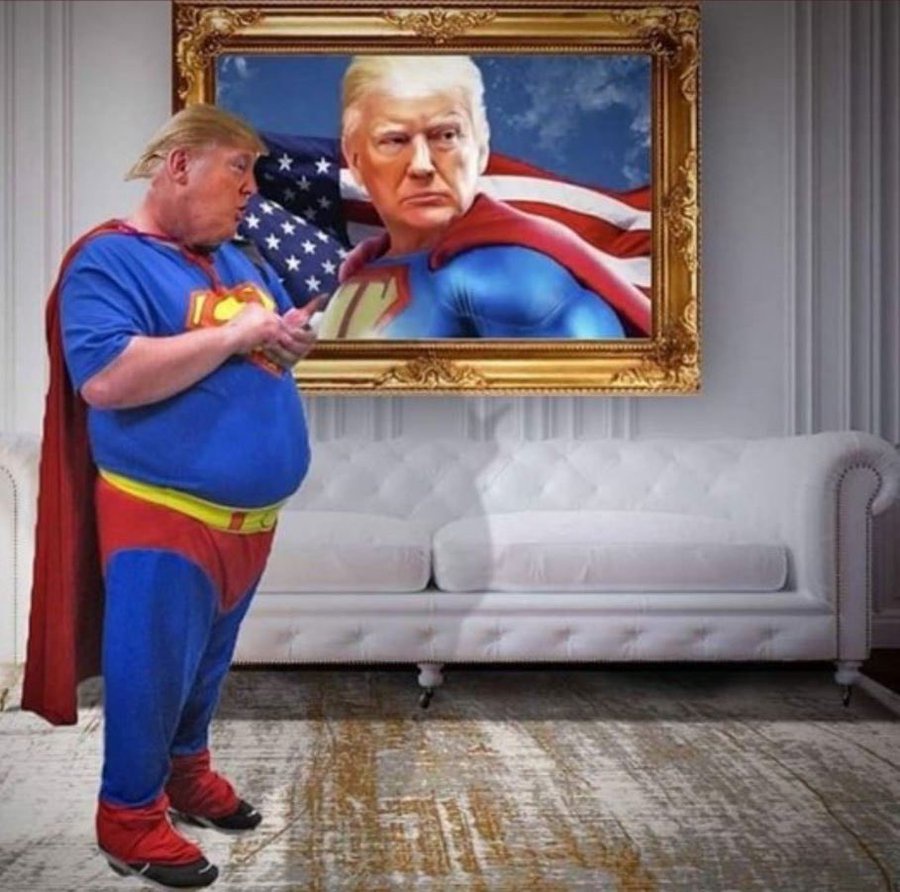
A new video shown last night on Jimmy Kimmel Live even more powerfully illustrated the collapse of Trump’s tough guy image. Written by Jesse Joyce of Comedy Central, the two-minute video featured actor and retired professional wrestler Dave Bautista dominating his sparring partner in a boxing ring and then telling those who think Trump is “some sort of tough guy” that “he’s not.”
Working out in a gym, Bautista insults Trump’s heavy makeup, out-of-shape body, draft dodging, and physical weakness, and notes that “he sells imaginary baseball cards pretending to be a cowboy fireman” when “he’s barely strong enough to hold an umbrella.” Bautista says Trump’s two-handed method of drinking water looks “like a little pink chickadee,” and goes on to make a raunchy observation about Trump’s stage dancing. “He’s moody, he pouts, he throws tantrums,” Bautista goes on. “He’s cattier on social media than a middle-school mean girl.”
Bautista ends by listing Trump’s fears of rain, dogs, windmills…and being laughed at.” “And mostly,” Bautista concludes, “he’s terrified that real, red-blooded American men will find out that he’s a weak, tubby toddler.” Calling Trump a “whiny b*tch,” Bautista walks away from the camera.
The sketch was billed as comedy, but it was deadly serious in its takedown of the key element of Trump’s political power.
And he seems vulnerable. Forbes and Newsweek have recently questioned his mental health; yesterday the Boston Globe ran an op-ed saying, “Trump’s decline is too dangerous to ignore. We can see the decline in the former president’s ability to hold a train of thought, speak coherently, or demonstrate a command of the English language, to say nothing of policy.”
Trump’s Fox News Channel town hall yesterday got 2.9 million viewers; Harris’s interview got 7.1 million. Today, Trump canceled yet another appearance, this one with the National Rifle Association in Savannah, Georgia, scheduled for October 22, where he was supposed to be the keynote speaker.
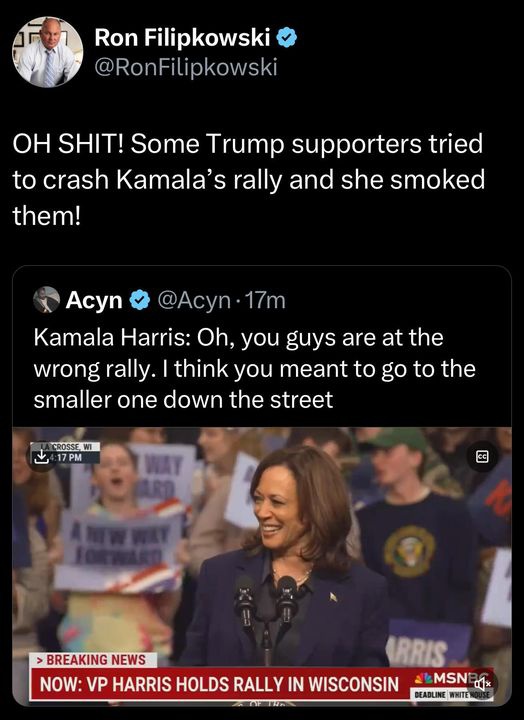
Meanwhile, Vice President Harris today held rallies in Milwaukee, Green Bay, and La Crosse, Wisconsin. In La Crosse, MAGA hecklers tried to interrupt her while she was speaking about the centrality of the three Trump-appointed Supreme Court justices to the overturning of the 1973 Roe v. Wade decision that recognized the constitutional right to abortion.
“Oh, you guys are at the wrong rally,” Harris called to them with a smile and a wave. As the crowd roared with approval, she added: “No, I think you meant to go to the smaller one down the street.”
The outer envelope containing official absentee balloting material for the Wisconsin November 2024 General Election ballot is photographed in Madison, September 21, 2024.
Jon Elswick/AP
A text message last week to young voters in Wisconsin is stirring new concerns in the battleground state about a messaging campaign that could intimidate college students from casting ballots this election, according to a letter from voter protection groups released Tuesday.
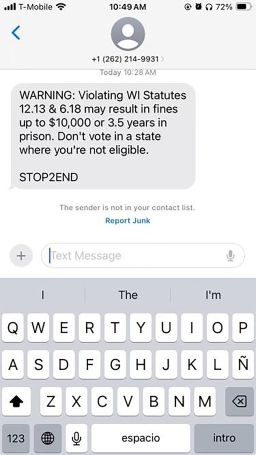
The unsolicited text, sent from at least one 262- number to cell phones of people in their early 20s on University of Wisconsin campuses and elsewhere, says: “WARNING: Violating WI Statutes 12.13 & 6.18 may result in fines up to $10,000 or 3.5 years in prison. Don’t vote in a state where you’re not eligible.”
The two state codes that the text message cites refer to laws that govern former Wisconsin residents who vote absentee and the consequences of committing election fraud in the state.
A text message sent last week to young voters across Wisconsin.
Free Speech for People
But it’s the text message’s warning and wording of “don’t vote” that are causing much of the alarm among the voter protection groups who call the message “threatening” and warn the message could “frighten eligible young voters into not voting.”
“It’s trying to convince students living in Wisconsin they don’t have a right to vote there,” Courtney Hostetler, the legal director of the non-profit group Free Speech for People, said on Tuesday.
Hostetler’s group and the League of Women Voters of Wisconsin alerted investigators and the public of the text message and their concerns about it on Tuesday, in a letter to Attorney General Merrick Garland and Wisconsin Attorney General Josh Kaul that the groups released publicly online. The letter urges Garland and Kaul to investigate.
The League said it had learned about the text message from some of its own staff members who are in their 20s and from a community outreach center at the University of Wisconsin-Madison.
Mark Pitsch, the university system’s spokesman, said the Universities of Wisconsin “have no indication how many students may have received such texts, which also may have been received by members of the general public.” Pitsch added that his office hadn’t received specific reports about the text message as of Tuesday.
Hostetler said her group fears voter intimidation campaigns could be effective if they go undetected.
“If it’s successful, people won’t report it. They’ll just believe it,” she said. “It’s scary, and it makes people really think [that] the safest thing may be for me to not vote.”
College students may be susceptible to the text messages, Hostetler added, given that students may not know where they are eligible to vote and if they can vote while living on their college campus away from home.
In Wisconsin, students who have lived in one voting area for 28 consecutive days and plan to continue staying there can vote in those places, according to the state’s election commission. Even if a college student returns to his or her parent’s house on weekends temporarily, they can still vote where they primarily live, such as on a college campus, the Wisconsin Election Commission’s guide for students says.
“Once a student has established residency at a campus address, the student may vote using the student’s campus address until the student establishes a new voting residence,” the WEC guide says. “This is the case even if the student is temporarily away from campus and does not know their campus address for the following school year.”
Meagan Wolfe, the administrator of the Wisconsin Elections Commission, said Wednesday that “a couple of voters” had contacted the commission with concerns about the text.
“Our best guidance to folks is, again, if you’re getting these concerning or questionable contacts from third-party groups, I wouldn’t trust that information, I would go right to the official source – I’d call your election official,” Wolfe said. “And of course, if a voter feels like something that they’ve received constitutes as voter intimidation, they should also report it to their law enforcement as well, so that they can look into it.”
Free Speech for the People and the League’s letter on Tuesday specifically asks for law enforcement authorities to identify who sent the text and investigate it further.
The organizations said they haven’t heard back yet from the authorities they wrote to seeking help, and the Wisconsin attorney general’s office didn’t immediately respond to an inquiry from CNN.
“We want a larger investigative engine than any of our little nonprofits to figure out who is behind this text message,” Debra Cronmiller, president of the League of Women Voters of Wisconsin, told CNN on Tuesday.
She said the text message is the type of intimidation tactic her organization had envisioned could happen this election cycle — though significant situations of widespread voter intimidation in the past have been spread more often via robocall or AI-generated voice recordings.
This story has been updated with additional reaction.
Republicans know their idea are unpopular and people don’t want their polices. So instead of changing to do the will of the people are they are hired / elected to do, they simply remove voters who won’t vote for them. Very democratic. They demand to rule over the people not represent the people’s will. Hugs.
Across the country, conservatives have challenged the legitimacy of large numbers of voter registrations ahead of the Nov. 5 election.
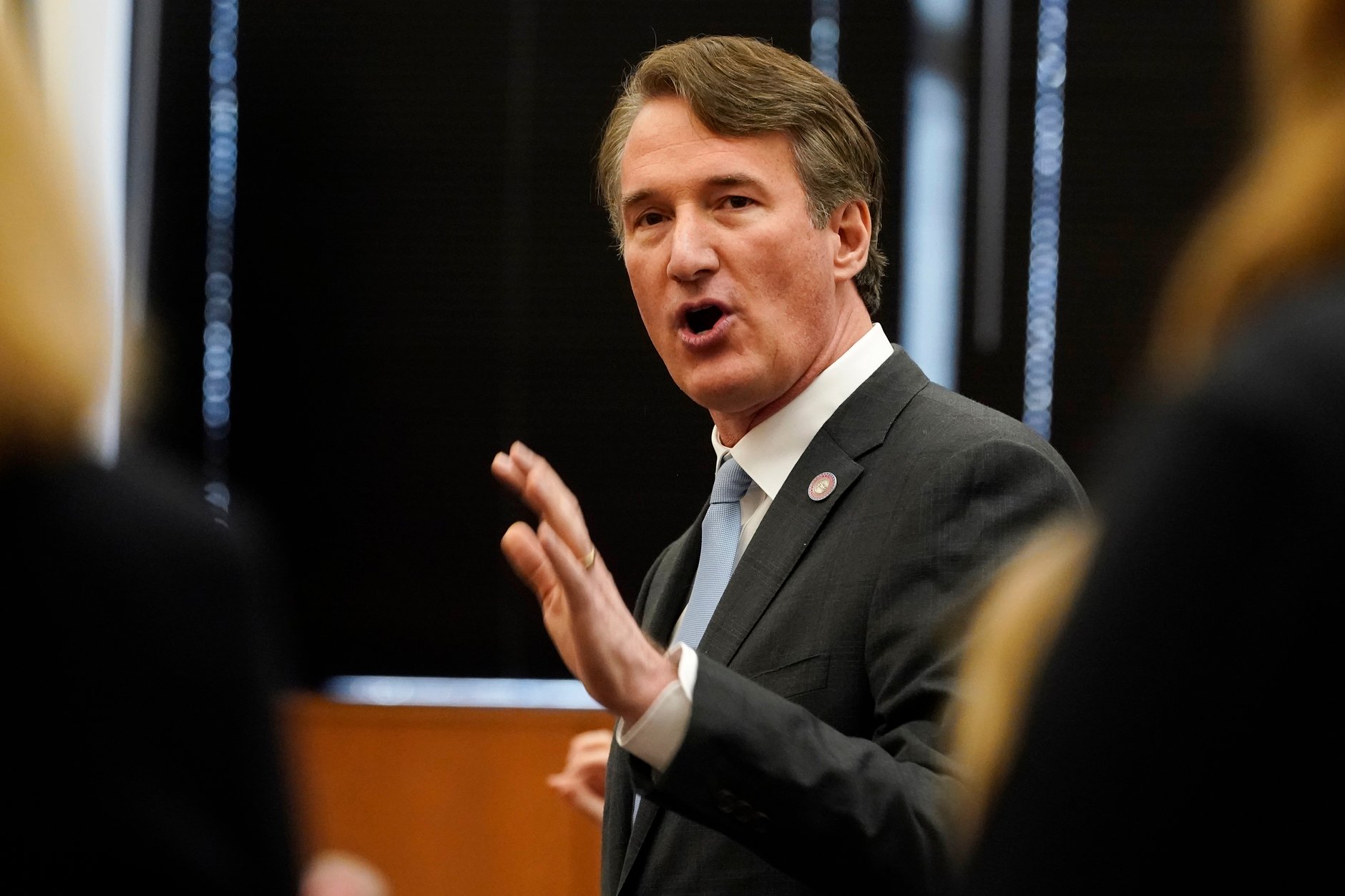
Virginia Gov. Glenn Youngkin speaks during a news conference at the state Capitol in Richmond, Va., on Jan. 27, 2022. (AP Photo/Steve Helber, File)
The U.S. Department of Justice filed a lawsuit against Virginia election officials Friday that accuses the state of striking names from voter rolls in violation of federal election law.
The lawsuit filed Friday in U.S. District Court in Alexandria says that an executive order issued in August by Republican Gov. Glenn Youngkin requiring daily updates to voter lists to remove ineligible voters violates federal law. The National Voter Registration Act requires a 90-day “quiet period” ahead of elections for the maintenance of voter rolls.
“Congress adopted the National Voter Registration Act’s quiet period restriction to prevent error-prone, eleventh hour efforts that all too often disenfranchise qualified voters,” Assistant U.S. Attorney General Kristen Clarke said in a statement. “The right to vote is the cornerstone of our democracy and the Justice Department will continue to ensure that the rights of qualified voters are protected.”
A similar lawsuit was filed earlier this week by a coalition of immigrant-rights groups and the League of Women Voters.
In its lawsuit, the Justice Department said the quiet-period provision reduces the risk that errors in maintaining registration lists will disenfranchise eligible voters by ensuring they have enough time to address errors before the election.
On Aug. 7 — 90 days before the Nov. 5 federal election — Youngkin’s order formalized a systemic process to remove people who are “unable to verify that they are citizens” to the state Department of Motor Vehicles from the statewide voter registration list.
Virginia election officials are using data from the Department of Motor Vehicles to determine a voter’s citizenship and eligibility, according to the filing. The lawsuit alleges the DMV data can be inaccurate or outdated, but officials have not been taking additional steps to verify a person’s purported noncitizen status before mailing them a notice of canceling their voter eligibility.
In a statement on Friday, Youngkin said that state officials were properly enforcing state law requiring the removal of noncitizens from voter rolls.
“Virginians — and Americans — will see this for exactly what it is: a desperate attempt to attack the legitimacy of the elections in the Commonwealth, the very crucible of American Democracy,” Youngkin said of the Justice Department’s lawsuit.
“With the support of our Attorney General, we will defend these commonsense steps, that we are legally required to take, with every resource available to us. Virginia’s election will be secure and fair, and I will not stand idly by as this politically motivated action tries to interfere in our elections, period,” Youngkin said.
Former president often mocks Kamala Harris for using a teleprompter
Video at link above.
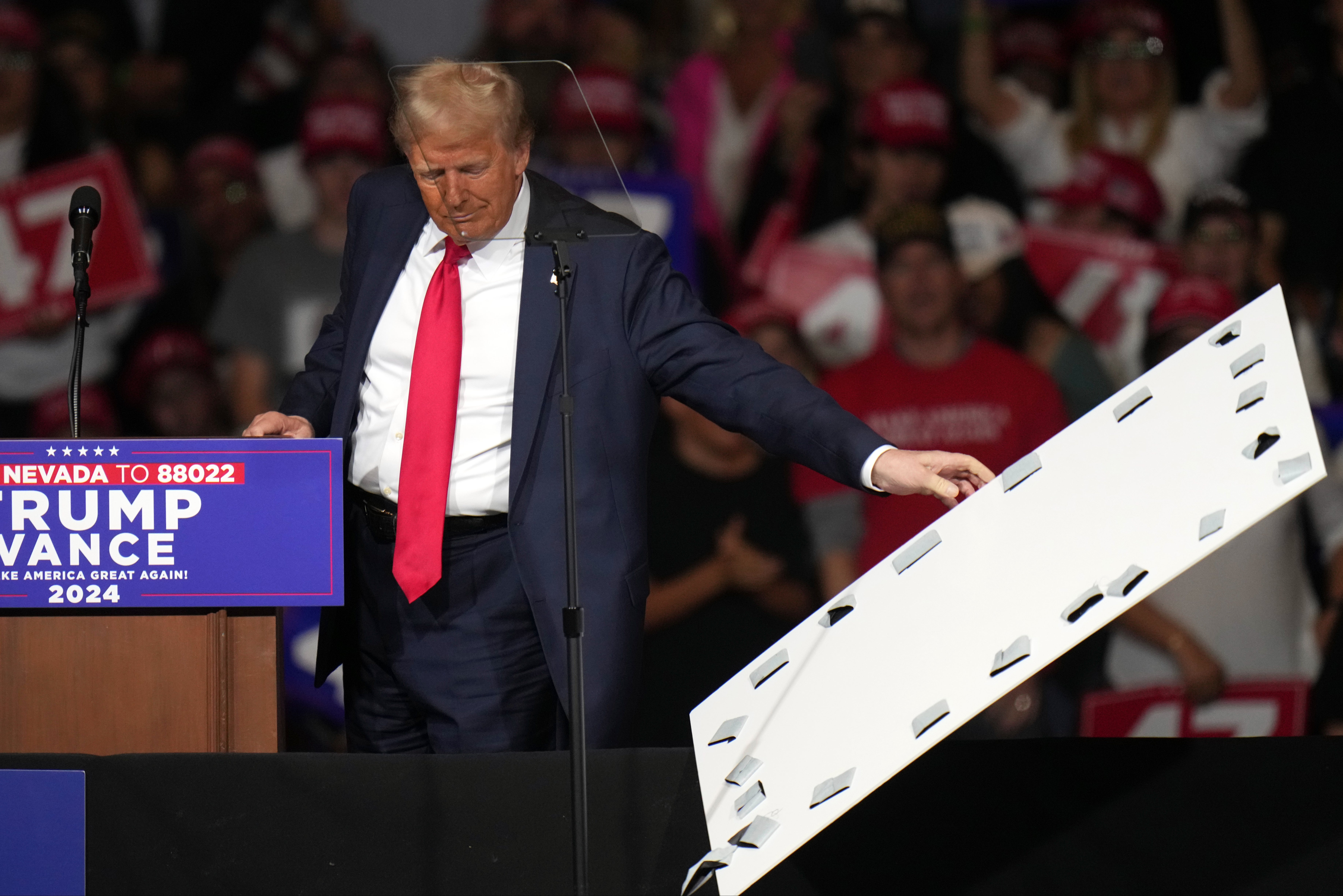
After mocking Vice President Kamala Harris over her teleprompter, Donald Trump’s rally in Reno, Nevada, ground to a halt as he was was forced to fix his on-stage after a campaign sign fell on it.
“Thank god I don’t use teleprompters too much,” Trump told rally goers after the sign fell on the teleprompter, causing the script to stop being projected. “I look at the teleprompter, it’s totally gone. I say ‘What the hell happened.’ The sign fell on top of it.”
Former president Donald Trump removed signage that fell on top of his teleprompter at a rally in Reno, Nevada (AP)
The irony of the incident comes to light when reflecting on the number of times the former president has accused Harris of relying on a teleprompter and mocking her for it.
Trump told supporters on Friday he would “level” with them, and admitted to his teleprompter usage, yet still asserted Harris uses one more.
“Isn’t it nice to have a guy that doesn’t need a teleprompter, a president, a potential president that doesn’t need a teleprompter?” Trump asked supporters moments after fixing his teleprompter.
He went on to, again, falsely accuse Harris of using one during her town hall with Univision on Thursday.
Both the Harris campaign and Univision have confirmed to CNN that the vice president did not use a teleprompter during her town hall. A teleprompter that was seen in a photo from the event was in Spanish and meant for the moderator, not Harris.
Trump and his allies have previously accused Harris of using a teleprompter in interviews when she did not. In instances where the vice president has used a teleprompter, they have mocked her and insinuated she needs one because she is not intelligent.
Similarly, Trump told supporters on Friday night that “there’s something wrong with [Harris]” for using teleprompters.
He added: “I don’t use them that much. The concept I use but I don’t like it.”
He then embarked on a hard-to-follow rant about making speeches.
“When you can’t get up and make a speech, like, normally, like – when all the work we do, you’d think you could for 40 minutes – well she makes very short speeches too. Have you ever noticed they’re like 10 minutes,” he told the crowd at Reno.
It’s been a day, really, but that can be a day-in-the-life post some other time. Meanwhile, I have a tab up that I intend to use in my voting post, and it’s still there because I haven’t gotten it done. Here I am at 1 til 5 PM, but I am doing it now. 🌞🤯🌞
So my mission for today was to vote this morning. I got around and fixed my hair, and went to vote. There’s a jury trial, so parking was short. There was a spot, and I fit, but it was tough getting out of the car, as the person to my left had parked just barely on their righthand, my lefthand, line. But it got done. I figured they’d leave and make me look like the a-hole, even though I did have 3 in. of space between my car and my righthand line. Then, I figured they probably pulled in the best they could, and maybe/probably the person they pulled in next to had parked too far over, making this person look like the a-hole. So, all’s well, I got in, got signed in, and voted. There was not a line, but each machine was kept in use; there was a steady flow of voters. Awesome!
It was smooth as silk, and I actually got to vote for Dems all the way down the ticket except one office, where I wrote in a good friend of mine who I admire, and who would be a superlative state rep. Else, I voted Dem all the way. It was good. I usually post a pic of my pen and my sticker, but county costs are up, and there are no stickers today, and no free stylus pens, either. So, big whoop, but it got done! I expect to hear (read) that everyone who reads here votes this season; look at my WP handle!
Anyway, here’s a great post about another voter who votes Blue:
This is the first president whose inauguration I can remember. Now, if you know my age, you might think that is improbable, but 1976 was a big year in Philadelphia with the Bicentennial and all. And I guess I imbibed political sensibility a bit from my mom. In 1977 I had a turntable, a Kiss album alongside my Sesame Street records and was a fan of Happy Days and watched some documentary about the 25th anniversary of rock and roll on PBS about a dozen times, it felt like.
I remember the 1970s. I was already me by the time I was a toddler cleaning up shot glasses after parties (the taste of blackberry brandy and the sound of Steppenwolf) and listening to the Midnight Special. when I definitely wasn’t supposed to still be awake and turning on the sole tv in the house and was lifting cold pizza out of the fridge. Mom finding me zonked on the floor with the farm report or Chief Halftown on in the morning.
He reminded me of Mr. Rogers then, and that was all right by me. He still does, and I don’t have a greater compliment. He cares, and he acts on his sense of caring. It’s the best thing you can say anyone ever does.
Kamala Harris is a lot closer to my age than Jimmy Carter and is a woman, like me. I am still mad about the women in their 100’s and their 90’s in 2016, who finally got to vote for a woman for president and she never broke through the ceiling she most certainly dented.
But maybe me and the first president I can remember as a girl, who talked so appreciatively of his own daughter, Amy, when I was a little girl myself and wanted grownups to believe in girls, can see Kamala Harris win together.
Maybe this is just a sentimental, schmaltzy departure from me busting on Trump’s mental decline or whatever–but I would like to see this. She is so ready, and I am so ready. and we are so ready.
So here is Harris calling Trump a weak bitch who loves dictators because of his weak bitchness. Because I am sentimental, but this is business and Trump needs a boot in the ass.
VP Harris on Trump: “It’s a sign of weakness that you want to please dictators…It’s a sign of weakness that you would demean America’s military…It’s a sign of weakness that you don’t have the courage to stand up for the Constitution…This man is weak, and he is unfit.” pic.twitter.com/yxZOav01aT
— Republican Voters Against Trump (@AccountableGOP) October 15, 2024
I’m not saying “we’ve come a long way, baby” or “she can bring home the bacon” or whatever passed for 1970s feminism. I am saying this candidate is herself outstanding and can do the damn job. Not because she’s a woman, but because she is a boss.
And the miserable misogynist she is running against is an echo of the past that a 100 year old man knows should be left to history. Because he has fought against that bigotry in his own life and in his own faith.
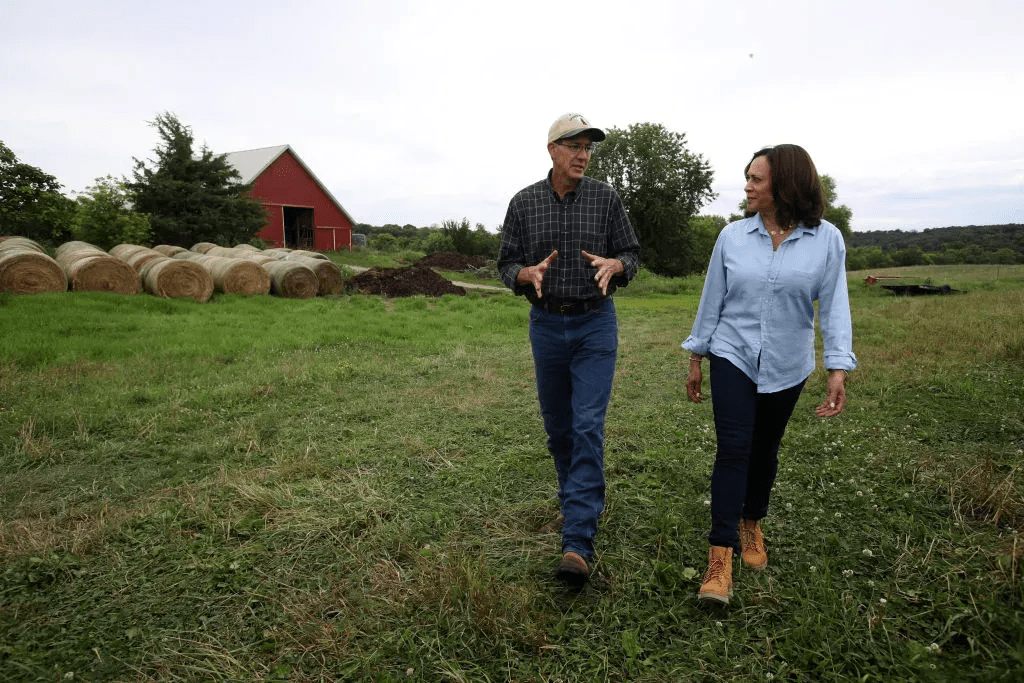
This morning, the Harris-Walz campaign announced an extensive economic plan for rural communities. It’s a deeply impressive vision for working class families in these parts of the country.
Given that much—perhaps, most—of political media will not adequately report on this and inform voters of what Vice President Harris plans to do for Rural America, I’m gonna take the rare step of publishing her plan, in full, as a blog post.
I’m doing this because Lord knows we’re all more likely to see an intellectually dishonest column in The New York Times about Vice President Harris ignoring rural voters than we are to see significant reporting and analysis on her proposed policies for rural voters.
So, here it is. Just to confirm, all of the below text was written by the campaign. Please share with your friends and family in rural areas of the country:
FOR IMMEDIATE RELEASE October 15, 2024
Vice President Harris and Governor Walz’s Plan for Rural Communities
New Initiative Will Strengthen Rural Health Care by Adding 10,000 Health Care Professionals, Expanding Telemedicine, Cutting the Number of Ambulance Deserts in Half, and Keeping Rural Hospitals and Pharmacies Open
Supporting the Next Generation of Small- and Mid-sized Farmers and Ranchers
Strengthening the Backbone of the Rural Economy with Investments in Housing, Child Care, and Senior Care
Vice President Harris and Governor Walz believe in rural communities and understand that supporting locally led solutions is key to rural prosperity. Their administration will make it a priority to equip the nearly 50 million rural Americans with the tools and resources they need not just to get by, but get ahead.
Today, Vice President Harris and Governor Walz are announcing a plan for rural America. The key elements will:
Increase access to affordable and high-quality health care in rural communities—by adding 10,000 health care professionals, expanding telemedicine, cutting the number of ambulance deserts in half.
Support the sandwich generation to care for elders at home, lowering the cost of childcare and increasing the number of providers, and expanding the Child Tax Credit to provide tax cuts up to $6,000 for families with newborns.
Lower the costs of buying a home, starting and expanding a business, and raising a family—by sparking the construction of 3 million new housing units, providing up to $25,000 in down payment assistance for first-time homebuyers, increasing the small business tax deduction for startup expenses 10-fold to $50,000.
Invest in the future of American agriculture by boosting access to credit, land, and markets, building new markets and streams of income for small- and mid-sized farmers and producers, and supporting the rise of the next generation of American farmers and ranchers.
Donald Trump will turn back the hard-earned progress that rural communities are making. As President, he tried to repeal the Affordable Care Act and vows to terminate it if reelected, stripping protections from people with pre-existing conditions and devastating rural hospitals and care services. He will ban abortion nationwide, threaten access to contraception and IVF, and force states to monitor women’s pregnancies and report women’s miscarriages and abortions to the federal government.
He already took overtime pay away from millions of Americans while giving tax breaks to billionaires and big corporations – at the same time that he tried to cut funding that supports rural housing and creates rural jobs. If Trump returns to office, he promises to give more tax cuts to the super-rich and big corporations while hiking taxes on rural families by $4,000 a year – as estimated by the conservative leaning American Action Forum, and putting Social Security and Medicare on the chopping block.
Independent analysis from Goldman Sachs, Moody’s Analytics, and other top economists – including those surveyed by the Financial Times and Wall Street Journal – and more also agree that Vice President Harris’ plans are better for the U.S. economy than Donald Trump’s. For example, an analysis by Moody’s Analytics shows that, under a Harris presidency, more than a million new jobs would be added to the economy than under a second Trump Administration. Meanwhile, Moody’s finds that Trump’s plan would cause a recession by mid-2025, cost 3.2 million jobs, and add over 1 percent to inflation. And, a survey of nearly 40 top economists by the Financial Times and University of Chicago found that 70 percent agree that Vice President Harris would be better on the deficit than Trump, while only 11 percent believe that Trump would be better on the deficit than Harris.
Trump’s Project 2025 agenda will slash the federal crop insurance program, gut protections for clean water and air, and repeal the Bipartisan Infrastructure Law and Inflation Reduction Act, which will roll back historic investments in small businesses and rural infrastructure including broadband, and clean energy. Under a Harris-Walz administration, rural America is not going back.
EXPANDING RURAL HEALTH CARE
Vice President Harris and Governor Walz believe quality health care is a right, not a privilege. That’s why they are announcing new initiatives to improve and expand affordable health care in rural areas. Their plan will recruit 10,000 additional rural health care professionals and protect and expand access to care from telemedicine to local independent pharmacies.
Recruiting 10,000 Rural Health Care Professionals, including doctors, nurses, community health workers, and EMS professionals to provide health services to Americans in rural and tribal areas—while working to protect our health workforce from burnout. This initiative will include:
Expanding Scholarships, Loan Forgiveness, and Other Pipeline Programs for Doctors and Nurses Who Will Provide Health Care in Rural and Tribal Areas: They will expand funding to recruit and retain doctors, nurses, pharmacists, public health professionals, and other health care providers through scholarships, loan repayment programs including the National Health Service Corps Loan Repayment Program, the Indian Health Service Loan Repayment Program, and the Public Service Loan Forgiveness Programs. Their plan to build 3 million new homes nationwide, including in rural and tribal areas, and to provide $25,000 in downpayment assistance will further lower costs of buying a home in rural America, creating incentives for health professionals to buy homes and stay in rural America. They will invest in programs that introduce rural youth to careers in medicine, and provide the necessary support for them to pursue that career path. This plan builds on Vice President Harris’s leadership in investing in programs to train more nurses and doctors who will live and work in rural and underserved communities, including funding an additional 1,000 residency slots in hospitals. When a provider trains in a rural area, they’re more likely to remain, living and working there.
Providing a Major Grant Program To Train and Fund Rural Community Health Workers: They will launch a new permanent grant program to train and fund Rural Community Health Workers; make it easier for Medicaid to cover Community Health Workers; and expand grants to Community Health Centers and Rural Health Centers.
Expanding Rural Telehealth Services: Americans living in rural areas are around 17 times more likely to use telehealth than those in cities, but half of all people living in rural areas lack access to the broadband speeds needed to support telehealth.
Double federal funding for telehealth equipment and technologies. They will double the U.S. Department of Agriculture’s (USDA) Distance Learning and Telemedicine Grant Program for Rural Communities to $120 million. This will give rural and tribal communities more resources for telehealth equipment—including at rural health clinics, hospitals, and schools–and support innovative new technologies like tele-medically equipped ambulances.
Slashing the Number of Ambulance Deserts in Half: At least 2.3 million rural Americans live in ambulance deserts—meaning they live at least 25 minutes away from an ambulance—and in 14 states more than 10% of the population lives in such an area. Volunteer squads—which provide the majority of rural EMS staff—struggle to survive due to a lack of sustainable funding sources and difficulty recruiting new volunteers. Vice President Harris and Governor Walz will take action to cut the number of rural Americans in ambulance deserts in half by the end of the decade:
Expanding EMTs and Paramedics in Rural Areas: They will dramatically increase financial and technical support to rural and tribal communities to train, equip, and employ first responders, and provide resources for ambulances, lifesaving equipment, and the construction and maintenance of first responder stations.
Increasing Funding and Support for Volunteer EMS Programs: They will provide grants to small volunteer ambulance and EMS programs to help them survive and thrive. These extra resources will support innovative uses of technology like telehealth and explore solutions to low reimbursement levels for both public and private insurers.
Keep Independent Pharmacies Open and Increase the Number by 3,000. Independent pharmacies make up more than three-quarters of pharmacies in rural areas, and their pharmacists are a critical and trusted health care resource. But nationally the number of independent pharmacies has decreased—by nearly 50% since 1980, leveling off at about 20,000 locations, with 1 in 10 independent retail pharmacies in rural America closing over the last decade.
A Harris-Walz Administration will set a goal of enabling 23,000 independent pharmacies to either launch or stay open by working to enact legislation that would prevent pharmaceutical middlemen known as pharmacy benefit managers from shortchanging rural independent pharmacies and steering orders of the most profitable drugs away from independent rural pharmacies and to chains. This would be a 15% increase in the number of independent pharmacies – restoring the rural independent pharmacies that have closed over the last decade and increasing their number by 5%.
Keeping Rural Hospital Doors Open To Ensure Access to Emergency Services. Since 2010, nearly 150 rural hospitals have either shuttered or ceased providing inpatient hospital services. A Harris-Walz Administration will work to strengthen Medicare’s Rural Emergency Hospital Designation – which helps facilities offer medical services in areas that may not be able to sustain a full-service hospital, while protecting the Affordable Care Act and supporting Medicaid expansion, which has helped to reduce uncompensated care in expansion states and improves the financial health of rural hospitals. This will also help support improvement in maternal health, which Vice President Harris has long advocated for, by increasing access to options for obstetric care.
Lowering Health Care Costs. Vice President Harris and Governor Walz will also lower health care and prescription drug costs for Americans. They will work to cap the cost of insulin at $35 and out-of-pocket expenses for prescription drugs at $2,000 for everyone. They will also fight to keep helping millions of Americans save $800 a year on their health insurance and accelerate Medicare negotiations over prescription drugs to help bring drug prices down more quickly and cover more drugs.
Restoring and Protecting Reproductive Freedoms. They will also keep fighting for womens’ rights to make decisions about their own bodies. The Vice President will, if elected, never allow a national abortion ban to become law. And when Congress passes a bill to restore reproductive freedom nationwide, she will sign it.
Supporting Veterinary Care in Rural Areas and address the increasing shortage of veterinarians by encouraging providers to work in areas with too few veterinarians by strengthening USDA’s Veterinary Medicine Loan Repayment Program, which reduces debt for physicians working in high-need areas for the food supply, and increasing grants for starting and expanding veterinary practices in critical areas.
Trump meanwhile tried to end the Affordable Care Act and has promised to terminate it if reelected — over 500 rural hospitals at risk of closure could close. He sought to make significant cuts to both Medicare and Medicaid in every single one of his budgets. His Project 2025 agenda will reverse the caps on insulin and other prescription drugs, raising the prices on life-saving Medications.
A HISTORIC PLAN TO EXPAND ACCESS TO CARE AND SUPPORT THE SANDWICH GENERATION
Vice President Harris cared for her aging mother and knows that when families cannot find affordable care for their elderly parents or children, it is not just a big financial strain, but also a source of severe emotional stress that takes a big toll on families. Nearly a quarter of American adults are part of the sandwich generation providing intergenerational care to both their children and a parent or a loved one with disabilities.
Protect and Strengthen Medicare, Help Rural Seniors Live Independently, and Support Family Caregivers. Vice President Harris and Governor Walz will protect Medicare and strengthen it with a historic Medicare at Home plan, which will cover robust home care for seniors under Medicare for the first time ever. This will help both seniors and their caregivers, who often shoulder the financial and emotional burden of caring for aging loved ones. Vice President Harris and Governor Walz will also expand Medicare to cover hearing and vision benefits to support the millions of seniors who rely on glasses and hearing aids.
These plans are common sense. They can help family caregivers work and save both families and the federal government money by allowing seniors to stay in their homes instead of being sent to nursing homes, which are often more expensive. Medicare at Home will also reduce hospitalizations. These new benefits will be fully paid for and extend the life of the Medicare Trust Fund by expanding Medicare drug price negotiations and more.
Make Quality, Affordable Child Care Accessible and Expand the Child Tax Credit. Vice President Harris and Governor Walz know that millions of Americans are balancing both care for their children and care for aging loved ones. Too many rural families struggle to access affordable child care near them. One survey found that only 38 percent of rural parents could easily find childcare within their budget, compared to over half of urban parents. Vice President Harris and Governor Walz will bring down child care costs for American families to help save thousands of dollars on child care and expand access to good child care options by building a robust child care supply. Vice President Harris is also proposing to expand and make permanent the Child Tax Credit, including giving families with newborns a tax cut of $6,000 per child. This will help families cover expenses early on in life. After Vice President Harris cast the tie-breaking vote on the legislation that temporarily expanded the Child Tax Credit in 2021, it helped the families of over 9 million children in rural areas.
As president, Trump tried to cut Medicare and Medicaid in every single one of his budgets, has called for raising the retirement age to 70, and said privatizing Medicare will create a “stronger system.” He denied millions of families the full child tax credit and tried to cut federal child care funding by nearly $100 million. His Project 2025 agenda will actually raise costs on families by $4,000 a year.
STRENGTHENING THE BACKBONE OF THE RURAL ECONOMY
Vice President Harris and Governor Walz are committed to helping rural communities grow and thrive economically. They are fighting to lower prices for Americans including through tax cuts for 100 million working and middle-class families and policies to lower the price of housing, groceries, and health care. They are also supporting small businesses by cutting red tape and proposing a ten-fold increase in the tax deduction for new businesses starting up.
Vice President Harris has fought for landmark investments in rural communities: high-speed internet access to every corner of rural and tribal America, as well as projects to build and fix roads and bridges in rural and tribal communities across America, and to support transit vehicles and infrastructure for thousands of rural and tribal transit systems. Rural communities stand to benefit from up to 45% of the total funding—or more than $450 billion—provided by the Bipartisan Infrastructure Law, the Inflation Reduction Act, and the CHIPS and Science Act is, and almost 30% of the IRA funding announced so far will flow to rural communities. Governor Walz has long championed rural communities. He spent 12 years representing a rural district in Congress, and as Governor, he spearheaded the largest single investment in broadband infrastructure in state history to help thousands of Minnesotans—including those in rural areas—connect to jobs, education, health care, and their communities.
But they know it is not enough—too many rural communities still do not have the tools they need to get ahead.
Supporting Small Businesses by Increasing Capital and Access to Resources. Vice President Harris has set an ambitious goal of 25 million new business applications by the end of her first term. She plans to encourage businesses to start and grow by increasing the small business deduction 10-fold to $50,000, providing low- to zero-interest loans to small businesses that grow and create jobs, allocating one-third of federal contract dollars to small businesses, and providing other financing for rural and tribal entrepreneurs through the Treasury Department’s State Small Business Credit Initiative—which lifts up entrepreneurs and founders in rural America, middle America, and underserved communities.
Create New Jobs and Opportunities Through:
New America Forward Tax Credits to promote investment in the industries of the future, including greater credits for companies investing in agricultural, manufacturing, and energy communities. This includes modernizing steel and iron production, developing biotechnology, building new data centers for AI and supporting AI innovation, further developing clean energy manufacturing, revitalizing America’s semiconductor industry, and investing in aerospace, autos, and other forms of transportation. These tax credits will provide significant additional benefits to investments made in longstanding manufacturing, energy, and agricultural communities and reward companies that work with unions and communities to support workers and protect jobs.
New Opportunities for Those Without Four-Year College Degrees including promoting meaningful pathways for those without college degrees to federal jobs and working with businesses to do the same in the private sector. Vice President Harris and Governor Walz have also set a goal of doubling the number of registered apprenticeships during their first term. This will include partnerships with community colleges on high-quality, evidence-based training programs.
Cutting Red Tape so that America Can Build More Housing, Manufacturing, and Energy Projects Faster while also ensuring community engagement and adequate protections for the environment and public health. This will build Vice President Harris’s work through the Inflation Reduction Act to speed permitting review, and her work to finalize a rule to modernize environmental reviews.
Keeping Rural Schools Open and Thriving. Vice President Harris knows that a great teacher can have a life-long impact on children. But teacher shortages disproportionately impact rural communities throughout the country. That’s why she will double down on programs that prepare and train teachers in rural and tribal areas in an effort to support new teachers and increase retention rates in rural communities—all of which will improve student outcomes like academic achievement and high school graduation rates, resulting in higher long-term earnings, job creation, and a boost to the economy. She will also build on federal transportation programs that help get children to school where bus routes or vehicle maintenance costs put additional strain on already limited budgets.
Protect and Strengthen Social Security while Making the Super Wealthy Pay their Fair Share. Vice President Harris and Governor Walz will protect and strengthen Social Security and Medicare by making the super-wealthy pay their fair share. Trump, by contrast, once called for raising the retirement age to 70, and he tried to cut Social Security and Medicare every year of his presidency. Now, on the campaign trail, Trump is continuing to talk up cuts to Social Security and Medicare, saying “there is a lot you can do…in terms of cutting.”
Lowering Costs:
Lower Costs of Buying and Renting a Home Across Rural America by sparking the construction of 3 million new affordable rental and owner-occupied homes, providing up to $25,000 in down payment assistance for first-time homebuyers, and cracking down on predatory investors. Vice President Harris and Governor Walz will also work to strengthen USDA’s programs for rural and tribal communities, especially in housing, and as part of their proposal to strengthen the Low Income Housing Tax Credit program to create more homes that are affordable for renters, they will work to ensure that rural states receive a fair allocation of these credits to address the unique challenges that rural communities face when dealing with housing challenges, including higher construction costs and lower housing density.
Providing Rural and Tribal Families with Reliable, Low-Cost Internet Access, by reenacting the Affordable Connectivity Program. The Bipartisan Infrastructure Law’s Affordable Connectivity Program provided 23 million households with up to $30 off of their monthly internet bills and a one-time discount of up to $100 to buy a laptop, desktop computer, or tablet. Over 3 million people who benefited from ACP live in rural and tribal areas. Vice President Harris will reenact this popular program, which ended in June of this year, to ensure that rural and tribal families can connect to the internet and obtain the financial, educational, and health opportunities that come from reliable internet access. She will also take common-sense steps to speed up the construction of new internet for rural and tribal communities.
Provide Funding and Support to Local Communities, Tailored to Address Local Needs.
Vice President Harris and Governor Walz will work with Congress to pass the bipartisan Rural Partnership and Prosperity Act, led by Senators Casey and Fischer. This will provide new grants to every state that will support locally led solutions to address rural and tribal communities’ needs—including for child care, housing, job training, and economic development.
Vice President Harris and Governor Walz will expand the Rural Partners Network nationwide by partnering with rural communities to help them navigate and access existing federal funding opportunities.
Trump neglected rural communities. He failed to address the housing supply crisis during this presidency, and now his Project 2025 agenda will increase mortgage premiums on federally backed loans, and drive up mortgage rates by around $1,200 by privatizing Fannie Mae and Freddie Mac. He also tried to eliminate the Economic Development Administration, and wants to repeal investments in infrastructure, clean energy, and more that have been strengthening the economies of rural communities. He will also raise costs by nearly $4,000 per family with a “Trump Sales Tax” on imported items that families rely on.
He also has no plan to support families and seniors. He has called for raising the retirement age to 70 years old. His Project 2025 agenda would slash funding for child care, abolish Head Start, and cut more than $20 billion in federal support for the nation’s most vulnerable students.
HARVESTING THE FUTURE OF AMERICAN AGRICULTURE
Vice President Harris and Governor Walz know that America’s farmers, farmworkers, and ranchers feed our nation, drive our economic growth, and enhance our security and resilience. That’s why Vice President Harris helped secure nearly $20 billion in investments to help hundreds of thousands of farmers and ranchers adopt voluntary innovative conservation practices, promote sustainable agriculture, and increase resilience against extreme weather. She also directed $1 billion to increase meat and poultry processing capacity, up to $900 million to boost domestic fertilizer production, and funding to strengthen food supply chains and give farmers more choices. Governor Walz—who grew up spending time on the family farm—has stood by farmers and ranchers throughout his time in public service. In Congress, Governor Walz worked across the aisle to pass three Farm Bills to expand veterans’ access to crop insurance, farm education, and job training and enacted legislation to improve veterans’ health care. And as Governor, he championed efforts to support new farmers and to build new markets and revenue streams.
But Vice President Harris and Governor Walz know that today too many small farmers and ranchers still face barriers to success or are getting ripped off by big corporations. Vice President Harris and Governor Walz have a plan to invest in the future of America’s agricultural industry. They will combat consolidation and other barriers that make it more difficult for small farmers to get ahead, and support the next generation of American farming by:
Making it Easier for Beginning Farmers and Ranchers to Get Started by improving access to credit for beginning farmers—including by reducing barriers to receive USDA’s farm ownership and operating loans—and supporting training and technical assistance including for military veterans and young farmers. This builds on Vice President Harris and Governor Walz’s proposals to provide one million forgivable loans to entrepreneurs who have historically faced barriers to accessing credit as well as low- to zero-interest loans to small businesses that create jobs.
Expanding Farmland Protection Programs including supporting working farm easements that ensure farmland remains farmland and isn’t lost to non-agricultural buyers.
Doubling Down on Partnerships with Farmers and Producers to Build New Markets and Streams of Incomes. That’s why Vice President Harris fought tirelessly for the Inflation Reduction Act, which included a $20 billion investment to help the agricultural community voluntarily adopt and expand conservation and climate smart agricultural strategies—all while saving money, creating new income streams, ensuring the wealthy pay their fair share in taxes, and increasing productivity. If elected, Vice President Harris and Governor Walz will double down on this work.
Ensuring America’s Farmers Have the Right to Repair Their Equipment. Currently, equipment manufacturers put in place restrictions, such as software blocks on tractors and other farm equipment, that make it difficult if not impossible for farmers to repair their own equipment. Vice President Harris and Governor Walz will require manufacturers of electronics-enabled agricultural equipment to share documents, parts, software, and tools with owners and independent repair shops by working with Congress to enact the Agricultural Right to Repair Act.
Boost Competition to Create Opportunities for Small Farmers and Ranchers. Vice President Harris and Governor Walz will support small businesses in the agricultural industry, including continuing successful efforts to block excessive consolidation by working with Congress to pass bipartisan legislation to increase antitrust enforcement in agriculture and help ensure poultry growers and ranchers get a fair price. They will also focus on expanding production among new suppliers and small farms, growers, and processors to create broad-based, resilient local and regional food supply chains and spur competition with large conglomerates.
Ensuring Crop Insurance Works for All Farmers and Ranchers. Vice President Harris and Governor Walz will strengthen the Federal Crop Insurance Program by directing the USDA to study whether the program should cover additional crops and working with Congress to ensure the program protects against more threats like natural disasters and extreme climate events – risks that raise costs and disrupt supply chains.
Growing Opportunities and Small and Mid-Size Farms and Small Businesses in Rural and Tribal Communities to Sell to Customers Around the Globe. Research shows that agricultural export losses due to retaliatory tariffs from Trump’s trade wars totaled more than $27 billion in 2018 and 2019. The impact on small farmers and rural communities was devastating: agricultural jobs fell, U.S. farm bankruptcies surged, and net farm income plummeted. Vice President Harris and Governor Walz will provide technical assistance to small and mid-sized farmers and businesses so that they have more opportunity to sell their products.
Donald Trump will make the challenges that American farmers face worse. As President, he bailed out the largest 10% of farmers, while sacrificing smaller family farms in his trade wars. Between September 2018 and September 2019, farm bankruptcy filings rose 24% nationally. He also enabled big meatpackers and agribusinesses to run family farms out of business. As his own Secretary of Agriculture said, “In America, the big get bigger and the small go out.” Now, if Trump is elected again, his Project 2025 agenda will hurt rural America, including making crop insurance for family farmers even more expensive and risking another slew of retaliatory tariffs.
Vice President Harris and Governor Walz believe in rural America and pledge to support rural Americans to create a New Way Forward.
























 Virginia Gov. Glenn Youngkin speaks during a news conference at the state Capitol in Richmond, Va., on Jan. 27, 2022. (AP Photo/Steve Helber, File)