
(Personally, at this stage of my life, I’m thinking of tattooing DNR on my forehead and chest. There is no need to rescusitate me now. But, over the years, I’ve watched little to no progress on women’s cardiac treatment; they’re treated as if they’re hysterical, and also by using research on men’s cardiac. Frequently, women’s heart attacks don’t present the way men’s do. Even though women bother to learn about this so they know when to get help, they aren’t able to be treated properly because of lack of knowledge, and, as reported below, disbelieving the women. Anyway, here is this.)
If your heart stopped right now, would a stranger save you? It depends on your sex.
Why women are less likely to receive CPR—and less likely to survive
If you’ve been watching The Pitt Season 2, you may have caught one of the most medically important scenes on television this year. (Alert: small spoiler from last week’s episode coming!)
A woman arrives at the ER by ambulance, clutching her chest, complaining of pain. Her EKG comes back looking normal. Doctors are puzzled. Then her heart stops.
Dr. Robby, played by Noah Wyle, figures out what happened: the paramedics placed her EKG leads too low on her chest, and far too low to get an accurate reading, missing her heart attack. Later, he confronts the paramedics directly. They felt uncomfortable moving her breasts to place the leads correctly. He turns to his staff and asks: “Shall we put it to a vote? Ladies in the room—show of hands—death with modesty, or life with brief nudity?”
The vote from the women is clear: they want to live.
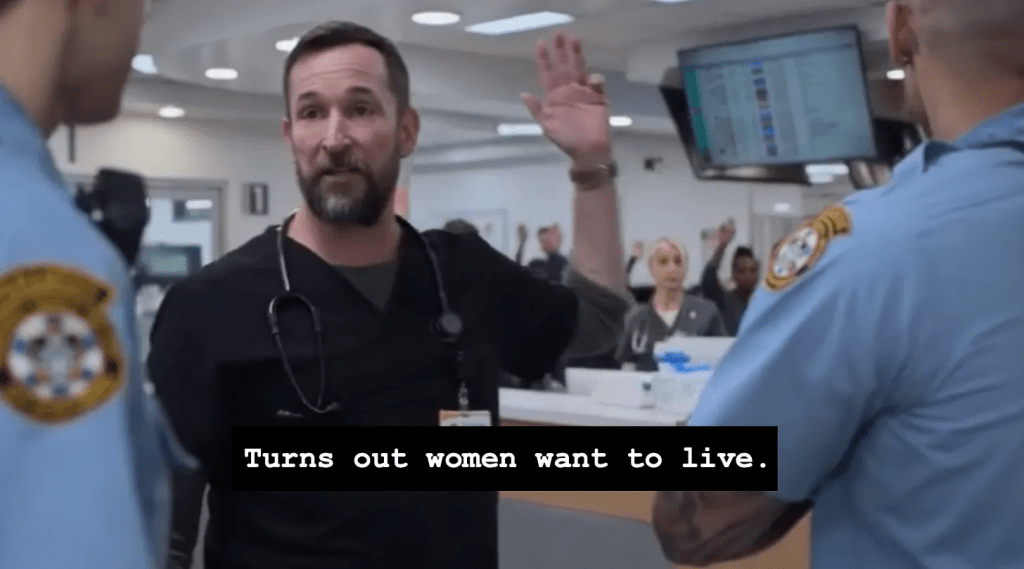
It’s a fictional scene (and in real life, public chastisement is certainly not the way to correct medical staff), but it highlights a very real problem we see every day.
Women are less likely to receive bystander CPR.
If someone collapsed at a restaurant, would you start CPR? It turns out that for many people, the answer depends on the sex of the person who collapsed: women are less likely than men to receive CPR from a bystander (a nonmedical professional who is nearby) in public, and they are less likely to receive defibrillation (shocks that can restart the heart).
A Duke University study of more than 309,000 cardiac arrests found that women who had a cardiac arrest in public were 14% less likely to receive bystander CPR than men. This is true around the world, too.
And women are less likely to survive. Chest compressions and shocks in those first few minutes are critical, and bystander CPR can double to triple the chance of survival.
Why are women less likely to receive CPR? The same reasons The Pitt depicted.
Researchers have asked the public why they think this happens, and the answers are striking:
- Concerns about touching a woman’s chest to provide compressions.
- Concerns about accusations of sexual assault.
- Fear of causing injury to women, in part due to perceptions they are more frail.
- Gender stereotypes that women are emotional or overreactive to symptoms.
- Misperceptions that women are unlikely to experience true cardiac arrest.
While these fears may be common, actual cases of lawsuits against bystanders performing CPR are not—and Good Samaritan laws protect individuals genuinely trying to help in medical emergencies.
A 2020 review of CPR lawsuits in the U.S. found the vast majority of lawsuits were related to withholding CPR (not providing it). Lawsuits alleging harm from CPR were extremely rare (only 3 out of 170 cases), and all took place in medical facilities (not bystander CPR). The review found zero cases where a layperson was found liable for harm by providing CPR.
When should CPR be provided?
If someone is unresponsive and not breathing (or only gasping), start CPR. The basics are simple, and anyone can do it. Here’s a quick refresher:
- Call 911 immediately (or have someone else call while you start CPR).
- Push hard and fast in the center of the chest: press 2 inches deep to the beat of “Stayin’ Alive” (or any other song with a beat of 100-120 per minute). Let the chest return to its normal position between each compression.
- Don’t stop until emergency services arrive. CPR is a WORKOUT. If you get tired (which is normal), try to switch out with someone.
- Use an automated external defibrillator (AED) as soon as one is available. Follow the voice prompts, it walks you through where to place the pads and when a shock is needed.
Common questions and misconceptions about CPR
(Note: this is for the general public, if you are health care provider, different guidance will apply.)
- Do I need to check a pulse? Nope! It turns out most people are pretty bad at this. Instead, if someone is not responsive and not breathing (or only gasping), assume their heart has stopped and start compressions.
- Do I need to provide rescue breaths (mouth-to-mouth)? If it’s a teen or adult, for most cases the answer is no. Chest compressions alone (“hands only CPR”) can be just as effective. While rescue breaths are important in cases of drowning, suspected overdose, and for children, in most other situations chest compressions alone is enough!
- Do I need to remove clothing to start chest compressions? Nope! The priority is starting compressions as soon as possible. If you find something they are wearing is getting in the way, then don’t hesitate to remove it, but otherwise you can do compressions on top of clothing.
- Do I need to remove clothing to use the defibrillator (AED)? Yes—the pads for a defibrillator should be placed directly on the skin. Place them where the stickers show they should go, and reposition or remove any clothing that is in the way. (This may include a bra!) Metal in bras is not an issue for shocks—you can leave it on as long as it’s not in the way of the pads.
- What if we’re in public and other people might feel awkward from exposure of a woman’s chest? Do it anyway. Remember, the alternative is letting the woman die. Other people’s potential opinions or discomfort should not be weighed as more important than a woman’s life.
- What if they appear frail and I might injure them? Start compressions anyway. You can’t get more injured than dead—which is what a cardiac arrest is. Broken ribs are common in CPR (for both male and female patients), but people can heal from those. They can’t heal from a heart that stops beating and isn’t restarted.
- If I haven’t taken a CPR course, should I still provide CPR? Yes! Any chest compressions—even imperfect ones—are far better than no compressions. If you’d like to take a course, find one at redcross.org or heart.org.
Bottom line
Women are less likely to receive CPR, less likely to be defibrillated, and less likely to survive cardiac arrest. The first few minutes after a cardiac arrest are the most critical, and CPR from someone like you significantly improves chance of survival. If someone isn’t responding and isn’t breathing, start chest compressions. Even if it’s a woman.
Love, KP
Thank you to Dr. Sarah Perman, emergency physician and cardiac arrest researcher, for reviewing this post!
Kristen Panthagani, MD, PhD, is completing a combined emergency medicine residency and research fellowship focusing on health literacy and communication. In her free time, she is a contributing writer for Your Local Epidemiologist and creator of the newsletters You Can Know Things and The Public Health Roundup. Views expressed belong to KP, not her employer.
Your Local Epidemiologist (YLE) is founded and operated by Dr. Katelyn Jetelina, MPH PhD—an epidemiologist, wife, and mom of two little girls. YLE reaches over 450,000 people in over 132 countries with one goal: “Translate” the ever-evolving public health science so that people will be well-equipped to make evidence-based decisions. This newsletter is free to everyone, thanks to the generous support of fellow YLE community members. (snip)
 Scottie's Playtime