On Friday, a new video surfaced of Rep. Cawthorn stumping away in front of a GOP-friendly audience. The clip is from a section where Cawthorn goes after Speaker of the House Nancy Pelosi. Pelosi has been a favorite target of the right for decades and Cawthorn choosing to use one of the leaders of the Democratic Party as a focal point for an attack isn’t new or surprising. The fact that Cawthorn’s attack on Pelosi is baseless isn’t even newsworthy, as most political attacks from the right these days are based almost entirely in a make-believe world of ‘deep state’ fake news controlled by Hillary Clinton and Barack Obama and George Soros.
What is newsworthy is that Rep. Madison Cawthorn of North Carolina apparently decided to slander Speaker Pelosi in a way that truly begs the question: What the hell is going on with Madison Cawthorn?
In the video, Cawthorn makes the partisan hack joke that Nancy Pelosi only has rules for others, and not for herself (likely something connected to the MAGA-bugaboo of mask mandates). He then jokes, “I’ll tell you, I have to work with her every day so please do pray for me.” He gets a light spatter of laughter as the audience realizes this is the high level of humor they’re going to get during today’s speech from this racist asshole.
But then Cawthorn says this: “The theories of alcoholism are very true and it’s very sad.” Cawthorn seems to be referencing “theories” that were not simply debunked but proven impossible. The Theories date back to the summer of 2020 when a doctored video of Pelosi, which slowed down her speech to make her sound drunk and slurred, was posted on Facebook and went viral among the kind of people Madison Cawthorn likes to fundraise off of. According to the Tampa Bay Times, Speaker Pelosi doesn’t drink but conservatives have spread the rumor that she was into drinking—not unlike a former Republican speaker of the House.
What is going on with Madison Cawthorn? This is the kind of truly wild and baseless claim that falls under most legal definitions of slander. Unlike parody, this statement by Cawthorn, after specifically referencing that he works with Pelosi “every day,” suggests he has real information that Nancy Pelosi has a substance abuse problem with alcohol. The joke Cawthorn made about Pelosi was not that she was drunk, but that she was Nancy Pelosi and Republicans dislike Nancy Pelosi and her elitism and therefore you need to pray for Madison Cawthorn to have the patience to work with such an insufferable person. Subsequently saying that the “theories” of her alcoholism are “very true and very sad” is saying she is literally an alcoholic.
Politics is one of the many professions that attracts pathological narcissists. Recent years have shown that some of those narcissists have a tendency to not simply be liars but to project their deepest anxieties and darknesses upon others. Cawthorn’s relentless statements about Democratic officials and Democrats in general do make one wonder: What the hell is going on with Madison Cawthorn?
Google and Apple blinked after threats from Russian agents
Russian President Vladimir Putin holds an iPhone in 2017. Over the past year, Putin has moved to bring foreign technology companies to heel. (Mikhail Svetlov/Getty Images)
Russian agents came to the home of Google’s top executive in Moscow to deliver a frightening ultimatum last September: take down an app that had drawn the ire of Russian President Vladimir Putin within 24 hours or be taken to prison.
Google quickly moved the woman to a hotel where she checked in under an assumed name and might be protected by the presence of other guests and hotel security, according to people with knowledge of the matter. The same agents — believed by company officials to be from Russia’s FSB, a successor to the KGB intelligence service — then showed up at her room to tell her the clock was still ticking.
Within hours, an app designed to help Russians register protest votes against Putin could no longer be downloaded from Google or Apple, whose main representative in Moscow faced a similarly harrowing sequence. Titans of American technology had been brought to their knees by some of the most primitive intimidation tactics in the Kremlin playbook.
The unnerving encounters, which have not previously been disclosed, were part of a broader campaign that Putin intensified last year to erode sources of internal opposition — moves now helping him maintain his hold on power amid a global backlash over the invasion of Ukraine.
In a single year, Putin had his political nemesis Alexei Navalny imprisoned after a poisoning attempt failed to kill him; pushed independent news outlets to the brink of extinction; orchestrated a Kremlin-controlled takeover of Russia’s Facebook equivalent; and issued “liquidation” orders against human rights organizations.
Amid this internal offensive, Putin also moved to bring foreign technology companies to heel. Moscow deployed new devices that let it degrade or even block Russians’ access to Facebook and Twitter, imposed fines totaling $120 million on firms accused of defying Kremlin censors, and ordered 13 of the world’s largest technology companies to keep employees in Russia and thus exposed to potential arrest orother punishment for their employers’ actions — a measure that U.S. executives refer to as the “hostage law.”
On their own, these moves were seen as disparate signs of Russia’s descent into authoritarianism. But they also laid the groundwork for the Soviet-style suppression of free expression now underway in Russia, much as the months-long military buildup set the stage for the invasion of Ukraine.
Putin’s crackdown has accelerated in recent weeks. Facebook and Twitter have been knocked offline by the government for millions of Russians. News outlets that survived state harassment for years shut down this month in the face of a new law imposing prison time of up to 15 years for spreading “fake” news — understood to be anything contradicting the Kremlin’s depiction of a “special military operation” unfolding with precision in Ukraine.
To Russian activists, the impact has been devastating.
“Every meaningful, practical avenue for dissent is being systematically shut down,” said Pavel Khodorkovsky, founder of the New York-based Institute for Modern Russia, whose father was one of Russia’s original oligarchs before spending a decade in prison after confronting Putin over corruption.
“I don’t think it’s an over-dramatization to say that Putin is longing for a return to Soviet Union times,” Khodorkovsky said, “not only in geopolitical power but in terms of total control inside the state.”
There is preliminary evidence that the suppression strategy is working. Polls, whose reliability is always uncertain in Russia, show that a majority of Russians support the war. In interviews with Western journalists that have gone viral online, Russians who rely on state-controlled media have consistently echoed Kremlin falsehoods about eradicating alleged Nazism in Ukraine while seeming to be genuinely oblivious to the war’s carnage.
For relatives on opposite sides of the Ukraine border, reality has cleaved. Civilians in the besieged cities of Kyiv, Kharkiv and Odessa have described surreal conversations with family members in Russia who refuse to believe that Russian forces are bombing residential districts, that women and children are among the casualties, and that 2 million people have fled a country hit by power outages and food shortages.
The war is still in its early days. And it may prove more difficult for the Kremlin to sustain its information blockade as costs of the conflict, including mounting casualties and sanctions that are turning the country into an economically marooned pariah, penetrate Russian society.
Apple, Facebook, Twitter, YouTube and other platforms have played a major role in galvanizing the global response. Viral images of the devastation in Ukraine and video clips of the country’s resilient leader, Volodymyr Zelensky, have shaped world opinion and exposed Moscow’s war claims as fiction.
American technology companies have used their power to add to the pressure on Putin. Google’s YouTube platform has blocked RT, Sputnik and other Russian propaganda channels globally, and cut them off from ad revenue. Facebook, which Russia has sought to declare an “extremist” organization, has taken similar steps against state media outlets. Apple has “paused” sales of iPhones and other devices in Russia and removed RT and Sputnik from its app store outside the country.
But American tech companies have also made numerous compromises with the Kremlin in recent years that have undermined activist groups, impaired Russians’ access to reliable information and look increasingly problematic in the wake of the invasion.
Playing ‘rope-a-dope’ with the Kremlin
Even after the threat to its executive, Google kept its employees in Russia and continued to negotiate with the Kremlin on ways to comply with the so-called landing law, putting company officials there at risk of arrest or other punishment, according to industry executives familiar with the discussions. Those talks were still underway, one executive said, even after U.S. officials were warning that a Russian invasion of Ukraine was imminent.
Apple has similarly kept employees in Russia and taken other steps to placate the Kremlin.The company last year began configuring iPhones sold in Russia to promote Kremlin-backed social media companies, enabling users to activate them with a single click. It is an accommodation Apple has rarely made elsewhere and advances Putin’s goal of migrating Russian people to platforms controlled by the government, according to Russia analysts.
Among them is VKontakte, a Facebook equivalent that in December became majority owned by the state-run energy giant Gazprom.
A building in St. Petersburg where the social network VKontakte rents an office space. (Olga Maltseva/AFP/Getty Images)
Apple is also yet to give Russian users access to a new security tool, Private Relay, that could help Russians reach foreign news coverage and other content deemed illegal by the government. The feature, designed to render Internet browsing untraceable, comes pre-installed on new phones in the United States and other markets. But those who try to activate it in Russia get a message saying that the program “is not supported” in that country.
Apple’s decision has baffled Russian analysts.
“What is the reason at this point to accommodate the Russian government?” asked Sergey Sanovich, a postdoctoral scholar at Princeton University tracking the Kremlin crackdown. “I’m not sure what [Apple] has in Russia that they are trying to protect at this point.”
For years, American technology companies navigated a narrow path in relations with the Kremlin. Google and others resisted some of the most invasive demands, including a law requiring the storing of users’ data on servers in Russia that were more likely to be breached by the government. But the firms granted concessions in other areas in part to preserve access to the Russian market.
“A lot of tech companies played rope-a-dope with the Russian government,” said Andrew Weiss, a former White House official who oversees research on Russia at the Carnegie Endowment for International Peace.
The war in Ukraine has scrambled those calculations, and, at least in some corridors of Silicon Valley, led to bouts of second-guessing.
“There is concern about the employees we have there,” said an executive with one of the companies that has been a target of pressure by the Kremlin. “There may come a point where [my] company decides it’s not worth it anymore and just completely pulls up stakes.” He and others spoke on the condition of anonymity, citing the situation’s sensitivity.
Even critics of U.S. tech companies acknowledge that departures on those terms could be harmful to U.S. interests and advantageous to Putin.
The devices and platforms provided by American tech firms have functioned as conduits of Western information and ideas to millions of Russians. This American technology has been critical to protest movements and reform advocates, enabling such groups to raise money, build support and map strategy on encrypted channels that are more difficult for Russian intelligence agencies to monitor.
Culmination of escalating pressure
A decade ago, Navalny’s group started with about 50,000 followers, but was reaching as many as 10 million a day before the war through videos and other messages distributed on YouTube, Twitter, Telegram and other platforms, according to Leonid Volkov, the political director for the organization.
That is in part why the decisions by Google and Apple to take down the Navalny app in September were seen as such betrayal, Volkov said. “It was a major blow to our supporters,” he said. “They really helped Putin.”
Alexei Navalny is surrounded by journalists in a plane before a flight to Moscow from Berlin in January 2021. (Mstyslav Chernov/AP)
The Smart Voting app, as it was called, had sought to help Navalny supporters across the country select candidates with the best prospects of beating representatives of Putin’s United Russia party. The aim was not to take control of the Duma — considered an impossibility because of ballot manipulation — but to eat into United Russia’s margin of victory, bring new energy to the opposition movement and deliver an embarrassing setback to Putin, Volkov said.
The app had been conceived in part as a way to evade Kremlin censors; while Russian authorities were well equipped to take down lists posted online, the main censorship body, Roskomnadzor, had not demonstrated that it could interfere with downloads through Google and Apple’s secure app stores to millions of cellphones.
Navalny’s organization had spent months fine-tuning the app and selecting 1,300 candidates for endorsements. Then, at 8 a.m. on Sept. 17, just as the three-day voting period for the Duma election was to get underway, the app disappeared from Google and Apple platforms.
The removal of the app came after a period of escalating pressure. Weeks earlier, Roskomnadzor had ordered Apple, Google and other companies to sever all ties to Navalny, citing his group’s status as an “extremist” entity and warning that any link to the voting app would be construed as foreign election interference.
On Sept. 3, a Moscow court had ordered Google and Yandex, the main Russian search engine, to stop displaying Navalny-related results on their websites. A week later, U.S. Ambassador John Sullivan was summoned to the Kremlin. “There is one reason — interference in Russian elections,” said foreign ministry spokeswoman Maria Zakharova in a posting on the messaging service Telegram.
When Google and Apple resisted removing the app, the Kremlin’s tactics became more menacing. On Sept. 14, armed Russian police entered Google’s offices in Moscow, a frightening show of force staged under the pretext of collecting fines for alleged content and other violations.
The first sign of trouble for Navalny’s team came the next day when the organization made its first attempt to post a list of endorsed candidates to the Smart Voting app and “nothing happened,” Volkov said. At first, he said, it was unclear whether there was a technical problem or the companies were succumbing to pressure.
Even so, the app had remained available to download until the morning after Russian agents arrived at the Google and Apple representatives’ doorsteps. Google’s executive, a Russian citizen, was “essentially threatened with treason as a Russian citizen,” said an executive with knowledge of the episode.
Executives asked that her identity not be disclosed out of concern for her safety.
The group tried to get its endorsements out through other means, posting lists to the Google Docs platform and even reading the names of endorsed candidates on videos posted to YouTube. But that material was also taken down under pressure from Roskomnadzor.
Volkov filed complaints with both companies, pleading with them to reinstate the group’s software. Google finally did so, but only days after the election — when distributing the list of endorsed candidates had become pointless.
Russia also tried to force Twitter to censor Navalny and others. But it did not have employees in the country to be threatened. Instead, the Russian government made a crude attempt to block Internet access to Twitter, inadvertently blocking other sites as well.
The removal of the app by Google and Apple was met with relative silence from Western governments, a muted reaction that stunned not only Navalny’s group but some company executives.
“When we took down the Navalny app, there was not a peep from any democratic element,” said an industry executive who had disagreed with the decision. “I was hoping we’d be beaten by [Secretary of State] Tony Blinken” or other U.S. or European Union officials, the executive said. “But no one did.”
Google executives disclosed the removal of the app in an internal email whose contrite tone suggests that the decision was not popular with some employees. “We resisted this position for as long as possible,” the message said, “but nothing is more important to Google than the safety and well-being of our employees.”
Apple responded to Navalny with a legalistic defense of its decision. The orders to take down the app “reflect the state of the law in Russia and Apple was obliged to act on the orders,” the letter said, according to a copy shared by Volkov.
It is hard to know what impact the companies’ capitulation had on the election. United Russia ended up losing about 20 seats in the Sept. 19 election, far short of the 60 or 70 that Volkov said his organization thought it was in position to gain before the decisions by Google and Apple.
A ‘black swan’ event
The core of Navalny’s team fled Russia last year and now works from an office in Vilnius, Lithuania, several blocks from a museum where Soviet-era prison cells and torture chambers have been preserved in a building that served as a KGB headquarters.
In an interview before the Ukraine invasion, Volkov talked about the dire situation for dissidents and how it might take an unexpected shock to society — what he referred to as a “black swan” event — to dispel Russia’s political apathy and threaten Putin.
The invasion has seemingly delivered such a scenario, creating extraordinary upheaval. But Navalny’s organization is not in Russia to mobilize opposition, and its ability to do so through online means has been impaired by Putin’s campaign of suppression.
In recent weeks, however, Navalny has found new use for the app, posting appeals to Russians urging them to attend antiwar rallies, and sharing news about his trial on charges of embezzlement from his own organization — allegations that he adamantly denies and that U.S. officials consider politically driven.
Those messages now flow to users of cellphones powered by Google’s Android operating system, which accounts for about two-thirds of the Russian market.
But iPhone users in Russia can’t see them.
Volkov sent another letter to Apple on March 1, urging the company again to reconsider. “With independent media being banned in Russia, our team’s resources serve as the key source of objective information about the war,” the letter said, adding that because other platforms were blocked, “the most important media among our resources was the application.”
Apple responded that it was reviewing the matter, Volkov said, but as of Friday had yet to reinstate the Navalny application.
“We’re right, right fresh in the midst — which everyone seems to have forgotten about — of a pandemic that wasn’t really a pandemic.
“That, if you go back to the National Institutes of Health, Dr. Fauci knew years ago that ivermectin, hydroxychloroquine, and all these things, you know, would treat COVID.
“And yet, they withheld these treatments. We know that COVID is a product of gain-of-function research. I mean, give me a break. Right?
“The vaccines are killing people. They’re actually murdering people. This is, you know, genocide by government.” – Lara Logan, on Charlie Kirk’s podcast.
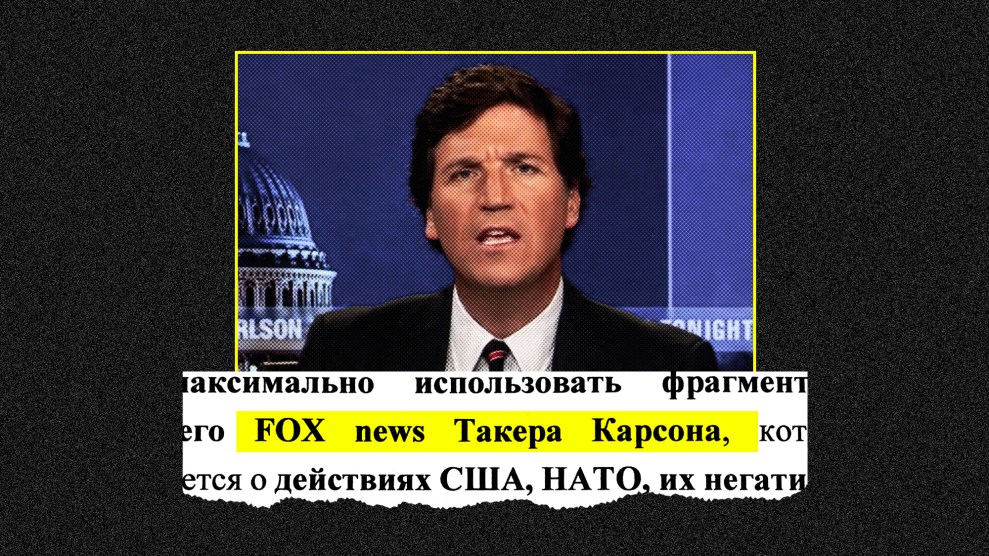
On March 3, as Russian military forces bombed Ukrainian cities as part of Vladimir Putin’s illegal invasion of his neighbor, the Kremlin sent out talking points to state-friendly media outlets with a request: Use more Tucker Carlson.
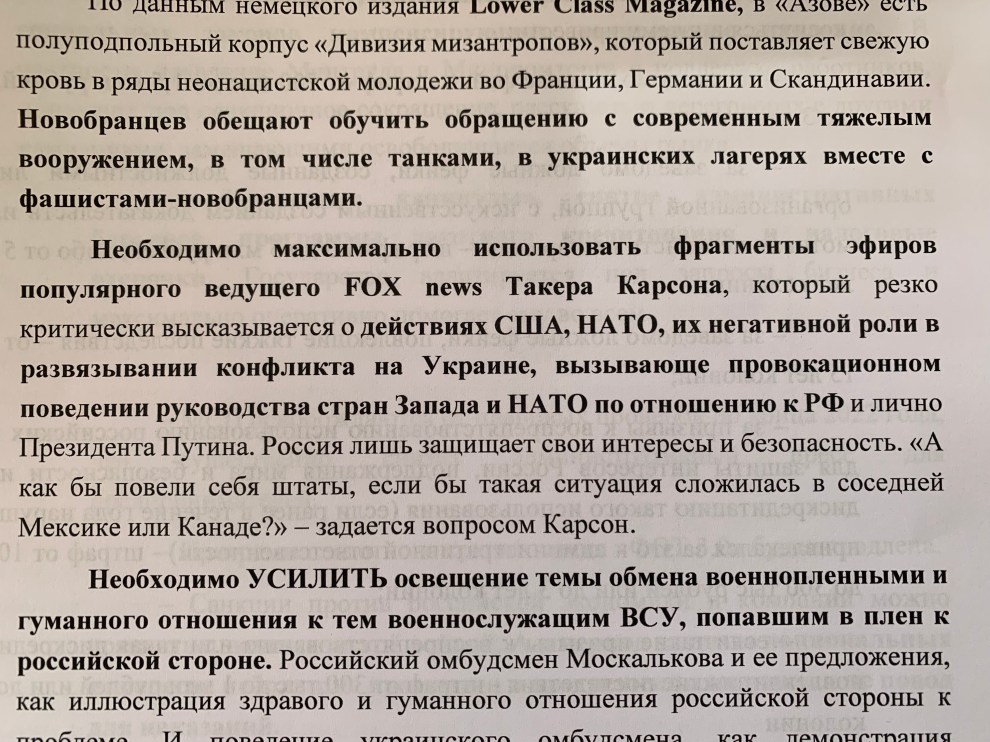
“It is essential to use as much as possible fragments of broadcasts of the popular Fox News host Tucker Carlson, who sharply criticizes the actions of the United States [and] NATO, their negative role in unleashing the conflict in Ukraine, [and] the defiantly provocative behavior from the leadership of the Western countries and NATO towards the Russian Federation and towards President Putin, personally,” advises the 12-page document written in Russian. It sums up Carlson’s position: “Russia is only protecting its interests and security.” The memo includes a quote from Carlson: “And how would the US behave if such a situation developed in neighboring Mexico or Canada?”
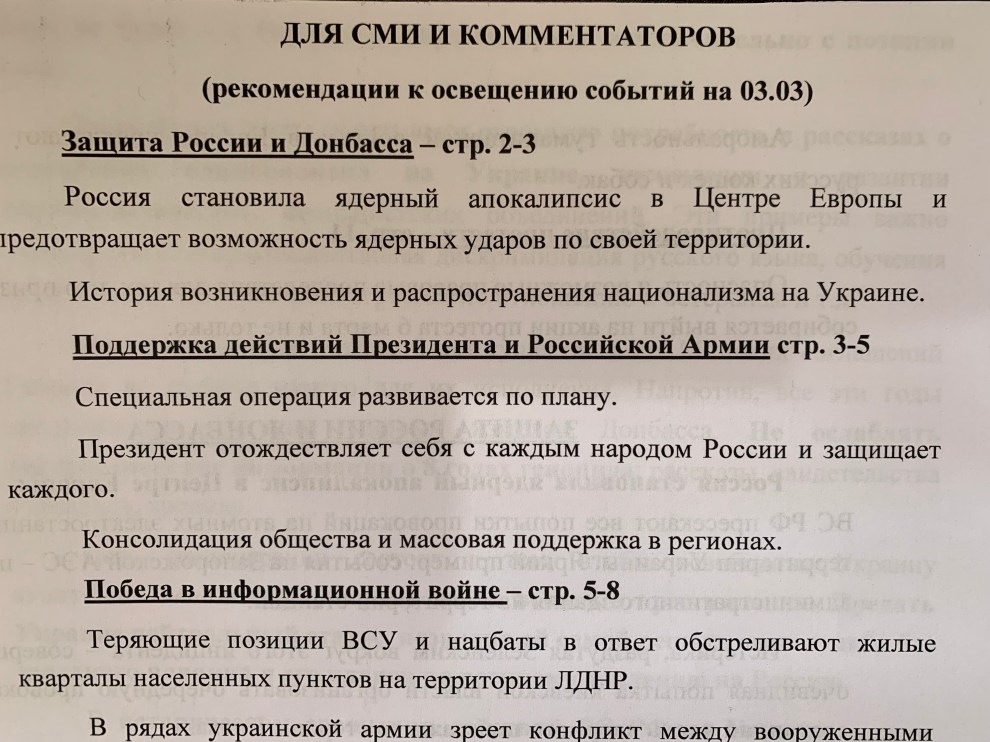
The document—titled “For Media and Commentators (recommendations for coverage of events as of 03.03)”—was produced, according to its metadata, at a Russian government agency called the Department of Information and Telecommunications Support, which is part of the Russian security apparatus. It was provided to Mother Jones by a contributor to a national Russian media outlet who asked not to be identified. The source said memos like this one have been regularly sent by Putin’s administration to media organizations during the war. Independent media outlets in Russia have been forced to shut down since the start of the conflict.
The March 3 document opens with top-line themes the Kremlin wanted Russian media to spread: The Russian invasion is “preventing the possibility of nuclear strikes on its territory”; Ukraine has a history of nationalism (that presumably threatens Russia); the Russian military operation is proceeding as planned; Putin is protecting all Russians; the “losing” Ukrainian army is shelling residential areas of eastern Ukraine controlled by Russia; foreign mercenaries are arriving in Ukraine; Europe “is facing more and more problems” because of its own sanctions; and there will be “danger and possible legal consequences” for those in Russia who protest the war. The document notes that it is “necessary to continue quoting” Putin. It claims that the “hysteria of the West had reached the inexplicable level” of people calling for killing dogs and cats from Russia and asks, “Today they call for the killing of animals from Russia. Tomorrow, will they call for killing people from Russia?”
A section headlined “Victory in Information War” tells Russian journalists to push these specific points: The Ukrainian military is beginning to collapse; the Kyiv government is guilty of “war crimes”; and Moscow is the target of a “massive Western anti-Russian propaganda” operation. It states that Russian media should raise questions about Ukraine President Volodymyr Zelenskyy’s state of mind and suggest he is not truly in charge of Ukraine. And it encourages these outlets to “broadcast messages” highlighting the law recently passed by the Russia Duma that makes it a crime to impede the war effort or disseminate what the government deems “false” information about the war, punishable for up to 15 years in prison. This portion instructs Russian journalists to emphasize that these penalties apply to anyone who promotes news about Ukrainian military victories or Russian attacks on civilian targets.
This is the section of the memo that calls on Russian media to make as much use as possible of Tucker Carlson’s broadcasts. No other Western journalist is referenced in the memo.
Mother Jones is not posting the full document to protect the source of the material. Here are photos of the memo. The first shows the opening page; the next displays the paragraph citing Carlson.
Prior to the Russian invasion, Carlson was perhaps the most prominent American voice challenging opposition to Putin. In one now-infamous commentary, he said, “Why do Democrats want you to hate Putin? Has Putin shipped every middle class job in your town to Russia? Did he manufacture a worldwide pandemic that wrecked your business? Is he teaching your kids to embrace racial discrimination? Is he making fentanyl? Does he eat dogs?”
Carlson repeatedly noted there was no reason for the United States to assist Ukraine in its battle with Russia and insisted it was “not treason, it is not un-American” to support Putin. He contended that Ukraine was not “a democracy” but a “client state” of the US government.
After Putin attacked Ukraine, Carlson ceased his anti-anti-Putin rhetoric and shifted to a new line: that the United States and the West purposefully goaded Putin into launching the war. Carlson said it was “obvious” that “getting Ukraine to join NATO was the key to inciting war with Russia.” He asked, “Why in the world would the United States intentionally seek war with Russia? How could we possibly benefit from that war?” He said he did not know.
More recently, Carlson mouthed Russian disinformation, and he did so as a new set of Kremlin talking points once again pushed Russian journalists to cite the Fox host.
On Wednesday, Carlson claimed that the “Russian disinformation they’ve been telling us for days is a lie and a conspiracy theory and crazy and immoral to believe is, in fact, totally and completely true.” He was referring to the Russian allegation that the United States had set up biowarfare labs in Ukraine. But this charge was far from proven. At a congressional hearing, Undersecretary of State Victoria Nuland had testified that Ukraine possessed biological research facilities and that the US government was worried about “research materials” falling into the hands of Russian forces. This was a far cry from substantiating the Russian charge that Washington was working on bioweapons in Ukraine. But Putin’s regime jumped on the Nuland testimony and cited it as proof of nefarious American activity. Carlson echoed this Russian propaganda.
A March 10 “recommendations for coverage” memo from the same Russian agency highlights this bioweapons allegation as a top talking point for Russian media, noting the message should be that the “activities of military biological laboratories with American participation on the territory of Ukraine carried global threats to Russia and Europe.” The document goes further, encouraging its recipients to allege that the “the United States is working on a ‘biogenocide of the Eastern Slavs.’”
The memo lays out the details of this bizarre conspiracy theory: The United States was conducting “experiments with genetic material collected on the territory of Ukraine,” with the “main objective” being “to create unique strains of various kinds of viruses for targeted destruction of the population in Russia.” The United States even had a plan to transmit pathogens “by wild birds migrating between Ukraine, Russia and other neighboring countries.” This scheme included “studying the possibility of carrying African swine fever and anthrax.” The memo claims “biolaboratories set up and funded in Ukraine have been experimenting with bat coronavirus samples.” It cites Nuland’s testimony and says the United States was involved with “military biological laboratories” in Ukraine that “potentially posed a global threat to all of Europe.”
Carlson had amplified a slice of this Russian propaganda.
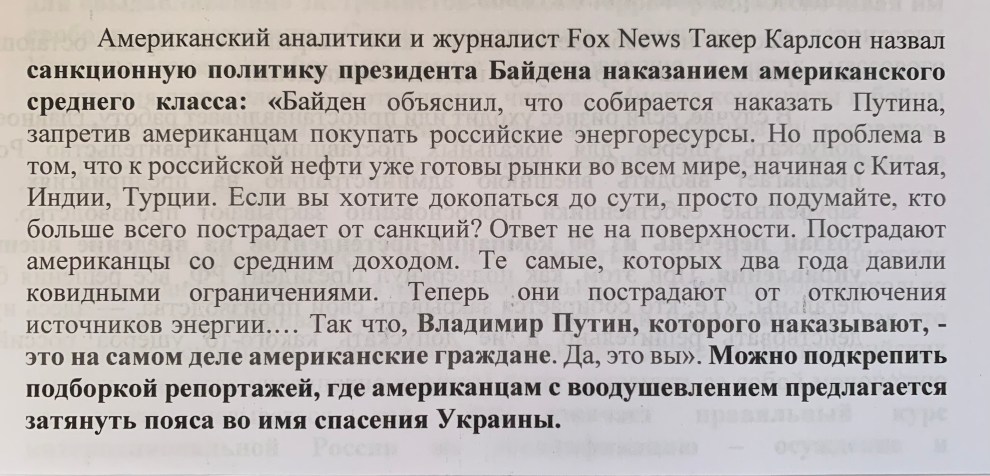
The March 10 memo advises Russian journalists to cite Carlson on another matter: how the economic sanctions imposed on Russia would harm Americans:
American analyst and Fox News journalist Tucker Carlson called President Biden’s sanctions policy a punishment for the American middle class: “Biden explained that he was going to punish Putin by banning Americans from buying Russian energy resources. But the problem is that markets around the world are already ready for Russian oil, starting with China, India, and Turkey. If you want to get to the bottom of it, just think about who will suffer the most from sanctions? The answer is not on the surface. Middle-income Americans will suffer. The very people who were crushed by Covid restrictions for two years. Now they will suffer from cuts to energy sources… So, the Vladimir Putin who is being punished, is actually American citizens—yes, all of you.”
The document notes that Carlson’s anti-sanctions argument “can be reinforced with a selection of reports that enthusiastically encourage Americans to tighten their belts in the name of saving Ukraine.”
As with the March 3 memo, Carlson was the only Western journalist named in this more recent how-to-help-Putin memo. But this edition does point out that the New York Post “writes that it was not anti-Russian sanctions that spurred inflation, but rather the wild spending of Joe Biden himself. President Biden wants to blame Vladimir Putin for the rise in inflation. However, all the fault comes from his policy implemented long before the Ukrainian crisis.”
The March 10 guidelines contains other false claims for Russian journalists to promote: that US forces had been training Ukrainians to launch an offensive in Donbas this month and that Russia’s attack on Ukraine was an effort to preempt that military action; that the Ukrainians have plans to “use nuclear weapons in some form”; and that the horrific bombing of Mariupol that struck a hospital and a birthing center was fake news. It urges Russian journalists to assert that Russia was being victimized by cancel culture and Russophobia was “on the march.”
It’s unclear whether these memos had any impact on Russian media outlets, which already were regularly citing and praising Carlson. Pro-Putin media organizations in Russia may not have needed the Kremlin’s recent encouragement to make Carlson a star. RT, the Russian propaganda outlet, embraced Carlson’s defense of RT after social media companies banned RT content. And on Friday, Komsomolskaya Pravda ran a splashy story headlined “Well-known American TV journalist Carlson was outraged by the ‘lies of the United States.’” It was all about Tucker’s on-air (and unfounded) anger over the Nuland testimony and the biolab allegations. In this instance, a pro-Putin Russian media outlet was using Carlson’s disinformation to advance Moscow disinformation. Just like the Kremlin wanted.
Fox News and Carlson did not respond to requests for comment.
Yesterday morning I got up at 4:30 AM, fired up the beasts of burden that are my computers, and got set to do the first roundup in nearly a week. I was excited to see how it would go together. I had spent the last few days before then updating and fussing over settings and getting things the way I like it and catching up on comments. If you remember I had to go back to the old router that was infected but a few days after I took it offline it cleared itself. I set it back up and I had total control again. Yea!!
I use two browsers on my computers I use routinely for my daily browsing and stuff. I normally use Chrome for everything. However I use Firefox for the roundup. Why do that? Because of the way I can get the cartoons and put them in the post I am creating. See Chrome won’t let me right click on a lot of the sites, and so I cannot copy and paste the cartoons. On some cartoon site neither browser will let me copy the cartoon and have it display correctly so for that I use the “take Screenshot” in Firefox. That allows me to save the cartoon to a folder and then add it to the post with WordPress software. One reason the roundup takes time is it is not a simple thing to get hundreds of cartoons / memes / tweets from the source to one page in WordPress.
Now one other step I set up in the morning when I start the roundup is to open one Chrome window with no tabs along with any leftover Chrome windows that were full of open tabs. This gives me a clean set of windows / tabs to look up information when I am doing the misinformation right wing media section. With Chrome all set up, I opened Firefox to my blog and went to sign into it. That did not work like normal. Instead of signing in it simply took me to the page I started from. Thinking I had just goofed something I tried again. Same result, instead of signing in I returned to the regular blog page. It was like I was not even trying to sign in. That set off alarm bells in my head. I turned to the other computer screen and tried to sign into my blog though Firefox. Same result. I click log in, put in my information, returns me to the same screen not signed in. Now I really knew I had an issue. But what was it.
I checked the WordPress status to see if there was a problem. Nope. So I went to down detector. That site refused to let me in claiming I had unusual traffic on my network. Now I get that sometimes on Google and other sites due to my VPN. I run Nordvpn and I like it, but sometimes the VPN can make it seem like unusual traffic. Normally simply disconnecting the VPN from the internet and putting it back on the internet again normally fixes that. This time it did not.
I wondered if the router was infected after a few clear days. Yes it was. I couldn’t change the same settings as before and couldn’t do the firmware updates. Damn. James got up and I told him that it was infected again. He said he had been having trouble with it on his phone and computer when he was playing YouTube or other videos. The videos would stop while they buffered. So I turned on the traffic monitors and other investigation tools and James and I spent several hours trying hard to figure out what was really going on. First thing we noticed was that my computer was not showing having any traffic even though I was playing a YouTube video. Every other device was showing traffic. So we worked on that, and suddenly my computer was showing traffic again. But James noticed something I missed. A device would have a steady in / receive traffic and a steady normally much lower out / transmit traffic, but for a few seconds that device would show a surge in outgoing traffic. Then a different device attached to the network would do the same thing and return to normal. Then another device on the network would suddenly spike its outgoing traffic for a few seconds. I knew how they were doing it now and why my security was not catching it. They were mimicking the devices attached to my network, pretending to be legitimate members of the network. All our phones, pads, computers, even the printer, all the IOT (internet of things which is the internet connected appliances, TV, stereos what ever) so the router thought it was that device sending out these packets of data. I read up on it and it is a common way bot networks worked now. That is why James and Ron were getting buffering when they watched YouTube, and why my computers were not affected. I have a lot more ram and page swap file hard drive space than their phones.
So what to do about it. I couldn’t clear the old router, and I was not sure if my computers were infected as the anchors. What was bothering me is that at first my main blogging computer did not show any traffic when it clearly was passing traffic. But that could have been a glitch of the router. So I looked at what was the solution and that was binding the mac addresses of the device with their network address / IP. It is not fool proof but better than what I had. The problem is that the old router did not have that or a few newer protocols that are designed to stop these malicious software bots. The new router I disliked did have them and did have the binding capability, but it did not have some features I liked on the old router. While the new router has some good points it still had until April 6th until that adult nanny parental controls for adults working that I couldn’t shut off. That is where under the guise of security they run all your traffic through their servers checking the IP address of the pages you go to against a list of known sites with malware or were dangerous to go to. Plus they also monitor content to check if data is malicious. Both of those things I hate. All that information about you is sold to marketers and other groups that build databases on individuals. But I either use that new router and put up with the parental controls for adults until April 6th or I go out and buy a new much more expensive router. I don’t have much choice do I.
I am sure some want to know how I keep getting infected with what is clearly a bot malware. It could be from Russia, North Korea, or any other country. It could be companies trying to break into large corporation’s computers to steal their intellectual property secrets. Thing is if you look at the threat maps more computers are infected than not. Even large businesses that have big security budgets cannot keep their networks from passing through traffic. The larger a network the more attractive it is for these nation state hackers. But how do they infect your computer I hear someone asking again. By going to your favorite website. Yup that is all you need to do. I bet most of my viewers are infected with the same bot network malware and don’t know it. By the way the old idea was that porn sites were full of malware. But reputable porn sites are scrubbed clean and very secure of malware. After all porn is big business, maybe the biggest money maker on the webs. So they keep their sites clean of bad software. Even the sketchy porn sites are more likely to have the old ransomware or password stealers. Not the real powerful well designed nation level malicious software. But don’t you need to download something I heard yelled from the back? Nope. When you go to the website it is sending your computer the page, how to display it, what is on it, what links are there, and more. The data is flowing into your computer. Now virus software like the old trojan information stealers, that kind will trip your anti-virus software and firewalls. These nation state level hacks are designed to get in without setting off the alarms, they mimic legitimate data, programs, or devices. So what these hackers look for are popular site that might not have as great a security or do security sweeps on a schedule. Like news sites, or cartoon sites. I am sure right wing media web sites are full of these malware programs trying to get into your system.
So late yesterday afternoon I dumped and wiped the two computers (just to be sure) and set up the yucky new router. Then I set about installing all my programs and updating Windows. Hours and hours of work. I was only started when it was suddenly late and I was tired, so about 8 PM I went to bed. Remember that I had gotten up at 4:30 that morning.
I woke at midnight and couldn’t sleep so at 2 AM I got up again to work the computers. I got the updating done and now I am just reloading files. I tried to take a nap but I couldn’t sleep, my mind full of desire to want the computers up and running. I will start the roundup again tomorrow morning. If I can stay uninfected. Maybe next time I will just leave them to it because until the Firefox the hack did not bother me or interfere with what I was doing. Best wishes.
Negotiations between the Florida Senate and House of Representatives, both controlled by Republicans, broke down, with the two sides unable to agree on a bill that would require inspections of aging condo buildings and mandate that condo boards conduct studies to determine how much they need to set aside for repairs. The talks were undone by a disagreement over how much flexibility to give condo owners in the funding of those reserves.
Read the full article. Florida Republicans managed to find the time to create new laws attacking LGBTQs, voting rights, women, and educators, but “ran out of time” to stop fatal building collapses.
The stalemate means that, barring a last-minute revival of talks, Florida condo law will remain unchanged despite broad calls for reform, and there will be no statewide requirement for safety inspections of older condo buildings. https://t.co/fV86UIII45
Don’t fall for this new Republican talking point “Florida session isn’t long enough & that’s why we didn’t pass property insurance reform! Or Surfside reforms! Or any meaningful policy!” Republicans set agenda. They chose culture wars over us b/c they want to distract, not serve.
These pregnancies, which occur when a fertilized egg implants and grows outside the uterus, most often in the fallopian tube, can be life-threatening for the pregnant person if left untreated, and the fetus can’t survive being carried to term, according to Mayo Clinic.
The bill, if passed into law, would make performing, inducing or attempting to perform or induce an abortion for such a pregnancy a class A felony. Insider reported that such a charge could carry a sentence of up to 30 years in prison.
Ectopic pregnancies comprise roughly 1 to 2 percent of all U.S. pregnancies, according to a 2020 study published by American Family Physician. Those that grow and cause the fallopian tube to rupture account for 2.7 percent of all pregnancy-related deaths in the country.
Missouri state Rep. Keri Ingle (D) pointed out that Seitz’s bill would criminalize those devices or drugs used to treat ectopic pregnancies, according to Newsweek.
“Do you know that one of the one of the medications that you’re trying to outlaw is one of the main drugs given to an unruptured ectopic pregnancy?” she asked him, per the outlet.
Ingle said that very “pro-life” people she knew had undergone treatment to terminate ectopic pregnancies and would be “horribly offended by the language in the bill,” Newsweek reported.
Seitz said that the bill would not prevent the legal use of ectopic pregnancy treatments, except in cases in which a woman was a victim of sex trafficking or was outside the care of a hospital or doctor, according to Newsweek.
“They don’t have the hospital machinery to tell if this is an ectopic pregnancy,” Seitz said to Newsweek. “They might just think it’s a normal pregnancy, and they want to abort that child. I would like to see that sort of unlawful activity stopped.”
This is sickening. Ectopic pregnancy causes 10% of all pregnancy related deaths and is the #1 cause of first trimester maternal deaths. Ectopic pregnancies are not viable and have zero chance of a successful live birth. This bill will sentence women to death.
Missouri State Rep. Brian Seitz's (R) bill would make it illegal to abort nonviable pregnancies that may be life-threatening to the mother. During debate, Seitz makes clear he doesn't know how ectopic pregnancies are treated.
I'm no expert but I am a father. Seems true that 1) In 100% of unresolved ectopic pregnancies, the fetus dies. 2) In almost 100% of unresolved ectopic pregnancies where there is no medical intervention (abortion), the woman also dies. 3) This is the bill's sponsor. He's insane. pic.twitter.com/bqVOhiFLeQ



 Scottie's Playtime