
Month: April 2022
Intel Develops Controversial AI to Detect Emotional States of Students
https://www.tomshardware.com/news/intel-students-ai-controversy
(Image credit: Shutterstock)
An Intel-developed software solution aims to apply the power of artificial intelligence to the faces and body language of digital students. According to Protocol, the solution is being distributed as part of the “Class” software product and aims to aid in teachers’ education techniques by allowing them to see the AI-inferred mental states (such as boredom, distraction, or confusion) of each student. Intel aims to expand the program into broader markets eventually. However, the technology has been met with pushbacks that bring debates on AI, science, ethics and privacy to the forefront.
The AI-based feature, which was developed in partnership with Classroom Technologies, is integrated with Zoom via the former’s “Class” software product. It can be used to classify students’ body language and facial expressions whenever digital classes are held through the videoconferencing application. Citing teachers’ own experiences following remote lessons taken during the COVID-19 pandemic, Michael Chasen, co-founder and CEO of Classroom Technologies, hopes its software gives teachers additional insights, ultimately bettering remote learning experiences.
The software makes use of students’ video streams, which it feeds into the AI engine alongside contextual, real-time information that allows it to classify students’ understanding of the subject matter. Sinem Aslan, a research scientist at Intel who helped develop the technology, says that the main objective is to improve one-on-one teaching sessions by allowing the teacher to react in real-time to each student’s state of mind (nudging them in whatever direction is deemed necessary).
But while Intel and Classroom Technologies’ aim may be well-intentioned, the basic scientific premise behind the AI solution – that body language and other external signals can be accurately used to infer a person’s mental state – is far from being a closed debate.
For one, research has shown the dangers of labeling: the act of fitting information – sometimes even shoehorning it – into easy to perceive (but ultimately and frequently too simplistic) categories.
We don’t yet fully understand the external dimensions through which people express their internal states. For example, the average human being expresses themselves through dozens (some say even hundreds) of micro expressions (dilating pupils, for instance), macro expressions (smiling or frowning), bodily gestures, or physiological signals (such as perspiration, increased heart rate, and so on).
It’s interesting to ponder the AI technology’s model – and its accuracy – when the scientific community itself hasn’t been able to reach a definite conclusion on translating external action toward internal states. Building houses on quicksand rarely works out.
Another noteworthy and potential caveat for the AI engine is that expressing emotions also vary between cultures. While most cultures would equate smiling with an expression of internal happiness, Russian culture, for instance, reserves smiles for close friends and family – being overly smiley in the wrong context is construed as a lack of intelligence or honesty. Expand this towards the myriad of cultures, ethnicities, and individual variations, and you can imagine the implications of these personal and cultural “quirks” on the AI model’s accuracy.
According to Nese Alyuz Civitci, a machine-learning researcher at Intel, the company’s model was built with the insight and expertise of a team of psychologists, who analyzed the ground truth data captured in real-life classes using laptops with 3D cameras. The team of psychologists then proceeded to examine the videos, labeling the emotions they detected throughout the feeds. For the data to be valid and integrated into the model, at least two out of three psychologists had to agree on how to label it.
Intel’s Civitci himself found it exceedingly hard to identify the subtle physical differences between possible labels. Interestingly, Aslan says Intel’s emotion-analysis AI wasn’t assessed on whether it accurately reflected students’ actual emotions, but rather on its results being instrumental or trustable by teachers.
There are endless questions that can be posed regarding AI systems, their training data (which has severe consequences, for instance, on facial recognition tech used by law enforcement) and whether its results can be trusted. Systems such as these can either prove beneficial, leading teachers to ask the right question, at the right time, to a currently troubled student. But it can also be detrimental to student performance, well-being, and even their academic success, depending on its accuracy and how teachers use it to inform their opinions on students.
Questions surrounding long-term analysis of students’ emotional states also arise – could a report from systems such as these be used by a company hiring students straight out of university, with labels such as “depressed” or “attentive” being thrown around? To what measure of this data should the affected individuals have access? And what about students’ emotional privacy – their capacity to keep their emotional states internalized? Are we comfortable with our emotions being labeled and accessible to anyone – especially if there’s someone in a position of power on the other side of the AI?
The line between surveillance and AI-driven, assistive technologies seems to be thinning, and the classroom is but one of the environments at stake. That brings an entirely new interpretation for wearing our hearts on our sleeves.

What bothers me is there are legal safeguards over what can be done with recording and using cameras on children, but no such safeguards on adults. We are getting used to every aspect of public life being under the watch of cameras and those that can tap into them. Plus many people have cameras in their homes, on their electronic devices, in their autos that all record or report on them. Over the years since 9/11 we have given up any real idea of privacy, our lives are a fishbowl. Even our TV’s report back what we watch, when we stop or pause. Our homes have cameras that the police want access to (ring system) that neighbors can join to share their cameras with. Now these face things on your computer. Ask this question, will they have to ask you to use your camera, or will the bad actors simply use them anyway. I run security programs to prevent access to my computer cameras and on my desktops when I am not using them I unplug them. But what about new independent digital cameras and phone cameras? Will you get notified when a company accesses them? The microphones? Do the terms of service you just ignore to get the app you want give them the right to spy on you? I wish I could say the government will protect us but the government is one of the biggest abusers of the system. After 9/11 the Patriot Act gave away most privacy rights of US citizens in favor of the feeling of being safe. Do you feel safer now? In some areas the public has to install cameras in their homes in case the police break in to protect the occupant that lives there. WTF has happened to the independent freedom loving Americans? Oh yes they are attacking school boards over mask policies and trying to stop people from reading books that have the true racist history or god forbid be about LGBTQ+.
Trump utterly HUMILIATES himself at disastrous rally appearance
Marjorie Taylor Greene caught LYING red handed IN COURT
PERJURY TAYLOR GREENE
Let’s talk about defense companies, money, and Ukraine….
Michael Lewis on why U.S. COVID response was so…crappy. (My word)
This audio only but I watched the beginning with the CC on and I thought it followed very well during the intro that I had it on.
NBC NEWS: ‘It was killing me’: Mother accuses Russia of forcibly deporting her son from Ukra ine
‘It was killing me’: Mother accuses Russia of forcibly deporting her son from Ukraine
“I am afraid there will be brainwashing and they will force them to take up arms,” said Natalia Demish.
Read in NBC News: https://apple.news/AyXU_CpBMQsW-qRri2Pb6gw
Shared from Apple News
Exclusive: Local election chief threatened by Republican leader seeking illegal access to voting equipment
1/2A “Stop the Steal” flag flies outside a campaign rally with U.S. President Donald Trump and Republican U.S. Senator Kelly Loeffler on the eve of Georgia’s run-off election in Dalton, Georgia, U.S., January 4, 2021. REUTERS/Brian Snyder/File Photo
April 23 (Reuters) – A local Republican Party leader in North Carolina threatened to get a county elections director fired or have her pay cut unless she helped him gain illegal access to voting equipment, the state elections board told Reuters.
The party official, William Keith Senter, sought evidence to support false conspiracy theories alleging the 2020 election was rigged against former U.S. President Donald Trump. The previously unreported incident is part of a national effort by Trump supporters to audit voting systems to bolster the baseless stolen-election claims.
Senter, chair of the Surry County Republican Party, told elections director Michella Huff that he would ensure she lost her job if she refused his demand to access the county’s vote tabulators, the North Carolina State Board of Elections said in written responses to questions from Reuters. Senter was “aggressive, threatening, and hostile,” in two meetings with Huff, the state elections board said, citing witness accounts.
Senter did not respond to requests for comment.
Huff, who refused Senter’s demands, was disturbed by the incident of political intimidation. Such threats have become common nationwide since the 2020 election. Reuters has documented more than 900 threatening or hostile messages aimed at election officials in a series of investigative reports.
“It’s a shame, that it is being normalized,” Huff told Reuters. “I didn’t expect to get it here in our county. We are just trying to do our job by the law.”
Senter’s demands are a potential violation of state law. In a legal memo responding to community calls for a “forensic audit” of voting machines, Mark Payne, an attorney retained by the Surry County Board of Elections, wrote this week that it was illegal to provide access to voting machines to unauthorized individuals. Anyone threatens or intimidates an election officer could also face felony charges, according to a state statute.
Senter and a prominent pro-Trump election conspiracist, Douglas Frank, met with Huff on March 28, claiming “there was a ‘chip’ in the voting machines that pinged a cellular phone tower on Nov. 3, 2020, and somehow influenced election results,” the state election board said, calling the claim “fabricated disinformation.” Separately, in a public gathering that Huff did not attend, Senter threatened to have Huff’s pay cut, according to Huff, who said a person at the meeting told her about the threat.
Two days before meeting with Huff, Frank gave a speech in Dobson, a town in the rural county of 72,000 people on the northern border with Virginia, where he spoke about “debunked conspiracy theories about the 2020 election,” the board said. The day after the meeting, Frank, an Ohio math teacher, thanked his “patriot” hosts in a post to the messaging app Telegram about his trip to North Carolina and said he was “leaving behind a bonfire burning in good hands.”
Frank did not respond to requests for comment.
Exactly how Senter planned to retaliate against Huff remains unclear. He claimed to have the backing of Surry County commissioners, all five of whom are Republican, to take action against her. But neither Senter nor the commission has any official power over her job, which rests with the state election board. The state board has three Democratic members and two Republican members.
Huff, a former Republican, is now registered independent.
The county commission chairman, Bill Goins, declined to comment on Senter’s efforts but confirmed the commission could not fire Huff.
Patrick Gannon, spokesman for the state board of elections, said in a statement that the board reported the threats against Huff to state, federal and local law enforcement and would continue to report “any attempts to interfere with state or federal elections or harass or intimidate election officials.”
No one has been charged in the incident.
The North Carolina Department of Public Safety and the Federal Bureau of Investigation did not immediately respond to requests for comment on Saturday.
Dobson Police Chief Shawn Myers said he was not aware of the threats to Huff and did not believe his department had responded. Sheriff Steve Hiatt did not respond to requests for comment.


Democracy is on its last legs here. I truly believe that
evanedwards Todd20036 • 20 hours ago
The next Republican in the oval office will surely end it.
doninkansas evanedwards • 19 hours ago
Or sooner if they control both houses again.
QAnon AZ Gov Candidate Sues To Ban Voting Machines
The Tucson Sun reports:
Two Republicans seeking statewide office are asking a federal judge to block the use of machines to tabulate the votes in Arizona in the 2022 election. The machines are unreliable because they are subject to hacking, contend Kari Lake, a gubernatorial hopeful, and Mark Finchem, who is running for secretary of state.
Neither Lake nor Finchem agreed to be interviewed on the lawsuit. But Lake, in an interview with Trump supporter Mike Lindell, said the litigation is the result of what she believes was a stolen 2020 election. “We know how tragic it was that this election (was) corrupted the way it was here in Arizona,” she said. “And we don’t want it to happen again.”
Read the full article.
Lake last appeared on JMG last month when she stormed out of a 60 Minutes interview after falsely claiming that Capitol rioters are being held in jail without charges.
Lake, who has been endorsed by Trump, has called for imprisoning Arizona election officials.
As I’ve reported on multiple occasions, Lake’s campaign events have featured a cornucopia of cuckoo crackpots, including white supremacists, neo-Nazis, militia members, anti-vaxxers, and QAnon podcasters.
Lake is a former anchor for a local Fox News affiliate.
As long as there is an auditable paper trail the counting machines are fine. If there is any doubt about the machines’ reliability ballots can be manually spot checked and recounted. In my county, after the machine counts are done, a random selection of precincts are always manually counted to spot-check the machines’ accuracy.
She probably wants to get rid of the machines’ efficiency and therefore create more opportunity for choas and alledged evidence of fraud during a slow and laborious hand count.
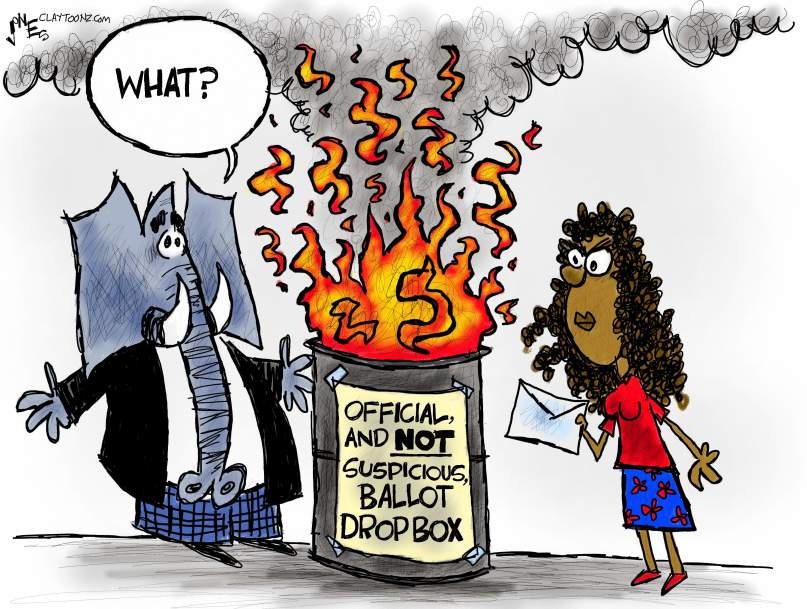
Arizona uses paper ballots already. What she is objecting to is an optical scanner. In NYS we went for paper ballot/optical scanner precisely so if there was any issue, the ballots can be hand counted. She’s another clueless Qmoron.
In addition to a GOP secretary of state candidate who disputes 2020’s election we also have this guy running for office in Michigan.
Octoberfurst safari • an hour ago
Where are all these lunatics coming from? Were they always out there? Or were they just emboldened by the orange one to come out from under the rocks?
 Scottie's Playtime