Miss Majesty Divine, a drag performer, collects tips and dances among the crowd at Phat Sammy’s tiki bar in Huntsville, Ala.Credit…D’Angelo Lovell Williams for The New York Times
It was an unusually chilly Thursday night in December, and a drag queen named Miss Majesty Divine was putting the final touches on her show makeup. She was about to go onstage for her regular gig at a basement tiki bar, one of the last performances before Christmas.
Up at street level, two unwelcome guests had arrived. They were not fans. They were men with bushy beards, one holding a bullhorn, the other a placard that depicted a drag queen holding a screaming baby and the hashtag #stopdragqueenstoryhour.
“Repent, you filthy dog! You are going to burn in hell!” the one with the bullhorn shouted. “God sent AIDS to deal with people like you!”
Madge, as she is known to her friends and adoring fans, was unfazed.
“I teach math to middle schoolers,” Madge deadpanned. “You think I haven’t been called some things?”
By the end of the next workday, Madge, who in the classroom was known as Mr. James Miller, would call himself something new: retired. In the middle of the school year, the teacher, 52 years old, abruptly put in his papers. His career was over.
“It’s funny — all these people who complain about cancel culture, and now they are trying to cancel my whole existence,” Madge told me.
Miller’s troubles began on Oct. 12, when the conservative social media account known as Libs of TikTok, which specializes in finding and spreading videos, often out of context, of supposedly outrageous liberal behavior, posted an edited video of him performing in drag as Madge at charity events, some of which had children in attendance.
The video went viral, landing Miller on The Daily Mail’s website and many conservative news sites, falsely portraying his tame performances as lewd and overtly sexual. An avalanche of hate came down on Miller. Amid the maelstrom he realized that he could not continue teaching in Alabama. He had already been thinking of retiring soon, and this cataclysm prompted him to accelerate his plans.
Image
Miss Majesty Divine applies her makeup backstage before her performance, transforming from middle school math teacher to drag queen.
Image
Miss Majesty Divine struts to her last number, a Tina Turner mix that ends with “Proud Mary.”
Image
Kirstin Orlando, a drag performer, dances onstage in a dominatrix-themed outfit, complete with a riding crop.
Image
Tsunami Rayne, a drag performer, does a final check of her outfit backstage at Phat Sammy’s.
I traveled to Alabama last month to try to understand the state of queer America today, to try to understand this unsettling whiplash I’ve been feeling lately as a queer person. The world watched a gay congressman lead the vote to codify national recognition of same-sex and interracial marriage, and the grandees of the L.G.B.T.Q. community gathered at the White House to watch President Biden sign that bill into law and to listen to Cyndi Lauper croon “True Colors.”
At the same time, queer people are being hounded by vigilantes and targeted by bigoted laws. On TV I watch queer people as protagonists but also hear them vilified as groomers and child molesters by right-wing news organizations and lawmakers. A web designer would rather go all the way to the Supreme Court than make a wedding website for a theoretical queer couple. Queer spaces, from clinics serving transgender youth to nightclubs, are under attack. These past few years have been a time of head-spinning backlash.
I chose to come here not because Alabama has one of the strongest records of homophobic legislation in the country or because it is one of the few states where less than half of the population supports federal protections for gay marriage. I came here because the last time I was in Alabama, in 2017, I had one of the best nights of my life, at a gay bar with a bunch of queer people I had just met.
At the time, I was the editor of HuffPost, and I was in town with a group of colleagues as part of a cross-country bus tour we did, interviewing people about the state of America along the way. We met and interviewed a man named Michael Meadows who had just been named Mr. Leather Birmingham. He invited us back to the local leather bar, Spike’s. It is hard to explain how good it feels to walk into a queer space when you are a queer person in a strange place — the warm embrace and recognition of a shared experience, no matter how different our lives might be. A night of karaoke, dancing in faux cages and rounds of shots ensued. My memories are hazy, but the pictures and videos on our phones don’t lie: We had a blast.
When I went to Birmingham in 2017, we were less than a year into the Trump administration. It was long before the phrase “don’t say gay” entered the popular vernacular and before the word “groomer” came roaring back into circulation as a slur hurled at queer people. It was before the tsunami of book bans and, Lord help us, long before Libs of TikTok.
It was a time when major TV shows featuring transgender actors were started. “RuPaul’s Drag Race” had become a cultural phenomenon, and drag performances drew wider audiences. Gay bars had become prime destinations for straight bachelorette parties, much to the chagrin of many gay patrons.
And it wasn’t just media and society. Supreme Court decisions affirming the right to same-sex marriage seemed to have paved the way to mainstream acceptance of gays and lesbians. Polling showed consistent majority support for same-sex marriage. Some of the hottest debates within the queer community every June were over whether Pride had become too mainstream and corporate.
That year Alabama, a blood-red state, stunned the nation by electing a Democrat to the Senate, choosing Doug Jones, a former prosecutor who had brought two of the Klan bombers of the 16th Street Baptist Church to justice, over the right-wing Republican Roy Moore. Jones spoke proudly of having a gay son.
Image
Miss Majesty Divine, Kirstin Orlando and Tsunami Rayne before going onstage at Phat Sammy’s.
The late 2010s were a pivotal time in James Miller’s life, too. He was interviewing for a teaching job at Mountain Gap Middle School in Huntsville.
“When I was interviewing, I said to myself: I don’t want to spend another 20 years in the closet,” Miller told me as he got ready for the drag show. So when he got the job offer, he pointedly told the hiring committee that he would need to discuss it with his husband and son. It was a test, and the school passed, welcoming him with open arms.
“I thought, ‘I found where I want to be,’” Miller said.
At that point, Miller had also been performing as a drag queen for roughly two decades, though like any good teacher, he kept a strict divide between his classroom and his life outside of school. He said he got his start in drag performing at a charity event to raise money for an AIDS hospice.
“A friend of mine said, ‘Why don’t you do drag? You’ve got a big mouth and a bad attitude,’” Miller said.
Over time, he built a loyal following, performing at local nightclubs and at charitable events. As drag grew more popular with broader audiences, he started performing at story hours for kids. He said he took care to tailor his performance to the audience, keeping it PG whenever children were around, though like any kids’ entertainer, he said he liked to slip in double entendres that would fly over children’s heads but give the grown-ups a chuckle. It was a fun side hustle.
Until now. After Libs of TikTok released the video of him performing, he was placed on paid leave from his job. His email inbox filled with hateful messages.
“People said things like, ‘Why are they letting this thing breathe?’” he told me. Other messages called for him to be prosecuted for child abuse.
But he also got warm and supportive messages from parents and students.
“I heard today about the stupid issue happening, and I just wanted to say as a parent that has had three of their own children in your classroom, we fully support you,” said one such message Miller showed me.
The crowd at the tiki bar that December night whooped when Majesty Divine finally pranced onstage, lip-syncing along to Lizzo.
“It’s bad bitch o’clock. Yeah, it’s thick-thirty,” she sang, thrusting out an ample hip and tossing a bewigged shrug. “I’ve been through a lot, but I’m still flirty.”
Then Madge shared some news.
“Y’all keep up with the news? Well, don’t. It’s too depressing,” she said. “Tomorrow at 3:15 is the end of 30 years of teaching for me. I’m retiring.”
The crowd let out a cacophony of supportive boos and cheers.
“I love you all so much,” Madge purred. She brought down the house with a Tina Turner mash-up that ended in a barn-burning rendition of “Proud Mary.”
Amber Portwood, the manager of the bar, said it was a huge loss for the children of Huntsville.
“Madge is such a wonderful teacher and community person,” she said. “Her students were the first to come to her defense. It is absolutely shameful what happened.”
Asked about Miller, Huntsville City Schools sent this statement: “The district addressed a personnel matter several months ago following viral posts on social media involving a teacher. While we are limited in what we can share for privacy reasons, this was not a school-related event, it did not take place on school property, it did not occur during school hours, and it has no connection to any instruction that occurs in our classrooms.”
Image
Lauren Jacobs, the assistant director of the Magic City Acceptance Center, in the center’s library. It stocks L.G.B.T.Q. books, which are banned in many Alabama schools.
How did we get here? Looking back, I cannot help wondering now whether what looked in the 2010s like an unstoppable march toward mainstream acceptance of gay and lesbian people was perhaps more of a wobble. Perhaps the wanton cruelty of the Trump era uncorked something that was there all along. Right-wing, nativist parties espousing what they describe as traditional values have made electoral gains across many continents, and almost all of them have found queer people an easy target to use to whip up support for their agenda.
What looked in American polls like widespread acceptance of gay and lesbian people came in large part from a highly effective campaign to show that gay people are just like everyone else, save one small difference that likely was genetic and immutable, and that we wanted the same things: the American dream of marriage, conventional career success, military service.
But like all liberation movements, the fight for queer liberation contained multitudes of different people with different beliefs, including those who wanted revolution — to overthrow the entire heteronormative patriarchal system built around monogamy and the nuclear family within capitalism. They saw that system as the root of oppression not just of queer people but also of women and all kinds of marginalized people.
But the vanguard’s demand for revolution inevitably runs up against the majority’s urgent need for safety and basic rights. Much of the L.G.B.T.Q. rights movement’s efforts moved toward reforming rather than remaking. And so we have decriminalized gay sex, legalized gay marriage and allowed gay people to serve openly in the military. And a lot of us slipped into a kind of complacency. We once chanted, “Silence equals death.” Now we cooed, “Love is love.”
As many more queer people have come out into the light, parts of the community that were more hidden from the mainstream are demanding their visibility, too, especially transgender and nonbinary people, among them many children and teenagers who in previous generations would not have dreamed of coming out. And that has made a lot of people of many different political stripes very uncomfortable.
“A lot of the improvements in L.G.B.T.Q. life that the pollsters point to and on which we base our conclusion that there has been significant progress — they don’t really tell us much about what people are privately feeling,” said Martin Duberman, a leading historian of the gay rights movement who, at 92, has some long-term perspective on this issue. “And I think what we are seeing now is those private feelings coming out again.”
For much of modern history in the United States, queerness had to be carefully hidden to avoid police harassment and violence. Eventually queerness came to be tolerated if it emulated heterosexual norms — gender appropriate, couple-focused, monogamous. Now the insistence on recognition from queer people who don’t conform to expectations about gender seems to have been a bridge too far.
We’ve been here before. Urvashi Vaid, the lionhearted activist who tragically died at the age of 63 last year, wrote about this in her prescient book, “Virtual Equality,” which was published in 1995. As a candidate, Bill Clinton had courted the gay vote, but he ultimately triangulated his way to the Defense of Marriage Act and the abominable “don’t ask, don’t tell” policy in the military.
In a 1994 speech Vaid warned us, “By aspiring to join the mainstream rather than continuing to figure out the ways we need to change it, we risk losing our gay and lesbian souls in order to gain the world.”
Years of effective activism culminated with the dismantling of the Defense of Marriage Act by the Supreme Court. But as supporters of voting and abortion rights will tell you, a Supreme Court decision turns out to be a flimsy scaffold on which to build your freedom. The court has gutted the Voting Rights Act and overturned Roe. The battles for the ballot and bodily autonomy have moved mostly to the state and local levels. It is clear that queer people will receive a frosty reception from the emboldened majority of the highest court in the land.
So what now? I posed this question to the organizer and writer Dean Spade, who has worked relentlessly as an advocate for queer and trans people.
“The only social movements that have ever won any liberation or even reduced the conditions of harm were made up of millions of ordinary people, gumming up the works, throwing wrenches into the machines of oppression and then helping each other survive the systems along the way so that they could keep organizing,” he told me.
Queer people have never sat around and waited for rights and dignity to be handed to them — from the first stirrings of gay resistance in the early 20th century to the Stonewall uprising to the horrors of the AIDS epidemic, we have built our own systems of mutual aid and care. In Alabama, that spirit and the people who carry it refuse to give in to the backlash.
I saw that spirit at the Magic City Acceptance Center, an organization that provides a safe space and supportive programming for queer youth in Birmingham. There I met a 31-year-old queer Black woman named Lauren Jacobs, who was born and raised in Birmingham. When she was trying to decide where to go to college, she could have done what generations of young queer people have done: Get a one-way ticket out of Alabama, head for one of the meccas on the coasts and never look back.
But she didn’t. After checking to make sure it had an L.G.B.T.Q. student organization, she chose to attend the University of Alabama in Tuscaloosa and joined the vibrant queer community there.
“We have a long, long track record of activism here,” Jacobs told me.
Image
Elizabeth Danielle Marceille Allen, a transgender woman who found shelter and support at TAKE.
Image
Daroneshia Duncan-Boyd, TAKE’s founder and director, with her husband, Logan Boyd, a transgender man, who helps run the center’s programming.
Image
Aniya Nicole, a member of the TAKE community, outside the center.
Image
Corey Oden, the program coordinator for the health program at TAKE, which helps transgender people get H.I.V. prevention, treatment information and medication and other medical care.
After graduation she decided to move back home to Birmingham, roll up her sleeves and fight for queer people in her home state.
“It felt like there was so much work to do in Alabama,” she said. “There is so much I like about how we organize in Alabama.”
The center now serves hundreds of queer youth in Birmingham and across the state. It offers space for them to hang out, play video games and be with their peers. Every year, the center holds a prom for queer kids; they can dress as they like and bring a date of whatever gender they prefer. Jacobs was among a couple of dozen attendees at the first one in 2014. Around 200 kids attended the most recent one.
The work of the center could not be more urgent. According to the Trevor Project, a mental health and suicide prevention organization focused on L.G.B.T.Q. youth, 47 percent of Alabama’s queer kids seriously considered suicide in the past year, and 20 percent of transgender kids attempted suicide.
“For young people who feel that Alabama doesn’t have spaces like this, for them to be able to walk into a place like this and feel they deserve it — that is always a joy,” Jacobs said.
I found another answer at the TAKE Resource Center, an organization in Birmingham’s East Lake neighborhood supporting transgender people of color. It was started by a transgender woman, Daroneshia Duncan-Boyd, who felt that too many trans people were suffering from poverty, homelessness and violence. She built TAKE in the mold of queer mutual aid organizations throughout history, with the knowledge that a hostile society would do little to save them.
“We started TAKE with sex-work dollars and unemployment checks,” Duncan-Boyd told me with a chuckle. Now the organization operates an emergency shelter, life-skills classes, legal clinics and a drop-in center.
“Other organizations provide surface-level services, but we get down into the nitty-gritty,” said Logan Boyd, a transgender man who works at the center. He moved to Alabama in 2017, and the following year he and Duncan-Boyd married. They are now trying to have a baby, a head-spinning but enticing prospect for Boyd.
“We’re trying to change the image of what the American dream can be,” he said. “I’ll have to wrap my head around being a pregnant man, I guess.”
Reimagining what life could be for transgender people in the South is central to TAKE’s mission. But first, it must attend to the most basic, urgent needs. I met one of TAKE’s clients, a 41-year-old trans woman named Marcy Allen. In November she had found herself penniless and homeless on the streets of southern Alabama after a string of bad luck.
“It was getting colder, so I needed somewhere indoors to sleep,” Allen told me. “I was doing things I didn’t want to do to pay for hotel rooms.”
News of her plight made its way to Duncan-Boyd, who leaped into action.
“The next thing I know, I am on a bus headed here,” Allen said. She told me she had been living in the group’s emergency shelter and was looking for a job. She had already made an appointment at the local gender clinic to begin her long-sought medical transition.
“March 4,” she said. “I have been on bootleg hormones, and now I can finally get the real thing.”
She attended a legal workshop to begin the process of changing her name. She said Marcy was a temporary name, a place holder. Now she is known as Elizabeth Danielle Marceille Allen.
“It suits me, don’t you think?” she asked, with a flick of her blond hair.
On my last night in Birmingham, I was invited to a party by the Magic City Sisters of Perpetual Indulgence. They are a charitable organization that raises money for mostly queer causes. The Sisters have their roots in a raucous and raunchy group of queer activists in San Francisco who dressed in nuns’ habits and behaved outrageously.
Birmingham’s Sisters throw elaborate parties every year, and this one, the Fire and Ice Red Dress Party, was to raise money for the Gender Health Clinic in Birmingham, which provides care for transgender and nonbinary people. They also give out awards to people who have done great service to the queer community.
“The Sisters promulgate universal joy and expiate stigmatic guilt,” the group’s leader, or abbess, Robert King Dodge, told me, decked out in a dazzling red frock and a bejeweled top hat.
It was held at an Arts and Crafts mansion in a fancy part of Birmingham, and all the grandees of the local gay community turned out in force. I thought about that carefree Birmingham night in 2017 and how different things felt now. Everyone I talked to was worried — about the terrible laws that would oppress queer people and the hateful message that sends to queer kids. They all thanked me for coming to Alabama to write about what’s happening.
As the award ceremony wound down, I was surprised to hear my name over the loudspeaker. King Dodge beckoned me up, a wrapped gift in his hand.
“Open it,” he urged.
It was a framed certificate naming me an honorary Sister of Perpetual Indulgence in the house of the Magic City Sisters of Birmingham.
I didn’t quite know what to say. My eyes filled with tears as I looked around the room, filled with people who were proud of all our community has accomplished but terrified of the gathering threats.
“Thank you,” I said. “It’s an honor to be your sister.”
I am so fortunate to have lived in a time and place that permitted me to live my whole adult life out and to be proud of being a lesbian. Increased visibility was supposed to make queer people more recognizable and accepted, and there is no question that it did. But I now wonder if, for some, the sheer volume and range of people coming out have had the opposite effect: making it seem that queer people are omnipresent and a threat.
I get it. When people who are alien to you tell you that deep down, they are just like you, it saves you from having to confront how you might actually be like them. How you might envy their freedom, the strength of their communities. As any decent psychoanalyst will tell you: The flip side of fear is desire.
As I left Birmingham the next morning, I thought about the extraordinary people I had met and the fights they were waging for the lives of queer people in their communities. I knew that this era’s slogan, that wan tautology “Love is love,” was no match for resurgent bigots reclaiming hateful chants about AIDS ridding the world of the homosexual scourge. We need to reach into our past as well and remember the time we chanted, “Silence equals death.” And an old favorite, a mantra for all time: “We’re here. We’re queer. Get used to it.”
And the erasing of gays from society continues in Florida. The don’t say gay law is working just the way the republican’s hoped it would. It is a fact that some kids have two dads or two moms, yet the republicans inred states want to outlaw anyone knowing about them. They are demanding those families are not real families, that those kids are dirty somehow. They want them ostracized and targeted for bullying. They want the fact that being gay is normal and shared widely in the animal kingdom. Kids will be forced into a heterosexual mode of acting only. Hugs
Schools are banning innocuous books about LGBTQ+ people to comply with the anti-LGBTQ+ law.
In the wake of Florida’s Don’t Say Gay law, schools in the state are banning books with LGBTQ+ themes, including And Tango Makes Three, a book about a baby penguin named Tango who has two dads.
The Don’t Say Gay law, also known as the Parental Rights in Education Act, was signed into law last year by Florida Gov. Ron DeSantis (R) and bans discussion of sexual orientation and gender identity in grades K through 3 and restricts such discussions in older grades.
Conservatives said the bill was necessary to stop sexual discussions in schools as well as instruction about sex and that the law wasn’t anti-LGBTQ+. The DeSantis administration called opponents of the bill “groomers,” another word for child sex abusers.
But it turns out that the bill is doing what opponents said it would do: making LGBTQ+ people a taboo topic in schools.
Popular Information reports that Lake County’s school district banned three books in grades K-3: A Day in the Life of Marlon Bundo (about a gay bunny who likes hula hooping), And Tango Makes Three, and In our Mothers’ House (about three kids with two moms).
A statement says that the books were “administratively removed due to content regarding sexual orientation/gender identification prohibited in HB 1557.” H.B. 1557 is the Don’t Say Gay law.
Seminole County Public Schools banned three books citing the Don’t Say Gay law. The books were 10,000 Dresses (about a boy with a dream of making dresses), I am Jazz (about the experiences of trans activist Jazz Jennings), and Jacob’s New Dress (about a boy who wants to wear a dress to school).
None of the books contain sexual content, but the district said they, “pursuant to the aforementioned statute [the Don’t Say Gay law], would be deemed as not being age appropriate or developmentally appropriate for students in kindergarten through grade 3.” They were removed from district libraries and “will only be available for check-out to a student in grade 4 or 5 when the parent has provided written consent and picks up the book from the principal or designee at the school.”
The DeSantis administration said in response to one of the legal challenges against the Don’t Say Gay law that it only applies to classroom instruction and not library books, but the Florida Department of Education is telling school librarians that “there is some overlap between the selection criteria for instructional and library materials” in its training materials for the Don’t Say Gay law and they should be “avoiding unsolicited theories that may lead to student indoctrination.” The materials tell librarians to “err on the side of caution.”
Opponents of the Don’t Say Gay law cited high suicide rates among LGBTQ+ youth and argued that erasing LGBTQ+ identities from school will make them feel more alone and isolated.
“42% of LGBTQ youth seriously considered attempting suicide last year,” Chasten Buttigieg said of the bill last year. “Now they can’t talk to their teachers?”
This man who authored the bill felt his religion and his opinion was more valid than all the science and medical data that shows he is wrong. He claims that identifying as a different gender than assigned at birth is a temporary problem, giving the idea it is a phase people go through like adolescence or acme. That was what people tried to claim about gay people in the past, that it was a phase young adults would grow out of, or it was done as rebellion against parents. That was wrong then and it is wrong about trans people now. These right wing people are just recycling all the old tropes against gay people to use against trans people. The goal is to destroy all the social advances in the US society and return to a past that was regressive and oppressive before equality and civil rights for minorities. Please understand that for trans people to wait that late in life until 26 means not only living as the wrong gender all that time but also the human body has by then been set into the mold of the wrong gender for the person. During puberty so many changes happen to create a male or female body that simply by looks is a lifetime sentence of being in the wrong body. If you are one gender imagine looking like the other all your life because someone said you couldn’t have the medical treatment needed to help you live as you really are. Hugs
The bill’s author said he did not speak to a single transgender person before writing it.
Oklahoma State Sen. David Bullard (R)Photo: Oklahoma Senate
In Oklahoma, a new bill called the “Millstone Act of 2023” has been proposed that would ban gender-affirming care in all forms for anyone under 26 years old. The bill targets healthcare providers and says anyone who violates the rule could face felony charges and have their medical license revoked.
The bill’s name reportedly refers to a passage in the Bible that says it is better to tie a large stone to your neck and drown than to cause harm to a child. It was introduced by state Sen. David Bullard (R), who was also behind a state law that passed last year banning trans youth from using school bathrooms and locker rooms that align with their gender identity.
In a statement to The Oklahoman, Bullard said gender-affirming surgery is “a permanent solution to a temporary problem” and called it a violation of doctors’ Hippocratic Oath to do no harm.
“We want to make sure that if we’re going to do a procedure like this that is irreversible, then we want to make sure an individual is at their full maturity when it comes to cognitive development,” he said.
He also explained why he wanted to restrict gender-affirming care to such a late age.
“At the age of 18, you can vote, but a vote is not a permanent change in your body that cannot be reversed. At the age of 21 you can drink, but at the end of the day if you decide to put the alcohol down, you can put the alcohol down. But with this surgery, there is no going back. We just want to make sure that the brain is fully developed before we allow this kind of surgery, permanent thing to happen.”
He also said he did not speak to a single transgender person before writing the bill.
Oklahoma has passed a slew of anti-trans legislation as of late.
The Millstone Act is also one of multiple bills that have been proposed targeting gender-affirming care for trans adults as Republicans continue to expand their crusade against trans people. Bills targeting medical care for trans adults have recently been proposed in South Carolina and New Hampshire as well.
“We have been saying a slow moving genocide targeted at eliminating transgender people through eliminating gender affirming care is happening,” wrote activist Erin Reed in December. “It continues.”
DeathSantis spokesperson says that they want to eliminate “political ideology” from public higher education. Yet Rufo is one of the most ideology driven people I have ever seen. He is a die hard far right to the point of being racist and virulently anti-LGBTQ+. Seriously he wants to roll back every social advance since 1855. Look at what DeathSantis says is a bad thing in education, he DeSantis admin plans to weed out concepts like diversity, equity and inclusion (DEI) and critical race theory (CRT). Hugs
Gov. Ron DeSantis has appointed conservative activist Christopher Rufo and five others to the New College of Florida Board of Trustees in his continuing move to eliminate “political ideology” from public higher education.
With the six new members of the school’s Board of Trustees, the DeSantis admin plans to weed out concepts like diversity, equity and inclusion (DEI) and critical race theory (CRT). The move comes amid low student enrollment at the New College of Florida and as DeSantis ramps up his second term.
In a statement Friday, DeSantis Communications Director Taryn Fenske said New College has been “completely captured by a political ideology that puts trendy, truth-relative concepts above learning.”
DeSantis appoints anti-civil rights activist Chris Rufo to New College of Florida Board of Trustees; Rufo is known for his attacks on CRT and spreading the “groomer” slur against gay and trans people https://t.co/cqz6BCnYtC
Rufo to the NY Times: “It’s wrong, factually and morally, to accuse someone of being a groomer with no basis and evidence. It’s become a powerful word that should be used with great responsibility." https://t.co/1Mpv5T72Lj Rufo in real life: pic.twitter.com/z9oLcXYyGk
As I noted to the NY Times, it's the same Rufo strategy between the CRT and groomer labels: take down policies or institutions that have popular support by rebranding them in a negative and misleading way. https://t.co/KxhCqoskLNpic.twitter.com/gYBfCcakdb
The same person who started the CRT panic also created the groomer lie. Christopher Rufo is nothing short of evil. “We are building a new model of conservative activism” with the grooming messaging, argues Christopher Rufo, a leading anti-critical race theory activist.” ~ Rufo
Christopher Rufo bitching about fact checking after he lied about CRT and groomer theory is just… So quintessentially 2022 it hurts. https://t.co/vEVFn5INEB
— Unironic Lesbian Dance Theorist, Doer of Jew Magic (@hamilcarenina) May 5, 2022
So Chris Rufo deceptively said the exec "wants a minimum of 50 percent of characters to be LGBTQIA and racial minorities" in the leaked video — though she doesn't say that.
Sandra Smith now says Disney wants 50% of their characters to be gay.
Exactly! Note the things he pointed out as “political ideology” are all progressive causes. Pushing right-wing ideology is going to be fine I guess. White nationalism, anti-gay/trans propaganda, misogyny and a white-washed US history will be back on the menu boys!
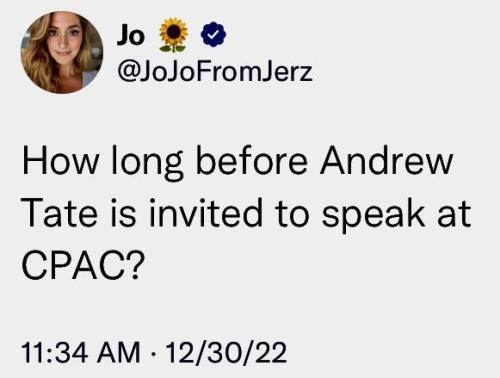
Nearly every single prominent anti-gay figure has sooner or later turned out to be a closet case. Case in point this week: Matt Schlapp. They’re all working out their own internalized homophobia and self-hatred by trying to hurt other people.
And I think every single leader that the so-called “ex-gays” have had later turned out to be still totally gay. To their credit, several of them later came clean and apologized for their actions.
Before it merged with USF in 2001, New College was the toughest Florida college to get into. It was a big deal when I was in high school. Since the merger with a public university, enrollment has plummeted to around 700.
The important information is that the rushing kids to be trans myth is disproven, the trans population is still a small subset of the LGBTQ+ group. The right uses emotion to drive fear because the data simply debunks and destroys their positions. Hugs
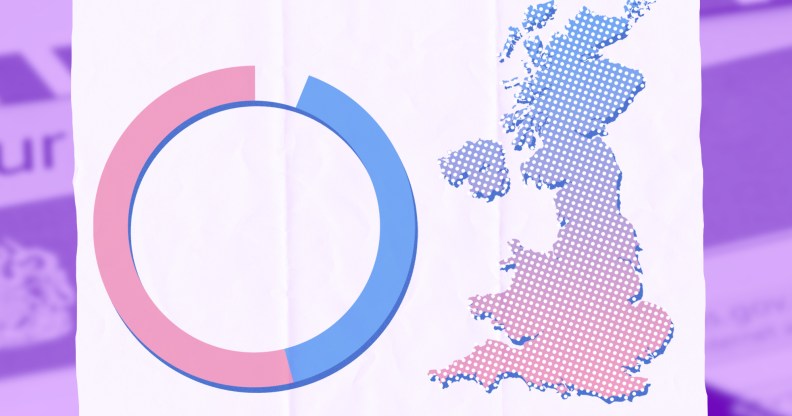
New census data for England and Wales should put a stop to the “anti-trans moral panic”. (PinkNews/Getty)
New census data revealing the size of the trans population should be used to combat anti-trans rhetoric and to secure vital resources for the community, experts have said.
The Office for National Statistics (ONS) released first-of-its-kind census data on sexual orientation and gender identity in England and Wales on Friday (6 January).
Around 1.5 million people (3.2 per cent) identified themselves as gay, lesbian, bisexual or as another sexual orientation, while 262,000 (0.5 per cent) said their gender identity was not the same as the sex they were assigned at birth.
The figures also found an equal number of trans men and trans women in England and Wales (48,000 in each group), while 30,000 identified themselves as non-binary.
An additional 18,000 wrote a different gender identity.
Stonewall CEO Nancy Kelley called the data “significant” and said the small size of the trans population should put to bed “fake narratives”.
“It’s such a small population – the negative obsession we’ve got with it nationally, it’s just not justified on the basis of these numbers,” Kelley said.
“Politicians and particularly the media have been part of creating this environment which is so hostile for trans people and frankly so dangerous for trans people. This data should be a moment for everybody to step back from that and calm down.
“This is an important but small population and there is no evidence here that justifies this obsessive negative focus in our national conversation. We should get on with supporting trans people to thrive in their day to day lives.”
A woman stands under an elaborate, rainbow gay pride banner with the text “We will not live in fear”. (EuropaNewswire/Gado/Getty)
She added that the census data proves anti-trans “social contagion” rhetoric is wrong.
Some anti-trans figures have claimed an increase in people who’ve come out as trans is down to a “contagion”, rather than because society is more accepting and understanding of trans identities.
“It’s really significant data. It’s important in terms of the moral panic we find ourselves in and should act as a bit of a corrective about that,” Kelley said.
0.5 per cent isn’t a huge number until you think that that’s one in every couple of hundred people in every village, every town.
Cleo Madeleine, Gendered Intelligence
Cleo Madeleine, communications officer at trans charity Gendered Intelligence, said the fact that the data has been collected in the first place proves once and for all that trans people are “part of the social fabric in England and Wales”.
“It is undeniable now by any stretch that trans people exist and that we need resources,” she told PinkNews.
“0.5 per cent isn’t a huge number until you think that that’s one in every couple of hundred people in every village, every town. If you look at some places in London – places like Norwich, Leicester, Brighton – that’s going up to 1 in 100.
“We’re really talking about quite a substantial chunk of the population when it comes to things like allocation of resources, community spaces, support services, and I really hope – I know it’s not that optimistic with the political situation – but I certainly hope that this recognition is the start of better formal recognition of the need for service for support for trans people.”
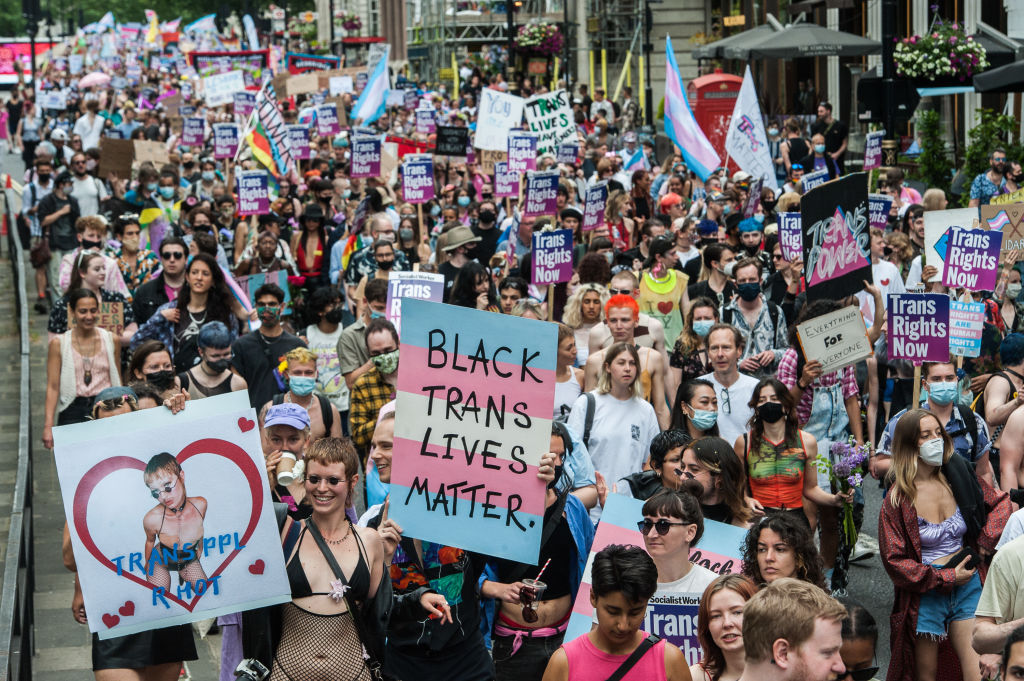
The protest proceeds down Piccadilly as thousands attend the third Trans Pride march on June 26, 2021. (Guy Smallman/Getty)
The statistics also show the need for legal recognition for non-binary gender identities, Madeleine said. As well as the 30,000 people who said they are non-binary, 118,000 said their gender was not the same as their sex registered at birth, but didn’t give any specifics.
“To see that there’s potentially tens of thousands, if not hundreds of thousands, of non-binary people in the UK is an undeniable case for proper legal recognition,” Madeleine said.
While many are celebrating the release of the data, Madeleine also points out that many trans and non-binary people will be anxious about how the government and local authorities will use it.
“There’s such a climate at the moment of something like toxic visibility where trans people are talked about constantly, and that constant visibility is used to the detriment of trans people.
“I think there’s a lot of worry that these statistics might be used for something similar, but of course only time will tell on that.”
Likely even more LGBTQ+ people than census suggests
Census data on sexual orientation is also groundbreaking, activists have said.
The question on sexual orientation was optional, but well over 90 per cent of people opted to answer it.
As far as Kelley sees it, the actual number of LGBTQ+ people in England and Wales is likely even higher than the official figure because not everybody will have felt comfortable answering questions on their identity.
“It is absolutely fair to assume that some of the people who chose not to answer the question are people who are not straight,” she says.
Rainbow flag at the Pride London gay and lesbian parade through central London. (Pictures Ltd./Corbis via Getty)
“In fact it’s probably reasonable to assume that you’re more likely to not answer that question if you’re lesbian, gay, bi, queer in some way than if you’re straight. So it’s right that some of those ‘prefer not to answers’ will also be lesbian, gay, bi, pan, queer people.”
We want a government that genuinely governs with compassion and with the needs and the experiences of all of its citizens at its heart.
Nancy Kelley, Stonewall
Having said that, the figures are “pretty much in line” with what Stonewall had expected them to be.
While there’s still some division and debate about the ways the ONS went about collecting the data, the census figures prove once and for all that queer people are part of communities all across England and Wales. That should be celebrated, Kelley says.
“We’ve been counted because we matter,” Kelley says.
Funny and informative without being overly science heavy. I doubt I will post more today, I had planned to do comments but spent most of the day in bed where my back feels the best. That new bed is really good on my back. I don’t intend to post much news until I can get to the old comments but right now videos are the most I can really deal with. I will soon go back to bed and finish watching “The Fifth Element”. Randy has suggested a bed setup for me to work from but the best position for me to slow down the pain is lying flat on one of my sides. I will get the epidural after the MRI and if that doesn’t fix the pain issues then I will switch to fentanyl. Hugs
I don’t care if you watch it, but I want to make a point about the resurgence of bathroom bills. You know those bills that say trans people must use the bathroom of their assigned sex at birth. Mostly because cis women have been told that trans women or women who do not look feminine enough will violate and hurt them. Yes we must judge everyone by their looks so we can tell who fits the girl enough or the boy enough categories. We already know that the idea that a person will go to the effort to claim to be trans to assault women in a bathroom is debunked and stupid. If a guy wants to assault women they are not going to change their entire life to do it in a woman’s bathroom, they will just charge into one and do it, or do it when the woman comes out or a dozen other ways. It simply is not reasonable. But let’s go back to comfort. A cis female person I respect said she would be uncomfortable in a bathroom with a “manly looking woman”. OK please look at this person in the video that says they are trans. That means if these “go to the toilet of your assigned birth” laws are enforced this person would be forced by law to use a female’s bathroom no matter how uncomfortable for them or the women. This is the stupidity of these laws and the people pushing the bigotry. Look at this guy, what bathroom does he belong in? These bathroom laws are based in bigotry and made up fears. What are you people doing in the bathroom, holding a social gathering? We have to understand what is driving these bathroom bill laws is an attempt to stop societal change and progression by the groups that are scared of the new ways. The die hard religious groups, the traditionalist who say it was not done this way when I was growing up, and the people that just simply feel the need to control society to make sure it stays the same so they feel comfortable. Hugs










 —————————————————————————–
 Scottie's Playtime