
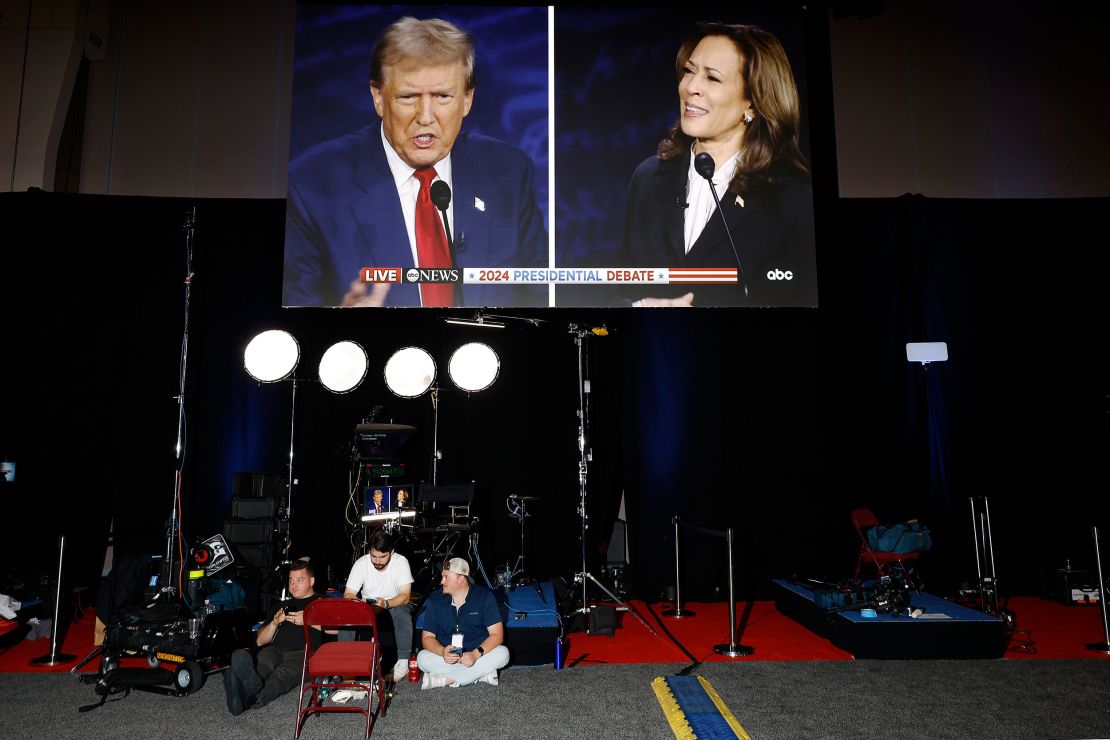
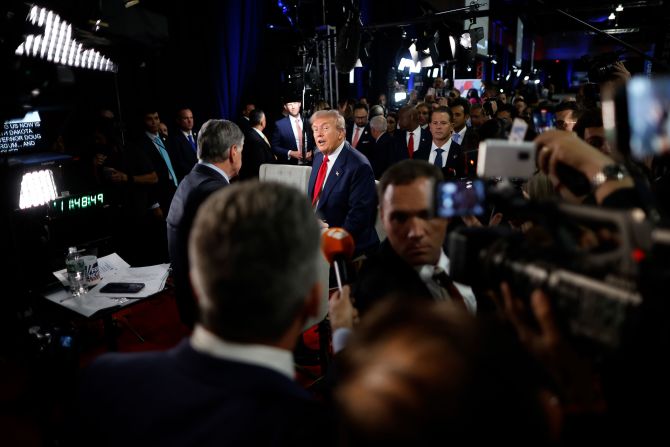
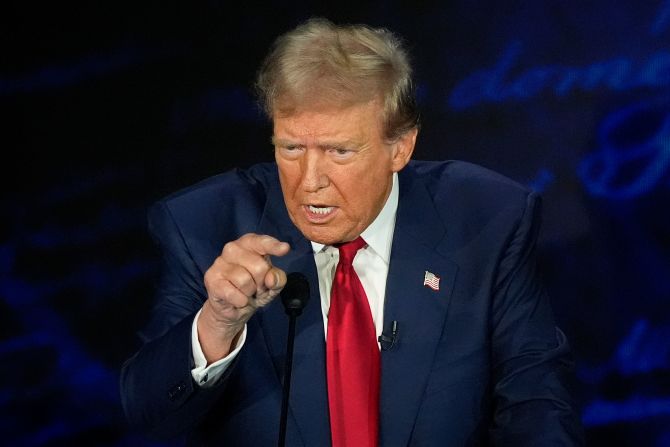
38 minute readFormer President Donald Trump delivered more than 30 false claims during Tuesday’s presidential debate against Vice President Kamala Harris, CNN’s preliminary count found – as he did during his June debate against President Joe Biden.
Trump again delivered a staggering quantity and variety of false claims, some of which were egregious lies about topics including abortion, immigration and the economy.
Harris was far more accurate than Trump; CNN’s preliminary count found just one false claim from the vice president, though she also added some claims that were misleading or lacking in key context.
Here is a fact check of some of the remarks made by each candidate.
Harris on Trump’s tariff plan
Former Vice President Kamala Harris said during Tuesday night’s debate that former President Donald Trump’s policies would result in a “Trump sales tax” that would raise prices for middle class families by about $4,000 a year.
Facts First: The claim is reasonable enough, but it’s worth explaining that Harris is referring to Trump’s proposal to implement new tariffs if he returns to the White House.
Trump has called for adding a tariff of 10% to 20% on all imports from all countries, as well as another tariff upward of 60% on all Chinese imports.
Together, a 20% across-the-board tariff with a 60% tariff on Chinese-made goods would amount to about a $3,900 annual tax increase for a middle-income family, according to the Center for American Progress Action Fund a liberal think tank.
If the 20% tariff was just 10%, as Trump sometimes suggests, the total impact for middle-class families could be $2,500 a year, according to CAP.
Separate studies estimate that the impact of Trump’s proposed tariffs would also raise prices for families, but by a lower amount. The Peterson Institute for International Economics estimated the new duties would cost the average middle-class household about $1,700 annually. And the Tax Policy Center said the impact could be $1,350 a year for middle-income households.
From CNN’s Katie Lobosco
Video Ad FeedbackWatch Harris react to Trump saying he was going to send her a MAGA hat01:18 – Source: CNNTrump on inflation during his presidency
Former President Donald Trump claimed in Tuesday’s debate with Vice President Kamala Harris that there was virtually no inflation during his administration.
“I had no inflation, virtually no inflation,” Trump said.
Facts First: This is false. Cumulative inflation over the course of Trump’s presidency was about 7.8%.
Inflation was low at the end of Trump’s term, having plummeted during the Covid-19 pandemic. The year-over-year inflation rate was about 1.4% in January 2021, the month Trump left office.
From CNN’s Daniel Dale and Tami Luhby
Trump claims migrants are arriving to US from prisons and mental institutions
Former President Donald Trump on Tuesday repeated a claim that migrants are arriving to the US after fleeing prisons and mental institutions.
“We have millions of people pouring into our country from prisons and jails, from mental institutions and insane asylums,” Trump claimed.
Trump makes this claim often, and he’s often alleged that jails and mental institutions are being emptied out deliberately to somehow dump people upon the US.
Facts First: There is no evidence for Trump’s claim.
Representatives for two anti-immigration organizations told CNN last year they had not heard of anything that would corroborate Trump’s story, as did three experts at organizations favorable toward immigration. CNN’s own search did not produce any evidence. The website FactCheck.org also found nothing.
Trump has sometimes tried to support his claim by making another claim that the global prison population is down. But that’s wrong, too. The recorded global prison population increased from October 2021 to April 2024, from about 10.77 million people to about 10.99 million people, according to the World Prison Population List compiled by experts in the United Kingdom.
In response to CNN’s 2023 inquiry, Trump campaign spokesman Steven Cheung cited one source for Trump’s claim about prisons being emptied for migration purposes – a 2022 article from right-wing website Breitbart News about a supposed federal intelligence report warning Border Patrol agents that Venezuela had done this. But that vague and unverified claim about Venezuela’s actions has never been corroborated.
And a second article that Cheung cited at the time, about Mexico’s president having freed 2,685 prisoners, was not about migration at all; that article simply explained that the president had freed them “as part of an effort to free those who have not committed serious crimes or were being held unjustly.”
From CNN’s Daniel Dale and Kaanita Iyer
Trump on the number of undocumented immigrants under Biden
Former President Donald Trump claimed during Tuesday night’s debate that “21 million people” are crossing the border monthly into the United States under President Joe Biden.
Facts First: This number is false. The total number of “encounters” at the northern and southern borders from February 2021 through July 2024, at both legal ports of entry and in between those ports, was roughly 10 million, far less than Trump’s “21 million” figure.
An “encounter” does not mean a person was let into the country; some people encountered are promptly sent away. Even if you added the estimated number of “gotaways” (people who evaded the Border Patrol to enter illegally), which House Republicans have said is more than 1.7 million during the Biden-Harris administration, “the totals would still be vastly smaller than 15, 16 or 18 million,” said Michelle Mittelstadt, spokesperson for the Migration Policy Institute think tank, said in an email in June, when Trump made similar claims.
From CNN’s Daniel Dale and Piper Hudspeth Blackburn
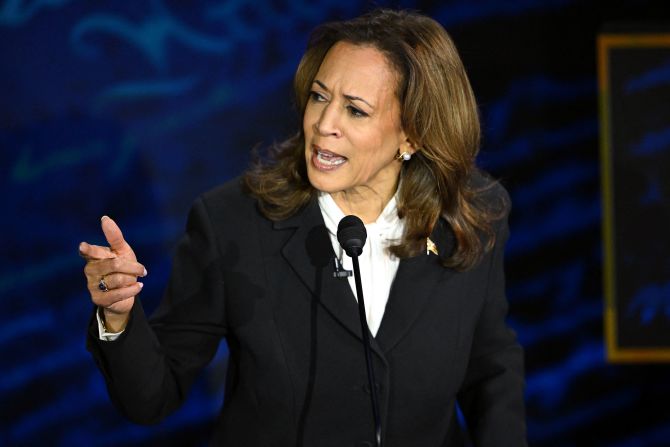
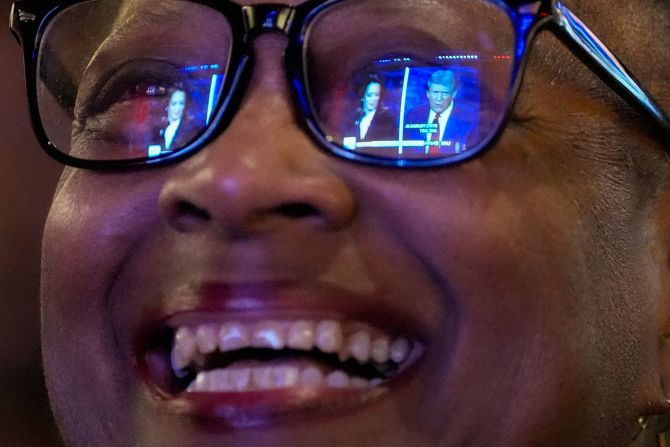
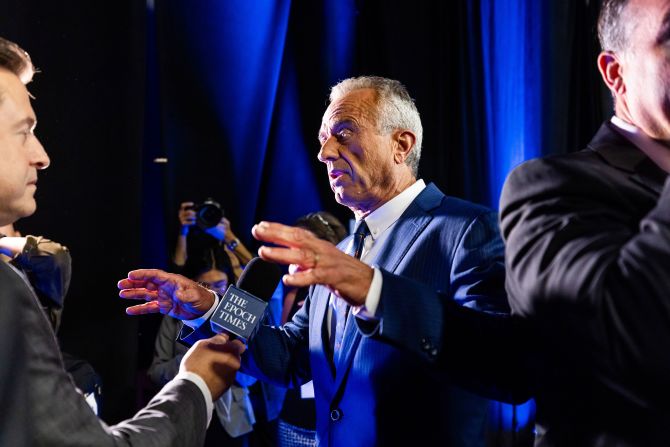
In pictures: Harris and Trump face off in presidential debate
1 of 35PrevNextHarris on the Supreme Court’s immunity ruling
Vice President Kamala Harris said during Tuesday night’s debate that the US Supreme Court ruled earlier this year that Trump would “essentially be immune from any misconduct” undertaken by him while in the White House.
“Let’s talk about extreme and understand the context in which this election in 2024 is taking place. The United States Supreme Court recently ruled that the former president would essentially be immune from any misconduct if he were to enter the White House again,” she said.
Facts First: This needs context. In their decision in July in the historic case, the six conservative justices granted Trump some presidential immunity from criminal prosecution, but not blanket immunity, as the former president had sought in his federal election subversion case. The court said Trump could not be criminally pursued over “official acts,” but that he could face prosecution over alleged criminal actions involving “unofficial acts” taken while in office.
“The President enjoys no immunity for his unofficial acts, and not everything the President does is official. The President is not above the law,” Chief Justice John Roberts wrote for the conservative majority.
From CNN’s Devan Cole
Trump repeats false claim about migrants eating people’s pets
Former President Donald Trump repeated a false claim at Tuesday’s debate that has been promoted by numerous prominent Republicans in the past week, including Republican vice presidential candidate Sen. JD Vance. Trump claimed that Haitian migrants in the city of Springfield, Ohio, are stealing people’s pet dogs and cats and eating them.
“In Springfield, they’re eating the dogs. The people that came in, they’re eating the cats,” Trump said. “They’re eating the pets of the people that live there.”
Facts First: This is false. The City of Springfield and the local police have said they have seen no evidence for the claim – which appeared to originate from a Facebook post in which someone purporting to be a local resident passed along what they said was a story about their neighbor’s daughter’s friend.
In a statement to CNN on Monday, a spokesperson for the City of Springfield said “there have been no credible reports or specific claims of pets being harmed, injured or abused by individuals within the immigrant community.”
The Springfield News-Sun reported that “the Springfield Police Division said Monday morning they have received no reports related to pets being stolen and eaten.”
Vance acknowledged on social media on Tuesday that it is “possible” that the “rumors” he has heard from local residents “will turn out to be false,” though he also encouraged people to “keep the cat memes flowing.”
From CNN’s Daniel Dale and Michael Williams
Trump on who pays for tariffs
Former President Donald Trump said Tuesday the United States took in billions of dollars from China as a result of his tariffs.
Facts First: Trump’s claim about how tariffs work is false. A US tariff is paid by importing businesses in the United States – not other countries – when a foreign-made good arrives at the American border.
Here’s how tariffs work: When the United States puts a tariff on an imported good, the cost of the tariff usually comes directly out of the bank account of an American importer.
Study after study, including one from the federal government’s bipartisan US International Trade Commission, have found that Americans have borne almost the entire cost of Trump’s tariffs on Chinese products.
It’s true that the US Treasury has collected more than $242 billion from the tariffs Trump imposed on imported solar panels, steel and aluminum, and Chinese-made goods – but those duties were paid by US importers, not the country of China.
From CNN’s Katie Lobosco
Harris on her stance on fracking
During Tuesday night’s debate, Vice President Kamala Harris said, “I made it that very clear in 2020 – I will not ban fracking,” though she had said, while running in the Democratic presidential primary in 2019, that “there’s no question I’m in favor of banning fracking.”
Facts First: This is misleading. Harris did not make her position on fracking clear during her only debate in 2020, the general election’s vice presidential debate against then-Vice President Mike Pence; Harris never explicitly stated a personal position on fracking during that debate.
Rather, she said that Joe Biden, the head of the Democratic ticket at the time, would not ban fracking if he was elected president. Harris said in the 2020 vice presidential debate: “Joe Biden will not end fracking”; “I will repeat, and the American people know, that Joe Biden will not ban fracking.”
It made sense that Harris was addressing Biden’s plans at the time given that the president sets administration policy. But contrary to her claim on Tuesday, neither of these 2020 debate comments made clear that she personally held a different view on the subject than she had the year prior.
From CNN’s Daniel Dale and Ella Nilsen
Trump falsely claims US experienced highest inflation ever under Biden
Former President Donald Trump said the US experienced “the highest inflation” ever under President Joe Biden and Vice President Kamala Harris.
Facts First: Trump’s claim that inflation was at its highest under the Biden-Harris administration is false. Inflation, as measured by the Consumer Price Index, hit 9.1% in June 2022. That wasn’t the highest ever recorded. Rather, it was the highest inflation rate in nearly forty years. For instance, in 1980, inflation hit nearly 15%, according to CPI data from the Bureau of Labor Statistics.
Some of the earliest inflation data the BLS maintains indicates that inflation was even higher in 1917, when it was trending at nearly 18%.
From CNN’s Elisabeth Buchwald
Trump on Harris’ previous run for president
Former President Donald Trump claimed that when Vice President Kamala Harris previously ran for the presidency, during the 2020 election cycle, she was the very first candidate to drop out of a crowded Democratic primary.
“When she ran, she was the first one to leave because she failed,” Trump claimed, referring to Harris’ 2020 bid, while arguing that Harris didn’t receive any votes this primary cycle because President Joe Biden was still at top of the ticket during the primaries.
Facts First: This is false. Harris was far from the first candidate to drop out of that Democratic primary when she exited the race in early December 2019
Harris was preceded by the sitting or former governors of Washington, Montana and Colorado; the sitting mayor of New York City and sitting or former members of the House of Representatives and Senate, plus some others.
From CNN’s Daniel Dale
Trump on Harris’ border role
Former President Donald Trump claimed at Tuesday’s debate that Vice President Kamala Harris has been the Biden administration’s “border czar.”
“Remember that she was a border czar,” Trump said. “She doesn’t want to be called the border czar because she’s embarrassed by the border.”
Facts First: Trump’s claim about Harris’ border role is false. Harris was never made Biden’s “border czar,” a label the White House has always emphasized is inaccurate. Homeland Security Secretary Alejandro Mayorkas is the official in charge of border security. In reality, Biden gave Harris a more limited immigration-related assignment in 2021, asking her to lead diplomacy with El Salvador, Guatemala and Honduras in an attempt to address the conditions that prompted their citizens to try to migrate to the United States.
Some Republicans have scoffed at assertions that Harris was never the “border czar,” noting on social media that news articles sometimes described Harris as such. But those articles were wrong. Various news outlets, including CNN, reported as early as the first half of 2021 that the White House emphasized that Harris had not been put in charge of border security as a whole, as “border czar” strongly suggests, and had instead been handed a diplomatic task related to Central American countries.
A White House “fact sheet” in July 2021 said: “On February 2, 2021, President Biden signed an Executive Order that called for the development of a Root Causes Strategy. Since March, Vice President Kamala Harris has been leading the Administration’s diplomatic efforts to address the root causes of migration from El Salvador, Guatemala, and Honduras.”
Biden’s own comments at a March 2021 event announcing the assignment were slightly more muddled, but he said he had asked Harris to lead “our diplomatic effort” to address factors causing migration in the three “Northern Triangle” countries. (Biden also mentioned Mexico that day). Biden listed factors in these countries he thought had led to migration and said that “if you deal with the problems in-country, it benefits everyone.” And Harris’ comments that day were focused squarely on “root causes.”
Republicans can fairly say that even “root causes” work is a border-related task. But calling her “border czar” goes too far.
From CNN’s Daniel Dale and Tami Luhby
Trump claims legal scholars wanted states, not the federal government, to decide how to regulate abortion
Former President Donald Trump repeated a version of one of his frequent claims Tuesday night that legal scholars wanted Roe v. Wade overturned so individual states could instead decide how to regulate abortion.
“Every legal scholar, every Democrat, every Republican, liberal, conservative, all wanted this issue to be brought back to the states where the people could vote, and that’s what happened,” Trump said. “It’s the vote of the people, now it’s not tied up in the federal government.”
Facts First: Trump’s claim is false. Many legal scholars wanted the right to have an abortion preserved in federal law, as several told CNN when Trump made a similar claim in April.
Some legal scholars who support abortion rights had wanted Roe written in a different way, including even the late liberal Supreme Court Justice Ruth Bader Ginsburg, but that isn’t the same as saying that “every legal scholar” believed Roe should be overturned and sent to the states.
“Any claim that all legal scholars wanted Roe overturned is mind-numbingly false,” Rutgers Law School professor Kimberly Mutcherson, a legal scholar who supported the preservation of Roe, said in April.
“Donald Trump’s claim is flatly incorrect,” another legal scholar who did not want Roe overturned, Maya Manian, an American University law professor and faculty director of the university’s Health Law and Policy Program, said in April.
Trump’s claim is “obviously not” true, said Mary Ziegler, a law professor at the University of California, Davis, who is an expert on the history of the US abortion debate. Ziegler, who also did not want Roe overturned, said in an April interview: “Most legal scholars probably track most Americans, who didn’t want to overturn Roe … It wasn’t as if legal scholars were somehow outliers.”
You can read more here.
From CNN’s Daniel Dale and Jen Christensen
Month: September 2024






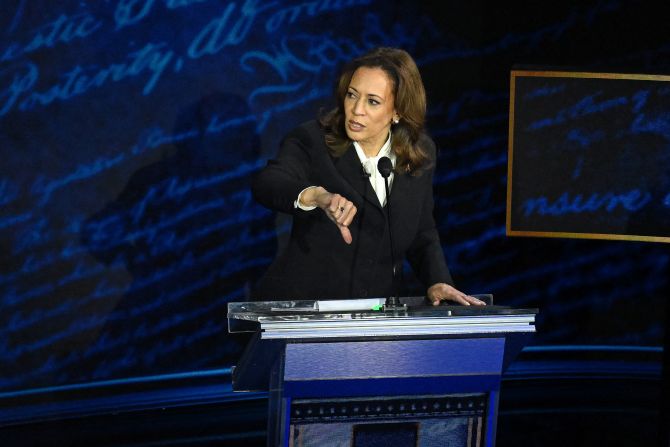
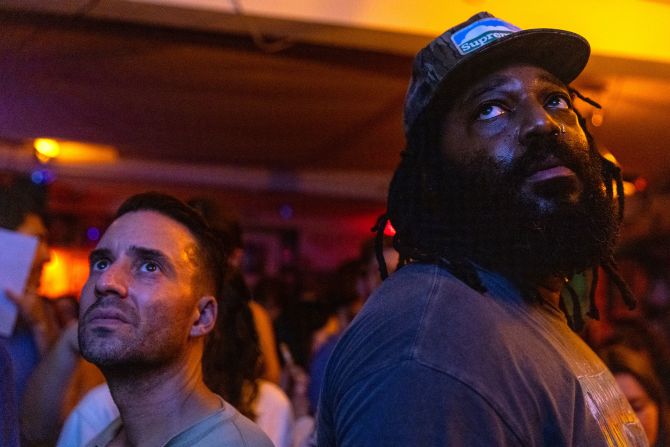

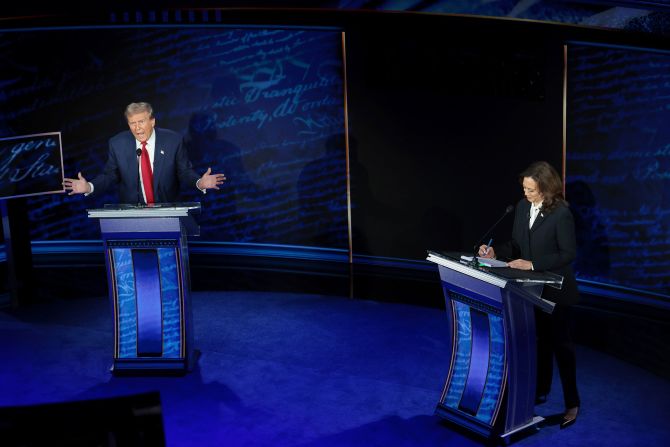
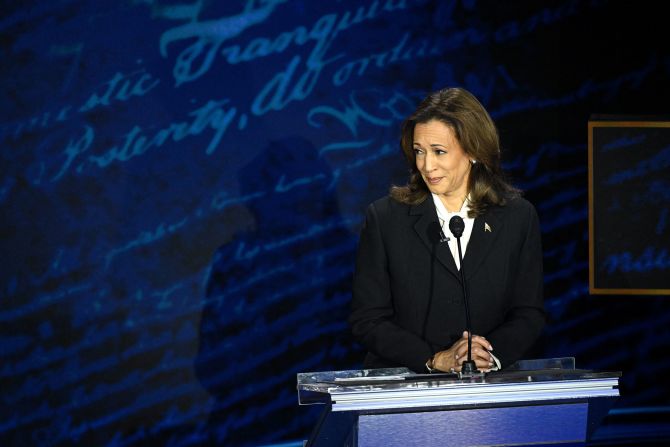
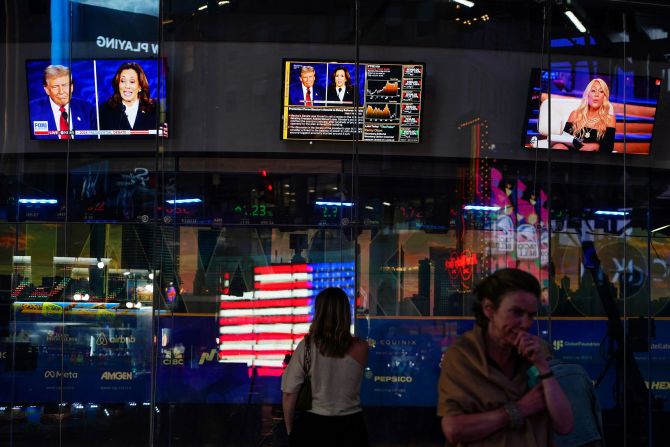
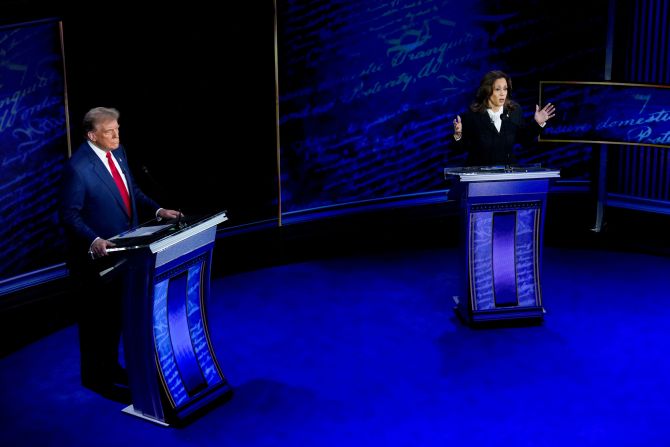
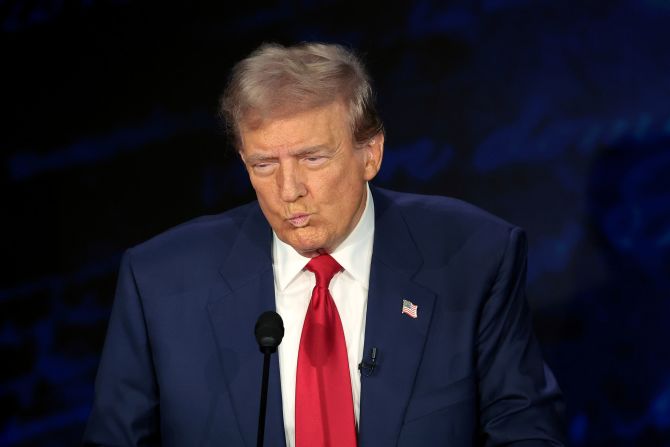
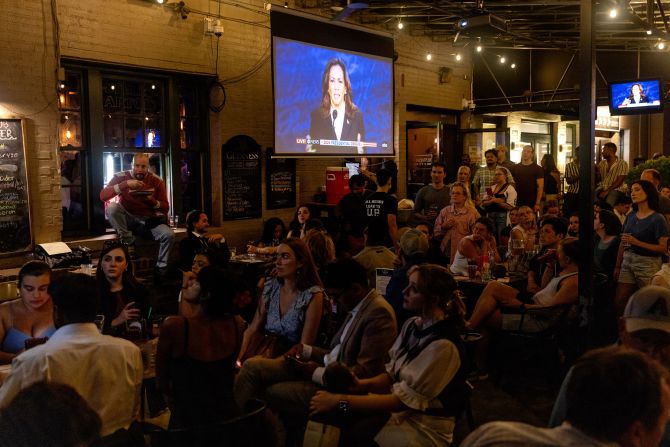








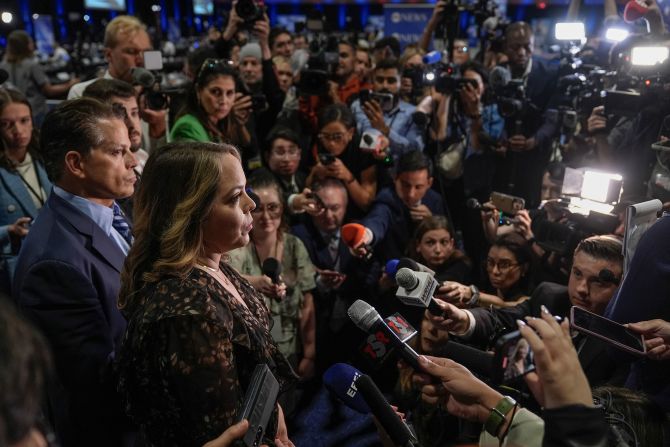
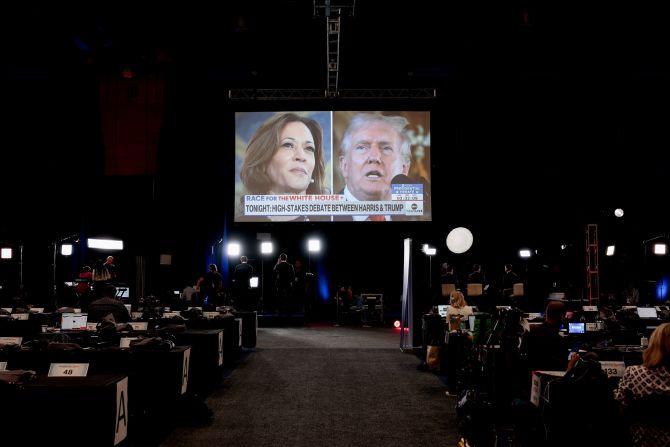


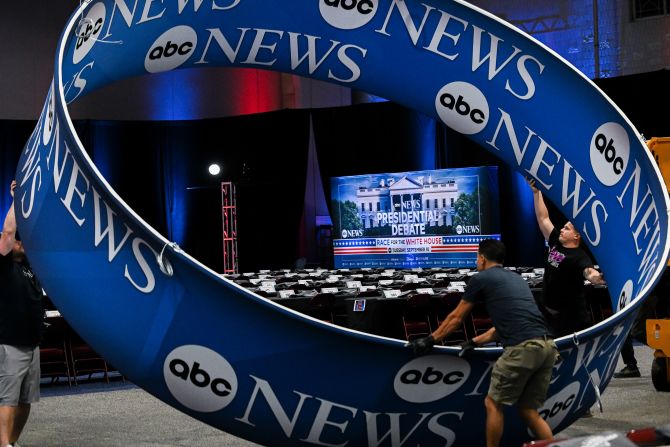
Debate reactions
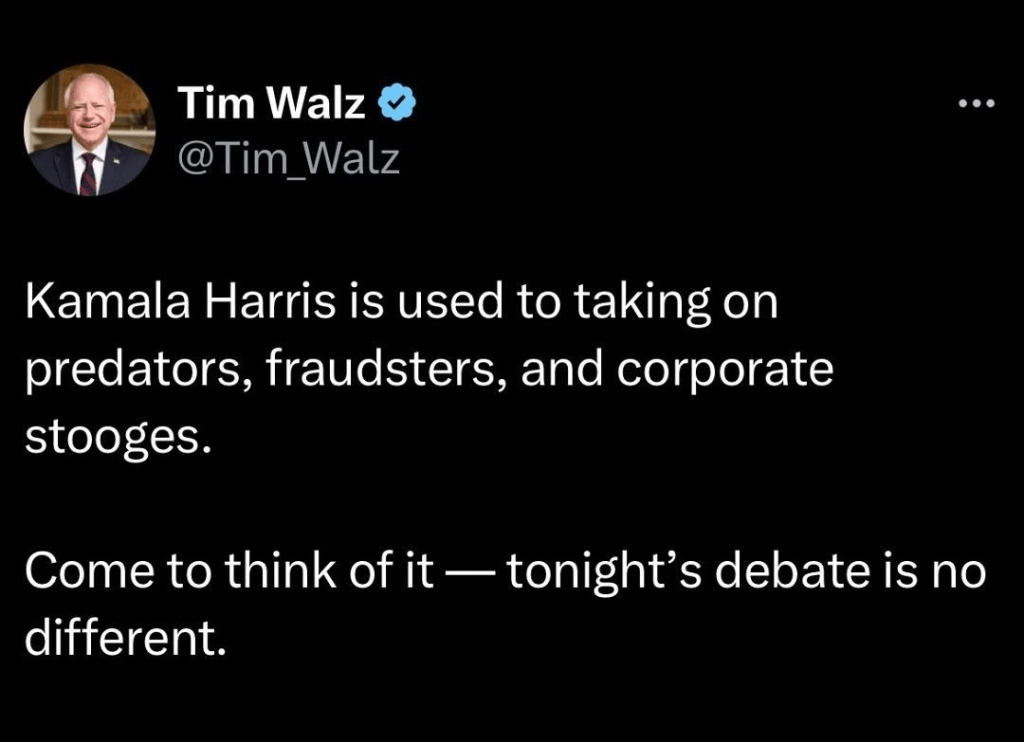
Some of the tweets have gotten millions of view. The first tweet below is from former NFL player Antonio Brown, who has 2.1 million followers. Check out the Community Note below.
Yesterday Vance lied that boy had been “murdered by a Haitian migrant.” Listen carefully to the father’s opening remarks below.
Wallnau last appeared here when he claimed that the Proud Boys were only at the Capitol riot to “pick up trash.”
In April 2024, he prophesied that God would murder Trump’s enemies the following month.
Also last year, he led a congregation in babbling in tongues to protect Trump from arrest, which obviously did not work.
PREVIOUSLY ON JMG: Wallnau cures Rush Limbaugh’s terminal cancer in the name of Jesus. Wallnau claims there are “high levels of angelic activity” at Trump’s DC hotel. Wallnau claims the MAGAbomber was possessed by Satan to make Trump look bad. Wallnau claims the Charlottesville Nazis were “paid actors” because right wing white supremacists do not exist. Wallnau declares that God killed Antonin Scalia to “wake up America” on how much they needed Trump. Wallnau “takes authority” over Hurricane Maria in the name of Jesus, orders it not to hit Puerto Rico. Wallnau claims Hurricane Irma bypassed Mar-A-Lago because Trump is under God’s protection. Wallnau releases the “Jezebel spirit” on Robert Mueller. Wallnau prays to protect Trump from witches, jinxes, and demons that jump into dogs. Wallnau prays for God to “unleash his holy sword” and smite Trump’s enemies. Wallnau claims angels literally dusted his face with gold flakes as a reward for loving Trump. Wallnau prays away obstruction of justice charges against Trump in the name of Jesus. Wallnau claims a gay bar owner was “cured of homosexuality” after eating a slice of anointed cake.


McCarthy, you may recall, once claimed that Barack Obama had a “Sharia agenda” and wrote a book claiming that Obama and Hillary Clinton conspired to rig the 2016 election against Trump.
Murillo appeared here last month when he called on Christians to “fast and pray” against Harris’s “dark powers.”
Murillo appeared here in June 2024 when he asked for $10 million in donations to stop Pride Month.
He first appeared here in 2021 when he prophesied that God was about to “send down a righteous fire” to smite America’s atheists.
He also appeared here in February 2024 when he joined Charlie Kirk’s alleged $100 million drive to mobilize Christian voters. Yesterday we learned that drive has netted only $2 million.
Nice troll that couldn’t happen to a “nicer” place, even-
Peace & Justice History for 9/12:
| September 12, 1977 Steve Biko, the leader of the black consciousness movement, and probably the most influential young black leader in South Africa, died while being held by security forces in Port Elizabeth; he was the forty-first person to die while in police custody in South Africa. The Death of Stephen Biko  |
| September 12, 1998 A group later known as the Cuban Five was arrested after infiltrating groups which had previously executed terrorist attacks on Cuban soil.They were convicted of conspiracy to commit espionage against the U.S. Their conviction was overturned by a three-judge panel of the 11th Circuit Court, then reinstated by the full court; an appeal to the Supreme Court is planned. The United Nations Commission on Arbitrary Detentions has characterized their imprisonment as arbitrary detention.  Who are the Cuban 5? |
September 12, 2002 President George W. Bush told skeptical world leaders at the United Nations to confront the ”grave and gathering danger” of Saddam Hussein’s Iraq, or to stand aside as the United States acted. |
https://www.peacebuttons.info/E-News/peacehistoryseptember.htm#september12
Arguments Against Taxing Unrealized Capital Gains of Very Wealthy Fall Flat
Middle Class Often Taxed on Unrealized Capital Gains
September 11, 2024
| By Chuck Marr and Samantha Jacoby
(This is long, but it’s better in full. The link is at the bottom, if you’d rather copy that, and go read this at your leisure. Also, this is why we the people who pay can’t have nice things.)
A proposal in the Biden-Harris Administration’s 2025 budget[1] would require households with more than $100 million in wealth to pay income taxes of at least 25 percent of their annual income, including their unrealized capital gains — gains in the value of assets that they have not yet sold. Critics argue that unrealized capital gains, which are a primary source of income for many extremely wealthy households, are mere “paper” gains that do not constitute real income (though they meet a textbook definition of income).[2] But unrealized gains make asset owners better off in very real ways. Claiming that unrealized gains are not “real” is akin to claiming that individuals such as Jeff Bezos and Elon Musk are not rich unless they sell their companies’ stock.
Critics also claim the proposal would mark a radical departure from current tax practices, but this too is incorrect. Two of the main types of assets that middle-income households own — their homes and defined-contribution retirement accounts like 401(k)s — are already taxed in ways that resemble proposals to tax the unrealized capital gains of the very wealthy. A family’s property taxes typically rise as the value of their home rises, and middle-class people pay the tax year after year in amounts reflecting those gains without selling their homes. Retirement account holders are required to begin realizing their deferred gains in those accounts and pay the associated tax when they reach a certain age, and their heirs then pay tax on any remaining gains.
Homes and retirement accounts account for relatively small shares of the income and wealth of very wealthy households, who tend to directly own large amounts of corporate stock or other capital assets. These assets face no comparable required realization requirement or annual tax. Instead they often increase in value, tax-free, year after year, and if they are never sold, the income tax that would be owed on those gains is simply erased when their heirs inherit them.
Requiring very wealthy people to pay income taxes on their unrealized gains and ending their ability to permanently avoid income tax when they pass appreciated assets to their heirs would thus constitute a reasonable reform. It would make the tax code more equitable while raising $500 billion in revenue over ten years, according to the Treasury Department,[3] from a small subset of the wealthiest households in the country.
Substantial Income of Very Wealthy Households Escapes Annual Tax
The individual income tax is our main federal tax, accounting for roughly half of federal revenue. For households along most of the income spectrum, the progressive federal income tax generally works as it should, with higher-income households paying a larger share of their incomes in tax than households with lower incomes. But this relationship often breaks down at the very top. That’s because very wealthy households accumulate a very large share of capital gains (increases in the value of stocks, bonds, real estate, or other assets), which enjoy two important tax advantages: deferral of unrealized capital gains and stepped-up basis.[4]

Deferral of capital gains income. Households that accumulate capital gains don’t have to pay tax on those gains until, or unless, they “realize” these gains, usually by selling the asset. This ability to put off paying capital gains tax is known as “deferral.” Deferral overwhelmingly benefits wealthy households because they own the overwhelming share of capital gains: nearly 70 percent of realized capital gains go to the top 1 percent of taxpayers.[5] (See Figure 1.)
The distribution of unrealized gains is also highly skewed toward the very wealthy. Because of deferral, wealthy households only report a small share of their total capital income on their tax returns.[6] Unrealized gains aren’t taxed, so filers don’t have to report them.
Research shows that unrealized gains constitute a growing share of a household’s total income as one moves up the wealth scale.[7] In 2021, for example, the Washington Post noted that “the wealth of nine of the country’s top [tech industry] titans has increased by more than $360 billion in the past year,” and nearly all of the increase was due to the rising value of their holdings of their companies’ stock.[8] Without policy changes, much of this wealth increase might never appear on income tax returns.
Stepped-up basis. Under a tax code provision known as “stepped-up basis,” the income tax that a wealthy person would have owed on an asset’s increase in value since they purchased it is erased when they die and pass their appreciated asset to their heirs. Neither they nor their heirs owe any income tax on this increase. (Technically, the asset’s basis — or the price paid for it — is “stepped up” to its fair market value at the time of inheritance.) Stepped-up basis encourages wealthy people to turn as much of their income into capital gains as possible and hold assets until their death, when a lifetime of gains becomes permanently exempt from income tax.[9]
Together, deferral and stepped-up basis enable some of the country’s wealthiest people to go through life without paying income taxes on much or all of their income each year, or ever. Among other impacts, this worsens inequality in income and wealth, both overall and across racial and ethnic groups. Because of racial barriers to economic opportunity, households of color are overrepresented at the lower end of the income and wealth distributions, while white households are overrepresented among the wealthy. For example, the wealthiest 10 percent of white households — a group that makes up just 7 percent of households — holds 61 percent of the nation’s wealth. By contrast, people of color account for 33 percent of all households but just 14 percent of the nation’s wealth. (See Figure 2.)

Policymakers can change the tax code in several ways to treat some or all of the unrealized capital gains of the wealthiest households as taxable income. One is to make the gains taxable each year, as in Senate Finance Committee Chairman Ron Wyden’s proposal to shift to a “mark-to-market” system for taxing capital gains.[10] A much more modest approach would be to repeal stepped-up basis: while wealthy people could still avoid tax on unrealized capital gains throughout their lives, they would have to pay taxes on those deferred capital gains at death. A third option, which the Biden-Harris Administration has proposed, would combine elements of both by essentially requiring very wealthy households to prepay some of their taxes on unrealized capital gains each year — similar to the withholding system that applies to wages and salaries — and paying any remainder when those gains are realized.
Biden-Harris Proposal Would Eliminate This Tax-Free Treatment
The Biden-Harris Administration’s 2025 budget would establish a minimum tax on total income, including unrealized capital gains, for the 0.01 percent of households with at least $100 million in assets — the tax would phase in and apply fully to households with at least $200 million in wealth.[11] The proposal would also end the stepped-up basis loophole for wealthy households with significant unrealized gains: married couples with at least $10 million in unrealized capital gains or single filers with at last $5 million in capital gains.[12]
The proposal’s critics argue that unrealized gains do not constitute “real” income because the asset owner has not received cash in exchange for the asset, whose value can either rise or fall before the asset is sold. For example, a Heritage Foundation economist recently argued that “until an asset is actually sold, any increase in value is purely speculative. It isn’t real, hence the classification of unrealized.”[13] But this argument ignores the fact that the wealthy receive significant new value — or income — from their assets even before they sell. Unrealized gains make asset owners better off in very real ways: stock purchased 20 years ago for $20 million that’s now worth $100 million has the same value as $100 million of stock purchased today (that has no unrealized gains yet).
As Martin Sullivan, chief economist at Tax Analysts, has explained, “[U]nrealized gain is economic income. Unrealized does not mean unreal. The wealthy can see it very clearly on their brokerage statements, even if the IRS will not see it on tax returns.”[14]
In addition to watching their untaxed income grow, wealthy households can use this income to finance their (often lavish) lifestyles. “It is a simple fact that billionaires in America can live very extraordinarily well completely tax-free off their wealth,” law professor Edward J. McCaffery writes.[15] They can do so by borrowing large sums against their unrealized capital gains, without generating taxable income.
For example, Larry Ellison, Oracle’s chief executive officer and one of the world’s richest people, has pledged over 300 million shares of Oracle stock worth over $45 billion as collateral for a personal credit line.[16] This lets him obtain cash without selling shares; thus, he avoids paying taxes, and the stock can continue growing in value. Though he must pay interest on the debt and he or his heirs will eventually pay back amounts borrowed (e.g., using the proceeds of appreciated assets that were never subject to the income tax), this is often a much cheaper strategy than selling stock and paying capital gains taxes. As a recent article by two tax scholars observes, “Ellison hasn’t just gotten richer on paper when he borrows against his stock to buy a Hawaiian island; he’s used that income just as if he’d sold the stock.”[17]
This doesn’t mean that the gains only become income when they are leveraged to finance other investments or consumption. Quite to the contrary: the gains were always real income available to the filer to use to buy Hawaiian islands, yachts, or invest in other types of stock or business investments. The gains raise their purchasing power, making them better off, whether or not they use that purchasing power to actually purchase things.
Middle-Class People Often Taxed on Unrealized Gains or Required to Realize Gains
Critics of proposals to tax unrealized gains of wealthy people fail to acknowledge that two of the primary assets owned by non-wealthy people — their homes and defined-contribution retirement accounts like 401(k)s — are already taxed in ways that resemble the capital gains proposals. To be sure, there are important differences between the taxation of these types of assets and capital assets like directly held corporate stock; for example, property taxes are not income taxes and are applied by state and local governments, not the federal government.[18] But as explained below, the reality is that in certain long-standing and uncontroversial contexts, asset owners pay tax as their assets gain value over time or are required to realize gains at a certain age. This fact contradicts critics’ claim that taxing unrealized capital gains would be novel or untested.
Property Taxes Apply to Unrealized Gains From Increases in Home Values
Corporate stocks and privately held businesses are the largest appreciable assets for the wealthiest people, but for the middle class, the biggest asset by far is their home.[19] These homes are subject to annual state and local property taxes across the country. The methods of assessing property values and calculating taxes differ, but generally the tax is calculated by multiplying the assessed value of the property (minus any exemptions) by the local property tax rate.[20] When a family buys a house, the property’s initial assessed value may be based on the purchase price of the house, and jurisdictions typically reassess the home’s value (based on what the house would sell for in a third-party transaction, for example) at specified intervals. As officials from the state of Illinois explained in a recent Q & A for residents:
Your property’s value is determined by many factors. Your assessment can increase because your neighborhood is improving, the sales prices of homes in your area are increasing, and inflation. The value that the assessor assigns to your property is the amount that the assessor determines your property would sell for in today’s market.[21]
In a recent example from the end of last year, the state of Maryland announced that assessments for a segment of properties would rise 23.4 percent from the last assessment three years prior.[22]
A home’s assessed value often increases over time due to market factors, and if it does, the property tax is partially a tax on the home’s increase in value, or an unrealized gain. This is the case even though no sale has occurred, and no cash has flowed to the homeowner. Yet the taxation of the portion of a property’s value that represents unrealized gains is a relatively uncontroversial aspect of a tax that accounts for over 15 percent of state and local general revenue, helping to fund public schools, for example.[23]
If middle-income homeowners can pay taxes that in part reflect the increase in value of their primary asset, very wealthy households can pay income tax on the increase in value of their primary assets: corporate stocks.
Retirement Account Holders Must Pay Income Tax on Accrued Gains
Middle-class families who own corporate stocks typically do so within retirement accounts such as 401(k) accounts, rather than in private brokerage accounts. Families between the 60th and 80th income percentiles have 28 percent of their assets in retirement accounts but only 12 percent in directly held corporate stock.[24] The situation is reversed for the top 1 percent of families: only 5 percent of their assets are in retirement accounts, versus 44 percent in corporate stocks.[25]
Under a typical 401(k), a person sets aside an average of about $5,000 per year from their paychecks on a pre-tax basis.[26] The underlying assets typically increase in value over time, and account holders do not pay tax each year on their gains. Thus, owners of retirement accounts, like direct owners of corporate stock, enjoy the benefit of deferral: their annual unrealized gains are not counted annually as taxable income. But the similarity in the tax treatment of directly held corporate stock and retirement accounts ends later in life.
Starting at age 73,[27] retirement account holders must take mandatory distributions — about $4,000 annually for every $100,000 in account balance (increasing with the age of the holder) — in part so they can’t use their accounts as tax shelters. This begins the process of drawing down the accounts and effectively requires account holders to begin realizing their gains, even if they would not otherwise want to. The distributions flowing out of the accounts, including the original contributions plus the accrued gains, are taxed at ordinary income tax rates.[28]
Moreover, if a retirement account holder dies with an account balance and leaves it to a family member or other heir other than a spouse,[29] the heir must liquidate the account over a ten-year period. The heir also must pay individual income taxes at ordinary income tax rates on the distributions in each of those ten years.
The bottom line for middle-class people who hold stocks in retirement accounts is that, while they enjoy generous tax advantages during their working lives as they build up their accounts, all accrued unrealized capital gains must be realized by either the account holder starting at age 73 or by their heirs within ten years of receiving them. Also, their capital gains income is taxed at ordinary income tax rates, rather than the lower capital gains rate enjoyed by holders of corporate stock held outside of retirement accounts. Turning 73 thus has important tax consequences for middle-class retirement account holders.
In contrast, for wealthy people whose assets consist primarily of direct ownership of stock or other capital assets, 73 is just another birthday. They face no realization requirement for capital gains accrued over a lifetime of owning corporate stock. By the end of their lives, they could have millions, hundreds of millions, or even billions of dollars in unrealized capital gains from their privately held stocks or other assets — income that has never faced the income tax. And after they die, the entire income tax liability on those gains is simply erased, for them and their heirs.[30]
Minimum Tax Would Be Paid Over Time, Raise Significant Revenue
Some critics have claimed that the Biden-Harris proposal to tax unrealized capital gains of extremely wealthy households would be unworkable or require business owners to prematurely sell their investments, such as shares in a closely held company, to pay the tax.[31] The proposal, however, includes several design mechanisms to make it easier to administer.
For instance, the tax would be paid over several years — essentially a down payment on the tax that will be owed when the gains are realized (typically, when assets are sold).[32] Spreading out the payments in this way would also mitigate concerns about wealthy taxpayers who have large gains in one year and losses the next: if a taxpayer later has a large unrealized loss, those losses will also be spread out over several years and future tax payments will be reduced to reflect the losses, with refunds paid to taxpayers who have no minimum tax payments to offset. It would also mitigate concerns that public company founders would have to sell large amounts of stock to pay the tax, because their initial payments would be made over nine years.[33]
Another design feature would allow taxpayers who primarily own non-publicly traded assets — like shares of a closely held company — to defer tax (with a charge akin to interest) until they sell assets. Moreover, the proposal applies only to the approximately 10,000 U.S. taxpayers with $100 million in assets,[34] and these very wealthy people tend to own large amounts of highly liquid assets like publicly traded stock or other financial assets, not shares in small businesses.
The proposal would raise $500 billion over ten years, according to the Treasury Department,[35] generated from a small subset of the wealthiest households in the country — those with more than $100 million in assets — who today often enjoy extremely low average tax rates. Thus, the proposal would not only mark a step toward creating a fairer tax code but would also raise revenue that is badly needed to meet the nation’s commitments to seniors, make high-value investments that will improve well-being and broaden prosperity, and improve the fiscal outlook.[36]
The Zeal of the Convert
Matthew Sheffield, a former rising star in the conservative movement, turned away from what he finally realized was an extremist, anti-truth agenda.
by Rick Perlstein September 11, 2024
Matthew Sheffield is one of the most interesting people I’ve ever met. His father had rebelled against the Mormonism of his youth, resentful of how it had shed its original, 19th-century strangeness. So he invented his own version, one in which he had direct prophetic access to the supernatural realm—for instance, the time Satan tempted him to become gay. He spent several years beseeching God, walking around in the mountains above the University of Utah, nearly killing himself several times from starvation.
The elder Sheffield was a professor of classical guitar, a brilliant composer beloved by the great Andrés Segovia. God commanded him to abandon his job, pack up his growing family, and become an itinerant street musician instead. “There were times we were homeless,” Matthew Sheffield told me. “One of my brothers was born in a tent. My mother gave birth to my sister by herself, in our apartment, with two kids around.”
He corrects himself: “No, three kids. Right next to her.”
Busking became a family profession. (“The Dark Osmonds,” I propose. “Yeah,” Matthew replies, “but we were classical.” He played French horn.) He grew interested in politics, in part from family connections (a grandfather was the Republican whip in the Utah state Senate), in part because the family did a lot of performing in the streets of Washington, D.C., because it was easy to scavenge food that vendors on the Mall threw away.
He and a brother developed computer proficiency, and he picked up a college education in dribs and drabs. He has a hard time remembering which of the nine universities he attended when he developed the first college newspaper website. He was around 20, and still on the road with his family, when he and his brother decided that CBS Evening News anchorman Dan Rather was too mean to Kenneth Starr, the special counsel investigating Bill Clinton. His brother came up with the idea to put some quotes of Rather’s on the internet to reveal his stealth liberalism. Matt said they should aim higher, and build a comprehensive website. So they did. “But we were afraid to put our names on it because we were two college kids. So we didn’t. And, um, the CBS people accused us of being a secret operation funded by Republican donors!”
The exclamation is a rare touch. He explained the rest nonchalantly at the Szechuan restaurant where we’re lunching in Chicago’s South Loop during the Democratic convention. Sheffield’s typical mien is sardonic bemusement at the strangeness of the world he managed to escape—as when he explains a second reason why he and his brother kept themselves hidden.
“Also, we were afraid because my mom had a dream that Bill Clinton was going to try to kill us.”
Sheffield’s faculty profile at the Leadership Institute, a right-wing clearinghouse for what they call “journalism training,” is no longer online, but it had noted that RatherBiased.com was “credited by the New York Times as being the most influential blog in taking down Dan Rather during the famous ‘Memogate’ scandal. Since that time, Matt has worked with … groups such as the Media Research Center where he created NewsBusters, Rush Limbaugh’s favorite blog. He also works with the Washington Examiner, helping them increase their traffic by over 600 percent to over a million visitors per month.”
Sheffield has long since become a committed leftist. I’m writing about him not just because he fascinates me. I’m writing about him because the lessons he learned on the road to becoming a right-wing media operative, and what he has learned since in his almost entirely frustrated efforts to impart those lessons to the upper echelons of the Democratic Party, are so crucial for all of us to know.
SHEFFIELD’S CAREER ON THE RIGHT was rather doomed from the start. Because he cared about the truth.
His damnable allergy to propaganda had already shown out by the time he came up with an idea for a study during a stint at Virginia Commonwealth University. It asked: Where Do Columnists Come From? “And my general thesis was that newspaper columnists who are on the right come out of political operations, and ones from the left come out of—journalism.” That is to say, they carry with them journalistic values of fairness and accuracy, by which conservative columnists remain blessedly unburdened.
In 2007, he joined Brent Bozell III’s Media Research Center, because that’s where the money was. He started NewsBusters, the site Limbaugh loved, which ferreted out alleged liberal media bias. NewsBusters would run pieces about Michelle Obama, “and we’d have to shut off the comments because they were too disgusting.”
RatherBiased, Sheffield notes, got all that New York Times attention because “it was completely accurate in every way. We didn’t use inflammatory language; we didn’t even state any political opinions.” No room for that in his next lunge up the right’s greasy pole. “I was horrified a lot of the time, quite honestly. You know when Ted Cruz was doing his first government shutdown attempt? I was in meetings about how we should cover the media’s coverage. I said, ‘Well, it’s an objectively stupid idea. It’s not unfair for the media to say that this is destabilizing and extreme and absurd.’”
My response is a guffaw, his a sardonic chuckle. “Uh, yeah. They looked at me like I had suggested they grow a third eye or something.”
THERE WAS A SECOND REASON Matthew Sheffield did not fit the conservative movement mold. “Our family musical group never really got off the ground. So we were beginning to wonder whether, you know, our father was as divinely led as he told us.” So he became an atheist. And you could only get so far in the conservative world without being religious, or at least paying religion obsequious tribute. “What’s her name, S.E. Cupp? She actually wrote an entire book saying, ‘Well, I’m not religious but I sure wish I was.’ That was her way of trying to get on the gravy train. And I wasn’t willing to do that.”
The consequences are more than theological. When it comes to conservatism, “the one thing that non-Republicans don’t understand is that almost all of them are bizarre religious fundamentalists. Even the ones who don’t present that to you.” And that’s how they learn to reason: as fundamentalists. Sheffield saw it over and over again on the job.
Sheffield became the first managing editor of the Washington Examiner. It’s now a website. But the project, handsomely funded by a right-wing billionaire, began in 2005 as a suite of local daily tabloids in several cities, as a strategy to move the media environment to the right by making readers feel like they were reading normal news in a normal local newspaper. “The people who I was recruiting and were writing for me often had no concept of verifying a story … Because religious fundamentalists don’t need that.” Conservatives always descend from some sacred, impregnable prior truth. As Sheffield says: “The reasoning is about affirming the concept.”
Sheffield tells a story from the Obama era about the federal program known as “Cash for Clunkers,” a rather thoughtful policy win-win that got inefficient cars off the road, stimulated new auto sales, and put cash in folks’ pocket after the financial crash. It was administered through car dealers. Someone sent the Examiner a tip that the Obama administration was discriminating against Republican car dealers. “But the thing is, almost all car dealers are Republican. It’s almost impossible to discriminate against Republican car dealers and have that program!” He nonetheless farmed it out to a young colleague, just in case. “You know: ‘This could be a really hot story if it’s true.’”
Two hours later, the kid comes up to him, exultant: “Yes! I got a Drudge link!”
“I was like, ‘Wait, for what?’ And he’s like, ‘That story you gave me.’ And I was like, ‘Wait, did you …verify it at all?’”
Right there, I put down the cumin lamb and leaned in. This was the real shit.
“And he’s like, ‘It had everything we needed right there!’ And of course it came out almost immediately that it was all bullshit. We had to pull the article. But ultimately, the fact that I believed in empirical reasoning was what destined me to flee. It meant I was not a good fit.”
[Correction: I had misheard Sheffield over restaurant din. It turns out the writer wasn’t a junior colleague, but a senior executive, the editorial page editor.]
THE SHUDDER INTO FULL APOSTASY came on the next rung up the ladder. He was working on a right-leaning comedy show, a kind of SNL “Weekend Update” rip-off, aiming for syndication on broadcast TV. It actually wasn’t terrible. (Here’s a segment covering Donald Trump and Barack Obama’s infamous convergence at the 2011 White House Correspondents’ Association Dinner.)
“We actually got more favorable coverage from the mainstream media than the right-wing media. The right-wing media didn’t like us because it wasn’t nasty enough.” (It was plenty nasty: Grok the joke about Sharia law.) But for Sheffield’s team, not-as-nasty was the feature, not the bug. That was the pitch they made for the better part of a year to, among others, the Koch organization: “We’re going for a broadcast audience here. We’re going for Jay Leno, but slightly more conservative.” That, he argued, was the missing piece of the puzzle to keep conservatism a thriving concern: to build and keep a majority coalition. He also pointed out that without conservative-dominated media organizations that aspired to some degree of mainstream credibility, like the sort he built with RatherBiased.com, they’d lose all the smart young talent, “because the only paths available to them are to become talk radio hosts or crazy bloggers.”
This pitch failed. “They thought it didn’t go hard enough after the Democrats.” This is conservatism’s authoritarian ratchet in action: the way the movement contains no mechanism for moderation—only for ever-greater extremism.
The last straw was when Sheffield learned about a lawsuit evangelicals filed against a liberal church in North Carolina, before the Supreme Court’s gay marriage ruling, that was blessing gay unions. “I was just horrified at all the awful things they were saying, and how anti-American they were, how they literally don’t believe in freedom of religion,” he said. The conservatives’ argument was: “Unless you’re historically rooted in your doctrines, you don’t have religious freedoms.”
I’d never heard of that, but it doesn’t surprise me, having written about the nascent religious right’s arguments in the late 1970s about why the state had no right to regulate churches at all, whether it came to building codes or segregation laws. They published law review articles saying that the Founders intended only Christian schools to have public legitimacy, that in fact non-Christian schools violated the First Amendment because they discriminated against Christians by inculcating a “state religion,” which was “secular humanism.”
Liberals tend to maintain a lingering sentimental attachment to the idea that people calling themselves “Christians” are, well, Christian as the word is commonly understood outside the evangelical world. Faith, hope, and charity, turning the other cheek, that sort of thing. The people who most clearly understand and articulate their imperialist designs for the rest of us tend to be apostates like Sheffield, Matt Sitman, and Frank Schaeffer.
Exiles, Bertolt Brecht suggests, make the best dialecticians. They refuse protective sentimentality toward the world they left behind. Thus Sheffield. “I was looking at polling and demographics that younger people do not believe in fundamentalist religion, that many of them are explicitly nonreligious; we have to change to have a future, to be relevant to people. If we actually want to serve people, we have to change for them.” That’s when the whole thing collapsed. “I realized that they don’t actually want to serve the public.”
I ask him to explain to liberals for whom this makes no sense how someone can be interested in the profession we after all call “public service” and not be interested in serving the public.
He replies, “The core American reactionary motivation is that they want to force the public to obey their principles.”
SHEFFIELD SHOULD BE MUCH BETTER KNOWN. You can read the exposés he wrote in Salon during the Trump presidency and his reporting from The Hill after that, or listen to his ambitious podcast theorizing how change-making works, or see him pop up in the media from time to time as a disinformation expert. But like my friend David Neiwert, the calls aren’t coming from the people who really need to understand what we’re up against, like strategists in the Democratic Party and the media voices to whom they pay most attention.
He’s a little bitter about it—“I haven’t been invited on MSNBC once”—but that’s OK; so am I, and so should you be. A party opposing authoritarianism ignoring resources like this is leaving money on the table.
“There are a lot of people like me. I have ten million-plus Twitter engagements every month. People like what I’m saying. But it goes back to that liberal thing—that they think the Republicans can be saved. They can’t be saved.”
Maybe that bluntness limits his impact. That sentimentality that there are no red states or blue states, only the United States, remains oh so seductive. Sheffield finally grasped the impossibility of Republican redemption during the high tide of Barack Obama’s fervor imploring Democrats to believe in the existence of Republicans of good faith—and that once he was re-elected, “the fever will break,” and “we can start getting some cooperation again.”
That wasn’t true then. And to believe it is bonkerdoodles now.
The conservative movement, he says, is “100 percent controlled by extremists. And they are very, very wealthy. So they can afford to push a politics that almost no one believes in. We’re not to that point yet, but let’s just say that at some point in the future the Republican Party is not getting even 15 percent in elections. They’re rich enough, fanatical enough, that they wouldn’t change. They would just keep trying to push the same things. And it might get more extreme. It will get more extreme. They have no relationship to the political marketplace.”
Who needs mere votes when you’re in direct touch with God?
“That’s right. There’s nothing that these people will do to compromise with you.”
The fever is not going to break?
He said it, I didn’t: “They have to be broken.”
https://prospect.org/politics/2024-09-11-zeal-of-the-convert-matthew-sheffield/
Republicans being their nutty selves hurting the country
Tuberville previously blocked the promotions of dozens of top soldiers over the Pentagon’s abortion policy. This is more grandstanding.
Leo said the money would target “companies and financial institutions that bend to the woke mind virus.”
As many have pointed out in the replies, that child wasn’t “murdered,” he was killed in a 2023 school bus crash with an immigrant who did not have a valid US drivers license.



Crazy is their name
Publicly claiming that someone is “suffering from a mental health episode” might be legally actionable.
One would think that as a former House Speaker, Gingrich would know that NASA’s budget is approved by Congress, specifically the House Appropriations Committee. (That’s a joke, of course he motherfucking knows.)
The committee’s current chairman is GOP Rep. Tom Cole. Additionally, the above-cited $4.5 billion contract was awarded in 2014 under the leadership of GOP Speaker John Boehner. GOP Rep. Hal Rogers was chairman of the House Appropriations Committee in 2014.
“But this isn’t that weird. People hunt. It’s cool. In fact, this makes me think more highly of of RFK’s environmentalism.” – Daily Wire host Michael Knowles.


Read the full article. Contrary to Paxton’s claims, Civic Government Solutions is a nonpartisan group.
I do not recommend
taking the Covid vac with other shots; I did flu and Covid yesterday, got tired and achey around 6 hours later, and chilled and sweated through the night. I did sleep some, but not as usual, and I’m exhausted today. Corky’s not even nagging me about a walk, she can tell, with her doggy ESP, that I really don’t feel good. Anyway, I thought I’d pass that along. I admire people who take both or more of the vacs, then live through this each year, but I’m going back to getting one one week, the other the next week. I sailed through, comparatively, last year doing that. But now I know! And it is true I do not have to go back next week for another shot. 👨⚕️
 Scottie's Playtime