
Sitck with it; some is technical, but one can get the info one needs from context, and it’s important.
The Week Ahead by Joyce Vance
October 19, 2025 Read on Substack
What comes after No Kings?
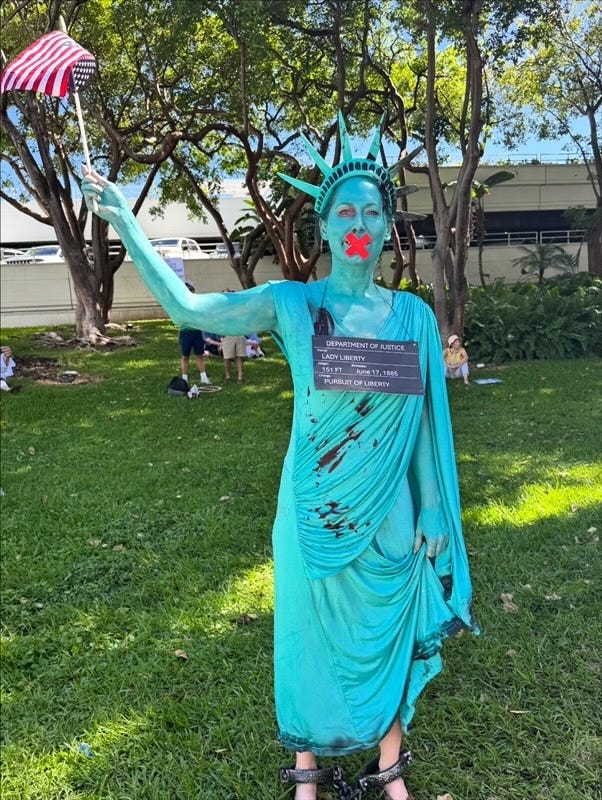
Apparently, Donald Trump felt threatened by a successful, peaceful protest and by seeing millions of us out in the streets protesting against him. Saturday night, he posted a childish, petulant video, portraying himself as the king of sh*t. Then, this morning, he resorted to a temper tantrum, insisting he would use his “absolute power” to invoke the Insurrection Act.
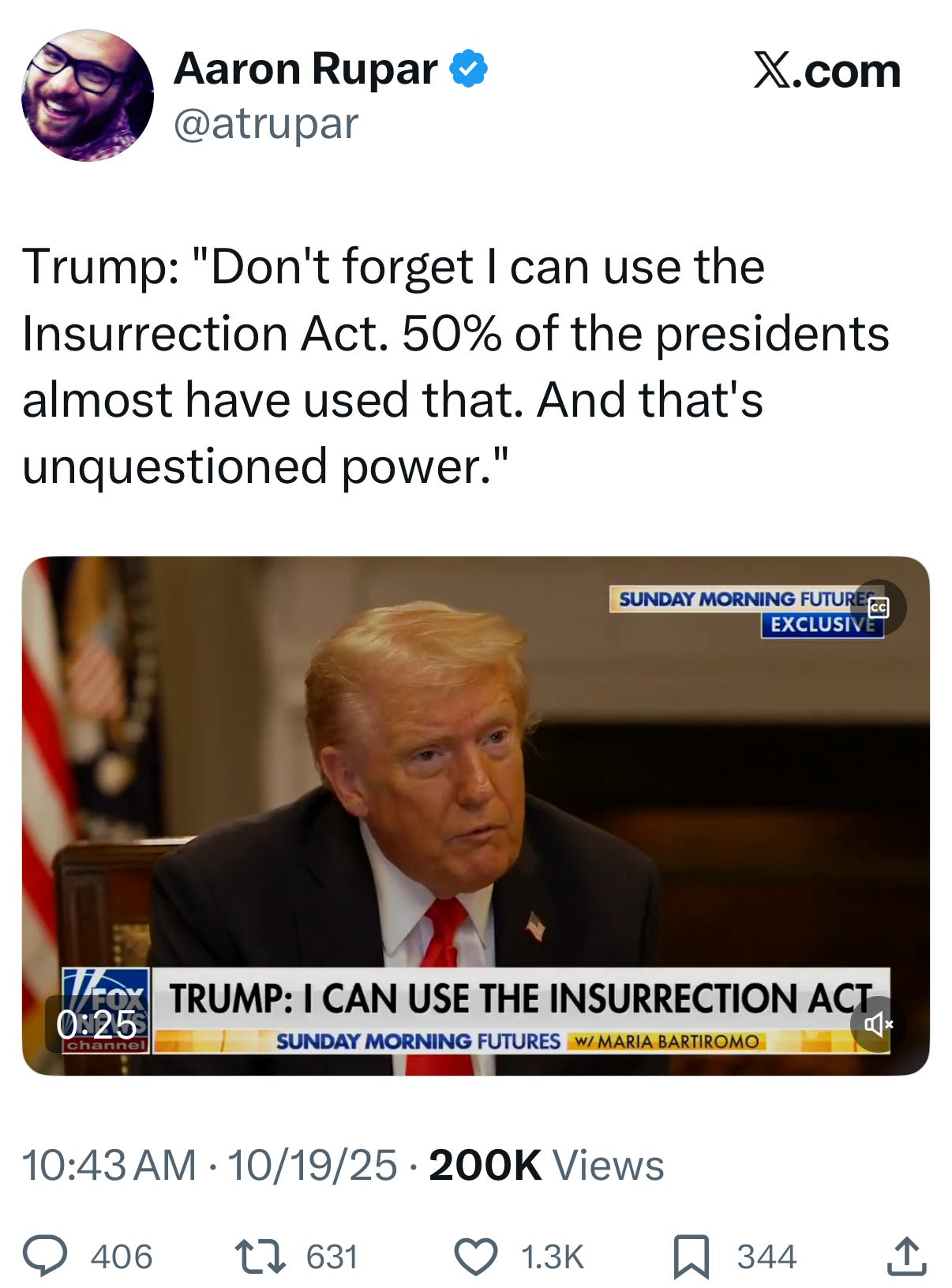
Of course, 50% of presidents have not invoked the Act. Wrong again.
Trump’s renewed focus on the Insurrection Act comes on the heels of a Seventh Circuit decision last week declining to permit Trump to deploy troops to Chicago. “Political opposition is not rebellion,” wrote a panel of the Seventh Circuit Court of Appeals, affirming District Judge April Perry. You can read the court’s order here. The panel consisted of appointees from the administrations of Presidents George H.W. Bush, Barack Obama, and Donald Trump.
That case is not about the Insurrection Act, however. Trump has, so far, stopped short of invoking it, instead using related authority that the administration maintains allows it to federalize National Guard troops, even over a governor’s objection.
The appellate judges in the Chicago case affirmed the portion of Judge Perry’s order that temporarily enjoined the administration from deploying the Guard within Illinois. They held that even affording Trump the substantial deference owed to a president’s decisions, Trump had failed to show he met the predicates for doing so. Under 10 U.S.C. § 12406, the administration had to establish that there was either (1) a rebellion or a danger of one or (2) that the situation on the ground made it impossible for the President to execute the laws of the United States with regular forces.
Among their justifications for that decision: “Despite President Trump’s federalization of Guard troops as necessary to enforce federal immigration law, DHS and ICE have touted the success of Operation Midway Blitz. In an October 3 press release, DHS stated that ICE and CBP have effected more than 1,000 immigration arrests since the start of the Operation. In a September 26 DHS press release, the Department declared that protests had not slowed ICE down, and, in fact, ICE has significantly increased its deportation and arrest numbers year over year.” The government contradicted its own case in its self-congratulatory press releases.
There is a technical legal point here. Because the plaintiffs had asked the court to prevent Trump both from federalizing the Guard and from deploying them, the panel looked at those two separately. To obtain an injunction, one of the elements plaintiffs have to establish is that they will be irreparably injured without it. The court held that “the administration’s likely violation of Illinois’s Tenth Amendment rights by deploying Guard troops in the state over the state’s objection ‘constitutes proof of an irreparable harm’” and enjoined their deployment. But it made a different finding when it came to Trump’s ability to federalize Guard troops, holding that it would not enjoin that action because the injury “appears to be relatively minimal.” This effectively gives the state the relief it sought, while interestingly, putting federalized state National Guard troops on the federal payroll during the shutdown, perhaps a topic for another day.
A key point we’ve been tracking in these cases reemerged in this one: Trump’s inexorable march towards obtaining more power for himself. The administration argued, as it has before, that a president’s decision to federalize National Guard troops under § 12406 cannot be reviewed by a judge. That really would make Trump a king. But the panel dismissed the argument, at least at this stage in the proceedings, rejecting the administration’s attempt to use an older case, Martin v. Mott, which we’ve discussed here and here, as going too far. That case involved an effort by militia men to override a presidential decision during a time of open war, and the panel said that did not suggest that the judicial branch of government could not review decisions by the executive branch. They concluded that nothing in the statute “makes the president the sole judge” of whether the reason for invoking it passes muster.
The Solicitor General filed an emergency appeal to the Supreme Court, which means we’ll spend at least part of the week ahead court watching.
All of that legal wrangling explains why Trump returns to threats to invoke the Insurrection Act whenever courts step in to check his authority. With the National Guard, there are clearly some limits on presidential power. Trump seems to believe none of them come into play when the Insurrection Act is involved. The first parts of the Act became law in 1792. It permits the president to deploy the military on domestic soil and use American soldiers against American citizens, making it the chief exception to the Posse Comitatus Act, which would otherwise prohibit that. There are exceptional circumstances where that sort of extreme action is necessary—the opening moments of the Civil War involved President Lincoln using it for just that purpose. But the law has been described by experts as “dangerously overbroad and ripe for abuse.”
Chief among its problems is language that could easily be interpreted as giving the president sole authority to determine when it should be invoked, without resort to the courts for constitutional review. This is why the Supreme Court’s decision about the reach of Martin v. Mott in Chicago and other cases will be so important. Whether the Court will finally take steps to curtail Trump’s attempt to consolidate all power in his own hands remains to be seen.
For the record, even Twitter AI Grok says that Trump got it wrong when it came to the number of presidents who’ve invoked the Insurrection Act: “15 U.S. presidents have invoked the Insurrection Act since its passage in 1807, including Thomas Jefferson, Abraham Lincoln, Dwight D. Eisenhower, and George H.W. Bush. It has been used about 30 times total for events like the Civil War, civil rights enforcement, and riots. That’s roughly a third of presidents, not half as claimed.” And a far better question is, how many times has it been invoked over the objection of the governor, which is a much smaller number.
The most recent use of the Act happened at the request of California’s governor, when sustained riots broke out following the April 29, 1992, acquittal of four Los Angeles police officers who were captured on videotape brutally beating Rodney King, a Black motorist. President George H.W. Bush deployed the National Guard and U.S. troops to restore order after both the governor and the mayor requested federal assistance to help stop the shootings, arson, looting, and other violence in the city that resulted in the deaths of more than 50 people, thousands of injuries and arrests, and property damage of more than $1 billion. That’s the sort of situation the Act is meant for. Not ones where a president trumps up baseless claims of out-of-control crime and violence to serve his own political purposes.
There is no good faith basis underlying Trump’s asserted justification for bringing in the Guard or potentially invoking the Insurrection Act. But that doesn’t matter if you’ve decided you’re a king.

So, when has the Insurrection Act been used absent a request for the governor and local officials? That happened during the Civil Rights Movement in a few extreme situations where the state was interfering with the enforcement of Supreme Court decisions. And in Alabama, George Wallace’s threatened stand in the schoolhouse door to prevent school integration faded away when President Kennedy sent in federal troops using a measure related to the Insurrection Act.
It’s important to understand that Trump is using a fictitious basis for invoking a statute designed for use in only the most serious of situations. There is no rampant crime that local law enforcement can’t handle as well without federal troops as they could with them, and certainly no rebellion. Trump has no plans to use federal forces to enforce Americans’ civil rights. Instead, it’s the same theme we’ve seen since he took office: An effort to seize more and more power and create a lopside executive branch that can rule over the rest of government—and the American people. (snip)
There is more going on this week, although that feels like enough.
The Courts. As the shutdown continues, the federal courts are preparing to run out of funding on Monday. They will maintain “limited operations necessary to perform the Judiciary’s constitutional functions” for as long as the shutdown continues. Constitutional litigation and criminal cases will continue to move forward, but staff will be furloughed and much of the courts’ civil work will slow down to a snail’s pace.
Abrego Garcia. A hearing on Abrego Garcia’s motions for selective and vindictive prosecution in the Tennessee-based criminal case the Justice Department charged him in after his return from deportation has been scheduled for November 4 and 5. In advance, we are learning some information about the evidence he plans to put on.
Abrego Garcia wants to call at least seven witnesses to testify. The government is apparently preparing to attempt to quash subpoenas for high-level officials at DHS and DOJ, and possibly someone from the White House. Abrego Garcia has also identified a series of emails between the U.S. Attorney’s Office and main Justice that he requests access to, to see if they shed any light on the decision to indict him for old crimes, which required obtaining the cooperation of a more culpable individual by promising to terminate his deportation proceedings. Abrego Garcia complains that he’s received very little information from the government in discovery because the local U.S. Attorney believes what he has requested is protected by a number of government privileges including deliberative process and attorney work product. This case, which has dropped off the radar screen in recent weeks, is about to return in a big way, setting the stage for similar motions in the Trump revenge cases as well.
Comey Motions. This case is still scheduled for trial on January 5, 2026, because the Eastern District of Virginia is the rocket docket. Comey’s first round of motions are due on Monday. The government will have two weeks to respond. It’s unclear which motions we will see, but there will likely be several to dismiss the case entirely, including ones arguing the U.S. Attorney was appointed improperly, rendering the indictment invalid, along with selective and vindictive prosecution motions.

Book tour. Also, this week I’m off on my book tour. Giving Up Is Unforgivable will officially be on sale on Tuesday. If you haven’t already, grab your copy here. If you’re in New York City, Preet Bharara and I will be at the 92nd Street Y, and they’ve moved us to a larger space, so there are more tickets available, if you weren’t able to get them earlier. I’d love to get to see you!
There may be lighter posting than usual this week and next while I’m traveling, but I’ll be here for all the important developments, and I’ll try to share pictures from the road with you too! Please make sure you say hi if you’re able to join me at one of our other tour locations.
We’re in this together,
Joyce
(snip)


Actually I think that he is right. I’m sure at least 50% of them if not 100% have, at one time or another in their Presidencies wanted to use it.
I’m pretty sure Obama was at least tempted when McConnell announced that becuase the ni-KLANG President was only 3/5ths of one, he was prohibited from nominating a Supreme Court justice in his final year ‘because there’s an election coming up in 11 months‘, while Fat Nixon could ram through his pick four days before the election.
I would have.
LikeLiked by 1 person