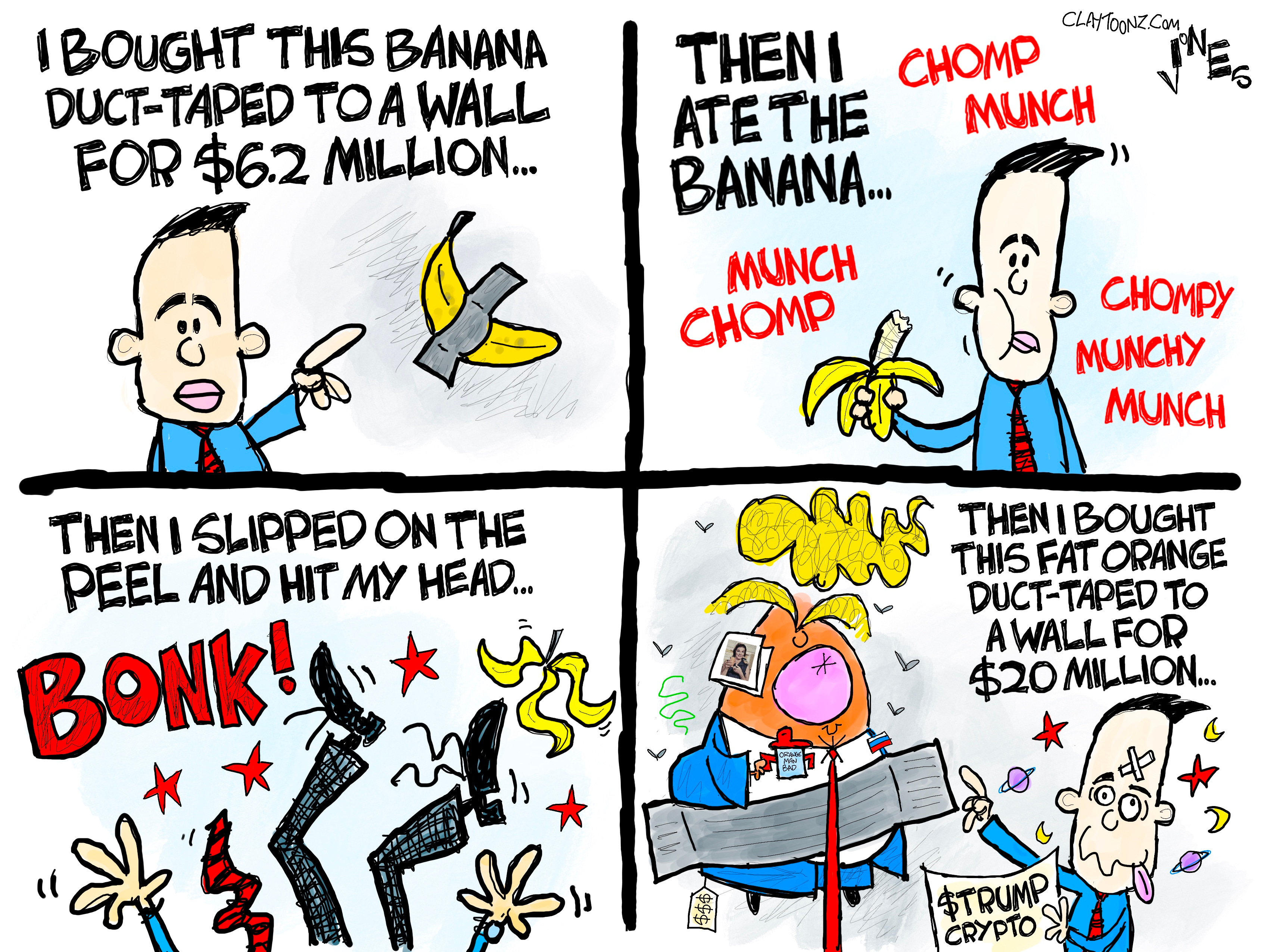
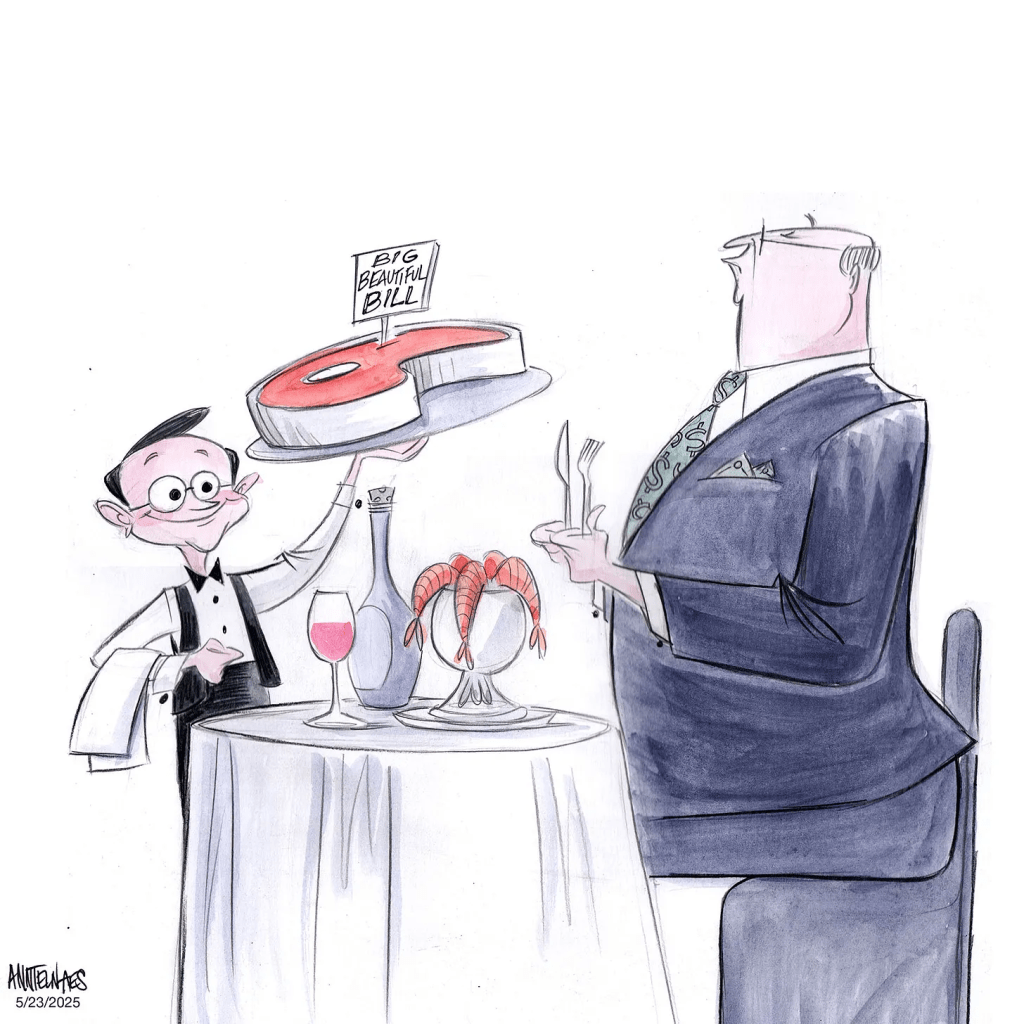
Especially Excellent Clay Jones!

Reciprocal Penguins by Clay Jones

Trump is putting tariffs on places where there are no exports…or humans. Read on Substack

The two major things about tariffs that Donald Trump doesn’t know are that tariffs are taxes and trade wars don’t work.

Trump may finally be starting to understand it’s American consumers who pay for tariffs, as he said in February that we may feel a little “disturbance” from them, and the “ultimate fruits of tariffs will be worth the pain.” In Trumpese, that means there’s going to be a HUGE disturbance (like living next door to a frat house) and pain, similar to a barbed wire catheter.

The people who don’t feel pain from tariffs are rich people, especially billionaire assholes like Trump and Elon Musk. Dickless fucos don’t have to worry about barbed wire catheters.

Trump called yesterday “Liberation Day,” which doesn’t make sense at all when it leads to Americans paying higher prices. By the way, I was in a grocery store last night, and the cheapest dozen of eggs was $5.35, and they got as high as $7 plus.

In yesterday’s announcement, Trump said, “For years, hardworking American citizens who were forced to sit on the sidelines as other nations got rich and powerful, much of it at our expense. But now it’s our turn to prosper and in so doing, use trillions and trillions of dollars to reduce our taxes and pay down our national debt.”

This is bullshit because the United States has the largest Gross Domestic Product (GDP). We have the largest economy in the world (thanks, Joe Biden). Our GDP is $90,000. By comparison with another rich nation, Germany’s is $58,000. This is also how Trump acts at tax time, crying that his buildings aren’t worth the amount he claims on loan applications.

Tariffs don’t reduce our taxes. It’s an additional tax. For the dunderheads who may be reading this, let’s say you increase tariffs on products coming from Heard Island, where only penguins live. Since penguins don’t actually export anything, we’ll have to make something up. Let’s say they export shiny rocks because I think I read somewhere that before a dude penguin can shag a nice lady penguin, he has to give her a shiny rock. So, these penguins are exporting shiny impressive rocks for wooing, and suddenly they have to pay a ten percent export tax to sell in the United States. The importer, NOT the exporting penguins, has to pay this tax. Do you think Walmart eats this ten percent? Of course not. You do, or whoever shops where they sell shiny penguin rocks from Heard Island (and McDonald Island.

Also, you can’t pay off the national debt with tariffs. The tariffs are designed to discourage Americans from purchasing foreign goods. If that works, then nobody’s going to pay those tariffs. The other idea is to force other nations to lower their tariffs, and if that works, then we lower ours again, and nobody’s paying for those high tariffs.

Ya see, kids, if the shiny rocks become too expensive for American consumers, then they stop buying them, and then the penguins will stop exporting them. That’s called supply and demand.

By the way, the shiny-rock trick works with humans, too. The rocks are just more expensive.

I’m not an expert on tariffs (nor shiny rocks), but it seems I understand it a lot better than the President (sic) of the United States. Feel free to correct me in the comments if I’m wrong on any of this.

Trump also said during his announcement, “The United States charges other countries only a 2.4 percent tariff on motorcycles. Meanwhile, Thailand and others are charging much higher prices, like 60 percent. India charges 70 percent, Vietnam charges 75 percent, and others are even higher than that. Likewise, until today, the United States has for decades charged a 2.5 tariff. Think of that 2.5 percent on foreign-made automobiles. The European Union charges us more than 10 percent tariffs.”

All that’s complicated as tariffs from a specific nation aren’t usually a flat rate, but are different per product. First, Trump’s numbers are wrong. Secondly, while we have low tariffs for imported cars, we charge a 25 percent tariff on pickup trucks, which is higher than what Europe charges for imported cars.

Trump ignores that Europe is our largest trading partner, and if they retaliate with “reciprocal” tariffs, then that hurts American manufacturers, and then DOGE won’t be the only one firing American workers.

Trump said, “Toyota sells 1 million foreign-made automobiles into the United States, and General Motors sells almost none. Ford sells very little. None of our companies are allowed to go into other countries.”

More lies. Our cars can go into other countries. China loves large American cars while Japan, which is a smaller nation geographically, does not. It’s not that our cars can’t be sold in Japan, but it’s that Japanese drivers don’t want them. Until two years ago, General Motors sold more cars in China than they did in the United States.

Trump said, “And with countries like Canada, you know, we subsidize a lot of countries and keep them going and keep them in business. In the case of Mexico, it’s $300 billion a year. In the case of Canada, it’s close to $200 billion a year.”

Lies. Our trade deficit with Mexico is NOT $300 billion but instead, it’s $172 billion. With Canada, it’s NOT $200 billion, but instead, $45 billion. These numbers are extremely easy to look up.

Trump said, “Canada, by the way, imposes a 250 to 300 percent tariff on many of our dairy products. They do the first, the first can of milk, they do the first little carton of milk at a very low price. But after that it gets bad, and then it gets up to 275, 300 percent.”

The truth is, this was the case, but it was renegotiated in the North American Free Trade Agreement during Trump’s first term (sic).

Trump also gave a history lesson. “Then in 1913, for reasons unknown to mankind, they established the income tax so that citizens, rather than foreign countries, would start paying the money necessary to run our government. Then, in 1929, it all came to a very abrupt end with the Great Depression, and it would have never happened if they had stayed with the tariff policy; it would have been a much different story.”

Trump sucks at history because the reasons are known. Lower-income people pay tariffs, so an income tax was added with the expectation wealthier Americans would take more of the burden, but as we have learned since 1913, Billionaire assholes aren’t all that ethical. I heard about one billionaire who doesn’t pay his contractors, lawyers, or taxes.

Trump says the Great Depression wouldn’t have hit if America “had stayed with the tariff policy,” yet it’s the tariff policy, the Smoot-Hawley Act, that raised tariffs, started a trade war that decreased world trade by 66 percent, and contributed to the Great Depression and World War II. Herbert Hoover signed Smoot-Hawley into law. The Northwest Progressive Institute ranks Hoover as our 39th best president. It ranks Trump dead last, and he hasn’t even started his depression and World War III yet.

Bragging about tariffs from his first term (sic), Trump said, “If you look at China, I took in hundreds of billions of dollars in my term.”

Lies. He took in $75 billion from China, paid by American consumers, and had to bail out American farmers at the cost of $28 billion to American taxpayers after China retaliated. What you wanna bet those farmers voted for Trump? Yee-haw, fuckers.

Now, what do penguins have to do with any of this?

Heard Island and McDonald Islands are among several “external territories” of Australia that Trump has hit with ten percent tariffs. The World Bank’s data says the United States imported $1.4 million of products from Heard Island and McDonald Island in 2022, nearly all of which were “machinery and electrical” imports.

What makes those numbers suspect is that it’s believed no human has set foot on either island in the past decade. With the islands closer to Antartica than to Perth, it takes a two-week boat ride to get to the islands (they don’t have airports). The life you find on these islands are seals and birds, and the birds are mostly four species of penguins. Those penguins are king, gentoo, macaroni, and eastern rockhopper. I did not know there was a macaroni penguin. That’s the kind of shit that distracts me from finishing a blog because I have to Google “macaroni penguins.” Holy crap, they have huge yellow eyebrows.

The tariffs on two of the most remote islands in the world where no products are exported from, or where humans don’t even visit, proves that the Trump administration hasn’t fully studied tariffs. If they’re placing tariffs on penguins, then how much have they studied the tariffs they’re placing on the French or British? How high are the tariffs on Thighland and Yo-Semite? Shit, don’t steal that for a cartoon, my political-cartooning colleagues!

Also, these tariffs are NOT reciprocal, as Trump claims. It’s not like those penguins were charging us a ten percent tariff to start this trade war.

Penguins are notorious for not paying their debts. If you loan a penguin ten bucks, you will never see that ten bucks again, and he’ll probably waste it all on anchovies. How are we supposed to collect tariff taxes from freeloading flightless birds? All those penguins in zoos are on welfare and don’t pay for food or housing. And I hear the seals aren’t much better. They do more arfing than tariff-paying. The Internal Australian Revenue Service has reported it has never received a payment from penguins, and not even in shiny rocks. Penguins are almost as bad at paying their bills as Donald Trump.

We’ll see penguins fly before we ever see a check.

Creative note: I would have done something on a McDonald’s tariff, Trump’s favorite food, if penguins weren’t a part of the story.

Music note: I listened to Collective Soul.

Drawn in 30 seconds: (snip-go see it)

Allies Being Allies, Bravely

(It’s all here except a Facebook post, because the page is jam-packed with active ads. But this deserves to be known, wherever you read it. -A.

‘They belong here’: In defiance of Trump, Guster shares Kennedy Center stage with canceled children’s musical

Guster welcomed the cast of the children’s musical “Finn” to the Kennedy Center over the weekend after the center’s Trump-appointed board canceled its national tour.

Guster shared the Kennedy Center stage with the cast of children's musical "Finn" on Saturday, March 29.
Guster shared the Kennedy Center stage with the cast of children’s musical “Finn” on Saturday, March 29. Charles Sykes/Invision/AP

By Kevin Slane April 1, 2025 2 minutes to read

Guster won’t be playing PorchFest this year, but the alt-rock band originally formed in Somerville still knows how to draw headlines when it takes the stage.

When Guster performed at the Kennedy Center over the weekend with the National Symphony Orchestra, it brought out a special guest: The cast of the children’s musical “Finn.”

After opening at the Kennedy Center to strong reviews in November and December 2024, the Kennedy Center-commissioned musical was supposed to begin a national tour this year. “Finn” — about a young shark who “wants to let out his inner fish” — was co-created by Chris Nee, the openly gay creator of the popular children’s TV show “Doc McStuffins.”

But after President Donald Trump took over as chairman of the arts institute in February — firing its board of trustees and installing allies including White House Deputy Chief of Staff Dan Scavino and Fox News hosts Laura Ingraham and Maria Bartiromo in their place — the planned national tour for “Finn” was canceled.

“We will soon announce a new Board, with an amazing Chairman, DONALD J. TRUMP!” Trump wrote on Truth Social in February. “Just last year, the Kennedy Center featured Drag Shows specifically targeting our youth — THIS WILL STOP.”

According to Deadline, the new regime at the Kennedy Center cited financial considerations when canceling the musical’s planned tour, but “the musical’s theme of tolerance and acceptance – the young gray shark named Finn ultimately decides to let out his ‘inner fish’ by adopting a vibrantly colored and glittery new appearance – has been widely interpreted as at least a contributing factor in the tour’s axing.”

During Friday evening’s show, Guster brought the cast of “Finn” on stage to accompany the band on its song “Hard Times.”

Guster lead singer Ryan Miller addressed the audience before bringing the cast on stage, talking about his friendship with “Finn” co-creator Michael Kooman.

“As the new administration has made abundantly clear, ‘Finn’’s themes of inclusivity, love, and self-acceptance aren’t going to be welcome in this building while they are in control,” Miller said. “Tonight our band is here to say our stage is your stage. We are your allies, we stand with the LGBTQ community, and we want you to sing with us.

“Please welcome the cast of ‘Finn’ and composer Michael Kooman,” Miller concluded. “They belong here.”

In a Facebook post on Monday, the band wrote that it left the Kennedy Center “imbued with energy, purpose, and righteousness.”

“Reflecting on the weekend and feeling so grateful for our fans,” the band wrote. “Many of you were hesitant to enter the charged atmosphere at the Kennedy Center but trusted us to navigate these shows with purpose and showed up as your fullest most spirited selves.”

“I think all of us, and it’s like 5000 of us over the weekend, left that venue feeling the power of music to heal and refresh,” the post continued. “And the power of community to overcome. (snip unembeddable Facebook post)

Kevin Slane

Staff Writer

A Word From A Canadian

Long Live Freedoms? by Dr. Richard Francis Hogan

“Liberation Day”🤕? Read on Substack

Written: 🇨🇦 Wednesday, April 3rd, 2025 10:15

Is it long live freedom?

In the shadow of Wednesday, April 3rd, 2025 circum 4 p.m. EST, the idea of liberation unfolds with all its complexities, its light and its shadow. The declaration, bold and unyielding, seeks to redefine the pillars on which trade and economic power rest, claiming to usher in an era of self-reliance and prosperity. Yet, as with all acts of change, the effects are far-reaching, unpredictable, and deeply personal.

From the bustling markets of India to the quiet farmlands of Iowa, the world absorbs the shockwaves of an economic strategy that promises protection but risks isolation. In homes and factories, the air is thick with speculation—what will these tariffs bring? A renaissance of domestic manufacturing or a tightening of belts for families already stretched thin?

Global markets shift like tectonic plates beneath the surface, each country recalibrating its position in this delicate dance. Some see an opportunity to assert their own independence, while others grapple with the economic turbulence caused by disruption. The landscape becomes a chessboard, nations maneuvering for advantage, each move echoing through the corridors of diplomacy and trade.

And amidst this vast interplay of economies and geopolitics stands the human spirit. For the individuals whose lives are touched by these decisions, liberation is not just a political or economic act—it is deeply personal. It is the parent deciding how to stretch a paycheck further in the face of rising costs. It is the worker who watches as their factory doors reopen, bringing hope to their community. It is the farmer who wonders if their crop will find a buyer in a world now reshaped by tariffs.

Liberation, then, becomes a question of perspective. For some, it is a moment of pride, an assertion of independence in a globalized world. For others, it is a reminder of vulnerability, the realization that no nation or individual exists in isolation. It is the tension between self-sufficiency and interdependence, between the desire for control and the inevitability of connection.

As the world moves forward from this day of declaration, the real measure of “Liberation Day” will not be found in the speeches or the headlines—it will be in the lives it changes, the challenges it creates, and the resilience it inspires. For in the end, liberation is not just the act of breaking free—it is the courage to forge a path in the uncharted territories that freedom brings. However, as a Canadian, my speak 🗣️

Wednesday, April 3, 2025, the sun rises not simply over land and water but over a tapestry woven with threads of commerce, diplomacy, and shared destinies. Across the expanse of North America, two neighbors—Canada and the United States—stand as towering pillars of trade, their economies entwined like the roots of ancient oaks. Their shared border, stretching like an endless promise, hums with the rhythm of industry, each heartbeat pulsing with goods and ideas that flow seamlessly between them.

But today, the pulse quickens, and the air grows dense with the weight of a proclamation. “Liberation Day,” declared boldly, aims to sever dependence, a bid for sovereignty through tariffs as high as mountain peaks. The United States, seeking refuge from the vulnerabilities of interdependence, turns inward, its gaze fixed on rekindling domestic sparks. Factories stir with newfound hope, their machines roaring with ambition, while farms stretch toward the horizon, bracing for winds of change.

Canada watches, its heart a blend of steel and shadow. From Ottawa to Alberta, the land whispers of resilience—a quiet determination to adapt and endure. Trade routes that have thrived for centuries suddenly feel fragile, threatened by the force of protectionist winds. Yet in this fragility lies the essence of ingenuity, the spark that drives nations to seek partnerships beyond familiar shores. Diversification becomes Canada’s anthem, a melody sung to the world, a testament to its strength.

Across fields and highways, rivers and rails, the individual stories unfold. In bustling Toronto, a worker questions the fate of their factory, now tethered to uncertain exports. In rural Saskatchewan, a farmer gazes at their wheat, their crop a silent plea for markets that may no longer welcome it. In Michigan, an assembly line thrums with renewed vigor, yet the workers pause, wondering how long the momentum will last. It is here, in the lives of ordinary people, that the consequences of Liberation Day resonate most deeply.

The Canada-U.S. trade relationship—a partnership that has weathered storms and celebrated triumphs—now stands at a crossroads. It is a reflection of the paradox of liberation: to free oneself from dependency is to risk isolation; to assert sovereignty is to acknowledge vulnerability. Yet, amid the challenges, hope persists. It whispers through the rustle of maple leaves and echoes across the Rockies, a reminder that change, though disruptive, breeds possibility.

As the sun will set, painting the sky in hues of amber and ash, the world holds its breath. Liberation is not a moment—it is a journey, one of adaptation and resilience, of finding strength in the struggle and light in the uncertainty. Canada and the United States, like two dancers navigating a shifting melody, move forward—not as rivals but as partners, bound by history, trade, and the human spirit that seeks meaning even in the face of transformation. Is it long live freedom?

That is as much as I will say as a Canadian.

What Happens When We Try

Sen. Ossoff was one of the Dems who appeared to be sitting on the fence about the budget a couple of weeks ago. I encouraged us all to call as many US Senators as we could, and of course that was after I’d done the calling because it just wouldn’t be proper to ask people to do that which I did not do. Here’s an example of what happens when we try; we get a nice letter in return. All of the senators didn’t go to this length, but Sen. Ossoff’s office did, and I won’t forget that!

April 2, 2025 

Dear Ms. Redford,

Thank you for contacting my office to share your perspective on the Fiscal Year 2025 (FY25) continuing resolution. I appreciate hearing from you.The FY25 continuing resolution was signed into law on March 15, 2025 and will fund the government until September 30, 2025. I opposed cloture and voted against final passage on the partisan House spending proposal. I believe the best available solution was a 30-day stopgap funding measure to avoid a shutdown, during which time Congress could do its job to pass a bipartisan budget.Among the risks to Georgia in the partisan House spending proposal: it guts National Institutes of Health research into diseases like Alzheimer’s and maternal mortality, funding for the prevention of violence against women, and U.S. Army Corps of Engineers construction of essential water infrastructure. The bill also irresponsibly fails to impose any constraints on the reckless and out-of-control Trump Administration, which is gutting the Centers for Disease Control and Prevention and the Department of Veterans Affairs while destabilizing the economy. Both parties in Congress must fulfill our Constitutional obligation to check the President.Thank you again for contacting me. I always welcome your input and feedback.Wherever and however I can be of service, please contact my office at 202-224-3521. All of our resources are also available at ossoff.senate.gov.
Sincerely,Jon Ossoff
United States Senator 
     

Peace & Justice History for 4/3

April 3, 1958
10,000 British joined a rally in advance of a three-day, fifty-mile peace march from Trafalgar Square, London, to Aldermaston, Berkshire. Berkshire was the site of the AWRE (Atomic Weapons Research Establishment). This march marked the beginning of many protests against Britain’s development of nuclear weaponry. Thousands made the march along the same route for many years.

Some 10,000 people joined the 1958 rally.

David and Renee Gill at the first Altermaston march 1958

and at the April 2004 march…still protesting fornuclear disarmament.
Their story
April 3, 1963
Black residents of Birmingham, Alabama, sat in at several lunch counters seeking to be served as customers. It was part of “Project C” (for Confrontation) on “B Day” (for Birmingham) organized by Reverends Fred Shuttlesworth of the Alabama Christian Movement for Human Rights and Martin Luther King, Jr. of the Southern Christian Leadership Conference (SCLC). They issued a Birmingham Manifesto: “. . . the patience of an oppressed people cannot endure forever.”
April 3, 1968

The Reverend Martin Luther King, Jr. delivered his “I’ve been to the mountaintop” speech in Memphis, Tennessee. King was there to support sanitation workers striking to protest low wages and poor working conditions.
“. . . I’ve seen the Promised Land. I may not get there with you. But I want you to know tonight, that we, as a people, will get to the promised land!And so I’m happy, tonight. I’m not worried about anything. I’m not fearing any man! Mine eyes have seen the glory of the coming of the Lord!”
King was assassinated the next day.

Read the speech  …or listen 
Watch an excerpt of his final and prophetic speech 

https://www.peacebuttons.info/E-News/peacehistoryapril.htm#april3

Three Bits I Ran Across Last Evening

Things Republicans Do:

Trump’s loser by Ann Telnaes

Elon’s millions didn’t buy him the votes in Wisconsin Read on Substack

https://www.npr.org/2025/04/01/nx-s1-5345862/wisconsin-supreme-court-crawford-schimel-election-results

=========================

https://www.levernews.com/florida-is-going-medieval-on-labor-law/

Florida Is Going Medieval On Labor Law

Republican lawmakers in the Sunshine State are advancing a suite of bills making it easier for employers to exploit society’s most vulnerable.

Snippet (there’s much more, also about other subjects, on this page -A):

Make labor law feudal again. The Florida legislature is rapidly advancing a suite of bills allowing employers to underpay subminimum-wage workers — including children. One measure proposes undoing key child labor restrictions, like rules regulating maximum hours per week, banning overnight shifts, and guaranteeing teens get meal breaks. Another bill would permit employers to misclassify full-time workers as interns and apprentices to circumvent the state’s new minimum wage law. Both bills are part of the business lobby’s long war to decimate labor rights in the state; proponents are citing ongoing labor market disruptions caused in part by the Trump administration’s mass deportation program. 

Florida didn’t want this. In 2020, a supermajority of Floridians voted to pass a ballot initiative to raise the state’s minimum wage from $8.56 to $15 an hour by 2026. But business interests have tried to stop that law from ever fully going into effect. Last year, the legislature passed a carve-out for minor league baseball players, and this year, the business community is coming back with a more sweeping overhaul. The new bill exempts interns, apprentices, and work-study programs from the new wage standards, despite the fact that a minimum wage is supposed to raise the floor for the lowest-paid segments of the labor force. 

Internships forever. Critics of the legislation point out that the bill text does not define any criteria for what differentiates an employee from an intern or apprentice. Without clear guardrails, employers could use this exemption to underpay just about any entry-level position that requires some training. All they’d need to do is require the employee to sign a form waiving their right to the state minimum wage. 

Thanks, Florida Man. In a committee hearing earlier this month, the bill’s sponsor, state Rep. Ryan Chamberlin (R-Belleview), acknowledged that retailers like Target may exploit these loopholes as written. “It’s certainly not intended for Target to be able to do that,” he said in response to a Democratic lawmaker’s concerns, without denying that it’s a possibility. Meanwhile, critics argue that the legislation is patently unconstitutional and suspect that it’s meant to push for a ruling from the state’s high court, which is stacked with loyalists of Gov. Ron DeSantis (R), who has opposed the minimum-wage law. With a favorable ruling, business groups could weaken the law and undermine a guaranteed state minimum wage. (snip)

======================

Trump Reveals Real Reason for His Extreme Tariffs

Donald Trump continues to bully one of the America’s longest allies.

Donald Trump just made the rationale for his tariff “Liberation Day” crystal clear: revenge.

In a post on Truth Social late Tuesday, the president said that the tariffs were his administration’s “fight” against Democrats’ “wild and flagrant push to not penalize Canada for the sale, into our Country, of large amounts of Fentanyl, by Tariffing the value of this horrible and deadly drug in order to make it more costly to distribute and buy.”

Approximately 0.2 percent of American fentanyl seizures occur at the Canadian border, according to federal statistics.

But Trump’s aggressive rhetoric and high levies on Canada have practically shattered the two neighbors’ long-standing allyship. On Thursday, Canadian Prime Minister Mark Carney announced that his country’s cozy relationship with the U.S. had come to an end, and that Canada would wean itself off American products and services “at speeds we haven’t seen in generations.”

Trump singled out four Republican senators in particular who have pushed back against his tariffs. “They are playing with the lives of the American people, and right into the hands of the Radical Left Democrats and Drug Cartels,” he said, referring to Mitch McConnell, Susan Collins, Lisa Murkowski, and Rand Paul.

“The Senate Bill is just a ploy of the Dems to show and expose the weakness of certain Republicans, namely these four, in that it is not going anywhere because the House will never approve it and I, as your President, will never sign it,” Trump said. “Why are they allowing Fentanyl to pour into our Country unchecked, and without penalty. What is wrong with them, other than suffering from Trump Derangement Syndrome, commonly known as TDS?”

Trump and his allies have frequently accused anyone that critiques their work of being mentally ill, effectively undermining the legitimacy of critical thought in the groupthink of his already sycophantic base.

“Who can want this to happen to our beautiful families, and why? To the people of the Great States of Kentucky, Alaska, and Maine, please contact these Senators and get them to FINALLY adhere to Republican Values and Ideals,” Trump said. “They have been extremely difficult to deal with and unbelievably disloyal to hardworking Majority Leader John Thune, and the Republican Party itself. MAKE AMERICA GREAT AGAIN!”

(I find it rich that Trump thinks those Senators have not adhered to Republican values and ideals, especially McConnell and Collins. Paul is in a world of his own, most decidedly a Libertarian world. Sheesh. -A.)

So Who, Exactly, Is Being Punished Under This Government Edict?

I can’t think of a lot that a person can do about this. I started reading it hoping for an avenue for activism, then got caught up in the story, which is packed with info that we don’t get with stories about deportation flights. I’m sharing it because of the information. The information can help we the people’s kids who think they’re getting one job, only to find there’s another one, and it isn’t really civilian-type work. (And that is leaving the deportees aspect out of the picture, but …) The only thing I can think of to do that can eventually help is to take the info and share it with people during conversation, and such. This is another thing that, if people knew more about, they would not like it. -A.

Inside ICE Air: Flight Attendants on Deportation Planes Say Disaster Is “Only a Matter of Time”

by McKenzie Funk April 1, 2025, 6 a.m. EDT

ProPublica is a nonprofit newsroom that investigates abuses of power. Sign up to receive our biggest stories as soon as they’re published.

Reporting Highlights

  • Unexpected Role: Flight attendants were told they would fly rock bands, sports teams and sun-seekers. Then Global Crossing Airlines started expanding into federal deportation flights.
  • Human Struggles: Some flight attendants said they ignored orders not to interact with detainees. “I’d say ‘hola’ back,” said one flight attendant. “We’re not jerks.”
  • Safety Concerns: Flight attendants received training in how to evacuate passengers but said they weren’t told how to usher out detainees whose hands and legs were bound by shackles.

(snip)

The deportation flight was in the air over Mexico when chaos erupted in the back of the plane, the flight attendant recalled. A little girl had collapsed. She had a high fever and was taking ragged, frantic breaths.

The flight attendant, a young woman who went by the nickname Lala, said she grabbed the plane’s emergency oxygen bottle and rushed past rows of migrants chained at the wrists and ankles to reach the girl and her parents.

By then, Lala was accustomed to the hard realities of working charter flights for Immigration and Customs Enforcement. She’d learned to obey instructions not to look the passengers in the eyes, not to greet them or ask about their well-being. But until the girl collapsed, Lala had managed to escape an emergency.

Lala worked for Global Crossing Airlines, the dominant player in the loose network of deportation contractors known as ICE Air. GlobalX, as the charter company is also called, is lately in the news. Two weeks ago, it helped the Trump administration fly hundreds of Venezuelans to El Salvador despite a federal court order blocking the deportations, triggering a showdown that experts fear could become a full-blown constitutional crisis.

In interviews with ProPublica, Lala and six other current and former GlobalX flight attendants provided a window into a part of the deportation process that is rarely seen and little understood. For migrants who have spent months or years trying to reach this country and live here, it is the last act, the final bit of America they may experience.

An ICE detainee waves from inside a bus that transported passengers to the airport before departing from Seattle’s Boeing Field on a GlobalX deportation flight in February. Credit:Emily Schultz

All but one of the flight attendants requested anonymity or asked that only a nickname be used, fearing retribution or black marks as they looked for new jobs in an insular industry.

Because ICE, GlobalX and other charter carriers did not respond to questions after being provided with detailed lists of this story’s findings, the flight attendants’ individual accounts are hard to verify. But their stories are consistent with one another. They are also generally consistent with what has been said about ICE Air in legal filingsnews accountsacademic research and publicly released copies of the ICE Air Operations Handbook.

That morning over Mexico, Lala said, the girl’s oxygen saturation level was 70% — perilously low compared with a healthy person’s 95% or higher. Her temperature was 102.3 degrees. The flight had a nurse on contract who worked alongside its security guards. But beyond giving the girl Tylenol, the nurse left the situation in Lala’s hands, she recalled.

Lala broke the rule about talking to detainees. The parents told Lala their daughter had a history of asthma. The mom, who Lala said had epilepsy, seemed on the verge of her own medical crisis.

Lala placed the oxygen mask on the girl’s face. The nurse removed her socks to keep her from further overheating. Lala counted down the minutes, praying for the girl to keep breathing.

The stories shared by ICE Air flight attendants paint a different picture of deportations from the one presented to the public, especially under President Donald Trump. On social media, the White House has depicted a military operation carried out with ruthless efficiency, using Air Force C-17s, ICE agents in tactical vests and soldiers in camo.

The reality is that 85% of the administration’s “removal” flights — 254 flights as of March 21, according to the advocacy group Witness at the Border — have been on charter planes. Military flights have now all but ceased. While there are ICE officers and hired security guards on the charters, the crew members on board are civilians, ordinary people swept up in something most didn’t knowingly sign up for. (snip-MORE)

A Reblog From Barry-

Peace & Justice History for 4/2 (& 4/1)

When I went to Peace buttons Monday night, their site was down, or something, so no P&J 4/1 morning. However, keep scrolling; it’ll be after 4/2! -A

April 2, 1917

Jeannette Rankin, a Republican from Montana, took her seat in the U.S. House of Representatives. The first woman ever elected to Congress, she became the only member to vote against U.S. entry into both world wars.
Rankin lost her seat in the next election but was re-elected twenty years later when she opposed entry into World War II. She again served just one term.

Though American women weren’t guaranteed the right to vote for three more years with passage of the 19th amendment, women in Montana, Wyoming, Utah and Washington had full voting rights even before statehood.
Rankin was instrumental in passing laws that made married women citizens in their own right.

Jeannette Rankin biography 
April 2, 1966
One hundred thousand Vietnamese demonstrated in DaNang against both the U.S. and their South Vietnamese governments. Civil unrest spread also to Hue and the capital, Saigon.
April 2, 1970
Massachusetts, in the midst of the Vietnam war, enacted a law which exempted its citizens from having to fight in an undeclared war.
The U.S. Congress had never formally declared war on North Vietnam as required by Article 1, Section 8 of the U.S. Constitution.

April 1, 1841


Brook Farm, perhaps history’s most well-known utopian community, was founded by George and Sophia Ripley near West Roxbury, Massachusetts. Its primary appeal was to young Bostonians who were uncomfortable with the materialism of American life, and the community was a refuge for dozens of transcendentalists, including authors Ralph Waldo Emerson and Nathaniel Hawthorne.
Following four days of demonstrations against the Military Services Act that devolved into rioting in Quebec City, Canadian Prime Minister Robert Borden sent in troops from Ontario to stop the violence. Orders from the soldiers were read only in English to the mostly Francophone demonstrators, and when the they didn’t disperse, the troops fired, killing four and wounding 70.
[see March 28, 1918]


A memorial in Quebec to those who died protesting conscription into World War I
More about Brook Farm 
April 1, 1932
500 schoolchildren, in the depth of the Depression, paraded through Chicago’s downtown section to the Board of Education offices, demanding that the school system provide them with food.
April 1, 1955
The African National Congress had called on parents to withdraw their children by this day from South African schools in resistance to the Bantu Education Act. That 1953 law transferred education of the Bantu (blacks) from religious missions to state-controlled schools. Mission education, argued then-Minister of Bantu Education Dr. H.F. Verwoerd, not only tended to create “false expectations” amongst the natives, but was also in direct conflict with South Africa’s racially separatist apartheid policies.
Whites, who were in complete control of government and society, comprised only 14% of South Africa’s population. Verwoerd presented to Parliament:
“When I have control of native education, I will reform it so that natives will be taught from childhood to realize that equality with Europeans is not for them. There is no place for him (the black child) in European society above the level of certain forms of labour…What is the use of teaching a Bantu child mathematics when it cannot use it in practice?”
April 1, 1983
Tens of thousands in the United Kingdom formed a “peace chain” 22.5 kilometers (14 miles) long to express their opposition to nuclear weapons. The chain started at the American airbase at Greenham Common, passed the Aldermaston nuclear research center, and ended at the ordnance factory in Burghfield.

At the same time 15,000 people took part in the first of a series of anti-nuclear marches in West Germany. They were protesting the siting of American cruise missiles on West German territory.
Contemporaneous coverage of the Peace Chain 
April 1, 1985
The U.S. Environmental Protection Agency ordered an end to the dumping of sludge off the New Jersey coast into the Atlantic Ocean.
21st century sludge 

https://www.peacebuttons.info/E-News/peacehistoryapril.htm#april2

Clay Jones Draws & Writes

Third Term Banana by Clay Jones

The nation is on notice Read on Substack

Donald Trump wants to become a dictator, and he’s saying the quiet parts out loud.

Trump is already turning this nation into an authoritarian state. He’s deporting people for protesting, he’s cutting funds to universities that have allowed protests, he’s claiming certain language and ideology is improper and illegal, he’s ignoring the courts, he’s cleansing government and history of DEI, he’s installed an oligarch to override Congress, and he’s even concerned that animals at the National Zoo might be too woke. Now, he’s openly talking about serving a third term.

Right after the election last November, Trump mused about serving a third term, saying he was only joking. Now, he’s openly talking about finding “methods” to serve a third term, and this time, he’s not joking.

There’s only one thing standing in the way of Trump serving a third term, and it’s this little thing I like to call the United States Constitution. The 22nd Amendment says, “No person shall be elected to the office of the President more than twice, and no person who has held the office of President, or acted as President, for more than two years of a term to which some other person was elected President shall be elected to the office of the President more than once.”

That seems pretty clear, right? But wait, Republicans and people sick of democracy and want to give fascism a chance say it’s not. They point to the word “elected” in the 22nd. They believe that as long as Trump can re-enter office without an election, then he’s in. Their theory is that JD Vance can become the Republican nominee in 2028, install Trump as his running mate, win the election (after destroying the nation with MAGA fascism the previous four years), resign the presidency, and Trump will become president for a third time.

So far, this nation has had only one president who was not elected as president or even Vice President. Who was that? I’ll give the answer in the notes.

But wait. The 12th Amendment says, “No person constitutionally ineligible to the office of President shall be eligible to that of Vice-President of the United States.”

Trump is NOT eligible to run for a third term. After his J6 insurrection, he shouldn’t have been eligible for a second. What’s scary is that nobody may try to stop him.

In France, Marine Le Pen is ineligible to hold political office after being convicted of embezzlement, but here in America, Donald Trump is talking about serving a third term even after a coup attempt. As Harry in Resident Alien would say, “This is some bullshit.”

The GOP has already caved into Trump. Corporate America has bent a knee to Trump, and now they’re throwing money at him. Universities are giving in to his demands. Even Chuck Schumer has adopted the philosophy that the best way to stop Trump is to give him everything he wants. We also know the voters are too stupid, too racist, and don’t care enough about this country to stop him.

You would think the courts are the firewall against Dictator Trump, but SCOTUS, with a 6-3 fucknut majority (with two open to bribes), has already ruled that Trump is immune to everything except syphilis and severe acne.

Nothing stopped Trump from violating the Emoluments Clause. Nothing stopped Trump from using the White House and Washington Monument during the 2020 convention. The Senate refused to convict him in both impeachments. The courts refused to prosecute him. Nothing is stopping him from grifting during his second term (sic). Nothing has stopped him from allowing DOGE to work as an unelected fourth branch. Nothing stopped him from being bribed by Elon for $277 million. So, excuse me if I’m a little nervous about him serving a third term. Do I have to repeat that the voters can’t be trusted anymore?

Trump says a lot of people want him to serve a third term, but none of those people are probably among the 56 percent polled to say Trump is doing a shitty job as president (sic). So maybe Trump, even under JD on the ticket, won’t be popular enough to win in 2028.

But wait.

Trump might believe he doesn’t have to win to serve a third term because, as we learned from history, he’ll just claim he won and make another coup attempt and then pardon everyone who participated in the coup.

So, excuse me for not trusting the safeguards in our republic and for being nervous. Do we have to wait for Trump to start his third term for us to become a banana republic, or are we already there?

Which president was never elected? Gerald Ford was never elected as president or vice president.

Creative note: I wasn’t sure if the quote on the sippy cup was genuine, so I Googled it.

I see this a lot on social media. Someone will post a quote they believe is genuine. I have a spider sense with fake shit on the internet. Usually, when I see something I suspect is fake on Facebook and people believe it, even liberals, I discover it’s a lie. People do this with quotes a lot, and most people don’t question it. Well, today I found a Hitler quote, but I wanted to make sure it was genuine.

I did a search, and it turned up in different forms, but that still doesn’t make it real. Proofer Laura looked it up, too. I decided to go with it because I found it on a university website, so I’m hoping they got shit together and fact-checked it for me.

Daily Cartoonist note: Last night, I saw a question posed to me four weeks ago at the Daily Cartoonist. A reader asked why he had to be a paid subscriber to comment here, and also said he would use it to post corrections to me. I would have replied there, but the comments were closed. I’m hoping he’ll see this here.

First, I don’t mind having corrections sent to me, but I don’t like them in the comments. Why not? Because it distracts from everything else. If you see a typo, please message it to me through whatever platform you prefer. You can email me at clayjonz@gmail.com. Trust me, people let me know when they see typos, and I make many.
If you want to challenge me on a fact or dispute anything, I’m cool with that being posted in the comments, as it can encourage discussions.

Second, only paid subscribers can comment because they’re paid subscribers. They gotta have something for their money. That reminds me that I need to make more exclusive content for the people who financially support me.

Drawn in 30 seconds: (snip-go see it)

===============================