Mother’s Day Proclamation Of Peace + Peace & Justice History for 5/10

History of Mother’s Day as a Day of Peace: Julia Ward Howe

Too few Americans are aware that early advocates of Mother’s Day in the United States originally envisioned it as a day of peace, to honor and support mothers who lost sons and husbands to the carnage of the Civil War.

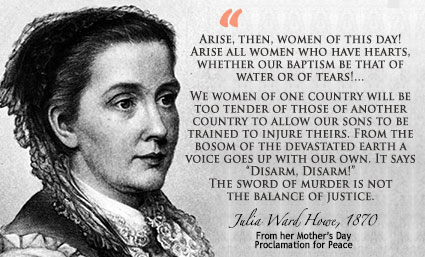
MOTHER’S DAY PROCLAMATION
Boston, 1870

Arise, then… women of this day!
Arise, all women who have hearts,
whether our baptism be that of water or of tears!
Say firmly:
We will not have great questions decided by irrelevant agencies.
Our husbands shall not come to us, reeking with carnage,
for caresses and applause.
Our sons shall not be taken from us to unlearn
all that we have been able to teach them of charity, mercy and patience.
We, women of one country, will be too tender of those of another country
to allow our sons to be trained to injure theirs.

From the bosom of the devastated earth a voice goes up with our own.
It says:  Disarm, Disarm!
The sword of murder is not the balance of justice.
Blood does not wipe out dishonor,
nor violence vindicate possession.
As men have often forsaken the plough and the anvil
at the summons of war,
let women now leave all that may be left of home
for a great and earnest day of council.

Let them meet first, as women, to bewail and commemorate the dead.
Let them then solemnly take council with each other as to the means
whereby the great human family can live in peace,
each bearing after his own kind the sacred impress, not of Caesar,
but of God.

In the name of womanhood and of humanity, I earnestly ask
that a general congress of women, without limit of nationality,
may be appointed and held at some place deemed most convenient,
and at the earliest period consistent with its objects,
to promote the alliance of the different nationalities,
the amicable settlement of international questions,
the great and general interests of peace.

~ Julia Ward Howe


May 10, 1857
The Sepoy Rebellion was triggered in Meerut, India, when native troops (known as Sepoys, which also designated a rank equivalent to private) turned on their British officers.It was the first instance of armed resistance against colonial rule. Indians constituted 96% of the 300,000-man British Army. Loading the Lee-Enfield Rifled Musket assigned to the Sepoys involved biting the end of a cartridge greased in a combination of pig fat and beef tallow.

“Attack of the Mutineers,” a British illustration of the Sepoy Rebellion
The former is haraam (forbidden) under Islamic law, the latter offensive to Hindus who consider the cow as aghanya (that which may not be slaughtered). When the Sepoys, including both Hindu and Muslim Indians, became aware of this, some refused to load their weapons. Mangal Pandey, a soldier in the Army shot his commander for forcing the Indian troops to use the controversial rifles. When others were charged with mutiny for refusing, Sepoys turned on their officers and released the imprisoned soldiers.
The rebellion is now considered the first Indian war for independence.

More on the rebellion 
May 10, 1967
Army Captain Howard Levy, a physician, was imprisoned three years for refusing to train U.S. Special Forces soldiers for Vietnam. He refused an order to perform the training as he considered it a violation of his medical ethics.
“The United States is wrong in being involved in the Viet Nam War. I would refuse to go to Viet Nam if ordered to do so. I don’t see why any colored soldier would go to Viet Nam: they should refuse to go to Viet Nam and if sent should refuse to fight because they are discriminated against and denied their freedom in the United States, and they are sacrificed and discriminated against in Viet Nam by being given all the hazardous duty and they are suffering the majority of casualties.”
From the Supreme Court case, Parker, Warden, et al. v. Levy.
May 10, 1968

Peace talks began in Paris between the U.S. and North Vietnam with businessman, former New York governor, ambassador and cabinet secretary W. Averell Harriman representing the United States. Former Foreign Minister Xuan Thuy, heading the North Vietnamese delegation, immediately demanded cessation of U.S. bombing.
May 10, 1972
Jane Briggs Hart, the wife of Senator Philip A. Hart
(D-Michigan), informed the Internal Revenue Service that she wouldn’t pay some of her taxes; instead, she deposited her quarterly estimated tax of $6,200 in a special bank account.
She wrote: “I cannot contribute one more dollar toward the purchase of more bombs and bullets.”


Jane Briggs Hart
More about Jane Briggs Hart 
May 10, 1980

The National Organization for Women (NOW) organized 85,000 people to march in Chicago in support of Illinois’s ratification of the Equal Rights Amendment to the U.S. Constitution.

A chronology of the Equal Rights Amendment, 1923-1996 
Visit the NOW Foundation 
May 10, 1980

A federal judge in Salt Lake City, Utah, found the U.S. government negligent for its above-ground testing of nuclear weapons in Nevada from 1951 to 1962.


The land of the Nevada Test Site is scarred with craters from nuclear testing.
May 10, 1994

Nelson Mandela was inaugurated as South Africa’s first black president. He had won the country’s first election in which all South Africans could vote, regardless of race. Mandela had spent nearly three decades imprisoned for his part in the struggle to attain political and civil rights for black and colored citizens. This ended more than three centuries of white rule, beginning with the Dutch in 1652.
Biography of Nelson Mandela 
South African chronology 

This Tracks

Appropriate Behavior

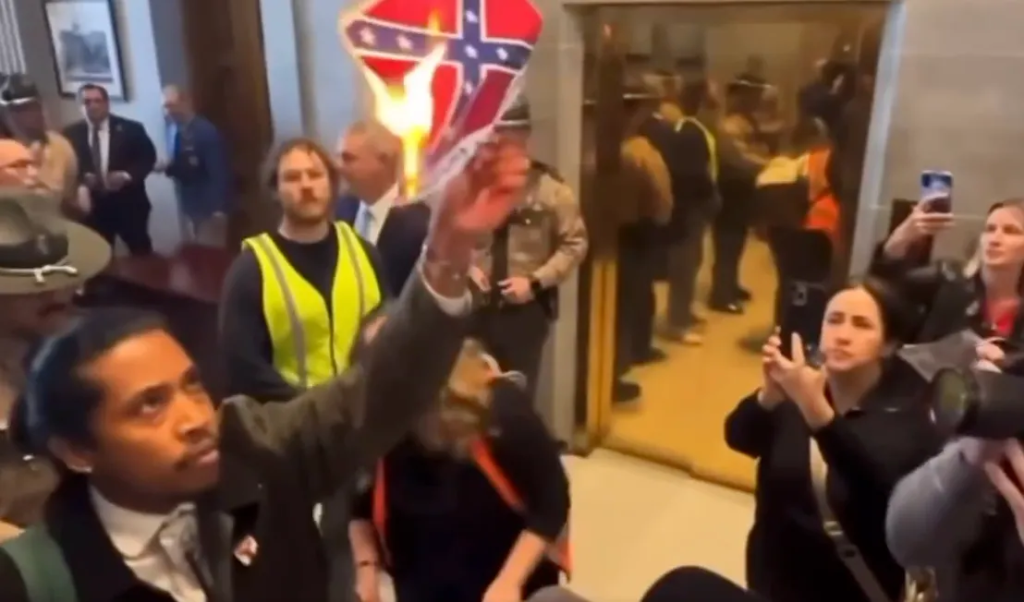
Justin Jones Burning The Confederate Flag In The TN State Capitol. That’s It, That’s The Post.

White racist Tennessee Republicans think they birthed a nation yesterday. Looks like they birthed something else instead.

Evan Hurst

Democratic TN state Rep. Justin Jones burns a Confederate flag in the state Capitol, Thursday, May 8, 2026, video screengrab

Yesterday, the Ku Klux Klan, we mean Tennessee state Legislature, rushed through new maps to eliminate the state’s last remaining Democratic congressional seat in Congress, and racist pigfuck Governor Bill Lee signed them, because that’s what white supremacists do when Donald Trump’s partisan hack Supreme Court says it’s unconstitutional for them not to hurt Black people by gutting the last remaining piece of the Voting Rights Act.

The lawsuits are already being filed, and to be sure, Republicans don’t even understand the war they started yesterday. As we wrote, it’s useful to remember that Republicans always, 100 percent of the time, overplay their hands.

We quoted Tennessee state Rep. Justin Pearson, who until yesterday was running in a primary against long-serving Congressman Steve Cohen to represent what was the Ninth District, in Memphis. We guess how exactly that will end up is undetermined at this exact moment, but Pearson said earlier this week at a rally that “[I]f we keep marching, if we keep pressing, if we keep fighting, the future that our descendants will live into will be a better one than this one. And our message to the Republican Party, our message to that racist, white-supremacist president Donald Trump is that we will fight.”

Pearson, if you remember, is one of the two Black men in the Tennessee Three, back when the grand wizards of the Tennessee Lege first bent over and showed everybody their Klan-hood-shaped buttplugs, expelling the two men from the state House for taking to the House floor to try to defend their constituents against gun violence. Also for being Black men, because they didn’t expel the white woman, Knoxville Rep. Gloria Johnson, for being part of the same protest. (Voters of course sent the two Justins right the fuck back to the Legislature.)

Both Justins were of course present yesterday to witness what white supremacist Tennessee Republicans really think was the Birth of a Nation. And there were many protests in the Tennessee state Capitol yesterday. Justin Jones of Nashville set a Confederate flag on fire, or at least a paper version of it.

And then he stomped that sad loser little bitch of a flag — a flag the greatest losers who ever lived died defending, and their family legacies are less valuable than dried dogshit because of it — right on out.

And what are people saying about that, and about iconic pictures photographers captured of that? “Hang it in the Louvre.”

Oh, it’s gonna be in museums and history books all right.

Rep. Jones, “Brother Jones” as he refers to himself on Instagram, posted videos and images of the already iconic moment.

And he typed:

The South will not rise again, until it’s paid for all its sins of racism and white supremacy.


Today, I left the Capitol Klan Rally, where my white Republican colleagues took off their white hoods and dismantled Black political power in our state. It’s shameful, it’s immoral, and it will go down in the history books alongside the legacy of George Wallace and Bull Connor.


Tennessee has shamefully become the first state to pass a new, racist congressional map following the U.S. Supreme Court’s decision in Louisiana v. Callais, which dismantled the Voting Rights Act of 1965.


When I walked into the building it was 2026, and when I walked out it was pre-1965. This racial power grab against Black voters is purely rooted in control and elimination of their voices in our democracy. Today’s Jim Crow laws passed in our legislature spit on the graves of our Civil Rights martyrs who bled and died for the right to political power and representation.


They are dragging us backwards in history but we refuse to be moved.


I burned the Confederate flag, because the neo-Confederate caucus that assembled today will be defeated again. Their vision of the South, rooted in plantation politics and racial division will not win. Instead we must use this moment to ignite our rebellion and movement even more towards real justice and multiracial democracy. We must build towards a South that can RISE ANEW.


We will not go back!

“Burn it, young brother,” said Joy-Ann Reid in response. So say we all.

Burn. That. Shit.

It’s A Bird’s Life


Yellow-breasted Chat

Icteria virens

Also Known As

  • Buscabreña (Spanish)
  • Reinita Grande (Spanish)
  • Chipe Parlanchín (Spanish)
  • Chipe Arriero (Spanish)

About

At first glance, the Yellow-breasted Chat seems to be a mishmash of many bird families: its larger size and stout bill resemble a Scarlet Tanager’s, while its skulking habits and complex vocalizations seem more like those of a thrasher or mockingbird. Taxonomically, this bird was considered an unusual wood warbler in the family Parulidae. However, in 2017, the American Ornithologists Union gave this bird its own family — Icteriidae — based on its unique physical and genetic features. It is considered to be related to the blackbirds and meadowlarks of the Western Hemisphere.

Among birders, the Yellow-breasted Chat is best-known for two features of its behavior: its habit of staying hidden at most times within the thickest vegetation available, and its loud, wild, weird song and flight display. In 1953, ornithologist Arthur Cleveland Bent described the Chat’s song as a “medley of strange sounds, musical and otherwise, catcalls, whistles, and various bird notes coming from points now here, now there in the bushes” — sounds which would “betray the presence of this furtive and elusive clown among birds.” The song is indeed a strange and wonderful mix of cackles, clucks, whistles, and hoots. Only males are known to sing, and they do so from deep inside the densest cover. A male chat may sometimes sound as if he’s laughing at the frustrated birders trying to locate him. (snip-MORE)


The Word Of The Term Is Corruption

The everything, everywhere, all at once corruption story.

I’m pleading with you to look at the president’s self-dealing.

1 May 2026 Written by: Isaac Saul

(snip-skipping a bit at the top)

During President Joe Biden’s term, the Department of Justice could say, at least, that it had investigated the president’s son. Republicans in Congress also conducted a yearslong investigation into the Hunter Biden business ties and how they might link back to the president. Here, though, we have nothing; every story I’m about to point to has not produced even a unified statement of concern from, say, a half dozen Republican senators worried about government corruption. 

Remember, Hunter’s story was about drawing a $50,000/month salary while his dad was vice president and then allegedly trying to arrange some business ventures he might cut Joe Biden in on once he was out of office. Republicans’ yearslong investigation never turned up any hard evidence of the latter, though there was enough smoke I still think the story was plausible.

Today, we’re talking about the president’s children launching multi-billion dollar business ventures — several of them — while the president is in office, and then explicitly exchanging all manner of domestic policy victories, foreign policy concessions, and literal pardons in the construction of those deals. Trump himself has all but admitted this is happening. He told The New York Times that “nobody cared” when he tried to separate his family business from his administration during his first term, so he isn’t even trying now.

I have tracked these stories with one of my senior editors for the last year and a half. The list of things that have happened is so long and shocking when you see it all together that I’m not entirely sure how to present it. I’ve gone back and forth; maybe I should build a flow chart? What about a spreadsheet? Should this be a YouTube video, instead of a written piece? Will anyone actually read the entire thing? Can anyone actually process this level of self-dealing, corruption, and shadiness at once? 

Ultimately, I decided that the best I can do is try to write all these instances down in an engaging way that might grab your attention and wake us all up from whatever stupor we’re in. So… here goes.

Let’s start with the cryptocurrency.

Perhaps the largest vehicle for Trump’s self-dealing has been his foray into cryptocurrency. This is a complicated space that I will try to make as straightforward and simple as possible.

In 2024, the Trump family launched a crypto company called World Liberty Financial. Trump is listed as a “co-founder emeritus.” By December of 2025, they had profited roughly $1 billion from proceeds while holding $3 billion in unsold cryptocurrency tokens, amassing a fortune larger than their entire real estate portfolio. At the same time the president was pushing his family’s new crypto venture, he was cutting crypto regulation, touting the potential of private digital currencies to help the U.S. economy, and promising to unleash the industry he and his family were simultaneously profiting from.

But the president wasn’t only directly making money in an industry he was deregulating; the Trumps benefitted through intermediaries, too. Last summer, World Liberty Financial bought a publicly listed firm and raised $750 million from investors to buy its own cryptocurrency, WLFI. The Wall Street Journal tepidly described this setup as an “unusually circular transaction with the same party as buyer and seller” that could net the Trump family an additional $500 million. 

Essentially, the Trump family launched a cryptocurrency firm while deregulating the crypto industry, then bought a separate firm that it used to buy its own cryptocurrency while also raising three quarters of a billion dollars from investors to buy that same cryptocurrency. 

Just days before he was inaugurated, Trump also launched a personal “memecoin” called $TRUMP. Memecoins are cryptocurrencies made about internet jokes, pop culture moments, or viral trends. They have no underlying value or technological purpose; the value of the coin is driven entirely by social hype. Trump created hype for his memecoin by launching it months after being elected and just three days before being inaugurated. He promoted $TRUMP on social media and, while president, even held a dinner for the top 220 holders of the coin at one of his golf resorts in Virginia. He held another one at Mar-a-Lago this past weekend. The initial coin offering released 200 million tokens of its billion-token supply to the public on the first day. The price skyrocketed 300% overnight and hit an all-time high of $74.27 on January 19, right before Trump’s inauguration. $TRUMP has since cratered, losing 97% of its value (for context, if you had bought $1,000 at its peak, your $1,000 would now be worth about $30). 

Trump, naturally, profited. The exact figures are hard to pin, but The Financial Times estimated that the scheme netted him personally about $350 million, while Trump’s holdings of the coin through a separate partnership could be worth billions more. It wasn’t just the president, either; First Lady Melania Trump launched her own memecoin, which also skyrocketed in value before a massive sell-off that she profited from (what people in the industry call a “rug pull”). Most of the people who bought and held the coin based on the hype the Trumps created ended up losing most of their money, but the coin’s creators got rich (or, in this case, richer).

This cryptocurrency foray hasn’t just been a vehicle for self-enrichment, but also a vehicle for quid pro quos. Perhaps the most obvious and overt involved Justin Sun, a crypto billionaire who was being investigated by the SEC for fraud. Sun, in the midst of his investigation, bought $75 million of WLFI — the World Liberty Financial coin — and then became an adviser at the company. Shortly after that investment, the SEC backed off its investigation and settled with him for $10 million, a small fraction of the expected penalties he was set to pay (on top of potential prison time). Of course, it’s possible that the SEC, an organization now openly being influenced by the president, just happened to back off its investigation in the weeks following Sun’s $75 million investment into Trump’s crypto firm. 

It’s also possible that the two events are related.

The crypto story, though, hardly ended there. In late April, CBS reported that Sun was suing the Trump administration’s World Liberty Financial, alleging fraud. That’s right: Sun, whose initial case has since concluded, has now turned around and sued the Trump family, alleging that the president and his sons are illegally blocking him from selling his digital tokens that are worth as much as $1 billion. Sun also claims that World Liberty Financial tried to pressure him into investing in its stable coin, and that the company froze his tokens after he refused to commit more money to the business. 

It’s hard to identify the villain.

Sun’s apparent quid pro quo to get out from under government oversight is just one example. Changpeng Zhao, the founder of Binance, was pardoned by President Trump shortly after Zhao helped boost WLFI’s prominence by allowing the currency to be traded on the crypto exchange Binance, which Zhao started. After the pardon, Zhao became one of the Trumps’ business partners, boosting the family’s crypto empire while skating serious charges that he allowed money to flow to terrorists, cyber criminals, and child abusers on his platform.

If that’s not enough, more shocking news broke this week. According to The Wall Street Journal, World Liberty Financial inadvertently partnered with two men the U.S. government had sanctioned a month before for helping run a transnational criminal syndicate that had stolen billions of dollars from Americans through online scams. To repeat: Last fall, the Trump administration announced criminal charges against a transnational criminal syndicate for stealing billions of dollars from Americans in online scams. A month later, two of the men it sanctioned partnered with the Trump family’s crypto company. 

The evidence of crypto investments from foreign nationals operating as de facto bribes doesn’t end there. Consider the story of Sheikh Tahnoun bin Zayed Al Nahyan, the brother of the United Arab Emirates (UAE) president and one of the most powerful politicians in the Middle East (he’s served as the UAE’s national security advisor since 2016). He stewards an empire of wealth worth roughly $1.5 trillion, and a firm closely tied to him secretly signed a deal for a 49% stake in WLFI worth $500 million — including $187 million paid upfront to Trump family entities just days before Trump’s inauguration. Shortly after Trump took office, the administration undid a national security block that would have prevented the UAE from getting up to 500,000 advanced Nvidia AI chips. 

Some right-wing writers, like National Review’s Andrew McCarthy, have been brave enough to take this story head-on — but many have ignored it.

Sometimes, the favors happen en masse. The crypto industry as a whole was a top donor to Trump’s 2025 inauguration fund, and the SEC then dropped or paused over a dozen cases against crypto firms, or simply handed them huge access to government-directed crypto entities. Several of those cases, like Sun’s, were tied directly to donations. Coinbase donated $1 million; its lawsuit was dropped. Ripple ($4.9 million) and Solana ($1 million) had their tokens added to the national Digital Asset Stockpile.

I want to pause here to remind people that we spent all four years of the Biden administration talking about Hunter Biden’s alleged $50,000 a month salary while working at an energy firm in Ukraine, and the possibility that he was setting up some business deals for his father after he left the vice presidency. Rep. Marjorie Taylor Greene (R-GA) introduced articles of impeachment alleging Biden “abused the power of the Office of the Vice President, enabling bribery and other high crimes and misdemeanors, by allowing his son to influence the domestic policy of a foreign nation and accept various benefits—including financial compensation—from foreign nationals in exchange for certain favors.” 

Conversely, the final tally of investments from parties with conflicts of interest into crypto assets personally managed by the Trump family safely enters the range of billions of dollars — a scale of thousands of millions, in just one sector and in just over one year, while the president was actually in office.

It’s not just cryptocurrency.

(snip-MORE. It reads just as quickly on the page)

Clay Jones, Open Windows

So much winning

Trump keeps claiming he’s won the war

Ann Telnaes


And Don’t Call Me, Shirley

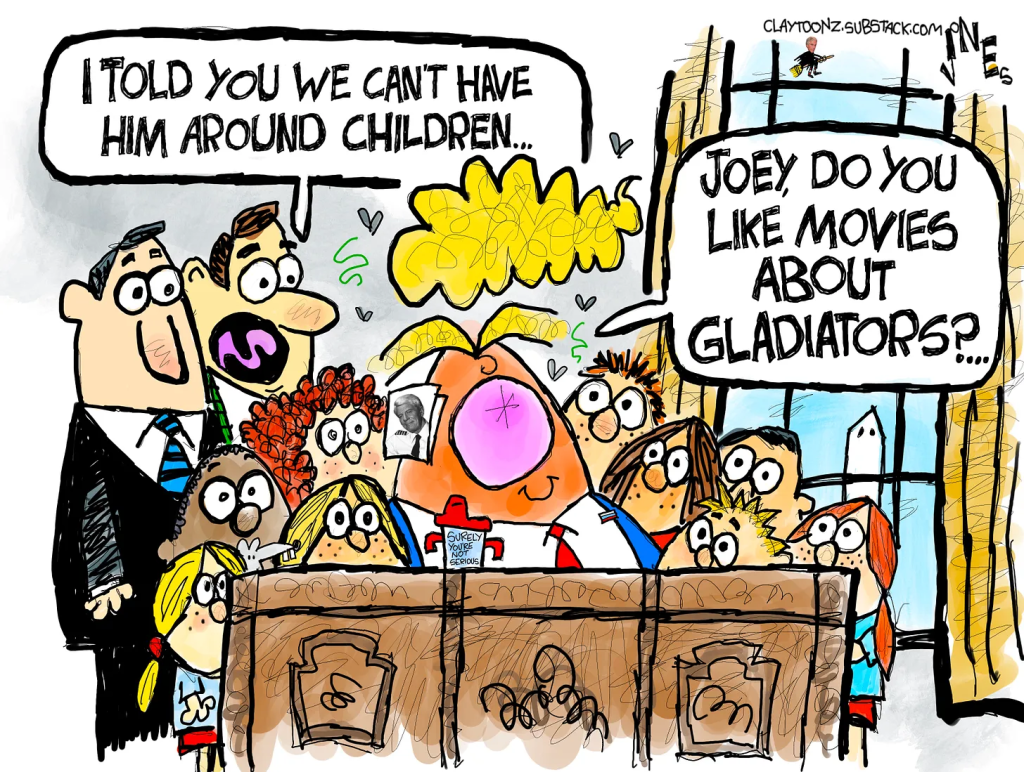
Surely Donald Trump should not be allowed around children

Clay Jones

Anytime Donald Trump is accused of being a pedophile, his base runs to the rescue as if they were personally slapped in the face. Currently, there are over 80 comments on this cartoon on my Facebook page, with the bulk of them being MAGAts demanding “verifiable” evidence that Trump is a pedophile. Of course, the same people who are demanding “verifiable” evidence are posting memes with fake quotes about Joe Biden and his daughter.

But how is this for verifiable evidence? Donald Trump went on the Howard Stern show in 2005 and bragged about walking into dressing rooms for teenage contestants in his beauty pageants. He bragged about it as if he had just won Michigan.

Here’s a small portion of that conversation: (snip-MORE; go read it!)

Now Here’s An Idea-

“This person is already thinking bigger, writing, ‘If this succeeds the people can band together to buy even more companies that get intentionally bankrupt by private equity and we can start bringing back consumer friendly practices or seizing the means of production maybe.’”

Man crowdsourcing to purchase shuttered Spirit Airlines exceeds $437 million in days

“Get in losers, we’re going to buy an airline.”

By Jacalyn Wetzel

“Get in losers, we’re going to buy an airline” is the short bio next to the smiling face of Hunter Peterson, an aviation enthusiast making waves as he tries to disrupt the air travel industry. On Saturday, May 2, at 3 a.m., Spirit Airlines abruptly shuttered, leaving thousands of employees out of work and thousands of travelers holding unusable tickets.

There was no notice or warning. One day, people were booking tickets, and the next, the budget airline went dark. The airline made air travel affordable to a subset of people who otherwise couldn’t afford it.

spirit airlines, man buys spirit, hunter peterson, buying airline, spirit airline shut down
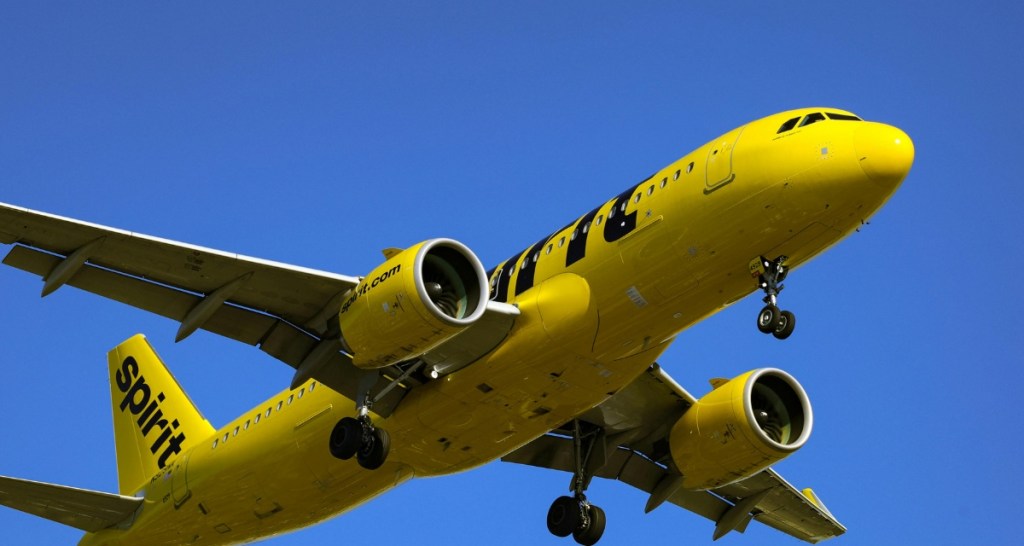
Spirit airplane.
Canva

The FAA and other airlines scrambled to offer solutions for those booked with the budget airline. While Spirit is offering refunds, the loss of a budget airline giant will be felt. Peterson decided to go further by doing something unheard of in the airline industry–crowdsource to buy an airline.

The idea behind crowdsourcing funds is to make the airline people-owned. This means there would be no corporation backing the airline. No overpaid CEO, and no large shareholder who gets to decide the fate of the company. Peterson calls it Spirit 2.0, and much to his surprise, an astonishingly large number of people were interested.

What started as a zany idea quickly turned into an unexpected movement. Peterson set up a website where interested people could pledge money starting at $45–the average price of a Spirit ticket. The potential CEO wanted to keep the price point within reach. None of the money has left anyone’s accounts. Their pledge acts as a placeholder for future funds, but the clock is ticking.

It may sound like an elaborate joke or scheme to go viral, but Peterson is doing the work. Not only has he met with the Spirit Flight Attendants’ Union, but he’s also spoken with attorneys. In videos shared on Instagram, he explains the importance of doing the legal footwork before money leaves people’s accounts.

“I just got off two calls,” Peterson says. “One, with one of the largest law firms in the world that specializes in mergers and acquisitions, aviation distress assets, and debt, and they basically said, this is doable. We can do this. I also got off a call with someone that represents high-net-worth individuals who may be interested in basically giving us some money to just burn to figure out the legalities of this.”

Peterson explains that in less than a week, they’ll be auctioning the operation certificate for Spirit. This means that if this lofty goal is going to be reached, potential small-donor investors need to reach the astronomical $1.75 billion total. Yes, billion.

Before giving the brief update, Peterson’s site letsbuyspiritair.com had already raised over $24 million. The total continues to climb rapidly, with people pledging amounts anywhere from $45 to $850. Since the website popped up, the total pledged has reached $437 million, and it’s restoring hope in people trying to make this proposed people-owned airline a reality.

“ITS ACTUALLY HAPPENING WE CAN DO THIS,” one person screams.

“Is this feeling I have…. hope? It’s been so long since I’ve felt it lol,” another says.

This person is already thinking bigger, writing, “If this succeeds the people can band together to buy even more companies that get intentionally bankrupt by private equity and we can start bringing back consumer friendly practices or seizing the means of production maybe.”

Someone else shares, “This Spirit Airlines 2.0 project is giving me hope for America. I know there are more important fish to fry when it comes to issues in America. But if we are successful with this, imagine all the other issues we can address (e.g. healthcare, reparations, homelessness, etc.) using this framework. Like truly power to the people.”

Two From Clay Jones

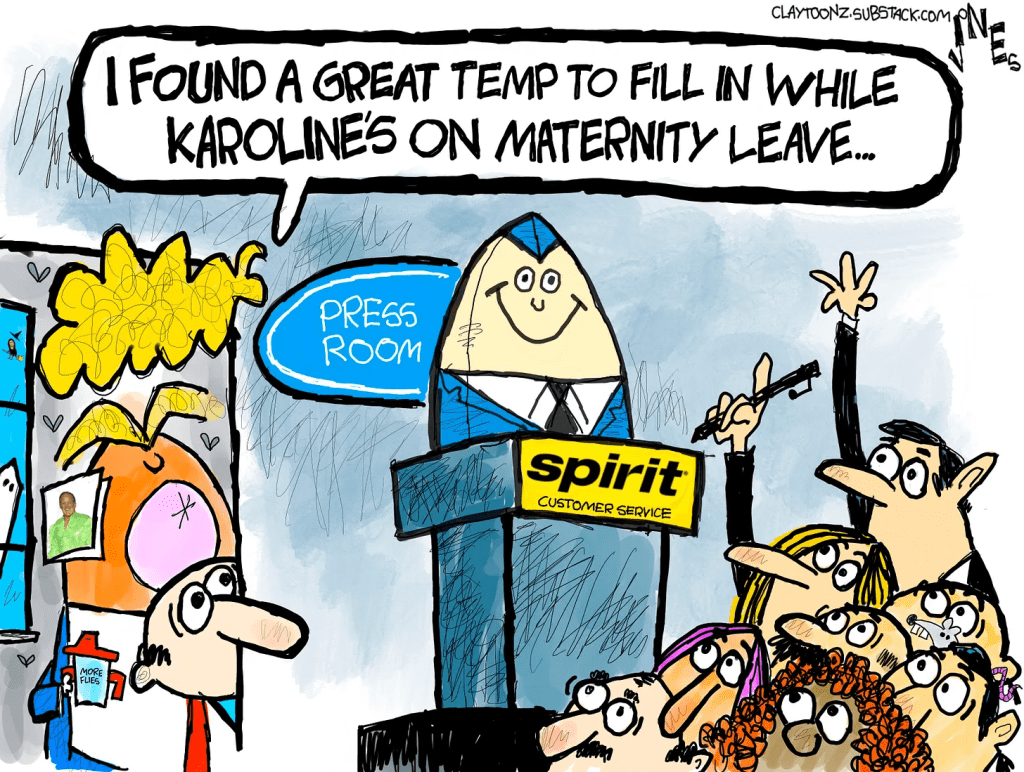
A Spirited Press Briefing

Is Donald Trump the Spirit of presidencies or is Spirit the Trump of airlines?

Clay Jones

When Spirit Airlines shut down on Saturday, it left thousands of customers and employees stranded. Customers finding themselves without a flight couldn’t even complain at the ticket counter, as there were no employees there. So basically, the quality of Spirit’s customer service didn’t change because of the bankruptcy.

Spirit, a budget airline whose business model forced other airlines to change the way they did business, had a reputation as the worst airline. If you ever purchased a flight on Spirit and told a friend, their reply was probably, “I’m so sorry.”

I did fly on Spirit once from Washington to Atlanta, which, fortunately, is a very short flight. But yeah, it was cheap. The seats don’t recline, and they feel very cheap, as though they might break underneath you.

Spirit had been in financial trouble since at least the pandemic, and there are several reasons why it went out of business so suddenly. Many blame a court that would not allow them to merge with JetBlue, but Spirit itself cites the “megaspike” in fuel prices caused by Donald Trump’s chosen war with Iran. There was also an attempt by the government to bail Spirit out, but since Donald Trump is not the best negotiator in the world, those talks collapsed. Maybe Trump should have brought in his negotiating dream team of Steve Witkoff and Jared Kushner. (snip-MORE)


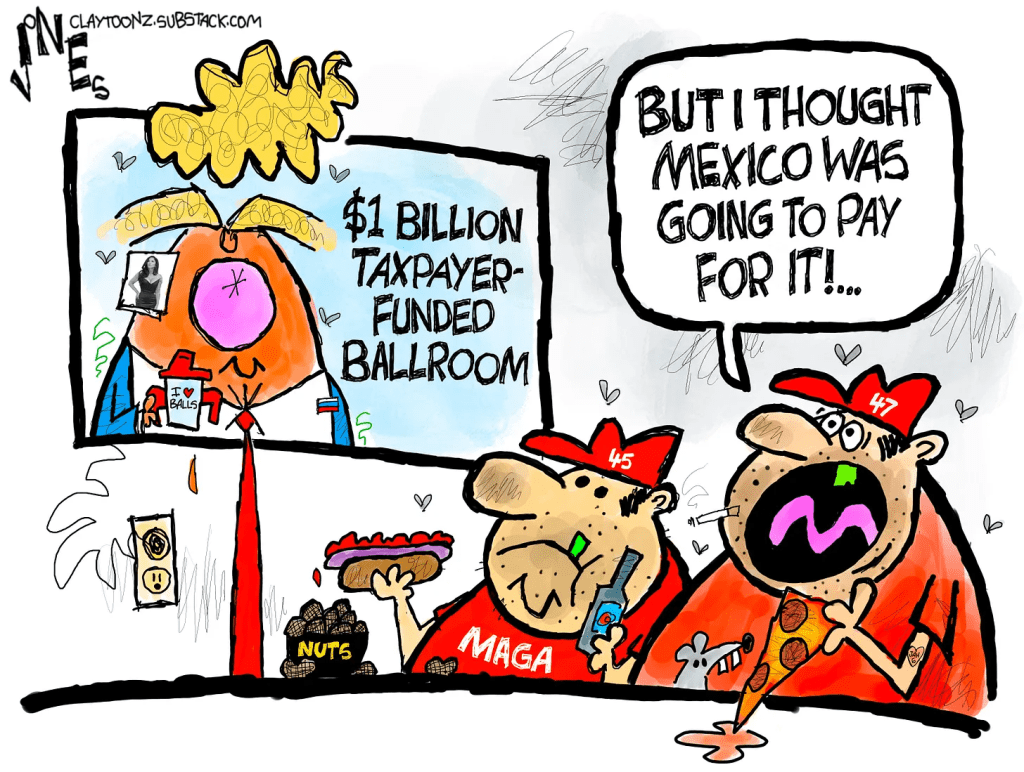
Expensive Balls

Mexico still has not paid for Donald Trump’s border wall

Clay Jones

For months, anytime Donald Trump’s planned ballroom, which he destroyed the East Wing, was criticized, a MAGAt would come along and point out that it was only being paid for by donors and Donald Trump himself. Now that we know that is no longer true, where are those guys?

Of course, it’s not new that what Trump was telling us was a lie. We always knew it was a lie. Remember the lie that Mexico was going to pay for the border wall? Trump began his 2016 campaign on that lie, along with telling us that Mexico was sending us rapists and murderers.

When a promise by Donald Trump falls apart, and it is undisputed that it is a lie, we’re supposed to forget about it. We’re supposed to forget that Donald Trump promised that he would be “too busy” to play golf if he won the presidency. We are supposed to forget that he would eventually release his taxes. We are supposed to forget that he was going to give us a brand new healthcare plan in two weeks, way back in 2016. We are supposed to forget that Donald Trump was going to lower the price of gasoline. We are supposed to forget that promise about no new wars. We are supposed to forget that Donald Trump was going to make housing more affordable. We are supposed to forget that Donald Trump was going to drain the swamp. We are supposed to forget that Donald Trump was going to lower the price of groceries. We are supposed to forget that he was going to release the Epstein files. We are supposed to forget that he was going to end the Russia/Ukraine war in his first 24 hours back in office. And we are supposed to forget that Mexico was going to pay for his racist border wall. (snip-MORE)

From “The White Pages”

Endless shrimp is a force that gives us meaning

The brands heard that you were lonely and would like to propose a solution

Garrett Bucks

Red Lobster wants your attention. You can tell, because their current ads deploy not one but two separate announcers. There’s the expository guy. He’s a little pushy but at least he sticks to the facts. And then there’s the loud guy. He’s got a deep voice. He sounds like he’s broadcasting live from the submerged city of Atlantis. He says it with feeling, and also reverb.

“Because you’ve been asking… a lot… and we made it happen.”

So claims the not-from-Atlantis announcer. But what’s he talking about? We have been asking for many things. To be able to afford homes, for example, or not to have war crimes committed in our names, or to have our planet still exist twenty years from now.

Oh, this is about shrimp. Endless shrimp. It’s back, or so I’m told, in multiple forms. Every time the less pushy guy shares one of the currently available shrimp offerings, his partner pipes up with a complementary point straight from the bottom of the sea.

“Walt’s favorite shrimp.”

“ ENDLESS!”

“Garlic shrimp scampi”

“ENDLESS”

“Shrimp linguini alfredo”

“ENDLESS?”

“And all new marry me shrimp”

“ALL ENDLESS!”

The duo isn’t wrong. Endless shrimp is back. While the previous iteration didn’t technically bankrupt the chain (the real culprit was private equity and real estate chicanery) it was, by all accounts, an absolute mess. American consumers, who rightfully identified that they were getting ripped off in every facet of their lives, leapt at the opportunity to get one over at least one big business.

Back when Endless Shrimp was a permanent feature, shrimp hoarders would occupy tables for hours at a time, not leaving until they beat the house. The real victim of this behavior was, of course, the chain’s underpaid servers (if you walk into a restaurant with “me against these suckers” mindset, you’re less likely to view your waiter as a fellow victim of capitalism and you’re definitely not going to tip well). For the C-Suite, though, the larger concern wasn’t the dignity of their employees. It was a jumbo-sized hole in their bottom line.

It’s like The Boss once sang. Endless shrimp dies baby, that’s a fact. But maybe the endless shrimp that dies, some days comes back. Put your make-up on, do your hair up pretty, and meet me tonight at the only Red Lobster still open in your city.

I’m not all that interested in the relative success or failure of chain restaurant promotions, but I do care about the various ways corporations try to win our affection (meaningful cultural signifiers, or so I’d argue). And contra the two announcer voices, the most interesting thing about Red Lobster’s promotion isn’t the shellfish, either of the Walt’s Favorite or Marry Me varieties. It’s what’s whispered rather than shouted.

You see, the biggest difference between the current iteration of Endless Shrimp and its unprofitable predecessor is that now Red Lobster wants you to know that you (the shrimp-loving consumer) and they (the company) are in this together.

If you want the full story, I highly recommend this piece by Luke Winkie in Slate, but here’s the truncated version. There are varieties of shrimp on the Red Lobster menu that aren’t officially part of the promotion. They’re on the menu, but excluded from the benevolent blanket of endlessness. But if a customer were to ask for unlimited quantities of a non-official item (for example, Crispy Dragon Shrimp, a food item that I’m assured contains no actual dragon), the server is to welcome them into a cool secret. Their official, handbook-mandated line? “These items aren’t on the menu for this promotion, but I would be happy to make an exception for you.”

It’s like they say, “the exception is the rule.” Except literally, and by mandate. Servers are required by corporate policy to act like you and they are cheating the system, in hopes that when you remember the night you rode the dragon (shrimp), you remember it not as a conspiracy-of-one, but a sneaky secret between you and your best friend (Red Lobster restaurants, a subsidiary of the Thai Union Seafood Company).

This is not a new psychological trick. It’s a classic low stakes confidence game. The most effective way to a mark is to convince them that they are, in fact, in on the con themselves. It’s the same move that car salesmen use when they leave the room to “talk to their manager” before returning with a report that “he didn’t want me to give you this deal, but…”

It’s still striking, though, to see the strategy laid out in grandiose internal strategy documents. A beleaguered but iconic American brand name, flailing for its survival, hedges its survival on two bets. First, that you are tired, angry and aware that you’re on the wrong side of a rigged game (correct). And second, that, by offering you a facsimile of camaraderie and a very real pile of seafood, that they can win your loyalty (huh).

“[This is] about more than just shrimp,” the document proclaims. An absolute work of art, that sentence.

“[It’s] about creating an experience that says, ‘We listen to you.”

“When guests see Endless Shrimp back on the menu, they feel heard and valued.”

I have never addressed a sit-down chain’s internal strategy document, but I’m sure I speak for all of us when I say, tears in my eyes: Red Lobster, thank you. THIS is what democracy looks like.

As Eli Zeger argued in his 2020 essay about companies that talk like snarky teens on social media, this particular iteration of the “brand as friend” canard is the product of the marriage of late stage capitalism (and its reliance on the selling of “ideas” rather than goods and services) and the post-Citizen United codification of corporate personhood. Red Lobster isn’t a restaruant anymore. It’s your rule-breaking, shrimp loving, newly empathetic pal. It sees you. In fact, it is the only one who see you. It gets that you’re broke, but more so that you’re alone. It’s no longer offering you cheap shrimp (the price tag for the promotion has risen markedly since its last iteration). It’s promising you something more important– belonging, connection, a port in the storm of alienation and precarity we’re all weathering.

Red Lobster’s friendship?

“Endless”

Or that’s the idea at least. Apparently, the promotion hasn’t been as lucrative as the company had hoped, at least so far. It’s not 2016 anymore. We’re seeking something more these days. Bread and roses? Perhaps, but definitely not just shrimp.

But Red Lobster isn’t alone, in surveying a landscape of mass alienation (economic, relational, spiritual) and seeing a business opportunity. Advertising agencies are publishing unironic blogs chillingly titled “the loneliness crisis: how brands can step up?” Silicon Valley’s greatest minds heard that you wanted community and responded with sycophantic AI chatbots. Apparently, our tech overlords’ understanding of human relationships is a robot who agrees with you all the time, including when you muse about harming yourself. Even the outright scammers get it. Gone are the days of far flung princes offering you a financial windfall. As you may have experienced personally, the hot new con is… pretending to be an acquaintance and inviting you to a party.

This is a step beyond the classic commodification funnel, as documented in nineties leftist classics like No Logo and The Conquest of Cool. The brands are no longer promising a great deal, or even hipness. What’s on offer now is the dream of a welcoming community, one deep enough to solve for the isolation that the companies themselves helped create.

That’s very depressing, of course, both the reminder that our economy has always been built on the exploitation of vulnerability, and the reality that there’s just so much more vulnerability to be exploited at this particular moment.

But there’s another truth, not a counterpoint, but a complement. How fortunate, for those of us who actually want to connect with other human beings, rather than just make a quick buck off of them. We already have what every corporation in the world wishes they had– the fact that, when we offer a space by our side, to either a stranger or a friend, we actually mean it. We’re not trying to trick you into springing for a Main Deck Margarita Flight to go along with your shrimp. We’re not trying to mine your data or add you to a marketing funnel or load you up with debt and junk. We just think this world would be more navigable together rather than apart.

And as an organizing opportunity? From union drives to neighbor-to-neighbor activism to the precious few political campaigns that care more about building community than personal brand building? My goodness. Why do you keep hearing about neighborism these days, and not just from true believers like me? Because more people are admitting every day how hungry they are for connection, and then taking the risk of making an offering.

The terrible news right now is that the hucksters are going to keep selling us a flim flam simulacra of belonging. Yes, the consultants, but also (I fear) the politicians. I strongly suspect the 2028 Democratic primary to feature a million text messages about “neighbors” and “community” penned by a well-heeled K-Street consultants. But the good news is that we aren’t that dumb. We know the brands aren’t our friends. We’ve lived through the great social media con together. We know what the lie looks like, and now we’d much prefer the deeply imperfect, thoroughly messy alternative.

They’ll offer us endless shrimp. And we’ll say no thank you. We’d prefer each other, please. Even if that’s not on the secret menu. (snip-end notes, the Boss, and general other stuff on the page)

Precious Brady-Davis is no stranger to being a first. Could she take that to Congress?

She’s the only Black trans person currently in public office in the country, and her political profile is growing.

This story was originally reported by Kate Sosin of The 19th. Meet Kate and read more of their reporting on gender, politics and policy.

Could she be the first Black trans person in Congress?

Every step Precious Brady-Davis has taken has been a first. 

She was the first transgender bride on the TV show “Say Yes to the Dress.” She and her husband are the first transgender parents in Illinois history to be listed as their accurate genders on their children’s birth certificates.

 “This idea of, ‘I won’t be erased,’ that’s something that brewed in my childhood,” she said. “I think that’s where the fight comes from. … I don’t want to fail, and I haven’t failed yet. I think that’s the scary part. I’ve never, ever had a floor beneath me.” 

Brady-Davis is currently the only Black trans person holding public office in the United States, serving on the Metropolitan Water Reclamation District of Greater Chicago. She previously shared that title with Minneapolis City Councilor Andrea Jenkins, who retired in January.

And while water reclamation commissioner, a job that involves juggling budgets and managing wastewater and stormwater for Cook County, might not sound like a big title, those in the know are eyeing Brady-Davis carefully. She recently toured Washington, D.C., with Rep. Sarah McBride, who made history herself as the first trans person elected to Congress. 

Brady-Davis doesn’t rule out the possibility of a congressional run. But she’s coy about her ambitions, talking around a bid for national office. 

“For now, my focus is on being effective at the local level — but I’ve thought about how that work could expand to have a broader impact on issues like the environment, LGBTQ rights, and education,” she said. 

“I absolutely think she could be a congressperson,” said Tracy Baim, co-founder of Chicago’s LGBTQ+ newspaper Windy City Times, who has watched Davis’ rise. “There’s no doubt in my mind she has the qualifications.”

Precious Brady-Davis sits at a desk with her hands raised as she speaks. A sign behind her reads, “We are not going back.”
Precious Brady-Davis speaks during an interview in her office. (Erin Hooley/AP)

Early life

Brady-Davis largely grew up with her grandparents but eventually wound up in foster care, where she was confronted with a version of Christianity that saw homosexuality as sinful. 

In her memoir, “I Have Always Been Me,” Brady-Davis recalls going to a Pentecostal youth retreat and having a pastor call her out specifically: “I bind the foul spirit of homosexuality out of you,” she recalled him saying. “You are not a woman. You are a man.”

The preacher and others in the group lunged toward her; Brady-Davis later awoke prostrate on a kitchen floor, traumatized from the experience.

While she worked to conform for a while, as she learned about the world and herself, she gradually rejected those ideas. In college, she began performing in drag, first in her home state of Nebraska and then in Chicago. 

At this time, two transitions were taking place. Brady-Davis was starting to live full-time as a woman. And her professional career was starting. 

She took a job doing HIV prevention work among youth of color at Chicago’s Center on Halsted, the LGBTQ+ community center in the heart of Chicago’s Boystown neighborhood, amid tension over violence at the 2011 Pride parade and the subsequent crackdown on crime. 

Glass-fronted building with a sign reading “Center on Halsted” at street level.
Center on Halsted, an LGBTQ+ community center in Chicago’s Northalsted neighborhood, where Precious Brady-Davis worked in HIV prevention among youth of color early in her career.
(Jamie Kelter Davis for The 19th)

The job would prove difficult to impossible. While residents were angry with the Center, youth advocates claimed that the Center over-policed young people, calling law enforcement on homeless kids looking for safe places to sleep. Brady-Davis was forced to defend an institution that was being attacked from all sides. It would be her first political test.

“I advocated for those young people the best I could,” she said. “It was just cruel. … When I think that something is wrong, I’m going to speak up about it.”

Baim said she watched Brady-Davis  turn every challenge into an advance.

“Precious has managed to navigate so many of the land mines that others have not survived, and came from a very, very grassroots approach to the work, and has really reimagined herself for each iteration,” Baim said.

Brady-Davis would do a stint with About Face Theatre, the LGBTQ+ youth theatre troupe in Chicago, and then join the Sierra Club, where she eventually became northeast communications director and battled President Donald Trump’s Environmental Protection Agency during his first term. 

It was work that made sense for her, she said. 

“How can I say that my work is invested in diversity, equity and inclusion when I’m not working in all kinds of diversity?” she asked. “Environmental justice felt like another kind of diversity.” 

A family legacy

During Brady-Davis’ stint at Center on Halsted, a young man came literally knocking at her door without an appointment. The man, Myles Brady, was bald and eager to chat. He wanted to get involved in programs with youths. He shared that he was transgender, too. The fact surprised Brady-Davis. But he was so talkative that Brady-Davis didn’t know what to make of him.

“Like it was weird to me, and I was very protective of the young people at the Center,” said Brady-Davis. She decided to never follow up with him again. 

Brady was persistent. He kept appearing at events. One night he asked Brady-Davis to dinner. She reluctantly agreed.

“I was like, at least I’ll get dinner out of it, right?” she said laughing. “I was like, I’ll go on this date, and I’ll never have to see him again.”

But a few months later Brady-Davis was headed to the Philadelphia Health Conference. She got an email from Brady. “I can’t wait to see you in Philly,” it said.

 The message struck her as cute. Later that night while she was out to dinner with trans friends Brady walked in and sat down. Brady-Davis didn’t know it, but he had been invited by others at the table. She was being set up. Brady told Brady-Davis she was the most beautiful woman he had ever seen and that he wanted to build a life with her and take care of her.

“I saw him so differently that night,” she said. “It was the first time that I truly saw him.”

The two left the conference together and have been together ever since.  They were married in 2016, and Brady-Davis appeared on TLC’s “Say Yes to the Dress,” the first transgender bride to be featured on the show. 

“Myles and I have shown that two trans people can love each other and that we are worthy of love,” Brady-Davis told Buzzfeed News at the time

Precious Brady-Davis and Myles Brady-Davis sit on the back of a convertible and wave to a crowd at the Chicago Pride Parade. Pride flags are visible throughout the crowd behind them.
Precious Brady-Davis and her husband, Myles Brady-Davis, wave to the crowd during the Chicago Pride Parade. The couple were the first transgender parents in Illinois history to be listed as their accurate genders on their children’s birth certificates. (Chicago Pride)

They had two daughters, Zayn and Zyon. 

The birth of their first daughter, Zayn, provided another opportunity for advocacy. Brady, who was carrying the child, learned in 2019 that the state of Illinois would list him as a “mother” on the birth certificate and Brady-Davis as “father.” The two teamed up with Lambda Legal and petitioned the state, successfully changing the policy. Brady would be recognized as Zayn’s father, and Brady-Davis was listed as her mother.

“I always say it brings me the most joy to take my kids to school in the morning,” said Brady-Davis. “It’s one of the most normal things that I get to do as a human being. And it’s not about me being trans at all. It’s about me being a mom. …I’m proud of the ways in which I’m parenting my girls to be a part of a world that I hope is more inclusive, diverse.”

Into politics

Sierra Club positioned her well for her next big move, into electoral politics. In 2022, she vied for a spot as a commissioner on the Water Reclamation District. Though she fell short in the primary, the next year Gov. JB Pritzker appointed her to finish the term of the candidate who had beaten her, who had since joined the state legislature. 

“Precious Brady-Davis distinguished herself as a trailblazer even before her historic appointment to public office in Cook County,” Pritzker said of Brady Davis in a statement to The 19th. “Throughout her political and nonprofit career, Precious consistently stepped up as the first — first to speak up for the LGBTQ+ community, first to share the story of her path to activism and public office, and first to encourage others to claim their seats at the table.” 

Precious Brady-Davis stands at a podium with the seal of the Metropolitan Water Reclamation District of Greater Chicago, speaking into a microphone during a public meeting.
Precious Brady-Davis speaks at a Metropolitan Water Reclamation District of Greater Chicago board meeting. After being appointed to the board in 2023, Brady-Davis won her primary this year by large margins. (Courtesy of Precious Brady-Davis)

When time came for her reelection bid this year, Brady-Davis won her primary by large margins.

But whether she finishes her six-year term remains to be seen. Apart from her time in D.C. with McBride, she  has been chatting up major political donors. McBride says she would not be surprised to see Brady-Davis serving alongside her in Congress. 

“I think the sky is the limit for her, and she is someone who I respect deeply,” McBride said. “It was personally meaningful to walk these halls with a trailblazer whose story is only just beginning.”