and may the upcoming year be kind to us all. I think Barry already has some 2026 experience, even, so we do know it’s coming! 😀 I second Frazz’s Motion, and hope to see everyone around!
https://www.gocomics.com/frazz/2025/12/31
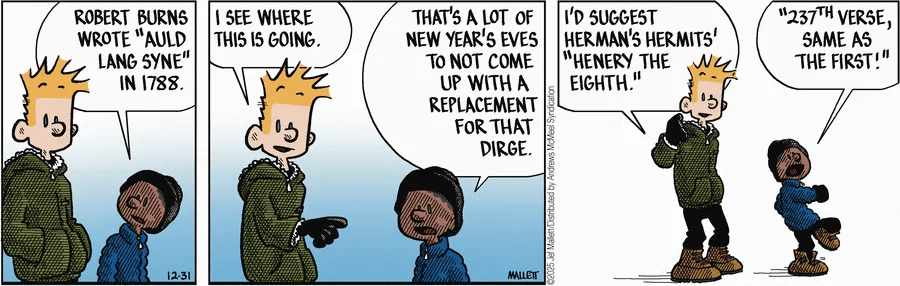

and may the upcoming year be kind to us all. I think Barry already has some 2026 experience, even, so we do know it’s coming! 😀 I second Frazz’s Motion, and hope to see everyone around!
https://www.gocomics.com/frazz/2025/12/31
Joyce Vance Dec 30, 2025
The sealed order in the Abrego Garcia case that I wrote about in Sunday night’s “The Week Ahead” column was unsealed today. This is in the government’s hastily manufactured criminal case against him, which seemed, at the time, to be some sort of face-saving gesture after they were forced to return him to the U.S. from El Salvador, where he was incarcerated in CECOT prison.
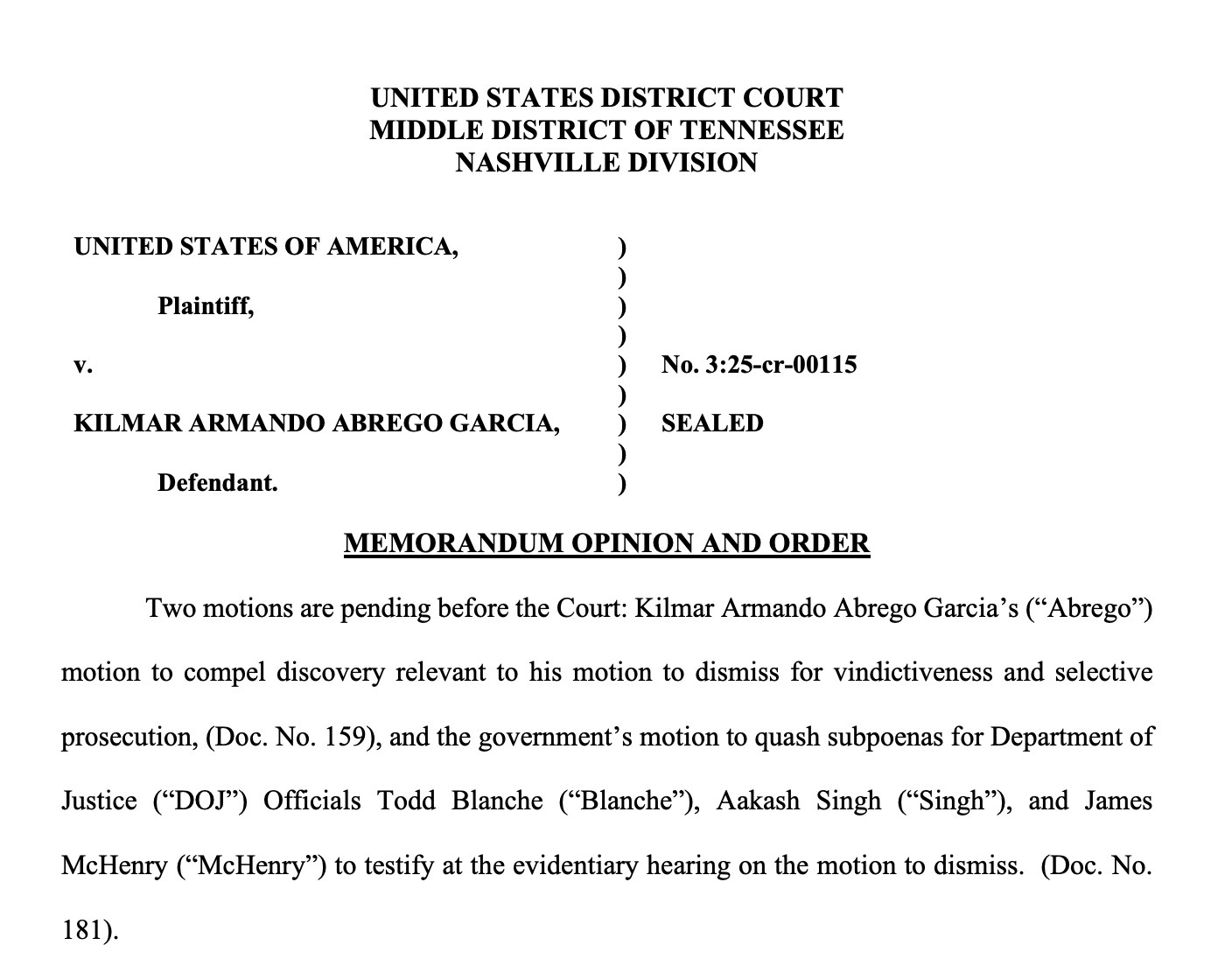
The case is before Federal District Judge Waverly D. Crenshaw, Jr. in the Middle District of Tennessee. It turned out that my conjecture that the sealed motion might have something to do with Abrego Garcia’s motions to dismiss the prosecution because it’s vindictive was on target. As we know from our discussion of this type of motion in the context of the Virginia prosecution of Jim Comey, it’s difficult for a defendant to prove, and cases are only rarely dismissed on this basis. But the timeline here has always seemed to suggest it could be a serious possibility in this one.
In the newly unsealed motion, the Judge goes straight to the heart of the government’s contention that the local U.S. Attorney made the decision to indict, so it was not influenced by any alleged vindictiveness on the part of higher-ups in Washington, writing, “The central question after Abrego established a prima facie case of vindictiveness is what information in the government’s control sheds light on its new decision to prosecute Abrego, after removing him from the United States without criminal charges. These documents show that McGuire [the local U.S. Attorney] did not act alone and to the extent McGuire had input on the decision to prosecute, he shared it with Singh [a Lawyer in Deputy Attorney General Todd Blanche’s office] and others. … Specifically, the government’s documents may contradict its prior representations that the decision to prosecute was made locally and that there were no outside influences.”
This, needless to say, is not good news for the government. To understand just how bad it is, let’s review a bit of the case’s history:
In October, Judge Crenshaw found that Abrego Garcia had come forward with evidence to suggest that a reasonable person might believe the indictment was motivated by vindictiveness on the part of the government. When that happens, the government has to offer evidence that the prosecution was undertaken for legitimate reasons, for instance, that newly discovered evidence made a case previously rejected as weak strong enough to be indicted.
Judge Crenshaw granted Abrego Garcia’s request to conduct discovery on the issue and have an evidentiary hearing. But he noted that it was entirely possible that “no fire will be discovered under all the smoke.”
The indictment stems from a 2022 traffic stop that did not result in Abrego Garcia’s arrest, or even a traffic ticket. The case file at Homeland Security Investigations remained open, but no action was ever taken on it, and the case was closed shortly after he was deported.
The timeline of the criminal prosecution gave rise to the presumption of vindictiveness in the Judge’s view:
As Judge Crenshaw noted back in October, “All of this stands in stark contrast to the 832 days the HSI investigation into Abrego remained pending, without referral to the U.S. Attorney’s Office in the Middle District of Tennessee for prosecution.” In other words, the case wasn’t even deemed significant enough to ask a prosecutor to take a look at it. It was only after Abrego Garcia’s lawsuit challenging the legality of his deportation—and the Supreme Court confirmation that he should be returned—that HSI seemed to take the case seriously. In the absence of any explanation from the government, the Judge correctly found these facts gave rise to a presumption of vindictiveness.
Sometimes, though, where there’s smoke, there is, in fact, fire.
The newly unsealed order relates to two motions filed by Abrego Garcia’s lawyers in the course of trying to obtain the discovery the court had ordered they were entitled to: one to compel the government to comply with some of the requests and one to obtain testimony from Deputy Attorney General Todd Blanche and some of the key people in his office. The government had submitted “over 3,000 documents” to the Judge for him to review privately, because the government maintained it wasn’t obligated to turn them over.
Judge Crenshaw has now ordered the government to “disclose to Abrego a sub-set of the over 3,000 documents that are relevant to the narrow issue of whether the government’s new decision to prosecute Abrego, after deciding not to do so, ‘was tainted by improper motivation’ arising from Abrego’s success in the Maryland civil case.” The government doesn’t have to turn over the remainder of the 3,000+ documents. The Judge asked for additional briefing on the government’s motion to prevent Blanche and his subordinates from testifying.
At the time the motion was filed, the government argued that the decision to prosecute was made by Acting U.S. Attorney Robert McGuire in Nashville, so it could not have been vindictiveness of the part of higher-ups in Washington. But as the Judge points out at length in this order, “at the time of Abrego’s arrest, Blanche linked Abrego’s criminal charges to his successful civil lawsuit in Maryland.” Blanche had “volunteered” in a television appearance that the government’s criminal investigation had started up after the judge in the civil case in Maryland accused the government of misconduct when it deported Abrego Garcia. So, Judge Crenshaw orders the government to provide the defendant with documents that “support Abrego’s argument. Specifically, some of the documents suggest not only that McGuire was not a solitary decision-maker, but he in fact reported to others in DOJ and the decision to prosecute Abrego may have been a joint decision, with others who may or may not have acted with an improper motivation.” If Abrego Garcia can use the discovery to successfully wipe out the government’s contention that the decision to indict wasn’t made in D.C., he may be on the road to getting his case dismissed.
Some of the documents the government must now turn over for the defense to use include:
These developments are all phrased in the polite language used in courts by judges and lawyers, but they are jaw dropping. The government represented to the court that the decision to prosecute Abrego Garcia was made locally, disconnected from his effort to enforce his constitutional rights and challenge his deportation. Their own emails appear to contradict that assertion. The government will still have the opportunity to come forward and explain away the presumption of vindictiveness. I’ve seen a number of cases during my 25 years at DOJ where a defendant argued vindictiveness. In every case, the government explained why the prosecution was legitimate, and in every case, it prevailed. I’ve never seen a case where the government made representations to a judge that were refuted by its own internal communications. It’s exceptionally unusual for prosecutors to have to take the witness stand to defend their own conduct. But Abrego Garcia’s case, which has been highly irregular from the start, may well be the one where that happens.
This is all about due process. Back in April, as Abrego Garcia’s situation was coming to light, Press Secretary Karoline Leavitt claimed that there was “a lot of evidence” Abrego Garcia was a convicted member of the gang MS-13, saying that “I saw it this morning.” We were supposed to take her word for it and leave Abrego Garcia to his fate of torture in a Salvadoran prison. That’s why the rule of law and due process matter. If it’s up to Trump, anyone can be swept up and swept away and have no recourse. Our ability to go to court to protect ourselves when the government gets it wrong is more and more important.
During his monumental filibuster earlier this year, New Jersey Senator Cory Booker said that this was our moral moment and that inaction was not enough. He asked: “Where does the Constitution live? On paper, or in our hearts?” Here at Civil Discourse, it lives in our hearts and stays on our minds.
Thank you for being here with me. I know you have lots of choices about where to get your news and analysis. I appreciate that you’re spending some of it with me. Your paid subscriptions make it possible for me to devote the time and resources it takes to write the newsletter. I’m proud that we’ve built a community together that’s dedicated to keeping the Republic.
We’re in this together,
Joyce
Enjoy, and be aware of your keyboard’s presence.
This is a full analysis of much of the reportage we receive all the time. Dr. Hogan has plenty of time to research, compare, let drafts marinate, and especially, to verify. It’s quite a long read, and while I so wish to put it all here, it’s too long for a blog post. It is highly informational, and it can really help a person trying to suss out news without being emotional or overwhelmed. So, here is part of Dr. Hogan’s Substack column. There is one outlet named, but they are not the only outlet included; he names Meidas Touch Network. They are not the only ones, nor are they by any stretch of imagination the worst, and I was gratified to find I am not the only one who’s noticed changes with MTN’s presentations! Anyway, here’s a snippet with the link & title just below. Read or not, up to you; thanks for your attention to this vital issue! 🙂
Richard Hogan, MD, PhD(2), DBA Dec 29, 2025
My publication employs a bit of critical-theory.
Throughout this publication, I speak only of the American acronym MTN, known publicly as MeidasTouchNetwork. I do so deliberately: the letters MTN already belong to a continental giant — Africa’s and Middle Eastern’s great signal‑bearer — a network‑mountain whose reach spans nations and whose currents carry nearly 300 million voices across the horizon.
To avoid confusing these two mountains, I name only the American one.
This work maintains that platforms such as Substack, YouTube, X, and TikTok are not built to honour verification:
They are engines calibrated for velocity, for heat, for the clean lines of ideological contrast. Within such machinery, truth becomes a faint watermark — present, but always subordinate to the algorithm’s appetite for motion.
In this environment, journalism becomes indistinguishable from:
I MTN as the exemplar because its signal is a typographic monolith — a glyph large enough to be seen across continents. I intend no diminishment of it. What I observe is that MTN emerges inside an epistemic script already dissolving at the edges. It is not a transgressor of journalistic form; it is written into a page where the old rules have faded from the margins.
CHAPTER I:
THE PARTISAN SENSORIUM: MEDIA, AFFECT, AND THE NEW POLITICAL SUBJECT
The Return of the Affective State
Every era produces its own political subject. The Enlightenment imagined a rational citizen; the industrial age imagined a disciplined worker; the broadcast era imagined a passive viewer. The digital age, however, has produced something different: a subject constituted through affective immediacy, algorithmic visibility, and continuous political stimulation.
This chapter introduces the concept of the partisan sensorium — the affective infrastructure through which contemporary political subjects perceive, interpret, and emotionally inhabit the world. It is within this sensorium that organizations like MeidasTouch emerge, thrive, and fail.
The partisan sensorium is not simply a media environment; it is a mode of being.
(snip-there is more on the page. He’s very kindly outlined his work, so it’s very organized. Do take a few minutes and look it over!)
Well worth the click! Well worth the subsequent clicks, too!
Considered sacred by several Mesoamerican civilizations, the Resplendent Quetzal remains culturally significant to this day. The Resplendent Quetzal likely inspired Quetzalcoatl, the “plumed serpent” god of Mesoamerica. Legend has it that Quetzalcoatl helped create Earth. Rulers and nobility wore headdresses made from this quetzal’s shining green feathers, which symbolically connected them to the god.
In some Mesoamerican cultures, it was considered a crime to kill a quetzal, so the plumes were procured by capturing the bird, plucking its long tail feathers, and setting it free. In several Mesoamerican languages, the term for quetzal can also mean “precious” or “sacred.”
These iridescent green tail feathers also symbolized spring plant growth to the Aztecs and Maya, who viewed the quetzal as the “god of the air” and as a symbol of goodness and light. The Maya also viewed the quetzal as a symbol of freedom (due to the difficulty of keeping them in captivity) and wealth and status, as its feathers were used as money. Even today, the currency of Guatemala is called the quetzal.
The Resplendent Quetzal is also the national bird of Guatemala, pictured on the country’s flag and coat of arms. It was thought to be the spirit guide of a Maya ruler and hero, Tecún Umán, who fought against the Spanish conquest. According to legend, Tecún Umán was killed as he fought the conquistador Pedro de Alvarado. As Tecún Umán lay dying, a quetzal flew down and landed on his chest, dipping its feathers in the hero’s blood. This is supposedly how the bird acquired its red breast and belly feathers.
This spectacular species belongs to the trogon family, a group of colorful, fruit-eating birds found in the Americas, Asia, and Africa. Other family members found in the Americas include the Golden-headed Quetzal, the Elegant Trogon, and Haiti’s national bird, the Hispaniolan Trogon.
Birds around the world are declining, and many of them, like the Resplendent Quetzal, are facing ever-increasing threats. Partners in Flight includes the Resplendent Quetzal on its Red Watch List as a species of high conservation concern, and also classifies it as a “Tipping Point” species — one that has lost more than 50 percent of its population within the past 50 years. (snip-so much more!)

For me, considering going through the adoption process as an adult is about having the right to configure my family the way that’s best for me—a right we should all have.
The word adoption is synonymous with babies and expectant parents, joy and dreams come true. For most, it’s about families becoming complete and children becoming a permanent part of a legally recognized household.
My story is more complicated.
Recently, I found myself in the atypical and unexpected position of discussing adult adoption with the woman who became my roommate two-and-a-half years ago when I desperately needed a safe place to collapse and recover from a lifetime of trauma. We were strangers who became fast family; she was the perfect big sister and, after understandable initial trepidation about opening her home to a stranger, her extended family and friends have become my family and friends.
Last year my childhood stocking hung on the fireplace and there were gifts under the tree for me—the first time I’ve had a family Christmas since my adopted mother decided I was gay and told me not to come home for the holidays in December 2011.
It hadn’t always been that way. Growing up, my adoptive parents would tell me the bedtime story about how I was wanted, desperately, for the ten years they waited for me. They loved me before they even knew me. While I still believe the sentiment to be true, I have learned over the past 38 years that loving someone does not a healthy environment or nurturing relationship make.
It’s also become clear to me that the caregiving contract between parents and children hardly ends at age 18—especially at a time when we are watching our social safety net be dismantled piece by piece—and it flows in two directions. Unless you are in a family with wealth and security spanning generations, concern about whether the kids will be able to land a good enough job (or jobs, let’s be frank) to support themselves and whether parents and grandparents will have enough in their retirement for their elder care has only increased over the past few decades. (snip-go read it, it’s great info)
===
The daughter of Democratic VP nominee Tim Walz didn’t start posting until after the 2024 election—and she’s starting to become a leading young political voice.
Hope Walz had no intention of becoming a social media sensation when she first whipped out her phone to shoot a video with her brother, Gus. A few months ago, the Walz siblings—children of former Democratic Vice Presidential nominee Tim Walz—were headed back to their home state of Minnesota. Their father and his running mate, then-Vice President Kamala Harris, had just lost the 2024 presidential election. And Hope Walz wanted to post an update.
From the front seat of a car, the pair described what it was like to drive without a Secret Service detail for the first time in months.
“We’re finally free,” Gus said from the driver’s seat.
“I would not describe it like that,” Hope replied. “It is a little weird, but it does feel freeing.”
“We’re going to be okay everyone,” she added, before posting the video to TikTok.
After spending months on the campaign trail with her dad, and watching Donald Trump and JD Vance clinch the White House, Walz was ready to return to her everyday life in Montana, where she’d settled after graduating college in 2023. Instead, the video she posted in the aftermath of the election quickly amassed more than 400,000 views. And her next video, breaking down her post-election thoughts, garnered 1 million. Now, Walz is navigating her newfound public platform while trying to map out a future career in public service—a decision inspired by her time on the campaign. (snip-go read the rest of this one, too!)

| December 27, 1914 The International Fellowship of Reconciliation (IFOR), an inter-religious peace group, was founded in Cambridge, England.  “The International Fellowship of Reconciliation (IFOR) is an international spiritually based movement composed of people who commit themselves to active nonviolence as a way of life and as a means of transformation – personal, social, economic and political.”  “Your goal is, in my opinion, the only reasonable one and to make it prevail is of vital importance.” –Albert Einstein, in a letter to the FOR Read more |
| December 27, 1971 Vietnam Veterans Against the War staged a peace protest at historic Betsy Ross House, Philadelphia. |
| December 27, 2002 North Korea ordered U.N. nuclear inspectors to leave the country and said it would restart the Yongbyon plutonium Plant to meet the fuel needs of its nuclear power reactor. The plant had been shut down and sealed by the U.N. in 1994 in exchange for shipments of fuel oil. When it was discovered that the North Korean had been pursuing a uranium-based weapons program, the U.S. and Japan, South Korea and the European Union suspended the fuel shipments. |
| December 27, 2002 1500 people gathered in Tel Aviv, Israel, the protest the Israeli military occupation of land beyond the 1948 borders of the country. With the slogans “End the Occupation” and “No to Racism,” and dressed mostly in black, they used a variety of means – drumming, singing, art installations, giving away olives and olive oil – to express their frustration and anger over the ongoing occupation.  Alternative Ten commandments at demonstration in Tel Aviv, Israel The Coalition of Women for Peace also showed a movie, Jenin, Jenin, which had been banned for public showing, in defiance of police orders to stop the projector. Shown on a large outdoor screen, it was a narrative about the actions of the Israeli army the previous Spring in the occupied West Bank town of Jenin. |
https://www.peacebuttons.info/E-News/peacehistorydecember.htm#december27
Sharing because I needed Abhijit Naskar’s gently assertive kick in the butt to remember humility with my service today.

Maybe; I hope the techies here will weigh in. I read a bit in 404 Media yesterday, and saw this piece about a product: Slop Evader. Of course it sounds pretty neat, and at least a better way to look for those events we remember, but when we look them up to cite, we can’t find them because the search’s AI piles chronologically current to top, no matter how tightly we phrase our question. So the 404 Media article is linked above, and here’s the Slop Evader site with a bit from it. Let me know what you think! I’m tossing around trying it out, but am still reading on it myself.

A browser extension for avoiding AI slop. Download it for Chrome or Firefox.
This is a search tool that will only return content created before ChatGPT’s first public release on November 30, 2022.
Since the public release of ChatGTPT and other large language models, the internet is being increasingly polluted by AI generated text, images and video. This browser extension uses the Google search API to only return content published before Nov 30th, 2022 so you can be sure that it was written or produced by the human hand.

(snip-go see it when you have a minute, and let’s discuss!)

