I love dogs and people. I want living creatures to thrive. I love to cook, and share the food, but ya gotta get in line in front of the dog, and greatest good luck with that!
October 18, 1648 I. Marc Carlson The Shoemakers Guild of Boston became the first labor union in the American colonies. Labor organization in colonial times
October 18, 1929 The Persons Case, a legal milestone in Canada, was decided. Five women from Alberta, later known as the Famous Five, asked the Supreme Court of Canada to rule on the legal status of women. Some decisions of Magistrate Emily Murphy had been challenged on the basis that she was not a legal person, and she was a candidate for appointment to the Canadian Senate. After the Supreme Court ruled against them, they appealed to the British Privy Council.The Privy Council found for the women on this day (eight years after the case began and eleven years after women received the federal vote), declaring that women were persons under the law. October 18 has since been celebrated as Persons Day in Canada, and October as Women’s History Month.
Sculpture by Barbara Paterson of the Famous Five in Ottawa, first on Parliament Hill to honor women The other women activists in the Famous Five: Henrietta Muir Edwards, Nellie McClung, Louise McKinney, and Irene Parlby. The Persons Case
Food is an essential human need, and even more so for infants and toddlers during the critical early months of rapid growth and development. The United States has the resources to ensure everyone has enough to eat. Yet millions of people across the U.S. experience food insecurity, meaning they struggle to afford enough food for an active, healthy life year-round. In 2023, the most recent data available, 33.6 million adults and 13.8 million children — including nearly 2 million children under 3 years old — lived in food-insecure households, meaning more than 1 in 8 households (13.5 percent) in the U.S. had difficulty acquiring food due to lack of resources.[1]
Figure 1
Households with young children are more likely to experience food insecurity. More than 1 in 7 (15.5 percent) households with infants and toddlers under 3 were food insecure in 2023, compared to 11.9 percent of households without children and 13.5 percent of all households. Nationally, more than 1 in 6 (17.1 percent) children under 3 lived in food-insecure households in 2023 and this share varies across states. (See Table 1.) These shares also vary by race and ethnicity, with children under 3 in American Indian or Alaska Native (30.3 percent), Hawaiian or Pacific Islander (26.3), Black (25.9), and Hispanic (22.4) households more likely to live in food-insecure households than those in Asian (5.5) or white (10.9) households.[2]
Roughly half of the children under age 3 who lived in food-insecure households didn’t experience food insecurity themselves, but the adults in those households were food insecure. Parents often find ways to maintain normal meal patterns for their children, even when they are food insecure themselves; these families often face other challenges as a result of their precarious financial circumstances. And in many households, food insecurity among children is so severe that caregivers report that children were hungry, skipped a meal, or did not eat for a whole day because there was not enough money for food.
Children are especially vulnerable to poverty, financial strain, and hardship. For infants and young children, the lack of access to good nutrition can lead to less favorable life-long outcomes. Caregivers’ struggles paying for food and other bills are linked to worse child outcomes.[3] Material hardship such as the lack of food also increases the risk for child welfare involvement due to neglect and abuse.[4] There is growing awareness among researchers that the consequences of adversity — poverty, abuse or neglect, parental substance use disorder or mental illness, housing instability, and exposure to violence — during the early years of life can extend well beyond childhood and affect people’s physical, mental, and economic well-being as adults.[5]
Conversely, when public policies provide economic security for their families, children tend to have better educational, health, and behavioral outcomes.[6]
Positive Health and Well-Being Effects of SNAP and WIC Last a Lifetime
The Supplemental Nutrition Assistance Program (SNAP) delivers more nutrition assistance to low-income children than any other federal program, making it the nation’s largest child nutrition program. In 2024, SNAP helped about 16 million children each month — about 1 in 5 U.S. children — including 2.8 million children under the age of 3.
While SNAP provides only a modest benefit — just $6.20 on average per person per day — it forms a critical foundation for the health and well-being of children in the U.S., lifting millions of families and their children out of poverty and improving food security. Food insecurity among children fell by roughly a third after their families received SNAP benefits for six months, a USDA study found.[7]
For young children in particular, SNAP’s benefits last a lifetime. Studies have found children have improved birth outcomes and better health, education, and employment outcomes as adults if they had SNAP access during early childhood or if their parent had SNAP access during pregnancy.[8] Access to SNAP among families with children is associated with reductions in child maltreatment reports and child welfare involvement.[9] Emerging evidence also suggests that SNAP helps decrease decades-long racial inequities in food security, reducing the gap between white households and Black and Hispanic households, who are more likely to experience food insecurity because of starkly unequal opportunities and outcomes in education, employment, health, and housing.[10]
The federally funded WIC program — more formally known as the Special Supplemental Nutrition Program for Women, Infants, and Children — also improves lifetime health for low-income pregnant and postpartum parents, their infants, and young children. Among other health and developmental improvements, WIC participation is associated with reduced risk of premature birth, low birthweight, and infant mortality. This is especially important because pregnancy-related complications and mortality, as well as infant mortality, are higher for families of color than for white families, again due to unequal access to health care and broader inequities in health, economic, and other systems for people of color.
Despite these benefits, only about half of all people eligible for WIC were enrolled in 2022. Less than half (46 percent) of eligible pregnant parents participated in WIC. Only 64.1 percent of eligible infants and children under the age of 3 participated.[11] And participation declines as children grow older. While nearly 4 in 5 (78.4 percent) infants eligible for WIC participated in the program in 2022, the rate drops to 65 percent, 50 percent, 44 percent, and 25 percent among children 1 to 4 years old, respectively.[12]
There are many opportunities for state agencies to reach more eligible families with low incomes, and these efforts are showing promise, with take-up and participation increasing in recent years. While data on WIC coverage rates for 2023 and 2024 are not yet available, nationwide average monthly participation increased by 7.1 percent between fiscal years 2022 and 2024, suggesting that coverage rates may have increased modestly.[13]
Increasing WIC take-up across the board — and for pregnant parents of color and their infants in particular — can be an important part of a strategy to improve pregnancy-related and child health, mitigate the large pregnancy-related health disparities affecting these communities, and advance racial equity in other aspects of pregnancy-related and child health and food security.[14]
Megabill Cuts Threaten Access to Nutrition Assistance
The harmful Republican megabill, H.R. 1, enacted on July 4, 2025, will dramatically raise costs and reduce food assistance for millions of people by cutting federal funding for SNAP by $187 billion (about 20 percent) through 2034, the largest cut to SNAP in history. These cuts will increase poverty, food insecurity, and hunger, including among children.
The bill includes a major structural change that will cut billions in federal funding for most states’ basic food benefits, with a new requirement that most states will have to pay between 5 and 15 percent of SNAP benefits. This amounts to billions of dollars each year that states across the country would now be required to pay. If a state can’t or won’t make up for some or all of these massive federal cuts with tax increases or spending cuts elsewhere in its budget, it will have to cut its SNAP program or it could opt out of the program altogether, terminating SNAP food assistance entirely in the state, including to households with young children.
If children lose SNAP, they will also experience harmful ripple effects in other child nutrition programs, such as free school meals and summer EBT, due to the loss of automatic eligibility that comes from receiving SNAP. To make up for the federal cuts and avoid cutting nutrition assistance as well as other priorities affecting young children, such as health care or education, state policymakers will need to either raise new revenue or rollback recent tax cuts to raise the funds needed to prevent harmful cuts.
TABLE 1
Nearly 2 Million Children Under 3 Years Old Lived in Food-Insecure Households, Thousands Across Every State
Children Under 3 Years Old in Food-Insecure Households
State
Number
Share
Alabama
38,000
21%
Alaska
5,000
16%
Arizona
55,000
23%
Arkansas
21,000
20%
California
172,000
13%
Colorado
27,000
14%
Connecticut
17,000
15%
Delaware
5,000
16%
District of Columbia
3,000
11%
Florida
102,000
16%
Georgia
60,000
16%
Hawai‘i
6,000
13%
Idaho
14,000
19%
Illinois
45,000
10%
Indiana
45,000
17%
Iowa
15,000
12%
Kansas
16,000
14%
Kentucky
39,000
25%
Louisiana
35,000
20%
Maine
8,000
21%
Maryland
28,000
12%
Massachusetts
25,000
12%
Michigan
63,000
19%
Minnesota
32,000
14%
Mississippi
21,000
20%
Missouri
38,000
17%
Montana
5,000
14%
Nebraska
15,000
19%
Nevada
18,000
18%
New Hampshire
NA
NA
New Jersey
35,000
13%
New Mexico
16,000
22%
New York
95,000
14%
North Carolina
67,000
18%
North Dakota
6,000
17%
Ohio
59,000
14%
Oklahoma
29,000
20%
Oregon
19,000
15%
Pennsylvania
58,000
16%
Rhode Island
NA
NA
South Carolina
28,000
16%
South Dakota
5,000
14%
Tennessee
34,000
14%
Texas
237,000
19%
Utah
23,000
15%
Vermont
NA
NA
Virginia
36,000
11%
Washington
36,000
13%
West Virginia
11,000
18%
Wisconsin
27,000
15%
Wyoming
5,000
23%
Total
1,808,000
16%
Note: Sum does not equal total due to rounding. Counts are rounded to the nearest 1,000, and shares to the nearest whole number. “NA” refers to states whose sample size was too small to calculate reliable estimates. These estimates rely on ten years of data due to small sample sizes in many states. However, for the 13 states that had large enough sample sizes, their five-year estimates of the share of children under 3 in food-insecure households were similar to the ten-year estimates presented here. Source: CBPP analysis of 2014-2023 Current Population Survey Food Security Supplement
This week’s doodle was one I started a long time ago and came back to off and on whenever my anxiety got crazy. This week I finished it.
“Sometimes when my anxiety gets out of hand the only thing that gives me comfort is doing the same thing over and over and over and over and over and…”
Does it count as art if it’s just text? I’m not sure, but it brings me comfort and maybe it will bring you comfort too.
Whenever I worked on this I reminded myself that every time I’d been worried in the past, if I could go back it time I would assure myself that “It will be okay.” Maybe not easy. But always okay, eventually. And now I tell myself that again. I tell you too.
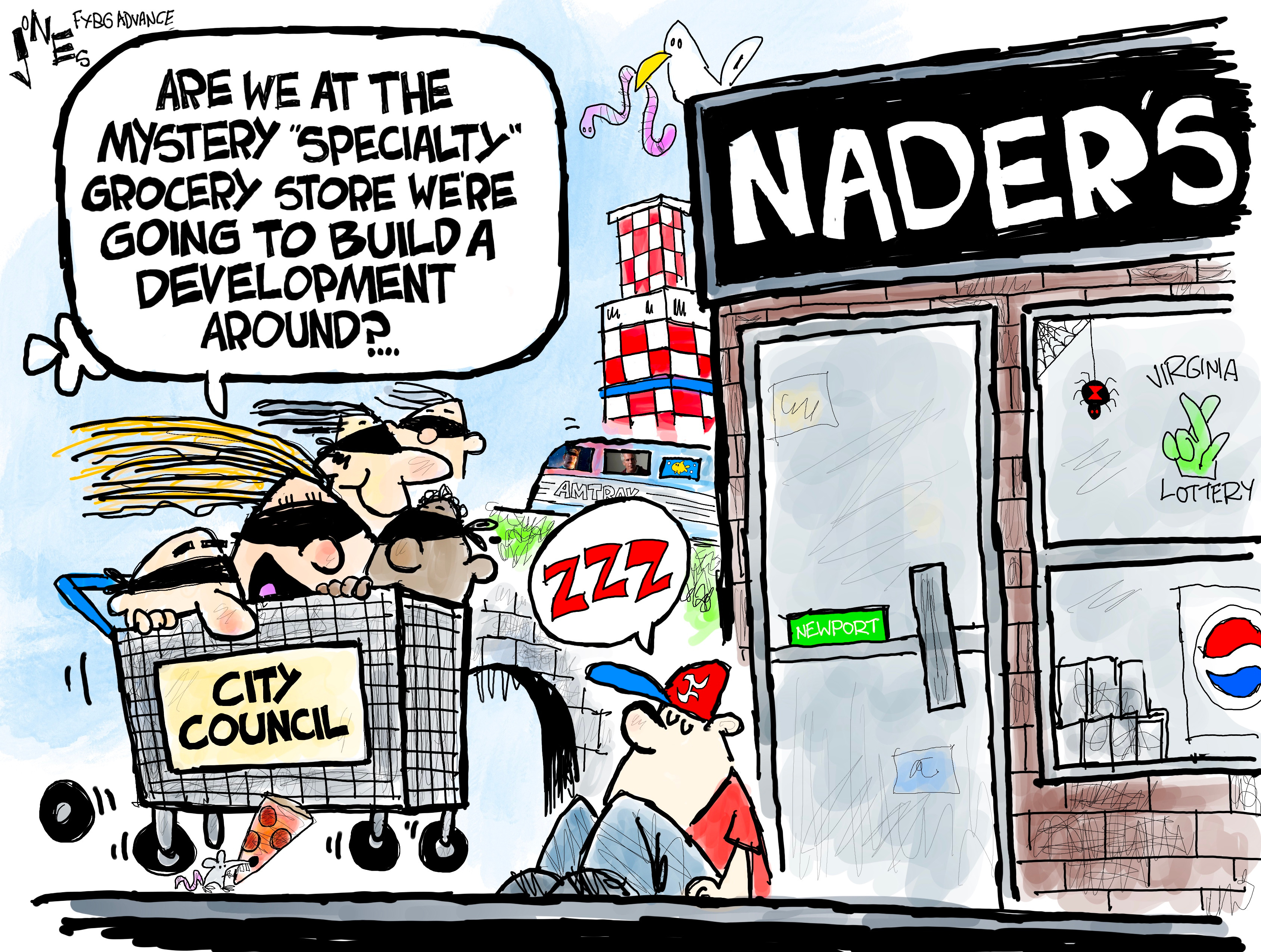
Back on July 6, I published another cartoon on this same issue. A sketchy developer is asking for Fredericksburg to zone an area for homes, apartments, retail space, and for it all to be anchored by a “specialty” grocery store. The catch is, the city won’t be allowed to know which grocery store it’s getting. And now, they’ve taken a closer step to approving it.
Nader’s is a downtown grocery store in Fredericksburg, and it’s an institution. But over the years, I’ve heard complaints about it being the only grocery store downtown. It’s probably Fredericksburg’s version of a Bodega. A Bohemian friend of mine wrote a song about the place. I think Nader’s name has changed, but it’s always going to be known as Nader’s. It is by the Purina tower and the train station.
Creative note: I came up with this idea while on the train to my convention last Thursday. Because of all the shenanigans happening here, I wasn’t able to finish the cartoon until Friday afternoon. I drew this in the lobby so I could spend more time with my colleagues, and a LOT of them were looking over my shoulder watching me draw this. That would have been intimidating a few years ago, as most of them are better artists than I am, but they’re really the coolest people and are super supportive.
During the awards ceremony Saturday night, the president of the AAEC, Marc Murphy, mentioned that the winner of the Rex Babin Award was drawing (a local cartoon) in the lobby with friends watching. And that’s how I knew I had just won the award. More on this soon. (snip)
I think Cosmos has found other evidence of burying tools with women, in the very early days. I remember posting something several months ago.
Tools buried with women challenge Stone Age stereotype
September 14, 2025 Velentina Boulter
Stone Age tools. Credit: University of York
Researchers have discovered that women and children were just as likely as men to be buried with stone tools at a Stone Age grave site, challenging the assumption that such tools were associated only with men.
Working with the Latvian National Museum of History, the team analysed artefacts and stone tools found in the Zvejnieki cemetery in Latvia – one of the largest Stone Age burial sites.
Zvejnieki cemetery was used for more than 5,000 years and contains over 330 graves.
The researchers focused their study on stone tools made from materials like flint and quartz, which date to between 7500 and 2500 BCE during the Neolithic period. These kinds of tools are often dismissed by researchers as utilitarian and uninteresting.
“The site in Latvia has seen numerous investigations of the skeletal remains and other types of grave goods, such as thousands of animal teeth pendants,” says Dr Aimée Little, from the University of York in the UK.
“A missing part of the story was understanding, with greater depth, why people gave seemingly utilitarian items to the dead.”
The researchers analysed the tools using a multiproxy approach which involved considering technological, spatial, depositional and geological information about the stone tools.
Despite the long-standing belief that women in the Stone Age played more of a domestic role, while men did the hunting, the analysis found that women were just as, if not more, likely to be buried with stone tools.
“Our findings overturn the old stereotype of “Man the Hunter” which has been a dominant theme in Stone Age studies, and has even influenced, on occasion, how some infants have even been sexed, on the basis that they were given lithic tools,” says Little.
The results also showed that children were the most likely age group to have been buried with these tools. The full analysis of the burial site has been published in PLOS One.
The researchers suggest that these stone tools must have played a more significant role in Stone Age society than previously assumed.
While some of the tools discovered were used to work animal hides, others seemed to have been specifically made and then broken – almost as though they were a part of a mourning ceremony or ritual.
“This research demonstrates that we cannot make these gendered assumptions and that lithic grave goods played an important role in the mourning rituals of children and women, as well as men,” says Dr Anđa Petrović from the University of Belgrade, Serbia.
Previous studies have uncovered similar traditions of deliberately breaking tools before burying them with the deceased across the eastern Baltic region, suggesting some sort of shared ritual tradition. Comparable funerary practices have also been observed in graves from a similar time period in Finland.
“The study highlights how much more there is to learn about the lives – and deaths – of Europe’s earliest communities, and why even the seemingly simplest objects can unlock insights about our shared human past and how people responded to death,” says Little.
I saw a few headlines about it on Monday, and meant to post it but didn’t get it done, then Tuesday was what it was. So, it’s been a week, but here it is: there is universal childcare in New Mexico, and they are heroes for getting that done. -A
New Mexico will be the first state to make child care free
In an unprecedented move, New Mexico is making child care free.
Beginning in November, it will be the first state in the nation to provide child care to all residents regardless of income, Gov. Michelle Lujan Grisham announced this week.
The state has been working to lower child care care costs since 2019, when it created the Early Childhood Education and Care Department and started to expand eligibility for universal child care. This latest change removes income eligibility requirements from the state’s child care assistance program altogether and waives all family copayments.
The initiative is expected to save families $12,000 per child annually.
“Child care is essential to family stability, workforce participation and New Mexico’s future prosperity,” Lujan Grisham said in her announcement. “By investing in universal child care, we are giving families financial relief, supporting our economy, and ensuring that every child has the opportunity to grow and thrive.”
The United States allocates some federal funding to states to lower the cost of child care for low-income kids, but eligibility for that funding is very limited and by and large, most families are paying an average of $13,000 on child care annually. It’s much higher in many states.
In the absence of a federal universal child care system, some states have worked to build their own systems, and New Mexico has been a leader in that effort over the past several years.
The state’s Early Childhood Education and Care Department got a budget increase of $113 million in the most recent legislative session, taking its total operating budget to nearly $1 billion. Half of that money goes specifically to child care payment support.
The state also established a fund in 2020 with money earmarked for early childhood education. Thanks to tax collections from the oil and gas industries, the fund has grown from $320 million to $10 billion. Latinas in New Mexico led the charge in 2022 to help pass a constitutional amendment in 2022 that ensured a portion of that fund went specifically to universal child care. Funding for the new initiative will come at least in part from there, and Lujan Grisham will also be requesting an additional $120 million in state funding next year, a spokesperson for the governor said.
The news also comes with improvements for child care facilities and, potentially, raises for their staff. As part of the rollout, the state will establish a $13 million loan fund to construct and expand facilities, launch a recruitment campaign for home-based providers and incentivize programs to pay staff a minimum of $18 an hour.
The state hopes the initiative will lead to the creation of 55 new child care centers and 1,120 home-based child care options.
Still, response to the initiative so far has been mixed. Republican state Rep. Rebecca Dow told the Albuquerque Journal that she believes child care vouchers should be reserved for children most at risk for child abuse and neglect. Since the state’s child care assistance program expanded eligibility over the past five years, fewer low-income families have participated in the program, the Journal reported.
But Thora Walsh Padilla, the president of the Mescalero Apache Tribe, praised the initiative, saying during a press conference Monday that it addresses various challenges the tribe has struggled with, including raising wages for providers. There are only three child care facilities on the 463,000 acre reservation.
“It is so timely and it answers so many needs,” she said. “A building? Oh my goodness, we’ll be one of the first to apply.”