
Author: ali redford
I love dogs and people. I want living creatures to thrive. I love to cook, and share the food, but ya gotta get in line in front of the dog, and greatest good luck with that!
The US v John Lennon, The IRA Ceases Military Operations, & More in Peace & Justice History for 8/31
| August 31, 1921 Marcus Garvey, leader of the Universal Negro Improvement Association, often referred to as the Back-to-Africa movement in the U.S., was declared “Provisional President of Africa” in a Harlem (New York City) ceremony.  Black nationalist Marcus Garvey is shown in a military uniform as the ‘Provisional President of Africa’ during a parades up Lenox Avenue in Harlem, New York City, in August 1922, during the opening day exercises of the annual Convention of the Negro Peoples of the World. Hear one of his speeches recorded that summer |
August 31, 1965 Draft card burning, 1967 U.S. President Lyndon Johnson signed into law a bill criminalizing destruction of draft cards. Although it could result in a five-year prison sentence and $1000 fine, the burnings became common during anti-Vietnam War rallies and often attracted the attention of news media. |
August 31, 1974 In federal court, John Lennon of The Beatles testified the Nixon Administration had tried to have him deported because of his involvement with anti-war demonstrations at the 1972 Republican convention in Miami. The U.S. v John Lennon trailer |
| August 31, 1994 The Irish Republican Army (IRA) declared a permanent and “complete cessation of military operations” after 25 years of bombing and 3000 deaths (both republican and unionist) intended to end British control of Northern Ireland.  |
https://www.peacebuttons.info/E-News/peacehistoryaugust.htm#august31
Some More Fun

When it’s seafood, it’s Shrimp Fantasia! Unlike the movie, you won’t have to wait years before it’s re-released, so to speak. It’ll probably be back tonight, around 3 AM.
Glorify. There’s that word again. As I’ve said elsewhere, it means “to improve in a magnificent and theatrical fashion, wonderfully so.” Early use of the term: Zeigfield’s Follies. Now it means the opposite, and was used sarcastically: that’s just a glorified X,” intended to deride the item for its pretensions.

Chicken Delight includes chicken that hasn’t just been cut, but washed. And dried! Sure, it sounds daunting, but you’ll get the hang of it. (Note from A-of course, don’t wash your chicken, unless you want to follow up by washing your kitchen with disinfectant from the splashing. We probably already know that, though.)
Set a pretty table, because you’ll be judged by it. People will wonder where you got this stuff – why, it’s Georg Jensen, he’s the most. No, dear, I mean who provided it? You can’t afford this on your shopgirl salary. Daddy help out?
You stare daggers at Betty and her innocent smile, as if she doesn’t know exactly what’s doing, reminding everyone her father owns the factory while your father merely manages it. If only you weren’t serving chicken, but had a dish that called for red wine. Something you could make sure ends up all over that nice white dress of hers.

Garden Salad #1
Imagine you’re hungover. Deeply hungover. Someone presents you with this – and shakes the plate so it wiggles. Frankly, it already looks like someone heaved into a mold and stuck the result in the fridge. But that’s Gel-Cookery!

Meat Thing
Bleached, washed, plucked Scalp of Klingon.

Bleached shrimp or rolls of fatty bacon? If you’re lucky, it’s both. In the middle: One of those rare recipies that include the words “Type AB Negative.” |

| Apologies. Really. There are many meals in the Gallery I’ve described in terms of inadvertent stomach evacuations, but this is perhaps the most vomitous dish I have ever seen. Just Rupe ‘n’ Heat!What were they thinking? Didn’t anyone remark how much this looks like a skillet full of spew? I’d suggest that this entire book was made by vegetarians, a sly piece of propaganda, but even the beans look awful.That concludes the Better Homes Guide to Meat, and I think I speak for us all: Thank God.Not to say you’re out of the woods. Let’s look at the Family Circle Guide to Meat. |
The above and so much more come from here:

Thurgood Marshall, Lech Walensa, & Much More, In Peace & Justice History for 8/30
| August 30, 1963 A “hotline” telephone link was installed between the Kremlin in Moscow and the White House in Washington, D.C. The intention was to allow direct communication in the event of a crisis between the U.S. president and the leader of the Soviet Union (U.S.S.R.). It had been agreed to following the Cuban Missile Crisis. |
| August 30, 1964 The Democratic Party National Convention refused to seat any delegates from the Mississippi Freedom Democratic Party (MFDP). The Credentials Committee chose to seat the all-white delegation from Mississippi’s regular Democratic Party despite overwhelming evidence of the state party’s efforts to disenfranchise Mississippi’s Negro citizens. A proposed compromise of two non-voting guest delegates from MFDP was rejected by its leaders. The dispute, the political intrigue, and the long-term effects |
| August 30, 1967 The Senate confirmed the appointment of Thurgood Marshall as the first Supreme Court Justice of African-American descent. Marshall had been counsel to the NAACP Legal Defense Fund, and had been the lead attorney in the Brown v. Board of Education case. He was appointed to the Court by President Lyndon Johnson after having served as Solicitor General of the U.S. for two years, and on the U.S. Court of Appeals for four.  Thurgood Marshall Who was Thurgood Marshall? NAACP |
| August 30, 1971 Ten empty school busses were dynamited in Pontiac, Michigan, eight days before a school integration plan was to begin. Following Federal Judge Damon Keith’s finding that Pontiac’s school board had “intentionally” perpetuated segregation, a plan was developed by the board that included bussing of 8700 children.  The bombers were later identified as leaders and members of the Ku Klux Klan, arrested, tried, convicted and imprisoned. |
| August 30, 1980 Striking Polish workers, their numbers approaching 150,000, won a sweeping victory in a battle with the Polish Communist government for the right to independent trade unions and the right to strike. Their lead negotiator was Lech Walesa, head of the union, Solidarnos´c´ (Solidarity).  Lech Walesa announces the deal to cheering crowds of shipyard workers. |
| August 30, 1999 Residents of East Timor voted for independence from Indonesia in a U.N.-sponsored election. More about the East Timor election |
https://www.peacebuttons.info/E-News/peacehistoryaugust.htm#august30
“Hawaiian Goose”
About The Foreign Aid Funding Case-
The D.C. Circuit’s realpolitik orders in the foreign aid funding case by Chris Geidner
What happened? Law Dork digs in. Read on Substack
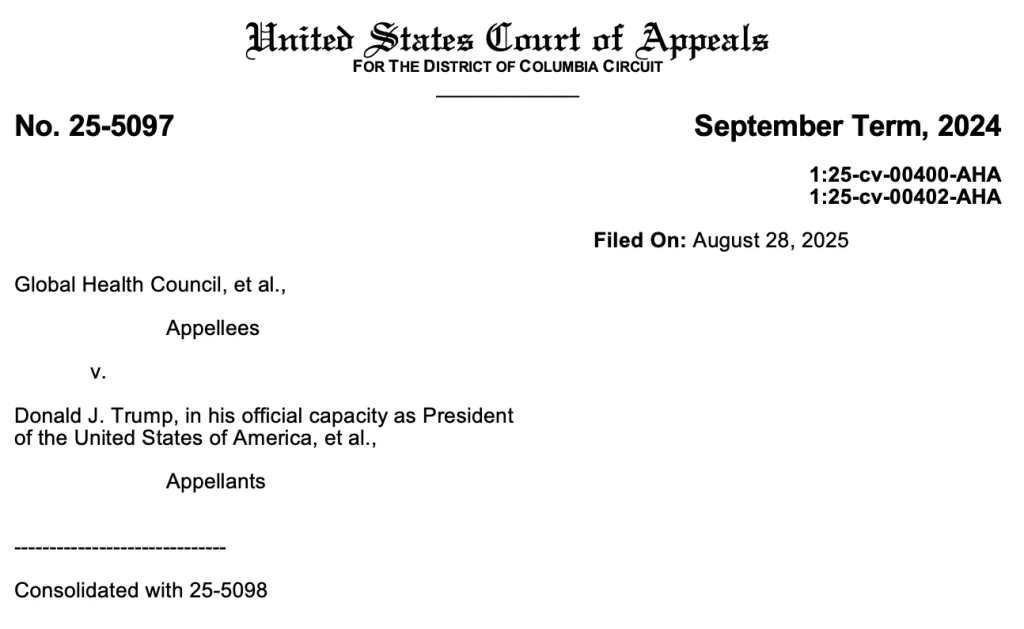
A federal appeals court on Thursday evening took steps that Democratic appointees wrote could represent that best possible way of helping organizations funded by foreign aid payments to get money before a quickly approaching September 30 deadline.
It was the latest unusual sets of rulings in a case challenging the Trump administration’s efforts to cut foreign aid funding — raising the “impoundment” question about the president’s ability not to spend money that Congress has, with its control over appropriations, directed the federal government to spend — that has been up to the U.S. Supreme Court already twice this year.
On Thursday evening over the course of 30 minutes, the U.S. Court of Appeals for the D.C. Circuit took seven actions that ultimately sent the case — technically, a pair of cases — back to the district court, where it is before U.S. District Judge Amir Ali.
It was a stark sign of where we’re at: Judges on the court generally thought of as second only to the Supreme Court taking strategic steps to try to protect people and organizations’ rights due to the ways other branches — and actors within their own branch — are failing to do so. (snip-go read the rest, if you’re interested. It’s very well-written.)
This is a thread on Bluesky. One doesn’t need an account to read there. It’s also an excellent explanation.
This was an extraordinarily shrewd *and* principled resolution by the en banc court, in a case in which the various arguments in the trial court and on appeal were *almost* hopelessly entangled and hard to parse. Of greatest importance are two things: [1]
[image or embed]— Marty Lederman (@martylederman.bsky.social) August 28, 2025 at 7:48 PM
And I got this all on Friday, but was out for a while, so here it is for Saturday mid-morning beverage. https://morningmemo.talkingpointsmemo.com/i/172269056/for-the-legal-nerds –A.
Catching Up With Clay Jones & Open Windows
We were out for a while yesterday, so I didn’t get as much done here. I have a trove, and here it is:
Dear Leader’s cabinet meeting by Ann Telnaes
A three hour marathon of flattery and groveling Read on Substack
I didn’t think the outright ass-kissing could get any worse than his first term’s cabinet meetings…

====================
Your Favorite Dictator by Clay Jones
Trump engages in dictator talk…again Read on Substack

Why would Donald Trump talk about becoming an American dictator…again?
NBC News reporter: Before signing a series of executive orders aimed at reducing crime in D.C. and across the nation, Trump referred to his critics bashing him for sending the National Guard to D.C., claiming that some people think they might “like a dictator.”
Referring to militarizing our cities, Trump said, “They say, ‘We don’t need him, freedom freedom. He’s a dictator. He’s a dictator.’ A lot of people are saying, ‘Maybe we like a dictator’…You send in troops, and instead of being praised they’re saying you’re trying to take over the republic. These people are sick.”
Before the election, Trump talked about “deleting” parts of the Constitution he doesn’t like. Then, he talked about becoming a dictator for one day. Now, he says some people in this country want a dictator, but to whom is he referring to that would be that dictator? I think we all know the answer. The dictator talk is so disturbing that everyone missed that part where he whines that he’s not being praised. (snip-MORE; go read it!)
Mass Mass Shooting by Clay Jones
And another school shooting Read on Substack
(The money graf: “Even the shooter offered “thoughts and prayers” to the intended victims. So, quite frankly, every single Republican’s answer to this isn’t any better than the shooter’s solution.”)
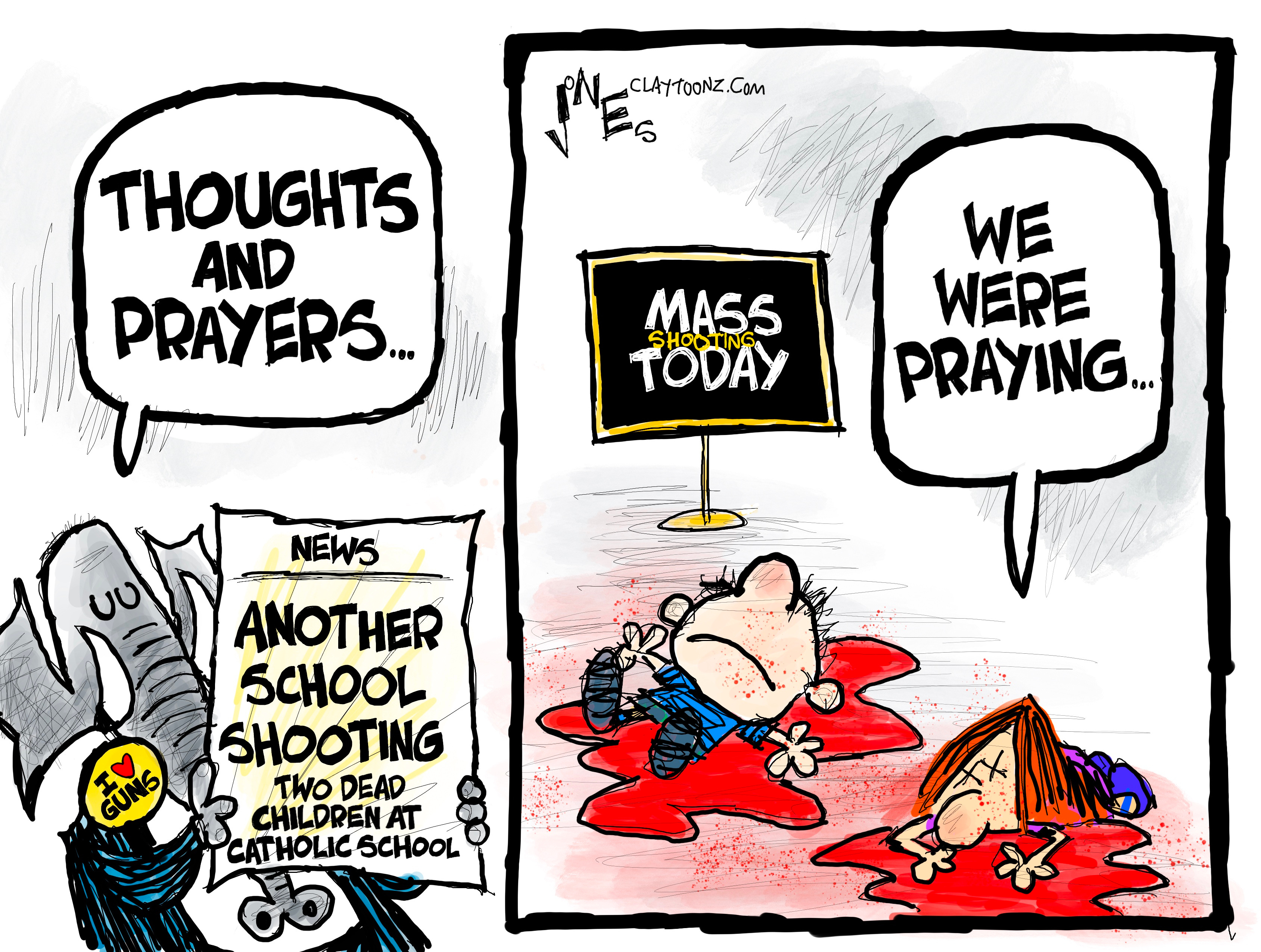
Another mass shooting and another opportunity for Republicans to give us empty thoughts and prayers instead of real solutions. You can’t find a solution when you can’t even identify the problem.
Today’s mass shooting just so happened to take place during a Mass.
An 8-year-old and a 10-year-old were killed while sitting in pews during a Mass at the Annunciation Church in Minneapolis, Minnesota. At least 17 people have been injured. The students were from the adjacent Annunciation Catholic School.
Robin Westman, a 23-year-old, has been identified as the shooter and shot through the windows from outside the church. Westman identified as a woman and had changed her name from Robert to Robin. The right-wing fucknuts are going to love this, but they’ll ignore the parts about the mental issues and racism.
The shooter left a manifesto that called for the destruction of Israel and included racist slurs. Westman flashed a white supremacy sign in a video that showed the shooter’s massive gun collection. The shooter admired those responsible for the massacres at Sandy Hook Elementary School, the Tree of Life Synagogue in Pittsburgh, and the mosque shootings in Christchurch, New Zealand, among others. (snip-MORE, and it’s good info)
Assault Sandwich Ban by Clay Jones
Anything to avoid the truth. Read on Substack
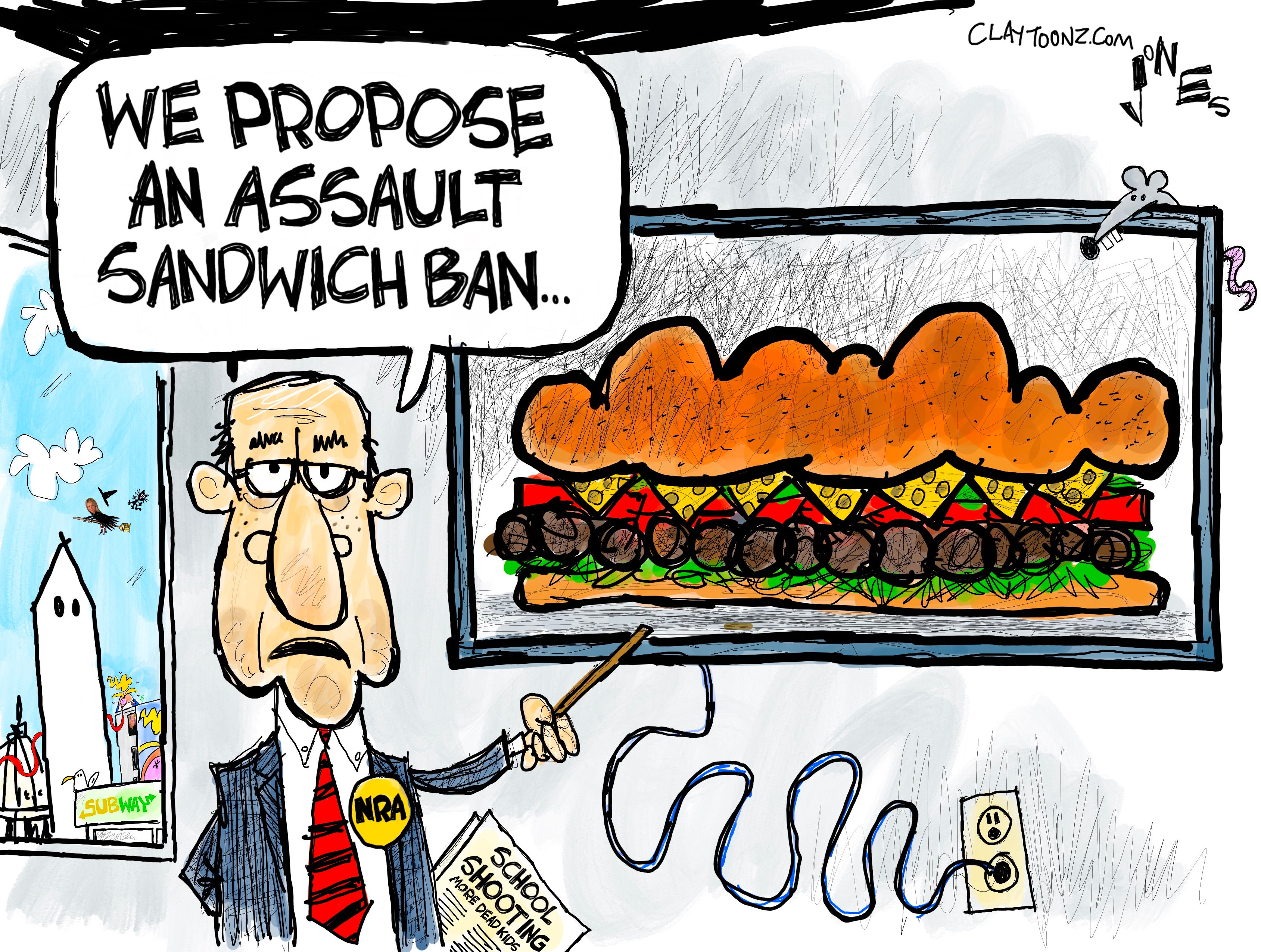
There’s a saying in the legal system that a good prosecutor can get a grand jury to indict a ham sandwich. It’s a criticism of the prosecutorial system because a prosecutor has near-total control of the evidence presented to a grand jury, the defense is not present, and the jury only has to be convinced a crime was committed without a real burden of proof, and on the flimsiest charges.
On Tuesday, a grand jury in Washington, DC, refused to indict Sean Charles Dunn, who is accused of throwing a Subway sandwich at a Border Patrol agent. This is a huge loss for US Attorney Jeanine Pirro, who was hired only because Donald Trump liked the way she looked on Fox News. She’s very hateful and always outraged. This is also a failure for Attorney General Pam Bondi, who declared the sandwich attack was part of the “deep state.
I don’t think we have to worry about a “deep state” if the worst they can do is throw sandwiches at cops.
Anyone charged with a federal felony must be indicted by a grand jury. The problem for Trump’s regime is that the voters in Washington, DC, are some of the most intelligent, most educated, and most aware of the issues. These are not West Virginia voters. You would think that if you wanted to indict someone with a felony, you wouldn’t call a grand jury while the city is occupied by the military.
You would think that with the government’s reaction to the sandwich attack, the accused had used one of the weapons used to murder children at a Catholic Church in Minneapolis this week. The Trump regime and Republicans have more outrage over an assault by a sandwich than outrage over a school shooting. (snip-MORE if you can handle it)
Here’s To Quick Recovery For Scottie
after his first cataract surgery. Eat all the ice cream, Scottie!

Open comments for well wishes, jokes, etc. —
We Deserve This-
Enjoy!

