I love dogs and people. I want living creatures to thrive. I love to cook, and share the food, but ya gotta get in line in front of the dog, and greatest good luck with that!
Celeste Yim, the first out nonbinary writer for Saturday Night Live, announced they are leaving the show this week after five years.
Yim, who was hired as an SNL staff writer in 2020 and promoted to writing supervisor in 2023, announced their decision to leave the show after its 50th season in an Instagram post late Sunday night.
“Lorne [Michaels] hired me over the phone when I was 23 and the job literally made all of my dreams come true BUT it was also grueling and I slept in my office every week BUT my friends helped me with everything BUT I got yelled at by random famous men BUT some famous girls too BUT I loved it and I laughed every day and it’s where I grew up,” Yim wrote in the post.
(snip-embedded Instagram on the page)
“I hate when other people say this but it’s true that I was the first ever out trans person to be a writer for SNL,” the scribe wrote. “I always felt honored to be working within the long tradition of queer writing at the show,” Yim added, joking that “Chevy [Chase] is nonbinary!” (Chase was a cast member and hosted Weekend Update in the first season of the long-running series.) Yim also vowed to keep writing comedy in the face of anti-trans oppression. “I feel so powerless to protect trans people in the world but writing connects us and makes us permanent, so it’s what I will continue to do,” they wrote.
“Thank you Bowen for changing my life and for making me feel normal,” Yim wrote on Instagram this week. (Yim also recently wrote for Yang and Matt Rogers’ Las Culturistas Awards, held earlier this month.) Their statement also thanked “every SNL assistant and production crew member who ever made any part of anything I ever wrote.”
Yim’s time on SNL saw an influx of queer and nonbinary cast members like Molly Kearney and Punkie Johnson, both of whom have since left the show. At the same time, SNL also earned backlash from LGBTQ+ viewers by inviting hosts like Shane Gillis and Dave Chappelle, both of whom have made homophobic and transphobic comments on stage; when Chappelle hosted SNL in 2022, a nonbinary writer — widely believed, but not confirmed, to be Yim — asked to sit out for the week, after which Chappelle made a joke calling the writer “a they” during dress rehearsal (which did not appear in the final show).
“Thank you to my family and friends who love me still even though I did not see them very much,” Yim wrote in their departure announcement. “And thank you all for your support. For writing to me and for wearing my sketches as Halloween costumes. […] I try to imagine my younger self learning about me. I would be amazed. But then I’d be like…Wait, why are you dressed like that…”
Yim’s comments were full of current and former SNL cast members and writers expressing wholehearted support, including Yang, Ego Nwodim, and Jane Wickline, as well as non-SNL celebs like Padma Lakshmi, Jeremy O. Harris, and Ziwe.
“My baby,” cast member (and L’Eggs icon) Aidy Bryant wrote simply, summing it up.
August 29, 1758 The first Indian reservation, Brotherton, was established in New Jersey. A tract of three thousand acres of land was purchased at Edge Pillock, in Burlington County. The treaty of 1758 required the Delaware Tribes, in exchange for the land, to renounce all further claim to lands anywhere else in New Jersey, except for the right to fish in all the rivers and bays north of the Raritan River, and to hunt on unenclosed land. History Of The Brotherton Reservation
August 29, 1957 Following consultations among the NATO allies and other nations, the Western (non-Communist) countries presented to the United Nations a working paper entitled, “Proposals for Partial Measures of Disarmament,” intended as “a practical, workable plan to start on world disarmament.” The plan proposed stopping all nuclear testing, halting production of nuclear weapons materials, starting a reduction in nuclear weapons stockpiles, reducing the danger of surprise attack through warning systems, and beginning reductions in armed forces and armaments.
August 29, 1957 African Americans in Milledgeville, Georgia, wait in line to vote following the Civil Rights Act of 1957. The U.S. Congress passed the Civil Rights Act, the first such law since reconstruction. The bill established a Civil Rights Commission which was given the authority to investigate discriminatory conditions. A Civil Rights Division was created in the Department of Justice, allowing federal prosecutors to obtain court injunctions against interference with the right to vote, among other things. In an ultimately futile attempt to block passage, then-Democrat, former Dixiecrat, and later Republican Senator Strom Thurmond of South Carolina set the all-time filibuster record: 24 hours, 19 minutes of non-stop speaking on the floor of the Senate. A filibuster is the deliberate use of prolonged debate and procedural delaying tactics to block action supported by a majority of members. It can only be stopped with a 60% majority voting to end debate. Senator Strom Thurmond with his 24-hour filibustering speech
August 29, 1961 Robert Moses,leader of SNCC The Student Nonviolent Coordinating Committee (SNCC) was pursuing its voter registration drive in Amite County, Mississippi. Of 5000 eligible Negro voters in the county, just one was registered to vote. SNCC leader Robert Moses was attacked and beaten this day outside the registrar’s office while trying to sign up two voters. Nine stitches were required but the three white assailants were acquitted. Bob Moses recorded the incident Hear Moses recall the time
August 29, 1970 Between 15 and 30 thousand predominantly Chicanos (Americans of Mexican descent) gathered in East LA’s Laguna Park as the culmination of the Chicano National Moratorium. It was organized by Rosalio Munoz and others to protest the disproportionate number of deaths of Chicano soldiers in Vietnam (more than double their numbers in the population). There had been more than 20 other such demonstrations in Latino communities across the southwest in recent months. Three died when the anti-war march turned violent. The Los Angeles Police Department attacked and one gunshot, fired into the Silver Dollar Bar, killed Ruben Salazar, a Los Angeles Times columnist and a commentator on KMEX-TV (he had been accused by the LAPD of inciting the Chicano community). The Chicano Moratorium Ruben Salazar LA Times
After all, George Washington and all were just regular people before they became part of the government. It really is up to all of us. If you click the article title just below this, all the embeds are there. This is from The Root.
From where you stand, it may look like you’re just watching unimaginable stuff go down, and nobody’s stepping in to stop it. In only eight months of his second term, President Donald Trump has managed to undermine the Constitution, disrupt the economy, send military troops to cities without congressional approval and divide the country over immigration, civil rights and more. It seems like there’s nothing regular Americans can do to stop him as he continues to complete the missions of his 2024 campaign, but many political leaders are offering suggestions to fight back in ways never seen before.
From journalist Toure to former Texas Rep. Beto O’Rourke, these powerful voices are urging folks to rebel against the Trump administration, and here’s exactly how they say it needs to be done.
Former Congressman Beto O’Rourke
(snip-Insta on the page linked above; text continues)
“If we’re not willing to play hardball right now, it is over,” former Texas Rep. Beto O’Rourke said during an interview. The Democrat continued comparing the rise of German dictator Adolf Hitler to how American society is handling President Trump now. He urged the Press, opposing political parties and every American to pay attention to Trump’s attempt to rewrite the Constitution, defy the federal courts and attack U.S. citizens before something unredeemable happens. “I don’t know if I’m saying that is going to happen in America,” O’Rourke said referring to Nazi Germany. “But this moment sure as hell rhymes with the 1930s, and if we don’t pay attention, we’re going to lose it.”
Roland Martin
(snip-again, Insta embedded on the page linked above, text continues)
Journalist Roland Martin has told Americans to put down the Tiktoks and fight back. During one video clip, he says “What we are talking about is a battle that’s generational,” Martin passionately began. As Trump continues to suggest red states move to redistrict their congressional seats in Republicans’ favor, Martin called out exactly how this will erase Black voices. “They could wipe out with one Goddamn ruling more than 30 Black Congressional seats,” he said.
Former Vice President Al Gore
On the list of avid critics of Trump is former Vice President Al Gore. During an event in April, Gore didn’t hold back his critiques, and like some others on this list, he compared the Trump administration to Hitler’s regime. He said Trump’s team is “trying to create their own preferred version of reality” to achieve their objectives similar to the Nazi Party. “It was uniquely evil, full stop,” Gore continued. But there are important lessons from the history of that emergent evil.”
Director Marshall Herskovitz
(snip-Insta, etc.)
“We must have what they call a popular uprising,” American director Herskovitz said before adding that in order for this movement to be successful, it would have to be peaceful. “This is not a revolt,” he continued. The producer mapped out his proposed plan. According to him, it would only take 12 to 15 million Americans to protest in the streets “day after day after day,” he said. Step two of the plan includes a “general” strike. “I’m not going to work… My store’s not open; my resturant’s not open. I’m not paying my taxes.” Only then would the country see true change similar to the results of the Arab Spring in 2011– the series of pro-democracy and anti-government uprisings which spread across the Middle East.
Congressman Jerry Nadler
NEW YORK, NEW YORK – JUNE 18: Rep. Jerrold Nadler (D-NY) arrives to view proceedings in immigration court at the Jacob K. Javitz Federal Building on June 18, 2025 in New York City. Rep. Jerrold Nadler (D-NY), Rep. Dan Goldman (D-NY), NYC Comptroller and Mayoral Candidate Brad Lander and Council Member Alexa Avilés visited immigration courts to watch proceedings a day after NYC Comptroller and Mayoral Candidate Brad Lander was arrested by federal agents while accompanying a person out of a courtroom as people continue to be detained following immigration court hearings. (Photo by Michael M. Santiago/Getty Images)
N.Y. Rep. Jerry Nadler released a six-page letter to the American people urging them to take action against Trump. “We cannot wait four years to vote Mr. Trump out of office,” he said before adding, “To achieve this, we must keep our eyes on two important goals: depressing Trump’s public support and dividing the Congressional GOP from him and from each other.” Nadler’s plan focuses on holding the administration accountable for unconstitutional acts and “exposing his Republican enablers in Congress.”
Former U.S. AG Eric Holder
(snip-Insta, etc.)
During an interview with MSNBC, former U.S. Attorney General Eric Holder said Trump’s current actions are “remarkably similar” to that of Europe in the 1930s– when Hitler rose to power. Because of this, Holder said all Americans need to be on high alert. “There’s a treadmill that we’re potentially getting on here that could result in the erosion of rights for American citizens,” he told the network.
Rep. Alexandria Ocasio-Cortez
N.Y. Rep. Alexandria Ocasio-Cortez stands strong as a controversial yet influential Democrat. Like many of her colleagues, she has remained steady in her criticism towards Trump, and during a rally in California, she said the key to defeating him rest in the hands of Americans. “Community is the most powerful building block we have to defeat authoritarianism and root out corruption,” she told the crowd.
NYT Columnist Charles M. Blow
(snip-TikTok embedded on page linked above, text continues)
Charles M. Blow of the New York Times referenced esteemed author Toni Morrison in his advice to fight back. “If you are taking a break from politics right now… good for you. There’s nothing to be ashamed of,” he began on TikTok. “You’re actually going to need the energy that you’re storing now for the fight to come in the next four years.” He added, “You can’t always stay in the crisis,” quoting Morrison from a 1977 interview. The writer encouraged Americans to “recenter what you love” in order to “remember why you fight.”
Congresswoman Lois Frankel
WASHINGTON, DC – MAY 12: Rep. Lois Frankel (D-FL) speaks during a news conference to celebrate the passage of legislation that will place statues of former Supreme Court associate justices Ruth Bader Ginsburg and Sandra Day O’ Connor in the U.S. Capitol on May 12, 2022 in Washington, DC. The Democratic leaders were joined by Scott O’ Connor, son of Justice O’ Connor, and Professor Kelsi Corkran, former clerk for Justice Ginsburg. (Photo by Chip Somodevilla/Getty Images)
Fla. Rep. Lois Frankel has an entire page on her website dedicated to ways Americans can help rebel against Trump. “He promised to lower costs, instead, he’s unleashing chaos and cruelty while his rubber-stamp Republicans in Congress are pushing a draconian budget that slashes Medicaid and food assistance—programs millions rely on to get by,” she said. Frankel continued telling folks to call and email their local representatives to voice their complaints, attend town halls and even share their own personal stories.
Greed v. Young Americans
(snip-TikTok etc.)
@geiggfcg on TikTok told younger Americans (ages 45 and younger) to wake up and get to the streets to protest. Why? Because older generations like the baby boomers– including Trump– have ruined the county with their greed, according to the TikToker. “You have been screwed over royally,” he told his followers. From the lack of affordable colleges to the growing cost to buy a home, @geiggfcg said young Americans will deal with the consequences of their parent’s greed. He went on to reference Trump “Big Beautiful Bill Act,” which promised to make major cuts to medicaid, add trillions to the national debt and also cut food stamps for millions by 2027.
Local Resistance Movements
(snip-TikTok, etc.)
“Donald Trump’s unpopularity is growing, and this era is going to end,” declared @indivisibleguide on TikTok. In order to ensure this happens, the movement is urging folks to get involved in their local communities and to organize. “You should host a community resistance gathering,” the TikToker said.
FEMA Fights Back
WASHINGTON, DC – OCTOBER 8: The Federal Emergency Management Agency Headquarters, in Washington is photographed on October 8, 2024 in Washington, DC. FEMA is running low on personnel, with only 9% of staff available as Hurricane Milton, with 175 mph winds, approaches Tampa, FL; Compared to 25% availability in previous years. (Photo by Kent Nishimura/Getty Images)
Nearly 200 employees at the Federal Emergency Management Agency (FEMA) signed a written letter expressing concerns that Trump’s “unqualified” government appointees could have long-lasting impact on Americans everywhere. NBC reported that 21 of those employees have been put on leave in response.
Peaceful March Against Trump
(snip-TikTok etc.)
ack in April, thousands of Americans across the nation flooded the streets in order to protest against Trump. In this video, a large group of demonstrators are gathered in Milwaukee all against the 47th president.
Army General Mark Milley
(snip-TikTok etc.)
Retired Army Gen. Mark Milley has been an avid critic of the Trump administration for years. In fact, his critiques of Trump even prompted Defense Secretary Pete Hegseth to pull Milley’s security clearance and protective detail back in January. Still, Milley has remained outspoken about why Americans need to stand strong against Trump. “We don’t take an oath to a tribe… We don’t take an oath to a king or queen or to a tyrant or a dictator,” Milley said. “And we don’t take an oath to a wannabe dictator.”
Journalist Toure
(snip-TikTok etc.)
For journalist Toure, the key to fighting back against Trump and his administration is to hold those doing his bidding accountable. “The pathway out of this is accountability– Not for Trump but for everybody who holds up his order,” he said on TikTok. “‘I was just following orders’ is not sufficient.” Instead, he said the licensed lawyers and licensed pilots who carry out Trumps wishes– such as deporting migrants against court orders and defending the president’s alleged unconstitutional actions in court– need to lose their licenses.
Calif. Gov. Gavin Newsom
SACRAMENTO, CALIFORNIA – AUGUST 21: California Gov. Gavin Newsom looks on during a bill signing event related to redrawing the state’s congressional maps on August 21, 2025 in Sacramento, California. In a move to counter Texas House Republicans’ plan to redraw the state’s congressional maps ahead of the 2026 midterm elections, California Democrats took up a proposed constitutional amendment to temporarily redraw their own congressional maps, potentially creating five additional U.S. House seats for their party. (Photo by Justin Sullivan/Getty Images)
While many Democrats are conflicted about going as low as Trump, who is known for ripping into his enemies with low blows and jabs online– Calif. Gov. Gavin Newsom seems to have no mercy. The two men have gone back and forth for years, but ever since Trump returned to the White House, Newsom has been fighting the president’s fire with fire, we previously reported. Most recently, Trump has encouraged red states to rezone their voting districts in order to gain more Republican seats come the 2026 midterms. In direct response to that, Newsom promised to do the same in his state.
August 28, 1833 The Abolition of Slavery Act was passed by the British Parliament. As early as 1787, members of the Society of Friends (Quakers), particularly Thomas Clarkson and Granville Sharp, organized to end the slave trade.Since Quakers were barred from serving in the House of Commons, the cause was led by a member of the Evangelical Party, William Wilberforce, ending the international trade in slaves in 1807. By 1827 slaving was considered piracy and punishable by death. The complete ban on slavery itself through the British Empire didn’t happen until this day; Wilberforce was informed of the Act’s passage on his death-bed. William Wilberforce ============================================ August 28, 1963 Reverend Martin Luther King, Jr. delivered his “I Have a Dream” speech from the steps of the Lincoln Memorial to a crowd of half a million gathered on the Mall in Washington, D.C. They gathered there for jobs and freedom. The speech organizing to build the march Film of the March and the speech 1983: Three hundred thousand marched in Washington on the 20th anniversary of MLK’s “I Have A Dream” speech for the second “March on Washington for Jobs, Peace and Freedom.” ============================================== August 28, 1976 60,000 joined the Community of Peace People demonstrations in Belfast and Dublin, Ireland. Peace People was founded by two women, Betty Williams and Mairead Corrigan to decry the painful violence between Catholics and Protestants, between unionists and republicans, and to move the peace process forward in Northern Ireland. Betty Williams Mairead Corrigan They jointly won the Nobel Peace Prize for 1976. More about Betty Williams and Mairead Corrigan From the Declaration of the Peace People: “ . . . We want to live and love and build a just and peaceful society. We want for our children, as we want for ourselves, our lives at home, at work and at play, to be lives of joy and peace. We recognize that to build such a life demands of all of us, dedication, hard work and courage . . . We dedicate ourselves to working with our neighbors, near and far, day in and day out, to building that peaceful society in which the tragedies we have known are a bad memory and a continuing warning.” The Peace People’s website
Chef Jose Andres with World Central Kitchen visits a temporary shelter for the victims of the Southern California wildfires at the Pasadena Convention Center in Pasadena, Calif., Thursday, Jan. 9, 2025. (AP Photo/Damian Dovarganes)
Celebrity chef and local D.C. icon Jose Andres is pushing back against Trump’s claim that his federal takeover and law enforcement surge in the nation’s capital has resulted in a “boom town” for the city’s restaurants.
Trump on Monday rejected reports that the flood of federal agents and National Guard troops had hurt D.C. restaurant and nightlife industry.
“Half the restaurants closed, because nobody could go, because they were afraid to go outside,” Trump said. “Now those restaurants are opening and new restaurants are opening up. It’s like a boomtown.”
Andres, in a Tuesday post on X, directly and sarcastically addressed Trump, saying: “I understand why you are confused…all your time in DC you haven’t eaten ONCE outside the White House or your own hotel. I’ve lived here for 33 years, and it’s a flat out lie that half the restaurants have closed because of safety…but restaurants will close because you have troops with guns and federal agents harassing people…making people afraid to go out.”
The Spanish-American restaurateur and founder of the global food charity World Central Kitchen and Trump have exchanged public hostilities in the past.
By LIUDAS DAPKUS Updated 7:46 PM CDT, August 24, 2025
VILNIUS, Lithuania (AP) — Cute and adorable Welsh corgis, widely known for their association with the British royal family, are in fact a breed of passionate racers.
That’s at least according to the 120 teams from around Europe taking part in the Corgi Race Vilnius, in Lithuania’s capital, which drew an international bunch of furballs and their owners from countries including Poland, Latvia, Germany, Austria and Italy.
Thousands of Lithuanians gathered in the capital’s largest park on Saturday and Sunday to watch the events — a solo sprint, a contest for the “mightiest voice,” costume challenges, and group racing.
The event is set to culminate on Sunday with the so-called World Corgi Meetup, where dogs in Lithuania will be connected via a live broadcast with their peers in the United States, Ireland and Poland.
“This is so much fun and great emotion for the entire family, something bright that many people are craving for these days,” said retired teacher Janina Stoniene, who attended the race with her three grandchildren. The children said they admired the costume challenge as dogs were dressed in eye-catching outfits like Batman, a princess or an airplane.
A corgi named Amigo, sporting a factory-themed costume complete with two tiny chimneys and “Fur Factory” lettering, was named the proud winner of that contest.
Another called Mango, whose owners are from Lithuania, was the champion of the solo race.
“So this is a mango, like a fruit mango, and we are participating (for the) second time in Corgi Race 2025,” said Ignas Klimaika, a proud corgi lover from Vilnius. “Last year we didn’t manage to end the race perfectly. We had a really good training. We had trained every day, but this year we decided we just go without training, just to participate, just to enjoy all the lots of corgis,” he said.
A corgi dog participates in a fashion show during a international event Corgi Race Vilnius 2025 in Vilnius, Lithuania, Saturday, Aug. 23, 2025. (AP Photo/Mindaugas Kulbis)A corgi dog participates in a fashion show during a international event Corgi Race Vilnius 2025 in Vilnius, Lithuania, Saturday, Aug. 23, 2025. (AP Photo/Mindaugas Kulbis)
But this year, Mango won the racing competition, while his owners screamed and waved to try to inspire him to triumph.
“He knows what he did and he’s really proud of himself,” said Ignas, who is already planning for 2026.
In a groundbreaking global mission, researchers have identified 866 new marine species, offering fresh insights into ocean biodiversity. The discovery comes after a two-year collaboration among scientists, governments, and research institutions.
This large-scale effort combines data from 400 institutions and more than 800 scientists to accelerate the cataloguing of life beneath the waves. The study confirms that much of the ocean remains unexplored, with only about 10% of marine species currently documented, leaving a vast number of creatures to be discovered, Faharas reports.
Photo YouTube / Your Wyoming Link
The Guitar Shark was found 200 meters deep off Africa.
Breakthrough Discoveries: Guitar Shark and Venomous Harpoon Snail
Among the newly identified species, the Guitar Shark stands out. Found at depths of approximately 200 meters off the coasts of Mozambique and Tanzania, this elusive shark adds to a critically endangered group, Afloat.ie reports. With only 38 known guitar shark species worldwide and a significant proportion threatened, its discovery sparks urgent calls for conservation measures.
Equally intriguing is the discovery of a venomous marine gastropod, Turridrupa magnifica. This creature, encountered in the South Pacific near New Caledonia and Vanuatu, possesses a specialized predatory mechanism. It employs harpoon-like teeth to inject toxins into its prey, a feature that opens potential avenues for developing novel pain relief and cancer treatments, according to Ocean Census. The promising medical applications of these peptides highlight the unforeseen benefits that emerging species can offer.
Photo YouTube / Your Wyoming Link
Scientists discovered 866 new marine species.
A Collaborative Effort Across the Globe
The ambitious mission, led by the Nippon Foundation and Nekton, kicked off in April 2023. It involved 10 global expeditions and 8 Species Discovery Workshops, creating an international network dedicated to marine research, IFL Science reports. By deploying divers, remotely operated vehicles, and submersibles, teams explored depths ranging from near-surface waters to nearly 5,000 meters below sea level. Such an extensive range allows researchers to capture a diverse snapshot of ocean life, from colorful reef fish to mysterious deep-sea creatures that dwell in near-total darkness.
The traditional process of species registration is lengthy, sometimes taking up to 13.5 years. This delay means that many species face extinction before they can be formally documented. Accelerated efforts, like the Ocean Census, aim to reduce this gap and develop conservation strategies rapidly, CBS News reports. The initiative has already facilitated a series of Species Discovery Awards, encouraging taxonomists worldwide to share their findings and enrich our understanding of marine ecosystems.
Photo YouTube / Your Wyoming Link
Discoveries inspire hope for future biotechnology advances.
Implications for Marine Conservation
The revelations extend beyond the thrill of new discoveries. They serve as a stark reminder that the ocean still holds many secrets critical to the health of our planet. With climate change, overfishing, and pollution increasingly threatening marine environments, the need for protective measures has never been more urgent.
A unified treaty reached by over 100 nations now aims to conserve 30% of the world’s oceans by 2030, CBS News reports. This commitment underscores the pivotal role that newly discovered species play in advancing marine conservation, as each new creature contributes to the broader ecological balance.
The comprehensive data gathered during these expeditions are now accessible through an online biodiversity platform. This initiative not only supports ongoing research but also informs policy decisions aimed at safeguarding marine habitats, according to Faharas. As more species become known, conservationists can design more effective strategies to protect fragile ecosystems. The discovery of species such as the Guitar Shark and Turridrupa magnifica becomes a clarion call for further exploration and immediate action to preserve oceanic life.
Charting a Course for Future Discoveries
This monumental effort in marine exploration opens the door to new scientific questions. Researchers now face the challenge of studying the biology, behavior, and ecological roles of these species. The data collected will fuel future expeditions and drive technological innovations in underwater research. A sustained commitment to cataloguing and conserving ocean life will help protect the planet’s largest ecosystem against ongoing environmental threats.
The Ocean Census project represents a major step forward in understanding marine biodiversity. Its findings remind us that the ocean remains a vast and vibrant frontier, rich with life forms that continue to captivate scientific curiosity and drive innovation. As nations work together to expand marine protected areas, these discoveries will serve as a cornerstone for global conservation efforts.
When a grand jury returns an indictment, it’s called a true bill. On those exceedingly rare occasions where they decline to sign off on an indictment prosecutors present to them, it’s called a no bill. In 25 years at DOJ, I never had a grand jury no bill one of my cases. And I can only recall a couple of instances where it happened in the entire district.
Donald Trump’s new U.S. Attorney in the District of Columbia can’t say that. Former judge, Fox News host, and defendant in a defamation case where she is accused of spreading false information about voter fraud, Jeanine Pirro, recently received three no bills—all in the same case. The U.S. Attorney’s Office tried to charge Sydney Lori Reid with felony assault on three separate occasions this month, but the grand jury declined to do so. CNN reports that “In one case this month — related to an FBI agent and an immigration officer allegedly scrapping with a detainee — the federal grand jury in Washington voted ‘no’ three times.”
Proceedings inside of the grand jury are conducted in secret, so there is no way of knowing why the grand jury rejected the charge. Typically, if a grand jury expresses some hesitation over a case, prosecutors will bring in additional witnesses or offer counsel about relevant laws to help alleviate their concerns. To fail to indict not once, but three times, indicates a failure of both competence and judgment.
When asked about her failure, Pirro responded, “Sometimes a jury will buy it and sometimes they won’t. So be it, that’s the way the process works.” But that’s not true. The standard for obtaining an indictment is a low one: The prosecution need only persuade the grand jury that probable cause to proceed on the charges exists. That’s a far lower bar than the requirement that the government prove a crime was committed beyond a reasonable doubt before a trial jury can convict. Any prosecutor who doesn’t back off of a case where they can’t even convince grand jurors that probable cause exists, knowing that much more will be expected of them at trial, is wasting taxpayer resources. Prosecutors have plenty of cases. Move on and do a righteous one. But apparently, that’s not how the D.C. U.S. Attorney’s Office operates these days.
Prosecutors, who have 30 days following an arrest like Reid’s to obtain an indictment, told a judge they now plan to bring misdemeanor charges against Reid. Misdemeanor charges can be brought by prosecutors without the need to present them to a grand jury for approval. But we already know at least some of the facts in the case, because a statement of facts was filed in support of the arrest warrant.
The affidavit alleges that Reid assaulted FBI agent Eugenia Bates. Reid was video recording agents outside of the D.C. jail, where at least two individuals were being arrested as “known gang members” and transferred into ICE custody. Reid was directed to step back, and according to the affidavit, she “got in Officer Lang’s face.” He said she smelled of alcohol and tried to interfere with the transfer of custody. According to the government, an officer pushed her against a wall, but she continued to struggle after being told to stop.
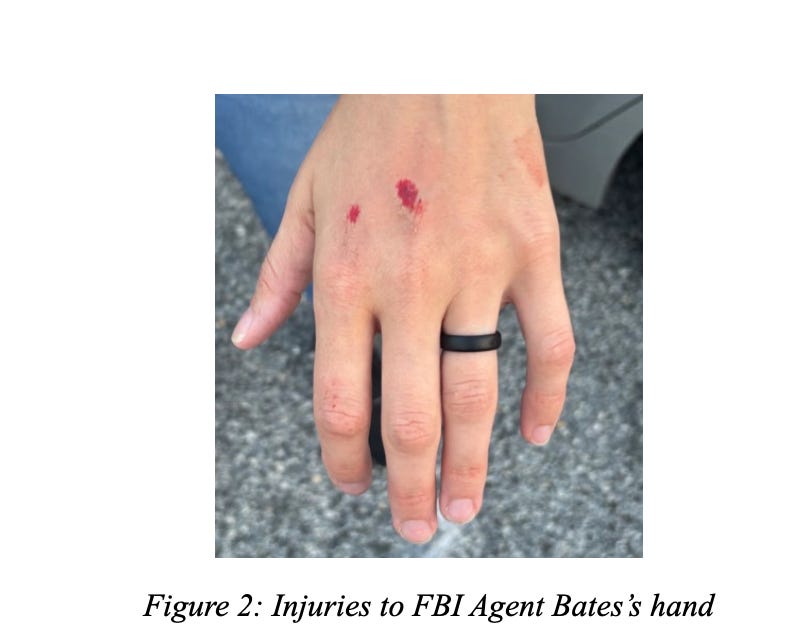
Here’s the heart of the allegation against Reid: “Agent Bates came to Office[r] Lang’s assistance in trying to control REID. REID was flailing her arms and kicking and had to be pinned against a cement wall. During the struggle, REID forcefully pushed Agent Bates’s hand against the cement wall. This caused lacerations on the back side of Agent Bates’s left hand.”
To convict on the federal felony assault charge, the government would have to establish that Reid forcibly assaulted a federal agent. A “forcible assault” is an intentional threat or attempt to cause serious bodily injury by a person who has the apparent ability to do so, including any intentional display of force that would cause a reasonable person to expect immediate and serious bodily harm or death. The statement of facts alleges that Reid “intentionally and forcibly obstructed the transfer of suspects into FBI custody and made physical contact with FBI Agent Eugenia Bates and inflicted bodily injury in violation.” The grand jury didn’t buy, despite having three opportunities to do so, that there was probable cause, let alone proof beyond a reasonable doubt, to believe that some or all of that happened.
The lacerations, which were pictured in the statement of facts and presumably shown to the grand jury, seem relatively minor. And it’s difficult to see, at least with this statement of the facts, how a grand jury could conclude, as it must, that Reid was the cause of those “lacerations” or even acting voluntarily when they happened. Assuming they could prove all of that, even small cuts like these could hypertechnically constitute assault. But it’s easy to imagine a grand jury viewing charging it as a felony as overreaching.
Judge Sparkle L. Sooknanan will hold a hearing in the matter on Thursday morning at 11:30.
The grand jury process still works as a check and balance on prosecutors, as the Constitution intends. Trump may want you to think he’s all-powerful, but guardrails are still in place. His administration can’t bring felony charges without a grand jury’s approval, an important protection not just for Ms. Reid but for others, as DOJ’s portfolio of revenge investigations continues to grow.
We talked previously about a grand jury in Los Angeles that declined to indict. Now, it’s spread to D.C. And grand juries are only the first layer of guardrails in the criminal justice system, where they are joined by trial juries, judges, and the appellate process.
You’ve heard the line—the one that says prosecutors can indict a ham sandwich, that it’s just that easy. Next stop in D.C., seeing whether they can indict a Subway sandwich. They should think twice after their experience in Ms. Reid’s case with bringing marginal prosecutions to please the president. That’s not justice.
August 27, 1963 DuBois in Ghana W.E.B. DuBois, the black American sociologist, scholar, author, pan-Africanist, communist, and one of the founders of the NAACP, died in Accra, the capital of Ghana, where he had expatriated. He had been charged and tried in the U.S. for being a “foreign principal” in 1951 because he chaired the The Peace Information Center. The Center was dedicated to banning nuclear weapons but Secretary of State Dean Acheson designated it a Communist front group. W.E.B. DuBois background
August 27, 1967 The Peace Torch Marathon arrives at the Mall. The San Francisco Peace Torch began its two-month journey to Washington, D.C. for a demonstration against the Vietnam War.