
Category: Anger
‘Day of trauma’: Students told they were going to career fair taken to ‘anti-LGBT church service’ instead
This is what the Fundamentalist Christian Nationalists want. They want public school kids forced to attend their sermons and forced to listen to their propaganda to be indoctrinated. When the FCN (Fundamentalist Chrisitan Nationalists) The goal is to either move school to the church or move these classes into the public schools. This time they had to lie to do it, but with so many of the rabid right winning school board seats they can do this stuff much more openly. You see at the end the school system was not apologetic, lied and claimed it was educational / beneficial for the students, and implied they will keep doing it. We look forward to seeing what our over 2,100 student participants will continue to achieve with the resources and knowledge gained from this event.” Hugs
A group of students in Baton Rouge, Louisiana thought that they were going to a career fair on Tuesday. Instead, they found that they had been sent to an event described as an anti-LGBT church service.
According to Baton Rouge-based newspaper The Advocate, over 2,100 students from local high schools in the East Baton Rouge Parish school system were told that they were participating in a districtwide ‘College & Career Fair.’ However, when they arrived at their destination, the students, most of whom were seniors, discovered that they had been dropped off at an event called ‘Day of Hope’ at the Living Faith Christian Center.
According to reports, many of the students came away from this event feeling traumatized, as the ‘Day of Hope’ was centered on a number of sexually charged, anti-LGBT issues. This reportedly included separating the kids by male and female, and forcing male and female-transgender students to participate in discussions with the opposite sex. Additionally, one parent said that a number of transgender students were bullied during the event.
“Other students poured water on top of transgender students’ heads without any repercussions by any of the adults present,” Brittany Bryant, a mother of a transgender child and high school biology teacher, wrote on Facebook. “They talked about rape (and) forgiving the offender, suicide, prayer leadership, and many more dark controversial topics. We had females in the bathrooms crying due to the topics of discussion.”
Bryant also wrote that the ‘boy’s talk’ also involved physical challenges, something the girl’s talk did not. “From the beginning no topics were discussed but (they) began male chauvinistic competition for monetary reward for winners,” Bryant wrote. “Then proceeded to compete for push-ups for more money. They were hyped up and egged on.”
Bryant told The Advocate that, while she was afraid of speaking out, she felt that she had to bring the story to light.
Another parent wrote on Facebook, “DAY OF HOPE? More like day of trauma. You prayed over my child, told her that she should remain abstinent, talked to her about suicide, and told her that if she’s being abused in a domestic violence situation that she should forgive her abuser even if he’s not sorry.”
Parents were not the only ones to express their anger on social media, with a number of students doing so as well.
One high schooler, senior Alexis Budyach, wrote on Facebook, “The majority of students chose to attend this field trip on the promise of free food and the opportunity to skip class, however the majority of students were not only disappointed by this event, but traumatized as well.”
The East Baton Rouge Parish school system responded to the outrage in a statement Wednesday, saying that “the event was structured to assist students with exploring what options are available after high school, along with allowing students to participate in breakout sessions and student-initiated activities and projects.”
“By providing entertaining activities with an educational focus, this event was an elevation of a traditional college and career fair…We look forward to seeing what our over 2,100 student participants will continue to achieve with the resources and knowledge gained from this event.”
Taliban lashes and flogs Afghans in crowded football stadiums for ‘adultery and gay sex’
This is what the Christian nationalists want to have in the US. This is what the fundamentalists / evangelical / fundamentalism religious groups want to create for US society. They want the ability to force their god, their ideas of right / wrong / morality on everyone. No disagreement tolerated, no free will, no religious freedom. You will worship their god as they tell you to and you will live / act as they demand. You will dress as they say you must. The Taliban make women cover head to toe, and men must wear man’s / manly clothing. Sound familiar? No drag queens there, and if the US Christian Taliban / vice police get their way there wont be any here. Only books that paise their god is allowed and insulting their god is a serious crime, and we have now attempts to ban any books the fundaments don’t like spreading across the red states especially in the bible belt areas. It is happening here now. As the people in Iran found out, once the religious people took over they wont ever let go of their power to force their god / ways on the public. They will kill everyone first. It is easy to let the fundamentalists take over but incredibly hard to remove them from power afterwards. We have to stop them now. Tell me will the LGBTQI+, gay people like me and my family have to apply to other countries for help to flee the US when the right wing republican maga fundies like DeathSantis take over? Will we beg these countries to open their borders for us, when now we limit and prevent those fleeing persecution from coming here? Hugs
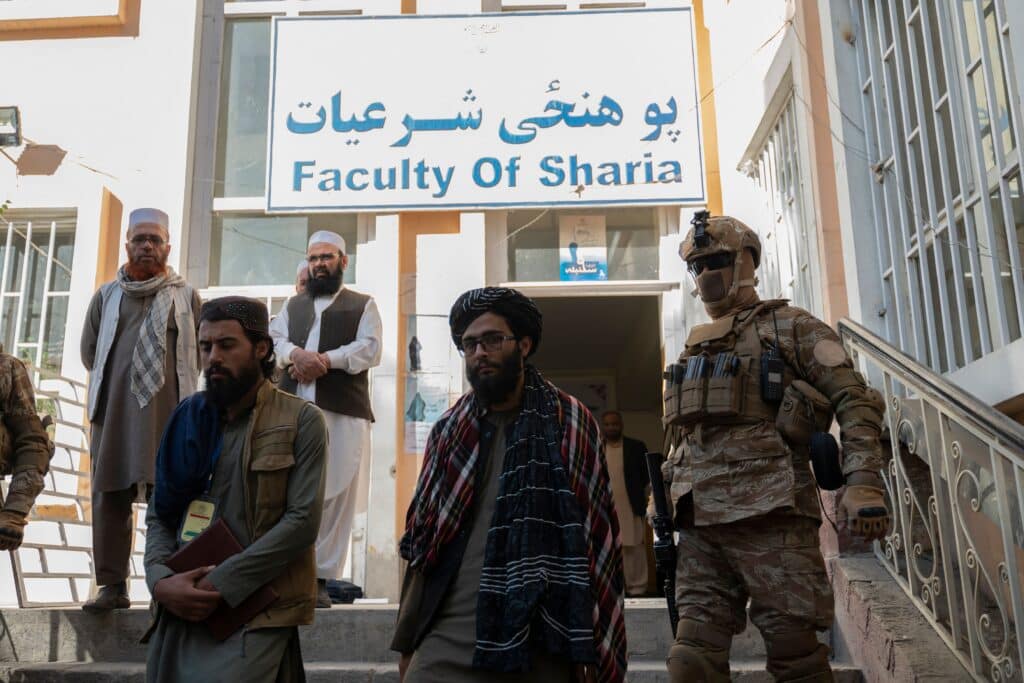
Taliban security personnel. (Photo by Wakil Kohsar / AFP via Getty Images)
The Taliban have flogged a group of people in a crowded football stadium for “moral crimes” including gay sex.
Twelve people, including three women, were lashed in front of thousands of onlookers in the eastern Logar province, a Taliban official has informed the BBC.
According to the source they were punished for “sins” including “adultery, robbery, and gay sex”.
The people flogged received between 21 and 39 lashes each, with the maximum a person can receive being 39, another Taliban official shared.
It comes a week after the Taliban’s supreme leader, Hibatullah Akhundzada, announced the group would be “implementing sharia law” in full force across the country.
The islamic law enforces punishments such as public executions, stoning, floggings and the amputation of limbs for thieves.
Under Sharia law same-sex sexual activity is prohibited and can be punished by the death penalty.
The recent floggings resemble the group’s previous rule from 1996 to 2001, when it was condemned for carrying out public executions, stoning and floggings at the national stadium in Kabul.
The flogging in Logar province follows 19 people being flogged in a similar way in the Takhar province in northern Afghanistan just last week.
It also comes after the Taliban promised a “softer” version of its regime, but since the group’s return to rule last year reports of public floggings have been rife.
Since the group’s rule it has continued to destroy women’s freedoms by banning them from entering parks, funfairs, gyms and public baths, with women saying they were beaten for standing up of their rights.
A 22-year-old gay man was previously shot dead by the Taliban in Afghanistan because of his sexuality.
Hamed Sabouri, from Kabul, was killed in August, local activists told PinkNews.
He was reportedly kidnapped by the Taliban and a video showing his murder sent to his family days later.
Nemat Sadat, an Afghan activist who is fighting to have LGBTQ+ people evacuated from the country, told PinkNews that Sabouri’s death is the result of inaction from western governments, many of which have failed to take in adequate numbers of fleeing Afghans.
Don’t Start No $h!t There Won’t Be No $h!t
Meet the transgender heartthrob of the Wild West
https://www.lgbtqnation.com/2022/11/meet-transgender-heartthrob-wild-west/
As I posted earlier today and despite something the anti-trans people try to push gender identity not matching birth assigned sex is not new, it is not being pushed in schools, and it is not being forced on kids. It has existed all through history just as same sex attractions have. Why not just give people equality and civil rights, why use old incorrect old traditions or religious dogma to stand in the way of the best medical understanding we have today. In 2022 we should not be denying the advanced reality we have to pretend that people that did not even understand to wash their hands had a better understanding of medical gender or sexual attraction. Also understand that in the end of the story they tried to bully this man into wearing female clothing that the sheriff thought he should be wearing. The authority of law had decided on their own that this person who by dressing and acting as the masculine person they were so upset the legal authorities they tried the best they could to force them into obeying. But Harry understood his gender and who he was and was willing to die first. Just like the kids today willing to kill themselves instead of being forced to live as a gender they are not. Hugs
 Harry Allen, the transgender heartthrob of the Wild West Photo: Public domain
He was a skilled barroom brawler, trick shooter, and dashing womanizer known for having multiple mares in his stable at any given moment. If 19th-century trans “cowboy” Harry Allen hadn’t been assigned female at birth, John Wayne—or Elliot Page, if we’re casting looks—would have played him in a sexy biopic already.
Hollywood has spent billions depicting the frontier as a gun-slinging frenzy of cisgender masculinity, but in reality, the Old West was one of the queerer places in America. This sprawl of undeveloped land drew hundreds of closeted men, women, and gender non-conforming folk from across the United States out of suburban hidey-holes, and into a difficult but liberating new ecosystem where survival meant more than gender norms.
Given the Wild West was built on the bones of indigenous tribal lands, its more relaxed approach to gender wasn’t surprising. Tribes like the Navajo and Cherokee were never moved by Christian colonizers’ binary dog-and-pony show, recognizing anywhere from four to six “genders” on average. Their tradition of accepting “two-spirits”—transgender, gender fluid, and/or non-binary tribe members—as treasured community members bled subtly into the culture of the West, creating cracks of space for other queer people to experiment. Infamously lawless, the burgeoning area was too busy dealing with murders and dysentery to make Puritanical “masquerading laws” a priority, removing the legal leverage well-established cities used to subjugate queer bodies for offenses like **checks notes** wearing a dress while male.
The ratio of men to women was also around 14:1 on the frontier, which meant three things:
- “Gay sex” wasn’t always seen as homosexual, just a necessity.
- Sexual violence was a significant problem across the board.
- It wasn’t uncommon for women to dress in men’s clothes to prevent becoming victims of sexual violence.
Because of this, some historians have reduced overt queerness to crossdressing as a survival tactic and all Brokeback Mountain sexual partnering as a supply and demand issue.
Harry Allen is a prime example of why these historians are silly.
Born in Indiana in 1882 to poor ranch workers, Allen’s family relocated to the Pacific Northwest just as he entered puberty. His mother, Jennie Gordon, gave interviews asserting her child rejected girls’ clothes almost immediately, dressing in pants instead of skirts and learning to shoot on horseback instead of taking up needlepoint. He formally changed his name to Harry Livingston in around 1900, switching to Allen once police records attached to “Livingston” became cumbersome. This name change was not, as some historians have suggested, for employment reasons.
Allen communicated clearly in a 1908 interview with The Seattle Sunday Times that everything from his name to hat choice was rooted in gender dysphoria, saying, “I did not like to be a girl, did not feel like a girl, and never did look like a girl,” he said. “Sick at heart over the thought that I would be an outcast of the feminine gender, I conceived the idea of making myself a man.”
As it turns out, Harry executed his idea a little too well for the time. He secured “manly” work throughout the Washington area, including bartending and participating in prize fights. He had no trouble attracting a parade of girlfriends, some quite desperate to marry him. Harry even assimilated into a gang of young men, though they participated in little crime outside of drinking and petty theft. But everything he did, from playing the piano drunk to messy breakups, became catnip for cops and local tabloids.
By 1902 Allen was in the newspaper regularly. His first publicized arrest in 1900 was for appearing “in male attire,” despite no local or federal law saying he couldn’t wear pants. Once the arresting officer was humiliated by the revelation Allen hadn’t committed a crime—and Harry loved polished menswear, always sporting a silk hat, tie, and a walking stick even on quick trips to the barber—the young man became a punching bag for law enforcement. “Vagrancy,” an intentionally vague charge used at the turn of the century to target LGBTQ people, appears on his rap sheet multiple times alongside accusations of bootlegging and prostitution.
While the frontier may have been safer than the average “lawful” city for queer people, Allen could never escape the burden police, judges, and media heaped on him. He was jailed in 1911 for selling liquor to an indigenous person, a minor and non-violent offense, but held on a massive bail for weeks while awaiting trial. During his imprisonment, the Spokane Chief of Police made bullying Allen into petticoats under threat of solitary confinement his personal pastime. Journalists enabled this by publishing weekly updates on whether Harry had given in to skirts. (He never did.)
By the time Harry Allen died of syphilis in 1922, he had been written up by the media no less than two dozen times, mostly for living as his authentic self and dating “young women of respectable parentage.” At the time of his passing, at least two paramours had committed suicide out of unrequited love for him, though it’s unclear if these reports were accurate or sensationalized tabloid fodder.
Allen remains strong evidence that gender dysphoria and trans ideology are not, as pundits today wail from their Twitter accounts, a new “social contagion,” but a long and well-documented part of the human experience no matter where those humans settle.
New State Voter Fraud Units Come Up Empty-Handed – JMG
If you go read the article you see things like this; “We’ve heard stories about voters who are eligible to vote but have a criminal conviction in their past, and they are now scared to register and vote,” said Michael Pernick, a voting rights attorney with the NAACP Legal Defense Fund. He called it “deeply concerning.” This was all about scaring the more marginalized members of society from voting. After all the unpopular minority republican party needs to cheat as much as possible to be able to win. Hugs
The Associated Press reports:
State-level law enforcement units created after the 2020 presidential election to investigate voter fraud are looking into scattered complaints more than two weeks after the midterms but have provided no indication of systemic problems.
That’s just what election experts had expected and led critics to suggest that the new units were more about politics than rooting out widespread abuses. Most election-related fraud cases already are investigated and prosecuted at the local level.
Florida, Georgia and Virginia created special state-level units after the 2020 election, all pushed by Republican governors, attorneys general or legislatures.
Read the full article.

Funny how most of the actual voter fraud was from republicans
DevilDog • 6 hours ago • edited
These enforcement units found no indication of systemic problems because they were (conveniently) looking in the wrong places. What about examining GOP gerrymandering, voter intimidation and suppression, marginalization of minority voters, refusal to make Election Day a national holiday (as it is in some countries), etc?
J Ascher DevilDog • 6 hours ago
Exactly! If the agents looked at rich, conservative, retirement communities, they’d find a lot of fraud and suspicious activity.
The fraud is ithe campaigns, the lies, the troll farms, the gerrymandering, and the pre-election voter suppression, not in the vote itself.
This is misdirection. Keep people looking at a few individual voters while their systemic efforts disenfranchise millions.
What, me worry? crewman • 5 hours ago
I wonder if now they will quietly stop claiming that all elections that they don’t “win” are somehow stolen… The gaslighting is really getting on my last nerve.
And yet the voter suppression laws will stay in place because it’s never been about fraud, it’s been about making it harder to vote.
greenmanTN • 5 hours ago • edited
Most people here get it, but just in case, here’s a recap.
GOP politicians have been screaming that the 2020 election was stolen, and in a very limited and twisted way, they are RIGHT. They had worked very hard to steal the election themselves, by purging voter rolls, limiting when, how, and who could vote. But then Covid came along and many states enacted new voting rules to increase access to voting to accommodate the new social distancing. So their hard-working effort to steal the election didn’t work; the people they attempted to prevent from voting were allowed to vote. THAT’S what they’re mad about, what all this talk of “voter fraud” is really about underneath the surface. Their own attempt to rig the election didn’t work. And they’re pissed about that!
heleninedinburgh • 6 hours ago
Then look again! Hard! Like this – no, harder than that! Because there’s got to be someone, somewhere, who’s doing it, otherwise this would just be a big waste of money designed to intimidate voters, especially voters of colour, and a respectable political party wouldn’t do that.
What, me worry? heleninedinburgh • 5 hours ago
That last bit is the bright shining lie in all of this. Republicans are all about making sure that the black and brown people are kept away from the polls. I’m really excited to see that wherever possible, early voting is catching on. I’ve been voting early for a long time now. These days, I’m doing it by mail. I get my signature and ballot notarized, just so they can’t fuck with me. I can get that done for free at my credit union or at the election office.
I entirely agree with other posters here:
– the voter fraud is wholly Republican in the gerrymandering and the intimidation of voters and their removal of ‘Drop boxes’, so as to make it more difficult to vote.
So, fuck you Republicans in Florida and everywhere.
Well, duh. The whole “voter fraud” thing was political grandstanding, not a serious effort to counteract fraud, because there wasn’t enough to worry about to begin with.
Voter Fraud Unit finds nothing.
MAGA response: I’ve been telling everyone that the Deep State goes even deeper than anyone suspected, and this just proves it! See! I’ve been right about EVERYTHING ALL ALONG !!! And Hillary, Hunter Biden and George Soros are behind it all! Why aren’t they in jail.
Hank: NO MORE WoW!!! • 4 hours ago
Was a single Resident of the Villages, convicted of Felony Voter Fraud, and Lost their Right to Vote???
NOPE!!!
Yet, voting to allow FORMER Felons to REGAIN their Right to Vote, has been BLOCKED by DeathSentence and the FL State Houses!!!
So, they weren’t able to plant enough “evidence”?
Why does the Mormon Church condemn homosexuality but support the Respect for Marriage Act?
 The Mormon temple in Salt Lake City, Utah.Photo: Shutterstock
Following a history of anti-LGBTQ policies and decrees, the nearly 17-million-member Mormon Church of Latter-Day Saints (LDS) released a stunning declaration supporting the federal Respect for Marriage Act that would codify federal and state recognition of same-sex marriages. LDS expressed its support because the bill also protects the rights of any denomination not to perform these ceremonies.
“We believe this approach is the way forward,” reads a statement posted on the church’s website. “As we work together to preserve the principles and practices of religious freedom together with the rights of LGBTQ individuals, much can be accomplished to heal relationships and foster greater understanding.”
The statement goes on to reiterate that the Church does not condone same-sex relationships, which it regards as sinful.
The Church has a lengthy and oppressive history toward LGBTQ people.
“Homosexual behavior violates the commandments of God, is contrary to the purposes of human sexuality, distorts loving relationships, and deprives people of the blessings that can be found in family life and in the saving ordinances of the gospel,” states the Handbook of Instructions of the Church of Jesus Christ of Latter-day Saints. “Those who persist in such behavior or who influence others to do so are subject to Church discipline. Homosexual behavior can be forgiven through sincere repentance.”
These words supposedly expressed God’s revelation to the leadership of LDS and were reaffirmed in 1995 when the First Presidency and the Quorum of the Twelve Apostles entered the debate on the parameters of marriage by issuing “The Family: A Proclamation to the World.”
It stated in part, “We, the First Presidency and the Council of the Twelve Apostles of the Church of Jesus Christ of Latter-day Saints, solemnly proclaim that marriage between a man and a woman is ordained of God and that the family is central to the Creator’s plan for the eternal destiny of His Children.” It claimed that the power to create children “is not an incidental part of the plan of happiness. It is the key – the very key….This commandment has never been rescinded.”
Leaders and members of the Church, therefore, justified contributing an estimated 22 million dollars to the 2008 California Ballot 8 initiative campaign, which succeeded in limiting the rights and benefits of marriage to one man and one woman.
If the Church’s position on same-sex attractions, expression, and marriage for same-sex couples was not clear enough, former LDS President of the Quorum of Twelve Apostles, Boyd K. Packer, referred to homosexuality throughout a sharply worded sermon as “wrong,” or “basically wrong,” “wicked,” “impure,” “unnatural,” “immoral,” “against nature,” “evil,” and as a threat to civilization.
Packer’s sermon – delivered to more than 20,000 participants in the LDS Conference Center in Salt Lake City and millions more watching on satellite television at the Church’s 180th Semiannual General Conference in October 2010 – stated, “We teach a standard of moral conduct that will protect us from Satan’s many substitutes or counterfeits for marriage. We must understand that any persuasion to enter into any relationship that is not in harmony with the principles of the gospel must be wrong. From the Book of Mormon we learn that ‘wickedness never was happiness.”‘
Packer continued, “There are those today who not only tolerate but advocate voting to change laws that would legalize immorality, as if a vote would somehow alter the designs of God’s laws and nature. A law against nature would be impossible to enforce….To legalize that which is basically wrong or evil will not prevent the pain and penalties that will follow as surely as night follows day….If we do not protect and foster the family, civilization and our liberties must perish.”
Under this backdrop and literally one block from the Mormon Temple in Salt Lake City, I was invited to present a keynote address to the delegates at the Eighty-First Annual Convention of the Rocky Mountain Psychological Association on April 16, 2011.
I titled my address, “Homophobia: How We All Pay the Price,” based on the notion that homophobia is pervasive throughout society and we are all at risk of experiencing its harmful effects.
Following my keynote address, a number of the convention delegates came to the podium to talk about how much they had gained from my remarks. I was enormously touched by the words of three delegates who moved me to tears.
A woman approached me with moistened eyes and tears running down her cheeks. Unable initially to speak, she hugged me and sobbed on my shoulder. She ultimately expressed how much my words had moved her, and through her sobs, told me the story of how her stepson, a young gay man, had killed himself three years earlier. She said members of her LDS community had shunned and scorned her when the young man’s sexual identity had become known.
Words failed me as we continued to hold and comfort each other.
Looking on was another woman who proceeded to join us. “I have a nine-year-old son, whom I am quite certain is gay,” she told us, as tears also streamed from her eyes. “I am forced to make a decision,” she said with urgency in her voice. “I must leave my LDS church and save my son from a possibly tragic fate if I remain. My son is the most important thing in my life, and I refuse to lose him to the narrow views of the people around me.”
While sad, she also felt somewhat empowered in her decision to separate from what she considered abuse and misunderstanding by her church community.
As I was on my way out of the large conference hall, I noticed a man, red-eyed, who beckoned me. “I am a professor at Brigham Young University,” he explained. “Until your talk, I had never truly understood the hurt the LDS policy has on real people, but you personalized the issue for me.” With a tone of deep sincerity in his voice, he said, “I commit to you that I will bring this message to my campus when I go back to work on Monday.”
***
The late Dr. Derrick Bell of New York University Law School put forward the theory of “interest convergence,” the idea that white people will support racial justice only when they understand and see that there is something in it for them (i.e. when there is a “convergence” between the interests of white people and racial justice).
Bell asserted that the Supreme Court ended the longstanding policy of “separate but equal” in the 1954 case of Brown v. Board of Education because it presented to the world, and in particular to the Soviet Union during the height of the cold war, a United States that supported civil and human rights.
Another example: the Church of Latter-Day Saints president, Brigham Young, instituted a policy on February 13, 1849. Emanating from “divine revelation” and continuing until as recently as 1978, the policy forbade the ordination of Black men to the ranks of LDS priesthood.
This policy prohibited Black men and women from participating in the temple Endowment and Sealings, which the Church requires for the highest degree of salvation. The policy likewise restricted Black people from attending or participating in temple marriages.
Young attributed this restriction to the sin of Cain, Adam and Eve’s eldest son, who killed his brother Abel: “What chance is there for the redemption of the Negro?” stated Young in 1849 following the declaration of his restrictive policy. “The Lord had cursed Cain’s seed with blackness and prohibited them the Priesthood.”
While making a speech to the Utah Territorial Legislature in 1852, Young further asserted, “Any man having one drop of the seed of [Cain]…in him cannot hold the Priesthood, and if no other Prophet ever spoke it before, I will say it now in the name of Jesus Christ I know it is true and others know it.”
In another instance, Young said: “You see some classes of the human family that are Black, uncouth, uncomely, disagreeable and low in their habits, wild, and seemingly deprived of nearly all the blessings of the intelligence that is generally bestowed upon mankind….Cain slew his brother. Cain might have been killed, and that would have put a termination to that line of human beings. That was not to be, and the Lord put a mark upon him, which is the flat nose and black skin…that they should be the ‘servant of servants’; and they will be, until that curse is removed….”
Joseph Fielding Smith, Tenth Prophet and President of the LDS Church wrote in 1935 that “Not only was Cain called upon to suffer, but because of his wickedness, he became the father of an inferior race. A curse was placed upon him and that curse has been continued through his lineage and must do so while time endures….”
And in 1963 he asserted: “Such a change [in our policy] can come about only through divine revelation, and no one can predict when a divine revelation will occur.”
It seems that the Twelfth LDS Church president, Spencer W. Kimball, who served from 1973 to his death in 1985, was touched with such a “vision” and, therefore, reversed the ban, referring to it as “the long-promised day.”
We can ask today whether “revelation” or mere pragmatism was the determining factor in permitting Black people full membership rights in the Church at a time of ongoing and heightened civil rights activities in the United States and an increase in LDS missionary recruiting efforts throughout the African continent.
We can also ask whether “revelation” or mere pragmatism was the motivating consideration for abandoning its promotion of polygamous marriages at a time when the United States Congress demanded this as a condition for the admission of Utah as a state within the United States.
In another example, the issue of slavery became a lightning rod in the 1840s among members of the Baptist General Convention, and in May 1845, 310 delegates from the Southern states convened in Augusta, Georgia to organize a separate Southern Baptist Convention on a pro-slavery plank. They asserted that to be a “good Christian,” one had to support the institution of slavery and could not join the ranks of the abolitionists.
Well, again, whether by divine inspiration or interest convergence stemming from political pressure and shrinking church membership, 150 years later in June 1995, the SBC reversed its position and officially apologized to African Americans for its support and collusion with the institution of slavery (regarding it now as an “original sin”), and also apologizing for its support of “Jim Crow” laws and its rejection of civil rights initiatives of the 1950s and 1960s.
LDS support for the Respect for Marriage Act may come from the Church’s awareness of its own self-interest to “come out” publicly to defend the right of same-sex couples to legally marry since overall, approximately 70% of U.S. residents support it following the 2015 Supreme Court decision granting this right nationwide.
Or, rather, was it divine revelation?
Mum and son move 1,000km from Texas to Colorado to escape cruel new trans laws: ‘It was hard’
This is the goal of the republicans in office, drive the LGBTQI+ in to hiding, make them disappear from society. Red states like Texas want gay and trans people / families to leave their states. They are trying to drive them out of the state if they cannot make them illegal. We need to stop the republicans and the right wing maga thug enforcers. Think of the US divided into states where it is legal to live your life openly as who you are yet in other states it is illegal for you to even exist. Imagine being a gay couple going from a blue state through a red state on a trip, as you enter that state you are in danger of being arrested simply for being born gay or having a different gender identity from assigned birth sex. If you are a male wearing a nice dress or pantsuit leaving your home blue state and as you cross into the red state you can be arrested as you are breaking the law by what you are wearing. I think people are now seeing the excess of the republican party / the right and that we need to stand up and fight back against these attacks on civil rights / equality. Hugs
A mum and son moved 1,000km to Colorado to escape cruel new trans laws in Texas. (Anatoliy Cherkasov/SOPA Images/LightRocket via Getty Images)
A mother and son have moved 1,000km across the US to escape cruel new trans laws in Texas that slash access to gender-affirming healthcare for young people.
In a documentary film for NBC OUT, Katie Laird and her 16-year-old son Noah have described the process of moving from their home in Texas, to Colorado, after Noah lost access to his gender-affirming care.
The family said they had been “living in fear” until they moved in June of this year, after Texas attorney general Ken Paxton described gender-affirming care as “child abuse”.
In a move quickly blocked by a judge, governor Greg Abbott, along with Paxton directed the state’s Department of Family and Protective Services to begin child abuse investigation on families who have provided their offspring with gender-affirming care.
The Texas Children’s Hospital then decided to pause all gender-affirming care for minors, including Noah, due to concerns over Abbott and Paxton’s attack on trans youth. It was this decision that triggered the move for Noah and his family.
“It was just hard, and it still is hard to leave literally everything I’ve ever known in my entire life,” Noah told NBC.
Laird added she and Noah will continue fighting for trans rights in Texas, despite having moved.
“That is a commitment that Noah and I made when we left,” she said.
“This is our home. We have been pushed from it, and we will keep fighting, no matter where we live, for the state because we know that what happens in Texas has great influence across the nation, and we have to stay in the fight.”
Texas has pushed through several anti-LGBTQ+ laws over the past year, with legislation seeking to ban all public drag performances, a ruling that Christian companies can deny life-saving PrEP coverage for HIV, and a ban on trans youth playing on school sports teams that align with their gender identities.
And a mother of a trans son who left the state in November 2021 said it was a “relief” to be out of Texas after several anti-trans bills passed.
Hillary Moore-Embry told PinkNews their family left after a ban on trans children taking part in the school sports team of their choice.
“Even if it hadn’t passed, listening to those lawmakers, listening to their plans, listening to how they view my child – this is not a place that I feel safe for him,” Moore-Embry said.

Dumb & Dumber: Shapiro & Walsh vs Gay Marriage 🌈
I love this YouTubers videos. She is fun to listen to, keeps your attention, has fact filled content, her voice is clear and she speaks in a way that is easy for me to understand. She will take the time to look up a point and correct the misinformation or lie spouted by the video she is reviewing. Like in this video she explains the many cultures in history that recognized same sex marriages refuting the often claimed that same sex marriages is something new the right likes to use. Hugs
Today Ben Shapiro manages to claim religion has nothing to do with his being against gay marriage, whilst using Genesis as a source. Not to mention he and his guest Matt Walsh pretending there are 0 societal benefits to marriage outside of having children. Incredible.

