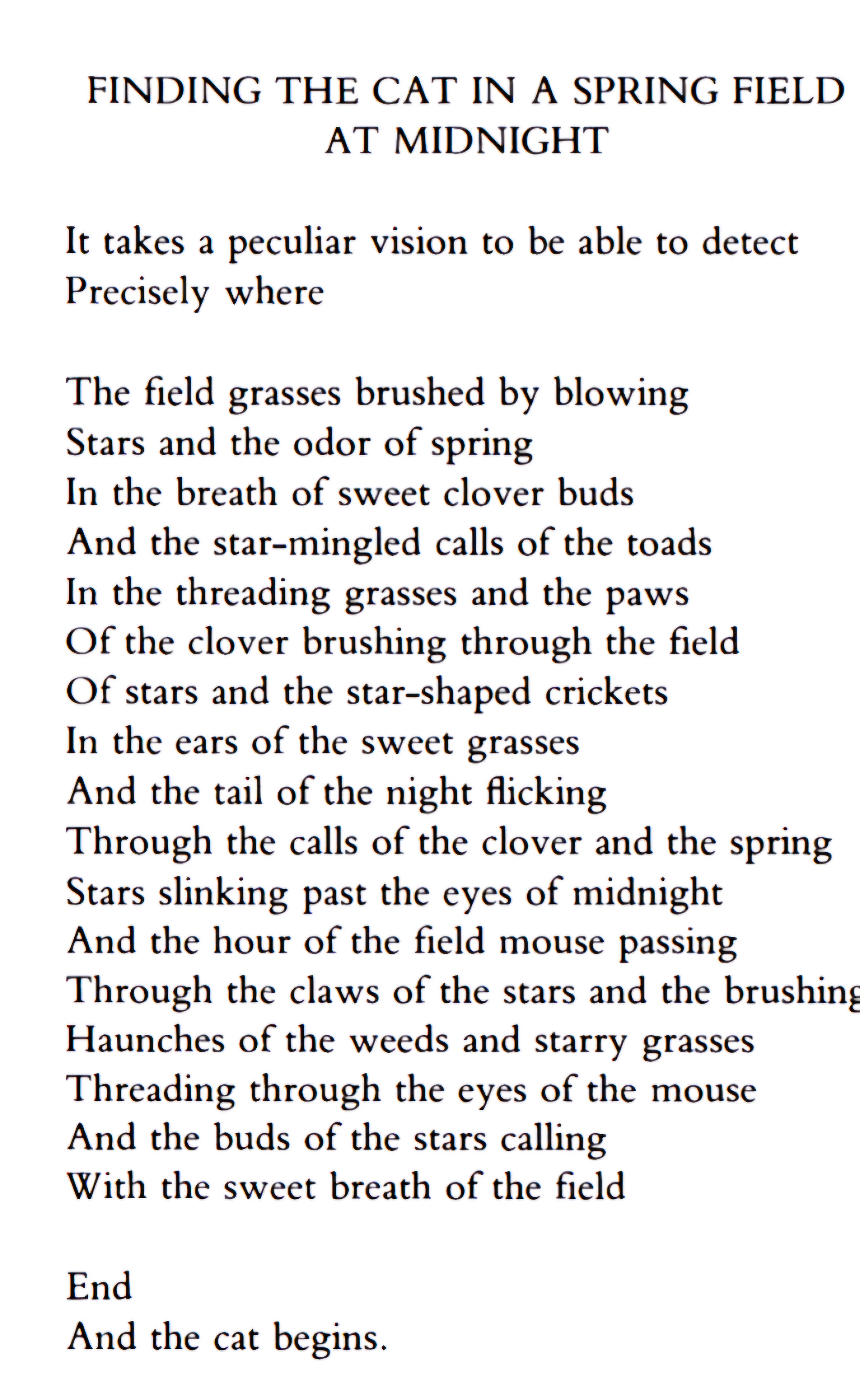
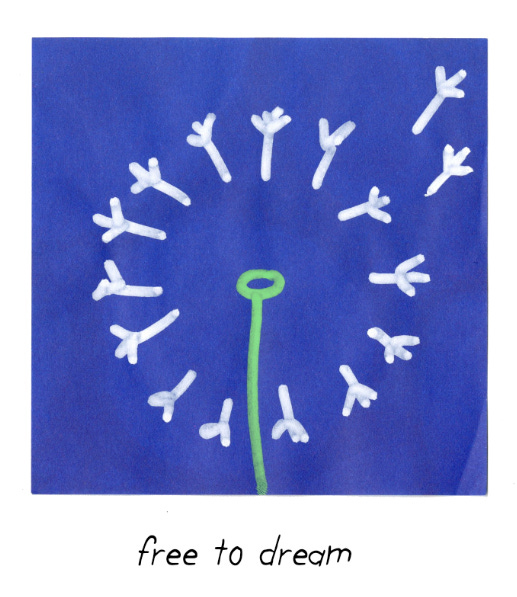
I love when the whole poem fits in the title box. I had a different poem I was trying to use but I couldn’t figure out an excerpt that made sense. Go read the whole poem, you’ll see what I mean. Plus, it’s a terrific poem!
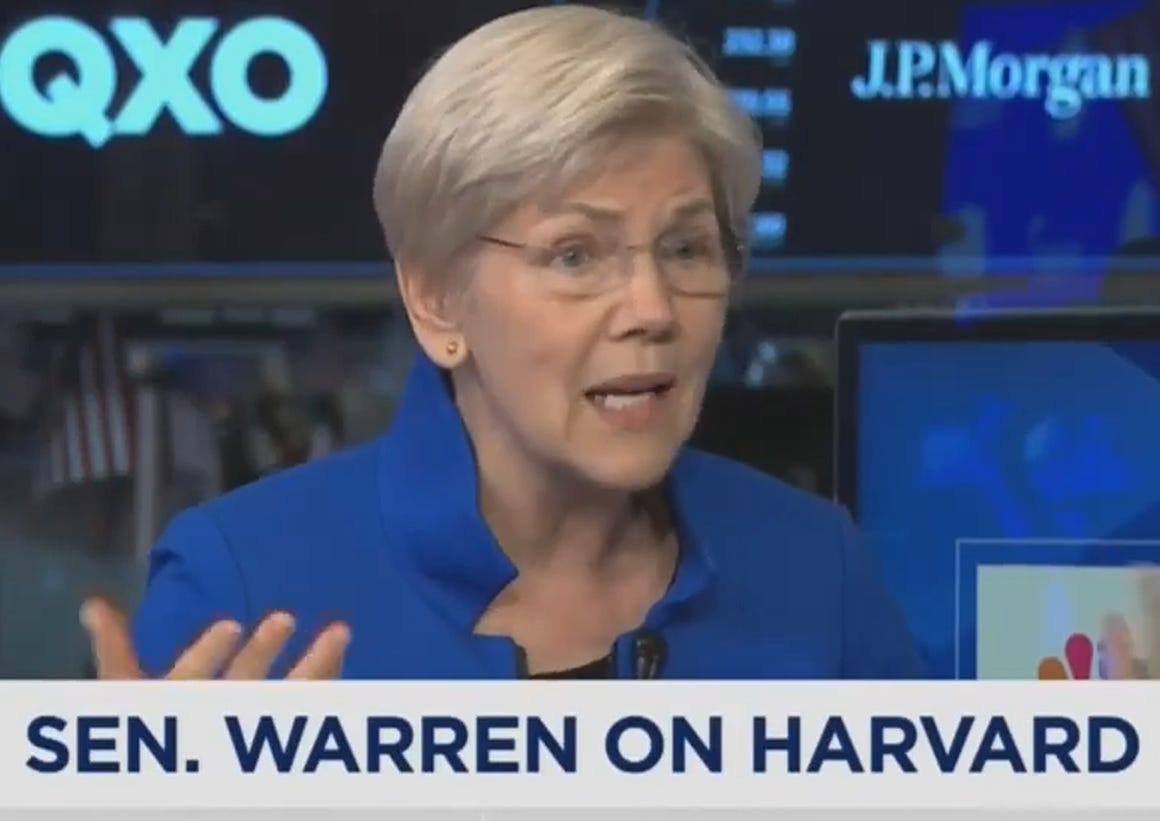
Snippet-go read this, the videos are delightful- Sen. Prof. Warren remains outstanding!
Oh yeah, baby, talk dirty to us.
Professor Senator Elizabeth Warren stopped by CNBC’s “Squawk on the Street”on Friday for some chattin’ and some rantin’ and some tarriffsplainin’ for the benefit of the show’s blow-dried hosts. We don’t normally watch financial news shows, because what are we, the Vanderbilts? But put Warren on anytime, and we’ll consider tuning in more. She can be entertaining!
Especially if your anchor isn’t following her argument, which sends her into her professorial did-you-not-do-the-reading voice. Which is what happened to Sara Eisen, who must have thought for one moment that she was back at the Medill School and had skipped that week’s assignment. (snip)
Black Mirror, eat your heart out. Researchers have apparently just figured out how to make people see a color completely new to humanity.
Scientists at the University of California, Berkeley conducted the research, published Friday in Science Advances. Using a technique called Oz, the research team induced human volunteers into seeing a color beyond the “natural human gamut.” Oz could allow scientists to conduct experiments previously not possible before, the authors say, and the lessons we learn from it might even someday help color-blind people regain their missing color vision.
Our retinas contain certain photoreceptive cells, known as cones, that allow us to see color. There are three cone types that correspond to different wavelengths of light: short-wavelength (S) cones, medium-wavelength (M) cones, and long-wavelength (L) cones.
Typically, when we try to reproduce color in front of someone’s eyes, we do so by manipulating the spectrum of light seen by the retina’s cones. But since some of our cones, particularly M cones, share overlap in how they respond to certain wavelengths, there are theoretically colors out there that our eyes can never truly see. The UC Berkeley researchers, based on their earlier work studying cone cells, say they’ve found a way around this limitation. (snip)
What is the South African Renewable Energy Masterplan?
It is an industrial strategy that sets out how South Africa can set up a new manufacturing industry in renewable energy and battery storage value chains.
The masterplan was developed by the government, some sections of organised labour, a non-profit organisation advocating for renewable energy, and representatives of the renewable energy industries. It sets out a framework to produce renewable technologies locally. These include solar photovoltaic panels, wind turbines and batteries.
The masterplan has been drawn up so that it aligns with South Africa’s existing national target of adding 3–5 gigawatts of renewable energy capacity each year to 2030. This is a scale that can support the development of local manufacturing hubs. (One gigawatt can supply electricity to about 700,000 average homes.) This steady supply will be enough to give businesses and investors the confidence to commit to long-term investments in local manufacturing hubs. These are zones where renewable systems and components are produced or assembled for domestic and export markets.
The state-owned electricity company, Eskom, has not directly guaranteed that it will buy 3-5 gigawatts of renewable energy each year. But the government’s national electricity plan (the Integrated Resource Plan) provides a strong indication of future demand. (snip)
How Crocodile Ancestors Survived The Dinosaur Extinction
Evrim Yazgin Cosmos science journalist
Crocodiles are often thought of as living fossils – unchanged over millions of years. New research has shown that their evolutionary history is a lot more complicated than that.
Crocodilia is the surviving family of a lineage which emerged about 230 million years ago (mya) called crocodylomorphs. This group split from other reptilian species including those that eventually became dinosaurs. Today, the crocodilia include crocodiles, alligators, caiman and gharials.
Ancestors of modern crocodilians survived through 2 mass extinctions, including the one which spelled the end of the “Age of Dinosaurs” 66 mya.
The teeth of this fossil Borealosuchus skull typify the toothy grin of semi-aquatic generalist predators that survived the end-Cretaceous mass extinction. Credit: Jack Rodgers/Natural History Museum of Utah.
The new study, published in the journal Palaeontology, shows that the secret to success of crocodylomorphs was their adaptability to new food sources and habitats.
“Lots of groups closely related to crocodilians were more diverse, more abundant, and exhibited different ecologies, yet they all disappeared except these few generalist crocodilians alive today,” says lead author Keegan Melstrom from the University of Central Oklahoma.
Today’s crocodilians are semi-aquatic generalists. The thrive in different habitats and aren’t picky eaters.
It was a different story with ancient crocodylomorphs.
Skulls of Araripesuchus gomesii (left), a Late Cretacious terrestrial predator and Cricosaurus suevicus (right), a Late Jurassic aquatic predator. Credit: University of Central Oklahoma.
The palaeontologists visited museum collections in 7 countries, across 4 continents to understand the evolution of crocodilian ancestors. They examined the skulls of 99 extinct crocodylomorph species and 20 living crocodilians.
Crocodylomorphs exploded after the end-Triassic mass extinction 201 mya which killed off ancient lineages of hypercarnivores and land-based predators.
“After that, it goes bananas,” says Melstrom. “Aquatichypercarnivores, terrestrial generalists, terrestrial hypercarnivores, terrestrial herbivores – crocodylomorphs evolved a massive number of ecological roles throughout the time of the dinosaurs.”
Toward the end of the time of the dinosaurs, however, crocodylomorphs started to decline.
Most of the specialised crocodylomorphs had died off by the end of the Cretaceous. Almost all 26 remaining species today are semi-aquatic generalists.
Some 215 million years ago in what is now northwestern Argentina, the terrestrial crocodylomorph Hemiprotosuchus leali prepares to devour the early mammal relative Chaliminia musteloides. Credit: Jorge Gonzalez.
“When we see living crocodiles and alligators, rather than thinking of ferocious beasts or expensive handbags, I hope people appreciate their amazing 200+ million years of evolution, and how they’ve survived so many tumultuous events in Earth history,” says co-author Randy Irmis from the Natural History Museum of Utah. “Crocodilians are equipped to survive many future changes – if we’re willing to help preserve their habitats.”
“Extinction and survivorship are 2 sides of the same coin,” Melstrom says. “Through all mass extinctions, some groups manage to persist and diversify. What can we learn by studying the deeper evolutionary patterns imparted by these events?” (snip-More)
US officials claim move was to curb drug trafficking while Quebec town says it ‘weakens collaboration’ among nations
View image in fullscreen A young girl walks over the Canada-US border line from the Haskell Free Library and Opera House in Derby Line, Vermont, on Friday. Photograph: Christinne Muschi/The Canadian Press via AP
The US has blocked Canadian access to a library straddling the Canada-US border, drawing criticism from a Quebec town where people have long enjoyed easy entry to the space.
The Haskell Free Library and Opera House is located between Stanstead, Quebec, and Derby Line, Vermont. It was built deliberately to straddle the frontier between the two countries – a symbol of cooperation and friendship between Canada and the US. (snip)
A nonprofit says it has raised enough money for Fairhope Public Library to cover state funds that the Alabama Public Library Service Board cut off last week.
Read Freely Alabama, a grassroots free speech advocacy organization that has fought restrictions on library content, said it had collected almost $39,000 from about 550 donors through Tuesday morning. Read Freely is organizing the campaign with EveryLibrary, an Illinois-based organization that promotes library funding and fights restrictions.
“We were trying to figure out what was the amount that they were pausing,” said Cheryl Corvo, a member of Read Freely Alabama and Fairhope resident. “Then, we found out it was $42,000 that they were pausing, and how it would affect our library.”
The Fairhope Public Library said it will have access to funding without interference from the state or any outside groups.
“We had a meeting with EveryLibrary, which is the group that has control of this particular fundraiser, and they take 10% and 90% of it comes to us,” said Randal Wright, a board member of the Fairhope Public Library.
The amount was not enough to severely debilitate the library’s operations, Corvo said. But it is enough to affect “some very vital resources that the library provided.” Corvo said the campaign should also make APLS aware of the magnitude of local support for the library.
Wright said that if the state continues to withhold money, the funds will go toward computers, books for the collection and paying for guest speakers. (snip)
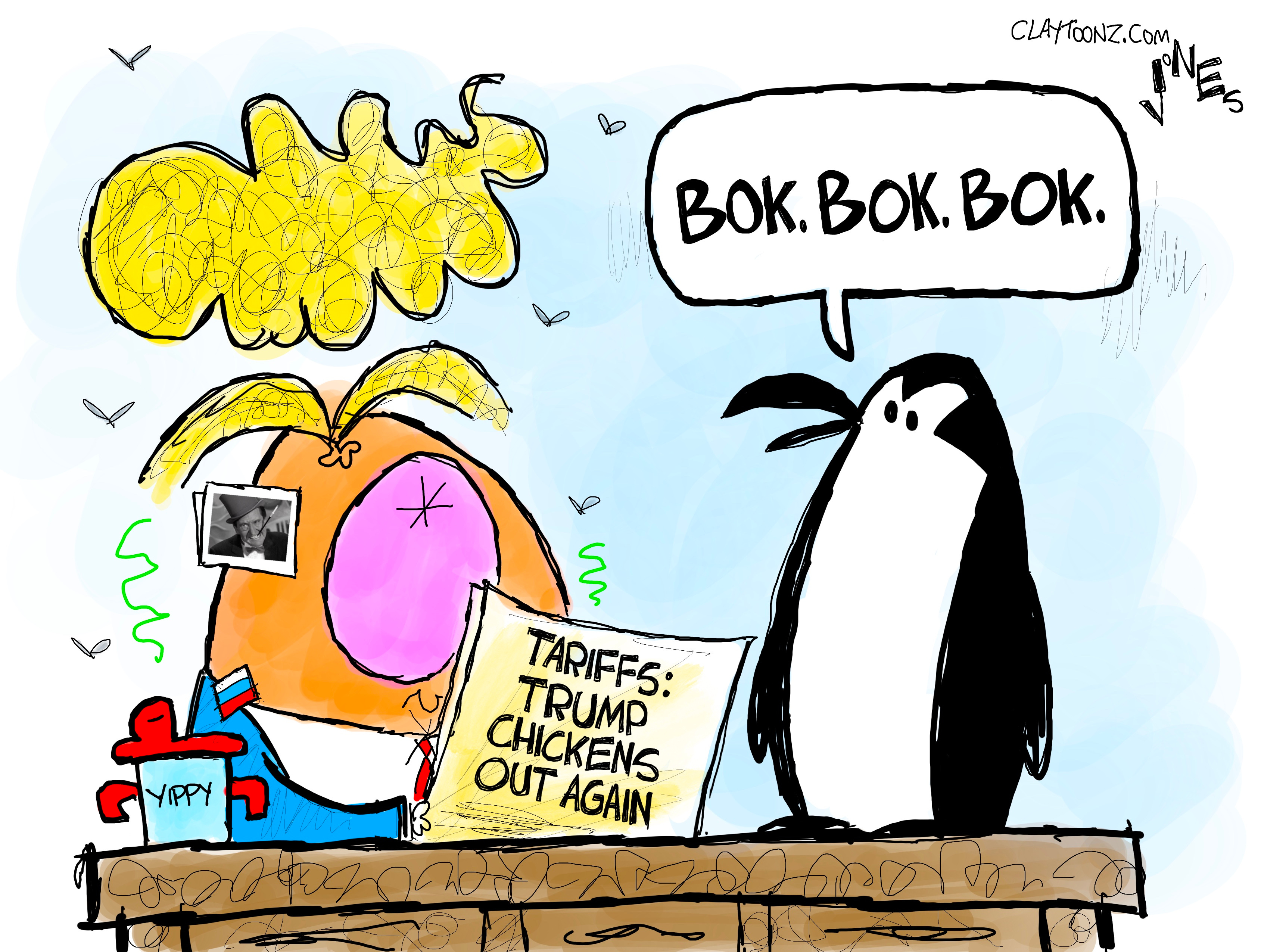
This is not a conspiracy theory, but it’s something to watch out for: Trump declares “Liberation Day” and raises tariffs on every nation in the world except Belarus and Russia. Stocks plummet, and Wall Street loses nearly $6 trillion. Then, after all sorts of promises from him and his goons about being tough, Trump chickens out and delays the tariffs for 90 days, and Wall Street rebounds. What needs to be questioned is if Trump gave any insider information to his friends that he was going to delay the tariffs, thus making Wall Street rebound. Can I get a “hmmm?”
Trump said, “I’m telling you, these countries are calling us up, kissing my ass. They are dying to make a deal. “Please, please, sir, make a deal. I’ll do anything, I’ll do anything, sir.” And then, Trump chickened out again without making any deals. Not one.
One nation that did NOT kiss Trump’s ass is China, who retaliated by raising their tariffs on us to 84 percent. Trump retaliated by raising tariffs against China to 145 percent. China is the only nation not spared by Trump’s 90-day delay.
China threatens to stop buying our products and even stop watching our movies. This is bad news because not only will that hurt Hollywood’s revenue but also make our Chinese competitors smarter because they won’t be sitting around all day watching shit like Dude, Where’s My Car?.
Trump is mad at China for retaliating. In his feeble, twisted little mind, he believes it’s personal. How dare they retaliate, which the European Union did too. The EU is now delaying their retaliatory tariffs.
So, what happened to “Liberation Day?” There was a giant dog and pony show for “Liberation Day,” and now it’s “never mind?”
Trump claims 75 nations called to negotiate, but as we’ve learned over the years, Trump lies. I’m pretty positive nobody told him, “I’ll make a deal. I’ll do anything.” But, of course, other nations are willing to negotiate. That’s what diplomacy is. Diplomacy is NOT attacking an ally by saying they should stop being a country and join yours. Diplomacy is not demanding that it give you parts of its territory. Diplomacy is not attacking your friends with tariffs to make them negotiate. You could negotiate without the attack.
Trump is making every one of his policies personal, which is how a narcissistic toddler governs. This is bullying. I would not be surprised if this entire thing is only about Trump getting more people to kiss his ass.
Attacking the entire planet with tariffs, then backing down a few days later, isn’t strength; it’s cowardice. It also shows the world that Trump is indecisive, suffers from mood swings, and can’t be trusted.
Trump’s National Economic Council Director Kevin Hassett said, “This was Trump’s plan all along.” Secretary of the Treasury Scott Bessent said this was Trump’s “strategy all along.” White House spokesgoon Karoline Leavitt said, “Many of you in the media clearly missed the art of the deal.”
I did miss “Art of the Deal,” Karoline, which Trump did NOT write and probably hasn’t even read. But do you know what I didn’t miss, Karoline? I didn’t miss Trump’s “art of the deal” when he negotiated ending a government shutdown with Nancy Pelosi. I didn’t miss that Trump walked into those negotiations with a little bit of something for his border wall and walked out of the negotiations with the government reopening and getting nothing for his stupid, racist border wall. Was that his strategy all along?
I also didn’t miss that Trump negotiated a new NAFTA with Canada and Mexico during his first term (sic) and broke those promises in his second term (sic).
I’m sure other nations didn’t miss those “arts of the deals,” nor did they miss that when Trump starts chaos, he’s impatient and will back down quickly. When push comes to shove, it’s easy to push Trump down. If you’re playing chicken with Trump, he’ll swerve first.
Every nation that negotiates with Trump on tariffs will start with the upper hand. Just like Obi-Wan Kenobi, they have the high ground.
Trump’s post about other nations kissing his ass is him showing his cards. All they have to do is kiss his ass by appealing to his giant ego, and they will out-negotiate him. It also helps them that our president (sic) is a dunderhead.
Fascist bloggerCurtis Yarvin(anti-democracy, pro-slavery, says Whites have higher IQs than Blacks, cited by JD Vance as an “influence,” attended Trump’s inauguration), talked about Trump’s “confidence” in 2.0 in an interview with The New York Times, saying, “It’s almost like he actually feels like he knows what he’s doing.”
Isn’t that exactly what we want in a president, for him to “almost feel like he knows what he’s doing?” That should have been one of the campaign messages.
What happened to make Trump chicken out with the tariffs wasn’t because he got 75 phone calls from nations ready to negotiate, but phone calls from oligarchs freaking out about the stock market. Trump says they got “yippy,” but nobody was saying, “Yippee.” Maybe something more like, “Yippee-ki-yay, Motherfucker.”
Cartooning colleagues, do NOT steal “yippee-ki-yay, Motherfucker” from me.
Trump gave himself credit for Wall Street’s rebound yesterday, but today, it’s going “yippy” again. But I’m sure Trump almost knows what he’s doing.
Creative note: I wanted to do something with “yippy,” but I couldn’t resist this penguin idea after it landed in my brain. I may do “yippee ki-yay” later if it’s not stolen from me.
Music note: I listened to the Red Hot Chili Peppers, but only for a few minutes because this cartoon didn’t take long to color.




 Scottie's Playtime