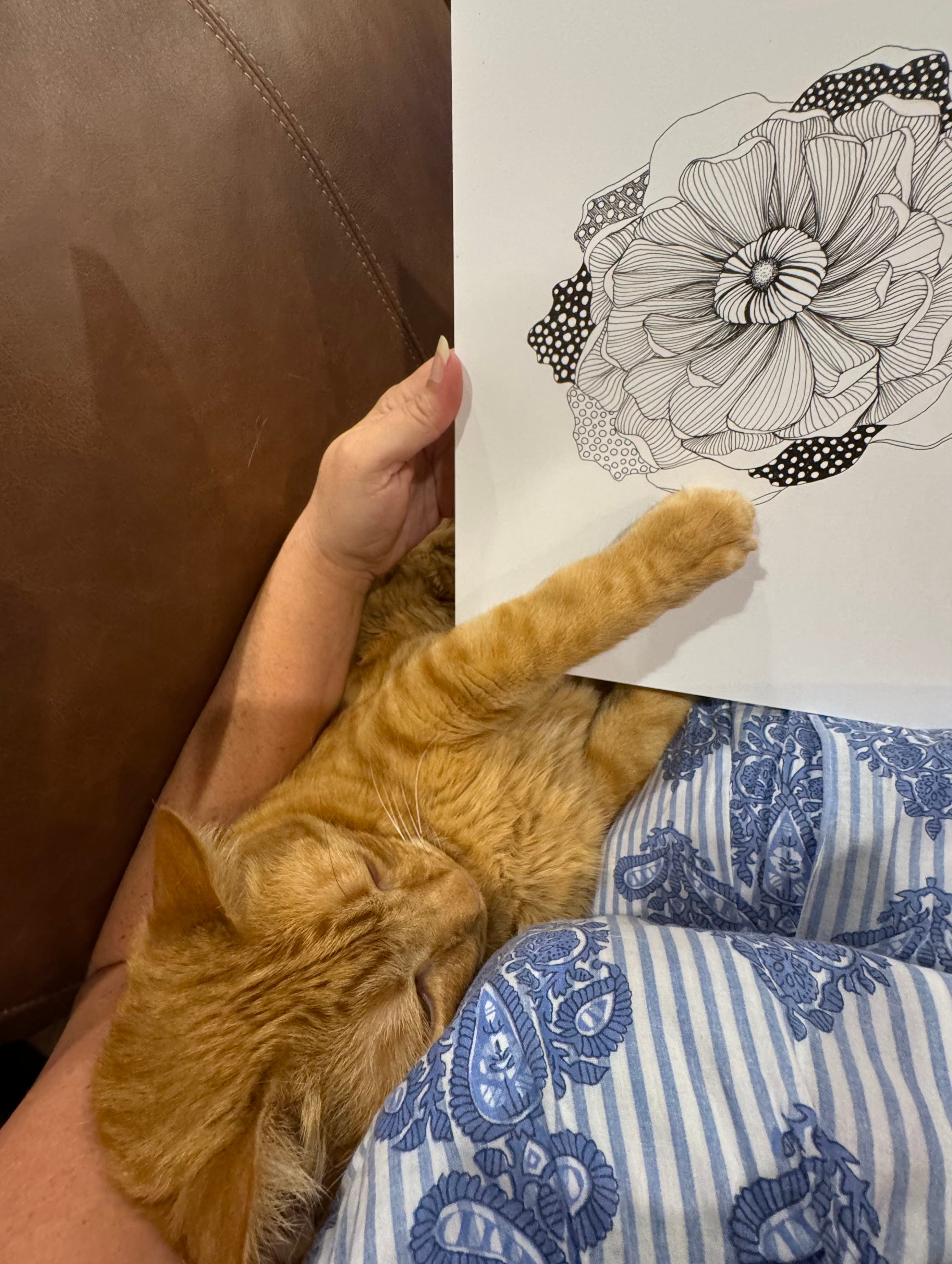
This week I started a drawing that was all vines and flowers and it was fine, but a little boring and so I decided to add Hunter S. Thomcat to it because he’s always trying to add himself to drawings anyway. Exhibit A:
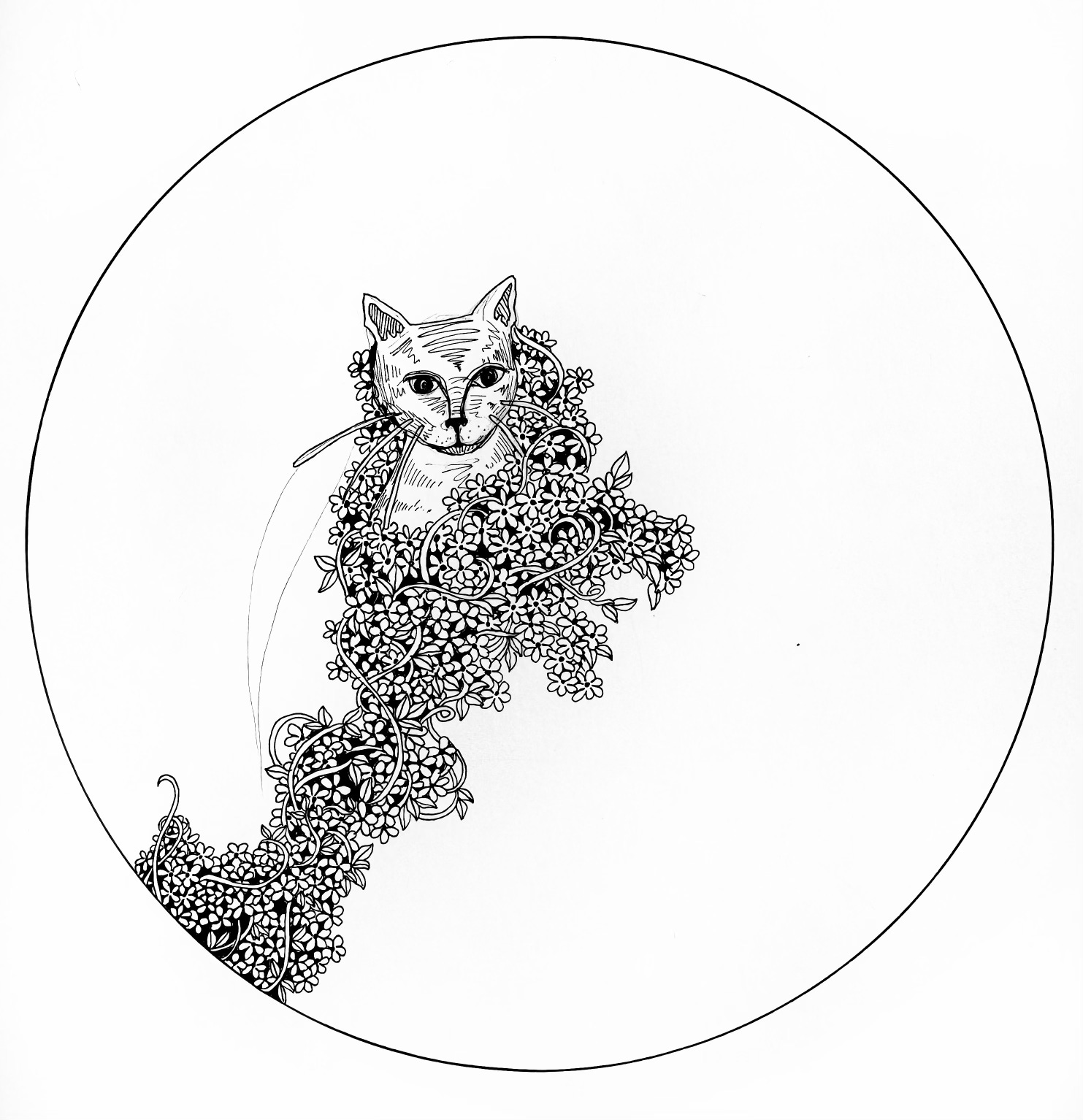
And it was a very good idea in theory but somehow it turned…weird? And I kept trying to fix it and it kept getting worse and I would like this to be one of those stories that ends with, “AND EMBRACING THE FLAWS MADE IT EVEN BETTER” but that did not happen because, well…look:
Why does he look vaguely human?
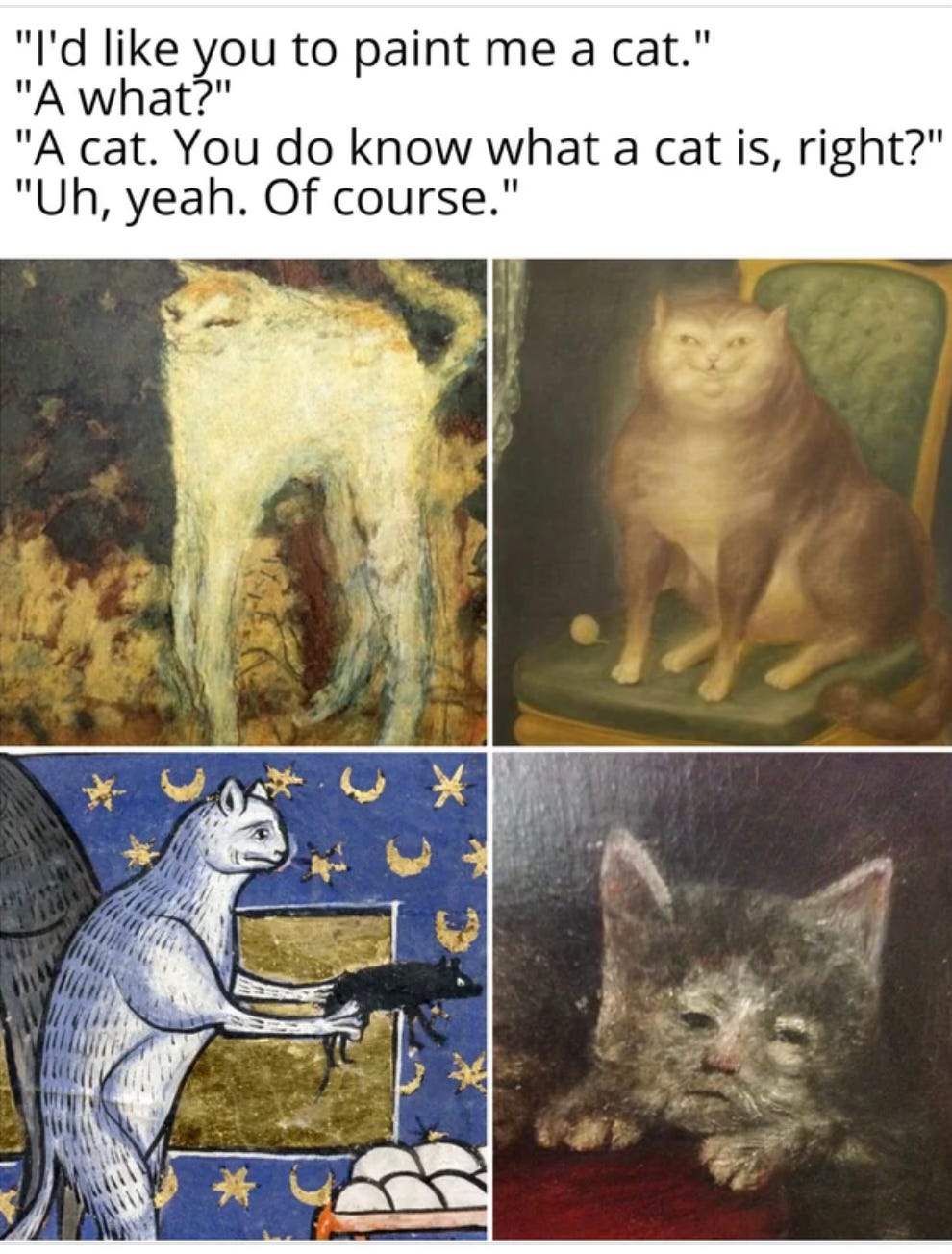
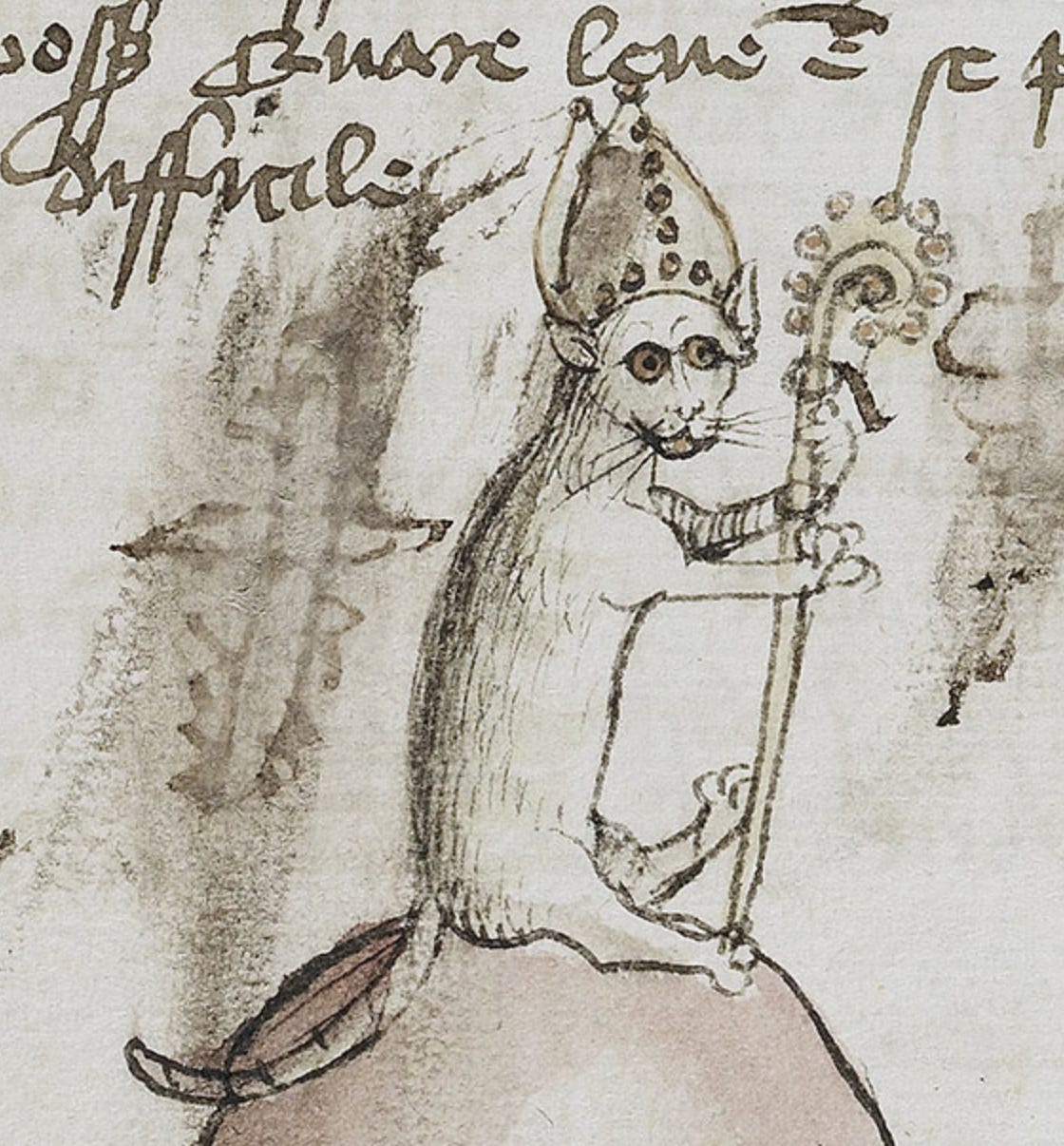
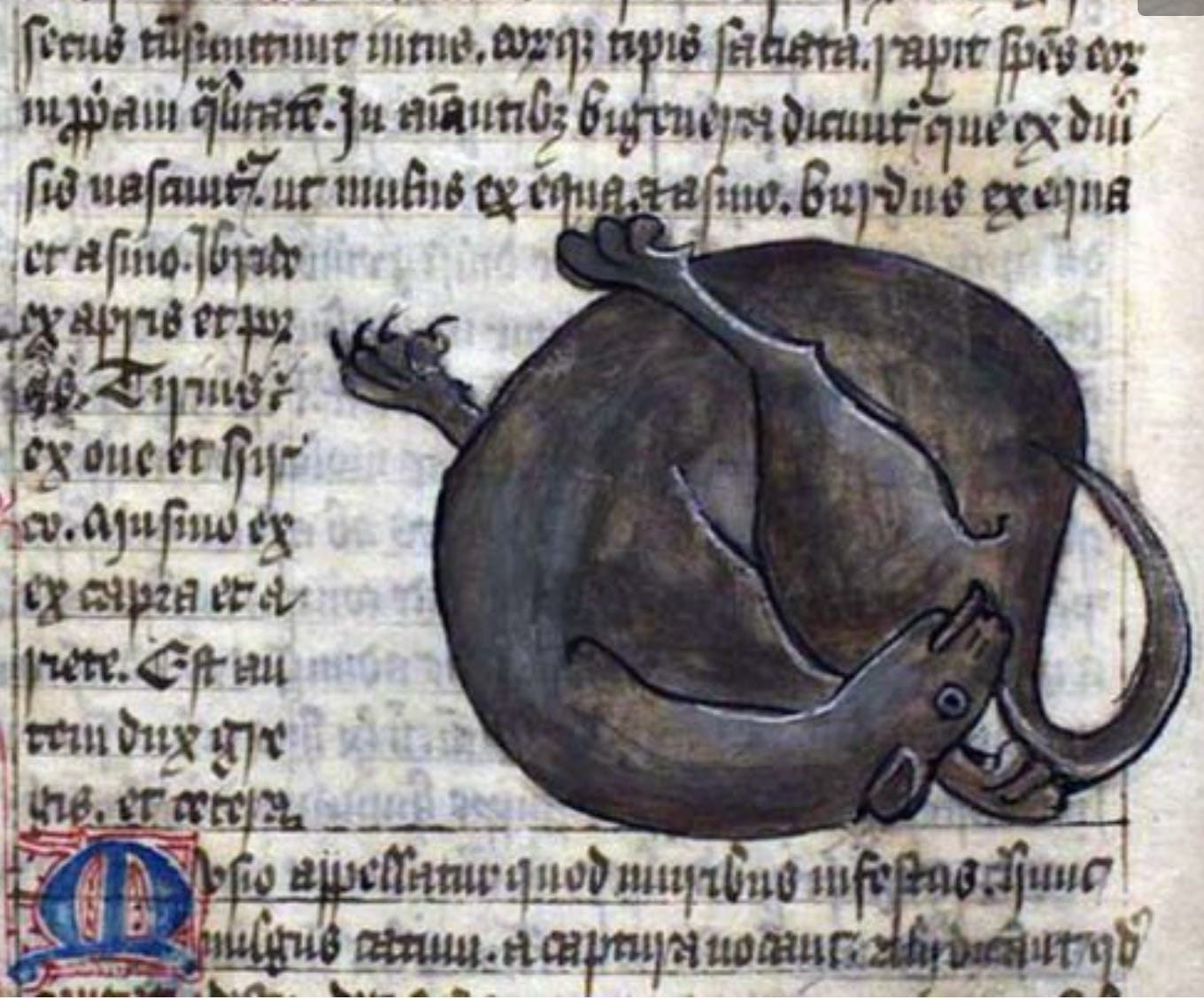
Anyway, I gave up and started another drawing but I’m not finished with it yet and I was feeling a little disappointed in my myself until I saw this collection of medieval cat paintings:
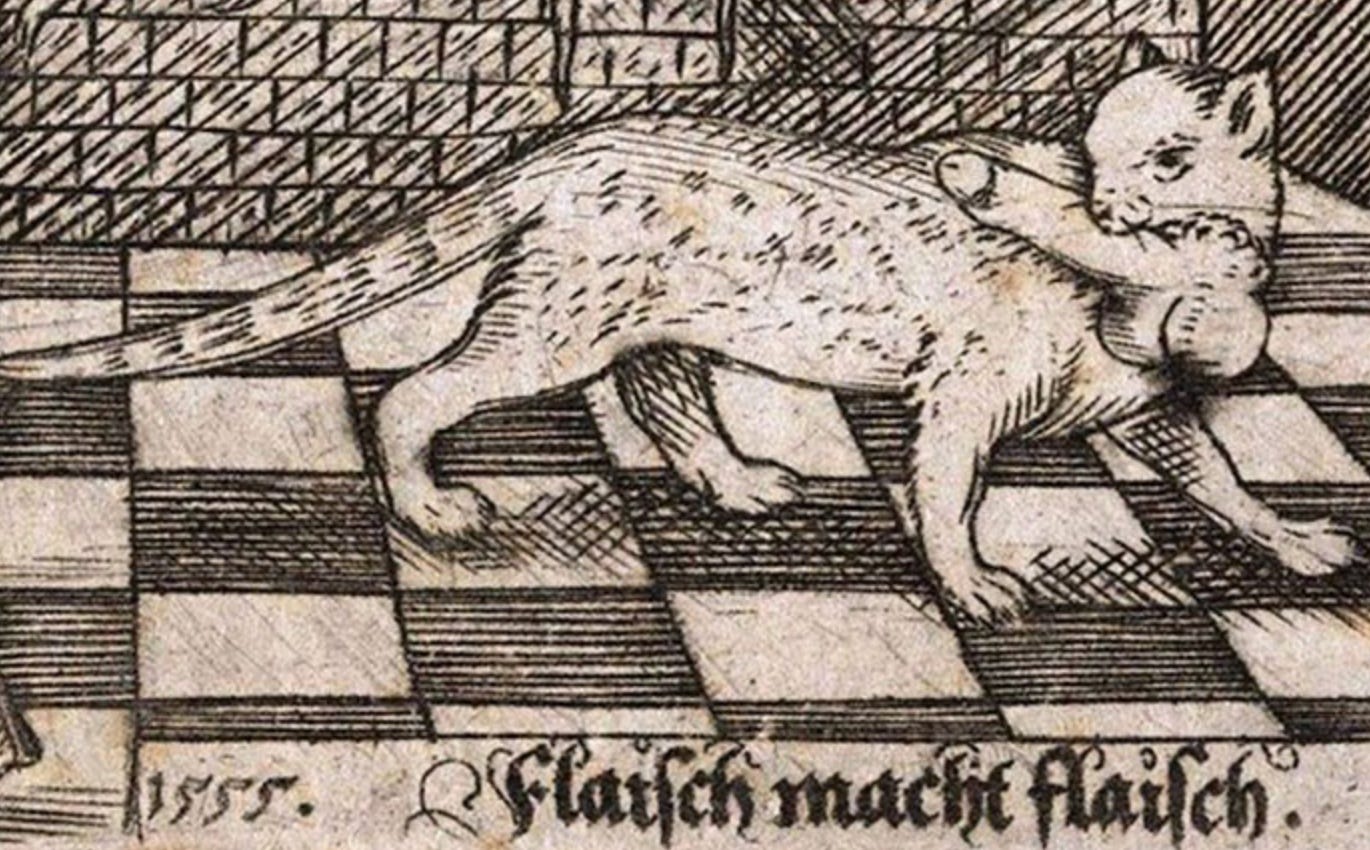
Turns out cats have been fucking up art for centuries because they are enigmatic and mysterious:
And comparatively, my cat drawing became slightly less unnerving.
It important to remember…they’re not all going to be winners.
Or…you know…always make sense?
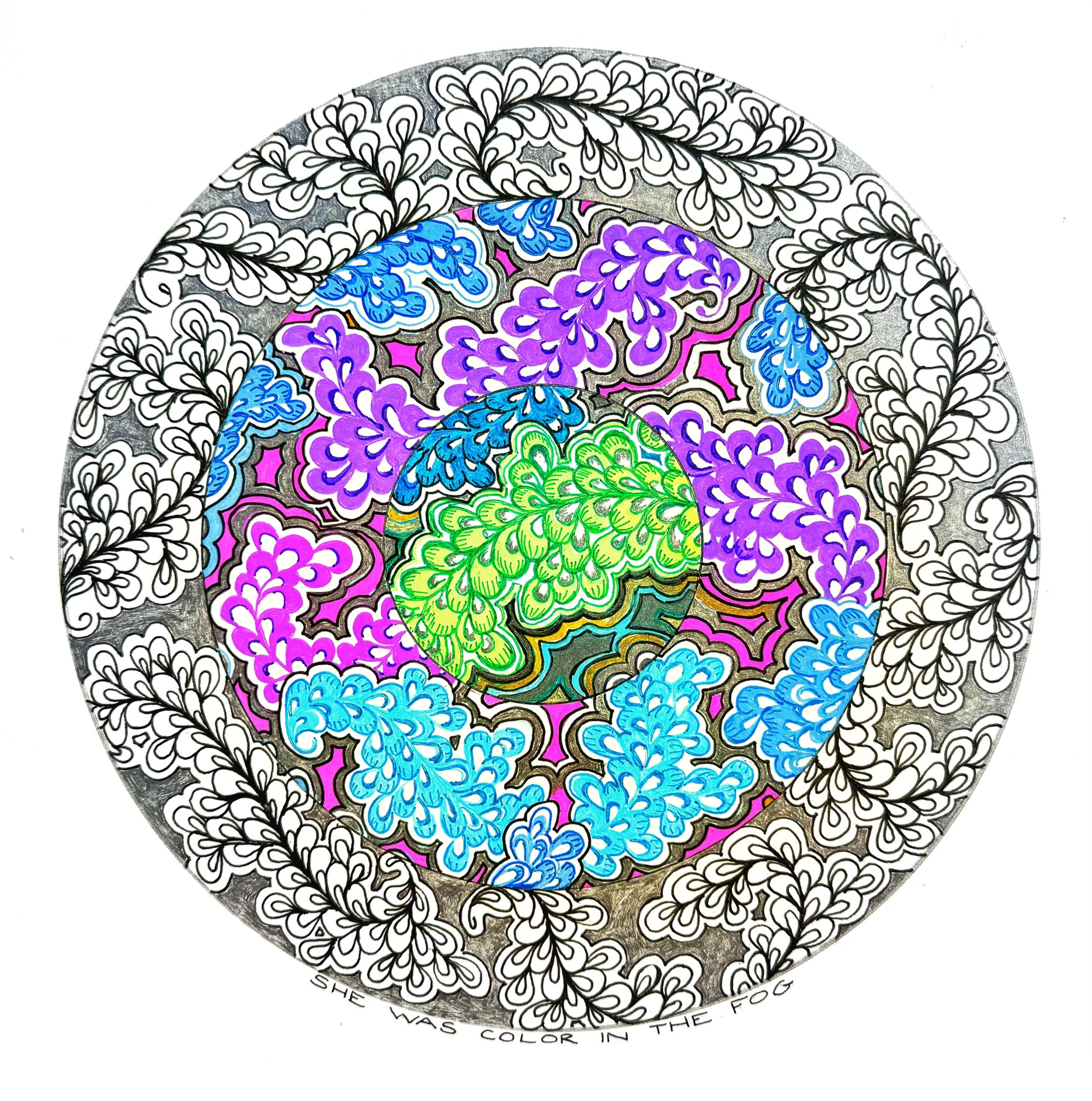
But since I don’t have a finished drawing I do have this for you…a drawing a did awhile ago that I added color to before I realized that I’m actually not that great at color combinations.
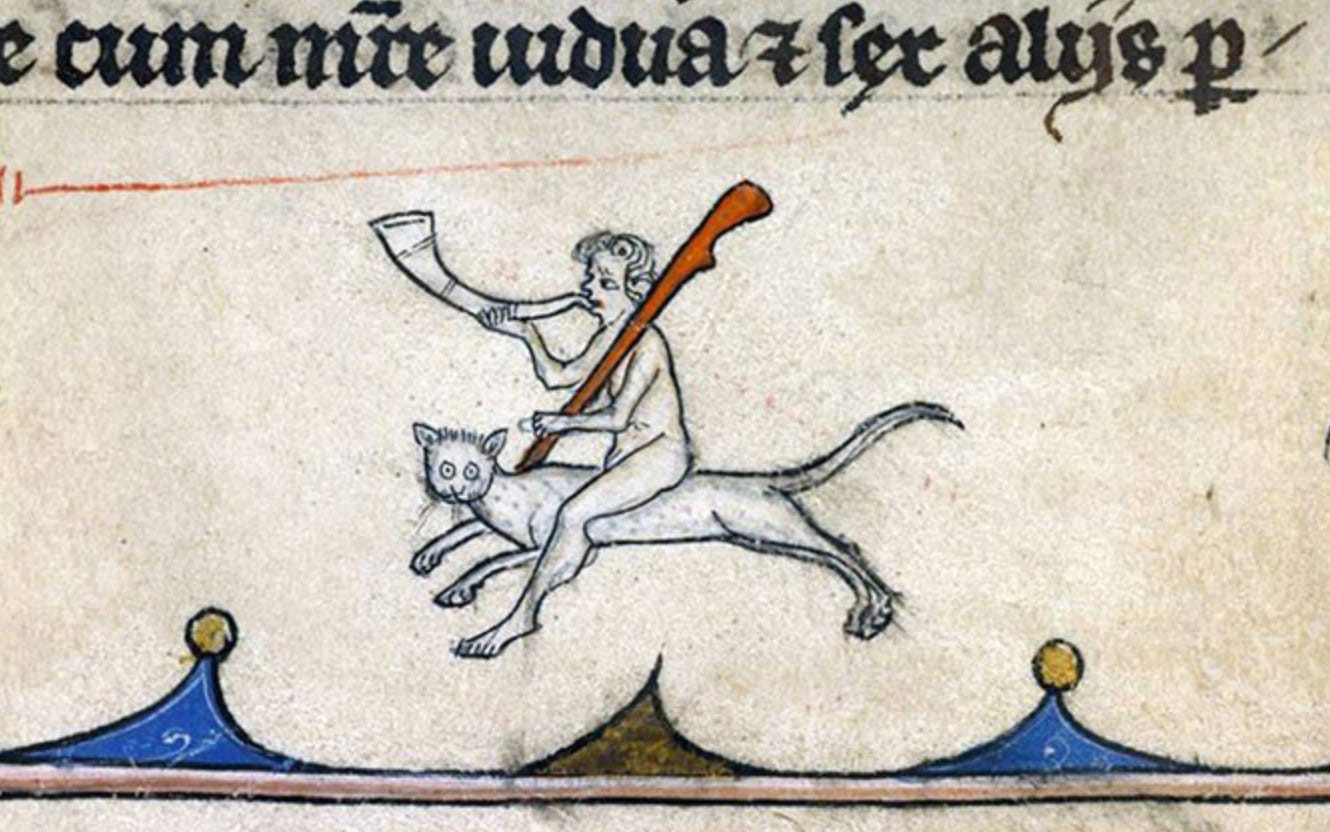
It’s no medieval cat eating a dismembered penis, but then again…what is?
In a world increasingly illuminated by artificial light, the beautiful night skies of a small coastal town in South Australia have attracted international recognition. Carrickalinga on the Fleurieu Peninsula is Australia’s first official Dark Sky Community. The title rewards a dedicated community effort to combat light pollution and preserve the natural environment at night.
The journey began three years ago when I was a PhD candidate at the Australian National University, working on the value of night skies. I was a regular visitor to Carrickalinga, but this time conversations at a picnic one evening turned to the clarity and brilliance of the stars. I was inspired to work with the locals to nominate Carrickalinga as a “Dark Sky Place”.
My recent research suggests restoring dark skies would be worth US$3.4 trillion (A$5.16 trillion) to the world, annually. That’s largely because light pollution is disrupting nocturnal pollinators, altering predator-prey interactions, and changing the behaviours of nocturnal species.
Light pollution has detrimental effects on wildlife, human health, and ecosystem functions and services. But there are simple solutions. By embracing responsible lighting practices, everyone can contribute to a healthier future in which the wonders of the night sky are accessible to all.
Understanding light pollution
Light pollution refers to human alteration of outdoor light levels. Excessive or misdirected artificial light brightens the night sky, diminishing our ability to see stars.
Research shows the problem is getting worse. Light pollution increased by 7–10% a year from 2011 to 2022. More than a third of people on Earth cannot see the Milky Way.
Light pollution not only affects our view of the cosmos, but also wastes energy and money, contributes to climate change and has significant repercussions for both ecological and human health.
Nocturnal animals such as bats and certain birds rely on darkness to navigate and find food. Insects, crucial for pollination and as a food source for other wildlife, are also affected. Artificial light at night is contributing to their decline.
In humans, studies have shown artificial light interferes with circadian rhythms, leading to sleep disorders and other health issues.
The global Dark Sky movement
DarkSky International, formerly known as the International Dark Sky Association, is a global network of volunteers combating light pollution. The non-profit organisation established in 1988 is based in Tuscon, Arizona in the United States. But more than 193,000 people across more than 70 countries are involved, including astronomers, environmental scientists and the public.
The International Dark Sky Places Program was born in 2001 when Flagstaff, Arizona was named the first International Dark Sky City. Now the program certifies five types of Dark Sky Places: sanctuaries, reserves, parks, communities, and urban night sky.
DarkSky says the aim is to “preserve and protect the nighttime environment and our heritage of dark skies through environmentally responsible outdoor lighting”. It recognises places that demonstrate a commitment to reducing light pollution through public education, policy, and promoting responsible lighting practices.
There are now well over 200 Dark Sky Places across the globe. This covers more than 160,000 square kilometres in 22 countries on six continents.
Australia’s Dark Sky Places
Australia is home to several Dark Sky Places, each recognised for their exceptional night skies and dedication to reducing light pollution. These include:
Since 2021, the Carrickalinga community has worked tirelessly towards achieving International Dark Sky Community certification. The journey involved several key initiatives:
Sky Quality Metering Program: regular measurements of sky brightness to monitor light pollution levels
Community engagement: presentations to community groups and the district council to raise awareness about light pollution, information stalls at local markets, community consultation process (led by the District Council of Yankalilla)
Educational materials: printed flyers, video, and a “Star Party” including a presentation on First Nations cosmology
Policy development: collaboration with the district council to create a lighting policy including public lighting design that complies with both Australian standards and DarkSky requirements.
Carrickalinga is currently upgrading existing public lighting to reduce light pollution. This will involve a new lighting design plan that reduces correlated colour temperature, ensuring shielded downward-facing lights minimise skyglow, glare and light trespass.
Reducing light pollution by upgrading lighting fixtures does not compromise safety. Dark sky does not mean dark ground.
Light pollution has become such a problem because our lights are unnecessarily bright and poorly designed. Fixing the problem simply involves changing the colour from white to amber, shielding and targeting lights so they do not shine upwards and outwards, and reducing wattage where it is surplus to requirements for people’s safety.
Carrickalinga became Australia’s first International Dark Sky Community in May, 2024. Credit: The Backyard Universe
How you can help
Achieving and maintaining dark sky status is not difficult but it does require ongoing community effort. Here are the five principles for responsible outdoor lighting, which apply equally to domestic as well as public lighting:
Useful – use light only if it is needed and has a clear purpose
Targeted – direct light so it falls only where it is needed
Low light levels – light should be no brighter than necessary
Controlled – use light only when it is needed
Warm colours – use warm coloured lights wherever possible and avoid short-wavelength (blue–violet) light.
An inspirational journey
Achieving International Dark Sky Community status was a significant achievement in preserving the natural night environment and educating the local community about light pollution. This accomplishment demonstrates the power of community action and serves as a model for others.
By protecting our night skies, we safeguard a vital part of our natural and cultural heritage and also promote healthier ecosystems and communities. Carrickalinga’s journey serves as an inspiring example of what can be achieved through collective effort and dedication to preserving our planet’s natural beauty.
I would like to acknowledge the enormous contribution of Carrickalinga Dark Sky Community volunteer Sheryn Pitman, who works for Green Adelaide in the South Australian Department for Environment and Water, and helped write this article.
Before internet memes, postcards offered a popular, accessible, shareable means to combine image and word. Messages could be as simple as “wish you were here,” but in their “golden age” (circa 1898–1917), postcards provided a powerful way to promote political agendas, writes scholar Kenneth Florey. The golden age neatly coincided with the height of the women’s suffrage movement in the United States and Britain. More than a thousand varieties of pro- and anti-suffrage-themed postcards were produced then, 200 of which are included in “Votes and Petticoats,” a Johns Hopkins University digital collection available on JSTOR. Of these, a significant number, curiously, depict cats—both as women’s pets and as women.
Associations between ladies, cats, and cat ladies—childless and otherwise—are rooted in a long, complicated cultural history. In Edwardian times, cats were linked to women as creatures of the domestic domain: woman was Angel of the House, the cat her companion, both of them sweet, warm, helpful, and cute. At the same time, animal lovers, “spinsters,” and suffragists represented overlapping, suspect categories of womanhood. It’s the perennial paradox in which women find themselves: somehow looked down upon while also placed on a pedestal.
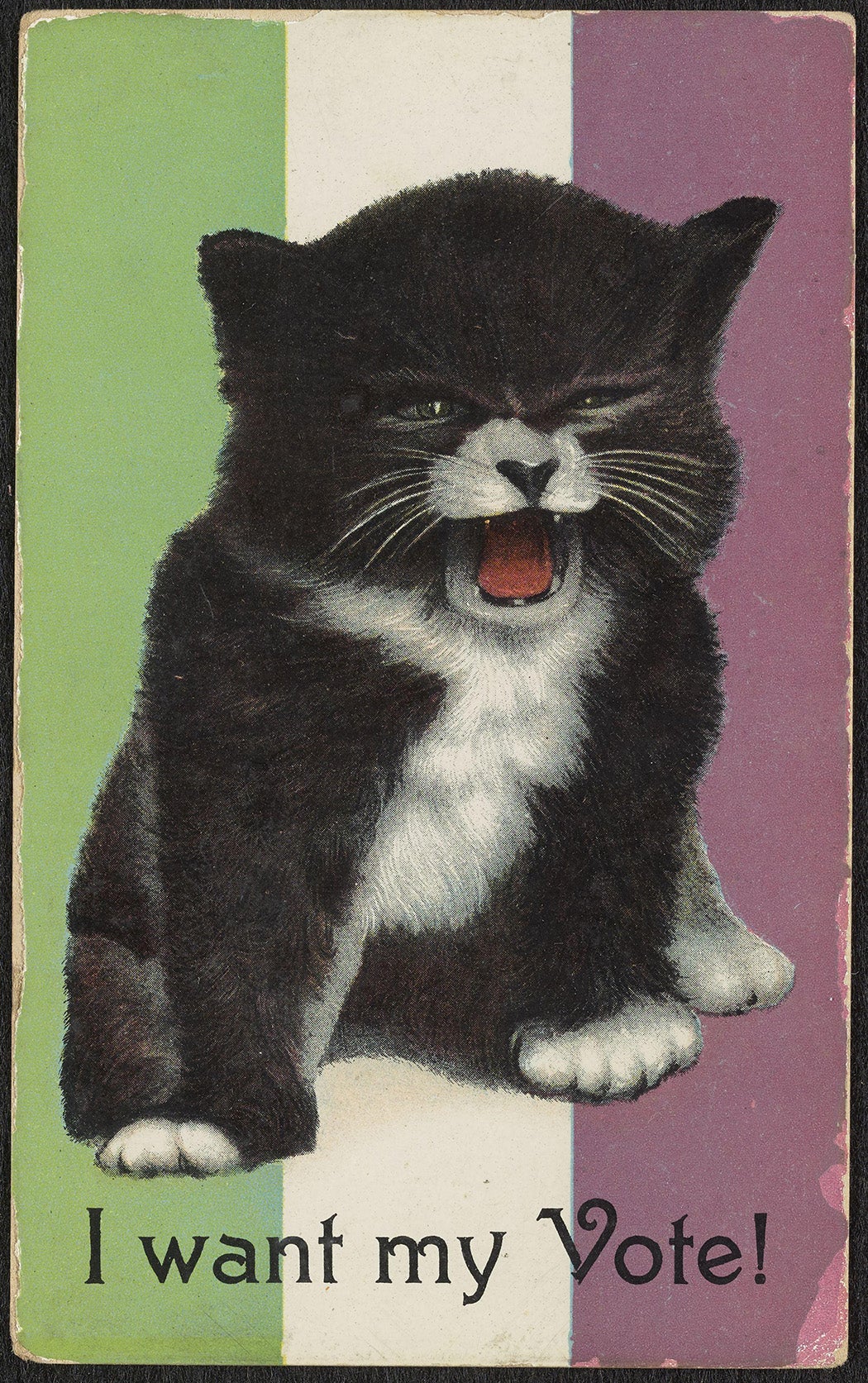
I Want My Vote! Courtesy Votes and Petticoats: Postcards, The Sheridan Libraries, Johns Hopkins University.
This postcard captures many of the themes that recur across the collection: it suggests that a woman demanding the vote is as silly as a kitten so doing, their protests as ineffective as the kitten’s mewls. The green, white, and purple stripes behind the kitten were the colors of the Women’s Social and Political Union (WSPU), one of the more militant British suffrage societies. Historian Krista Cowman interprets the sexism in this postcard as infantilizing though not especially cruel. Similarly, Florey describes the use of cats in suffrage postcards as softening a message that might otherwise seem harsh.
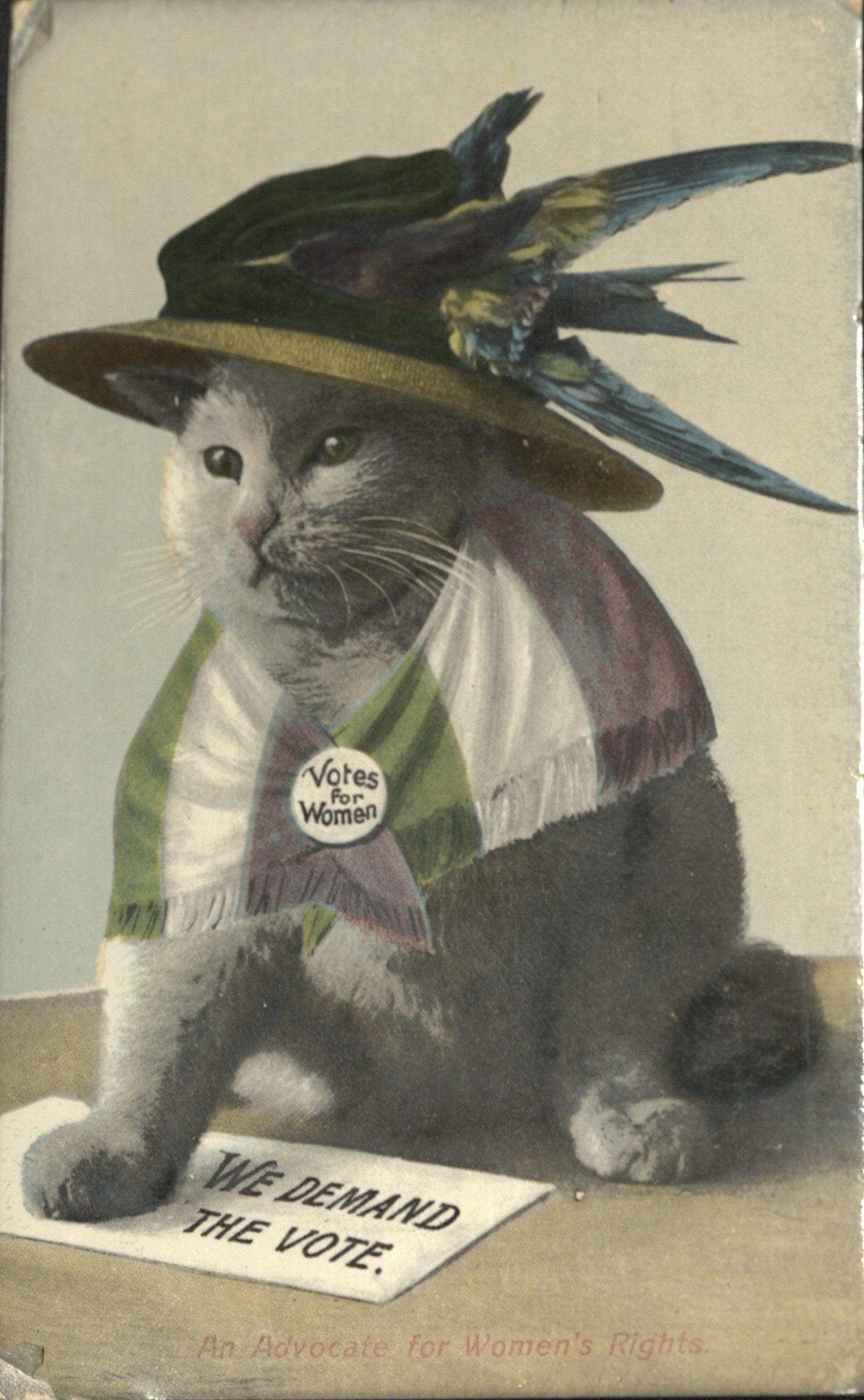
We Demand the Vote: An Advocate for Women’s Rights. Courtesy Votes and Petticoats: Postcards, The Sheridan Libraries, Johns Hopkins University.
In a similar vein, this cat is draped in the colors of the WSPU and wearing a fashionably magnificent hat. The message is ambiguous: Larissa Schulte Nordholt contends that it’s probably meant to satirize the concept of women participating in politics, the well-groomed, fat feline playing on the perception of suffragists as spoiled. It was published by a company that produced other, more clearly anti-suffrage postcards. But there’s a certain dignity in the cat’s determined forward gaze and assertive paw that perhaps suffragists could have embraced, regardless of the creator’s intention. Then again, that seriousness can also be interpreted as the very thing an anti-suffragist postcard maker was mocking by attaching it to a fluffy house cat.
Less whimsically, other postcards feature cats as pets in human scenes.
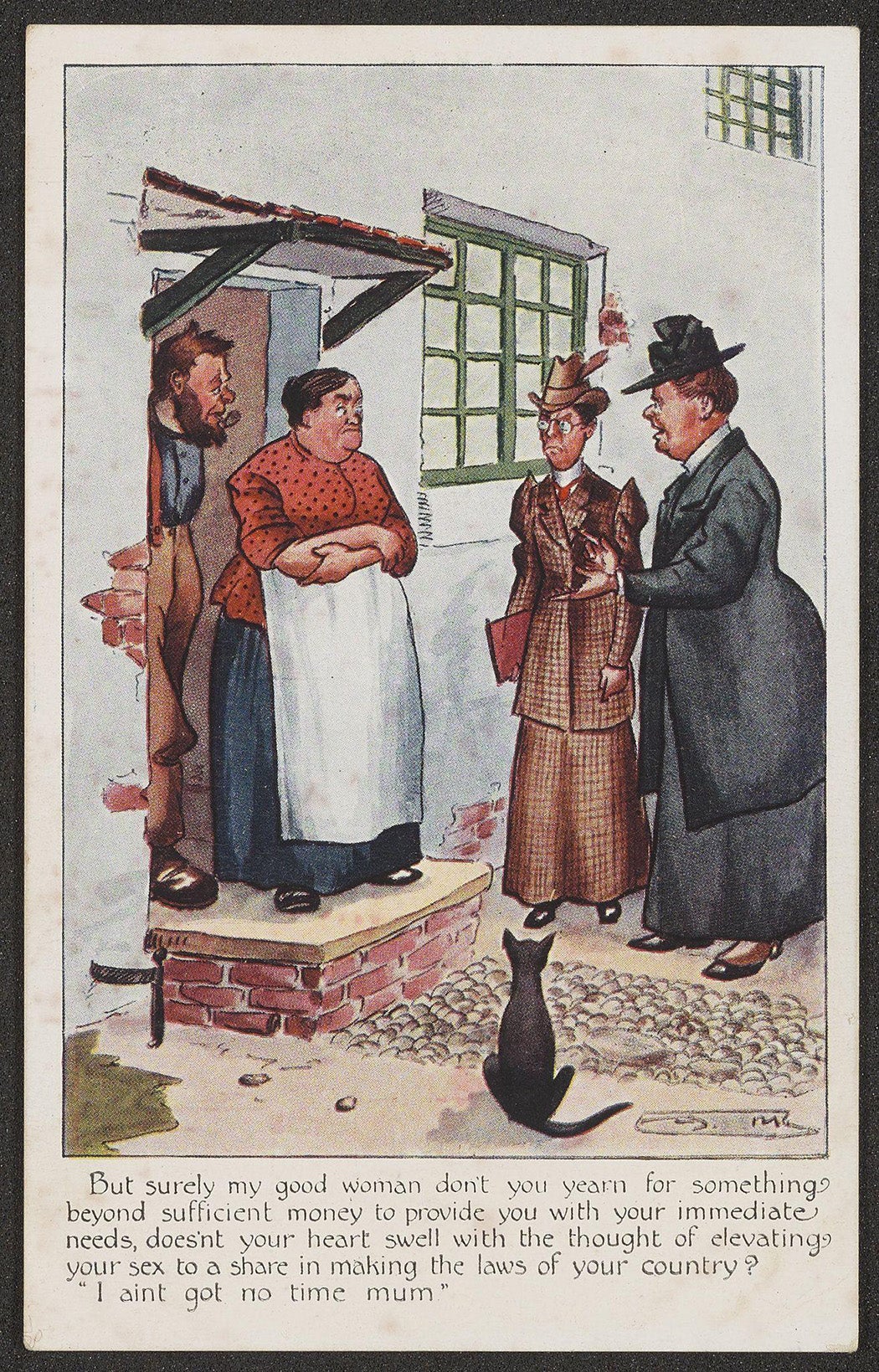
Courtesy Votes and Petticoats: Postcards, The Sheridan Libraries, Johns Hopkins University.
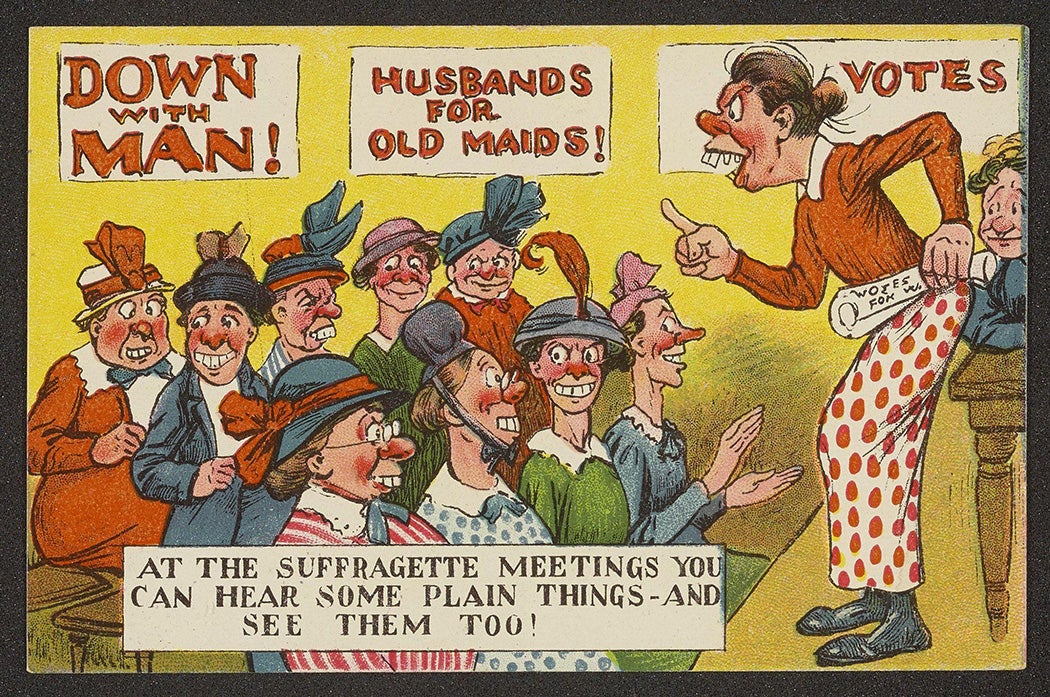
Here, the suffragists portrayed are mannish and middle-aged, typical of many negative suffragist depictions, stereotyping them as unsexed spinsters. While the housewife they address isn’t an idealized Angel of the House, she has a traditionally “motherly” figure and wears more feminine clothing. The suffragists, the viewer thus understands, are out of touch with what “real” working women want. If the suffragists had families to occupy them, they wouldn’t worry about the vote. And if lower-class women had the vote, they wouldn’t care to exercise it.
The cat in this postcard is outside the house and thus linked to the suffragists (it sits slightly apart, but arguably that positioning is dictated by compositional rather than symbolic reasons). The suffragists are “outdoor cats,” less benign and more feral—less feminine—than their indoor counterparts. It’s also worth noting that the cat is black, which taints it, and thus the suffragists, with associations of witchcraft and bad luck.
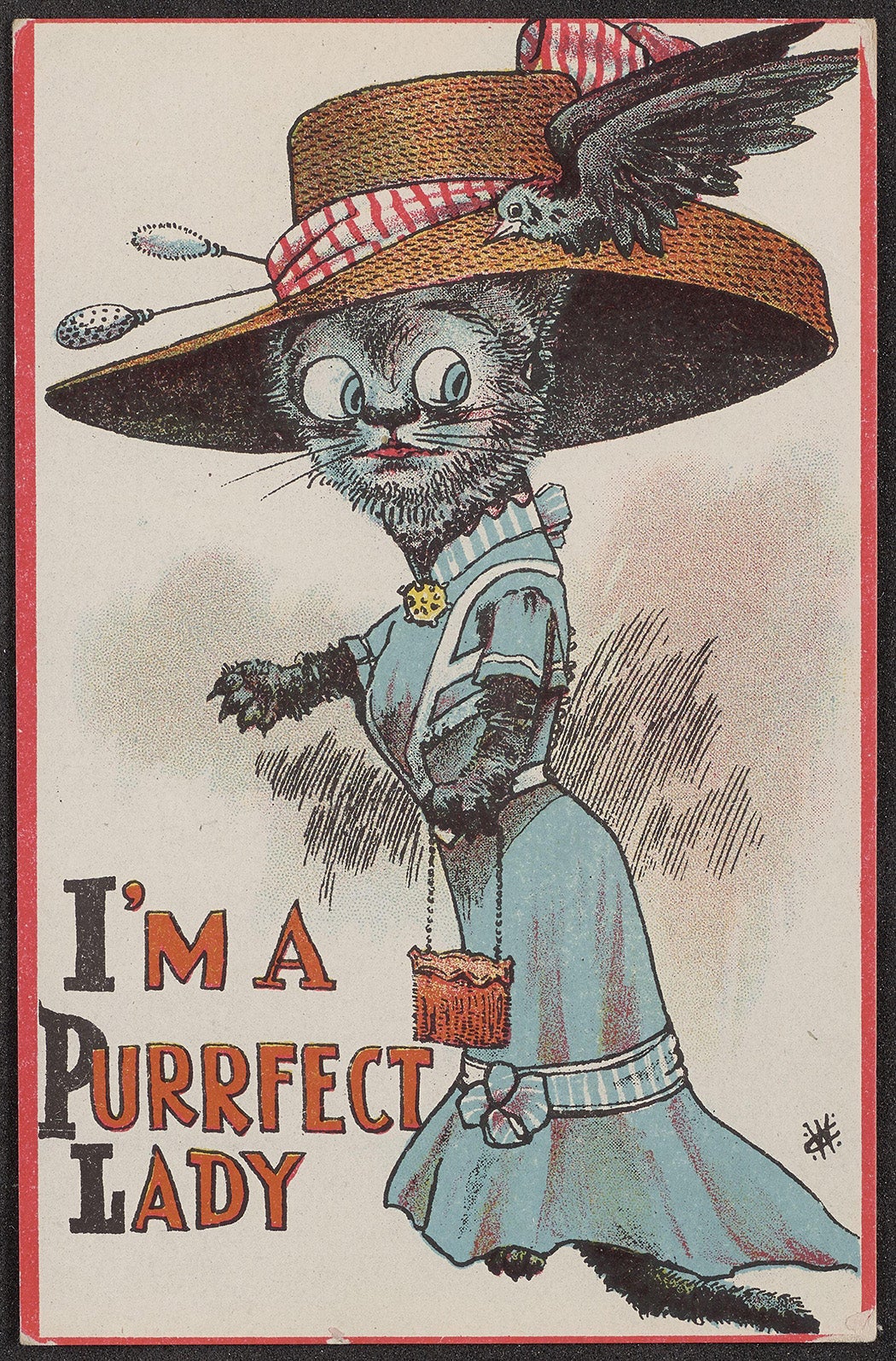
I’m a Purrfect Lady. Courtesy Votes and Petticoats: Postcards, The Sheridan Libraries, Johns Hopkins University.
Here too the suffragist is associated with a black cat, to unflattering, ridiculous effect. Although it was considered appropriately feminine for women to care for animals, women and femininity were also considered weaker, sillier, and more frivolous than men and masculinity; caring too much for other creatures came was considered a sign of fragility and triviality.
Tobias Menely has traced the disparagement of animal welfare through the evolution of gender norms in the modern period. As an early example, he cites a 1786 Scottish magazine story about a “Mrs. Sensitive” who dotes on a menagerie of pets yet cares little for “poor Christians.” In Menely’s analysis, Mrs. Sensitive is “immoral and unnatural, an ancestor of our own crazy cat ladies, women whose maternal instincts, we are led to believe, have been attenuated by an affinity for animals.”
By 1909, around the time these postcards were produced, sensitivity to animals was fully pathologized, as Menely relates: one doctor, Charles Dana, called it “zoöphilpsychosis” and published an article about it in the Medical Record. A case study pronounced a “childless woman who transformed her house into a hospital for sick felines” as “beyond medical redemption.” Sufferers of “zoöphilpsychosis” were described as “sentimental,” “weak,” and “hysterical”—terms loaded with sexist connotations.
These stereotypes are further repeated in conversations surrounding the anti-vivisection movement, another woman-dominated cause that reached its height in the Victorian and Edwardian eras.
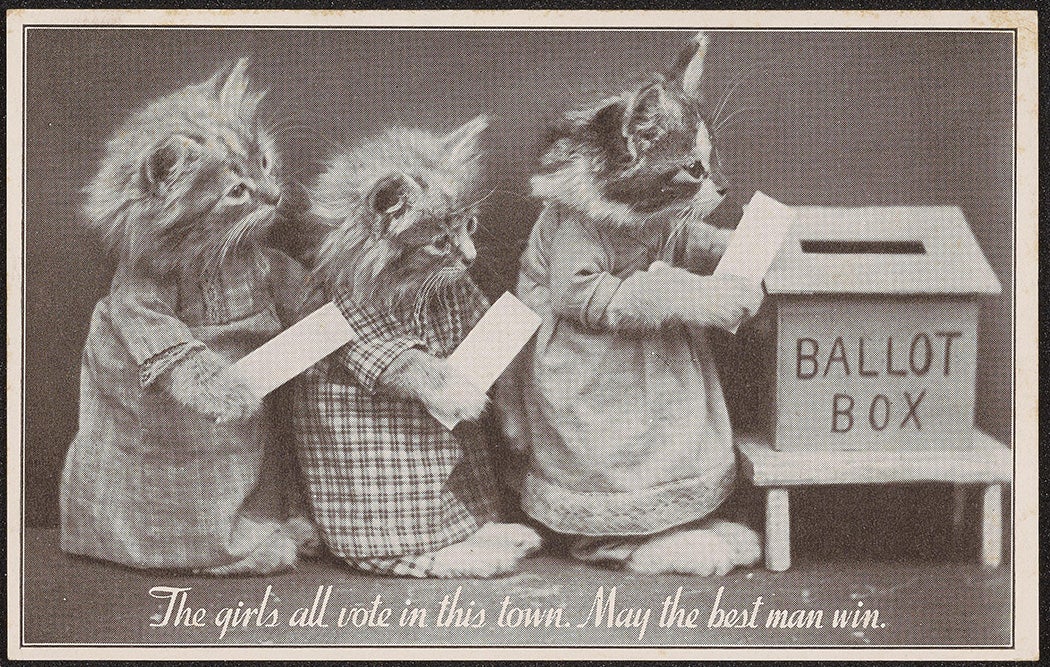
The Girls All Vote in This Town. May the Best Man Win. Courtesy Votes and Petticoats: Postcards, The Sheridan Libraries, Johns Hopkins University.
This is one of several suffrage postcards that feature photographs of live and presumably taxidermized kittens dressed up and posed. Although this postcard’s message could be interpreted multiple ways, Nordholt points out that the use of taxidermy speaks to the “synchronous oppressions of women and cats.”
Indeed, Susan Hamilton quotes a contemporary critic of anti-vivisection using misogyny to defend animal cruelty:
Is it necessary to repeat that women—or rather, old maids—form the most numerous contingent of [antivivisectionists]? Let my adversaries contradict me, if they can show among the leaders of the agitation one young girl, rich, beautiful, and beloved, or some young wife who has found in her home the full satisfaction of her affections!
Although suffragettes and antivivisectionists didn’t always align, the two movements had much in common, including the consistent stereotyping of their members as spinsters. And as we have seen in “But Surely My Good Woman…,” spinsters were objects of mistrust and derision.
Courtesy Votes and Petticoats: Postcards, The Sheridan Libraries, Johns Hopkins University.
It wasn’t always that way. For a time in the nineteenth century, single women could claim feminine power through the “Single Blessedness” movement. Where women had long been shamed or pitied for not marrying, they began to frame their singleness as reflective of a higher calling: still nurturing, still Christian, but outside of marriage. Harriet Tubman, for example, spent eighteen of her most productive and prominent years without a husband. As a Black woman, Tubman faced extra scrutiny for being unmarried. She leveraged the concept of Single Blessedness for respectability.
As women began to agitate more for equal rights, however, Single Blessedness fell out of favor. Lee Chambers-Schiller provides an overview, writing that
[a]s the century wore on, spinsters were increasingly defined as unacceptable childcare providers, guardians, or even teachers of children. Their spinsterhood took on an ominous cast, their celibacy no longer evidence of pure, Christian love, but now suggestive of physical, emotional, and intellectual degeneracy.
It wasn’t just that spinsters lacked the feminine graces needed to attract a man—their “degeneracy” was a result of their childlessness:
The woman whose reproductive organs went unused would experience their atrophy and derangement, together with a painful menopause and general physical and mental deterioration. A spinster could look forward to a shortened life span and quite possibly insanity.
Courtesy Votes and Petticoats: Postcards, The Sheridan Libraries, Johns Hopkins University.
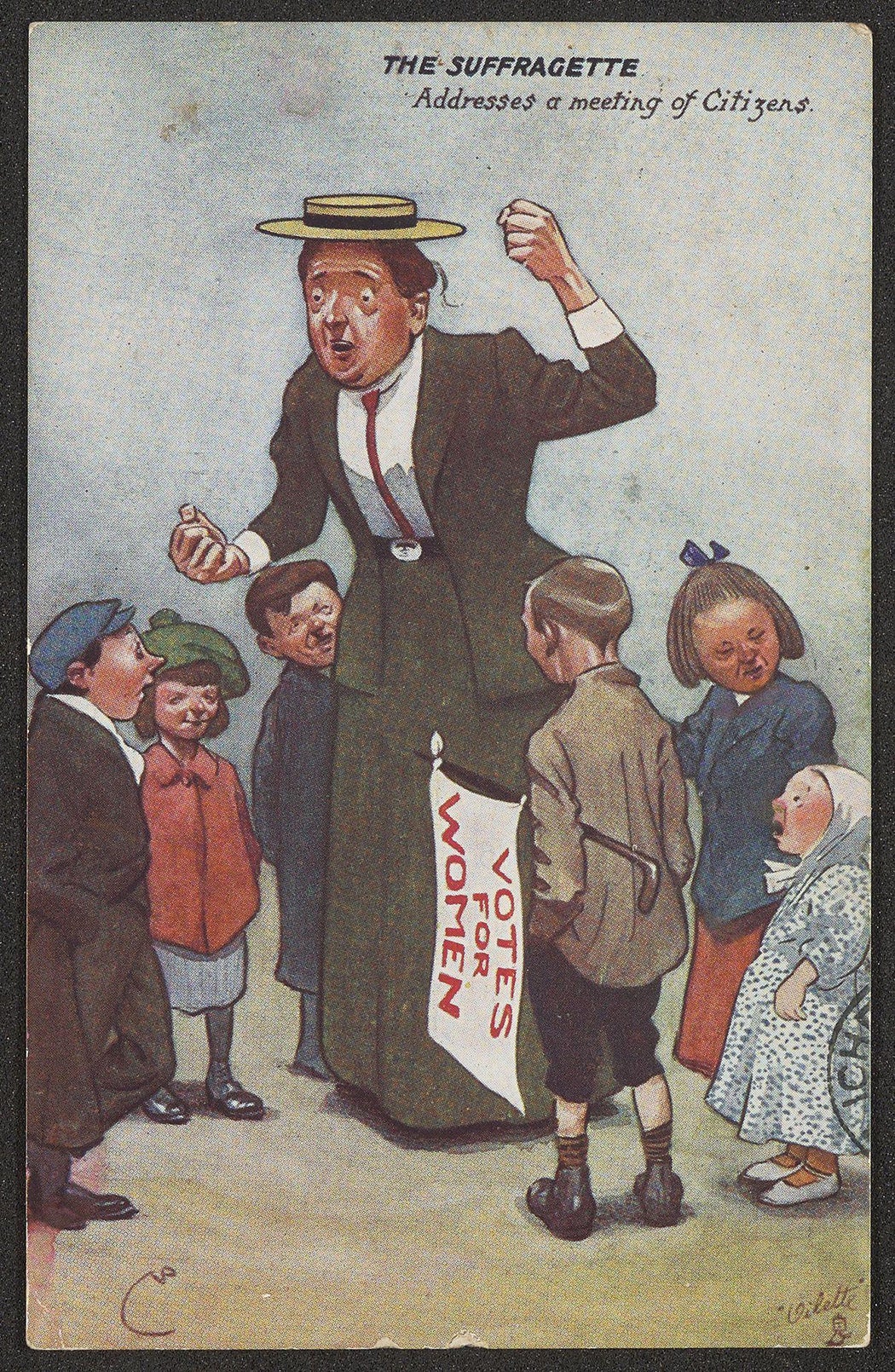
The suffragist in this postcard is marked as a spinster; her masculine features, hat, and clothing tell us as much. Wild-eyed and staring off the page, she’s so out of touch with reality and with her maternal instincts that she doesn’t even realize her audience of “Citizens” consists only of confused children.
Opponents of women’s suffrage argued that banning women from voting was actually a way of protecting them and preserving their angelic femininity. Politics, they claimed, was a nasty business that would take women away from their divine calling in the home, to the detriment of the race.
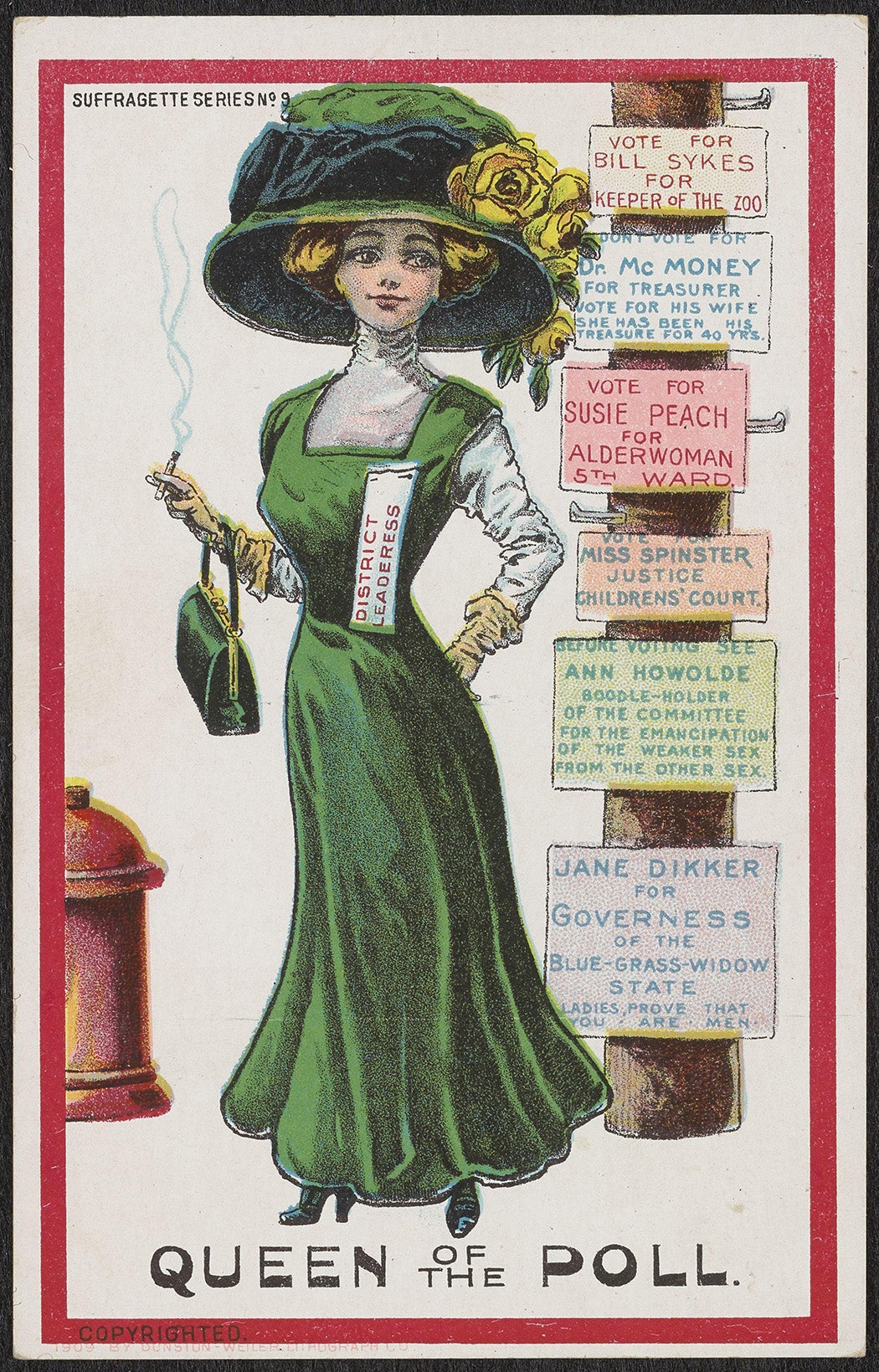
The Queen of the Polls. Courtesy Votes and Petticoats: Postcards, The Sheridan Libraries, Johns Hopkins University.
This woman represents anti-suffragists’ fears of what society would look like if women gained the vote. In contrast to the depictions of suffragists as dowdy old maids, the woman portrayed in this postcard is conventionally attractive and fashionably dressed. But her decadent New Woman status is given away by her cigarette—proper women didn’t smoke!—and her “District Leaderess” sash. The pole behind her is covered in campaign signs for mostly female candidates, including “Miss Spinster” for justice of the children’s court, which viewers are of course meant to interpret as an outrageous irony.
The role-reversal that women’s suffrage would supposedly bring about is communicated in several postcards, once again, through cat imagery.
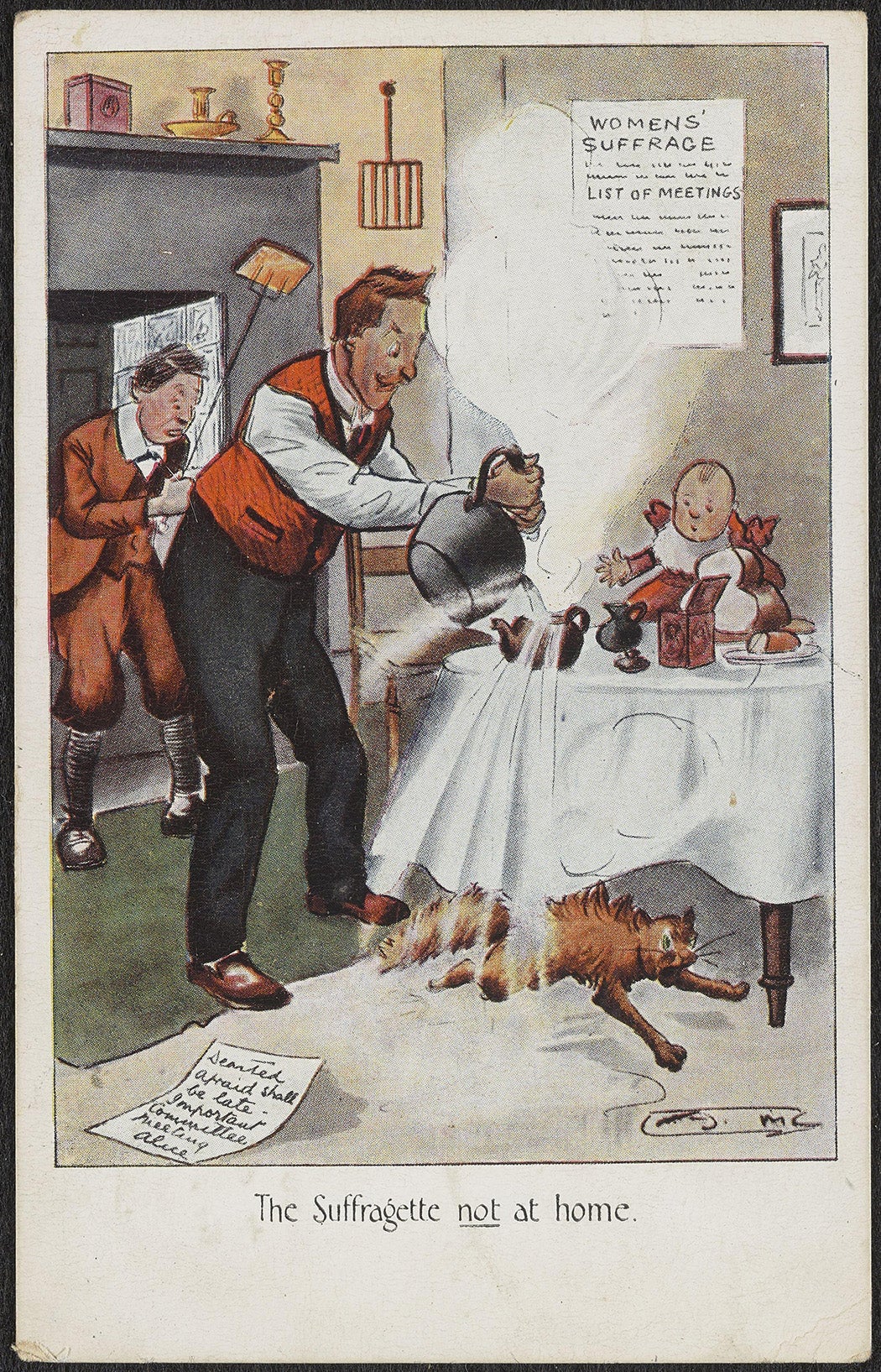
The Suffragette Not at Home. Courtesy Votes and Petticoats: Postcards, The Sheridan Libraries, Johns Hopkins University.Courtesy Votes and Petticoats: Postcards, The Sheridan Libraries, Johns Hopkins University.
Here, the man of the house is substituting for the absent woman by staying home, caring for the children, and making tea. The cat suffers the consequences of his ineptitude in the unnatural role.
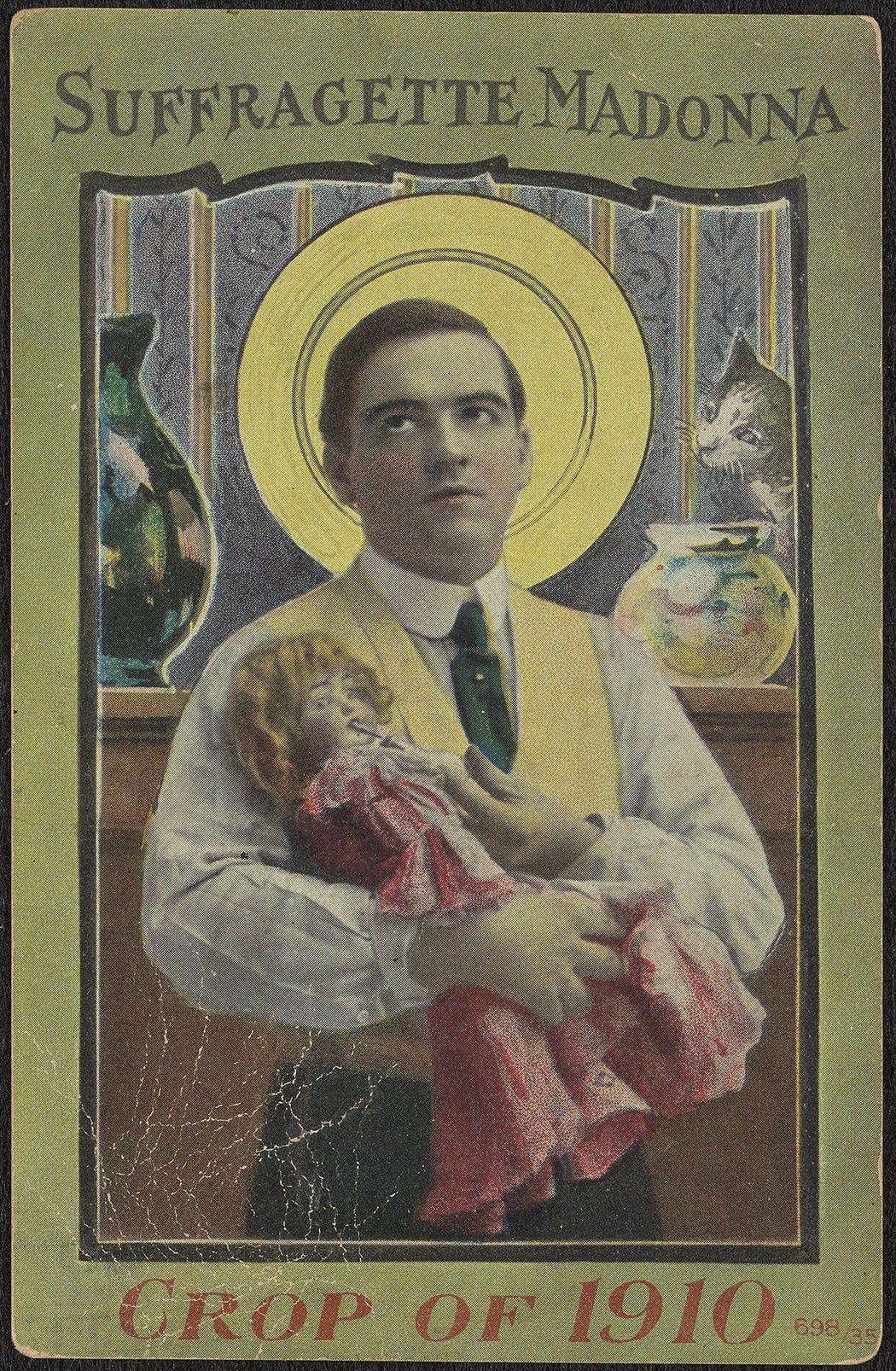
Suffragette Madonna Crop of 1910. Courtesy Votes and Petticoats: Postcards, The Sheridan Libraries, Johns Hopkins University.
Alternately, this man is taking good care of the home and family for his suffragist wife, but he’s thus emasculated. The halo of the golden plate, evoking the Virgin Mary, as well as the cat on the hearth behind him, emphasize his domesticity.
The absurdity of men in the women’s/cats’ sphere is surpassed by the absurdity of women/cats in the men’s sphere.
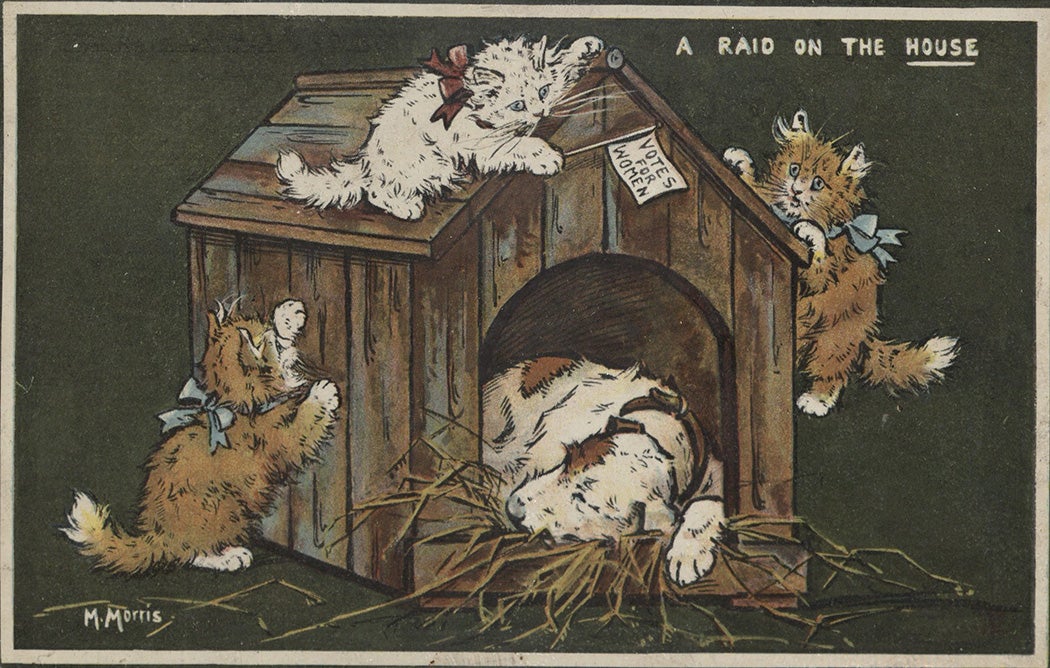
A Raid on the House. Courtesy Votes and Petticoats: Postcards, The Sheridan Libraries, Johns Hopkins University.
This British postcard seems to reference suffragists’ “raids” on the Houses of Parliament, during which women attempted to occupy the legislative chambers to protest their exclusion from them. The symbolism of this image is a striking echo of how the Daily Express described a suffrage raid in 1907: “[T]he sight reminded one very much of the removal of naughty kittens from a room in which they had been disporting themselves freely.” Cowman cites this description as example of voices in the press that often made light of the women’s suffrage movement, thus “making it appear over-feminine and consequently somewhat frivolous.”
Like “I Want My Vote!”, both this postcard and the Daily Express article infantilize women by portraying them as kittens. Viewers are meant to chuckle at the silly kittens’ attempt to infiltrate the doghouse—the kittens are cute, but they’ll never displace or even disturb the dog, who sleeps through their efforts.
“A Raid on the House” is particularly insulting when contrasted with the reality of the women’s suffrage movement, in which participants faced violent attacks. One march on the House of Commons in 1910 became known as “Black Friday” when suffragists were brutally beaten by police.
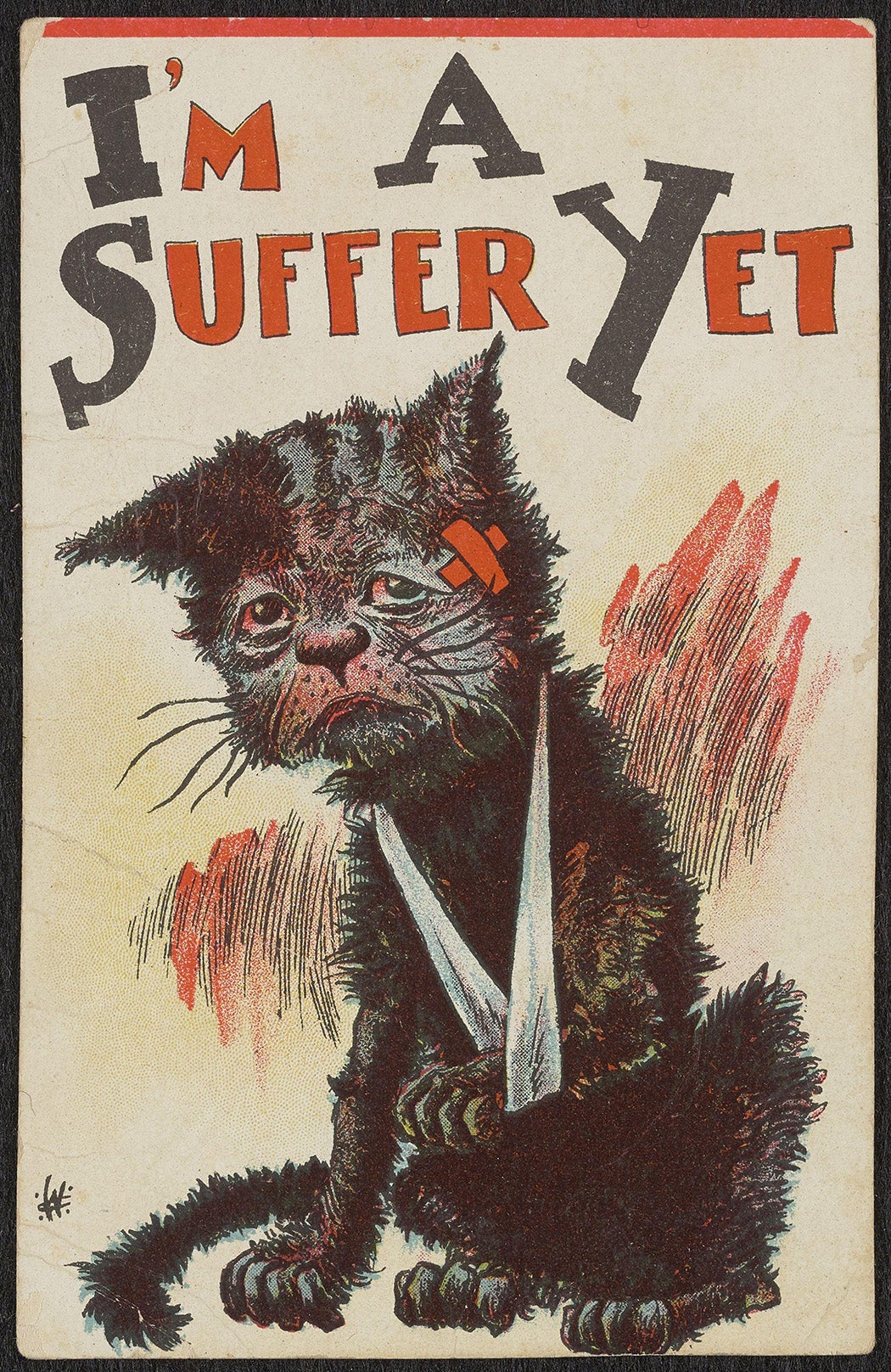
I’m A Suffer Yet. Courtesy Votes and Petticoats: Postcards, The Sheridan Libraries, Johns Hopkins University.
Bandaged and bruised, this bedraggled cat seems to represent a suffragist who has been beaten but is still dedicated to the cause. Whether the cat’s determination makes it sympathetic or stupid is a matter of interpretation.
Cats, as it turns out, are difficult to pigeonhole. So are women. According to Alleyn Diesel, the association between cats and women goes back at least as far as Ancient Egypt. Goddesses in ancient and contemporary religions have frequently been portrayed as either part-cat or accompanied by cats. And when it comes to goddesses, being catlike doesn’t mean being sweet and domestic. On the contrary, feline-linked deities are known for “self-reliance, elegance, and… willingness to be tamed strictly on their own terms”: powerful qualities that patriarchal societies mistrust in women.
When JD Vance questioned why a childless person would want to be a teacher or a leader, infamously calling Kamala Harris and her ilk “miserable” and “childless cat ladies,” he was invoking old, sexist stereotypes. The Harris campaign responded by selling “childless cat lady” merch. This tactic of reclaiming an insult and turning it into a badge of honor also has rich historical precedent.
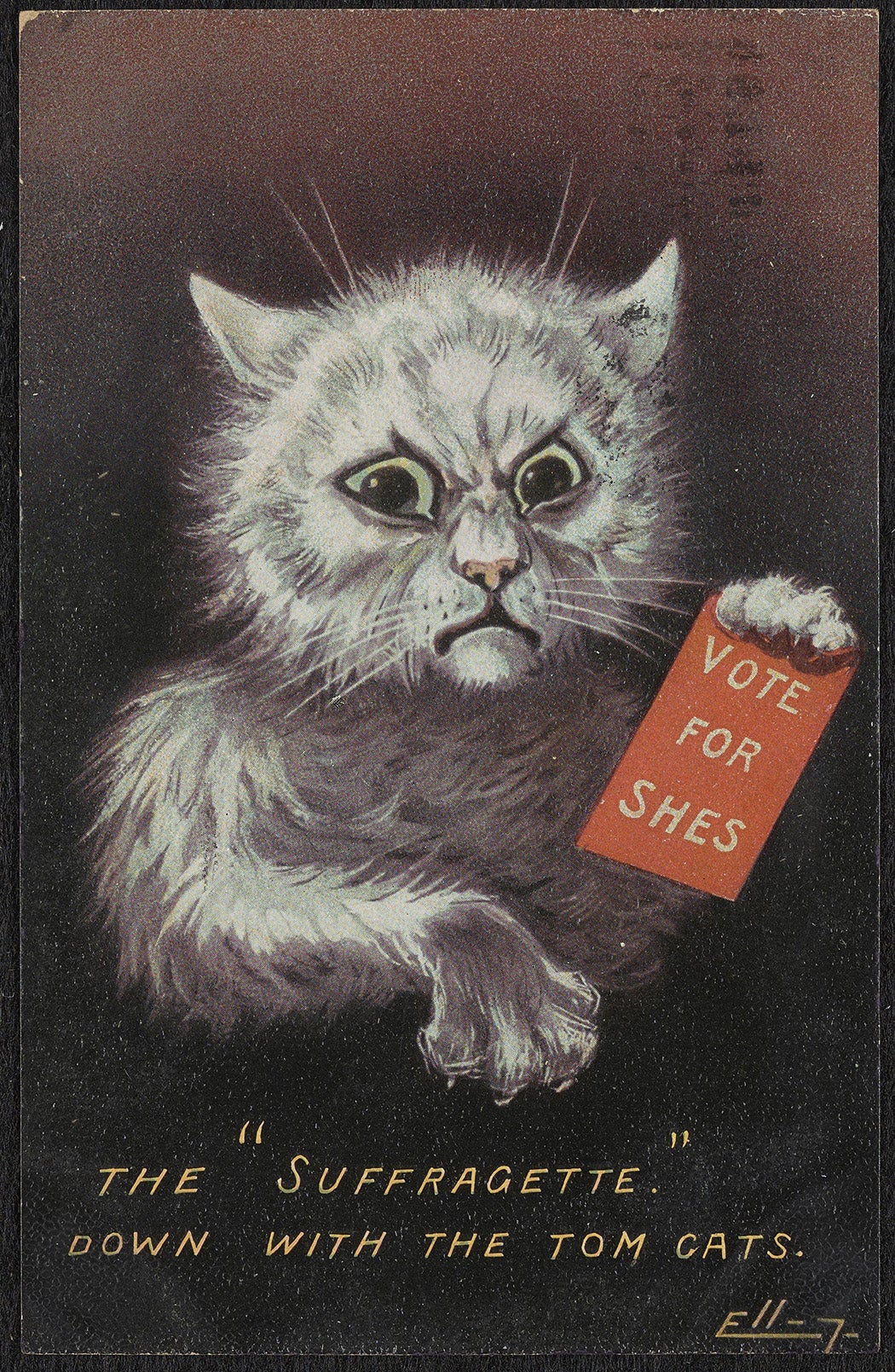
The Suffragette Down with the Tom Cats. Courtesy Votes and Petticoats: Postcards, The Sheridan Libraries, Johns Hopkins University.
The intention behind this final postcard may have been, yet again, to paint the fight for suffrage as absurd, to make suffragists seem like willful, unfeminine animals.
But the sender of the postcard wrote on the back, “See the expression: In town for the fight. Have used my night off for training my guns in the new campaign. Ha! Ha! You will see the signs soon.” We can’t be sure, but the writer seems to have been a suffragist, claws out.
Editor’s Note: Harry Whittier Frees, the likely photographer of the image depicting clothed kittens in line to vote, used live animals in his work, not taxidermy. The text has been amended to account for this fact.
Insects called burying beetles haul mouse carcasses down into the dirt and prep them to feed their future offspring. Also known as carrion beetles, they have some stiff competition … and some help from tiny traveling mites.
When an asteroid slammed into Earth 66 million years ago, it caused a mass extinction. Now researchers have evidence that this catastrophe ushered in the invention of agriculture by ants.
“Extinction events can be huge disasters for most organisms, but it can actually be positive for others,” says Ted Schultz, curator of ants at the Smithsonian National Museum of Natural History and senior author of the paper. “At the end of the Cretaceous, dinosaurs did not do very well, but fungi experienced a heyday.”
What’s the link between fungi and ants?
A worker ant of a fungus-farming species in Brazil. Credit: Don Parsons
The researchers propose this anti-culture heyday began with a cataclysmic collision that filled the atmosphere with debris and blocked out the sun, halting photosynthesis for years. As plants died en masse, they littered the ground with organic matter.
Fungi proliferated and ants ate the fungi for food. Some ants continued to eat fungi after Earth’s ecosystems rebounded and today more than 250 ant species have adapted and actively create conditions for fungus to thrive.
“Ants have been practicing agriculture and fungus farming for much longer than humans have existed,” says Schultz.
To pinpoint when this symbiotic interaction began, Schultz and colleagues amassed the largest genetic dataset of fungus-farming ants.
They also analysed the genetics of hundreds of fungi species, including those that are farmed by ants and their wild relatives.
Next, the team assembled evolutionary trees for both ants and fungi which revealed that farming ants and their fungus crops have been intertwined for 66 million years.
The data also revealed that “higher” forms of agriculture, where ants and fungi are completely reliant on one another, evolved around 27 million years ago. This coincided with a rapid global cooling event that fractured tropical environments. These changes led to ants cultivating a fungus outside its natural habitat.
“The ants domesticated these fungi in the same way that humans domesticated crops,” says Schultz. “What’s extraordinary is now we can date when the higher ants originally cultivated the higher fungi.”
A new study warns that sloths living in high-altitude rainforests of South and Central America could face extinction if temperatures there continue to rise according to climatic predictions.
The research, published in PeerJ Life & Environment, suggests that some sloths’ restricted ability to migrate to cooler regions and limited metabolic flexibility make them particularly vulnerable to climate change.
“Sloths are inherently limited by their slow metabolism and unique inability to regulate body temperature effectively, unlike most mammals,” says Dr Rebecca Cliffe, lead researcher of the study from Swansea University and The Sloth Conservation Foundation in the UK.
“Our research shows that sloths, particularly in high-altitude regions, may not be able to survive the significant increases in temperature forecast for 2100.” (snip-MORE)
A team at Monash University in Victoria developing a hormone-free, reversible male contraceptive has now figured out the 3D structure of one of their primary therapeutic targets – the P2X1-purinergic receptor (P2X1).
According to Dr Sab Ventura from the Monash Institute of Pharmaceutical Sciences (MIPS), this has been the main stumbling block that has so far hindered the team from progressing the drug discovery program to the next stage.
“Our primary goal is to develop a male contraceptive pill that is not only hormone-free but also bypasses side effects such as long-term irreversible impacts on fertility, making it suitable for young men seeking contraceptive options,” says Ventura.
In previous research in mice, the team showed that simultaneous inactivation of P2X1 and a second protein, α1A-adrenergic receptor, resulted in male infertility.
“Now we know what our therapeutic target looks like, we can generate drugs that can bind to it appropriately, which totally changes the game,” says Ventura. (snip-MORE)
Mount Everest is tall. In other news, the sky is blue.
But Everest (also called Chomolungma and Sagarmāthā) is taller than it logically should be – towering 238m above the world’s next highest peak, K2, and more than 250m higher than any of its counterparts in the relatively uniform Himalaya range.
Plus, it’s growing at about 2mm a year, faster than the expected rate for the range.
A team of Chinese and UK scientists have now suggested why this is the case.
The researchers think the culprit is a nearby river which “captured” another river 89,000 years ago, causing erosion that made Everest more buoyant.
They’ve published their findings in Nature Geoscience.
The Himalayan peaks get their extraordinary height from the collision of the Indian and Eurasian tectonic plates, causing the Earth’s crust to thicken and the mountain range to push upwards.
“An interesting river system exists in the Everest region,” says co-author Dr Jin-Gen Dai, from China University of Geosciences.
The team used numerical modelling to see how the river changed over time. They found that, about 89,000 years ago, the Arun river “captured” another nearby river.
This event, referred to as “river piracy”, happens when a river diverts its course and takes up the discharge of another river or stream.
“Our research shows that as the nearby river system cuts deeper, the loss of material is causing the mountain to spring further upwards,” says co-author Adam Smith, a PhD student at University College London, UK.
The team estimates that the river piracy has made Everest between 15 and 50m higher than it would otherwise be.
It’s also made neighbouring peaks, Lhotse and Makalu, unusually tall. These are the 4th and 5th highest mountains in the world, respectively. (snip-MORE)
It’s not the famous Star Trek tricorder but it’s close: researchers have developed a hand-held scanner that can generate highly detailed 3D images of body parts in almost real time.
The technology can accurately image blood vessels up to 15mm deep in human tissue, which the researchers say could help to diagnose conditions such as cancer, cardiovascular disease, and arthritis.
“We’ve come a long way with photoacoustic imaging in recent years, but there were still barriers to using it in the clinic,” says Paul Beard of University College London (UCL), UK, corresponding author of the new Nature Biomedical Engineeringpaper.
“The breakthrough in this study is the acceleration in the time it takes to acquire images, which is between 100 and 1,000 times faster than previous scanners.
“This speed avoids motion-induced blurring, providing highly detailed images of a quality that no other scanner can provide. It also means that rather than taking 5 minutes or longer, images can be acquired in real time, making it possible to visualise dynamic physiological events.
“These technical advances make the system suitable for clinical use for the first time, allowing us to look at aspects of human biology and disease that we haven’t been able to before.” (snip-MORE)
Neo-Nazis, the KKK and other hate groups are now routinely visiting Springfield, marching through city streets or distributing recruitment flyers and raising fears of intimidation and violence.
Over the weekend, the Blood Tribe — a violent Neo-Nazi hate group, according to the Southern Poverty Law Center (SPLC) — stood outside Springfield Mayor Rob Rue’s home waiving swastika flags. In a previous march through the city, some carried guns.
Also this weekend, an unidentified group stood outside Springfield city hall with a banner that said “Haitians Have No Home Here” in English and Haitian Creole.
These groups are responding to the growth of Springfield’s Haitian community, an issue that made the national spotlight following unsubstantiated rumors circulated on social media and parroted by politicians that Haitian immigrants were eating Springfield residents’ pets.
Since then, Springfield NAACP president Denise Williams says residents have also reported to her agency flyers being distributed in local neighborhoods from a group associated with the Ku Klux Klan.
“They’re trying to intimidate us. But we’re not a city that’s easily intimidated,” Williams said. “We need to stand together.”
The group, the Trinity White Knights, has a P.O. Box based in Kentucky. The Lexington Herald-Leader reported in September that similar flyers from the same group were distributed in Covington, Ky.
Springfield Police Chief Allison Elliott said the department is aware of the flyers.
Some residents have reported harassment from a group of people purporting to be members of the Proud Boys, which the SPLC designates as a hate group that believes in “Western chauvinism” and “an anti-white guilt agenda.”
Clark County Democratic Party chairman Austin Smith said a volunteer canvassing near the political party’s Springfield headquarters earlier this month was returning to the office to drop off campaign materials when a truck with large flags that appeared to say “Proud Boys” pulled up.
A group of men in the truck, the volunteer told Smith, made “vaguely threatening” statements.
“We’ve had threats and things pour into the office. No bomb threats, but ‘You better watch out.’ ‘We’re watching you.’ So that definitely created a lot of fear,” Smith said.
The party increased security measures for its recent meeting as a safety precaution, Smith said.
Members of the religious group Israel United in Christ (IUIC) were also in Springfield in September, gathering in multiple public places around the city.
The members, clad in purple shirts with the group’s name and logo, were seen marching and passing out literature to passersby.
At one point, group members gathered in the parking lot of Groceryland on South Limestone Street, near the corner of East John St. Members were preaching into a microphone about the organization’s teachings. Members also met with NAACP leaders from Dayton and Springfield.
According to its website, the IUIC is a Bible-based organization that believes people within the Black, Hispanic, and Native American communities represent “the true and historical descendants of the Biblical Israelites.”
SPLC categorizes IUIC as one of the handful of “Radical Hebrew Israelites” groups in the U.S. The SPLC designates these groups as hate groups. IUIC denies that it is a hate group, according to a post on the IUIC Classrooms Facebook page. The newspaper reached out to IUIC but did not hear back.
Williams said the Springfield NAACP chapter has plans to host a virtual community meeting to talk about recent activity in the city.
Springfield’s police chief asked residents to remain vigilant and “say something if you see something suspicious or out of the norm.”
“We know our city has looked a little different lately, and you also may notice an increased public safety presence. We assure you that our top priority has always been and will continue to be safety,” Elliott said. “Safety is a shared responsibility and our officers, along with our public safety partners, take all tips and information seriously.”
Serhiy Kraskov picked up a twig and poked at a small fish floating in the Desna River. “It’s a roach. It died recently. You can tell because its eyes are clear and not blurry,” he said. Hundreds of other fish had washed up nearby on the river’s green willow-fringed banks. A large pike lay in the mud. Nearby, in a patch of yellow lilies, was a motionless carp. “Everything is dead, starting from the tiniest minnow to the biggest catfish,” Kraskov added mournfully.
Kraskov is the mayor of the village of Slabyn, in Ukraine’s northern Chernihiv region. The rustic settlement – population 520 – escaped the worst of Russia’s 2022 full-scale invasion. But the war arrived last week in a new and horrible form. Ukrainian officials say the Russians deliberately poisoned the Seym River, which flows into the Desna. The Desna connects with a reservoir in the Kyiv region and a water supply used by millions.
Serhiy Kraskov, the mayor of the village of Slabyn, near the banks of the Desna River in northern Ukraine. Photograph: Alessio Mamo/The Guardian
A toxic slick was detected on 17 August coming from the Russian border village of Tyotkino. According to Kyiv, chemical waste from a sugar factory had been dumped in vast quantities into the Seym. It included ammonia, magnesium and other poisonous nitrates. At the time, fierce fighting was going on in the surrounding area. Ukraine’s armed forces had launched a surprise incursion into Russia and had seized territory in Kursk oblast.
The pollution crossed the international border just over a mile away and made its way into Ukraine’s Sumy region. The Seym’s natural ecosystem crashed. Fish, molluscs and crayfish were asphyxiated as oxygen levels fell to near zero. Settlements along the river reported mass die-offs. Kraskov got a call from the authorities warning him a disaster was coming his way. He spotted the first dead fish on 11 September. “There were a few of them in the middle of the river,” he said.
He returned the following weekend to find the Desna’s banks clogged with rotting fish, stretching out from the shore for three metres into the water. Volunteers wearing rubber boots, masks and protective gloves shovelled the fish into sacks. They found a metre-long catfish. “The stench was terrible. You could scarcely breathe. The river was quiet. Nothing moved apart from a few frogs,” Kraskov said. A tractor took the sacks to an abattoir that used to belong to the village’s Soviet-era collective farm. They were buried in a pit.
Serhiy Zhuk, the head of Chernihiv’s ecology inspectorate, described what had happened as an act of Russian ecocide. “The Desna was one of our cleanest rivers. It’s a very big catastrophe,” he said. Zhuk traced the slick’s route on a map pinned to his office wall: a looping multi-week journey along the Seym and Desna. “More than 650km is polluted. Not a single organism survived. This is unprecedented. It’s Europe’s first completely dead river,” he said. (snip-MORE)
Today’s posts got interrupted by a friend needing my help with an emotional crisis which I was very happy to give, and then my wonderful husband who puts up and supports me through my own crises / helps me through them needing to work in my Pink Palace to get my Pride Flag backdrop done and start moving my shelving around to make things better for me. Hubby is wonderful and truly understands and wants my Pink Palace to be not only a good space for me but a safe space for all my needs. To anyone who has a complaint about my naming my office space my Pink Palace … nicely said get over yourself. This is 2024 and I get to call my spaces what I want … the not nicely way to put it came to mind but instead of voicing it I will say that I left being embarrassed or upset over my being who I am sexually and emotionally behind me over 40 years ago. Hugs. Scottie.