TEL AVIV, Israel (AP) — Tens of thousands of grieving and angry Israelis surged into the streets Sunday night after six more hostages were found dead in Gaza, chanting “Now! Now!” as they demanded that Prime Minister Benjamin Netanyahu reach a cease-fire with Hamas to bring the remaining captives home.
The mass outpouring appeared to be the largest such demonstration in 11 months of war and protesters said it felt like a possible turning point, although the country is deeply divided.
Israel’s largest trade union, the Histadrut, further pressured the government by calling a general strike for Monday, the first since the Oct. 7 Hamas attack that started the war. It aims to shut down or disrupt major sectors of the economy, including banking, health care and the country’s main airport. (snip-MORE)
(Meanwhile, democracy in Israel doesn’t seem to be the system anymore, US Republicans’s statements regardless-) (This narrative runs current to the top. There’s a good feature at the bottom here.)
Arnon Bar-David, the chair of Histadrut Labour Federation, Israel’s main trade union which launched the strike, said he respects the decision by the labour court to end the strike at 14:30 (local time) 12.30 BST, according to the Times of Israel.
It reports him saying in a statement:
It is important to emphasise that the solidarity strike was a significant measure and I stand behind it. Despite the attempts to paint solidarity as political, hundreds of thousands of citizens voted with their feet.
I thank every one of you – you proved that the fate of the hostages is not right-wing or left-wing, there is only life or death, and we won’t allow life to be abandoned.
Meanwhile, the newspaper reports that the Hostages and Missing Families Forum encourages the public to continue the demonstrations despite the ruling. “This is not about a strike, this is about rescuing the 101 hostages that were abandoned by [prime minister Benjamin] Netanyahu with the cabinet decision last Thursday,” the forum says, referring to the vote by ministers backing the IDF’s continued presence on the Philadelphi Corridor.Share
The labour court’s ruling that today’s strike must end was welcomed by Israel’s finance minister Bezalel Smotrich.
In a post on X, Smotrich praised the decision to end what he called a “political and illegal strike.”
The Times of Israel reports he said in his statement that Israelis went to work today “in droves,” proving they are no longer slaves to “political needs.”
He added: “We won’t allow harm to the Israeli economy and thereby serve the interests of [Yahya] Sinwar and Hamas.”
‘Strike was not as powerful as people expected’ – dispatch from Tel Aviv
Julian Borger
Julian Borger is the Guardian’s world affairs editor
Tel Aviv this morning did not feel like a society about to bring its government down.
The debris had been removed from last night’s demonstration on the Ayalon Highway, the motorway which passes through the city centre, and traffic was moving normally.
Protesters stopped traffic at a couple of junctions around the city but for the most part, the traffic flowed. The national rail line was working, though some buses and light railway lines stopped.
Private companies gave their staff the day off, but it was more in the spirit of some sombre holiday rather than the start of an existential struggle with the government.
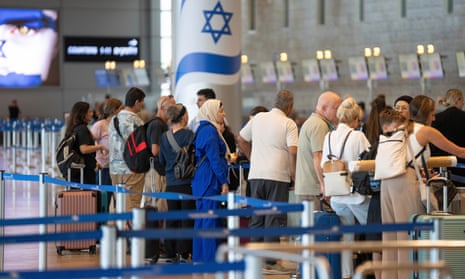
Ben Gurion airport only closed for a few hours, and it was announced that the whole general strike would end at 6pm. It is not government-ending stuff.
Travellers line up at Ben Gurion International Airport near Tel Aviv. Photograph: Ohad Zwigenberg/AP
The mood can best be described as bitterly realistic on Hostages Square, the name given to the plaza between the national library and the Tel Aviv Museum of Art, where hostage families and their supporters gather every day.
“I’m not sure the strike was as powerful as people expected,” said Debbie Mason, a social worker for the Eshkol regional council, the area of southern Israel abutting Gaza.
She made a distinction between what she hoped would happen and what she believed would happen, the latter being that nothing would change for the hostages.
“Unfortunately, there are too many things that are going to obstruct a deal, whether it’s on our side, whether it’s on Hamas’ side, it just doesn’t seem to be in anyone’s interest, that something should happen,” Mason said.
Hostage Square, established in the plaza between the National Library, the Tel Aviv Museum of Art and the Tel Aviv District Court. Buses arrive here daily with youth groups from the kibbutzes, moshavs and towns from the area of southern Israel invaded by Hamas on 7 October 2023. Photograph: Julian Borger/The Guardian
Rayah Karmin, who comes from Mabu’im, a village near Netivot, near the Gaza border, agreed that a one-day strike would change little.
“Only a longer strike will make the people in government understand that the economy of Israel is going to go down,” Karmin, a vitamin supplement salesperson, said.
She pointed out that all the demonstrations and strikes were up against an immovable political fact. If a ceasefire is agreed, the far-right members of the coalition, notably Itamar Ben-Gvir and Bezalel Smotrich, will walk out and the government will fall.
“Smotrich and Ben-Gvir will leave Netanyahu, and then he will be without a coalition, and he will have to go home,” Karmin said. “And he knows that next time he won’t be elected, so he wants to stay as long as he can.”
“Bibi is a magician, a really big fucking magician,” Aaron, a 28-year-old legal adviser in a pharmaceutical corporation, said. He had been out on the streets for Sunday’s mass protests, but he had no illusions about who they were up against.
“If there’s a hostage deal, the government will fall, so they are not interested in a deal,” Aaron said. “What Ben-Gvir wants and what Smotrich wants, they get, because Bibi doesn’t want to go to jail. He doesn’t want to lose power, because Bibi will be voted out in the first election if the government falls.”
This is what the fundamentalist religious / maga right want to do in the US notice the reason why they feel they need to pass this law. Because it is changing tradition. Tradition is peer pressure from dead people. The right wing straight cis people like the way things are and don’t want to include other ideas or ways. Just a warning. Hugs. Scottie
The legislation would ban LGBTQ+ rights on multiple fronts, including adoption, marriage, and civil IDs.
TBILISI, GEORGIA – MAY 17, 2018: Family day. People attend a rally marking the Day of Family Purity and opposing the International Day Against Homophobia and TransphobiaPhoto: Shutterstock
Georgia’s parliament on Thursday pushed ahead a sweeping package of bills that would effectively outlaw LGBTQ+ identity in the former Soviet republic.
The set of bills proposed by the ruling pro-Putin Georgian Dream party bans depictions of same-sex relationships in the media, outlaws gender-affirming surgery, and will make Pride events and the public display of the Pride flag in Georgia a thing of the past.
Parliamentary speaker Shalva Papuashvili describes the bills as necessary to control “LGBT propaganda,” which he said was “altering traditional relations.”
The first reading of the bill titled “On the Protection of Family Values and Minors,” which draws heavily from Russia’s anti-LGBTQ+ “propaganda” law passed last year, drew widespread support among Georgia Parliament deputies. The bill is scheduled for second and third readings in the fall.
In addition to outlawing public gatherings “promoting” same-sex relationships, the legislation would also limit adoption to heterosexuals, ban gender changes on official identification, and outlaw “LGBT propaganda” in education.
Georgian Dream MPs have also proposed introducing “genetic” requirements in establishing legal marriage, whereby marriage would be a union of a “genetic woman” and a “genetic man.”
The Constitution already bans same-sex marriage in Georgia, where the deeply conservative Orthodox Church holds outsized influence in the government and public sphere.
Georgia enjoyed decades of progress on human and LGBTQ+ rights following the Rose Revolution in 2003, as a majority of citizens supported a pro-Western turn and integration into the European Union and NATO.
The rise of the Georgian Dream party in the last ten years, however, has seen the government reorienting toward Russia, with the Church encouraging the rapprochement.
Georgia’s version of Putin’s draconian “LGBT propaganda” law seems designed not only to roll back progress on LGBTQ+ rights but to scuttle any hope of Georgia entering the European Union, with its strict requirements upholding civil liberties and personal freedoms.
The introduction of the anti-LGBTQ+ legislation follows the Georgia Parliament’s passage of another Russian-inspired law to label Western NGOs “foreign agents,” teeing up a harassment campaign aimed at expelling human rights and other groups that far-right conservatives and the Orthodox Church have accused of infecting Georgia and other countries with “degeneracy.”
Speaking of opponents of the nascent legislation in March, Mamuka Mdinaradze, leader of the Georgian Dream parliamentary majority, said, “Even if they brand the law against LGBT ‘propaganda’ not Russian, but Soviet, we will follow it through, given that it is the biggest challenge of modern times.”
Anti-LGBTQ+ sentiment runs high among extremists in the onetime Soviet vassal. In 2021 and 2023, violent mobs shut down Pride marches in the capital Tbilisi.
Organizers say foreign agents, delivered by Russian President Vladimir Putin, joined far-right fascist political gangs and members of the Georgian Orthodox church to sabotage the peaceful demonstration. Hundreds were injured in the two incidents.
Rights groups and supporters described the attacks as “pogroms.”
September 2, 1885 A mob of white coal miners, led by the Knights of Labor, violently attacked their Chinese co-workers in Rock Springs, Wyoming, killing 28 and burning the homes of 75 Chinese families. The white miners wanted the Chinese barred from working in the mine. The mine owners and operators had brought in the Chinese ten years earlier to keep labor costs down and to suppress strikes.Chinese fleeing Rock Springs The unfortunate story and illustrations of the scene (scroll down)
September 2, 1945 Revolutionary leader Ho Chi Minh declared Vietnam a republic and independent from France (National Day). Half a million people gathered in the capital of Hanoi to hear him read the Vietnamese Declaration of Independence, which was modeled on the U.S. Declaration of Independence. note: Ho Chi Minh translates to ‘He Who Enlightens’ Read about how it was influenced by the U.S. Declaration
September 2, 1966 On what was supposed to be the first day of school in Grenada, Mississippi—and the first day in an integrated school for 450 Negro children—the school board postponed opening of school for 10 days because of “paperwork.” Nevertheless, the high school played its first football game that night. Some of the Negro kids who had registered for that school tried to attend the game but were beaten, and their car windows smashed.
September 2, 1969 Vietnamese revolutionary and national leader Nguyen Tat Thanh (aka Ho Chi Minh), 79, died of natural causes in Hanoi. Uncle Ho, Ho Chi Minh Ho and his struggle for Vietnamese independence
Palestinian villages in the West Bank are seeing an increase in illegal settler attacks since October 7, 2023, the start of the Israel-Hamas war. Some of the settlers are attacking farms and killing livestock. NBC News’ Hala Gorani has more on the increase in violence.
Violence has flared in the Occupied West Bank. At least five Palestinians, including two children, have been killed in an Israeli air strike on a refugee camp, and one Palestinian man was shot dead in an attack by Israeli settlers near Bethlehem.
In Kansas, lawyers for the American Civil Liberties Union have drafted a letter reminding election workers that a gender marker on a person’s identification does not need to match or correspond to a voter’s gender expression. Staff for the organization have also held clinics elsewhere to prepare trans Americans for the identification requirements they will have to navigate.
In eight battleground states, the nonprofit VoteRiders is on the ground helping voters get the identification they need to cast ballots in the November election — and one that reflects who they are.
Equality Florida, the state’s leading LGBTQ+ advocacy group, is holding “know your rights” trainings in the wake of new regulations barring many transgender voters from obtaining photo identification that reflects their gender.
As Republican politicians push anti-transgender rhetoric ahead of a historic election, transgender and nonbinary Americans are facing new laws and rules that effectively prohibit them and others from obtaining documentation like birth certificates and driver’s licenses that align with their gender identities.
Advocates are fighting back. They’ve been mobilizing communities and organizing resources to help transgender Americans, an effort aimed at safeguarding their civic rights. Some trans voters have expressed confusion and fear of discrimination at the ballot box that could discourage them from participating in public life.
“There is a chilling effect,” said Lauren Kunis, CEO and executive director of VoteRiders, which helps voters obtain identification. “There is an unsafe and intimidating environment around existing as trans in society, and definitely in being able to go to the polls safely and cast a ballot.”
The ripple effect could extend beyond trans people, these advocates warn. Regulations around gender impact cisgender people, particularly women and women of color. America’s decentralized elections system relies on a temporary workforce tasked with enforcing varying policies around identification rules. In states that require voters to “reasonably resemble” the picture on their ID, like North Carolina and Wisconsin, the results could ensnare anyone at the ballot box who doesn’t fit the binary concept of masculinity and femininity traits.
“A lot is falling on poll workers to correctly enforce the law,” Kunis added. “And I would argue that is less of a solid protection in states where anti-trans rhetoric is skyrocketing.”
The measures often focus on sex classification that narrowly defines an individual’s sex as either male or female at birth. They’re among a broad scope of anti-trans legislation that have popped up in Republican-led statehouses in recent years and served as breeding ground for the binary vision of the country embraced by former President Donald Trump and U.S. Sen. JD Vance, his running mate on the Republican ticket. At least nine states in the past two years have explicitly regulated gender in this way, according to a tally by the Movement Advancement Project (MAP), which tracks LGBTQ+ policy.
Anti-transgender rhetoric was front and center at the Republican National Convention in July, and Trump has taken to verbally targeting transgender people in his campaign. He described Democratic vice presidential nominee Tim Walz recently as “very heavy into the transgender world.”
The verbal attacks are against a group that is highly invested in electoral politics. An analysis released in August of respondents to the 2022 U.S. Transgender Survey, widely seen as the most comprehensive study of binary and nonbinary transgender Americans, found that voting-eligible trans people had cast ballots in the last presidential election at a higher rate than the U.S. population. The study included more than 92,000 respondents, including more than 84,000 adults who were 18 and older.
“Trans votes count,” said Ankit Rastogi, director of research for the National Center for Transgender Equality, which conducted the survey and will soon be known as Advocates for Trans Equality Education Fund. “I think the big takeaway is that our community is really trying to come out and make a difference through the democratic process.”
The new laws and rules around sex classification vary widely. Those that intentionally target government identification that people use in everyday life, like driver’s licenses, are particularly challenging. Forcing a person to show identification that does not align with their gender identity could out them to people in their community, as Lucas Cameron-Vaughn, an attorney for the ACLU of Tennessee, explained.
“Trans people, just like everyone else, want to be able to travel, start new jobs, open bank accounts, enroll in school, vote — all of those things require some form of ID. And so when a state goes out of its way to enforce its message about its belief about sex and gender on a license, and transgender people then have to publicize that when they show other people, it creates a dangerous environment,” he said.
Last year, Tennessee Gov. Bill Lee, a Republican, signed a bill into law that defines sex as “determined by anatomy and genetics existing at the time of birth.” The state’s Department of Safety and Homeland Security then created a rule banning transgender people from changing gender markers on their driver’s licenses. The ACLU sued the agency for discrimination, claiming the rule was adopted illegally because it didn’t follow proper administrative procedure.
“It’s a tactic that’s designed to splinter support for trans rights and suggest sort of who is harmed by protecting trans people — to frame that as cisgender women being the people harmed by protections for trans people,” said Rose Saxe, who is deputy project director for the ACLU’s LGBT & HIV Project.
Nearly 21 million voting-eligible U.S. citizens do not have a current driver’s license, according to the Center for Democracy and Civic Engagement at the University of Maryland, whose research was partially supported by VoteRiders. Black and Hispanic people are among those most likely not to have a current license, so the requirement harms them too, regardless of their gender identity.
In the 2024 election, 38 states will require voters to show some form of identification at the polls, including 17 states that have new or stricter ID laws passed since 2020.
The full impact of these laws amid new and evolving voter identification laws is not yet clear, in part because of how recent they are — and that, experts say, could mask their harm. The Williams Institute at the University of California, Los Angeles School of Law, estimated ahead of the 2022 midterm election that more than 200,000 voting-eligible transgender Americans may find it difficult to vote at the time because of voter ID laws.
But these don’t just affect transgender people. In many red states, Republican-led attacks on transgender people are going hand-in-hand with new identification requirements and other laws that pose barriers to the ballot that reach beyond gender lines.
“The states with the anti-trans laws are also the ones that are more likely to be passing anti-voter laws, full stop,” Kunis said.
In Florida, which has emerged as a national epicenter of policies targeting LGBTQ+ people in recent years, the state’s Department of Highway Safety and Motor Vehicles issued a new regulation barring residents from updating their gender identity on their drivers’ license.
To Quinn Diaz, a public policy associate at advocacy group Equality Florida, the failure of most anti-LGBTQ+ bills introduced in this year’s legislative session showed that the tide in Florida is turning. But the new gender marker regulation signals yet another way that state agencies in Florida have overstepped their bounds and been “weaponized” to target transgender Floridians, they argued.
“We saw it as a move to inflict maximum chaos and misunderstanding,” Diaz said. “And really to scare trans folks from even participating and getting the license if they needed to update it.”
For transgender people, lacking identification that reflects their gender identity and appearance can make them vulnerable to discrimination in everyday situations at a bar or liquor store, for example, and in interactions with law enforcement and at the polls.
“With these laws in Florida, you’re forced to choose between living authentically and just not really participating in public life,” Diaz said.
Diaz, who is transgender, moved to Florida from Massachusetts, where they had an “X” gender marker on their driver’s license. Because they didn’t have all the necessary documentation and weren’t established yet with a local provider when they transferred their license to Florida, they forfeited that marker and defaulted to a license with their sex assigned at birth.
Diaz said they didn’t have any problems voting in person in the 2022 midterms, but they plan to vote by mail this November.
“I can imagine that a lot of trans folks in Florida who might not have access … to an accurate and affirming ID might not want to engage in that process at all, especially in such a heightened political environment,” Diaz said.
Such rhetoric could also be most dangerous in states where far-right groups are trying to recruit poll watchers. Since 2020, many Republican-controlled states have passed laws expanding the authority of those temporary election observers who work elections under certain rules and may feel compelled to stop someone from voting under the guise of stopping widespread election fraud, which has been repeatedly debunked.
“Gender nonconforming people are already under such public scrutiny nationwide,” Diaz said. “That’s when you’re gonna see the convergence of those two elements. It really seems like it would only result in more discrimination, more discomfort for trans people, more interrogation and potentially just being turned away.”
Hazel Krebs, a 42-year-old transgender woman living in Kansas, one of the states with a new anti-trans law, felt the weight of that increased scrutiny as she cast her ballot in March. Krebs wondered whether her identification — one that for weeks no longer reflected her gender identity — might impact her ability to vote.
She chatted with the election workers in the mostly empty precinct, then showed her ID. She did her homework, learned that gender is not required information to vote and showed up ready to explain it.
But no one questioned her. Krebs voted and was out of the polling site within minutes. Still, she worries that, under the same circumstances, another trans person might have stayed home.
“They won’t stop me, but I can see how it would stop others,” she said. “It is almost certainly stopping some people from showing up at the polls.”
The ACLU, which is tracking some of these laws and rules, has tried to prepare election workers on how to process trans voters who come into their polling sites. VoteRiders is conducting year-round voter education. While the driver’s license is the most ubiquitous form of identification in the United States’ car-centric society, Kunis wants to dispel the “common misconception” that it’s the only form of ID people can use to vote.
Trans voters can obtain a U.S. passport or passport card that reflects their gender identity without needing to provide underlying documentation. However, that option may not be accessible to people who struggle to pay the related fees or may not have the time or knowledge required to fill out the forms and request the passport.
It’s also a temporary solution if a future presidential administration rescinds the ability for people to self-attest their gender on their passports. Some advocacy groups and lawmakers in Florida also argue the state’s new regulations conflict with the federal Real ID Act, but that question is unlikely to be resolved before November.
In addition to using passports as identification, Diaz said that Florida voters have the option to vote by mail, vote early in person and bring a friend or family member to the polls.
“Our ability to participate in this democracy in Florida, it’s been on the line for a while,” Diaz said. Transgender people, they said, are being “forced to choose between participating in our greatest civic right or just sitting out because the state doesn’t see us for who we are.”
It’s still unclear how many trans people will be denied affirming identification — and how many will choose not to vote — as a result of these new regulations. Several of the new laws are written with no clear penalties.
“Something that’s very frustrating for us at VoteRiders is you will never be able to capture the number of people who do not feel safe voting, and who therefore stay home. And you also won’t be able to capture the people who are trans and show up to try and vote and are turned away.” Kunis said. “And we know that is happening, but it is difficult to quantify.”
Cameron-Vaughn said he also worries about a scenario where a trans person is stopped at a polling place because of mismatching information on their identification and must fill out a provisional ballot — a voting option that often requires a person to return at a later date with more documentation to ensure their vote is counted.
“There are definitely the physical dangers, the dangers for harassment, discrimination — but also ultimately, voter suppression,” he said.
Josie Caballero, director of voting and elections for the group that conducted the 2022 U.S. Transgender Survey, said it’s important to remember that barriers to voting existed for trans people before the latest slate of laws and rules targeting sex classification, particularly around voter ID rules. Trans people turned out to vote despite those policy roadblocks.
“It really shows the resiliency of the trans community to ensure that our voices are heard and we have visibility at the ballot box,” she said.
Krebs, who plans to vote in November, is worried about how the dynamics of a crowded polling site might impact her ability to vote. But she is determined to access the ballot, and to stay in Kansas despite the heightened scrutiny.
“There’s nothing these laws will do to stop me from living my best life,” she said. “It just puts my energy and passion towards making this place better for me and other trans people.”
August 30, 1963 A “hotline” telephone link was installed between the Kremlin in Moscow and the White House in Washington, D.C. The intention was to allow direct communication in the event of a crisis between the U.S. president and the leader of the Soviet Union (U.S.S.R.). It had been agreed to following the Cuban Missile Crisis.
August 30, 1964 The Democratic Party National Convention refused to seat any delegates from the Mississippi Freedom Democratic Party (MFDP). The Credentials Committee chose to seat the all-white delegation from Mississippi’s regular Democratic Party despite overwhelming evidence of the state party’s efforts to disenfranchise Mississippi’s Negro citizens. A proposed compromise of two non-voting guest delegates from MFDP was rejected by its leaders. The dispute, the political intrigue, and the long-term effects
August 30, 1967 The Senate confirmed the appointment of Thurgood Marshall as the first Supreme Court Justice of African-American descent. Marshall had been counsel to the NAACP Legal Defense Fund, and had been the lead attorney in the Brown v. Board of Education case. He was appointed to the Court by President Lyndon Johnson after having served as Solicitor General of the U.S. for two years, and on the U.S. Court of Appeals for four. Thurgood Marshall Who was Thurgood Marshall?
August 30, 1971 Ten empty school busses were dynamited in Pontiac, Michigan, eight days before a school integration plan was to begin. Following Federal Judge Damon Keith’s finding that Pontiac’s school board had “intentionally” perpetuated segregation, a plan was developed by the board that included bussing of 8700 children. The bombers were later identified as leaders and members of the Ku Klux Klan, arrested, tried, convicted and imprisoned.
August 30, 1980 Striking Polish workers, their numbers approaching 150,000, won a sweeping victory in a battle with the Polish Communist government for the right to independent trade unions and the right to strike. Their lead negotiator was Lech Walesa, head of the union, Solidarnos´c´ (Solidarity). Lech Walesa announces the deal to cheering crowds of shipyard workers.
August 30, 1999 Residents of East Timor voted for independence from Indonesia in a U.N.-sponsored election.More about the East Timor election
After a court ruling from the 11th Circuit Court of Appeals allowed an anti-trans law in Florida targeting youth and adults go back into effect, many providers were forced to end care. Read on Substack
*With thanks to Janet.*
Several transgender youth and adults are being told their care will be terminated following a ruling from the 11th Circuit Court of Appeals by a majority-Trump appointed panel. The court ruled that a 2023 law, which restricts transgender care at any age, can go back into effect after being permanently blocked in June 2024.
The ruling, released late Monday, stated that transgender people are not a “quasi-suspect class,” meaning they do not receive the same level of equal protection under the Constitution as other categories such as race, ethnicity, religion, or sex. This decision implies that laws discriminating against transgender people are likely to be considered valid and constitutional by the 11th Circuit Court.
One such law, SB254, was passed in 2023. The law banned gender-affirming care for transgender youth but went further than similar legislation passed in several Republican-led states that year by also restricting care for transgender adults. The bill mandated that care for transgender adults could only be provided by physicians and required that patients receive forms outlining the “risks” of gender transition. Many proposed versions of these forms are filled with disinformation about transgender care.
The physician requirement has proven especially burdensome for transgender adults, as the majority of their care is provided by nurse practitioners. This is because the number of transgender adults far exceeds the capacity of physicians who offer gender-affirming care. Planned Parenthood, the largest hormone therapy provider in the United States, explains, “Most gender-affirming hormone care is provided at PPSP by advanced practice providers (physician assistants, certified nurse midwives, and nurse practitioners) in our health centers or over telemedicine.”
Now, with the law fully in effect, transgender adults who previously had access to care are being notified that their care will no longer be provided.
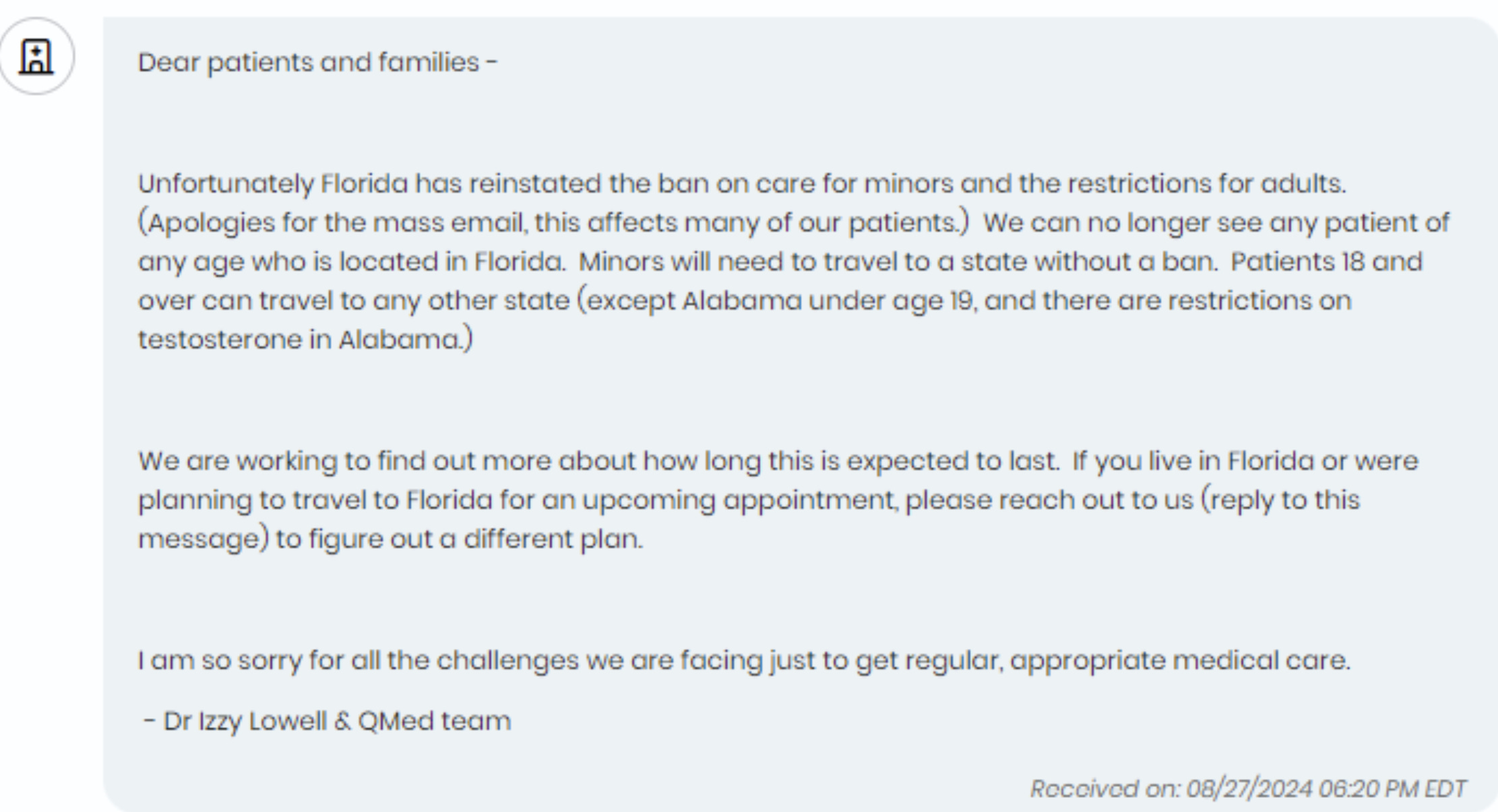
One anonymous patient shared an email from their provider, QueerMed, which stated, “Unfortunately, Florida has reinstated the ban on care for minors and the restrictions for adults… We can no longer see any patient of any age who is located in Florida.”
See that email here:
Email provided from a QueerMed Patient
Spektrum, a major provider in Florida, was also forced to terminate care and cancel new patient appointments. However, during the period when the law was blocked, the organization reportedly took steps to ensure patients were well-supplied with medication in case the law went back into effect:
“During this little freedom period as I call it … we made good use of that time to make sure all of our patients were well supplied with medication. Although I had hoped that it wouldn’t have been necessary, at least now we can say, I’m glad we did all the things that we did,” said Joseph Knoll, a nurse practitioner at the clinic, as reported by the Associated Press.
Healthcare bans are currently a contentious issue in courts across the United States, with some courts blocking bans on transgender healthcare coverage or provision. A major point of contention is whether discrimination against transgender people qualifies as sex discrimination, which would subject these laws to higher scrutiny regarding their constitutionality.
The Supreme Court is poised to rule on such questions later this year in a case stemming from Tennessee’s trans care ban. If the Supreme Court were to rule that transgender people are not entitled to equal protection under the law, many forms of discrimination against transgender youth and adults could be deemed fully legal.
For trans people in Florida, many cannot afford to wait for such a decision, and many have already fled the state. For those unable to leave, disruptions to their care will likely have significant impacts on their mental and physical health.
“We are deeply disappointed by this decision and the panel’s disregard for the district court’s careful findings and adherence to the Eleventh Circuit’s recent precedent. Allowing these discriminatory restrictions to go back into effect will deny transgender adults and adolescents lifesaving care, and prevent Florida parents from making medical decisions that are right for their children. As the district court found based on voluminous evidence, the record shows that these extraordinary restrictions were based on disapproval of transgender people and serve no purpose other than to harm transgender Floridians. The plaintiffs in this case are considering their options and will take every step possible to protect their right to equal treatment under Florida’s laws, which these restrictions egregiously violate. We will continue fighting for transgender Floridians and their families, and for everyone’s right to make healthcare decisions without government interference,” said the organizations representing the plaintiffs in the case.



 Chinese fleeing Rock Springs

 Uncle Ho, Ho Chi Minh
 Thurgood Marshall

 Scottie's Playtime