I knew it!
I thought so;
I knew it!

I knew it!
| September 14, 1918 |
 | Eugene V. Debs was sentenced to ten years in prison for opposing U.S. entry into World War I. Debs had been an elected official in Indiana, a labor organizer, writer and editor, had founded the first industrial union in the U.S., the American Railway Union, and had run for President four times on the Socialist Party ticket. |
| He ran again for president from prison in 1920 with the slogan “From Atlanta Prison to the White House,” and received nearly one million. Learn more about Eugene V. Debs |
| September 14, 1940 Congress passed the Selective Service Act, providing for the first peacetime draft (though Japan had already invaded China in 1937 and Germany had invaded Poland and Czechoslovakia in 1939) in U.S. history.  |
| September 14, 1948 A groundbreaking ceremony took place in New York City at the site of the United Nations’ world headquarters.  The site selected for the permanent The site selected for the permanentheadquarters of the United Nations as it was in 1946. The 39-story building on 18 acres of Manhattan’s Turtle Bay neighborhood (donated by John D. Rockefeller, Jr.) on the East River. It is a major expression of the International Style with its simple geometric form and glass curtain wall, designed principally by Le Corbusier.  The UN building today The UN building todayBackground and more examples of the minimalist, utilitarian International style |
| September 14, 1963 The ABC television network invited singer, songwriter, banjo player and activist Pete Seeger to appear on its Saturday night folk and acoustic music show, Hootenanny, despite the fact that he had been blacklisted.  But the invitation stood only if he’d sign an oath of loyalty to the U.S. He described his reaction: “This is ridiculous. I’d sign ’em, if you sign ’em, and everybody who’s born will sign ’em, then we’d all be clean.” In the 1940s Seeger traveled throughout the country with Woody Guthrie, performing at union meetings, strikes and demonstrations. After World War II, he and Lee Hays co-founded the Weavers, the legendary folk group that gained commercial success despite being blacklisted. A Pete Seeger Biography More about Hootenanny |
September 14, 1964 The Free Speech Movement began at the University of California-Berkeley when its Dean Katherine Towle (pronounced toll) announced that existing University regulations prohibiting advocacy of political causes or candidates, signing of members, and collection of funds by student organizations at the corner of Bancroft and Telegraph, would henceforth be ”strictly enforced.”  Read more Read more |
| September 14, 1982 Wisconsin became the first to approve a statewide referendum calling for a freeze on all testing of nuclear weapons. |
| September 14, 1990 The Pentagon announced a $20 billion arms sale to Saudi Arabia. Saddam Hussein’s Iraq (Saudi Arabia’s eastern neighbor) had invaded Kuwait six weeks earlier.  Saud royal family Saud royal family |
| September 14, 1991 The South African government, the African National Congress, the Inkatha Freedom Party, a total of forty organizations, signed the National Peace Accord. It led to the country’s first multi-racial elections and the end of South Africa’s racially separatist apartheid (literally separateness in the Afrikaans language) political, economic and social system by 1994. “ Bearing in mind the values which we hold, be these religious or humanitarian, we pledge ourselves with integrity of purpose to make this land a prosperous one where we can all live, work and play together in peace and harmony.” Background of the conflict |
https://www.peacebuttons.info/E-News/peacehistoryseptember.htm#september14
Middle Class Often Taxed on Unrealized Capital Gains
September 11, 2024
| By Chuck Marr and Samantha Jacoby
(This is long, but it’s better in full. The link is at the bottom, if you’d rather copy that, and go read this at your leisure. Also, this is why we the people who pay can’t have nice things.)
A proposal in the Biden-Harris Administration’s 2025 budget[1] would require households with more than $100 million in wealth to pay income taxes of at least 25 percent of their annual income, including their unrealized capital gains — gains in the value of assets that they have not yet sold. Critics argue that unrealized capital gains, which are a primary source of income for many extremely wealthy households, are mere “paper” gains that do not constitute real income (though they meet a textbook definition of income).[2] But unrealized gains make asset owners better off in very real ways. Claiming that unrealized gains are not “real” is akin to claiming that individuals such as Jeff Bezos and Elon Musk are not rich unless they sell their companies’ stock.
Critics also claim the proposal would mark a radical departure from current tax practices, but this too is incorrect. Two of the main types of assets that middle-income households own — their homes and defined-contribution retirement accounts like 401(k)s — are already taxed in ways that resemble proposals to tax the unrealized capital gains of the very wealthy. A family’s property taxes typically rise as the value of their home rises, and middle-class people pay the tax year after year in amounts reflecting those gains without selling their homes. Retirement account holders are required to begin realizing their deferred gains in those accounts and pay the associated tax when they reach a certain age, and their heirs then pay tax on any remaining gains.
Homes and retirement accounts account for relatively small shares of the income and wealth of very wealthy households, who tend to directly own large amounts of corporate stock or other capital assets. These assets face no comparable required realization requirement or annual tax. Instead they often increase in value, tax-free, year after year, and if they are never sold, the income tax that would be owed on those gains is simply erased when their heirs inherit them.
Requiring very wealthy people to pay income taxes on their unrealized gains and ending their ability to permanently avoid income tax when they pass appreciated assets to their heirs would thus constitute a reasonable reform. It would make the tax code more equitable while raising $500 billion in revenue over ten years, according to the Treasury Department,[3] from a small subset of the wealthiest households in the country.
The individual income tax is our main federal tax, accounting for roughly half of federal revenue. For households along most of the income spectrum, the progressive federal income tax generally works as it should, with higher-income households paying a larger share of their incomes in tax than households with lower incomes. But this relationship often breaks down at the very top. That’s because very wealthy households accumulate a very large share of capital gains (increases in the value of stocks, bonds, real estate, or other assets), which enjoy two important tax advantages: deferral of unrealized capital gains and stepped-up basis.[4]

Deferral of capital gains income. Households that accumulate capital gains don’t have to pay tax on those gains until, or unless, they “realize” these gains, usually by selling the asset. This ability to put off paying capital gains tax is known as “deferral.” Deferral overwhelmingly benefits wealthy households because they own the overwhelming share of capital gains: nearly 70 percent of realized capital gains go to the top 1 percent of taxpayers.[5] (See Figure 1.)
The distribution of unrealized gains is also highly skewed toward the very wealthy. Because of deferral, wealthy households only report a small share of their total capital income on their tax returns.[6] Unrealized gains aren’t taxed, so filers don’t have to report them.
Research shows that unrealized gains constitute a growing share of a household’s total income as one moves up the wealth scale.[7] In 2021, for example, the Washington Post noted that “the wealth of nine of the country’s top [tech industry] titans has increased by more than $360 billion in the past year,” and nearly all of the increase was due to the rising value of their holdings of their companies’ stock.[8] Without policy changes, much of this wealth increase might never appear on income tax returns.
Stepped-up basis. Under a tax code provision known as “stepped-up basis,” the income tax that a wealthy person would have owed on an asset’s increase in value since they purchased it is erased when they die and pass their appreciated asset to their heirs. Neither they nor their heirs owe any income tax on this increase. (Technically, the asset’s basis — or the price paid for it — is “stepped up” to its fair market value at the time of inheritance.) Stepped-up basis encourages wealthy people to turn as much of their income into capital gains as possible and hold assets until their death, when a lifetime of gains becomes permanently exempt from income tax.[9]
Together, deferral and stepped-up basis enable some of the country’s wealthiest people to go through life without paying income taxes on much or all of their income each year, or ever. Among other impacts, this worsens inequality in income and wealth, both overall and across racial and ethnic groups. Because of racial barriers to economic opportunity, households of color are overrepresented at the lower end of the income and wealth distributions, while white households are overrepresented among the wealthy. For example, the wealthiest 10 percent of white households — a group that makes up just 7 percent of households — holds 61 percent of the nation’s wealth. By contrast, people of color account for 33 percent of all households but just 14 percent of the nation’s wealth. (See Figure 2.)

Policymakers can change the tax code in several ways to treat some or all of the unrealized capital gains of the wealthiest households as taxable income. One is to make the gains taxable each year, as in Senate Finance Committee Chairman Ron Wyden’s proposal to shift to a “mark-to-market” system for taxing capital gains.[10] A much more modest approach would be to repeal stepped-up basis: while wealthy people could still avoid tax on unrealized capital gains throughout their lives, they would have to pay taxes on those deferred capital gains at death. A third option, which the Biden-Harris Administration has proposed, would combine elements of both by essentially requiring very wealthy households to prepay some of their taxes on unrealized capital gains each year — similar to the withholding system that applies to wages and salaries — and paying any remainder when those gains are realized.
The Biden-Harris Administration’s 2025 budget would establish a minimum tax on total income, including unrealized capital gains, for the 0.01 percent of households with at least $100 million in assets — the tax would phase in and apply fully to households with at least $200 million in wealth.[11] The proposal would also end the stepped-up basis loophole for wealthy households with significant unrealized gains: married couples with at least $10 million in unrealized capital gains or single filers with at last $5 million in capital gains.[12]
The proposal’s critics argue that unrealized gains do not constitute “real” income because the asset owner has not received cash in exchange for the asset, whose value can either rise or fall before the asset is sold. For example, a Heritage Foundation economist recently argued that “until an asset is actually sold, any increase in value is purely speculative. It isn’t real, hence the classification of unrealized.”[13] But this argument ignores the fact that the wealthy receive significant new value — or income — from their assets even before they sell. Unrealized gains make asset owners better off in very real ways: stock purchased 20 years ago for $20 million that’s now worth $100 million has the same value as $100 million of stock purchased today (that has no unrealized gains yet).
As Martin Sullivan, chief economist at Tax Analysts, has explained, “[U]nrealized gain is economic income. Unrealized does not mean unreal. The wealthy can see it very clearly on their brokerage statements, even if the IRS will not see it on tax returns.”[14]
In addition to watching their untaxed income grow, wealthy households can use this income to finance their (often lavish) lifestyles. “It is a simple fact that billionaires in America can live very extraordinarily well completely tax-free off their wealth,” law professor Edward J. McCaffery writes.[15] They can do so by borrowing large sums against their unrealized capital gains, without generating taxable income.
For example, Larry Ellison, Oracle’s chief executive officer and one of the world’s richest people, has pledged over 300 million shares of Oracle stock worth over $45 billion as collateral for a personal credit line.[16] This lets him obtain cash without selling shares; thus, he avoids paying taxes, and the stock can continue growing in value. Though he must pay interest on the debt and he or his heirs will eventually pay back amounts borrowed (e.g., using the proceeds of appreciated assets that were never subject to the income tax), this is often a much cheaper strategy than selling stock and paying capital gains taxes. As a recent article by two tax scholars observes, “Ellison hasn’t just gotten richer on paper when he borrows against his stock to buy a Hawaiian island; he’s used that income just as if he’d sold the stock.”[17]
This doesn’t mean that the gains only become income when they are leveraged to finance other investments or consumption. Quite to the contrary: the gains were always real income available to the filer to use to buy Hawaiian islands, yachts, or invest in other types of stock or business investments. The gains raise their purchasing power, making them better off, whether or not they use that purchasing power to actually purchase things.
Critics of proposals to tax unrealized gains of wealthy people fail to acknowledge that two of the primary assets owned by non-wealthy people — their homes and defined-contribution retirement accounts like 401(k)s — are already taxed in ways that resemble the capital gains proposals. To be sure, there are important differences between the taxation of these types of assets and capital assets like directly held corporate stock; for example, property taxes are not income taxes and are applied by state and local governments, not the federal government.[18] But as explained below, the reality is that in certain long-standing and uncontroversial contexts, asset owners pay tax as their assets gain value over time or are required to realize gains at a certain age. This fact contradicts critics’ claim that taxing unrealized capital gains would be novel or untested.
Corporate stocks and privately held businesses are the largest appreciable assets for the wealthiest people, but for the middle class, the biggest asset by far is their home.[19] These homes are subject to annual state and local property taxes across the country. The methods of assessing property values and calculating taxes differ, but generally the tax is calculated by multiplying the assessed value of the property (minus any exemptions) by the local property tax rate.[20] When a family buys a house, the property’s initial assessed value may be based on the purchase price of the house, and jurisdictions typically reassess the home’s value (based on what the house would sell for in a third-party transaction, for example) at specified intervals. As officials from the state of Illinois explained in a recent Q & A for residents:
Your property’s value is determined by many factors. Your assessment can increase because your neighborhood is improving, the sales prices of homes in your area are increasing, and inflation. The value that the assessor assigns to your property is the amount that the assessor determines your property would sell for in today’s market.[21]
In a recent example from the end of last year, the state of Maryland announced that assessments for a segment of properties would rise 23.4 percent from the last assessment three years prior.[22]
A home’s assessed value often increases over time due to market factors, and if it does, the property tax is partially a tax on the home’s increase in value, or an unrealized gain. This is the case even though no sale has occurred, and no cash has flowed to the homeowner. Yet the taxation of the portion of a property’s value that represents unrealized gains is a relatively uncontroversial aspect of a tax that accounts for over 15 percent of state and local general revenue, helping to fund public schools, for example.[23]
If middle-income homeowners can pay taxes that in part reflect the increase in value of their primary asset, very wealthy households can pay income tax on the increase in value of their primary assets: corporate stocks.
Middle-class families who own corporate stocks typically do so within retirement accounts such as 401(k) accounts, rather than in private brokerage accounts. Families between the 60th and 80th income percentiles have 28 percent of their assets in retirement accounts but only 12 percent in directly held corporate stock.[24] The situation is reversed for the top 1 percent of families: only 5 percent of their assets are in retirement accounts, versus 44 percent in corporate stocks.[25]
Under a typical 401(k), a person sets aside an average of about $5,000 per year from their paychecks on a pre-tax basis.[26] The underlying assets typically increase in value over time, and account holders do not pay tax each year on their gains. Thus, owners of retirement accounts, like direct owners of corporate stock, enjoy the benefit of deferral: their annual unrealized gains are not counted annually as taxable income. But the similarity in the tax treatment of directly held corporate stock and retirement accounts ends later in life.
Starting at age 73,[27] retirement account holders must take mandatory distributions — about $4,000 annually for every $100,000 in account balance (increasing with the age of the holder) — in part so they can’t use their accounts as tax shelters. This begins the process of drawing down the accounts and effectively requires account holders to begin realizing their gains, even if they would not otherwise want to. The distributions flowing out of the accounts, including the original contributions plus the accrued gains, are taxed at ordinary income tax rates.[28]
Moreover, if a retirement account holder dies with an account balance and leaves it to a family member or other heir other than a spouse,[29] the heir must liquidate the account over a ten-year period. The heir also must pay individual income taxes at ordinary income tax rates on the distributions in each of those ten years.
The bottom line for middle-class people who hold stocks in retirement accounts is that, while they enjoy generous tax advantages during their working lives as they build up their accounts, all accrued unrealized capital gains must be realized by either the account holder starting at age 73 or by their heirs within ten years of receiving them. Also, their capital gains income is taxed at ordinary income tax rates, rather than the lower capital gains rate enjoyed by holders of corporate stock held outside of retirement accounts. Turning 73 thus has important tax consequences for middle-class retirement account holders.
In contrast, for wealthy people whose assets consist primarily of direct ownership of stock or other capital assets, 73 is just another birthday. They face no realization requirement for capital gains accrued over a lifetime of owning corporate stock. By the end of their lives, they could have millions, hundreds of millions, or even billions of dollars in unrealized capital gains from their privately held stocks or other assets — income that has never faced the income tax. And after they die, the entire income tax liability on those gains is simply erased, for them and their heirs.[30]
Some critics have claimed that the Biden-Harris proposal to tax unrealized capital gains of extremely wealthy households would be unworkable or require business owners to prematurely sell their investments, such as shares in a closely held company, to pay the tax.[31] The proposal, however, includes several design mechanisms to make it easier to administer.
For instance, the tax would be paid over several years — essentially a down payment on the tax that will be owed when the gains are realized (typically, when assets are sold).[32] Spreading out the payments in this way would also mitigate concerns about wealthy taxpayers who have large gains in one year and losses the next: if a taxpayer later has a large unrealized loss, those losses will also be spread out over several years and future tax payments will be reduced to reflect the losses, with refunds paid to taxpayers who have no minimum tax payments to offset. It would also mitigate concerns that public company founders would have to sell large amounts of stock to pay the tax, because their initial payments would be made over nine years.[33]
Another design feature would allow taxpayers who primarily own non-publicly traded assets — like shares of a closely held company — to defer tax (with a charge akin to interest) until they sell assets. Moreover, the proposal applies only to the approximately 10,000 U.S. taxpayers with $100 million in assets,[34] and these very wealthy people tend to own large amounts of highly liquid assets like publicly traded stock or other financial assets, not shares in small businesses.
The proposal would raise $500 billion over ten years, according to the Treasury Department,[35] generated from a small subset of the wealthiest households in the country — those with more than $100 million in assets — who today often enjoy extremely low average tax rates. Thus, the proposal would not only mark a step toward creating a fairer tax code but would also raise revenue that is badly needed to meet the nation’s commitments to seniors, make high-value investments that will improve well-being and broaden prosperity, and improve the fiscal outlook.[36]
Tuberville previously blocked the promotions of dozens of top soldiers over the Pentagon’s abortion policy. This is more grandstanding.
Leo said the money would target “companies and financial institutions that bend to the woke mind virus.”
As many have pointed out in the replies, that child wasn’t “murdered,” he was killed in a 2023 school bus crash with an immigrant who did not have a valid US drivers license.



As a reminder, Trump has publicly floated Loomer to be his next White House press secretary and he has reposted hundreds of her tweets on Truth Social.
Molson Coors joins Ford, Harley Davidson, Lowes, Tractor Supply, John Deere, and the maker of Jack Daniel’s in retreating from diversity and pro-LGBTQ programs.
Coors beer, once the subject of a nationwide boycott by gay bars over its founder’s anti-LGBTQ stance, has been prominent at Pride events in recent years. Last year, for example, Coors Light was the main sponsor of Denver Pride despite attacks by the cult.
In 2015, when the company was called MillerCoors, its chairman and then-US Senate candidate Pete Coors, dropped out of a speaking gig at the convention of Legatus, the ex-gay and pro-ex-gay torture Catholic group, after widespread criticism.
The company’s current brands include Coors, Coors Light, Blue Moon, Icehouse, Miller, Miller Light, Keystone, Molson, and dozens of others.

This blog kills fascists. Eventually. It’s a process I’m working on. Be patient with me.

Since 2016, I’ve felt sort of hyperaware about the potentiality of Russian disinfo because obviously, WikiLeaks and the IRA. Per the Senate Intelligence Committee, in multiple volumes, this was anything but a hoax. The claim Trump didn’t welcome it and appreciate it is more than answered by his campaign’s silence about it and even attempted cover-up. Money was funneled through Facebook and Twitter ads and RW-pressure groups like NRA. I joke that we are still living in 2016 because we are still finding out how that election was, well, weird.
I deleted a post about how weird it was that Benny Johnson was a dupe to launder Russian talking points in the Tenet exploit because I realized that his basic dopiness and right-wing credulity is a whole fucking bigger mood than I was handling at the moment. We get that RW dopey incendiaries are out here–and they are pretty well-funded domestically as it is. Like, you pick a random concern-trolling “Liberty” “Freedom” “Heritage” or “Family”-labelled group from the last 100 years, and it was probably founded by some freaky Christian billionaire bigot family like the DeVos, Wilkes, Prince, Mellon, Coors, Koch, Busch, etc. The family-tree of theocratic and Bircher-light think tankitude has been incestuous and generously endowed since forever.
But where there is money and batshit, you have a real problem–people who love the hell out of money and don’t care what degree of batshit they spew. If you wanted useful idiots for foreign actors, this is one way you could open up a path for useful idiots to wrongfully mobilize people by playing on their fears and so on. Propaganda is cheap and effective. Even when we try to sanction the fuck out of the players to try and make it prohibitively costly to shit in the US litterbox–someone will try it.
Part of the reason why is we have a great big permission-structure to lie on the GOP side of things. We talk about it, but I don’t think we talk about it as much as we need to. The media is in part at fault, but also, money has generated a whole right-wing puke funnel, just feeding viewers like baby birds. And the results of the propaganda: fear and anger–short circuit logical critical thinking pathways. Well-fed ducklings become sitting ducks.
The internet influencer thing though, is even more perverse. There’s no reason to believe these people are anything but cons. I’ve thought of it as the “Triumph of the Swill”, because it’s propaganda without even artistry or competence. It relies on people being poorly educated or getting hopped-up on the idea that contrarianism is “independent thinking”–because you are a super genius of rare qualities, you can see through Big Atmosphere’s lies since Joseph Priestly and reject climate change, or see where that shill Jenner was headed with his vaccination/germ theory nonsense. You have clearly beat the mentality of Darwin and Le Compte de Buffon regarding that evolution jazz, too.
Conspiracy theories proliferate and why not? Anything might be true once anything can be called false.
Why not DARVO Russia and Ukraine? Why not introduce a little Holocaust denial? Why not suggest civil wars are actually good and healthy, or that secession could be beneficial to a large US State?
Harmful, wrongheaded views can be pimped out to attractive or engaging morons, who speak down to controversy-curious people without the tools to resist. They’ll even have you believing education itself is a problem and suggest you do away with it.
I think it’s good it’s being addressed, but the right wing is super-great at trying to say their free speech right are denied whenever they get told to stop being shills for utter bullshit. I get the feeling the pool of people who have been Russian-cash injected and super-bullshit charged will widen. And yes to people maybe being made examples of, because the shit has to stop.
But we clearly have a problem with toxic “elements” in our political environment. Some remediation feels like a good thing. Geting people to realize and care that one side has been enabling foreign propaganda to influence us and to recognize it as a national security threat is very important–that we haven’t been screaming about it enough since 2016 feels like a failure.
Also the Feds need to do Posobiec and Flynn. because I can’t believe those asses aren’t being handled from elsewhere.
Labels: 2016 Presidential election, assholes, GOP, journalism, new media, old media, propaganda, social media, trump
https://www.theframelab.org/why-are-fact-checks-vouching-trumps-lies/
Let’s hope 2024 will be the year that “both sides” fact-checking as a journalistic genre grows up.
The comically bad “fact-checking” that came out of the Democratic National Convention should be a wake-up call for anyone who cares about the truth.
Example: Kamala Harris received a “Mostly False” when she said that, through Project 2025, Donald Trump “plans to create a national anti-abortion coordinator and force states to report on women’s miscarriages and abortions.” Politifact explained that “Project 2025 doesn’t mention a ‘national anti-abortion coordinator.’ The document calls for a ‘pro-life politically appointed Senior Coordinator of the Office of Women, Children, and Families.’”
That’s like saying it’s untrue to suggest a diner serves ketchup when it merely offers catsup.
These attempts to parse “tomato” from “tomah-to” might make some sense in a reality that didn’t include Donald Trump, whose complete rejection of the truth thrives when the press falls into the trap of suggesting “both sides” as equally flawed. The perennial GOP nominee lies about everything from hurricane warnings to his historically bad jobs record.
His lies – including his flood of falsehoods about the 2020 election that led to the end of America’s tradition of a peaceful transfer of power – define him.
Even the idea that Trump can be fact-checked helps Trump. It falsely suggests there are times when he might be constrained by the truth when he, like all authoritarians, is “cognitively irresponsible,” says rhetoric scholar Jennifer Mercieca. He uses his words almost solely to reject the idea that he’s accountable to anyone or democracy itself.
The combination of Trump’s firehose of falsehoods and the media’s agenda to appear even-handed has always yielded toxic slop. But “fact checkers’” do accidentally reveal two truths:
The whole fact-check genre could be called “Don’t Think of this Thing I Think is Wrong.” Whether it’s Richard Nixon saying, “I am not a crook,” or the AP telling us that JD Vance didn’t technically mate with furniture, the idea you’re trying to dispel is spread far more than it can ever be debunked. A fact check tends to be the opposite of a truth sandwich, which Dr. Lakoff proposed to minimize the spread of blatant lies.
Many of the worst fact checks – like the suggestion Trump doesn’t want to repeal Obamacare – rely on Trump’s constant contradictions of himself, often in the same sentence. This loads in the presumption that Trump uses language the way typical politicians do instead of as a super salesman/demagogue.
Lakoff categorized Trump’s tweets to make it easier to analyze Trump’s linguistic vandalism:
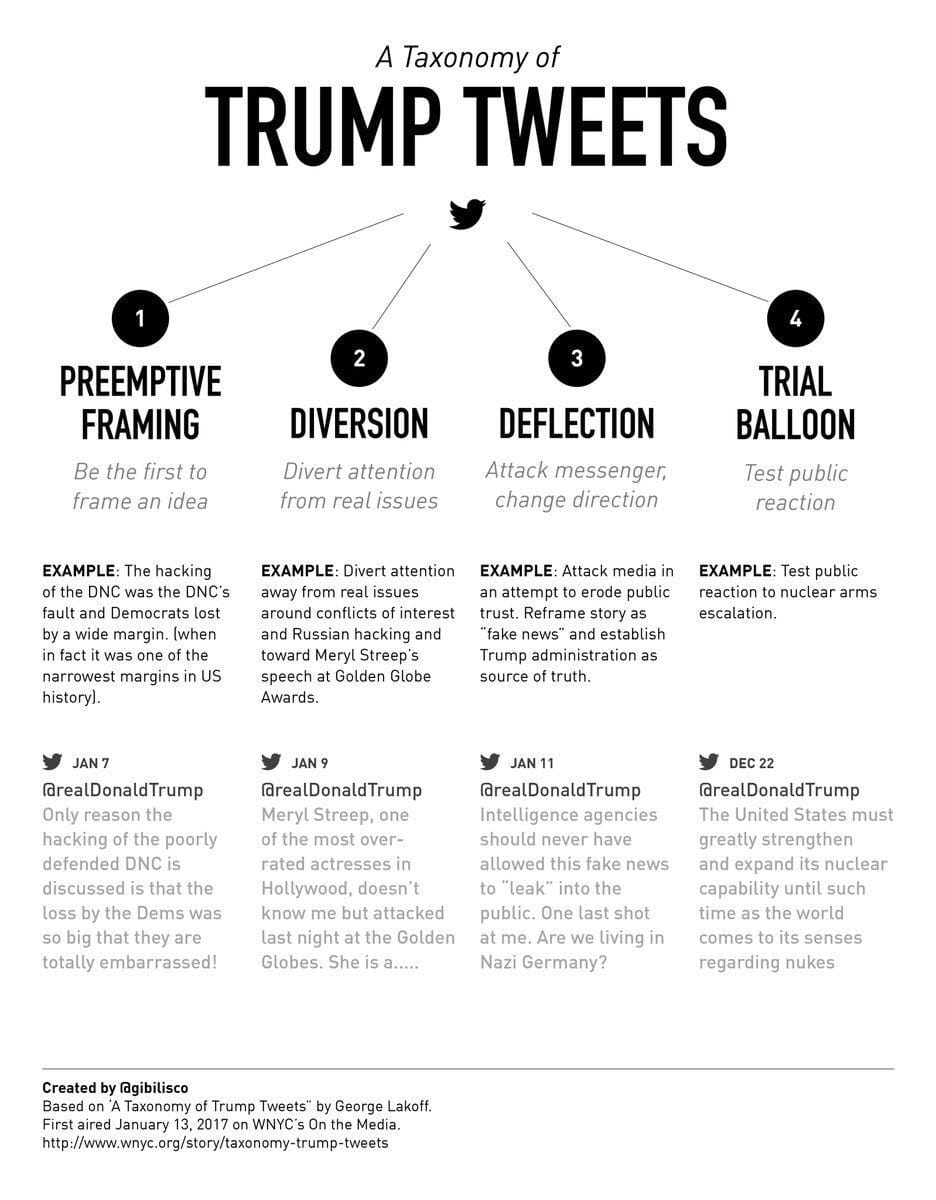
Trump is also an expert in paralipsis, which Mercieca describes as his way of asserting something without taking responsibility for saying it himself. It’s his game of “I’m not saying/I’m just saying.” He does this by retweeting particular noxious notions or images he’s trying to spread or framing his assertions with “many people are saying.” It’s a repulsive hack that renders fact-checks useless.
Fact checks in the Trump era have begun to operate a bit like the “Community Notes” scam on Elon Musk’s version of Twitter. Sure, you occasionally get a gem that exposes an obvious scam – like a faked Trump rally photo or a Republican bragging about an infrastructure program he opposed. But think about where those notes don’t appear. They’re never on Elon’s tweets, which are saturated with right-wing propaganda, AI-generated disinformation, and neo-Nazi conspiracy theorizing. So, in essence, they’re vouching for every lie he spreads.
Donald Trump depends on journalism’s failed conventions to continue to normalize his unprecedented attack on American freedoms. That’s why editors must pursue multiple strategies to ensure they don’t mislead anyone into thinking Trump’s dishonesty is comparable to his opponent’s or any relevant American political figure.
We need information to debunk lies, yet there should be a greater sense of responsibility when dealing with blatant untruths. That starts with recognizing that lies change brains, even when debunked. They are like toxic spilloff or nuclear waste that must be tracked, contained and cleaned up as much as possible. The best way to do that is to lead with the truth whenever possible, the exact thing Trump is trying to bury with his lies.
Readers also need a sense of Trump’s lies’ unprecedented scope, recurrence and purpose. One strategy is to annotate a typical rally speech with facts and reality checks. Then, compare it to a typical Harris speech. Another is to track his most-repeated lies. And, as Dr. Lakoff has suggested for decades, journalists should also analyze the rhetoric’s frames to give voters a sense of the information war being waged for their brains.
The problem with all of these strategies is that the press would be required to do something that they seem to do their best to avoid: Call out Trump’s lies directly. The best we can hope for is a “falsely claims” in a headline or two, which is better than nothing.
Fact checkers should stop pretending they are the be-all and end-all of determining a fact’s value. Since their jobs do not seem to depend on their reputations or track records, they should bring in experts whose careers depend on accuracy to take on Trump’s most repeated lies.
Publications that care about the truth need to show they understand the seriousness of this moment. Democracy and journalism face an unprecedented attack from Trump and MAGA that threatens the future of these two pillars of a free society.
Cowering to Trump will, at best, buy you more opportunities to cower to Trump, who will never be satisfied – not until he can imprison anyone who displeases him by suggesting he alone isn’t in charge of deciding what is true.
The amount of grift, graft, and corruption during his time as president is stunning. His entire con is to deny reality and repeat the lies so much that people will believe it. He accuses others like President Biden of dealing with China when he was renting an entire floor of one of his properties to the Chinese when he was president. He makes his money scamming people and working with corrupt governments. He made more money easier as president than ever in his life, and he wan’ts that money mill back again. We must not let him. Hugs. Scottie

 Scottie's Playtime
