Feel For The Big Investors

‘Concerns About A Stronger-Than-Expected Economy’ Is A Real CNN Thing We Just Read by Rebecca Schoenkopf

Oh no everybody’s got jobs. This is terrible news for stonks! Read on Substack

Now that Yr Wonkette is doing thinky pieces instead of trying to keep up with every last bit of news, we won’t feel obligated to bring you every monthly jobs report, but golly, this story from CNN sure is a ride. Looka this headline: β€œStocks tumble following blowout jobs report.”
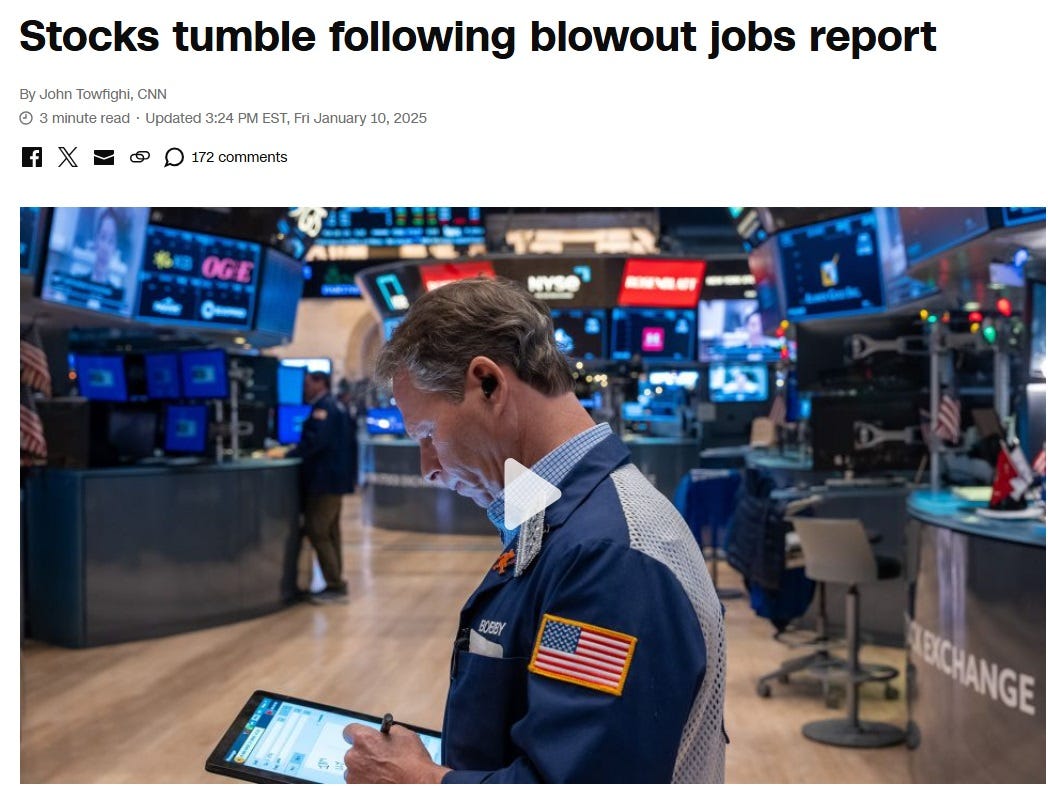
screenshot of a CNN Business story headlined 'Stocks tumble following blowout jobs report.'  A thumbnail image for video embedded in the story features a stock trader looking concerned as he stares at a tablet in his hand. He wears a blue trading jacket with a white mesh back, an American flag patch on the sleeve, and the name 'BOBBY' printed on it. I did not know the term 'trading jacket' before just now.
Hey, Bobby.

We are informed that US stocks β€œplunged” Friday in response to a much better-than-expected jobs report for December, showing that the economy added 256,000 jobs, way more than the 153,000 jobs that Wall Street economists predicted. Investors were reportedly worried that meant that the Federal Reserve will be too nervous about possible inflation to make more interest rate cuts anytime soon:

The Dow dropped by 697 points, closing at 41,938, while the S&P 500 fell by 1.5% and the tech-heavy Nasdaq index was lower by 1.6%.

The three indices all finished the week in the red as Friday’s selloff erased the week’s previous gains.

That’s one way to report the strong job growth, which was accompanied by a drop in the unemployment rate to 4.1 percent.

Or the numbers could also be reported with headlines like these, from ABC News and NBC News, respectively:
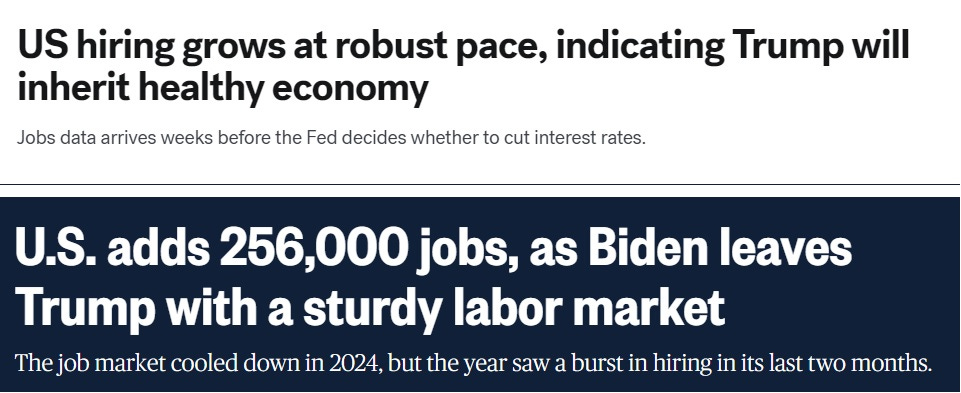
Screenshots of headlines about December jobs reports. ABC News headline: 'US hiring grows at robust pace, indicating Trump will inherit healthy economy." ABC subheading: 'Jobs data arrives weeks before the Fed decides whether to cut interest rates.'   NBC News headline: ' U.S. adds 256,000 jobs, as Biden leaves Trump with a sturdy labor market.' NBC subheading: 'The job market cooled down in 2024, but the year saw a burst in hiring in its last two months.'
caption…

Oh yes, and on a completely separate story that was only about the jobs report itself, CNN Business ran the hed β€œJob growth skyrocketed in December, boosting one of the strongest labor markets in US history.” Huh!

You know, just in case you needed a reminder that the stock market is not the economy, the stock market is not the economy, and did we also mention that the stock market is not the economy?

The CNN stock market story went on to explain,

Traders now expect just a 2.7% chance the Fed will cut rates at its policy meeting later this month, according to the CME FedWatch Tool.

The Russell 2000 index, which tracks smaller companies, fell 2.2%, highlighting concerns about the impact of β€œhigher for longer” interest rates.

And yes, it’s quite true that higher interest rates can be a drag on the economy, which is how the Fed deploys them, sometimes too aggressively, to keep inflation in check.

The story also noted that returns on 10-year Treasury notes,

spiked to 4.76% and the yield on the 30-year US treasury rose to 4.95%.

Rising yields signal concern about a stronger-than-expected economy, resurgent inflation and potentially fewer rate cuts in 2025 than anticipated.

Let’s just repeat that: β€œconcern about a stronger-than-expected economy.” In other words, the strong economy that Joe Biden is handing off to Donald Trump as he leaves office is primarily a concern for big investors, not necessarily the rest of us proles out there.

The contrast in perceptions was evident even in the video attached to the CNN stocks story, which focuses more on the jobs numbers than on stocks. Reporter Matt Eagan was almost giddy, saying, β€œThis is really good news for Main Street, right? It shows that workers are still very much in demand.” Eventually he did get to the response on Wall Street, but before that, Egan pointed out that yet again, workers’ buying power increased because wage growth outpaced inflation, yay.

In fact, let’s hit that one in detail. We’ll crib from Simon Rosenberg’s Hopium Chronicles, because that’s a kickass name for a blog:

Unemployment rate at 4.1%, widely considered to be β€œfull employment.” Wages have risen 3.9% over the past 12 months, outpacing the inflation rate 2.8% during this period.

Rosenberg also helpfully reminds us that net job creation under Biden β€” 16.6 million jobs β€” is far greater than under the last three Republican presidents (Trump and both Bushes) combined, a piddling 1.9 million. Yes, yes, that includes the pandemic shock for Trump and the recovery of those jobs under both Trump and Biden β€” some nine million of β€˜em lost and regained all told; roughly half of the bounceback occurred under Trump in the second half of 2020. But the pandemic job losses were all restored by June 2022, far earlier than most economists predicted, meaning that Biden’s economy has added around 6.8 million jobs since regaining the pandemic losses.

On the whole, the economy in 2024 added 2.2 million jobs, returning to something like the pre-pandemic job growth rate, and β€” we’re gonna say it again β€” reaching a β€œsoft landing” from the high inflation that hit every industrialized country in the world following the pandemic and its disruption of supply chains. Joe Biden also pulled off something rarely seen in US history: Job gains in every single month of his presidency.

So congratulations, Mr. Trump. After cleaning up the mess made by the 2008 economic crash, Barack Obama handed you an economy that kept growing until the pandemic hit. Now Joe Biden, after getting things on track in the wake of the pandemic, will leave behind what just might be the best economy any incoming president has inherited.

Please try not to fuck it up too badly, Sir.

Suggestions for Resources, Actions

Building an open web that protects us from harm

We live in a world where right-wing nationalism is on the rise and many governments, including the incoming Trump administration, are promising mass deportations. Trump in particular has discussed building camps as part of mass deportations. This question used to feel more hypothetical than it does today.

Faced with this reality, it’s worth asking: who would stand by you if this kind of authoritarianism took hold in your life?

You can break allyship down into several key areas of life:

  • Who in your personal life is an ally?Β (Your friends, acquaintances, and extended family.)
  • Who in your professional life is an ally?Β (People you work with, people in partner organizations, and your industry.)
  • Who in civic life is an ally?Β (Your representatives, government workers, individual members of law enforcement, healthcare workers, and so on.)
  • Which service providers are allies?Β (The people you depend on for goods and services β€” including stores, delivery services, and internet services.)

And in turn, can be broken down further:

  • Who will actively help you evade an authoritarian regime?
  • Who will refuse to collaborate with a regime’s demands?

These two things are different. There’s also a third option β€” non-collaboration but non-refusal β€” which I would argue does not constitute allyship at all. This might look like passively complying with authoritarian demands when legally compelled, without taking steps to resist or protect the vulnerable. While this might not seem overtly harmful, it leaves those at risk exposed. As Naomi Shulman points out, the most dangerous complicity often comes from those who quietly comply. Nice people made the best Nazis.

For the remainder of this post, I will focus on the roles of internet service vendors and protocol authors in shaping allyship and resisting authoritarianism.

For these groups, refusing to collaborate means that you’re not capitulating to active demands by an authoritarian regime, but you might not be actively considering how to help people who are vulnerable. The people who are actively helping, on the other hand, are actively considering how to prevent someone from being tracked, identified, and rounded up by a regime, and are putting preventative measures in place. (These might include implementing encryption at rest, minimizing data collection, and ensuring anonymity in user interactions.)

If we consider an employer, refusing to collaborate means that you won’t actively hand over someone’s details on request. Actively helping might mean aiding someone in hiding or escaping to another jurisdiction.

These questions of allyship apply not just to individuals and organizations, but also to the systems we design and the technologies we champion. Those of us who are involved in movements to liberate social software from centralized corporations need to consider our roles. Is decentralization enough? Should we be allies? What kind of allies?

This responsibility extends beyond individual actions to the frameworks we build and the partnerships we form within open ecosystems. While building an open protocol that makes all content public and allows indefinite tracking of user activity without consent may not amount to collusion, it is also far from allyship. Partnering with companies that collaborate with an authoritarian regime, for example by removing support for specific vulnerable communities and enabling the spread of hate speech, may also not constitute allyship. Even if it furthers your immediate stated technical and business goals to have that partner on board, it may undermine your stated social goals. Short-term compromises for technical or business gains may seem pragmatic but risk undermining the ethics that underpin open and decentralized systems.

Obviously, the point of an open protocol is that anyone can use it. But we should avoid enabling entities that collude with authoritarian regimes to become significant contributors to or influencers of open protocols and platforms. While open protocols can be used by anyone, we must distinguish between passive use and active collaboration. Enabling authoritarian-aligned entities to shape the direction or governance of these protocols undermines their potential for liberation.

In light of Mark Zuckerberg’s clear acquiescence to the incoming Trump administration (for example by rolling back DEI, allowing hate speech, and making a series of bizarre statements designed to placate Trump himself), I now believe Threads should not be allowed to be an active collaborator to open protocols unless it can attest that it will not collude, and that it will protect vulnerable groups using its platforms from harm. I also think Bluesky’s AT Protocol decision to make content and user blocks completely open and discoverable should be revisited. I also believe there should be an ethical bill of rights for users on open social media protocols that authors should sign, which includes the right to privacy, freedom from surveillance, safeguards against hate speech, and strong protections for vulnerable communities.

As builders, users, and advocates of open systems, we must demand transparency, accountability, and ethical commitments from all contributors to open protocols. Without these safeguards, we risk creating tools that enable oppression rather than resisting it. Allyship demands more than neutrality β€” it demands action.

https://werd.io/2025/building-an-open-web-that-protects-us-from-harm

Peace & Justice History for 1/11

January 11, 1952
The Peace Pledge Union organized “Operation Gandhi,” which became the first British protest against nuclear weapons. Ten members staged a “sit-down” at the War Office in London.
===================================
January 11, 1998

Twenty-five thousand occupied the site of one of 30 dams to be built on the Narmada River in India.

They objected to a World Bank-funded project to build 30 large, 135 medium and 3000 small dams to harness the waters of the Narmada and its tributaries to provide electrical power and irrigation to Gujarat and Rajasthan provinces.Local residents known asΒ Narmada Bachao AndolanΒ (Save the Narmada movement), organized as they became concerned about their livelihoods, the dams’ environmental impact and a host of other issues.
The largest proposed dam, Sardar Sarovar, would submerge 61 villages and displace more than 320,000 people.
A Brief Introduction to the Narmada IssueΒ 
International Rivers projectΒ 
=====================================
January 11, 2002

The first of the detainees/enemy combatants arrived at GuantΓ‘namo Bay, the U.S. military base on the southeastern coast of Cuba.

Detainees in a plane on their way to Guantanamo
Detailed report of the status of GuantΓ‘namo detaineesΒ 

https://www.peacebuttons.info/E-News/peacehistoryjanuary.htm#january11

The 19th Explains: How Trump’s Cabinet nominees will get confirmed

Originally published by The 19th

The 119th Congress was officially sworn in Friday, meaning the Republican-controlled U.S. Senate will soon begin the process of confirming President-elect Donald Trump’s Cabinet nominees. 

Article II of the U.S. Constitution enables the president to appoint officials to the Cabinet and other positions with the β€œadvice and consent” of the Senate. Many of the committees, all of which have a majority of Republicans, will hold hearings on the nominees related to their area of expertise: the Senate Judiciary Committee, for example, holds hearings for the nominees for attorney general and other top posts at the Department of Justice. Those hearings will begin soon, with senators likely prioritizing confirming nominees to national security positions. 

Republicans will control the Senate 53 to 47 seats once Senator-elect Jim Justice of West Virginia is sworn in later in January and Ohio Gov. Mike DeWine appoints a senator to fill Vice President-elect JD Vance’s seat. 

Some nominees like Sen. Marco Rubio of Florida, Trump’s nominee for secretary of state, are expected to easily sail through the Senate, while others are likely to garner more opposition and scrutiny. Here’s how the process will work: 

When do hearings start?

Sen. Roger Wicker, who leads the Senate Armed Services Committee, is set to hold Pete Hegseth’s confirmation hearing for secretary of defense starting January 14, even before Trump’s inauguration. The hearing for former Rep. Tulsi Gabbard’s nomination for director of national intelligence in the Senate Intelligence Committee is also set to take place that week, according to Punchbowl News. The Senate Judiciary Committee is expected to prioritize confirming Pam Bondi, Trump’s nominee for attorney general, and his nominees for deputy attorneys general before taking up the nomination of Kash Patel to lead the FBI, the outlet reported.  

Are hearings required for every nominee?  

Not necessarily. There are over 1,300 political appointee positions that require Senate confirmation, and some nominees, like military promotions, often go straight to the Senate floor. But nominees for the Cabinet and other high-profile political appointments almost always have confirmation hearings. 

What happens at a confirmation hearing?

Before a hearing, senators on relevant committees will request biographical information and a financial disclosure from the nominee. At the hearing, senators will ask questions about a nominee’s background, their qualifications and their views. Nominees for positions that require a security clearance also traditionally undergo an FBI background check. 

Gabbard and Patel are expected to draw scrutiny for their records and stances on national security issues. Democrats will likely question Hegseth about a past allegation of sexual assault against him, which he denies, as well as his previous comments opposing women in combat roles. Senators on both sides of the aisle are also likely to question Robert F. Kennedy Jr., Trump’s nominee for Health and Human Services secretary, on his views on abortion, vaccines and food policy. 

How does a nominee get confirmed after a hearing?  

After a committee holds a hearing, its members can report the nomination favorably or unfavorably to the full Senate for a final vote. In 2013, then-Senate Majority Leader Harry Reid led his fellow Senate Democrats in changing the chamber’s rules to require only a simple majority to invoke cloture, or end debate, on presidential nominations other than Supreme Court nominees. A simple majority is also needed for final confirmation. In 2017, then-Majority Leader Mitch McConnell and Senate Republicans also lowered the threshold for Supreme Court nominees.  

Historically, it’s been very rare for the Senate to reject a president’s Cabinet nominee. The last time the Senate voted down a Cabinet nominee was in 1989, when senators rejected Sen. John Tower, then-President George H.W. Bush’s nominee for defense secretary, due to concerns about his drinking. Some Cabinet nominees like former Rep. Matt Gaetz, Trump’s first pick for attorney general, also bow out of the process before they go up for confirmation. 

Well, hell’s bells. I wasn’t going to add more of this sort of thing, but it’s important, so here it is.

Read in full here: https://www.platformer.news/meta-new-trans-guidelines-hate-speech/

Snippet:

Earlier this week, Meta announced a sweeping set of changes intended to reduce the amount of content it moderates and align its speech policies more closely with the incoming Trump administration. On Thursday, employees and contractors working on trust and safety began to learn what this would mean in practice.

One change Meta made this week was to eliminate restrictions on some attacks on immigrants, women, and transgender people. Specifically, its hateful conduct policy now allows β€œallegations of mental illness or abnormality when based on gender or sexual orientation, given political and religious discourse about transgenderism and homosexuality and common non-serious usage of words like β€˜weird.’”

Meta has long supplemented its public community standards with nonpublic guidelines that it shares with employees and contractors charged with enforcing its policies. The guidelines give moderators examples of what is and is not allowed.

Today, Platformer is sharing some of those guidelines.

In an answer to the question β€œDo insults about mental illness and abnormality violate when targeting people on the basis of gender or sexual orientation?” Meta now answers β€œno.” It gave the following examples of posts that do not violate its policies:

Non-violating: “Boys are weird.”
Non-violating: “Trans people aren’t real. They’re mentally ill.”
Non-violating: “Gays are not normal.”
Non-violating: “Women are crazy.”
Non-violating: “Trans people are freaks.”

And in a follow-up questions about whether denying that a protected class violates the hateful content policy, Meta also answers no. It gave these as examples of posts that are nowΒ allowedΒ on Facebook and Instagram: (snip-MORE. This is from the guy who left Substack a while back. I don’t want to steal from him. It’s free to read.)

Oh, Dear, Watch Out Now…

It’s a very short, well-written read. Seems important, to me.

Yesterday’s asshat news headlines.

Hi Everyone.Β  I woke at 12:22 last night.Β  But I got up at 1 am and started making posts and doing things.Β  Β So I just finished the asshat yesterday news posts.Β  So now before I answer the comments … and I love comments everyone sends to me, I have to make a red sauce.Β  Β Ron promised to make me a grand lasagna if I make the sauce.Β  Β So with ear buds in, off I go to make the sauce.Β  Β Hugs and loves to everyone.Β  Remember that I really care for everyone.Β  Add any questions or comments in the comments and I will reply there.Β  Β Hugs.Β Β 


JoeMyGod
Moda day ago

Two months ago Fat Hitler vowed to imprison Zuckerberg.

This is the result.

If you criticize the dear leader of the maga cult then you are forever an enemy.Β  Death to the nonbelievers.Β  Β This is why the current republicans and maga is very much a cult.Β  Hugs.Β 

This is great.Β  The tRump world crowed about this citizen of Greenland who praised tRump’s plan to take over Greenland.Β  Yet the truth did come out … He was a tRumpΒ  loving fanboy violent felon drug dealer prison escapee.Β  Β Hugs.

Things To Think About Over The Next Couple of Weeks-

10th anniversary of the Charlie Hebdo killings by Ann Telnaes

On January 7, 2015 the editorial cartooning community suffered a horrible blow Read on Substack

The attack at the Paris offices of the satirical magazine Charlie Hebdo left 12 people dead, including five cartoonists, and set off a worldwide debate about free speech and satire.

Peace & Justice History for 1/8

The 2003 entry is one of my very favorite things!

January 8, 1912
=
The African National Congress was founded in South Africa. The ANC (now multi-racial) was the first black political organization in South Africa. It was formed to combat the racially separatist system known in the Afrikaans language asΒ apartheid. The ANC is now the majority party in the South African government.
African National Congress historyΒ 
==================================
January 8, 1961

The people of France voted to grant Algeria its independence in a referendum. This followed more than 130 years of French colonial control of the north African country. The result was a clear majority for self-determination, with 75% voting in favor.
Read moreΒ 
===================================
January 8, 1973

U.S. National Security Advisor Henry Kissinger and North Vietnam’s Le Duc Tho resumed secret peace negotiations near Paris.
After the South Vietnamese had blunted the massive North Vietnamese invasion launched in the spring of 1972, Kissinger and the North Vietnamese had finally made some progress on reaching a negotiated end to the war. However, a recalcitrant South Vietnamese President Nguyen Van Thieu had inserted several demands into the negotiations that caused the North Vietnamese negotiators to walk out of the talks a month earlier.

Le Duc Tho and Henry Kissinger
==================================
January 8, 2003


Three activists, including Kate Berrigan (daughter of Phil) and Liz McAlister, rappelled down a 32-story skyscraper near the Los Angeles Auto Show and unfurled a banner reading β€œFord: Holding America Hostage To Oil.” They had chosen Ford due to its having the lowest average fuel economy of any auto manufacturer, and that it was not living up to the reputation it put forth as being an environmental car company.
Frida Berrigan tells the storyΒ 

https://www.peacebuttons.info/E-News/peacehistoryjanuary.htm#january8

So About Meta

Personally, I don’t think it’s surrender on the part of Meta, nor any of the other media moguls. It’s all of one piece-they’re all in it together with the new 47th president. I’ve read this from others, too, both last night and this morning. We the people are not part of the club. Anyway, here is this.

Meta surrenders to the right on speech

β€œI really think this a precursor for genocide,” a former employee tells Platformer

Casey Newton

Jan 7, 2025Β β€”Β 12 min read

Snippet:

I. The past

Donald Trump’s surprising victory in the 2016 US presidential election sparked a backlash against tech platforms in general and against Meta in particular. The company then known as Facebook was battered by revelations that its network dramatically amplified the reach of false stories about Trump and his opponent, Hillary Clinton, and was used as part of a successful effort by Russia to sow division in US politics and tilt the election in favor of Trump.

Chastened by the criticism, Meta set out to shore up its defenses. It hired 40,000 content moderators around the world, invested heavily in building new technology to analyze content for potential harms and flag it for review, and became the world’s leading funder of third-party fact-checking organizations. It spent $280 million to create an independent Oversight Board to adjudicate the most difficult questions about online speech. It disrupted dozens of networks of state-sponsored trolls who sought to use Facebook, Instagram, and WhatsApp to spread propaganda and attack dissenters.

CEO Mark Zuckerberg had expected that these moves would generate goodwill for the company, particularly among the Democrats who would retake power after Trump lost in 2020. Instead, he found that disdain for the company remained strongly bipartisan. Republicans scorned him for policies that disproportionately punished the right, who post more misinformation and hate speech than the left does. Democrats blamed him for the country’s increasingly polarized politics and decaying democracy. And all sides pilloried him for the harms that his apps cause in children β€” an issue that 42 state attorneys general are now suing him over.

Last summer, the threats against Zuckerberg turned newly personal. In 2020, Zuckerberg and his wife had donated $419.5 million to fund nonpartisan election infrastructure projects. (Another effort that had seemingly generated no goodwill for him or Meta whatsoever.) All that the money had done was to help people vote safely during the pandemic. But Republicans twisted Zuckerberg’s donation into a scandal; Trump β€” who lost the election handily but insisted it had been stolen from him β€” accused Zuckerberg of plotting against him. 

β€œWe are watching him closely,” Trump wrote in a coffee-table book published ahead of the 2024 election, β€œand if he does anything illegal this time he will spend the rest of his life in prison.”

By the end of 2024, Zuckerberg had given up on finding any middle path through the polarized and opposite criticisms leveled against him by Republicans and Democrats. His rival Elon Musk had spent the past year showing how Republican party support can be bought β€” cheaply. 

In business and in life, Zuckerberg’s motivation has only ever been to win. And a doddering, transactional Trump presented Meta with a rare opportunity for a fresh start.

All they would have to do is whatever Trump wanted them to do.

II. The announcements

On Tuesday, Meta announced the most significant changes to its content moderation policies since the aftermath of the 2016 election. The changes include:

  • Ending its fact-checking program, which funds third-party organizations to check the claims in viral Facebook and Instagram posts and downrank them when they are found to contain falsehoods. It will be replaced with a clone ofΒ Community Notes, X’s volunteer fact-checking program.
  • Eliminating restrictions on some forms of speech previously considered harmful, including some criticisms of immigrants, women, and transgender people.
  • Re-calibrating automated content moderation systems to prioritize only high-severity violations of content policy, such as those involving drugs and terrorism, and reviewing lower-severity violations only when reported by users. (This sounds boring but might be the most important change of all, as we’ll get to)
  • Re-introducing discussion of current events, which the company calls “civic content,” into Facebook, Instagram, and Threads.
  • Moving content moderation teams from California to Texas to fight the perception that Meta’s moderation reflects a liberal Californian bias. (Never mind that the company has always had content moderation teams based in Texas, or that it was Zuckerberg and not the moderators who set the company’s policies.)

Zuckerberg announced these changes in an Instagram Reel; Joel Kaplan, a Republican operative and longtime Meta executive who last week replaced Nick Clegg as the company’s president of public policy, discussed the changes in an appearance on “Fox and Friends.” (See transcripts of both here.)

One way to understand these changes is as a marketing exercise, intended to convey a sense of profound change to an audience of one. In this, Meta appears to have succeeded; Trump today called the company’s changes “excellent” and said that the company has “come a long way.” (“Mr. Trump also said Meta’s change was ‘probably’ a result of the threats he had made against the company and Mr. Zuckerberg,” dryly noted the Times’ Mike Isaac and Theodore Schleifer.)

Whether this will be enough to get Trump to end the current antitrust prosecution against Meta, or otherwise advocate for the company in regulatory affairs, remains to be seen. By the cynical calculus of the company’s communications and policy teams, though, one assumes that Trump’s comments inspired a round of high-fives in the company’s Washington, DC offices.

But these changes are likely to substantially increase the amount of harmful speech on Meta’s platforms, according to 10 current and former employees who spoke to Platformer on Tuesday.

Start with the end of Meta’s fact-checking partnerships, which perhaps generated the most headlines of the company’s changes on Tuesday. While the company has been gradually lowering its investment in fact-checking for a couple years now, Meta’s abandonment of the project will have real effects: on the fact-checking organizations for whom Meta was a primary source of revenue, but also in the Facebook and Instagram feeds of which Meta is an increasingly begrudging steward. (snip-MORE. Go read; he left Substack because of the nazis, and made Platformer to get his writing to people. It’s free to read, and you don’t have to subscribe, either.)
