
Category: Climate / Environment
Good morning, Scottie’s Playtime!
From jeff tiedrich:
Stuff I Ran Across Yesterday
How Crocodile Ancestors Survived The Dinosaur Extinction
Evrim Yazgin Cosmos science journalist
Crocodiles are often thought of as living fossils – unchanged over millions of years. New research has shown that their evolutionary history is a lot more complicated than that.
Crocodilia is the surviving family of a lineage which emerged about 230 million years ago (mya) called crocodylomorphs. This group split from other reptilian species including those that eventually became dinosaurs. Today, the crocodilia include crocodiles, alligators, caiman and gharials.
Ancestors of modern crocodilians survived through 2 mass extinctions, including the one which spelled the end of the “Age of Dinosaurs” 66 mya.

The new study, published in the journal Palaeontology, shows that the secret to success of crocodylomorphs was their adaptability to new food sources and habitats.
“Lots of groups closely related to crocodilians were more diverse, more abundant, and exhibited different ecologies, yet they all disappeared except these few generalist crocodilians alive today,” says lead author Keegan Melstrom from the University of Central Oklahoma.
Today’s crocodilians are semi-aquatic generalists. The thrive in different habitats and aren’t picky eaters.
It was a different story with ancient crocodylomorphs.

The palaeontologists visited museum collections in 7 countries, across 4 continents to understand the evolution of crocodilian ancestors. They examined the skulls of 99 extinct crocodylomorph species and 20 living crocodilians.
Crocodylomorphs exploded after the end-Triassic mass extinction 201 mya which killed off ancient lineages of hypercarnivores and land-based predators.
“After that, it goes bananas,” says Melstrom. “Aquatic hypercarnivores, terrestrial generalists, terrestrial hypercarnivores, terrestrial herbivores – crocodylomorphs evolved a massive number of ecological roles throughout the time of the dinosaurs.”
Toward the end of the time of the dinosaurs, however, crocodylomorphs started to decline.
Most of the specialised crocodylomorphs had died off by the end of the Cretaceous. Almost all 26 remaining species today are semi-aquatic generalists.

“When we see living crocodiles and alligators, rather than thinking of ferocious beasts or expensive handbags, I hope people appreciate their amazing 200+ million years of evolution, and how they’ve survived so many tumultuous events in Earth history,” says co-author Randy Irmis from the Natural History Museum of Utah. “Crocodilians are equipped to survive many future changes – if we’re willing to help preserve their habitats.”
“Extinction and survivorship are 2 sides of the same coin,” Melstrom says. “Through all mass extinctions, some groups manage to persist and diversify. What can we learn by studying the deeper evolutionary patterns imparted by these events?” (snip-More)
==============================================================
Free by Grant Snider
A poem in pictures Read on Substack




















==============================================================
More Library Tidbits (+ a way to be an impediment to the strangling of libraries.)
US blocks Canadian access to cross-border library, sparking outcry
US officials claim move was to curb drug trafficking while Quebec town says it ‘weakens collaboration’ among nations
View image in fullscreen A young girl walks over the Canada-US border line from the Haskell Free Library and Opera House in Derby Line, Vermont, on Friday. Photograph: Christinne Muschi/The Canadian Press via AP
The US has blocked Canadian access to a library straddling the Canada-US border, drawing criticism from a Quebec town where people have long enjoyed easy entry to the space.
The Haskell Free Library and Opera House is located between Stanstead, Quebec, and Derby Line, Vermont. It was built deliberately to straddle the frontier between the two countries – a symbol of cooperation and friendship between Canada and the US. (snip)
Fairhope Public Library supporters raise money to replace funds state plans to withhold
By: Ralph Chapoco – March 25, 2025 11:49 am
A nonprofit says it has raised enough money for Fairhope Public Library to cover state funds that the Alabama Public Library Service Board cut off last week.
Read Freely Alabama, a grassroots free speech advocacy organization that has fought restrictions on library content, said it had collected almost $39,000 from about 550 donors through Tuesday morning. Read Freely is organizing the campaign with EveryLibrary, an Illinois-based organization that promotes library funding and fights restrictions.
“We were trying to figure out what was the amount that they were pausing,” said Cheryl Corvo, a member of Read Freely Alabama and Fairhope resident. “Then, we found out it was $42,000 that they were pausing, and how it would affect our library.”
The Fairhope Public Library said it will have access to funding without interference from the state or any outside groups.
“We had a meeting with EveryLibrary, which is the group that has control of this particular fundraiser, and they take 10% and 90% of it comes to us,” said Randal Wright, a board member of the Fairhope Public Library.
The amount was not enough to severely debilitate the library’s operations, Corvo said. But it is enough to affect “some very vital resources that the library provided.” Corvo said the campaign should also make APLS aware of the magnitude of local support for the library.
Wright said that if the state continues to withhold money, the funds will go toward computers, books for the collection and paying for guest speakers. (snip)
Peace & Justice History for 4/17
| April 17, 1959 22 were arrested in New York City for refusing to take shelter during a civil defense drill. |
| April 17, 1960 Inspired by the Greensboro sit-in of four black college students at an all-white lunch counter, nearly 150 black students from nine states formed the Student Nonviolent Coordinating Committee (SNCC). Meeting in Raleigh, North Carolina, with Ella Baker, James Lawson and Martin Luther King, Jr., the founders set SNCC’s initial goals as overturning segregation in the South.   They also considered it important to give young blacks a stronger voice in the civil rights movement, as many had participated in sit-ins that had proliferated to dozens of cities over the previous three months. At the Raleigh conference Guy Carawan sang a new version of “We Shall Overcome,” an adaptation of an old labor song. This song would become the national anthem of the civil rights movement. People joined hands and gently swayed in time singing “black and white together,” repeating over and over, “Deep in my heart, I do believe, we shall overcome some day.” History of SNCC (It’s a Stanford.edu page, which “cannot be reached.” Take from that what you will. I’ve decided to note these things when they happen.) What SNCC did to make change happen (This page is good.) |
April 17, 1961 Cuban leader Fidel Castro during the Bay of Pigs invasion. An army of 1500 anti-Castro Cuban exiles, mercenaries equipped and trained at a secret Guatemala base by the CIA, landed at Bahia de Cochinos (Bay of Pigs) in an attempt to “liberate” Cuba from Communist rule. Within three days, the invasion proved disastrous with nearly 1200 members of Brigade 2506 (who had been trained in the U.S.) taken prisoner. Known as Operation Zapata, it was conceived by Vice President Nixon, planned and approved by the Eisenhower administration, and executed shortly after President John Kennedy’s inauguration.  President Kennedy receives the Brigade 2506 flag in Miami in 1962 and declares: “I promise to return this flag in a free Havana.” Soviet General Secretary Nikita Kruschev sent a telegram to President Kennedy: “Mr. President, I send you this message in an hour of alarm, fraught with danger for the peace of the whole world. Armed aggression has begun against Cuba. It is a secret to no one that the armed bands invading this country were trained, equipped and armed in the United States of America. The planes which are bombing Cuban cities belong to the United States of America, the bombs they are dropping are being supplied by the American Government . . . .” What actually happened |
April 17, 1965 The first national demonstration against the Vietnam War took place in the nation’s capital. Students for a Democratic Society (SDS), the organizers, had expected about 2000 marchers; the actual count was 15,000–25,000. This was the largest anti-war protest ever to have been held in Washington, D.C. up to that time. The number of marchers approximately equaled the number of U.S. soldiers in Vietnam. Several hundred students in the protest broke away from the main march and conducted a brief sit-in at the U.S. Capitol’s door. An exam prepared by SDS about the Vietnam War (answers available) |
April 17, 1965 Gay rights advocate Jack Nichols The first demonstration promoting equal treatment of homosexuals, Jack Nichols, Barbara Gittings and others picketed in front of the White House. There were no media present.. Read more |
| April 17, 1986 Reverend Jesse Jackson, future congresswoman Maxine Waters and others co-founded the Rainbow Coalition, initially intended as a progressive public-policy think tank within the Democratic Party.  Representative Maxine Waters, Harry Belafonte, John Sweeney, President of the AFL-CIO, Reverend Jesse Jackson, and Willie Nelson August 6, 2005-Atlanta, Georgia. Brief history of Rainbow Push Coalition |
| April 17, 1992 On Good Friday morning, about 50 people accompanied Fr. Carl Kabat and Carol Carson to Missile Silo Site N5 at Whiteman Air Force Base in Missouri, the same silo that Carl and other members of the Silo Pruning Hooks (see below) disarmed in 1984. They cut through a fence and, once inside, Carol used a sledgehammer on the concrete lid of the silo while Carl performed a rite of exorcism. Eventually, the police arrived and arrested Carl and Carol. They were jailed and held until their court appearance. At that time, they made a preliminary agreement with federal prosecutors wherein they would plead “no contest” to trespass in exchange for the property destruction charge being dropped; they were sentenced to six and three months, respectively, in a halfway house.  Carl Kabat A History of Direct Disarmament Actions About the Silo Pruning Hooks action |
https://www.peacebuttons.info/E-News/peacehistoryapril.htm#april17
An Unsettling Headline-
For the First Time, Artificial Intelligence Is Being Used at a Nuclear Power Plant
Alex Shultz Published April 13, 2025 | Comments (4)
Diablo Canyon, California’s sole remaining nuclear power plant, has been left for dead on more than a few occasions over the last decade or so, and is currently slated to begin a lengthy decommissioning process in 2029. Despite its tenuous existence, the San Luis Obispo power plant received some serious computing hardware at the end of last year: eight NVIDIA H100s, which are among the world’s mightiest graphical processors. Their purpose is to power a brand-new artificial intelligence tool designed for the nuclear energy industry.
Pacific Gas and Electric, which runs Diablo Canyon, announced a deal with artificial intelligence startup Atomic Canyon—a company also based in San Luis Obispo—around the same time, heralding it in a press release as “the first on-site generative AI deployment at a U.S. nuclear power plant.”
For now, the artificial intelligence tool named Neutron Enterprise is just meant to help workers at the plant navigate extensive technical reports and regulations — millions of pages of intricate documents from the Nuclear Regulatory Commission that go back decades — while they operate and maintain the facility. But Neutron Enterprise’s very existence opens the door to further use of AI at Diablo Canyon or other facilities — a possibility that has some lawmakers and AI experts calling for more guardrails.
PG&E is deploying the document retrieval service in stages. The installation of the NVIDIA chips was one of the first phases of the partnership between PG&E and Atomic Canyon; PG&E is forecasting a “full deployment” at Diablo Canyon by the third quarter of this year, said Maureen Zawalick, the company’s vice president of business and technical services. At that point, Neutron Enterprise—which Zawalick likens to a data-mining “copilot,” though explicitly not a “decision-maker”—will be expanded to search for and summarize Diablo Canyon-specific instructions and reports too.
“We probably spend about 15,000 hours a year searching through our multiple databases and records and procedures,” Zawalick said. “And that’s going to shrink that time way down.” (Emphasis mine- A. I worked at the nuke plant in my state in my 20s. I did Records Management. I’m not going to explain it all from back then the way I trained people, but it involves reading and interpreting what one has read in application to the function, part, area, etc. a document records, which is learned by reading the document, then coding it so it is efficiently retrieved later. So far, I don’t know that AI does that. Others who are more knowledgeable about records management and retrieval in this era and context may see better things than I see. The best worst I see is really angry and impatient engineers and inspectors in all the disciplines still at the plant. That’s no fun, anyway.)
Trey Lauderdale, the chief executive and co-founder of Atomic Canyon, told CalMatters his aim for Neutron Enterprise is simple and low-stakes: he wants Diablo Canyon employees to be able to look up pertinent information more efficiently. “You can put this on the record: the AI guy in nuclear says there is no way in hell I want AI running my nuclear power plant right now,” Lauderdale said.
That “right now” qualifier is key, though. PG&E and Atomic Canyon are on the same page about sticking to limited AI uses for the foreseeable future, but they aren’t foreclosing the possibility of eventually increasing AI’s presence at the plant in yet-to-be-determined ways. According to Lauderdale, his company is also in talks with other nuclear facilities, as well as groups who are interested in building out small modular reactor facilities, about how to integrate his startup’s technology. And he’s not the only entrepreneur eyeing ways to introduce artificial intelligence into the nuclear energy field.
In the meantime, questions remain about whether sufficient safeguards exist to regulate the combination of two technologies that each have potential for harm. The Nuclear Regulatory Commission was exploring the issue of AI in nuclear plants for a few years, but it’s unclear if that will remain a priority under the Trump administration. Days into his current term, Trump revoked a Biden administration executive order that set out AI regulatory goals, writing that they acted “as barriers to American AI innovation.” For now, Atomic Canyon is voluntarily keeping the Nuclear Regulatory Commission abreast of its plans.
Tamara Kneese, the director of tech policy nonprofit Data & Society’s Climate, Technology, and Justice program, conceded that for a narrowly designed document retrieval service, “AI can be helpful in terms of efficiency.” But she cautioned, “The idea that you could just use generative AI for one specific kind of task at the nuclear power plant and then call it a day, I don’t really trust that it would stop there. And trusting PG&E to safely use generative AI in a nuclear setting is something that is deserving of more scrutiny.”
For those reasons, Democratic Assemblymember Dawn Addis—who represents San Luis Obispo—isn’t enthused about the latest developments at Diablo Canyon. “I have many unanswered questions of the safety, oversight, and job implications for using AI at Diablo,” Addis said. “Previously, I have supported measures to regulate AI and prevent the replacement and automation of jobs. We need those guardrails in place, especially if we are to use them at highly sensitive sites like Diablo Canyon.” (snip-MORE; not tl;dr, though.)
Peace & Justice History for 4/14
April 14, 1947 Segregation of Mexican-American children, common in California at the time, was declared unconstitutional by the Federal Appeals Court for the Ninth Circuit. Suit had been brought against several school districts in Orange County by Gonzalo Méndez and several World War II veterans. Separate schools for those of Mexican parentage was struck down in Méndez et al. v. Westminster School District: “ . . . commingling of the entire student body instills and develops a common cultural attitude among the school children which is imperative for the perpetuation of American institutions and ideals. It is also established by the record that the methods of segregation prevalent in the defendant school districts foster antagonisms in the children and suggest inferiority among them where none exists . . .”  Sylvia Mendez Mendez v Westminster History |
| April 14, 1968 A massive student rally in West Berlin blocked the city’s main thoroughfare, the Kurfurstendamm. It ended in violent clashes between police and the marchers. The students were protesting the shooting a week earlier of one of their leaders, Rudi Dutschke, outside the offices of the German Socialist Students Federation (SDS).  Read more |
| April 14, 1988 The Soviet Union signed an agreement pledging to withdraw its troops from Afghanistan after nearly ten years. The pact, drawn up in negotiations between the United States, the USSR, Pakistan and Afghanistan, was signed at a United Nations ceremony in the Swiss capital of Geneva.  Entertaining and basically factual story of what pushed the Soviets out of Afghanistan |
| April 14, 1988 Denmark’s parliament, the Folketing, insisted that foreign warships affirmatively state whether or not they carry nuclear weapons before being allowed to enter Danish ports. Previously, their non-nuclear policy had not been enforced and such weapons were routinely carried on nuclear-capable NATO ships visiting Denmark. U.S. and other allies had abided by a policy known as “neither confirming nor denying” (NCND).  Denmark’s Folketing The policy and its consequences |
https://www.peacebuttons.info/E-News/peacehistoryapril.htm#april14
Jessica Craven’s Extra
Extra! Extra! 4/13 by Jessica Craven
What’s right with this picture? Read on Substack

Hi, all, and happy Sunday!
Also, a belated Chag Sameach to everyone who celebrated Passover yesterday.
I know it’s been a super tough week—it’s all the more reason that a pause for good news is important. So here’s everything I could find that went right in the last seven days. As always, there was a lot more of it than you might have thought.
Enjoy reading this list. And please share. Lots of folks need a morale boost—I’m sure you know a few of them.
And if you notice that I forgot something please drop it in the comments! Like everything in this newsletter, they’re open to everyone.
OK, my friends. Have a great rest of your day. Tomorrow we get back to the fight.
Read This 📖
Rebecca’ Solnit’s post about the Hands Off protests, which includes the speech she made at the one she attended, is an absolute must-read.
Celebrate This! 🎉
In an unexpected win for antitrust, one of the Republican commissioners remaining on the Federal Trade Commission will save the agency’s investigation into pharmacy benefit managers by unrecusing himself from the case.
A plan to study “social housing” passed the Portland City Council with unanimous support.
Four countries—Brazil, Thailand, Zambia and Poland—have successfully reversed democratic decline in recent years.
AOC is leading Chuck Schumer among Democratic primary voters by double digits.
A judge blocked the White House’s AP ban.
Sen. Richard Blumenthal announced that he plans to place a hold on ALL Trump nominees going forward.
Sen. Brian Schatz is placing holds on over 50 Trump nominees. He has also placed holds on all nominations at the State Department, bringing his total to over 300 positions. Bravo!
The American Library Association, the largest library association in the world, and the American Federation of State, County and Municipal Employees, the largest union representing museum and library workers, are suing the Trump administration over its gutting of the Institute of Museum and Library Services.
In response to public backlash, the National Park Service restored original content to its webpage about Harriet Tubman and the Underground Railroad.
A federal judge in Texas (appointed by Trump) has issued a ruling blocking the removal of individuals under the Alien Enemies Act, citing concerns raised in the Supreme Court’s recent decision and the controversial Abrego Garcia case.
A Delaware judge ruled that Newsmax’s coverage of Dominion Voting Systems was false and defamatory.
Senator Adam Schiff called on Congress to investigate whether President Donald Trump engaged in insider trading or market manipulation when he abruptly paused a sweeping set of tariffs, a move that sent stock prices skyrocketing.
Indiana lawmakers in the state’s Republican-led senate are looking to take on pharma’s price-gouging middlemen known as pharmacy benefit managers by creating a public system.
The Government Accountability Office (GAO) is auditing DOGE.
A federal court ordered multiple government agencies to provide additional details about their use of Signal for official government business.
A coalition of more than 240 pastors, Christian faith leaders, and faith-based nonprofit organizations across Tennessee have come together to oppose a bill that could allow public schools there to deny enrollment for migrant children without legal status.
American Oversight secured a significant legal victory after a Georgia court denied State Election Board member Janice Johnston’s motion to dismiss in its ongoing transparency lawsuit against the Georgia State Election Board.
Maine officials sued the Trump administration to try to stop the government from freezing federal money in the wake of a dispute over transgender athletes in sports.
The Supreme Court told the Trump administration to seek the return of a migrant mistakenly sent to a Salvadoran prison, rebuffing government claims that it need do nothing to remedy its error.
In Wisconsin, former state Supreme Court Justice Michael Gableman agreed to surrender his law license following a disciplinary complaint related to his conduct during his investigation of the 2020 presidential election.
Two groups representing Harvard professors sued the Trump administration, saying that its threat to cut billions in federal funding for the university violates free speech and other First Amendment rights
The Trump administration restored USAID emergency food programs in Lebanon, Syria, Somalia, Jordan, Iraq, and Ecuador.
After local residents organized a 1000-person march past Tom Homan’s house in rural upstate NY, the Sackets Harbor Superintendent announced that an ICE-abducted family—including 3 small children—would be returning home. Amazing!
Since Trump’s “Liberation Day” announcements his approval ratings have absolutely plummeted.
Solar energy in New York got a big boost with the announcement of a $950 million contract to construct the state’s largest solar farm, and the program has now broken ground.
A first-of-its-kind pilot to electrify homes on Cape Cod and Martha’s Vineyard is set to finish construction in the coming weeks — and it could offer a blueprint for decarbonizing low- and moderate-income households in Massachusetts and beyond.
Initial analysis of the Wisconsin elections on April 5 shows that relative to 2024’s presidential race, every single county in Wisconsin moved left. Wow!
A federal judge rejected Johnson & Johnson’s third attempt to use a controversial legal maneuver to settle tens of thousands of lawsuits claiming its baby powder and other products were tainted with toxic asbestos and caused cancer.
A Mississippi judge on April 4 dismissed former governor Phil Bryant’s (R) defamation suit against a nonprofit newsroom for exposing potential corruption in his administration.
Companies are starting to tack tariff surcharges onto invoices as a separate line item.
Fossil fuels made up less than half of the U.S. electricity mix in March for the first month on record.
Senator Chris Murphy raised 8M in the first quarter of this year—even though he just won re-election last year! (Presidential run coming?)
Chevron was ordered to pay more than $740 million to restore coastal wetlands in Louisiana.
The U.S. solar industry has stockpiled 50 GW of imported equipment, which will help it stave off the impact of President Trump’s tariffs.
Some House Freedom Caucus members are apparently warming to the idea of a new 40% tax bracket for those earning $1 million or more to offset some new tax cuts. YEs, you read that right.
Alabama legislators unanimously passed a bill that would expedite access to Medicaid for pregnant women.
Former New Hampshire Gov. Chris Sununu (R) told the Pulse of New Hampshire that he will not run for the U.S. Senate, a setback for Republicans’ hopes to flip the open seat.
The Senate parliamentarian ruled that Republicans in Congress cannot use an obscure legislative maneuver to stop California’s ban on the sale of new gasoline-powered cars by 2035.
The Wisconsin Supreme Court dismissed a challenge last week that sought to limit municipalities’ authority to set early voting locations and prevent the future use of a mobile voting van.
Maryland lawmakers passed a package of energy bills that includes provisions for fast-tracking some community solar project approvals and prohibiting counties from banning solar development in hopes of curbing power rates.
Republican senators, led by Sens. Bill Cassidy of Louisiana and Lindsey Graham of South Carolina, unveiled a bill Tuesday that would slap penalties on countries that generate high levels of manufacturing pollution. Yes, really.
The world used clean power sources to meet more than 40% of its electricity demand last year for the first time since the 1940s, figures show.
Jeff Bezos is funding a secretive EV startup based in Michigan called Slate Auto that could start production as soon as next year. Slate Auto is tackling a big goal: an affordable two-seat electric pickup truck for around $25,000.
36K people attended Bernie Sanders’ and AOC’s “Fighting Oligarchy” event in Los Angeles.
For the first time, a fully electric airplane flew from New York to California and back again.
The California Coastal Commission voted to fine Sable Offshore, an oil drilling company, nearly $18 million after Sable repeatedly ignored cease-and-desist orders, failed to obtain Coastal Development Permits, and proceeded to restart its work on oil infrastructure with a documented history of environmental disaster.
DOGE backed away from cuts to Social Security phone services following intense backlash.
Federal agents attempted to enter two Los Angeles Unified elementary schools this week. The principals of each school denied the agents entry and contacted legal support; the agents left. Let’s give a round of applause to the LAUSD community members and activists—some of whom I know—who “went deep on proper warrants for entry,” as soon as Trump was elected. Because of them, these schools were prepared and disaster was averted!
Russia freed a Russian-American ballerina in a prisoner exchange with the Trump administration.
Almost 300,000 new EVs were sold in the U.S. in the first three months of the year, a nearly 11% increase.
A federal judge ordered the Trump administration to unfreeze federal funding that was allocated to Maine from the U.S. Department of Agriculture — funds that had been withheld following President Trump’s clash with Maine Gov. Janet Mills over the issue of transgender athletes.
In Coeur d’Alene, Idaho, police have recommended criminal charges—including battery and false imprisonment—against the security team who brutally dragged Dr. Teresa Borrenpohl out of a town hall in February.
For the first time, fossil fuels accounted for less than half of U.S. electricity production across an entire month as clean power generation surged in March.
A federal judge in New York also blocked the Trump administration from continuing to deport people under the Alien Enemies Act.
A federal judge has rejected President Trump ‘s effort to dismiss a defamation lawsuit against him filed by the men formerly known as the Central Park Five
It’s official: The Tesla Cybertruck is a flop. (snip-a bit more)
Earth News
Would Some Climate Nice Time Recharge Your Batteries? Here You Go! by Rebecca Schoenkopf
40 percent of the world’s electricity now comes from clean power. That’s big! Read on Substack

With all the terribleness going on, we need to make those in power know that their attempts to bring fascism to America will not stand, man. But we also need to remind ourselves that a better country is worth fighting for, and that despite all the free range evil in our politics, humans really can do some amazing things, too. And so, let’s do another Climate Nice Time, not because we’re whistling past the graveyard and refusing to acknowledge the abyss, but because staring into that sucker all the time is exhausting.
Clean Energy Doing 40 Percent Of World’s Electricity, And Keeps Growing
The rapid growth of renewable energy in the last couple decades, especially the proliferation of solar, which has become almost ridiculously inexpensive, means that in 2024, a bit more than 40 percent of the world’s electricity came from carbon-free sources. That’s according to the latest annual review of world electricity by the clean-energy thinktank Ember, which looked at electricity use and generation data in 215 countries, not one of which is an island populated only penguins.
While solar has been the fastest-growing source of clean energy for 20 years running, all solar (both grid-scale power plants and rooftop home installations) still provides only seven percent of world electricity, with wind accounting for another eight percent. Thing is, those percentages keep growing, while the two top sources of carbon-free electricity, hydroelectric (14 percent) and nuclear (nine percent) have remained fairly static. Other renewable sources like geothermal, biomass, and tidal energy account for another three percent; the growth of enhanced geothermal in the next decade is almost certain to take it out of the “other” category as surely as the Professor and Mary Ann broke out of “And the rest” in the second season of “Gilligan’s Island.”
The Ember study notes that total solar generation has doubled in the last three years, and about half of that new solar has come online in China, which is beating the pants off the rest of the world in deploying clean energy.
Ember had previously predicted that the world’s emissions from electricity would peak in 2023 and begin declining after that, but a series of deadly heatwaves around the world that year boosted air conditioning use and therefore electricity demand past the growth of clean energy, also increasing fossil fuel generation by about 1.4 percent. Hello again, first chapter of The Ministry for the Future. Even if we don’t see a similar outbreak of heatwaves, increasing demand from data centers and for charging EVs means it remains critical to install as much new renewable energy as possible to keep up. Happily, the rest of the world doesn’t have That Man running it. [Guardian / Ember]
Germany: Balcony Solar Panels Help Renters Go Greener
Here’s just one of the energy success stories that contributed to the growth in clean energy: Germany has in the last few years seen a small revolution in solar panels that can be mounted right on apartment balconies. Unlike rooftop systems that are meant for homeowners, balcony solar is meant to be easily installed by renters, and the basic equipment can be bought online or even in supermarkets. Hell yeah, energy solutions for renters!
They start at around 500 Euros (around $570) for a simple system. In Germany, that socialist hellhole, government incentives also help with the purchase price. The systems include a “microinverter” that converts the panels’ DC output to AC home current, and plugs right into the wall. Regulations limit balcony systems’ output to 800 watts, because grid strain problems could result from lots of folks plugging more powerful systems into apartment walls. Still, it’s enough to
power a small fridge or charge a laptop, [and] the cumulative effect is nudging the country toward its clean energy goals while giving apartment dwellers, who make up more than half of the population, an easy way to save money and address the climate crisis.
Then there’s the sense of shared community involvement in doing one’s part: Neighbors see those panels and want to know more, and as renter Matthias Weyland said of his balcony solar setup,
“I love the feeling of charging the bike when the sun is shining, or having the washing machine run when the sun is shining, and to know that it comes directly from the sun. […] It’s a small step you can take as a tenant.”
Neato! I’m always excited to hear about options for renters to become part of the energy transition, and when you elect me, I’ll make damn sure the next climate bill includes subsidies for ebikes, balcony solar, and incentives for EV charging for apartments and condos too! [Grist]
USA: Still Too Much Fossil Overall, But 96 Percent Of New Power Last Year Was Carbon-Free!
Thanks in part to the incentives in Joe Biden’s climate law, but also because solar is so friggin’ cheap, a whopping 96 percent of new energy capacity in 2024 was carbon-free. Here, have a nice chart from Canary Media:
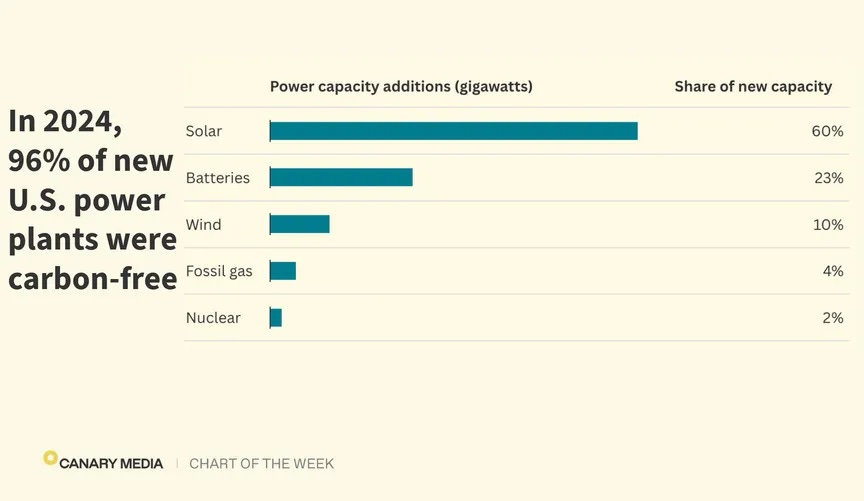
Solar installations dominated power plant additions — 34 gigawatts of utility-scale solar were constructed across the U.S., a 74 percent jump from 2023’s record-high year. Texas and California drove most of this surge.
Grid batteries were the next-biggest new source of power capacity — and saw the fastest growth. The U.S. built 13 GW of energy storage last year, almost double 2023’s record-shattering 6.6 GW. Texas and California led the way here as well.
The amount of new wind resources coming online dropped for the fourth straight year, however. The pandemic’s supply chain disruptions, followed by high inflation and the Fed’s high interest rates meant to combat inflation, really did a number on wind, far more than on solar and storage. Wind has also been hit hard by the slow process of connecting new generation capacity to the grid, a huge problem for all new energy. Donald Trump’s bizarre hatred of wind is likely to seriously slow wind growth in the US in the next few years, as will astroturfed rightwing opposition in red states. Stupid, stupid Right creatures!
We still need to do a good deep dive on just how idiotic Trump’s “energy emergency” declaration is, since it leaves out renewables, the least expensive and fastest-growing energy sector, for the sake of trying to boost fossil fuels — even as his idiotic tariffs will play hell with fossil fuel prices, too! But today is climate nice time, so that deep dive remains on our to-do list.
Hey, speaking of nice, here’s another fun fact, also from Canary Media and Ember: March was pretty sunny and windy in the USA, and that meant that for the first time ever, America’s energy grid had more clean energy on it than electricity generated by fossil fuels. A decade ago, the US electric grid relied on fossil fuels for two-thirds of its power, and a good chunk of that (34 percent) was still coal, the most carbon-intensive source, and one that’s far more expensive than renewables. It’s down to just 15 percent of the energy mix today, and fuck you, Donald Trump, we ain’t going back. (Fuck Trump is always in the “nice” category). [Canary Media / Canary Media again]
Climate Nicetime McNuggets!
Just a few random nice climate moments, Tabs-style:
Two years ago, Helsinki, Finland, decided to ditch coal power, which at the time made up 64 percent of the city’s electric power. The effort to reach the decision took a decade, but once made, it’s gone into effect quickly. Thanks to being ideally situated for wind power (resulting in absurdly low electric rates that approached zero Euros per kilowatt hour) and having a huge distributed heating system that warms homes and businesses with hot water pipes, Helsinki has largely shut down the coal plants that it used to run on. [Fast Company (paywalled); archive link]
For Earth Day (April 26) this month, 54 streets in New York City will be closed to cars so people can stroll and bike and generally see what living without cars could look like. It’s a one-day cleaner, quieter, Euro-style socialist hellhole celebration that the city has been doing since 2016! [Time Out New York]
Thanks to aggressive socialist hellhole government regulations and oppression, plastic pollution along Australia’s coastlines has dropped nearly 40 percent since 2013, and the sea turtles and people walking and doing recreation On the Beach are pretty damn glad to see it. The number of surveyed sites that had no plastic debris at all increased by an impressive 16 percent in the same period. [The Independent]
Lego this week opened a $1 billion factory in Vietnam that will by 2026 be making the popular building bricks using entirely clean energy, primarily solar panels and battery storage. The playsets produced there will be almost entirely for the booming Asian market, although Crom only knows how stupid US tariffs on Vietnam and the rest of the world may affect that rollout. Possibly some! And yes, Lego bricks are made with oil-based plastic; the company is spending big on researching more sustainable materials, but so far with only mixed success. [AP]
Go have you a great weekend, keep your activist batteries charged, and remember that the bastards only win if we let them! (snip)
Peace & Justice History for 4/12
| April 12, 1935 60,000 students across the U.S. took part in the first nationwide student strike. The protest was against fascism and participation in any war.   Posters from the anti-war movement of the 1930’s One of the events that day |
| April 12, 1963 Martin Luther King, Jr. and his fellow ministers Fred Shuttlesworth and Ralph Abernathy, along with 60 others were arrested on Good Friday in Birmingham, Alabama, for marching downtown. They had been denied a parade permit, and were violating a court order banning them from all protest activities. Public Safety Commissioner Theophilus Eugene “Bull” Connor had sought the injunction to put an end to a series of sit-ins, kneel-ins, boycotts and other nonviolent actions designed to challenge the local and state segregation laws.  Fred Lee Shuttlesworth (left), Ralph David Abernathy (center), and Martin Luther King Jr. (right) march on Good Friday on April 12, 1963, in Birmingham. The Birmingham campaign of 1963 Arrest in Birmingham |
April 12, 1971 Protest at Fessenheim The first European demonstration against nuclear power brought together 1300 peacefully to oppose construction of a nuclear power plant at Fessenheim, on the Rhine in the Alsace region of France. The four 900 megawatt reactors have been in operation since 1977. |
https://www.peacebuttons.info/E-News/peacehistoryapril.htm#april12

