(Barfbag alert for the 2002 entry. But it is US history.)
December 5, 1955 Five days after Rosa Parks was arrested for refusing to give up her bus seat to a white man, the African-American community of Montgomery, Alabama, launched a boycott of the city’s bus system. The Montgomery Improvement Association (MIA) was formed to coordinate the boycott with Dr. Martin Luther King, Jr., elected as its president. Out of Montgomery’s 50,000 black residents, 30,000-40,000 participated. They walked or bicycled or car-pooled, depriving the bus company of a substantial portion of its revenue. The boycott lasted (54 weeks) until it was agreed the buses would be integrated. Waiting at a transportation pickup point during the Montgomery bus boycott – 1955-1956 < What was the Montgomery Bus Boycott? >
December 5, 1955 The American Federation of Labor, which had historically focused on organizing craft unions, merged with the Congress of Industrial Organizations, an organization of unions largely representing industrial workers, to form the AFL-CIO with a combined membership of nearly 15 million. George Meany was elected its first president. AFL-CIO history
December 5, 1957 New York became the first city to legislate against racial or religious discrimination in housing (Fair Housing Practices Law).
December 5, 1967 Dr. Benjamin Spock 264 were arrested at a military induction center in New York City during a Stop the Draft Week Committee action. Dr. Benjamin Spock and poet Allen Ginsberg were among those arrested for blocking (though symbolically) the steps at 39 Whitehall Street where the draft board met. 2500 had shown up at 5:00 in the morning to show their opposition to the draft and the Vietnam War. Allen Ginsberg
December 5, 1980 The United Nations adopted the charter for the University for Peace in Costa Rica. Its purpose would be “promoting among all human beings the spirit of understanding, tolerance and peaceful coexistence, to stimulate cooperation among peoples and to help lessen obstacles and threats to world peace and progress . . . .” The monument sculpted by Cuban artist Thelvia Marín in 1987, is the world’s largest peace monument. It also established short-wave Radio for Peace International (RFPI)which was shut down by the University in 2004 when RFPI exposed a plan between the University for Peace and the U.S. to hold anti-terrorist combat training on campus. Interview with James Latham, CEO of RFPI when it was under siege
December 5, 2002 President George W. Bush with Sen. Lott and Sen. Thurmond At the 100th birthday celebration for Senator Strom Thurmond (R-South Carolina), Senate Republican leader Trent Lott (R-Mississippi) praised Thurmond’s Dixiecrat Party 1948 presidential campaign (official slogan: “Segregation Forever!”). “I want to say this about my state. When Strom Thurmond ran for president, we voted for him. We’re proud of him. And if the rest of the country had followed our lead, we wouldn’t have had all these problems over all these years, either.” The reaction to this sentiment led to Lott’s resignation as Senate majority leader.
The American economy expanded at a healthy 2.8% annual pace from July through September on strong consumer spending and a surge in exports, the government said Wednesday, leaving unchanged its initial estimate of third-quarter growth
ByPAUL WISEMAN AP economics writer
November 27, 2024, 8:39 AM
The American economy expanded at a healthy 2.8% annual pace from July through September on strong consumer spending and a surge in exports, the government said Wednesday, leaving unchanged its initial estimate of third-quarter growth.
U.S. gross domestic product — the economy’s output of goods and services — slowed from the April-July rate of 3%, the Commerce Department reported Wednesday.
But the GDP report still showed that the American economy — the world’s largest — is proving surprisingly durable. Growth has topped 2% for eight of the last nine quarters.
Within the GDP data, a category that measures the economy’s underlying strength rose at a solid 3.2% annual rate from July through September, up from 2.7% in the April-June quarter. This category includes consumer spending and private investment but excludes volatile items like exports, inventories and government spending.
Still, American voters — exasperated by high prices — were unimpressed by the steady growth and chose this month to return Donald Trump to the White House to overhaul the nation’s economic policies. He will be supported by Republican majorities in the House and Senate.
Consumer spending, which accounts for about 70% of U.S. economic activity, accelerated to a 3.5% annual pace last quarter, up from 2.8% in the April-June period and fastest growth since the fourth quarter of 2023. Exports also contributed to the third quarter’s growth, increasing at a 7.5% rate, most in two years. Still, the third-quarter growth in both consumer spending and exports was lower than the Commerce Department initially estimated.
But growth in business investment slowed sharply on a drop in investment in housing and in nonresidential buildings such as offices and warehouses. By contrast, spending on equipment surged.
When he takes office next month, President-elect Trump will inherit an economy that looks broadly healthy.
Growth is steady. Unemployment is low at 4.1%. Inflation, which hit a four-decade high 9.1% in June 2022, has fallen to 2.6%. That is still above the Federal Reserve’s 2% target, but the central bank felt satisfied enough with the progress against inflation to cut its benchmark interest rate in September and again this month. Most Wall Street traders expect the Fed to cut rates again in December.
Wednesday’s report also contained some encouraging news on inflation. The Federal Reserve’s favored inflation gauge — called the personal consumption expenditures index, or PCE — rose at just a 1.5% annual pace last quarter, down from 2.5% in the second quarter. Excluding volatile food and energy prices, so-called core PCE inflation was 2.1%, down from 2.8% in the April-June quarter.
The public still feels inflation’s sting: Prices are about 20% higher than they were in February 2021, just before inflation started picking up
Trump has promised an economic shakeup. On Monday, for example, he vowed to slap new import taxes on goods from China, Mexico and Canada. Mainstream economists view such taxes — or tariffs — as inflationary. That is because they are paid by U.S. importers, who then seek to pass along the higher costs to their customers.
Wednesday’s report was the second of three looks at third-quarter GDP. The Commerce Department will issue the final report on Dec. 19.
___
This story has been corrected to show that consumer spending rose at the fastest pace since the fourth quarter, not the first quarter, of 2023.
Tonight is a break from the craziness of the news.
I often say that 1883 is my favorite year in history because of all that happened in that pivotal year, and one of those things is the way modernity swept across the United States of America in a way that was shocking at the time but that is now so much a part of our world we rarely even think of it….
Until November 18, 1883, railroads across the United States operated under 53 different time schedules, differentiated on railroad maps by a complicated system of colors. For travelers, time shifts meant constant confusion and, frequently, missed trains. And then, at noon on Sunday, November 18, 1883, railroads across the North American continent shifted their schedules to conform to a new standard time. Under the new system, North America would have just five time zones.
Fifteen minutes before the time of the shift, the telegraph company Western Union shut down all telegraph lines for anything but the declaration of the new time. It identified the moment the new time went into effect in telegraph messages to local railroad offices and to the jewelers known in cities for keeping time. In offices that got the message, men had their timepieces in their hands and ready to reset when the chief operator shouted “twelve o’clock!”
In Boston the change meant that the clocks would move forward about 16 minutes; in New York City, clocks were set back about four minutes. For Baltimore the time would move forward six minutes and twenty-eight seconds; in Atlanta it went back 22 minutes.
The system was a dramatic wrench for the rural United States, bringing it into the modern world. Uniform time zones had been proposed by pioneering meteorologist Cleveland Abbe, who developed the U.S. system of weather forecasting. Having joined the United States Weather Bureau as chief meteorologist in 1871, he recognized that predicting the weather required a nationally coordinated team and worked with Western Union to collect information about temperature, wind direction, precipitation, and sunset times from across the country.
Coordinating that information required keeping time across all the stations he had set up. To do so, Abbe divided the United States into four time zones, each one hour apart, and in 1879 he suggested those zones might smooth out the chaos of the railroad systems, each trying to coordinate schedules across a patchwork of local times. Railroad executives, who were concerned that if they didn’t do something, the government would, listened to Abbe, and by 1883 they had concluded to put his new system in place.
Members of the new professional class who traveled by train from city to city were on board because they thought the need to regularize train schedules was imperative. But standard time was controversial. In the United States, people had operated entirely by the rhythms of the sun until the establishment of factories in New England in the 1830s, and most people still lived by those rhythms, their local time adjusting to solar time according to their geographical location.
Telling the time by sundial and history not only was custom, but also was understood as following God’s time. The idea of overriding traditional timekeeping because of the needs of the modern world seemed positively sacrilegious. “People…must eat, sleep and work…by railroad time,” wrote a contributor to the Indianapolis Daily Sentinel. “People will have to marry by railroad time…. Ministers will be required to preach by railroad time…. Banks will open and close by railroad time; notes will be paid or protested by railroad time.”
The mayor of Bangor, Maine, vetoed an ordinance in favor of standard time, saying it was unconstitutional, that it changed the immutable law of God, that the people didn’t want it, and that it was hard on the working men because it changed day into night. Those planning for a switch to standard time tried to ease fears by providing that Americans would operate on both local time and standard time, with both times represented on clocks.
On November 18, no one quite knew what the dramatic wrench into the future might mean.
What did it mean to gain or lose time? Many people expected “a sensation, a stoppage of business, and some sort of a disaster, the nature of which could not be exactly ascertained,” a New York Times reporter recorded. As the great moment approached, people crowded the streets in front of jewelers to see the “great transformation.”
They were disappointed when, after all the buildup, the future arrived quietly.
The New York Times explained: “When the reader of THE TIMES consults his paper at 8 o’clock this morning at his breakfast table it will be 9 o’clock in St. John, New Brunswick, 7 o’clock in Chicago, or rather in St. Louis—for Chicago authorities have refused to adopt the standard time, perhaps because the Chicago meridian was not selected as the one on which all time must be based—6 o’clock in Denver, Col. and 5 o’clock in San Francisco. That is the whole story in a nut-shell.”
—
Notes:
Chicago Daily Tribune, “At Noon today Most of the Railroads Will Discard the Old and Adopt the New,” November 18, 1883, p. 12.
Boston Daily Globe, “Modern Joshuas: They Make Clocks, If Not the Sun, Stand Still,” November 19, 1883, p. 5.
Boston Daily Globe, “At the Railroad Stations, At the Churches,” November 19, 1883, p. 5.
Washington Post, “New Time in Other Cities,” November 18, 1883, p. 1.
Chicago Daily Tribune, “Standard Time,” November 19, 1883, p. 1.
Indianapolis Daily Sentinel, November 21, 1883, p. 4, Quoted in Ian R. Bartky, Selling the True Time: Nineteenth-Century Timekeeping in America (Stanford: Stanford University Press, 2000), p. 144.
While the new President and new Congress will not take office until early next year, they have already put forward an agenda — through Project 2025, Republican budget plans, and campaign proposals — that would increase poverty and diminish opportunity. Their proposals would raise costs for basics like housing, food, and health care and take health coverage away from people; slash funding for schools where our children learn, roads and bridges we use to get to work, and scientific and medical research that improve our health and strengthen our economy; double down on tax giveaways for wealthy households and corporations while imposing tariffs that fuel inflation; and further widen already glaring differences in people’s well-being and opportunity across income, race, and ethnicity.
These policymakers campaigned on promises to make the economy work better for people without big bank accounts who are trying to get ahead. But their proposals to date seldom match those promises.
Instead, a policy agenda designed to advance economic opportunity and racial justice and help families make ends meet would:
Make it easier for people to afford housing, food, health care, and prescription drugs.
Support children and families with an expanded Child Tax Credit, especially for children who don’t get the full credit today because their families’ incomes are too low; more affordable child care; and investment in our schools so that all of our nation’s children get what they need to thrive.
Invest in the things that will keep the economy strong and growing, including basic building blocks like roads, bridges, and research, as well as protections that keep our communities’ food, air, water, and workplaces safe.
Support these investments with a fairer federal tax system that requires wealthy households and corporations to pay their fair share and strengthens our fiscal outlook.
Create an immigration system that recognizes the critical role that immigrants and their families play in our communities and the economy, eschewing harsh deportation regimes that separate families and embracing reforms that provide people with a workable opportunity to gain legal status and a pathway to citizenship.
This kind of policy agenda would build toward a nation whereeveryone — regardless of their income or their background — can get the health care they need, afford to put groceries on the table, live in safe homes and strong communities, and have the income, education, and child and home care they need throughout their lives. And it would reflect the truth that our nation succeeds only when all of us succeed.
We are eager to work with policymakers who put forward policies that advance this agenda and we — together with our partners — will work hard against policies that make people less economically secure, less healthy, and have less access to opportunity.
Despite having their citizenship withheld before the war, Chinese American women in the Bay Area made significant contributions to the wartime labor force.
Amid the social upheaval of World War II, women entered the American workforce on an unprecedented level. And, for younger Chinese American women in the San Francisco Bay Area, the war made it possible to smash not just entrenched gender barriers, but racial ones as well.
“Partly because of a scarcity of English-language sources on this topic, some scholars simply have assumed that Chinese American women did not share the experience of ‘Rosie the Riveter,’” she reports. But she uses newspapers, company records, and oral histories to push back on this view.
Many Chinese American women already worked out of economic necessity. Yet racial discrimination and social isolation typically restricted them to jobs in Chinatown enclaves.
“It was difficult for many Chinese American women to go outside their communities to work, even when they wanted to,” Zhao explains. “The decades-long isolation had also limited the ability of immigrant Chinese working women to communicate with the outside world.”
During the war, women were also encouraged to adopt domestic roles—preparing “nutritional food” for their families and “show[ing] our fighting men that we are… absolutely behind them.”
But World War II still marked a major turning point—especially for younger, unmarried daughters of Chinese immigrants. Many of these women had either a high school or college-level education.
“With relatively few household responsibilities, in contrast to their mothers, they had the freedom and independence to work outside the home,” Zhao writes. “Since most of them were already living in the Bay Area before the war, these younger Chinese American women were among the first American women to join the Bay Area’s defense labor force.”
In fact, Zhao’s research turned up only four women who were older than forty during their wartime jobs. Still, those wives and mothers capably juggled their duties at home and on the home front. (snip-More; it’s a worthy click!)
if we all click our heels together three times, everything will be okay Read on Substack (Language NSFW, as always with Jeff Tiedrich’s writing)
the worthless scribblers of the corporate-controlled media utterly failed us during the 2024 campaign season.
New York Times executive editor Joe Kahn came right out and said it: defending democracy is a ‘partisan act,’ and we won’t do it — and, fuck us all, the press kept their word, and didn’t do it. they enthusiastically put their fingers on the scale for Donny Convict.
arguably, the media’s worst transgression was the sanewashing — the cleaning-up of Donny’s incomprehensible blitherings, to hide his obvious cognitive disintegration and make him sound coherent.
a minutes-long disjointed word-salad about how tariffs on Chinese goods were going to lower the cost of childcare became “a major economic speech.”
Donny’s inability to keep his increasingly-demented mind on the topic at hand — his crazypants pinballing from they’re eating the dawgs to Hannibal Lecter wants to have you for dinner to would you rather be eaten by a shark or electrocuted — was explained away by Donny as his brilliant “weave.”
[Wishcasting is] the act of interpreting information or a situation in a way that casts it as favorable or desired, despite the fact that there is no evidence for such a conclusion; a wishful forecast.
sure enough, the media has now gone into overdrive, churning out piece after piece in which they promise us that if we all click our heels together three times, everything will be okay.
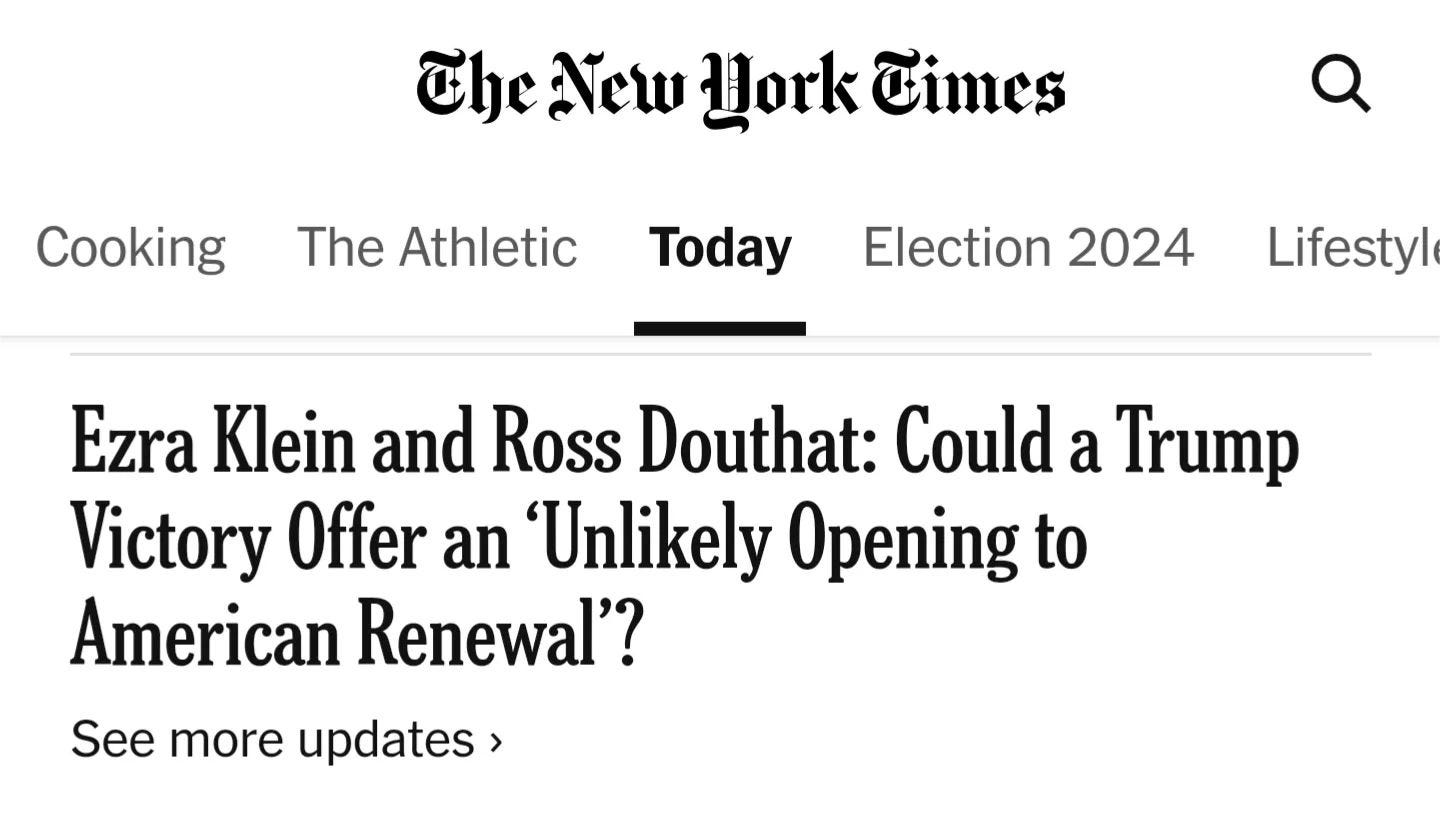
not twelve hours after the election had been called for Donny, the Times wasted no time in assuring us that the election of a vindictive fascist is an amazing opportunity for vindictive fascism not to happen.
what kind of magical, everybody-gets-a-pony thinking is this? just fucking stop it.
did Ezra Klein and Ross Douthat both experience some kind of recent head trauma that has caused them to forget the years 2017 through 2020? Donny’s first presidency was a dumpster fire of corruption, mismanagement and mass death — but somehow now, given a second chance to fuck shit up worse, Donny’s going to bring us an “American renewal”?
anything’s possible, right? overnight, Donny Convict could magically become a wise and fair statesman — also, technicolor pigs could fly out of my ass.
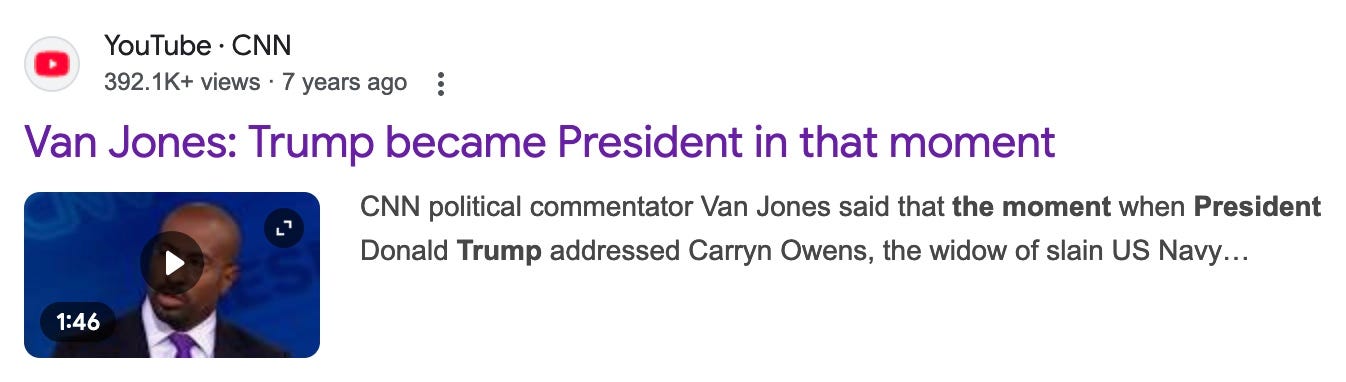
oh my god, the media never stops imagining that Donny is going to somehow become presidential. during his first term — over and over — every time Donny stopped short of taking out his dick and pissing on the floor, the press would fall all the fuck over itself in a mad dash to proclaim him presidential.
spoiler alert: Donny never became presidential. not from the the first time he threw a ketchup-hurling tantrum in the White House, to the moment he absconded back to his Florida golf motel, taking with him boxes of stolen classified documents.
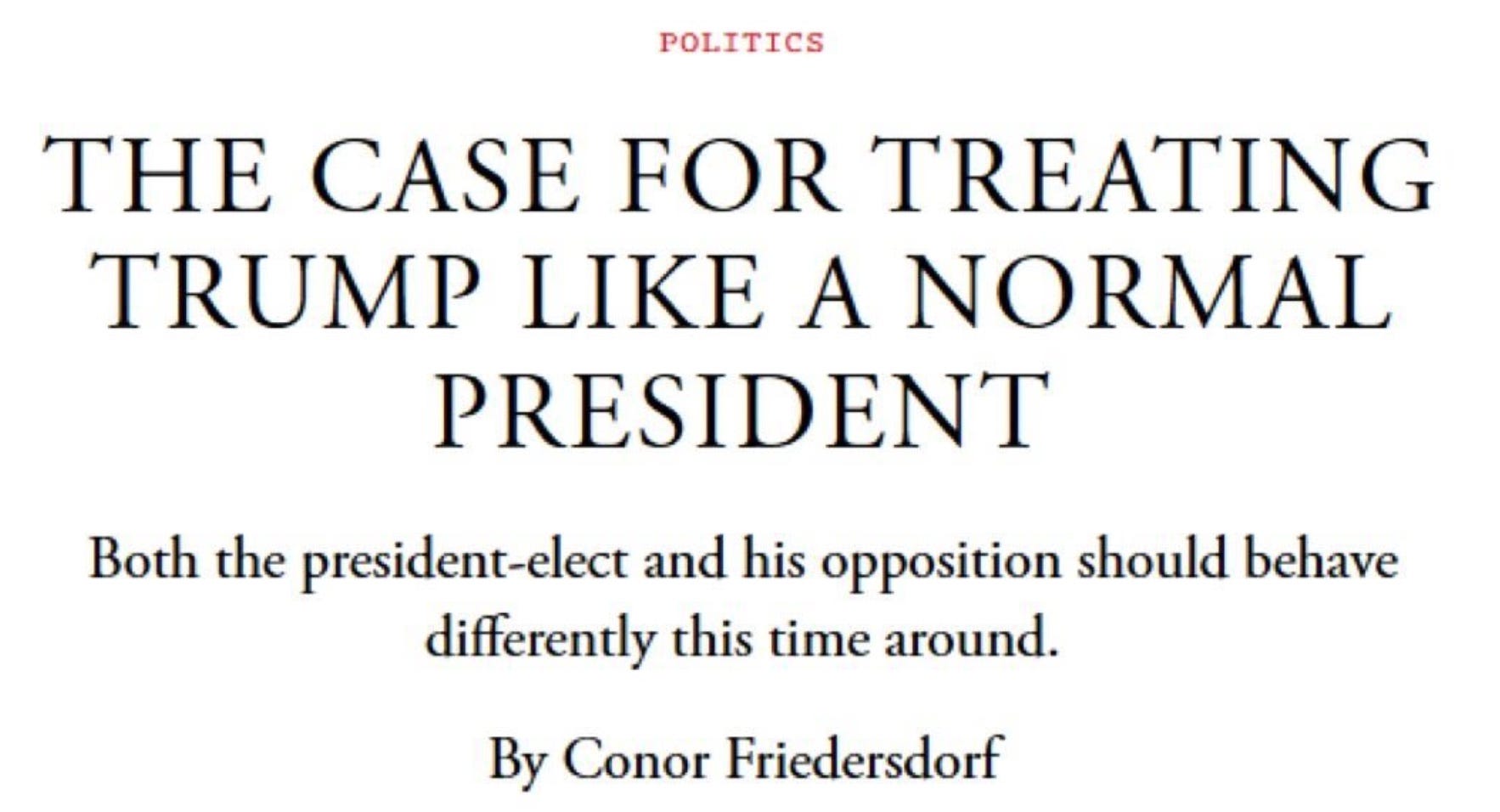
the premise here is that if we’re respectful to Donny — if we fucking kowtow to him, and stop opposing him — he’ll be nice to us in return. he’ll become — dare I say it? — presidential.
Stop indulging the fantasy that outrage, social stigma, language policing, a special counsel, the Twenty-Fifth Amendment, or impeachment will disappear him. And stop talking as if normal political opposition is capitulation.
Everyone should normalize Trump. If he does something good, praise him. Trump is remarkably susceptible to flattery.
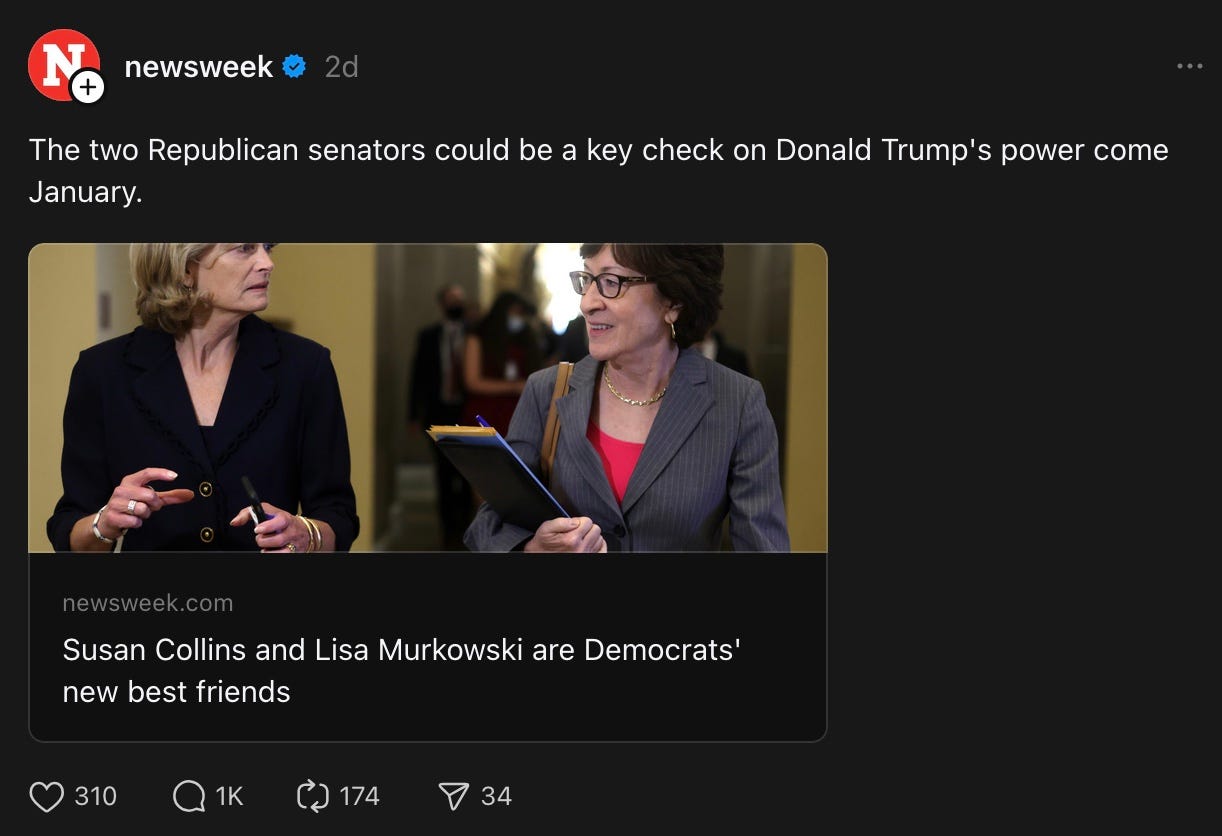
okay, I will grant that Newsweek may be half right. Lisa Murkowski seems to genuinely loathe Donny, and we can probably count on her to vote against the worst of his fuckery — but Susan Collins? the credulous naïf who assured us over and over again that Donny had learned his lesson, and would never transgress again?
now, let’s bask under some rays of hope from people who aren’t just blindly wishcasting, but are actually offering reasoned arguments.
in the middle of a fairly clear-eyed assessment of the Trumpian horrors to come, the Guardian gives us this:
Elaine Kamarck, a former official in the Bill Clinton administration, said: “For him to expand presidential power, Congress has to give up power and they’re not in the mood to do that. They’ve never done that. There are plenty of institutionalists in Congress.”
Kamarck also expressed faith in the federal courts, noting that judges appointed by Trump only constitute 11% of the total placed on the bench by former presidents. A Trump dictatorship is “not going to happen,” she added. “Now, there might be things that the president wants to do that people don’t like that the Republican Congress goes along with him on but that’s politics. That’s not a dictatorship.”
Paradoxically, however, Trump’s reckless venality is a reason for hope. Trump has the soul of a fascist but the mind of a disordered child. He will likely be surrounded by terrible but incompetent people. All of them can be beaten: in court, in Congress, in statehouses around the nation, and in the public arena. America is a federal republic, and the states—at least those in the union that will still care about democracy—have ways to protect their citizens from a rogue president. Nothing is inevitable, and democracy will not fall overnight.
Americans cannot vote themselves into a dictatorship any more than you as an individual can sell yourself into slavery. The restraints of the Constitution protect the American people from the unscrupulous designs of whatever lawless people might take the reins of their government, and that does not change simply because Trump believes that those restraints need not be respected by him. The Constitution does not allow a president to be a “dictator on day one,” or on any other day. The presidency will give Trump and his cronies the power to do many awful things. But that power does not make them moral or correct.
I sure hope to fuck they’re right.
This is going to be my closing message for the foreseeable future:
practice self-care. do what you need to do to keep sane. if that means disengaging with my daily posts for a while, I get it. this community of ours will still be here when you return.
to all the people who have signed on in the days since the election, welcome aboard. settle in as we all try to deal with the shitfuckery that’s ahead of us.
we are all in this together, and we are all here for each other.
Lovable policy dork and new US Congresswoman Sarah McBride gives a hug to the kid who stole my pink unicorn dress. Yes, I will sue.
How do you do, fellow Wonks! It is I, your friendly neighborhood trans woman who is happy about a thing!
What? What is with those faces? Did something bad happen? No matter! For it is my job to give you the good news, with a spring in my step and a song in my heart and I am going to fucking do that because it is my job, melonfuckers, and I will not neglect my professional duty to be happy about a happy thing. Or three!
Yesterday, for those not in the know, the United States had an election. And during this election the transgenders worked their genderqueer asses off, not only running for election to the local sixth-grade softball team but also to at least 35 political positions around the country. And while we here at Wonkette salute every single one of those eager beavers, a couple stand out for their prominence and their victories.
No trans star shines brighter in, lo, these early morning hours as I write you this, than Sarah McBride. While McBride was not the first trans person to be elected to any ol’ thing, she was not elected to any ol’ thing. She was elected to the actual Congress of the US America. That’s right! We’re talking about the very same federal legislature made famous in Schoolhouse Rock’s song “I’m Just A Bill.”
This is not particularly surprising, as like some San Franciscans we could name, she was very well qualified for the position she sought. Before coming out or even turning 20 years old she worked as a junior staffer for Delaware Governor Jack Markell’s campaign in 2008 and Attorney General Beau Biden’s campaign in 2010. Next she lobbied for adding gender identity to Delaware’s equal protection law and interned at the White House in 2012 before graduating from college. She was on this shit young, I tell ya. And after she came out that year, her story was featured on American University Radio (later rebroadcast on NPR) including an anecdote about Beau telling her that after coming out she “was still part of the Biden family.”
After graduating she went to work as an activist with Equality Delaware and used her relationships to help pass positive bills before she became the first ever out trans speaker at a major party political convention in 2016 — something she’s sure as hell going to do again now. She then went on to write a book (foreword by some dude named “Joe Biden”), work for the Human Rights Campaign as their spokesperson, and then spend the most recent four years representing 50,000 Delawareaniteishers in the state Senate.
With her resumé and the Blue-leaning makeup of the state electorate, she had this. And it showed both during her campaign and in her 57/42 victory. (Which won me five bucks.) And now she’s going to Congress to make sure that Republican dickweasel bigots have to look a trans person in the eye as they ban driving through McDonalds while trans or whatever evil-ass bill they’re proposing next January. She lists her top two priorities as universal healthcare and reproductive rights, with other big ticket items like the John Lewis Voting Rights Act, the union-friendly PRO Act, curbing climate change, ending mass incarceration and more. She sounds too good to be true, but she’s real and she’s going to be kicking Matt Gaetz ass in just eight weeks.
Still convinced there’s a catch? Like maybe she’s great but replaced someone greater? Worry not: The woman she’s replacing is now your new US Senator from Delaware Lisa Blunt Rochester, making all kinds of demographic firsts from a state previously obsessed with sending only white men to the Senate but which has now elected a Black woman 56/39/4.
Yeah, we could use a lot more Delawares right now.
But if you’ll excuse Hawaii for not being Delaware, there’s also some good shit doing down on the islands. Over the last few decades indigenous Hawaiians have become homeless at a horrible rate — yes, this started long before Lahaina burned to the ground. The primary culprit is a tourism-first legislature full of corporate Democrats who never met a bit of housing they couldn’t rezone for rental to visiting mainlanders. Along with other forces making housing expensive even on the continent, this has made trying to find a place to live in the state a genuine crisis, especially for the people working those low-paying service jobs catering to tourists.
While Kim Coco Iwamoto isn’t the only Hawaiian to notice the problem, she made it her mission to knock off the incumbent Speaker of the Hawaiian state House in the Democratic primary. It took three tries, but this year she managed it and put the game away in the general last night. She only takes over the district of Scott Saiki, not his speakership, and the still pro-corporate Dem majority is certain to elect another tourism-pleasing Speaker, but Iwamoto becomes a trans voice against homelessness and for affordable housing. Iwamoto didn’t start off in politics going straight after Saiki. She was actually the first out trans person ever to hold statewide office anywhere in the US as she was elected to an at-large position on the Hawaii Board of Education and then later appointed to the state Civil Rights Commission. She is experienced and determined, she knows Hawaii politics, and she’s going to get things done.
Our third and final Trans Nice Times! for this morning comes to you from Los Angeles, where for the first time ever a trans-centric non-profit was designated a voting center. You may be used to voting in gymnasiums and churches, but yesterday in West Hollywood if you wanted to drop off your ballot (or fill one out if you hadn’t had a chance to vote from home as is the norm in California these days), your home precinct was The Connie Norman Transgender Empowerment Center where instead of having to to look at posters saying, “Jesus dies a little every time you touch your cooter! Don’t be chewed bubblegum!” as you walk through the lobby to cast your vote, you instead got to see signs saying, “Trans joy **is** resistance!” Won’t that just be a hoot for the two conservatives who still live in West Hollywood?
In summary and conclusion, there is still joy in this world, like trans people who kick ass and golden retrievers who know just a little too much English.
Now ain’t that some nice times?
Send this post to a friend who needs to read it! (I thought we all needed this here. -A)
About 4 or five years ago the mattress in our bedroom was totally destroyed. It was way beyond the use life. I am serious while both of us were much heavier than we are right now, while my side had a big hole where my body was his side had given up and was trying to run away. He had no side wall of the mattress and was trying not to fall on the floor. One night I got so upset I demanded an end to the bullshit and insisted he remove the mattress.
So instead of buying a new mattress he decided to remove the bed frame and instead put up a high air mattress we had for when we needed to go to the hospital during a hurricane and kept for visitors to sleep on. But that was too low for my hips and back and I was constantly struggling. One night as I was sleeping the value gave out and I ended up trapped in the bed, crying for help. James heard me and came down and got me up.
So Ron overcame his hate to spend money on his own comfort and realized we couldn’t do this. Now here is where our lives are different. I figured we would get a new bed frame, a storage bed I always wanted due to our abundance of stuff and lack of space to put it, and a normal mattress from the mattress stores that cost around $1,200.00
Nope, Ron listened to James who had just spend a large amount of money on a frame and mattress from the Purple company. So Ron told me to asked me to order the new king-size storage bed that was already very high, and he and James went back and forth over what mattress we needed for it. When Ron told me that the mattress was going to cost $4,000.00 I was shocked. I was like what about this or that one advertised locally. Nope he said we need this for you and your very painful bones. I tried hard to say my bones could deal … but he wouldn’t bend. So the king size bed frame I choose because of the storage and headboard space for $1,800 he added $4,000 grand for the purple mattress.
Now I was upset but decided if he insisted, I could live with it. But when the bed arrived and we set it up, it had a weight limit of … 300 pounds. But the new mattress that Ron bought was 300 pounds itself. So before Ron and James put the new mattress on the bed, Ron added a few under the bed supports and a couple large 2x4s to run down the length of the bed.
Move to this last week as Ron was frantically trying to figure out what was happening to our south sided wall outlets on a split circuit that seemed to go mostly to the south wall and a small part to my Pink Palace including his TV and player stuff. After we went to bed about 1 am we both woke to a huge … Bang, crack, boom. We did not realize what happened until he got up a few hours later after trying hard to stay in bed and hitting me in the face accidentally.
So after a few hours he gave up and got up. We took the mattress off. And Ron was shocked. All the support legs had twisted off, and the too thin boards had warped under the weight or broke. So Ron stopped replacing the outlets and electrical work he was doing for two days … We do have priorities and not sleeping on the floor is one of them. So he got his tools including his drill and saws out, and went to work. Sadly it was a time in the month when we only had $50 dollars in our account (yes we are now among the US seniors who are very poor) so he did not buy a sheet of 1/4 plywood which he feels would have fixed the problem, instead he grabbed all the different pieces of wood he had to patch things and promised me he would buy the plywood to fix it when I got paid.
Ron sadly tries to cheer me up by reminding me our life has become management by crisis. Great news. The bed is again very strong and comfortable … even able to stand … active seniors sex activities. Below are the pictures. Hugs and loves to all. And yes the drama of our grand life continues. Hugs
(I don’t know if this is gonna work; I’m not on Instagram, but I went there, and could see, hear, read, and got the embed link. MomsRising is asking for shares, so if anyone cares to share, thank you!)
(Honestly, the entire Don-Madison Square Garden “event” idea sickened me, but I didn’t think his campaign could afford to do it. Anyway, it happened, and the fact that there was any crowd at all nauseates me. One of my great grandfathers immigrated to the US before the 1st World War, earning his citizenship in part by fighting for the US and allies in that war. The other side of the family immigrated between the wars, as they could see what may have been coming, and did. I’m fairly certain all their spirits, including each and every US veteran in my family living or dead, are also nauseated and maybe angry about this “event.” I’m happy there are people like Heather Cox Richardson, who put sensible light onto historic events. So everybody do all you can to Get Out The Vote! The facts are all on our side. -A)
I stand corrected. I thought this year’s October surprise was the reality that Trump’s mental state had slipped so badly he could not campaign in any coherent way.
It turns out that the 2024 October surprise was the Trump campaign’s fascist rally at Madison Square Garden, a rally so extreme that Republicans running for office have been denouncing it all over social media tonight.
There was never any question that this rally was going to be anything but an attempt to inflame Trump’s base. The plan for a rally at Madison Square Garden itself deliberately evoked its predecessor: a Nazi rally at the old Madison Square Garden on February 20, 1939. About 18,000 people showed up for that “true Americanism” event, held on a stage that featured a huge portrait of George Washington in his Continental Army uniform flanked by swastikas.
Like that earlier event, Trump’s rally was supposed to demonstrate power and inspire his base to violence.
Apparently in anticipation of the rally, Trump on Friday night replaced his signature blue suit and red tie with the black and gold of the neofascist Proud Boys. That extremist group was central to the January 6, 2021, attack on the U.S. Capitol and has been rebuilding to support Trump again in 2024.
On Saturday the Trump campaign released a list of 29 people set to be on the stage at the rally. Notably, the list was all MAGA Republicans, including vice presidential nominee Ohio senator J.D. Vance, House speaker Mike Johnson (LA), Representative Elise Stefanik (NY), Representative Byron Donalds (FL), Trump backer Elon Musk, Trump ally Rudy Giuliani, Robert F. Kennedy Jr., right-wing host Tucker Carlson, Trump sons Don Jr. and Eric, and Eric’s wife, Republican National Committee co-chair Lara Trump.
Libbey Dean of NewsNation noted that none of the seven Republicans running in New York’s competitive House races were on the list. When asked why not, according to Dean, Trump senior advisor Jason Miller said: “The demand, the request for people to speak, is quite extensive.” Asked if the campaign had turned down anyone who asked to speak, Miller said no.
Meanwhile, the decision of the owners of the Los Angeles Times and the Washington Post not to endorse Democratic presidential candidate Vice President Kamala Harris seems to have sparked a backlash. As Will Bunch of the Philadelphia Inquirer noted, “in a strange way the papers did perform a public service: showing American voters what life under a dictator would feel like.”
Early on October 26, the Washington Post itself went after Trump backer billionaire Elon Musk with a major story highlighting the information that Musk, an immigrant from South Africa, had worked illegally when he started his career in the U.S. Musk “did not have the legal right to work” in the U.S. when he started his first successful company. As part of the Trump campaign, Musk has emphasized his opposition to undocumented immigrants.
The New York Times has tended to downplay Trump’s outrageous statements, but on Saturday it ran a round-up of Trump’s threats in the center of the front page, above the fold. It noted that Trump has vowed to expand presidential power, prosecute his political opponents, and crack down on immigration with mass deportations and detention camps. It went on to list his determination to undermine the North Atlantic Treaty Organization (NATO), use the U.S. military against Mexican drug cartels “in potential violation of international law,” and use federal troops against U.S. citizens. It added that he plans to “upend trade” with sweeping new tariffs that will raise consumer prices, and to rein in regulatory agencies.
“To help achieve these and other goals,” the paper concluded, “his advisers are vetting lawyers seen as more likely to embrace aggressive legal theories about the scope of his power.”
On Sunday the front page of the New York Times opinion section read, in giant capital letters: “DONALD TRUMP/ SAYS HE WILL PROSECUTE HIS ENEMIES/ ORDER MASS DEPORTATIONS/ USE SOLDIERS AGAINST CITIZENS/ ABANDON ALLIES/ PLAY POLITICS WITH DISASTERS/ BELIEVE HIM.” And then, inside the section, the paper provided the receipts: Trump’s own words outlining his fascist plans. “BELIEVE HIM,” the paper said.
On CNN’s State of the Union this morning, host Jake Tapper refused to permit Trump’s running mate, Ohio senator J.D. Vance, to gaslight viewers. Vance angrily denied that Trump has repeatedly called for using the U.S. military against Americans, but Tapper came with receipts that proved the very things Vance denied.
Trump’s rally at Madison Square Garden began in the early afternoon. The hateful performances of the early participants set the tone for the rally. Early on, comedian Tony Hinchcliffe, who goes by Kill Tony, delivered a steamingly racist set. He said, for example: “There’s literally a floating island of garbage in the middle of the ocean right now. I think it’s called Puerto Rico.” He went on: “And these Latinos, they love making babies too. Just know that. They do. They do. There’s no pulling out. They don’t do that. They come inside. Just like they did to our country.” Hinchcliffe also talked about Black people carving watermelons instead of pumpkins.
The speakers who followed Hinchcliffe called Vice President Kamala Harris “the Antichrist” and “the devil.” They called former secretary of state Hillary Clinton “a sick son of a b*tch,” and they railed against “f*cking illegals.” They insulted Latinos generally, Black Americans, Palestinians and Jews. Trump advisor Stephen Miller’s claim that “America is for Americans and Americans only” directly echoed the statement of Adolf Hitler that “Germany is for Germans and Germans only.”
Trump took the stage about two hours late, prompting people to stream toward the exits before he finished speaking. He hit his usual highlights, notably undermining Vance’s argument from earlier in the day by saying that, indeed, he believes fellow Americans are “the enemy within.”
But Trump perhaps gave away the game with his inflammatory language and with an aside, seemingly aimed at House speaker Johnson. “I think with our little secret we are gonna do really well with the House, right? Our little secret is having a big impact, he and I have a secret, we will tell you what it is when the race is over,” Trump said.
It seems possible—probable, even—that Trump was alluding to putting in play the plan his people tried in 2020. That plan was to create enough chaos over the certification of electoral votes in the states to throw the election into the House of Representatives. There, each state delegation gets a single vote, so if the Republicans have control of more states than the Democrats, Trump could pull out a victory even if he had dramatically lost the popular vote.
Since he has made virtually no effort to win votes in 2024, this seems his likely plan.
But to do that, he needs at least a plausibly close election, or at least to convince his supporters that the election has been stolen from him. Tonight’s rally badly hurt that plan.
As Hinchcliffe was talking about Puerto Rico as a floating island of garbage, Democratic presidential nominee Vice President Kamala Harris was at a Puerto Rican restaurant in Philadelphia talking about her plan to spread her opportunity economy to Puerto Rico. She has called for strengthening Puerto Rico’s energy grid and making it easier to get permits to build there.
After the “floating island of garbage” comment, Puerto Rican superstar musician Bad Bunny, who has more than 45 million followers on Instagram, posted Harris’s plan for Puerto Rico, and his spokesperson said he is endorsing Harris.
Puerto Rican singer and actor Ricky Martin shared a clip from Hinchcliffe’s set with his 16 million followers. His caption read: “This is what they think of us.” Singer and actress Jennifer Lopez, who has 250 million Instagram followers, posted Harris’s plan. Later, singer-songwriter and actress Ariana Grande posted that she had voted for Harris. Grande has 376 million followers on Instagram. Singer Luis Fonsi, who has 16 million followers, also called out the “constant hate.”
The headlines were brutal. “MAGA speakers unleash ugly rhetoric at Trump’s MSG rally,” read Axios. Politico wrote: “Trump’s New York homecoming sparks backlash over racist and vulgar remarks.” “Racist Remarks and Insults Mark Trump’s Madison Square Garden Rally,” the New York Times announced. “Speakers at Trump rally make racist comments, hurl insults,” read CNN.
But the biggest sign of the damage the rally did was the frantic backpedaling from Republicans in tight elections, who distanced themselves as fast as they could from the insults against Puerto Ricans, especially. The Trump campaign itself tried to distance itself from the “floating island of garbage” quotation, only to be met with comments pointing out that Hinchcliffe’s set had been vetted and uploaded to the teleprompters.
As the clips spread like wildfire, political writer Charlotte Clymer pointed out that almost 6 million Puerto Ricans live in the states—about a million in Florida, half a million in Pennsylvania, 100,000 in Georgia, 100,000 in Michigan, 100,000 in North Carolina, 45,000 in Arizona, and 40,000 in Nevada—and that over half of them voted in 2020.
In 1939, as about 18,000 American Nazis rallied inside Madison Square Garden, newspapers reported that a crowd of about 100,000 anti-Nazis gathered outside to protest. It took 1,700 police officers, the largest number of officers ever before detailed for a single event, to hold them back from storming the venue.



























 Scottie's Playtime