
Later I will explain all the steps he has taken. But right now I have been up over 30 plus hours so I am going to stop trying to blog and watch movies, helping him as he needs me to. Hugs and loves.
Category: Construction / Building
I Am So Glad
to see Scottie posting more again! I’ve missed him here, and I’m sure everyone else who reads here did, as well. So, here’s to many more fine Playtime posts by the original!
It’s also been handy, because life has been busy at the Redford manse, and somewhat stressful. We’ve needed foundation work for years, probably since before DH bought the house, even (he had it when I came into the picture; we paid it off, and just never did move out. Anyway.) So, having saved, and retired, it’s time. Meeting with the contractor, learning necessary facts, and of course, parting with the dollars needed to get the work done. Part of the work will be done the second week of November, the other part will be done the first week of December. There are some things that need to be moved before the December date; we’ll need some help with a few items. But we’ll get it worked out. Things will be all right.
3 weeks ago, Corky crossed the Rainbow Bridge. She went into acute kidney failure, likely due to age, according to the vet. She was 13, and a larger medium dog, though very healthy until this happened. I worry it’s because we let her have too much human food, but she was a happy old girl until the last 2 days of her life, and even then, was not miserable. She is very missed after 4.5 years with us, and the search is on for who she’s sending us. But it’s cut a bit of brightness out of the days, until The One shows up.
Other than the election, which is discussed everywhere all the time, that’s what’s happening. I’ve gotten the postcards done, and am awaiting the phone banking instructions. Life sometimes takes time, though, so I haven’t posted so much. (Probably a relief to readers!) I hope all are doing at least as well in your own little slices of heaven, and here’s to a good day today.
we could all use a Good News Tuesday by Jeff Tiedrich
(More good news, after Scottie’s video, as to the early voting news! Blue language alert, so no reading until you’re not somewhere the f-word is not acceptable. Else scroll just a bit, because of course the first sentence is joyous and contains the f-word. Also, italicized script beneath the suns are by the author, Jeff Tiedrich.)
Kamala’s up and Donny’s down Read on Substack
LA LA LA LA no reading here if you’re at work,
LA LA LA LA no reading here if you’re at work.
LA LA LA LA no reading here if you’re at work,
LA LA LA LA no reading here if you’re at work!
🌞 🌞 🌞 🌞 🌞
Okay. Next line,
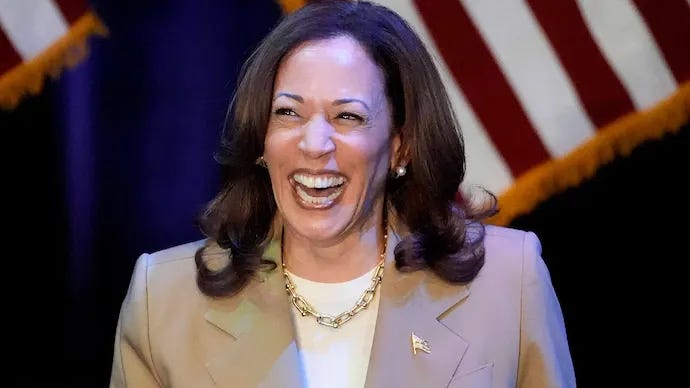
fuck this fucking nail-biter of an election. good news is out there — let’s have a look.
undecideds are deciding — and they’re breaking towards Kamala Harris.
A majority of voters (80%) say they made up their minds about which candidate to support over a month ago, while 11% made up their minds in the last month, 6% made up their minds in the past week, and 3% still have not made up their mind.
“Voters who made their decision on who to support over a month ago break for Trump, 52% to 48%, while voters who made up their mind in the last month or week break for Harris, 60% to 36%,” Kimball said. “The three percent of voters who said they could still change their mind currently favor Harris, 48% to 43%.”
I know, right? who could be undecided in a race that’s basically everyone gets a puppy vs diarrhea forever?
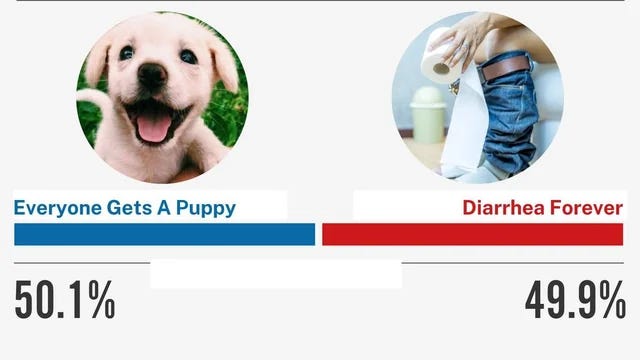
but there are huge swaths of votes who just don’t pay attention to politics until the very last minute — and now that they’re finally tuned in, it’s dawning on them that wait, one of the candidates is ass-spraying mayhem? oh, fuck that shit.
think back to 1980. polling showed the race was a dead heat — but in the final weeks, just about every goddamned undecided broke towards Reagan, and what looked like a nail-biter ended up being a blowout.
this year, however, it looks like the fence-sitters are doing the right thing.
hang on, you need some more good polling news? fine, be that way.
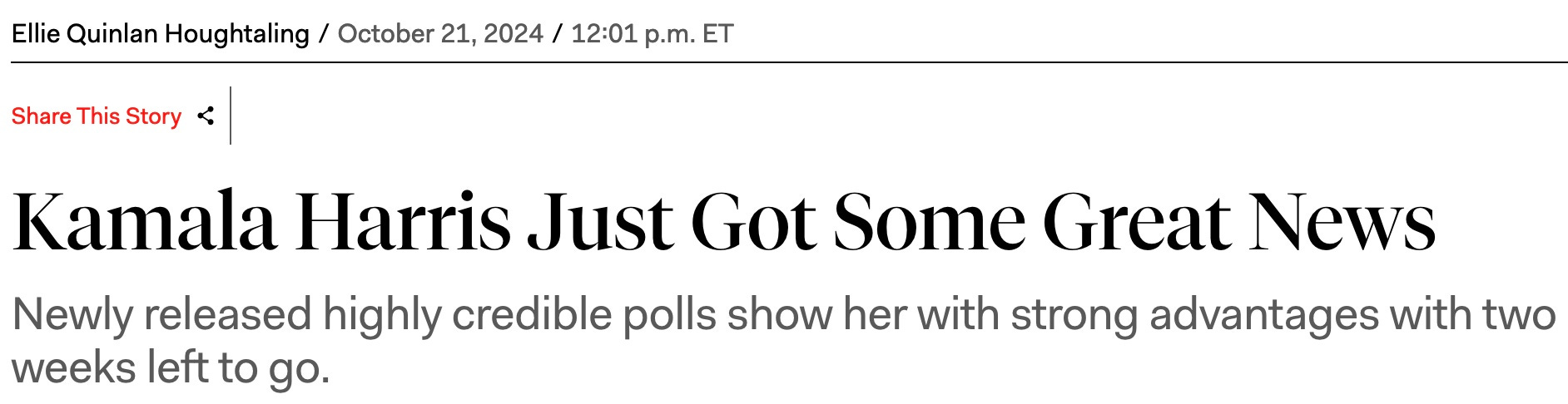
Kamala leads dong-obsessed fry chef Donny Convict in favorability by 11 percentage points, while 58% of registered voters fucking loathe Donny.
The nationwide poll, conducted last week, found Harris’s favorability to be significantly higher than Trump’s, with 51 percent of registered voters viewing Harris as a favorable candidate compared to just 40 percent who felt the same about Trump. Independent voters, notably, were equally split on their opinions of Harris, while the majority of independent voters—58 percent—felt negatively about Trump.
don’t forget that this is going to be the first post-Roe national election.
But perhaps no Democratic stance resonated more with voters than abortion, which saw Harris lead Trump by 23 percent.
reproductive rights continues to be a losing issue for Donny, and he’s still bragging about being the guy who shitcanned Roe.
Donny is being abandoned by his base.
white folks who never went to college have long been Donny’s most hardcore cultists — but this year they seem to be suffering from Dear Leader Fatigue.
here’s CNN’s Harry Enten to explain.
“it’s been a key demographic for him — his base. and this is what’s so interesting … in fact, it’s moving away from him. this is Trump’s margin with non-college white voters. this group is not moving towards him. it’s moving slightly away. go back eight years ago, he won it by 33. you go back four years ago, he won it be 31. now we see he’s only up by 27.”
Donny’s losing the people who have been filing out of his hate-rallies early.
after a half hour of listening to him drone on about sharks and batteries and Hannibal Lecter wants to have you for dinner, they turn to their spouse and say Lurleen, let’s go home and see if NASCAR’s on TV.
plus-27 is still a fuck-ton of support from Donny’s base — but in a close election, he can’t afford to lose the additional 6% who voted for him in 2016. these people may never vote for Komrade Kamala, but enough of them may stay home on election day to make a difference.
we’re all worried about post-election fuckery, but let’s not forget that nearly all swing state governors are Democrats.
here’s WaPo’s Jennifer Rubin to talk us all down off that ledge.
Constitutional expert Richard H. Pildes reminded us that scenarios involving mischief by governors are unlikely. “In nearly all the swing states, the governors are Democrats, who are hardly going to be receptive to any entreaties by Trump,” he wrote. Even in Georgia, Gov. Brian Kemp and Secretary of State Brad Raffensperger, both Republicans, “have done as much under fire as any political officials to prove their commitment to certifying an accurate, lawful count.” And although a few local boards might refuse to certify, there are remedies in court. (A Georgia court recently rejected the notion that officials could refuse to certify results.)
and, on that note, some Arizona dipshit who thought she could fuck around with certifying her state’s 2022 senate race is now learning that finding out truly sucks.
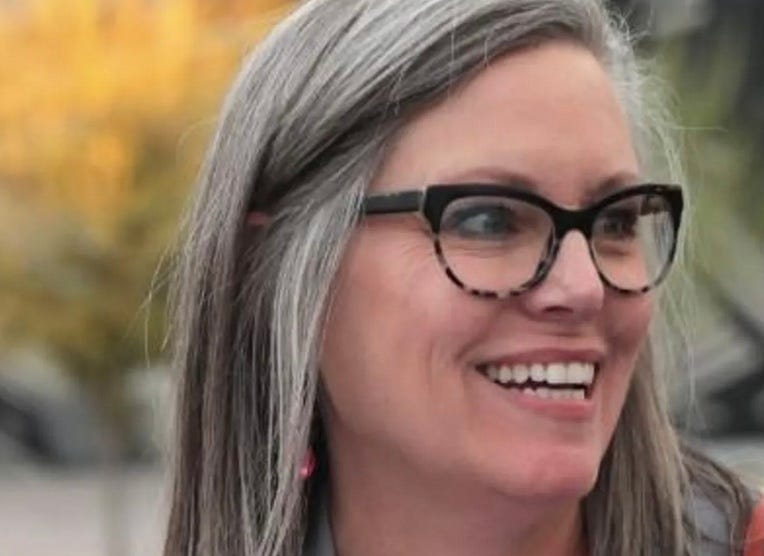

An Arizona County elections official has agreed to plead guilty after she refused to certify the 2022 election in which Kari Lake lost to Katie Hobbs.
The Washington Post reported Monday that Peggy Judd, who helps lead Cochise County southeast of Phoenix, was indicted last year for allegedly “flouting the state’s deadlines” for the 2022 election certification.
actions, consequences. it’s nice when things work out in that order.
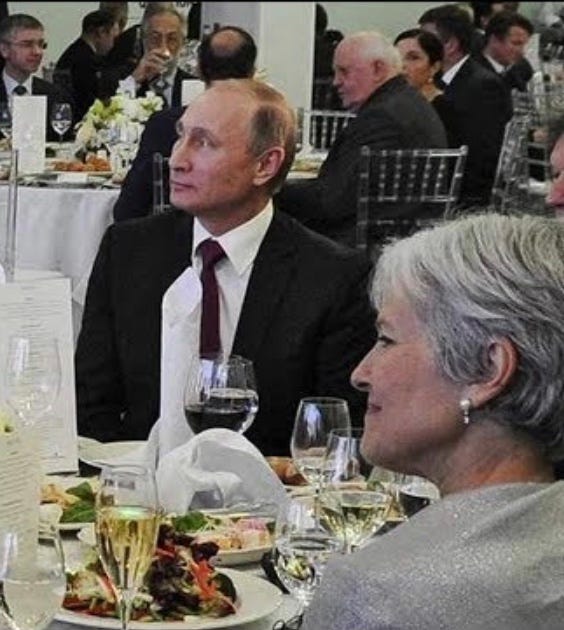
Jill Stein might be hurting Donny this year.
perpetual Kremlin dinner guest Jill Stein is like some fucked-up asteroid. every four years, her weird-ass orbit swings her too close to the Earth, and she ends up dicking with the tides and screwing with our electoral magnetic field.
Jilly’s back, but a new poll apparently indicates that this year, she’s taking away votes from Donny.
A new poll suggests that Green Party presidential candidate Jill Stein is drawing more voters from former President Donald Trump than from Vice President Kamala Harris.
The poll shows Harris leading Trump 49 percent to 47 percent. However, with Stein in the race, Trump’s support dips to 46 percent, while Harris maintains her 49 percent backing, suggesting that Stein draws more support from Trump than from Harris. Though Stein’s voter base remains relatively small, at about 1 percent, it could prove crucial in an election that hinges on tight margins in swing states.
the five innocent and exonerated black men known as the Central Park Five are suing Donny for defamation.
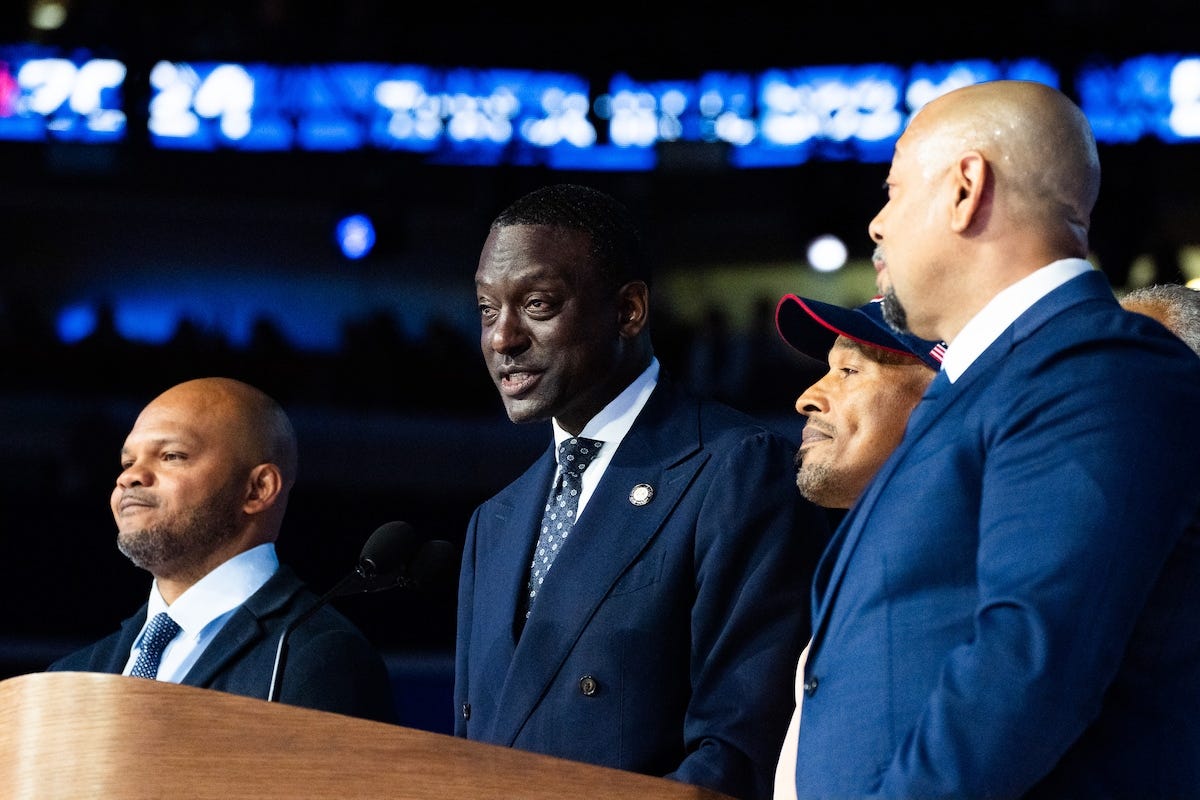
The five men who make up the Central Park Five and now call themselves the Exonerated Five have filed a defamation lawsuit against Donald Trump over his remarks during the presidential debate last month.
During the debate he said: “They admitted — they said, they pled guilty. And I said, well, if they pled guilty they badly hurt a person, killed a person ultimately. And if they pled guilty — then they pled we’re not guilty.”
At the time of the trials, each had pleaded not guilty, and the victim of the attack survived.
ok, this one is not election-related news — but it still makes me laugh to see Donny get served another big, fat slice of Justice Pie.
Donny continues to be an increasingly-deteriorating imbecile.
“it’s as big a water— y’know, it’s as big a water-storm, they say, as we’ve ever seen.”
‘water-storm?’ the word is hurricane, you decompensating dotard.
Alexa, what’s aphasia?
Aphasia is a language disorder that affects how you communicate. It’s caused by damage in the area of the brain that controls language expression and comprehension. Aphasia leaves a person unable to communicate effectively with others.
Alexa, can aphasia be a sign of dementia?
what the fuck do you think?
so, there’s lots of good news all around — but as a commenter under yesterday’s post said, “we still have to fight like we’re ten points down.” that person is exactly right. we don’t have the luxury of complacency. that’s how we fucked it up in 2016 — we all thought Hillary’s got this in the bag, and so we blew up the balloons and popped the champagne way too early, and too many of us decided it was totes okay stay home on election day. after all, Nate Silver promised us that Hillary had a 99% chance of victory, right? but polls don’t vote — people do.
this year, we all understand the assignment.
Kamala understands the assignment, too. unlike the email lady in 2016, Kamala and Uncle Tim are hitting all the swing states. meanwhile, Donny Convict is squandering his time doing vanity rallies in places like California and New York — states he hasn’t a snowball’s chance of winning.
14 days to the election. if we vote, we win.
Electric vehicles as grid storage? It’s right around the (model house) corner
October 21, 2024 Ellen Phiddian
Many Australians now sell solar power generated on their rooftops into the grid on sunny days. In a handful of years, it may be possible to do the same thing when it’s dark – with the help of an electric vehicle (EV).
Nascent vehicle-to-grid (V2G) technology operates around the idea of EVs with bi-directional chargers: they can charge from power sources, but they can also be used to provide power. EVs could be used as mobile grid storage, with owners charging them on rooftop solar and then either using the power themselves later in the evening, or selling it back to the grid.
At the moment, the technology is rare in Australia, with both technological and economic research still needed to figure out how it will best fit into our energy mix.
Some of that research has just started at a model house in Port Macquarie, on the Mid-North Coast of New South Wales.
“If we can get the energy optimisation answer right with vehicle-to-grid technologies, we can avoid unnecessary expansion on the network, and we can help customers minimise their energy bills,” Brad Trethewey, manager of innovation at energy company Essential Energy, tells Cosmos.
Essential Energy has partnered with the CSIRO to trial V2G technology. The trial is running at a mock-home, fitted out with solar panels, batteries, a hot water system, and appliances including a fridge, a dishwasher, a TV and a pool pump.

“In this first phase, we’re looking at how vehicle-to-grid can be technically integrated into the home of the future. We’re doing tests where the vehicle powers a lab for periods of time, and we’re doing scheduled discharge and charge cycles with the vehicle,” says Trethewey.
“The second phase of the test is how we can coordinate the vehicle-to-grid technology, in a more integrated sense, with customers’ appliances and their flexible loads to minimise bills and maximise the use of their renewable energy resources – so, solar.”
The team expects the first phase to finish in late March next year.
“I don’t have an end date for second phase, because we expect the emergence of V2G to have ongoing research needs, even after it’s technically available,” says Trethewey.
While there are currently EVs being made with V2G technology, they’re not yet much use in Australia. Many EVs aren’t sold here with the right hardware or software, and regulations and standards around electricity can’t yet accommodate it.
Part of the work in the trial will be helping to assess how EV and solar owners might best use V2G.
“What is the value proposition? Does the market need to change as a result of vehicle-to-grid capability, or is most of the value in self-consumption – using it for your own energy consumption and needs?” says Trethewey.

Once the second phase of the trial has wrapped, Trethewey says that the team will be interested in seeing how V2G plays out at scale – and in different areas, with different energy mixes.
One way or another, though, he expects bi-directional chargers and energy-storing EVs to become commonplace – soon.
“I think that there’s an inevitability about this. Once vehicle manufacturers produce vehicle-to-grid capability in their cars, cars are going to come with it, and when customers realise the value of that in terms of reducing their energy bills in their house, it’s going to become widespread.”
When might this happen? Trethewey thinks it’s possible before the end of the decade.
“Most vehicle manufacturers are saying they’re going to have some vehicle-to-grid capability in Australia, they’re talking late 2025, early 2026. Now, that doesn’t mean they’ll have it switched on – it just means that they’ll have the vehicles capable for it.
“So the next five years, I think, is probably well within reason.”
Originally published by Cosmos as Electric vehicles as grid storage? It’s right around the (model house) corner
https://cosmosmagazine.com/technology/energy/vehicle-to-grid-trial/
Agenda 47
Thank you, Ten Bears! I keep pointing out that Project 2024, Agenda 47, and the Republican National Party Platform are all cut from the same whole cloth. It’s important to be aware, even though one need not read each document separately.
This Is Very Seriously A Big Deal: Pro-Trump dark money network tied to Elon Musk behind fake pro-Harris campaign scheme
An initiative called Progress 2028 that purports to be Kamala Harris’ liberal counter to the conservative Heritage Foundation’s Project 2025 is actually run by a dark money network supporting former President Donald Trump.
Building America’s Future, the dark money group at the helm of the network, has steered money to a constellation of groups and initiatives boosting Trump’s agenda and spreading messaging aimed at chipping away voters from Harris. The dark money group reportedly received over $100 million in funding from billionaire Elon Musk, along with other donors, the New York Times recently reported.
The newest effort to benefit from their largesse is Progress 2028. Building America’s Future registered to use Progress 2028 as a fictitious name on Sept. 23 and the website was created three days later, OpenSecrets’ analysis of corporate filings and DNS records found.
The Progress 2028 site appears to be created by IMGE LLC, a firm run by Republican political operatives that the New York Times described as the “hidden hand” behind Building America’s Future, and a page on the Progress 2028 site includes the firm’s sizzle reel.
IMGE LLC has also done work for Elon Musk’s America PAC and several other Republican political committees, including a super PAC funded by America’s Future Fund named Future Coalition PAC, as first pointed out by Brendan Fischer, Deputy Executive Director of Documented, an investigative watchdog and journalism project.
The Progress 2028 manifesto draws clear parallels to Project 2025, a controversial blueprint for restructuring the executive branch under the next Republican administration. The Project 2025 blueprint was developed by the Heritage Foundation and written by many conservatives who worked in or with Trump’s administration. Project 2025 has drawn intense criticism, and the former president has said it does not reflect his own priorities should he return to the White House.
Some of the policies listed in Progress 2028 highlight disproven and misleading claims about Harris’ positions. Policies listed include “Empowering Undocumented Immigrants, Building Our Future” and “Expanding Medicaid to Undocumented Immigrants.”
“Undocumented immigrants are the backbone of our country, and by removing barriers, we unlock incredible potential,” the document states. “Kamala Harris believes that every person, no matter their immigration status, deserves access to basic healthcare.”
Harris expressed support for allowing immigrants residing in the U.S. to obtain health insurance with her 2019 Medicare for All plan but did not indicate whether there would be a cost. Her 2024 running mate, Minnesota Gov. Tim Walz, recently said that Harris does not currently support programs for undocumented immigrants to qualify for free government health care, free tuition at state universities or driver’s licenses.
The document claims Harris will “support policies that protect minors’ access to gender-affirming care and ensure that schools provide comprehensive LGBTQIA education.”
“She’s committed to banning fracking, phasing out internal combustion engines, and rolling out the most progressive Green New Deal yet,” another section of the Progress 2028 plan reads. Harris has explicitly stated that she won’t ban fracking natural gas but her campaign has sent mixed signals about her own position on regulation of gas-powered cars.
Some individuals have received text messages directing them to the Progress 2028 page.
“Kamala Harris will support a nationwide gun buy-back program that will take dangerous weapons off our streets,” one text message reads, noting, “A mandatory buy-back is the only way to keep our streets safe.” Harris expressed support for a mandatory buyback of military assault weapons in 2019 but has expressed a more lenient stance in 2024, highlighting her own gun ownership.
(snip-graphics on the page)
Digital advertisement featuring Kamala Harris paid for by Progress 2028 (Screenshot from Meta Ad Library)
Progress 2028 has also started pouring money into digital advertising. Since Oct. 11, several digital ads on Facebook and Instagram have included the disclaimer “paid for by Progress 2028” — totaling over $36,000 in ad buys over just five days.
While the ads appear to include pro-Harris messaging, they lean into contentious issues listed on the Progress 2028 site that have created friction among different divisions of the party.
“Let’s remove barriers for undocumented immigrants who are undocumented!” one ad states, adding, “Access to affordable housing, driver licenses, and fair wages creates a stronger America for everyone.”
Another ad reads, “A national, mandatory buy-back program means fewer guns & fewer tragedies. Kamala Harris gets it!”
Operating under a shroud of aliases, Building America’s Future has funneled tens of millions of dollars in dark money from anonymous sources into campaigns boosting Trump ahead of the 2024 election. The dark money network also has a history of fueling initiatives impersonating and parodying Democrats.
Building America’s Future is the top funder of Citizens for Sanity, a dark money group that bankrolled inflammatory ads mocking Democrats and progressive policies in battleground states ahead of 2022 midterms, tax returns show. The Wall Street Journal recently reported that Elon Musk secretly steered tens of millions of dollars through Building America’s Future to help fund the effort.
Citizens for Sanity spent over $90 million on messaging pitting minority communities against each other and chipping away at traditionally Democratic voting blocs.
Similar to Progress 2028, the ads hit on contentious issues such as LGBTQ+ rights, immigration and criminal justice reform. The ads have been accused of trying to suppress voting among minority communities.
(snip-embed video on the page)
Citizens for Sanity does not disclose its donors but other groups were legally required to report money they gave to it. That includes $43 million from Building AmerIca’s Future as well as $28.7 million from Freedom’s Future Fund, a sister group of Building America’s Future, and $13.4 million from American Commitment.
The many faces of Building America’s Future
Building America’s Future has also fueled other pro-Trump groups and was the sole funder of the Future Coalition PAC, new Federal Election Commission records filed Oct. 15 show.
The super PAC that has run ads targeting Harris in Michigan by highlighting her positions that are pro-Israel and the Jewish faith of her spouse, Doug Emhoff. The ads are reported to be pro-Harris but have been criticized as featuring antisemitic dog whistles. The PAC has been accused of attempting to use the conflict in the Middle East as a wedge issue to depress turnout for Harris in Michigan, a state with a significant Muslim and Arab American population.
Future Coalition PAC reported receiving $3 million from Building America’s Future through the end of September.
Another $16 million was steered through Building America’s Future to Duty to America PAC, according to new FEC disclosures filed Oct. 15. The super PAC has targeted young male voters and Black voters trying to persuade them to vote for Trump.
Building America’s Future was also the top funder of Stand For Us PAC, OpenSecrets’ analysis of FEC reports filed Oct. 15 found. The super PAC received at least $3.8 million from the dark money group and has spent over $15 million on ads attacking Republican primary candidates in Ohio with divisive messaging tying a prescription drug program to immigration and transgender rights.
In addition to funding a cluster of political groups, Building America’s Future operates under several fictitious names such as Americans for Consumer Protection.
In August, Americans for Consumer Protection launched an ad campaign criticizing the White House’s proposal to ban menthol cigarettes. CNBC reported that the effort was intended to chip away at Harris’ key base of Black voter support in swing states including Arizona, Georgia, Michigan, North Carolina and Wisconsin.
Building America’s Future reportedly raised and spent more than $100 million over the last four years, the New York Times reported.
Building America’s Future is not legally required to report its finances, vendor payments or outgoing grants for 2023 until after Election Day and, even then, will not be required to disclose its donors.
OpenSecrets’ requests for comment to Building America’s Future and Progress 2028 were not returned prior to publication.
Feel free to distribute or cite this material, but please credit OpenSecrets.
For permission to reprint for commercial uses, such as textbooks, contact OpenSecrets: info@opensecrets.org
Kamala Harris Has a Great Plan for Rural America by Charlotte Clymer
And you should know it. Read on Substack
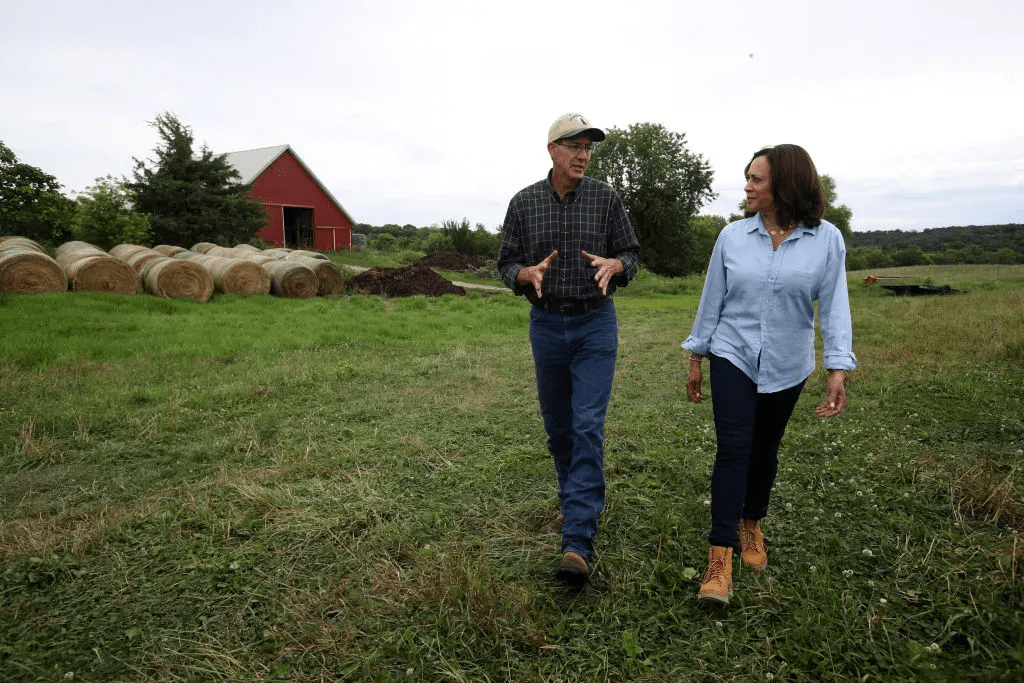
This morning, the Harris-Walz campaign announced an extensive economic plan for rural communities. It’s a deeply impressive vision for working class families in these parts of the country.
Given that much—perhaps, most—of political media will not adequately report on this and inform voters of what Vice President Harris plans to do for Rural America, I’m gonna take the rare step of publishing her plan, in full, as a blog post.
I’m doing this because Lord knows we’re all more likely to see an intellectually dishonest column in The New York Times about Vice President Harris ignoring rural voters than we are to see significant reporting and analysis on her proposed policies for rural voters.
So, here it is. Just to confirm, all of the below text was written by the campaign. Please share with your friends and family in rural areas of the country:
FOR IMMEDIATE RELEASE
October 15, 2024
Vice President Harris and Governor Walz’s Plan for Rural Communities
New Initiative Will Strengthen Rural Health Care by Adding 10,000 Health Care Professionals, Expanding Telemedicine, Cutting the Number of Ambulance Deserts in Half, and Keeping Rural Hospitals and Pharmacies Open
Supporting the Next Generation of Small- and Mid-sized Farmers and Ranchers
Strengthening the Backbone of the Rural Economy with Investments in Housing, Child Care, and Senior Care
Vice President Harris and Governor Walz believe in rural communities and understand that supporting locally led solutions is key to rural prosperity. Their administration will make it a priority to equip the nearly 50 million rural Americans with the tools and resources they need not just to get by, but get ahead.
Today, Vice President Harris and Governor Walz are announcing a plan for rural America. The key elements will:
- Increase access to affordable and high-quality health care in rural communities—by adding 10,000 health care professionals, expanding telemedicine, cutting the number of ambulance deserts in half.
- Support the sandwich generation to care for elders at home, lowering the cost of childcare and increasing the number of providers, and expanding the Child Tax Credit to provide tax cuts up to $6,000 for families with newborns.
- Lower the costs of buying a home, starting and expanding a business, and raising a family—by sparking the construction of 3 million new housing units, providing up to $25,000 in down payment assistance for first-time homebuyers, increasing the small business tax deduction for startup expenses 10-fold to $50,000.
- Invest in the future of American agriculture by boosting access to credit, land, and markets, building new markets and streams of income for small- and mid-sized farmers and producers, and supporting the rise of the next generation of American farmers and ranchers.
Donald Trump will turn back the hard-earned progress that rural communities are making. As President, he tried to repeal the Affordable Care Act and vows to terminate it if reelected, stripping protections from people with pre-existing conditions and devastating rural hospitals and care services. He will ban abortion nationwide, threaten access to contraception and IVF, and force states to monitor women’s pregnancies and report women’s miscarriages and abortions to the federal government.
He already took overtime pay away from millions of Americans while giving tax breaks to billionaires and big corporations – at the same time that he tried to cut funding that supports rural housing and creates rural jobs. If Trump returns to office, he promises to give more tax cuts to the super-rich and big corporations while hiking taxes on rural families by $4,000 a year – as estimated by the conservative leaning American Action Forum, and putting Social Security and Medicare on the chopping block.
Independent analysis from Goldman Sachs, Moody’s Analytics, and other top economists – including those surveyed by the Financial Times and Wall Street Journal – and more also agree that Vice President Harris’ plans are better for the U.S. economy than Donald Trump’s. For example, an analysis by Moody’s Analytics shows that, under a Harris presidency, more than a million new jobs would be added to the economy than under a second Trump Administration. Meanwhile, Moody’s finds that Trump’s plan would cause a recession by mid-2025, cost 3.2 million jobs, and add over 1 percent to inflation. And, a survey of nearly 40 top economists by the Financial Times and University of Chicago found that 70 percent agree that Vice President Harris would be better on the deficit than Trump, while only 11 percent believe that Trump would be better on the deficit than Harris.
Trump’s Project 2025 agenda will slash the federal crop insurance program, gut protections for clean water and air, and repeal the Bipartisan Infrastructure Law and Inflation Reduction Act, which will roll back historic investments in small businesses and rural infrastructure including broadband, and clean energy. Under a Harris-Walz administration, rural America is not going back.
EXPANDING RURAL HEALTH CARE
Vice President Harris and Governor Walz believe quality health care is a right, not a privilege. That’s why they are announcing new initiatives to improve and expand affordable health care in rural areas. Their plan will recruit 10,000 additional rural health care professionals and protect and expand access to care from telemedicine to local independent pharmacies.
- Recruiting 10,000 Rural Health Care Professionals, including doctors, nurses, community health workers, and EMS professionals to provide health services to Americans in rural and tribal areas—while working to protect our health workforce from burnout. This initiative will include:
- Expanding Scholarships, Loan Forgiveness, and Other Pipeline Programs for Doctors and Nurses Who Will Provide Health Care in Rural and Tribal Areas: They will expand funding to recruit and retain doctors, nurses, pharmacists, public health professionals, and other health care providers through scholarships, loan repayment programs including the National Health Service Corps Loan Repayment Program, the Indian Health Service Loan Repayment Program, and the Public Service Loan Forgiveness Programs. Their plan to build 3 million new homes nationwide, including in rural and tribal areas, and to provide $25,000 in downpayment assistance will further lower costs of buying a home in rural America, creating incentives for health professionals to buy homes and stay in rural America. They will invest in programs that introduce rural youth to careers in medicine, and provide the necessary support for them to pursue that career path. This plan builds on Vice President Harris’s leadership in investing in programs to train more nurses and doctors who will live and work in rural and underserved communities, including funding an additional 1,000 residency slots in hospitals. When a provider trains in a rural area, they’re more likely to remain, living and working there.
- Providing a Major Grant Program To Train and Fund Rural Community Health Workers: They will launch a new permanent grant program to train and fund Rural Community Health Workers; make it easier for Medicaid to cover Community Health Workers; and expand grants to Community Health Centers and Rural Health Centers.
- Expanding Rural Telehealth Services: Americans living in rural areas are around 17 times more likely to use telehealth than those in cities, but half of all people living in rural areas lack access to the broadband speeds needed to support telehealth.
- Permanently extend Medicare coverage of telemedicine benefits, currently set to expire, by working with Congress to pass the Preserving Telehealth, Hospital, and Ambulance Act.
- Double federal funding for telehealth equipment and technologies. They will double the U.S. Department of Agriculture’s (USDA) Distance Learning and Telemedicine Grant Program for Rural Communities to $120 million. This will give rural and tribal communities more resources for telehealth equipment—including at rural health clinics, hospitals, and schools–and support innovative new technologies like tele-medically equipped ambulances.
- Slashing the Number of Ambulance Deserts in Half: At least 2.3 million rural Americans live in ambulance deserts—meaning they live at least 25 minutes away from an ambulance—and in 14 states more than 10% of the population lives in such an area. Volunteer squads—which provide the majority of rural EMS staff—struggle to survive due to a lack of sustainable funding sources and difficulty recruiting new volunteers. Vice President Harris and Governor Walz will take action to cut the number of rural Americans in ambulance deserts in half by the end of the decade:
- Expanding EMTs and Paramedics in Rural Areas: They will dramatically increase financial and technical support to rural and tribal communities to train, equip, and employ first responders, and provide resources for ambulances, lifesaving equipment, and the construction and maintenance of first responder stations.
- Increasing Funding and Support for Volunteer EMS Programs: They will provide grants to small volunteer ambulance and EMS programs to help them survive and thrive. These extra resources will support innovative uses of technology like telehealth and explore solutions to low reimbursement levels for both public and private insurers.
- Keep Independent Pharmacies Open and Increase the Number by 3,000. Independent pharmacies make up more than three-quarters of pharmacies in rural areas, and their pharmacists are a critical and trusted health care resource. But nationally the number of independent pharmacies has decreased—by nearly 50% since 1980, leveling off at about 20,000 locations, with 1 in 10 independent retail pharmacies in rural America closing over the last decade.
- A Harris-Walz Administration will set a goal of enabling 23,000 independent pharmacies to either launch or stay open by working to enact legislation that would prevent pharmaceutical middlemen known as pharmacy benefit managers from shortchanging rural independent pharmacies and steering orders of the most profitable drugs away from independent rural pharmacies and to chains. This would be a 15% increase in the number of independent pharmacies – restoring the rural independent pharmacies that have closed over the last decade and increasing their number by 5%.
- Keeping Rural Hospital Doors Open To Ensure Access to Emergency Services. Since 2010, nearly 150 rural hospitals have either shuttered or ceased providing inpatient hospital services. A Harris-Walz Administration will work to strengthen Medicare’s Rural Emergency Hospital Designation – which helps facilities offer medical services in areas that may not be able to sustain a full-service hospital, while protecting the Affordable Care Act and supporting Medicaid expansion, which has helped to reduce uncompensated care in expansion states and improves the financial health of rural hospitals. This will also help support improvement in maternal health, which Vice President Harris has long advocated for, by increasing access to options for obstetric care.
- Lowering Health Care Costs. Vice President Harris and Governor Walz will also lower health care and prescription drug costs for Americans. They will work to cap the cost of insulin at $35 and out-of-pocket expenses for prescription drugs at $2,000 for everyone. They will also fight to keep helping millions of Americans save $800 a year on their health insurance and accelerate Medicare negotiations over prescription drugs to help bring drug prices down more quickly and cover more drugs.
- Restoring and Protecting Reproductive Freedoms. They will also keep fighting for womens’ rights to make decisions about their own bodies. The Vice President will, if elected, never allow a national abortion ban to become law. And when Congress passes a bill to restore reproductive freedom nationwide, she will sign it.
- Supporting Veterinary Care in Rural Areas and address the increasing shortage of veterinarians by encouraging providers to work in areas with too few veterinarians by strengthening USDA’s Veterinary Medicine Loan Repayment Program, which reduces debt for physicians working in high-need areas for the food supply, and increasing grants for starting and expanding veterinary practices in critical areas.
Trump meanwhile tried to end the Affordable Care Act and has promised to terminate it if reelected — over 500 rural hospitals at risk of closure could close. He sought to make significant cuts to both Medicare and Medicaid in every single one of his budgets. His Project 2025 agenda will reverse the caps on insulin and other prescription drugs, raising the prices on life-saving Medications.
A HISTORIC PLAN TO EXPAND ACCESS TO CARE AND SUPPORT THE SANDWICH GENERATION
Vice President Harris cared for her aging mother and knows that when families cannot find affordable care for their elderly parents or children, it is not just a big financial strain, but also a source of severe emotional stress that takes a big toll on families. Nearly a quarter of American adults are part of the sandwich generation providing intergenerational care to both their children and a parent or a loved one with disabilities.
- Protect and Strengthen Medicare, Help Rural Seniors Live Independently, and Support Family Caregivers. Vice President Harris and Governor Walz will protect Medicare and strengthen it with a historic Medicare at Home plan, which will cover robust home care for seniors under Medicare for the first time ever. This will help both seniors and their caregivers, who often shoulder the financial and emotional burden of caring for aging loved ones. Vice President Harris and Governor Walz will also expand Medicare to cover hearing and vision benefits to support the millions of seniors who rely on glasses and hearing aids.
These plans are common sense. They can help family caregivers work and save both families and the federal government money by allowing seniors to stay in their homes instead of being sent to nursing homes, which are often more expensive. Medicare at Home will also reduce hospitalizations. These new benefits will be fully paid for and extend the life of the Medicare Trust Fund by expanding Medicare drug price negotiations and more.
- Make Quality, Affordable Child Care Accessible and Expand the Child Tax Credit. Vice President Harris and Governor Walz know that millions of Americans are balancing both care for their children and care for aging loved ones. Too many rural families struggle to access affordable child care near them. One survey found that only 38 percent of rural parents could easily find childcare within their budget, compared to over half of urban parents. Vice President Harris and Governor Walz will bring down child care costs for American families to help save thousands of dollars on child care and expand access to good child care options by building a robust child care supply. Vice President Harris is also proposing to expand and make permanent the Child Tax Credit, including giving families with newborns a tax cut of $6,000 per child. This will help families cover expenses early on in life. After Vice President Harris cast the tie-breaking vote on the legislation that temporarily expanded the Child Tax Credit in 2021, it helped the families of over 9 million children in rural areas.
As president, Trump tried to cut Medicare and Medicaid in every single one of his budgets, has called for raising the retirement age to 70, and said privatizing Medicare will create a “stronger system.” He denied millions of families the full child tax credit and tried to cut federal child care funding by nearly $100 million. His Project 2025 agenda will actually raise costs on families by $4,000 a year.
STRENGTHENING THE BACKBONE OF THE RURAL ECONOMY
Vice President Harris and Governor Walz are committed to helping rural communities grow and thrive economically. They are fighting to lower prices for Americans including through tax cuts for 100 million working and middle-class families and policies to lower the price of housing, groceries, and health care. They are also supporting small businesses by cutting red tape and proposing a ten-fold increase in the tax deduction for new businesses starting up.
Vice President Harris has fought for landmark investments in rural communities: high-speed internet access to every corner of rural and tribal America, as well as projects to build and fix roads and bridges in rural and tribal communities across America, and to support transit vehicles and infrastructure for thousands of rural and tribal transit systems. Rural communities stand to benefit from up to 45% of the total funding—or more than $450 billion—provided by the Bipartisan Infrastructure Law, the Inflation Reduction Act, and the CHIPS and Science Act is, and almost 30% of the IRA funding announced so far will flow to rural communities. Governor Walz has long championed rural communities. He spent 12 years representing a rural district in Congress, and as Governor, he spearheaded the largest single investment in broadband infrastructure in state history to help thousands of Minnesotans—including those in rural areas—connect to jobs, education, health care, and their communities.
But they know it is not enough—too many rural communities still do not have the tools they need to get ahead.
- Supporting Small Businesses by Increasing Capital and Access to Resources. Vice President Harris has set an ambitious goal of 25 million new business applications by the end of her first term. She plans to encourage businesses to start and grow by increasing the small business deduction 10-fold to $50,000, providing low- to zero-interest loans to small businesses that grow and create jobs, allocating one-third of federal contract dollars to small businesses, and providing other financing for rural and tribal entrepreneurs through the Treasury Department’s State Small Business Credit Initiative—which lifts up entrepreneurs and founders in rural America, middle America, and underserved communities.
- Create New Jobs and Opportunities Through:
- New America Forward Tax Credits to promote investment in the industries of the future, including greater credits for companies investing in agricultural, manufacturing, and energy communities. This includes modernizing steel and iron production, developing biotechnology, building new data centers for AI and supporting AI innovation, further developing clean energy manufacturing, revitalizing America’s semiconductor industry, and investing in aerospace, autos, and other forms of transportation. These tax credits will provide significant additional benefits to investments made in longstanding manufacturing, energy, and agricultural communities and reward companies that work with unions and communities to support workers and protect jobs.
- New Opportunities for Those Without Four-Year College Degrees including promoting meaningful pathways for those without college degrees to federal jobs and working with businesses to do the same in the private sector. Vice President Harris and Governor Walz have also set a goal of doubling the number of registered apprenticeships during their first term. This will include partnerships with community colleges on high-quality, evidence-based training programs.
- Cutting Red Tape so that America Can Build More Housing, Manufacturing, and Energy Projects Faster while also ensuring community engagement and adequate protections for the environment and public health. This will build Vice President Harris’s work through the Inflation Reduction Act to speed permitting review, and her work to finalize a rule to modernize environmental reviews.
- Keeping Rural Schools Open and Thriving. Vice President Harris knows that a great teacher can have a life-long impact on children. But teacher shortages disproportionately impact rural communities throughout the country. That’s why she will double down on programs that prepare and train teachers in rural and tribal areas in an effort to support new teachers and increase retention rates in rural communities—all of which will improve student outcomes like academic achievement and high school graduation rates, resulting in higher long-term earnings, job creation, and a boost to the economy. She will also build on federal transportation programs that help get children to school where bus routes or vehicle maintenance costs put additional strain on already limited budgets.
- Protect and Strengthen Social Security while Making the Super Wealthy Pay their Fair Share. Vice President Harris and Governor Walz will protect and strengthen Social Security and Medicare by making the super-wealthy pay their fair share. Trump, by contrast, once called for raising the retirement age to 70, and he tried to cut Social Security and Medicare every year of his presidency. Now, on the campaign trail, Trump is continuing to talk up cuts to Social Security and Medicare, saying “there is a lot you can do…in terms of cutting.”
- Lowering Costs:
- Lower Costs of Buying and Renting a Home Across Rural America by sparking the construction of 3 million new affordable rental and owner-occupied homes, providing up to $25,000 in down payment assistance for first-time homebuyers, and cracking down on predatory investors. Vice President Harris and Governor Walz will also work to strengthen USDA’s programs for rural and tribal communities, especially in housing, and as part of their proposal to strengthen the Low Income Housing Tax Credit program to create more homes that are affordable for renters, they will work to ensure that rural states receive a fair allocation of these credits to address the unique challenges that rural communities face when dealing with housing challenges, including higher construction costs and lower housing density.
- Providing Rural and Tribal Families with Reliable, Low-Cost Internet Access, by reenacting the Affordable Connectivity Program. The Bipartisan Infrastructure Law’s Affordable Connectivity Program provided 23 million households with up to $30 off of their monthly internet bills and a one-time discount of up to $100 to buy a laptop, desktop computer, or tablet. Over 3 million people who benefited from ACP live in rural and tribal areas. Vice President Harris will reenact this popular program, which ended in June of this year, to ensure that rural and tribal families can connect to the internet and obtain the financial, educational, and health opportunities that come from reliable internet access. She will also take common-sense steps to speed up the construction of new internet for rural and tribal communities.
- Provide Funding and Support to Local Communities, Tailored to Address Local Needs.
- Vice President Harris and Governor Walz will work with Congress to pass the bipartisan Rural Partnership and Prosperity Act, led by Senators Casey and Fischer. This will provide new grants to every state that will support locally led solutions to address rural and tribal communities’ needs—including for child care, housing, job training, and economic development.
- Vice President Harris and Governor Walz will expand the Rural Partners Network nationwide by partnering with rural communities to help them navigate and access existing federal funding opportunities.
Trump neglected rural communities. He failed to address the housing supply crisis during this presidency, and now his Project 2025 agenda will increase mortgage premiums on federally backed loans, and drive up mortgage rates by around $1,200 by privatizing Fannie Mae and Freddie Mac. He also tried to eliminate the Economic Development Administration, and wants to repeal investments in infrastructure, clean energy, and more that have been strengthening the economies of rural communities. He will also raise costs by nearly $4,000 per family with a “Trump Sales Tax” on imported items that families rely on.
He also has no plan to support families and seniors. He has called for raising the retirement age to 70 years old. His Project 2025 agenda would slash funding for child care, abolish Head Start, and cut more than $20 billion in federal support for the nation’s most vulnerable students.
HARVESTING THE FUTURE OF AMERICAN AGRICULTURE
Vice President Harris and Governor Walz know that America’s farmers, farmworkers, and ranchers feed our nation, drive our economic growth, and enhance our security and resilience. That’s why Vice President Harris helped secure nearly $20 billion in investments to help hundreds of thousands of farmers and ranchers adopt voluntary innovative conservation practices, promote sustainable agriculture, and increase resilience against extreme weather. She also directed $1 billion to increase meat and poultry processing capacity, up to $900 million to boost domestic fertilizer production, and funding to strengthen food supply chains and give farmers more choices. Governor Walz—who grew up spending time on the family farm—has stood by farmers and ranchers throughout his time in public service. In Congress, Governor Walz worked across the aisle to pass three Farm Bills to expand veterans’ access to crop insurance, farm education, and job training and enacted legislation to improve veterans’ health care. And as Governor, he championed efforts to support new farmers and to build new markets and revenue streams.
But Vice President Harris and Governor Walz know that today too many small farmers and ranchers still face barriers to success or are getting ripped off by big corporations. Vice President Harris and Governor Walz have a plan to invest in the future of America’s agricultural industry. They will combat consolidation and other barriers that make it more difficult for small farmers to get ahead, and support the next generation of American farming by:
- Making it Easier for Beginning Farmers and Ranchers to Get Started by improving access to credit for beginning farmers—including by reducing barriers to receive USDA’s farm ownership and operating loans—and supporting training and technical assistance including for military veterans and young farmers. This builds on Vice President Harris and Governor Walz’s proposals to provide one million forgivable loans to entrepreneurs who have historically faced barriers to accessing credit as well as low- to zero-interest loans to small businesses that create jobs.
- Expanding Farmland Protection Programs including supporting working farm easements that ensure farmland remains farmland and isn’t lost to non-agricultural buyers.
- Doubling Down on Partnerships with Farmers and Producers to Build New Markets and Streams of Incomes. That’s why Vice President Harris fought tirelessly for the Inflation Reduction Act, which included a $20 billion investment to help the agricultural community voluntarily adopt and expand conservation and climate smart agricultural strategies—all while saving money, creating new income streams, ensuring the wealthy pay their fair share in taxes, and increasing productivity. If elected, Vice President Harris and Governor Walz will double down on this work.
- Ensuring America’s Farmers Have the Right to Repair Their Equipment. Currently, equipment manufacturers put in place restrictions, such as software blocks on tractors and other farm equipment, that make it difficult if not impossible for farmers to repair their own equipment. Vice President Harris and Governor Walz will require manufacturers of electronics-enabled agricultural equipment to share documents, parts, software, and tools with owners and independent repair shops by working with Congress to enact the Agricultural Right to Repair Act.
- Boost Competition to Create Opportunities for Small Farmers and Ranchers. Vice President Harris and Governor Walz will support small businesses in the agricultural industry, including continuing successful efforts to block excessive consolidation by working with Congress to pass bipartisan legislation to increase antitrust enforcement in agriculture and help ensure poultry growers and ranchers get a fair price. They will also focus on expanding production among new suppliers and small farms, growers, and processors to create broad-based, resilient local and regional food supply chains and spur competition with large conglomerates.
- Ensuring Crop Insurance Works for All Farmers and Ranchers. Vice President Harris and Governor Walz will strengthen the Federal Crop Insurance Program by directing the USDA to study whether the program should cover additional crops and working with Congress to ensure the program protects against more threats like natural disasters and extreme climate events – risks that raise costs and disrupt supply chains.
- Growing Opportunities and Small and Mid-Size Farms and Small Businesses in Rural and Tribal Communities to Sell to Customers Around the Globe. Research shows that agricultural export losses due to retaliatory tariffs from Trump’s trade wars totaled more than $27 billion in 2018 and 2019. The impact on small farmers and rural communities was devastating: agricultural jobs fell, U.S. farm bankruptcies surged, and net farm income plummeted. Vice President Harris and Governor Walz will provide technical assistance to small and mid-sized farmers and businesses so that they have more opportunity to sell their products.
Donald Trump will make the challenges that American farmers face worse. As President, he bailed out the largest 10% of farmers, while sacrificing smaller family farms in his trade wars. Between September 2018 and September 2019, farm bankruptcy filings rose 24% nationally. He also enabled big meatpackers and agribusinesses to run family farms out of business. As his own Secretary of Agriculture said, “In America, the big get bigger and the small go out.” Now, if Trump is elected again, his Project 2025 agenda will hurt rural America, including making crop insurance for family farmers even more expensive and risking another slew of retaliatory tariffs.
Vice President Harris and Governor Walz believe in rural America and pledge to support rural Americans to create a New Way Forward.
Bye-Bye, Russian Gas!
A funny bit; I pasted in the link to see if it would embed the story, and it did! Sort of. It put the title as a hyperlink, as you can see below. I was sorely tempted to just leave it there like that, because what a witty title on its own! Then everyone could either be curious enough to click (it’s not too long to read,) or go ahead and post it all.
Here’s a snippet, because the photo should be seen on the page, and JSTOR is generous and deserves a click now and then:
By: Aissa Dearing and Michaela Rychetska October 10, 2024 4 minutes
Russia’s invasion of Ukraine has fundamentally altered Europe’s geopolitical landscape, with profound implications for its energy security. The invasion exposed Europe’s vulnerabilities, particularly its heavy reliance on Russian oil and natural gas. This has repositioned energy security as a central concern, with Russia seen as a significant threat to the stability and reliability of Europe’s energy supply chains. In response, Europe has taken decisive action to reduce its energy imports from Russia. In May 2022, the European Council agreed to ban almost 90 percent of Russian oil imports—with the notable exception of pipeline crude oil—complemented by stringent sanctions aimed at weakening Russia’s economic leverage. Does this shift suggest that the European Union’s transition to renewable energy is accelerating, not solely for climate reasons, but to achieve energy sovereignty amidst a geopolitical crisis?
The ongoing conflict in Ukraine has indeed catalyzed a unified European reassessment of energy dependence on Russia, prompting collective efforts to diversify energy sources and bolster energy security. As security studies scholar Marc Ozawa notes, Western European countries historically framed their reliance on Russian energy within the context of market transactions and economic interests, a legacy of the oil shocks during the 1970s OPEC crisis. In this light, reliance on Russian energy was, in some respects, a strategic response to earlier crises. (snip)
The transition to an energy sovereign economy cannot solely focus on implementing renewable energy—it requires more than technological advancements—it necessitates profound socioeconomic shifts and a reevaluation of the traditional monopolistic energy business model. A just transition, as scholars Elianor Gerrard and Peter Westoby emphasize, is “the idea that the burdens of decarbonization—such as job losses from the closing of the fossil fuel industry or the high costs of clean technologies—should not unfairly impact any one group.” Achieving this transition involves developing policies that are both pragmatic and ethically sound, ensuring that the shift to a low-carbon economy goes beyond labor market adjustments. At its core, a just transition seeks to reconcile environmental protection with the need to protect vulnerable communities long reliant on fossil fuels. The decarbonization process cannot succeed without prioritizing these communities, providing workforce development for fossil fuel workers, and supporting decentralized, community-owned renewable technologies with adequate storage capacities. Existing electric technologies and grid infrastructure shouldn’t become stranded in this process but be retrofitted to ensure efficiency and multilateral grid cooperation.
Work to focus on engaging communities during the energy transition
(It can’t hurt to put bits like this out into the universe. Somebody’s working on this, and more people ought to. So a nice little discussion of what’s working is appropriate. -A)
October 11, 2024 ARC Laureate Fellows
This Cosmos series on Australian Research Council Laureate Fellows 2024 reflects excellence from world class researchers in Australia.
Chris Gibson is a Senior Professor in the School of Geography and Sustainable Communities at the University of Wollongong. For his ARC Fellowship, he is investigating how decarbonisation impacts Australian regions.
Professor Chris Gibson: finding a truce in the climate wars.
Decarbonisation and energy transition are at the sharp edge of a hot political battle. There is a lot of dispute over new technologies like offshore wind, and exactly what mix of energy we need. It’s like a second iteration of the climate wars. But after a decade of stalled policy on climate, we have to embrace the decarbonised future, whether we like it or not. It’s an issue that needs to transcend the political divide.
But we’re faced with a dilemma: we need urgent change, but urgent change rarely occurs, if ever, in a way that is fair. The burdens and benefits of change are not distributed equally across society. And the quicker the change, the more risks there are. Regions can be all too easily left behind.
Geographers think about how substantial change, like this energy transition, affects communities. We think of ourselves as an integrative discipline. We bring together expertise from across environmental science, economics, social geography, legal geography, and from experts who are good on governing transitions. By stitching together insights from all directions, we try to see the bigger picture.
My ARC project is aiming to put together a systematic understanding of what’s happening in decarbonisation, both from the top down, with a nationwide view, and from the ground up, about how people in different regions are responding to change.
We’re putting together a team to look at how decarbonisation hits the ground in different regions, and how it affects different workers, different industries, what kinds of opportunities come out of that, what kinds of changes are needed, how communities and households are responding to the decarbonisation challenge, and how a First Nations’ perspective can lead the way.
Community responses have to be taken seriously. It’s too easy and too convenient to cast aside sceptics as “nimbies” (Not In My Backyard) or selfish or ignorant. If you take the time to hear the diversity of opinions that come from communities, you’ll often find that people are worried about real issues, with valid concerns. Local communities are very knowledgeable about their patch, and have a capacity to understand what kinds of changes are needed. If we can forge a more inclusive process that brings regional perspectives, skills and experience to the forefront, we reduce the risk that regions are left behind. And governments might actually see regional communities as an opportunity rather than a hindrance to change.
A good example is here in the Illawarra, (Coastal New South Wales) where offshore wind has been very controversial in the last year. One of the lessons to be had is to not underestimate the community’s ability to understand what an energy transition means, and not to underestimate the degree of attachment people have to their local places.
The community here is highly knowledgeable about energy. The Illawarra has a workforce with a long history in heavy industry – the number of electricians per capita in the Illawarra must be as high as anywhere in Australia. And people have opinions – it’s not a passive region that knows nothing about the change that’s coming. The task is not purely to convince local people that this is a good thing, but to have a mature conversation with them about the pros and cons.
Who benefits in the energy transition?
There are all kinds of philosophical questions about who benefits, how those benefits are shared, what it means to turn our oceans into a space for energy generation. Some members of the community are asking for a proper conversation, because they don’t feel like they’ve been part of the story so far.
People react unpredictably to change that they see is imposed upon them. Let’s say it’s closing down a coal-fired power station in the Hunter Valley in New South Wales, or proposing a green hydrogen hub in South Australia – people don’t necessarily assess these as singular proposals that exist outside of everything else in their region or in their lives. People make sense of change in relation to their place, their community, their household, their family.
My work is about putting those people and their households first, and looking at it from their point of view. How does structural change look when we take into account the pressures of cost of living, on housing, on employment? People are grappling with these issues in their everyday lives.
There’s also a real risk in introducing changes that are presented to communities as if they have arrived from elsewhere, as a fait accompli. The direction of the flow of ideas and proposals, how they hit the ground, are a very important part of the process. If a proposal seems to arrive in their backyard from the top down – from a government or a corporation provider – you can get a community offside from the outset.
My work is about setting up different kinds of approaches that recognise that these communities have their own capacities and their own perspectives to offer. What we hope to do in the five years of the ARC Laureate program is develop an evidence base so that we can craft better models of how to manage this change. We’re looking at some of the implementations that have already occurred, tracing where those decarbonisation initiatives are hitting the ground, and looking at different kinds of community reactions – what sorts of processes work better than others in terms of building that relationship with community, as well as what happens when things end up in a more antagonistic situation.
Geography is the study of the relationship between humans and our environment. It has always occupied a slightly slippery position in universities and in public life, because we’re both a science and a social science, because we do this work of integrating perspectives from different areas of knowledge. In fact, we call ourselves all sorts of different things: we’re also environmental managers and coastal managers, policy officers and sustainability experts. It’s a discipline that connects, that fills the gaps. We often find solutions to problems by putting knowledge together from those different perspectives. It’s making these connections that can make a big difference.
As told to Graem Sims
https://cosmosmagazine.com/energise/engaging-communities-during-energy-transition/
Up date on our home and hurricane Milton.
Just an update on our situation. It is like a ghost town here. Few of us stayed. Most left and went to hotels or friends homes even closer to the water, which is silly. The fact is they did not want to be alone. The storm shifted south, meaning it is closer to us so we are going to get more than we thought, plus it has become a cat 4 at landfall. It is slowed a bit now expected to hit around 1 or 2 in the morning. Good thing is we will be sleeping, the bad thing is we will lose power. I will offer Ron one of my back up power supplies from the computers to keep his C-PAP running all night. He will be too upset to sleep but I will try to help him. He has fortified the home as much as possible even boarding up windows we did not board up for Ian. The good news is unlike Ian which hung over us for 8 hours this storm will pass quickly over us and be gone. The biggest danger to us and why we took so much damage from Ian was the roofs of other homes smashing into our home and slicing open our own roof, letting it peel open. Plus the sides of the house was hit by flying debris that people left out when they left. People don’t realize that stuff becomes missiles to hit other homes or people. The animals are all hunkered down outside. Last night the animals like rabbits, possums, armadillos, raccoons, and other small critters all foraged like crazy knowing they wouldn’t eat for a few days. Now there are no animals out at all. Our security cameras show nothing moving out there. We should be OK if the house holds. If not, well it was nice being friends with you all. Hugs. Scottie
 Scottie's Playtime